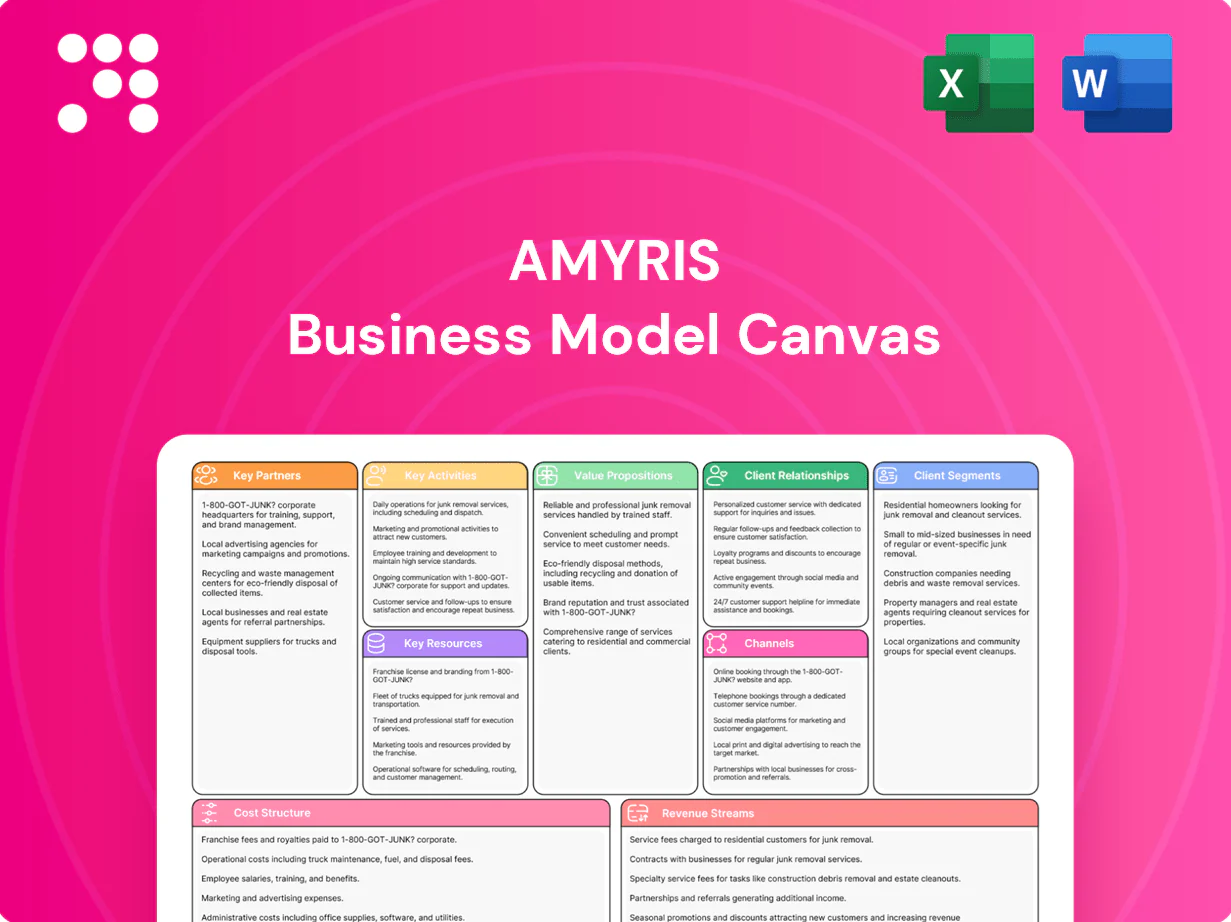
Amyris Business Model Canvas

Unlock a bioscience firm's Business Model Canvas: customers, IP, partners, revenue
Unlock Amyris’s strategic playbook with our Business Model Canvas—detailing customer segments, proprietary bioscience capabilities, key partnerships, and revenue streams that drive scalability. This concise yet powerful snapshot reveals competitive advantages and cost drivers critical for investment or strategic planning. Ideal for founders, analysts, and investors seeking actionable insight. Purchase the full, editable Canvas to access all nine blocks and deploy immediately.
Partnerships

Feedstock and sugar suppliers
Partnerships with growers and sugar processors secure plant-based sugars through multi-year supply contracts (typically 3–5 years), reducing input price volatility and de-risking scale-up. Joint initiatives to align feedstock specs improve fermentation yields, lowering feedstock-driven COGS which industry estimates can represent 30–40% of variable costs. Working with sustainability-certified suppliers (e.g., Bonsucro, RTRS) also strengthens ESG claims and market access.
Fermentation and downstream toll manufacturers
Fermentation and downstream toll manufacturers give Amyris flexible CMOs for scale-up and commercial runs, often adding capacity within 6–12 months, which complements in-house assets. Tolling models reduce upfront capex—commonly cutting project capex by over 50%—and accelerate time-to-market for new molecules. Shared process optimization across partners has driven progressive COGS declines, while geographic diversification improves supply resilience and mitigates regional disruptions.

Flavors, fragrances, and beauty brand houses
Co-development with flavors, fragrances, and beauty brand houses validates ingredient performance in real applications, accelerating formulation approval cycles; the global flavors and fragrances market was about 36 billion USD in 2024. Long-term offtake agreements provide predictable demand and revenue visibility, de‑risking scale-up. Access to partners’ global distribution and formulation expertise speeds adoption, while joint marketing amplifies sustainable, high-performance alternatives.

Academic and research institutions
Collaborations with academic and research institutions expand Amyris' access to cutting-edge synbio methods and talent, with the company engaging multiple university labs in 2024 to accelerate strain engineering; sponsored research has driven faster breakthroughs and shared IP and publications have bolstered credibility, while consortia participation in 2024 helps set standards for bio-based ingredients.
- 2024: multi‑lab collaborations
- Sponsored research accelerates strain engineering
- Shared IP and publications boost credibility
- Consortia participation sets bio-based ingredient standards
Regulatory, certification, and logistics partners
Regulatory advisors streamline approvals across cosmetics, nutraceuticals, and pharma, cutting review timelines and legal risk for Amyris’s bio-based ingredients; the global cosmetics market (≈$420B in 2023) heightens the value of faster clearance. Third-party certifications (vegan, clean, low-carbon) boost shelf appeal and export access, while logistics partners handle cold-chain, hazmat, and global compliance. Together they shorten time-to-market and lower operational and regulatory risk.
- Regulatory advisors: faster approvals, reduced legal risk
- Certifications: improve marketability and exportability
- Logistics: cold-chain/hazmat + customs compliance
Supply + tolling cut capex >50%; brands speed $36B
Multi‑year supply contracts with growers (3–5 yrs) secure sugars and cut feedstock-driven COGS (feedstock = 30–40% of variable costs). Tolling/CMOs reduce upfront capex by >50% and add capacity in 6–12 months. Brand co‑dev speeds adoption (flavors market ≈36B USD in 2024) while multi‑lab collaborations in 2024 accelerated strain engineering and shared IP.
| Partnership | Role | 2024 metric |
|---|---|---|
| Growers/sugar | Supply security | 3–5 yr contracts; feedstock 30–40% |
| CMOs/tollers | Scaling/flex capacity | Capex ↓ >50%; 6–12M lead |
| Brands/R&D | Validation/IP | Flavors $36B; multi‑lab 2024 |
What is included in the product
 Detailed Word Document
Amyris Business Model Canvas: a concise, investor-ready 9-block blueprint detailing customer segments (B2B ingredients, consumer brands), channels, value propositions (fermentation-based sustainable ingredients), revenue streams, key partners and activities, plus SWOT and competitive advantages for strategic planning and funding discussions.

 Customizable Excel Spreadsheet
High-level view of Amyris's sustainable biotech business model with editable cells to quickly pinpoint value drivers, supply-chain challenges, and commercialization levers for fast strategic decisions.
Activities

Strain engineering and pathway optimization
Design-build-test-learn cycles iteratively engineer yeast for target molecules, focusing on metabolic flux, tolerance, and yield improvements across multiple pathways. Genome editing (CRISPR) and high-throughput screening platforms evaluate over 100,000 variants per campaign in 2024 to accelerate selection of top performers. Key gains and workflows are protected through patents and trade secrets to secure commercial advantage.
Fermentation scale-up and process engineering
Translate lab results into pilot (100–10,000 L) and commercial fermenters (50,000–250,000 L) to validate scale-dependent physiology; focus on improving productivity, titer and rate at scale through strain and bioprocess optimization. Standardize SOPs for reproducible runs across sites and implement process control and automation to tighten quality control and lower unit cost.

Downstream purification and formulation
Develop efficient extraction, separation and polishing steps to maximize yield while targeting consistent purity and sensory or functional specs; by 2024 Amyris focuses downstream efforts on reproducible, scalable unit operations. Formulate ingredients into customer-ready formats and validate stability and compatibility in end-use systems through accelerated and real-time testing. Continuous monitoring ensures batch-to-batch consistency and regulatory-ready documentation.

Quality, regulatory, and safety management
Maintain GMP and ISO-certified operations with rigorous QA/QC, preparing regulatory dossiers for cosmetic, nutraceutical, and pharmaceutical submissions; conduct safety, toxicology, and allergen testing and ensure end-to-end traceability and cross-geography compliance.
- GMP/ISO certified sites
- Dossier prep: cosmetic, nutraceutical, pharma
- Safety, tox, allergen testing
- Traceability and multi-jurisdiction compliance
Partnerships, licensing, and business development
Partnerships, licensing, and business development focus on identifying high-value molecules and co-creating formulations with industry leaders, negotiating offtakes, joint ventures and IP licenses, and managing key accounts with dedicated technical support teams. Market monitoring prioritizes profitable product roadmaps and adjusts commercial terms to capture premium margins.
- Co-create high-value molecules with strategic partners
- Negotiate offtakes, JVs, and IP licensing
- Manage key accounts and provide technical support
- Continuously monitor markets to prioritize profitable roadmaps
CRISPR yeast: 100,000+ variants, scale to 250k L fermenters
Iterative design-build-test-learn cycles engineer yeast for target molecules, using CRISPR and high-throughput screens (>100,000 variants per campaign in 2024) to boost yield and tolerance. Scale validation spans pilot (100–10,000 L) to commercial fermenters (50,000–250,000 L) with SOPs and automation to cut unit costs. Downstream, formulate and validate customer-ready ingredients; maintain GMP/ISO quality and prepare dossiers for cosmetic, nutraceutical, pharma.
| Metric | 2024 |
|---|---|
| Variants screened/campaign | 100,000+ |
| Pilot scale | 100–10,000 L |
| Commercial fermenter | 50,000–250,000 L |
What You See Is What You Get
Business Model Canvas
The Amyris Business Model Canvas previewed here is the exact document you'll receive after purchase. It's not a mockup—this live snapshot contains the same content, structure, and formatting as the final deliverable. After ordering you'll get the complete, editable file ready for use. No surprises.

Unlock a bioscience firm's Business Model Canvas: customers, IP, partners, revenue
Unlock Amyris’s strategic playbook with our Business Model Canvas—detailing customer segments, proprietary bioscience capabilities, key partnerships, and revenue streams that drive scalability. This concise yet powerful snapshot reveals competitive advantages and cost drivers critical for investment or strategic planning. Ideal for founders, analysts, and investors seeking actionable insight. Purchase the full, editable Canvas to access all nine blocks and deploy immediately.
Partnerships
Feedstock and sugar suppliers
Partnerships with growers and sugar processors secure plant-based sugars through multi-year supply contracts (typically 3–5 years), reducing input price volatility and de-risking scale-up. Joint initiatives to align feedstock specs improve fermentation yields, lowering feedstock-driven COGS which industry estimates can represent 30–40% of variable costs. Working with sustainability-certified suppliers (e.g., Bonsucro, RTRS) also strengthens ESG claims and market access.
Fermentation and downstream toll manufacturers
Fermentation and downstream toll manufacturers give Amyris flexible CMOs for scale-up and commercial runs, often adding capacity within 6–12 months, which complements in-house assets. Tolling models reduce upfront capex—commonly cutting project capex by over 50%—and accelerate time-to-market for new molecules. Shared process optimization across partners has driven progressive COGS declines, while geographic diversification improves supply resilience and mitigates regional disruptions.
Flavors, fragrances, and beauty brand houses
Co-development with flavors, fragrances, and beauty brand houses validates ingredient performance in real applications, accelerating formulation approval cycles; the global flavors and fragrances market was about 36 billion USD in 2024. Long-term offtake agreements provide predictable demand and revenue visibility, de‑risking scale-up. Access to partners’ global distribution and formulation expertise speeds adoption, while joint marketing amplifies sustainable, high-performance alternatives.
Academic and research institutions
Collaborations with academic and research institutions expand Amyris' access to cutting-edge synbio methods and talent, with the company engaging multiple university labs in 2024 to accelerate strain engineering; sponsored research has driven faster breakthroughs and shared IP and publications have bolstered credibility, while consortia participation in 2024 helps set standards for bio-based ingredients.
- 2024: multi‑lab collaborations
- Sponsored research accelerates strain engineering
- Shared IP and publications boost credibility
- Consortia participation sets bio-based ingredient standards
Regulatory, certification, and logistics partners
Regulatory advisors streamline approvals across cosmetics, nutraceuticals, and pharma, cutting review timelines and legal risk for Amyris’s bio-based ingredients; the global cosmetics market (≈$420B in 2023) heightens the value of faster clearance. Third-party certifications (vegan, clean, low-carbon) boost shelf appeal and export access, while logistics partners handle cold-chain, hazmat, and global compliance. Together they shorten time-to-market and lower operational and regulatory risk.
- Regulatory advisors: faster approvals, reduced legal risk
- Certifications: improve marketability and exportability
- Logistics: cold-chain/hazmat + customs compliance
Supply + tolling cut capex >50%; brands speed $36B
Multi‑year supply contracts with growers (3–5 yrs) secure sugars and cut feedstock-driven COGS (feedstock = 30–40% of variable costs). Tolling/CMOs reduce upfront capex by >50% and add capacity in 6–12 months. Brand co‑dev speeds adoption (flavors market ≈36B USD in 2024) while multi‑lab collaborations in 2024 accelerated strain engineering and shared IP.
| Partnership | Role | 2024 metric |
|---|---|---|
| Growers/sugar | Supply security | 3–5 yr contracts; feedstock 30–40% |
| CMOs/tollers | Scaling/flex capacity | Capex ↓ >50%; 6–12M lead |
| Brands/R&D | Validation/IP | Flavors $36B; multi‑lab 2024 |
What is included in the product
Detailed Word Document
Amyris Business Model Canvas: a concise, investor-ready 9-block blueprint detailing customer segments (B2B ingredients, consumer brands), channels, value propositions (fermentation-based sustainable ingredients), revenue streams, key partners and activities, plus SWOT and competitive advantages for strategic planning and funding discussions.
Customizable Excel Spreadsheet
High-level view of Amyris's sustainable biotech business model with editable cells to quickly pinpoint value drivers, supply-chain challenges, and commercialization levers for fast strategic decisions.
Activities
Strain engineering and pathway optimization
Design-build-test-learn cycles iteratively engineer yeast for target molecules, focusing on metabolic flux, tolerance, and yield improvements across multiple pathways. Genome editing (CRISPR) and high-throughput screening platforms evaluate over 100,000 variants per campaign in 2024 to accelerate selection of top performers. Key gains and workflows are protected through patents and trade secrets to secure commercial advantage.
Fermentation scale-up and process engineering
Translate lab results into pilot (100–10,000 L) and commercial fermenters (50,000–250,000 L) to validate scale-dependent physiology; focus on improving productivity, titer and rate at scale through strain and bioprocess optimization. Standardize SOPs for reproducible runs across sites and implement process control and automation to tighten quality control and lower unit cost.
Downstream purification and formulation
Develop efficient extraction, separation and polishing steps to maximize yield while targeting consistent purity and sensory or functional specs; by 2024 Amyris focuses downstream efforts on reproducible, scalable unit operations. Formulate ingredients into customer-ready formats and validate stability and compatibility in end-use systems through accelerated and real-time testing. Continuous monitoring ensures batch-to-batch consistency and regulatory-ready documentation.
Quality, regulatory, and safety management
Maintain GMP and ISO-certified operations with rigorous QA/QC, preparing regulatory dossiers for cosmetic, nutraceutical, and pharmaceutical submissions; conduct safety, toxicology, and allergen testing and ensure end-to-end traceability and cross-geography compliance.
- GMP/ISO certified sites
- Dossier prep: cosmetic, nutraceutical, pharma
- Safety, tox, allergen testing
- Traceability and multi-jurisdiction compliance
Partnerships, licensing, and business development
Partnerships, licensing, and business development focus on identifying high-value molecules and co-creating formulations with industry leaders, negotiating offtakes, joint ventures and IP licenses, and managing key accounts with dedicated technical support teams. Market monitoring prioritizes profitable product roadmaps and adjusts commercial terms to capture premium margins.
- Co-create high-value molecules with strategic partners
- Negotiate offtakes, JVs, and IP licensing
- Manage key accounts and provide technical support
- Continuously monitor markets to prioritize profitable roadmaps
CRISPR yeast: 100,000+ variants, scale to 250k L fermenters
Iterative design-build-test-learn cycles engineer yeast for target molecules, using CRISPR and high-throughput screens (>100,000 variants per campaign in 2024) to boost yield and tolerance. Scale validation spans pilot (100–10,000 L) to commercial fermenters (50,000–250,000 L) with SOPs and automation to cut unit costs. Downstream, formulate and validate customer-ready ingredients; maintain GMP/ISO quality and prepare dossiers for cosmetic, nutraceutical, pharma.
| Metric | 2024 |
|---|---|
| Variants screened/campaign | 100,000+ |
| Pilot scale | 100–10,000 L |
| Commercial fermenter | 50,000–250,000 L |
What You See Is What You Get
Business Model Canvas
The Amyris Business Model Canvas previewed here is the exact document you'll receive after purchase. It's not a mockup—this live snapshot contains the same content, structure, and formatting as the final deliverable. After ordering you'll get the complete, editable file ready for use. No surprises.
Description
Unlock a bioscience firm's Business Model Canvas: customers, IP, partners, revenue
Unlock Amyris’s strategic playbook with our Business Model Canvas—detailing customer segments, proprietary bioscience capabilities, key partnerships, and revenue streams that drive scalability. This concise yet powerful snapshot reveals competitive advantages and cost drivers critical for investment or strategic planning. Ideal for founders, analysts, and investors seeking actionable insight. Purchase the full, editable Canvas to access all nine blocks and deploy immediately.
Partnerships
Feedstock and sugar suppliers
Partnerships with growers and sugar processors secure plant-based sugars through multi-year supply contracts (typically 3–5 years), reducing input price volatility and de-risking scale-up. Joint initiatives to align feedstock specs improve fermentation yields, lowering feedstock-driven COGS which industry estimates can represent 30–40% of variable costs. Working with sustainability-certified suppliers (e.g., Bonsucro, RTRS) also strengthens ESG claims and market access.
Fermentation and downstream toll manufacturers
Fermentation and downstream toll manufacturers give Amyris flexible CMOs for scale-up and commercial runs, often adding capacity within 6–12 months, which complements in-house assets. Tolling models reduce upfront capex—commonly cutting project capex by over 50%—and accelerate time-to-market for new molecules. Shared process optimization across partners has driven progressive COGS declines, while geographic diversification improves supply resilience and mitigates regional disruptions.
Flavors, fragrances, and beauty brand houses
Co-development with flavors, fragrances, and beauty brand houses validates ingredient performance in real applications, accelerating formulation approval cycles; the global flavors and fragrances market was about 36 billion USD in 2024. Long-term offtake agreements provide predictable demand and revenue visibility, de‑risking scale-up. Access to partners’ global distribution and formulation expertise speeds adoption, while joint marketing amplifies sustainable, high-performance alternatives.
Academic and research institutions
Collaborations with academic and research institutions expand Amyris' access to cutting-edge synbio methods and talent, with the company engaging multiple university labs in 2024 to accelerate strain engineering; sponsored research has driven faster breakthroughs and shared IP and publications have bolstered credibility, while consortia participation in 2024 helps set standards for bio-based ingredients.
- 2024: multi‑lab collaborations
- Sponsored research accelerates strain engineering
- Shared IP and publications boost credibility
- Consortia participation sets bio-based ingredient standards
Regulatory, certification, and logistics partners
Regulatory advisors streamline approvals across cosmetics, nutraceuticals, and pharma, cutting review timelines and legal risk for Amyris’s bio-based ingredients; the global cosmetics market (≈$420B in 2023) heightens the value of faster clearance. Third-party certifications (vegan, clean, low-carbon) boost shelf appeal and export access, while logistics partners handle cold-chain, hazmat, and global compliance. Together they shorten time-to-market and lower operational and regulatory risk.
- Regulatory advisors: faster approvals, reduced legal risk
- Certifications: improve marketability and exportability
- Logistics: cold-chain/hazmat + customs compliance
Supply + tolling cut capex >50%; brands speed $36B
Multi‑year supply contracts with growers (3–5 yrs) secure sugars and cut feedstock-driven COGS (feedstock = 30–40% of variable costs). Tolling/CMOs reduce upfront capex by >50% and add capacity in 6–12 months. Brand co‑dev speeds adoption (flavors market ≈36B USD in 2024) while multi‑lab collaborations in 2024 accelerated strain engineering and shared IP.
| Partnership | Role | 2024 metric |
|---|---|---|
| Growers/sugar | Supply security | 3–5 yr contracts; feedstock 30–40% |
| CMOs/tollers | Scaling/flex capacity | Capex ↓ >50%; 6–12M lead |
| Brands/R&D | Validation/IP | Flavors $36B; multi‑lab 2024 |
What is included in the product
Detailed Word Document
Amyris Business Model Canvas: a concise, investor-ready 9-block blueprint detailing customer segments (B2B ingredients, consumer brands), channels, value propositions (fermentation-based sustainable ingredients), revenue streams, key partners and activities, plus SWOT and competitive advantages for strategic planning and funding discussions.
Customizable Excel Spreadsheet
High-level view of Amyris's sustainable biotech business model with editable cells to quickly pinpoint value drivers, supply-chain challenges, and commercialization levers for fast strategic decisions.
Activities
Strain engineering and pathway optimization
Design-build-test-learn cycles iteratively engineer yeast for target molecules, focusing on metabolic flux, tolerance, and yield improvements across multiple pathways. Genome editing (CRISPR) and high-throughput screening platforms evaluate over 100,000 variants per campaign in 2024 to accelerate selection of top performers. Key gains and workflows are protected through patents and trade secrets to secure commercial advantage.
Fermentation scale-up and process engineering
Translate lab results into pilot (100–10,000 L) and commercial fermenters (50,000–250,000 L) to validate scale-dependent physiology; focus on improving productivity, titer and rate at scale through strain and bioprocess optimization. Standardize SOPs for reproducible runs across sites and implement process control and automation to tighten quality control and lower unit cost.
Downstream purification and formulation
Develop efficient extraction, separation and polishing steps to maximize yield while targeting consistent purity and sensory or functional specs; by 2024 Amyris focuses downstream efforts on reproducible, scalable unit operations. Formulate ingredients into customer-ready formats and validate stability and compatibility in end-use systems through accelerated and real-time testing. Continuous monitoring ensures batch-to-batch consistency and regulatory-ready documentation.
Quality, regulatory, and safety management
Maintain GMP and ISO-certified operations with rigorous QA/QC, preparing regulatory dossiers for cosmetic, nutraceutical, and pharmaceutical submissions; conduct safety, toxicology, and allergen testing and ensure end-to-end traceability and cross-geography compliance.
- GMP/ISO certified sites
- Dossier prep: cosmetic, nutraceutical, pharma
- Safety, tox, allergen testing
- Traceability and multi-jurisdiction compliance
Partnerships, licensing, and business development
Partnerships, licensing, and business development focus on identifying high-value molecules and co-creating formulations with industry leaders, negotiating offtakes, joint ventures and IP licenses, and managing key accounts with dedicated technical support teams. Market monitoring prioritizes profitable product roadmaps and adjusts commercial terms to capture premium margins.
- Co-create high-value molecules with strategic partners
- Negotiate offtakes, JVs, and IP licensing
- Manage key accounts and provide technical support
- Continuously monitor markets to prioritize profitable roadmaps
CRISPR yeast: 100,000+ variants, scale to 250k L fermenters
Iterative design-build-test-learn cycles engineer yeast for target molecules, using CRISPR and high-throughput screens (>100,000 variants per campaign in 2024) to boost yield and tolerance. Scale validation spans pilot (100–10,000 L) to commercial fermenters (50,000–250,000 L) with SOPs and automation to cut unit costs. Downstream, formulate and validate customer-ready ingredients; maintain GMP/ISO quality and prepare dossiers for cosmetic, nutraceutical, pharma.
| Metric | 2024 |
|---|---|
| Variants screened/campaign | 100,000+ |
| Pilot scale | 100–10,000 L |
| Commercial fermenter | 50,000–250,000 L |
What You See Is What You Get
Business Model Canvas
The Amyris Business Model Canvas previewed here is the exact document you'll receive after purchase. It's not a mockup—this live snapshot contains the same content, structure, and formatting as the final deliverable. After ordering you'll get the complete, editable file ready for use. No surprises.











