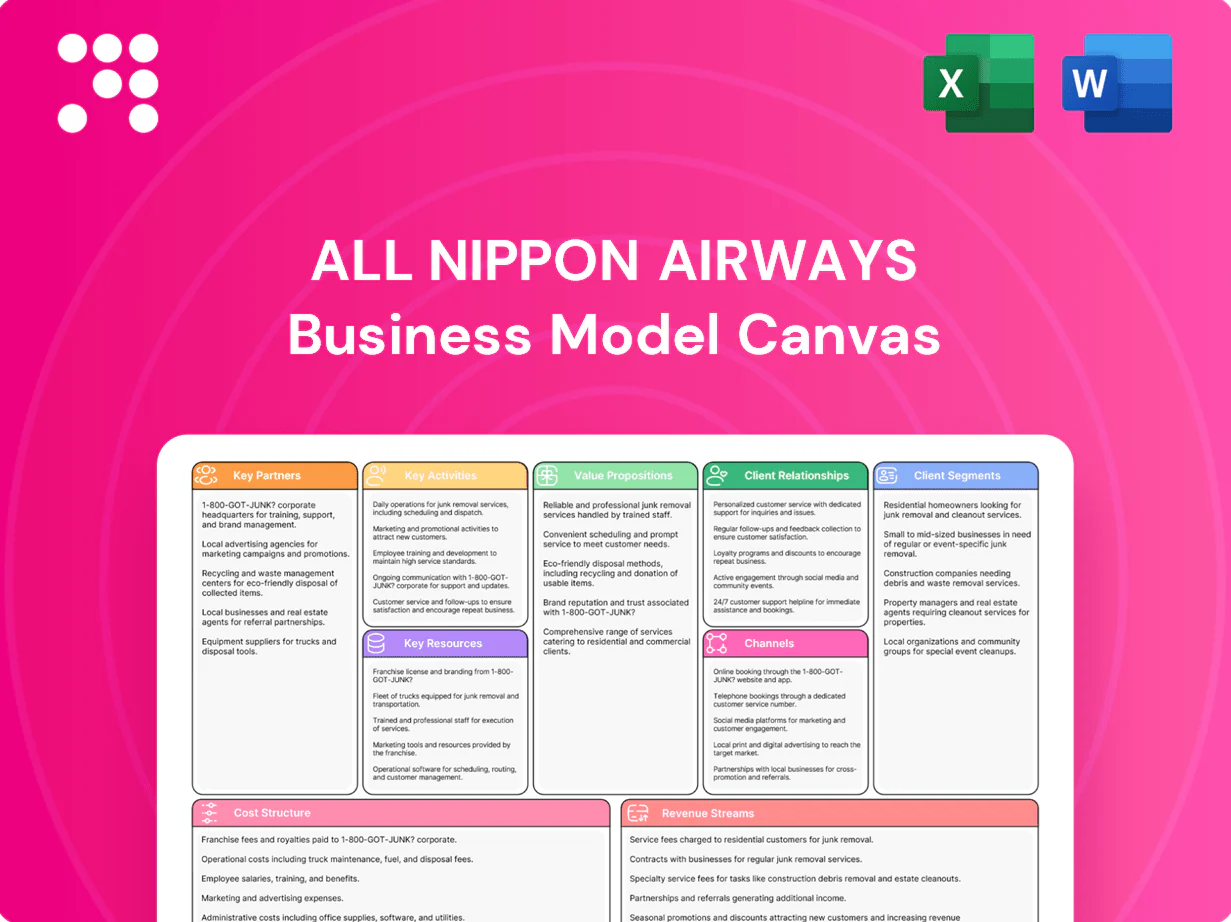
All Nippon Airways Business Model Canvas

Concise Airline Business Model Canvas: map value propositions, partnerships, revenue levers
Unlock the strategic blueprint behind All Nippon Airways with our concise Business Model Canvas—three to five sentences that map its value propositions, partnerships, and revenue levers. Ideal for investors and strategists, the full downloadable Canvas provides section-by-section insights in Word and Excel to benchmark or replicate ANA’s success—purchase now to access the complete analysis.
Partnerships

Star Alliance & codeshare airlines
Star Alliance membership (26 members as of 2024; ANA member since 1999) expands ANA’s network via through-ticketing and lounge reciprocity across 1,300+ destinations in 195 countries, boosting connectivity. Codeshares fill seats on thinner routes and improve schedule frequency. Joint ventures enable coordinated pricing and capacity, lifting yields and load factors while deep partnership depth supports seamless status recognition and service continuity.
Aircraft OEMs & lessors
Boeing and Airbus supply and support ANA’s fleet from widebodies to narrowbodies; ANA operated about 250 aircraft in 2024 with ongoing OEM support programs. Long-term purchase and lease agreements optimize capex and fleet flexibility, spreading cost and securing deliveries. OEM maintenance programs and shared parts pools enhance dispatch reliability, while lessors provide capacity agility across cycles.

Airports & ground service providers
Strategic slots and facilities at Haneda, Narita, Kansai and global hubs underpin ANA’s network connectivity, enabling high-frequency domestic and international feeds; ANA reported consolidated revenue of ¥2.47 trillion in FY2024 supporting hub investments. Airport authorities and ground handlers coordinate turnaround, gates and baggage flows to sustain on-time performance. Lounge partners elevate premium service, while local partners manage disruptions and peak operations.

Fuel, catering, and logistics suppliers
Jet fuel suppliers secure stable supply and hedging options, with jet fuel making up roughly 25–30% of airline operating costs (IATA 2023). Caterers deliver consistent onboard quality aligned with ANA brand standards and SLAs. Logistics and cargo ground handlers enable fast, reliable freight throughput across ANA’s network. Sustainability partners support SAF adoption—IEA 2023: SAF <0.1% of aviation fuel—and waste reduction.
- Fuel: 25–30% of costs (IATA 2023)
- SAF: <0.1% global supply (IEA 2023)
- Catering: brand-aligned SLAs
- Logistics: fast cargo throughput
Travel agencies, GDS, and IT vendors
Travel agencies and OTAs broaden ANA’s reach to leisure and corporate buyers across domestic and international markets; GDS platforms (reach 195 countries) enable global distribution and interline ticketing; IT vendors power PSS, revenue management, and personalization; marketing partners drive co-promotions and bundled offerings to boost load factors and ancillary sales.
- Agencies/OTAs: broaden reach
- GDS: 195 countries, interline
- IT vendors: PSS, RM, personalization
- Marketing: co-promos, bundles
Star Alliance boosts Japan carrier reach; 26, ¥2.47T
Star Alliance (26 members in 2024) expands ANA’s global reach via through-ticketing and lounges; codeshares and joint ventures raise yields and load factors. OEMs and lessors support ~250-aircraft fleet (2024) and optimize capex; hub slots at Haneda/Narita enable dense feeds while FY2024 revenue reached ¥2.47 trillion. Fuel and SAF partners manage ~25–30% fuel cost exposure and nascent SAF supply.
| Partnership | Role | 2024 metric |
|---|---|---|
| Star Alliance | Network & lounges | 26 members, 1,300+ destinations |
| OEMs/Lessors | Fleet supply/support | ~250 aircraft |
What is included in the product
 Detailed Word Document
A comprehensive pre-written business model tailored to All Nippon Airways’ strategy, covering customer segments, channels, value propositions, key partners, activities, resources, cost structure and revenue streams aligned with airline operations. Organized into 9 BMC blocks with competitive analysis, linked SWOT insights and a polished format for presentations, investor discussions and strategic decision-making.

 Customizable Excel Spreadsheet
High-level view of ANA's business model with editable cells—quickly spot revenue levers, cost drivers, and network constraints to resolve strategic and operational pain points.
Activities

Flight and network operations
Daily execution of ANA’s domestic and international schedules—supported by a fleet of about 260 aircraft—drives core value and carried millions of passengers in FY2023 as traffic recovered; ANA Holdings reported operating revenue of roughly 1.84 trillion JPY in FY2023. Slot management and fleet assignment balance peak-demand routes and efficiency across over 80 international and domestic lanes. Operational control centers monitor disruptions in real time and guide recovery actions. Rigorous crew planning ensures regulatory compliance and consistent service quality.
Safety and regulatory compliance
Strict adherence to ICAO and Japan JCAB standards underpins ANA’s operations across approximately 260 aircraft and 90+ international routes. Continuous pilot and cabin training, recurrent simulator hours, internal audits and SMS processes reduce operational risk and support industry-leading reliability. Proactive regulatory engagement secures route rights and certifications, while a data-driven safety culture—leveraging flight data monitoring and predictive analytics—sustains trust.

Maintenance, repair, and overhaul
Line and heavy maintenance keep ANA's fleet airworthy and efficient, supporting an operating fleet of roughly 260 aircraft in 2024. Predictive analytics reduce unscheduled downtime and delay risk, cutting turnaround variability and improving utilization. Robust parts logistics and vendor coordination ensure targeted turn times for line checks and C-checks. ANA also monetizes MRO expertise by offering third-party services to other carriers and leasing firms.

Customer service and experience design
Product design covers cabins, catering and lounges with service standards aligned to restored network capacity (≈90% of 2019 by mid‑2024), while multichannel service manages bookings, changes and disruption response across web, app and contact centers. NPS feedback loops drive iterative enhancements; accessibility and multilingual (EN/中文/한국어) support broaden market appeal.
- Cabin & lounge design
- Multichannel disruption handling
- NPS-driven updates; accessibility & multilingual
Revenue management and sales
Revenue management at All Nippon Airways uses dynamic fare optimization to maximize RASK across cabins and routes, while corporate contracting and group sales secure baseline demand; ancillary merchandising (around 10% of passenger-related revenue industry-wide in 2024) boosts per-passenger yield, and targeted marketing campaigns raise off-peak and new-route load factors.
- Fare optimization: higher RASK per route
- Corporate/group sales: base demand stability
- Ancillaries: ~10% lift to passenger revenue (2024 industry level)
- Marketing: increases off-peak/new-route traffic
~260 ac, ~1.84T JPY, ~90% 2019
ANA operates ~260 aircraft, flying ~90% of 2019 capacity by mid‑2024 and generating ~1.84 trillion JPY revenue in FY2023; core activities: network ops, crew training, MRO, product design and revenue management. Safety/regulatory compliance, predictive maintenance and dynamic revenue optimization drive reliability and yield.
| Metric | Value |
|---|---|
| Fleet | ~260 |
| FY2023 Revenue | ~1.84T JPY |
| Network capacity (mid‑2024) | ~90% of 2019 |
| Ancillary lift (industry 2024) | ~10% |
Full Version Awaits
Business Model Canvas
The document you're previewing is the actual All Nippon Airways Business Model Canvas, not a mockup. When you purchase, you'll receive this exact file with all sections included—no trimmed content. Delivered ready-to-edit in Word and Excel formats, it’s the same professional, complete document shown here.

Concise Airline Business Model Canvas: map value propositions, partnerships, revenue levers
Unlock the strategic blueprint behind All Nippon Airways with our concise Business Model Canvas—three to five sentences that map its value propositions, partnerships, and revenue levers. Ideal for investors and strategists, the full downloadable Canvas provides section-by-section insights in Word and Excel to benchmark or replicate ANA’s success—purchase now to access the complete analysis.
Partnerships
Star Alliance & codeshare airlines
Star Alliance membership (26 members as of 2024; ANA member since 1999) expands ANA’s network via through-ticketing and lounge reciprocity across 1,300+ destinations in 195 countries, boosting connectivity. Codeshares fill seats on thinner routes and improve schedule frequency. Joint ventures enable coordinated pricing and capacity, lifting yields and load factors while deep partnership depth supports seamless status recognition and service continuity.
Aircraft OEMs & lessors
Boeing and Airbus supply and support ANA’s fleet from widebodies to narrowbodies; ANA operated about 250 aircraft in 2024 with ongoing OEM support programs. Long-term purchase and lease agreements optimize capex and fleet flexibility, spreading cost and securing deliveries. OEM maintenance programs and shared parts pools enhance dispatch reliability, while lessors provide capacity agility across cycles.
Airports & ground service providers
Strategic slots and facilities at Haneda, Narita, Kansai and global hubs underpin ANA’s network connectivity, enabling high-frequency domestic and international feeds; ANA reported consolidated revenue of ¥2.47 trillion in FY2024 supporting hub investments. Airport authorities and ground handlers coordinate turnaround, gates and baggage flows to sustain on-time performance. Lounge partners elevate premium service, while local partners manage disruptions and peak operations.
Fuel, catering, and logistics suppliers
Jet fuel suppliers secure stable supply and hedging options, with jet fuel making up roughly 25–30% of airline operating costs (IATA 2023). Caterers deliver consistent onboard quality aligned with ANA brand standards and SLAs. Logistics and cargo ground handlers enable fast, reliable freight throughput across ANA’s network. Sustainability partners support SAF adoption—IEA 2023: SAF <0.1% of aviation fuel—and waste reduction.
- Fuel: 25–30% of costs (IATA 2023)
- SAF: <0.1% global supply (IEA 2023)
- Catering: brand-aligned SLAs
- Logistics: fast cargo throughput
Travel agencies, GDS, and IT vendors
Travel agencies and OTAs broaden ANA’s reach to leisure and corporate buyers across domestic and international markets; GDS platforms (reach 195 countries) enable global distribution and interline ticketing; IT vendors power PSS, revenue management, and personalization; marketing partners drive co-promotions and bundled offerings to boost load factors and ancillary sales.
- Agencies/OTAs: broaden reach
- GDS: 195 countries, interline
- IT vendors: PSS, RM, personalization
- Marketing: co-promos, bundles
Star Alliance boosts Japan carrier reach; 26, ¥2.47T
Star Alliance (26 members in 2024) expands ANA’s global reach via through-ticketing and lounges; codeshares and joint ventures raise yields and load factors. OEMs and lessors support ~250-aircraft fleet (2024) and optimize capex; hub slots at Haneda/Narita enable dense feeds while FY2024 revenue reached ¥2.47 trillion. Fuel and SAF partners manage ~25–30% fuel cost exposure and nascent SAF supply.
| Partnership | Role | 2024 metric |
|---|---|---|
| Star Alliance | Network & lounges | 26 members, 1,300+ destinations |
| OEMs/Lessors | Fleet supply/support | ~250 aircraft |
What is included in the product
Detailed Word Document
A comprehensive pre-written business model tailored to All Nippon Airways’ strategy, covering customer segments, channels, value propositions, key partners, activities, resources, cost structure and revenue streams aligned with airline operations. Organized into 9 BMC blocks with competitive analysis, linked SWOT insights and a polished format for presentations, investor discussions and strategic decision-making.
Customizable Excel Spreadsheet
High-level view of ANA's business model with editable cells—quickly spot revenue levers, cost drivers, and network constraints to resolve strategic and operational pain points.
Activities
Flight and network operations
Daily execution of ANA’s domestic and international schedules—supported by a fleet of about 260 aircraft—drives core value and carried millions of passengers in FY2023 as traffic recovered; ANA Holdings reported operating revenue of roughly 1.84 trillion JPY in FY2023. Slot management and fleet assignment balance peak-demand routes and efficiency across over 80 international and domestic lanes. Operational control centers monitor disruptions in real time and guide recovery actions. Rigorous crew planning ensures regulatory compliance and consistent service quality.
Safety and regulatory compliance
Strict adherence to ICAO and Japan JCAB standards underpins ANA’s operations across approximately 260 aircraft and 90+ international routes. Continuous pilot and cabin training, recurrent simulator hours, internal audits and SMS processes reduce operational risk and support industry-leading reliability. Proactive regulatory engagement secures route rights and certifications, while a data-driven safety culture—leveraging flight data monitoring and predictive analytics—sustains trust.
Maintenance, repair, and overhaul
Line and heavy maintenance keep ANA's fleet airworthy and efficient, supporting an operating fleet of roughly 260 aircraft in 2024. Predictive analytics reduce unscheduled downtime and delay risk, cutting turnaround variability and improving utilization. Robust parts logistics and vendor coordination ensure targeted turn times for line checks and C-checks. ANA also monetizes MRO expertise by offering third-party services to other carriers and leasing firms.
Customer service and experience design
Product design covers cabins, catering and lounges with service standards aligned to restored network capacity (≈90% of 2019 by mid‑2024), while multichannel service manages bookings, changes and disruption response across web, app and contact centers. NPS feedback loops drive iterative enhancements; accessibility and multilingual (EN/中文/한국어) support broaden market appeal.
- Cabin & lounge design
- Multichannel disruption handling
- NPS-driven updates; accessibility & multilingual
Revenue management and sales
Revenue management at All Nippon Airways uses dynamic fare optimization to maximize RASK across cabins and routes, while corporate contracting and group sales secure baseline demand; ancillary merchandising (around 10% of passenger-related revenue industry-wide in 2024) boosts per-passenger yield, and targeted marketing campaigns raise off-peak and new-route load factors.
- Fare optimization: higher RASK per route
- Corporate/group sales: base demand stability
- Ancillaries: ~10% lift to passenger revenue (2024 industry level)
- Marketing: increases off-peak/new-route traffic
~260 ac, ~1.84T JPY, ~90% 2019
ANA operates ~260 aircraft, flying ~90% of 2019 capacity by mid‑2024 and generating ~1.84 trillion JPY revenue in FY2023; core activities: network ops, crew training, MRO, product design and revenue management. Safety/regulatory compliance, predictive maintenance and dynamic revenue optimization drive reliability and yield.
| Metric | Value |
|---|---|
| Fleet | ~260 |
| FY2023 Revenue | ~1.84T JPY |
| Network capacity (mid‑2024) | ~90% of 2019 |
| Ancillary lift (industry 2024) | ~10% |
Full Version Awaits
Business Model Canvas
The document you're previewing is the actual All Nippon Airways Business Model Canvas, not a mockup. When you purchase, you'll receive this exact file with all sections included—no trimmed content. Delivered ready-to-edit in Word and Excel formats, it’s the same professional, complete document shown here.
Description
Concise Airline Business Model Canvas: map value propositions, partnerships, revenue levers
Unlock the strategic blueprint behind All Nippon Airways with our concise Business Model Canvas—three to five sentences that map its value propositions, partnerships, and revenue levers. Ideal for investors and strategists, the full downloadable Canvas provides section-by-section insights in Word and Excel to benchmark or replicate ANA’s success—purchase now to access the complete analysis.
Partnerships
Star Alliance & codeshare airlines
Star Alliance membership (26 members as of 2024; ANA member since 1999) expands ANA’s network via through-ticketing and lounge reciprocity across 1,300+ destinations in 195 countries, boosting connectivity. Codeshares fill seats on thinner routes and improve schedule frequency. Joint ventures enable coordinated pricing and capacity, lifting yields and load factors while deep partnership depth supports seamless status recognition and service continuity.
Aircraft OEMs & lessors
Boeing and Airbus supply and support ANA’s fleet from widebodies to narrowbodies; ANA operated about 250 aircraft in 2024 with ongoing OEM support programs. Long-term purchase and lease agreements optimize capex and fleet flexibility, spreading cost and securing deliveries. OEM maintenance programs and shared parts pools enhance dispatch reliability, while lessors provide capacity agility across cycles.
Airports & ground service providers
Strategic slots and facilities at Haneda, Narita, Kansai and global hubs underpin ANA’s network connectivity, enabling high-frequency domestic and international feeds; ANA reported consolidated revenue of ¥2.47 trillion in FY2024 supporting hub investments. Airport authorities and ground handlers coordinate turnaround, gates and baggage flows to sustain on-time performance. Lounge partners elevate premium service, while local partners manage disruptions and peak operations.
Fuel, catering, and logistics suppliers
Jet fuel suppliers secure stable supply and hedging options, with jet fuel making up roughly 25–30% of airline operating costs (IATA 2023). Caterers deliver consistent onboard quality aligned with ANA brand standards and SLAs. Logistics and cargo ground handlers enable fast, reliable freight throughput across ANA’s network. Sustainability partners support SAF adoption—IEA 2023: SAF <0.1% of aviation fuel—and waste reduction.
- Fuel: 25–30% of costs (IATA 2023)
- SAF: <0.1% global supply (IEA 2023)
- Catering: brand-aligned SLAs
- Logistics: fast cargo throughput
Travel agencies, GDS, and IT vendors
Travel agencies and OTAs broaden ANA’s reach to leisure and corporate buyers across domestic and international markets; GDS platforms (reach 195 countries) enable global distribution and interline ticketing; IT vendors power PSS, revenue management, and personalization; marketing partners drive co-promotions and bundled offerings to boost load factors and ancillary sales.
- Agencies/OTAs: broaden reach
- GDS: 195 countries, interline
- IT vendors: PSS, RM, personalization
- Marketing: co-promos, bundles
Star Alliance boosts Japan carrier reach; 26, ¥2.47T
Star Alliance (26 members in 2024) expands ANA’s global reach via through-ticketing and lounges; codeshares and joint ventures raise yields and load factors. OEMs and lessors support ~250-aircraft fleet (2024) and optimize capex; hub slots at Haneda/Narita enable dense feeds while FY2024 revenue reached ¥2.47 trillion. Fuel and SAF partners manage ~25–30% fuel cost exposure and nascent SAF supply.
| Partnership | Role | 2024 metric |
|---|---|---|
| Star Alliance | Network & lounges | 26 members, 1,300+ destinations |
| OEMs/Lessors | Fleet supply/support | ~250 aircraft |
What is included in the product
Detailed Word Document
A comprehensive pre-written business model tailored to All Nippon Airways’ strategy, covering customer segments, channels, value propositions, key partners, activities, resources, cost structure and revenue streams aligned with airline operations. Organized into 9 BMC blocks with competitive analysis, linked SWOT insights and a polished format for presentations, investor discussions and strategic decision-making.
Customizable Excel Spreadsheet
High-level view of ANA's business model with editable cells—quickly spot revenue levers, cost drivers, and network constraints to resolve strategic and operational pain points.
Activities
Flight and network operations
Daily execution of ANA’s domestic and international schedules—supported by a fleet of about 260 aircraft—drives core value and carried millions of passengers in FY2023 as traffic recovered; ANA Holdings reported operating revenue of roughly 1.84 trillion JPY in FY2023. Slot management and fleet assignment balance peak-demand routes and efficiency across over 80 international and domestic lanes. Operational control centers monitor disruptions in real time and guide recovery actions. Rigorous crew planning ensures regulatory compliance and consistent service quality.
Safety and regulatory compliance
Strict adherence to ICAO and Japan JCAB standards underpins ANA’s operations across approximately 260 aircraft and 90+ international routes. Continuous pilot and cabin training, recurrent simulator hours, internal audits and SMS processes reduce operational risk and support industry-leading reliability. Proactive regulatory engagement secures route rights and certifications, while a data-driven safety culture—leveraging flight data monitoring and predictive analytics—sustains trust.
Maintenance, repair, and overhaul
Line and heavy maintenance keep ANA's fleet airworthy and efficient, supporting an operating fleet of roughly 260 aircraft in 2024. Predictive analytics reduce unscheduled downtime and delay risk, cutting turnaround variability and improving utilization. Robust parts logistics and vendor coordination ensure targeted turn times for line checks and C-checks. ANA also monetizes MRO expertise by offering third-party services to other carriers and leasing firms.
Customer service and experience design
Product design covers cabins, catering and lounges with service standards aligned to restored network capacity (≈90% of 2019 by mid‑2024), while multichannel service manages bookings, changes and disruption response across web, app and contact centers. NPS feedback loops drive iterative enhancements; accessibility and multilingual (EN/中文/한국어) support broaden market appeal.
- Cabin & lounge design
- Multichannel disruption handling
- NPS-driven updates; accessibility & multilingual
Revenue management and sales
Revenue management at All Nippon Airways uses dynamic fare optimization to maximize RASK across cabins and routes, while corporate contracting and group sales secure baseline demand; ancillary merchandising (around 10% of passenger-related revenue industry-wide in 2024) boosts per-passenger yield, and targeted marketing campaigns raise off-peak and new-route load factors.
- Fare optimization: higher RASK per route
- Corporate/group sales: base demand stability
- Ancillaries: ~10% lift to passenger revenue (2024 industry level)
- Marketing: increases off-peak/new-route traffic
~260 ac, ~1.84T JPY, ~90% 2019
ANA operates ~260 aircraft, flying ~90% of 2019 capacity by mid‑2024 and generating ~1.84 trillion JPY revenue in FY2023; core activities: network ops, crew training, MRO, product design and revenue management. Safety/regulatory compliance, predictive maintenance and dynamic revenue optimization drive reliability and yield.
| Metric | Value |
|---|---|
| Fleet | ~260 |
| FY2023 Revenue | ~1.84T JPY |
| Network capacity (mid‑2024) | ~90% of 2019 |
| Ancillary lift (industry 2024) | ~10% |
Full Version Awaits
Business Model Canvas
The document you're previewing is the actual All Nippon Airways Business Model Canvas, not a mockup. When you purchase, you'll receive this exact file with all sections included—no trimmed content. Delivered ready-to-edit in Word and Excel formats, it’s the same professional, complete document shown here.











