Annexon SWOT Analysis

Go Beyond the Preview—Access the Full Strategic Report
Annexon’s SWOT snapshot highlights its innovative complement-targeting pipeline, strong scientific leadership, and niche market potential, balanced against clinical risk, funding needs, and competitive immunotherapy pressures. Our full SWOT unpacks financial context, timelines, and strategic options to inform investment or partnership decisions. Purchase the complete, editable report to access detailed analysis, models, and actionable recommendations.
Strengths

First-mover in C1q inhibition
Annexon’s C1q focus—targeting the initiator of the classical complement pathway—distinctly separates it from C3/C5-centric peers and aims for disease-modifying effects in complement-driven neurodegeneration. Early leadership in C1q biology can yield IP advantages and clinician mindshare, boosting partner leverage and trial-site enthusiasm. Global dementia burden was ~55 million in 2020, with 6.7 million US Alzheimer's patients in 2023.
Platform potential across multiple indications
Blocking C1q targets classical complement mechanisms implicated in neurodegenerative (Alzheimer’s ~55 million affected worldwide), autoimmune (Guillain-Barré incidence ~1–2/100,000 annually) and ophthalmic disorders, enabling a single-target platform to seed multiple assets and label expansions. This diversification raises probability of value creation and provides portfolio optionality across rare and large markets.

Biomarker-driven development
C1q and complement biomarkers, exemplified by Annexon’s anti-C1q program ANX005, enable patient selection, dose optimization and proof-of-mechanism by directly measuring target engagement. Precision biomarker readouts link engagement to clinical outcomes, de-risking trials and reducing attrition. A formal biomarker strategy supports regulatory dialogue and pathways such as FDA’s Biomarker Qualification Program. It also strengthens payer narratives around responder enrichment.

Clear unmet need in neurodegenerative diseases
Patients with complement-mediated neuroinflammation have limited disease-modifying options today; preventing synapse loss and destructive inflammation targets core biology and could meaningfully change outcomes. High unmet need supports regulatory incentives—US orphan designation applies to conditions affecting fewer than 200,000 people—and can enable premium pricing and faster clinician uptake if efficacy and safety are shown.
- Targets core pathology: synapse preservation
- Regulatory tailwind: orphan threshold <200,000 (US)
- Market pull: faster adoption with clear benefit
Focused R&D execution
Annexon’s narrow, mechanism-led R&D concentrates capital on two lead programs and, per 2024 filings, preserves runway into 2025, boosting resource efficiency. Operational focus standardizes trial design and learning transfer across indications, shortening iteration cycles and lowering development risk. Clear, concise program messaging improves engagement with investors, partners, and regulators.
C1q-first therapy aims to modify disease across neuro, autoimmune and ophthalmic indications
Annexon’s C1q-first approach uniquely targets classical complement initiation, positioning it apart from C3/C5 peers and aiming for disease modification. A single-target platform spans neurodegenerative, autoimmune and ophthalmic indications, increasing optionality. C1q biomarkers (ANX005) enable patient selection and de-risking. Two lead programs concentrate resources with runway into 2025 (2024 filings).
| Metric | Value |
|---|---|
| Global dementia (2020) | ~55M |
| US Alzheimer (2023) | 6.7M |
| Guillain-Barré incidence | 1–2/100,000 |
| Programs | 2 lead |
| Runway | into 2025 (2024 filings) |
What is included in the product
 Detailed Word Document
Provides a concise SWOT assessment of Annexon, detailing internal strengths and weaknesses alongside external opportunities and threats to evaluate strategic positioning, growth drivers, and future risks.

 Customizable Excel Spreadsheet
Delivers a clear Annexon-focused SWOT matrix to quickly align strategy and remove analysis friction, while the editable layout simplifies updates and produces stakeholder-ready visuals.
Weaknesses

Single-target concentration risk
Annexon’s heavy dependence on C1q — with its two lead clinical programs, ANX005 and ANX007, both C1q-directed — concentrates company-level risk if the mechanism underdelivers clinically. Negative readouts could impair multiple programs simultaneously, amplifying downside given limited target diversification at this stage. This single-target focus increases stock volatility and heightens financing risk for the small-cap biotech.
Clinical-stage with no commercial revenues
As a clinical-stage company with no commercial revenues, Annexon depends on capital markets and strategic partnerships to fund operations and late-stage programs. Ongoing cash burn is expected through pivotal trials and launch preparation, creating funding and timing risk for scale-up. Adverse macro conditions can narrow financing windows and delay pivotal milestones.

Regulatory uncertainty in novel mechanism
First-in-class pathways for Annexon face unclear endpoints and evolving approval standards, with drug development averaging 10–12 years to market; regulators often demand robust functional outcomes beyond biomarker changes. Requirement for additional confirmatory studies can add 12–36 months and tens to hundreds of millions in cost, and initial labels tend to be conservative in scope.

Manufacturing and CMC complexity for biologics
Manufacturing and CMC complexity for biologics strains Annexon: large-molecule assets demand high-quality process development and supply reliability, and biologics comprised a majority of FDA approvals through 2024. Scale-up, comparability studies and device/drug logistics add execution risk and can delay pivotal trials or launch. CMC setbacks commonly bottleneck timelines and costs are often several-fold higher than small-molecule peers.
- High CMC bar: supply/reliability risks
- Execution risk: scale-up, comparability, device logistics
- Delays: pivotal trials/launch bottlenecks
- Cost: biologics manufacturing often several-fold > small molecules
Safety considerations with complement modulation
Inhibiting complement elevates infection and immune-related adverse event risk; CDC data show eculizumab is associated with a roughly 1,000–2,000-fold increased meningococcal disease risk. Long-term safety data in chronic neurodegeneration are limited, with few agents having >5-year neuro datasets. Safety signals could restrict dosing, indications or combination use, narrowing commercial opportunity.
- Infection risk: eculizumab 1,000–2,000x meningococcal risk (CDC)
- Limited >5‑year neurodegeneration safety data
- Potential limits on dosing, populations, combos → smaller market
C1q-directed therapy: single-target failure, meningococcal risk and biologics CMC burden
Annexon’s C1q concentration (ANX005, ANX007) creates single‑target failure and financing volatility for a clinical‑stage, no‑revenue biotech. Complement inhibition raises infection risk (eculizumab ~1,000–2,000x meningococcal risk, CDC) and sparse >5‑year neuro safety data may limit labels. Biologics CMC/scale‑up drives higher execution risk and cost versus small molecules.
| Weakness | Impact | Evidence |
|---|---|---|
| Target concentration | Program/stock risk | ANX005, ANX007 both C1q‑directed |
| Safety | Labeling/market shrink | eculizumab 1,000–2,000x meningococcal (CDC) |
| CMC | Delays/costs | Biologics > small‑molecule CMC burden |
What You See Is What You Get
Annexon SWOT Analysis
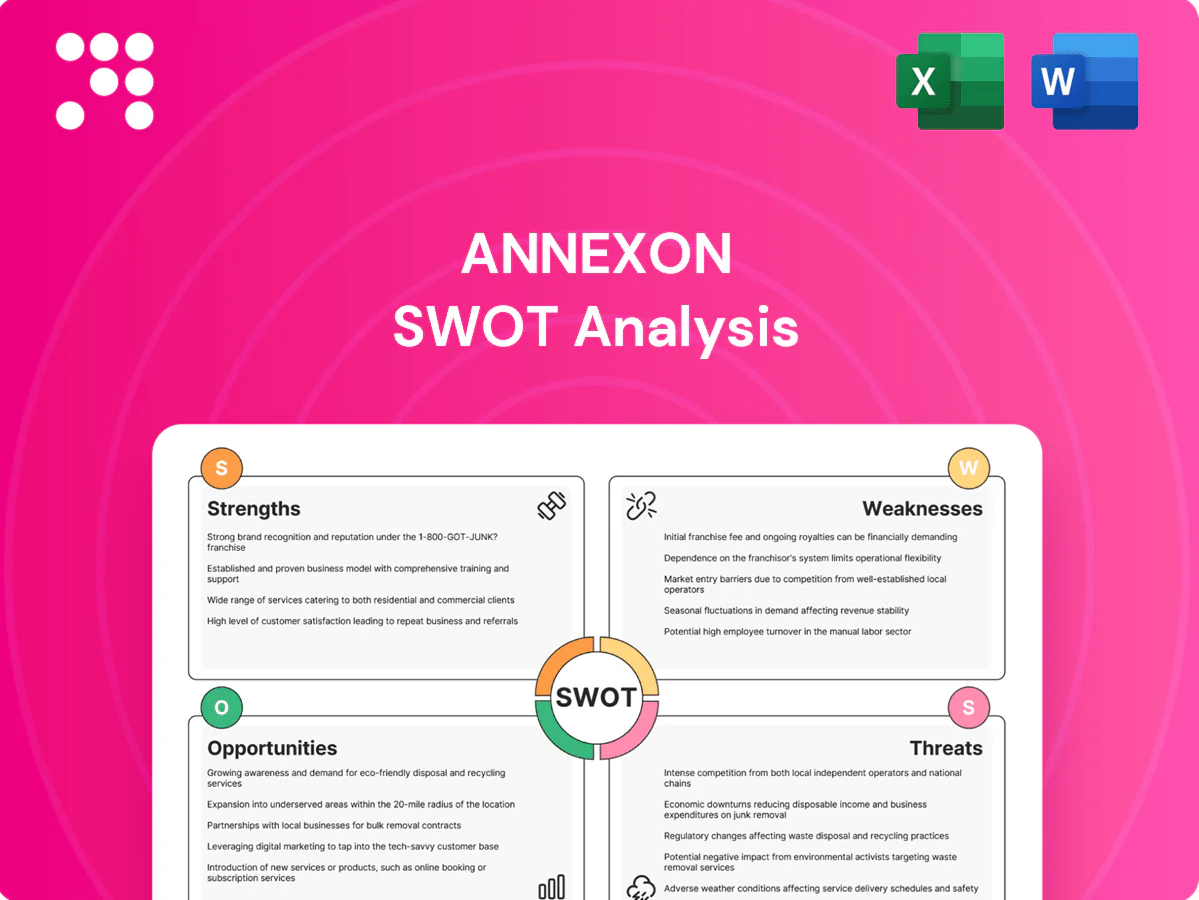
This is the actual Annexon SWOT analysis document you’ll receive upon purchase—no surprises, just professional quality. The preview below is taken directly from the full report; buy to unlock the complete, editable version. You’re viewing a live excerpt of the real file available after checkout.

Go Beyond the Preview—Access the Full Strategic Report
Annexon’s SWOT snapshot highlights its innovative complement-targeting pipeline, strong scientific leadership, and niche market potential, balanced against clinical risk, funding needs, and competitive immunotherapy pressures. Our full SWOT unpacks financial context, timelines, and strategic options to inform investment or partnership decisions. Purchase the complete, editable report to access detailed analysis, models, and actionable recommendations.
Strengths
First-mover in C1q inhibition
Annexon’s C1q focus—targeting the initiator of the classical complement pathway—distinctly separates it from C3/C5-centric peers and aims for disease-modifying effects in complement-driven neurodegeneration. Early leadership in C1q biology can yield IP advantages and clinician mindshare, boosting partner leverage and trial-site enthusiasm. Global dementia burden was ~55 million in 2020, with 6.7 million US Alzheimer's patients in 2023.
Platform potential across multiple indications
Blocking C1q targets classical complement mechanisms implicated in neurodegenerative (Alzheimer’s ~55 million affected worldwide), autoimmune (Guillain-Barré incidence ~1–2/100,000 annually) and ophthalmic disorders, enabling a single-target platform to seed multiple assets and label expansions. This diversification raises probability of value creation and provides portfolio optionality across rare and large markets.
Biomarker-driven development
C1q and complement biomarkers, exemplified by Annexon’s anti-C1q program ANX005, enable patient selection, dose optimization and proof-of-mechanism by directly measuring target engagement. Precision biomarker readouts link engagement to clinical outcomes, de-risking trials and reducing attrition. A formal biomarker strategy supports regulatory dialogue and pathways such as FDA’s Biomarker Qualification Program. It also strengthens payer narratives around responder enrichment.
Clear unmet need in neurodegenerative diseases
Patients with complement-mediated neuroinflammation have limited disease-modifying options today; preventing synapse loss and destructive inflammation targets core biology and could meaningfully change outcomes. High unmet need supports regulatory incentives—US orphan designation applies to conditions affecting fewer than 200,000 people—and can enable premium pricing and faster clinician uptake if efficacy and safety are shown.
- Targets core pathology: synapse preservation
- Regulatory tailwind: orphan threshold <200,000 (US)
- Market pull: faster adoption with clear benefit
Focused R&D execution
Annexon’s narrow, mechanism-led R&D concentrates capital on two lead programs and, per 2024 filings, preserves runway into 2025, boosting resource efficiency. Operational focus standardizes trial design and learning transfer across indications, shortening iteration cycles and lowering development risk. Clear, concise program messaging improves engagement with investors, partners, and regulators.
C1q-first therapy aims to modify disease across neuro, autoimmune and ophthalmic indications
Annexon’s C1q-first approach uniquely targets classical complement initiation, positioning it apart from C3/C5 peers and aiming for disease modification. A single-target platform spans neurodegenerative, autoimmune and ophthalmic indications, increasing optionality. C1q biomarkers (ANX005) enable patient selection and de-risking. Two lead programs concentrate resources with runway into 2025 (2024 filings).
| Metric | Value |
|---|---|
| Global dementia (2020) | ~55M |
| US Alzheimer (2023) | 6.7M |
| Guillain-Barré incidence | 1–2/100,000 |
| Programs | 2 lead |
| Runway | into 2025 (2024 filings) |
What is included in the product
Detailed Word Document
Provides a concise SWOT assessment of Annexon, detailing internal strengths and weaknesses alongside external opportunities and threats to evaluate strategic positioning, growth drivers, and future risks.
Customizable Excel Spreadsheet
Delivers a clear Annexon-focused SWOT matrix to quickly align strategy and remove analysis friction, while the editable layout simplifies updates and produces stakeholder-ready visuals.
Weaknesses
Single-target concentration risk
Annexon’s heavy dependence on C1q — with its two lead clinical programs, ANX005 and ANX007, both C1q-directed — concentrates company-level risk if the mechanism underdelivers clinically. Negative readouts could impair multiple programs simultaneously, amplifying downside given limited target diversification at this stage. This single-target focus increases stock volatility and heightens financing risk for the small-cap biotech.
Clinical-stage with no commercial revenues
As a clinical-stage company with no commercial revenues, Annexon depends on capital markets and strategic partnerships to fund operations and late-stage programs. Ongoing cash burn is expected through pivotal trials and launch preparation, creating funding and timing risk for scale-up. Adverse macro conditions can narrow financing windows and delay pivotal milestones.
Regulatory uncertainty in novel mechanism
First-in-class pathways for Annexon face unclear endpoints and evolving approval standards, with drug development averaging 10–12 years to market; regulators often demand robust functional outcomes beyond biomarker changes. Requirement for additional confirmatory studies can add 12–36 months and tens to hundreds of millions in cost, and initial labels tend to be conservative in scope.
Manufacturing and CMC complexity for biologics
Manufacturing and CMC complexity for biologics strains Annexon: large-molecule assets demand high-quality process development and supply reliability, and biologics comprised a majority of FDA approvals through 2024. Scale-up, comparability studies and device/drug logistics add execution risk and can delay pivotal trials or launch. CMC setbacks commonly bottleneck timelines and costs are often several-fold higher than small-molecule peers.
- High CMC bar: supply/reliability risks
- Execution risk: scale-up, comparability, device logistics
- Delays: pivotal trials/launch bottlenecks
- Cost: biologics manufacturing often several-fold > small molecules
Safety considerations with complement modulation
Inhibiting complement elevates infection and immune-related adverse event risk; CDC data show eculizumab is associated with a roughly 1,000–2,000-fold increased meningococcal disease risk. Long-term safety data in chronic neurodegeneration are limited, with few agents having >5-year neuro datasets. Safety signals could restrict dosing, indications or combination use, narrowing commercial opportunity.
- Infection risk: eculizumab 1,000–2,000x meningococcal risk (CDC)
- Limited >5‑year neurodegeneration safety data
- Potential limits on dosing, populations, combos → smaller market
C1q-directed therapy: single-target failure, meningococcal risk and biologics CMC burden
Annexon’s C1q concentration (ANX005, ANX007) creates single‑target failure and financing volatility for a clinical‑stage, no‑revenue biotech. Complement inhibition raises infection risk (eculizumab ~1,000–2,000x meningococcal risk, CDC) and sparse >5‑year neuro safety data may limit labels. Biologics CMC/scale‑up drives higher execution risk and cost versus small molecules.
| Weakness | Impact | Evidence |
|---|---|---|
| Target concentration | Program/stock risk | ANX005, ANX007 both C1q‑directed |
| Safety | Labeling/market shrink | eculizumab 1,000–2,000x meningococcal (CDC) |
| CMC | Delays/costs | Biologics > small‑molecule CMC burden |
What You See Is What You Get
Annexon SWOT Analysis
This is the actual Annexon SWOT analysis document you’ll receive upon purchase—no surprises, just professional quality. The preview below is taken directly from the full report; buy to unlock the complete, editable version. You’re viewing a live excerpt of the real file available after checkout.
Original: $10.00
-65%$10.00
$3.50Description
Go Beyond the Preview—Access the Full Strategic Report
Annexon’s SWOT snapshot highlights its innovative complement-targeting pipeline, strong scientific leadership, and niche market potential, balanced against clinical risk, funding needs, and competitive immunotherapy pressures. Our full SWOT unpacks financial context, timelines, and strategic options to inform investment or partnership decisions. Purchase the complete, editable report to access detailed analysis, models, and actionable recommendations.
Strengths
First-mover in C1q inhibition
Annexon’s C1q focus—targeting the initiator of the classical complement pathway—distinctly separates it from C3/C5-centric peers and aims for disease-modifying effects in complement-driven neurodegeneration. Early leadership in C1q biology can yield IP advantages and clinician mindshare, boosting partner leverage and trial-site enthusiasm. Global dementia burden was ~55 million in 2020, with 6.7 million US Alzheimer's patients in 2023.
Platform potential across multiple indications
Blocking C1q targets classical complement mechanisms implicated in neurodegenerative (Alzheimer’s ~55 million affected worldwide), autoimmune (Guillain-Barré incidence ~1–2/100,000 annually) and ophthalmic disorders, enabling a single-target platform to seed multiple assets and label expansions. This diversification raises probability of value creation and provides portfolio optionality across rare and large markets.
Biomarker-driven development
C1q and complement biomarkers, exemplified by Annexon’s anti-C1q program ANX005, enable patient selection, dose optimization and proof-of-mechanism by directly measuring target engagement. Precision biomarker readouts link engagement to clinical outcomes, de-risking trials and reducing attrition. A formal biomarker strategy supports regulatory dialogue and pathways such as FDA’s Biomarker Qualification Program. It also strengthens payer narratives around responder enrichment.
Clear unmet need in neurodegenerative diseases
Patients with complement-mediated neuroinflammation have limited disease-modifying options today; preventing synapse loss and destructive inflammation targets core biology and could meaningfully change outcomes. High unmet need supports regulatory incentives—US orphan designation applies to conditions affecting fewer than 200,000 people—and can enable premium pricing and faster clinician uptake if efficacy and safety are shown.
- Targets core pathology: synapse preservation
- Regulatory tailwind: orphan threshold <200,000 (US)
- Market pull: faster adoption with clear benefit
Focused R&D execution
Annexon’s narrow, mechanism-led R&D concentrates capital on two lead programs and, per 2024 filings, preserves runway into 2025, boosting resource efficiency. Operational focus standardizes trial design and learning transfer across indications, shortening iteration cycles and lowering development risk. Clear, concise program messaging improves engagement with investors, partners, and regulators.
C1q-first therapy aims to modify disease across neuro, autoimmune and ophthalmic indications
Annexon’s C1q-first approach uniquely targets classical complement initiation, positioning it apart from C3/C5 peers and aiming for disease modification. A single-target platform spans neurodegenerative, autoimmune and ophthalmic indications, increasing optionality. C1q biomarkers (ANX005) enable patient selection and de-risking. Two lead programs concentrate resources with runway into 2025 (2024 filings).
| Metric | Value |
|---|---|
| Global dementia (2020) | ~55M |
| US Alzheimer (2023) | 6.7M |
| Guillain-Barré incidence | 1–2/100,000 |
| Programs | 2 lead |
| Runway | into 2025 (2024 filings) |
What is included in the product
Detailed Word Document
Provides a concise SWOT assessment of Annexon, detailing internal strengths and weaknesses alongside external opportunities and threats to evaluate strategic positioning, growth drivers, and future risks.
Customizable Excel Spreadsheet
Delivers a clear Annexon-focused SWOT matrix to quickly align strategy and remove analysis friction, while the editable layout simplifies updates and produces stakeholder-ready visuals.
Weaknesses
Single-target concentration risk
Annexon’s heavy dependence on C1q — with its two lead clinical programs, ANX005 and ANX007, both C1q-directed — concentrates company-level risk if the mechanism underdelivers clinically. Negative readouts could impair multiple programs simultaneously, amplifying downside given limited target diversification at this stage. This single-target focus increases stock volatility and heightens financing risk for the small-cap biotech.
Clinical-stage with no commercial revenues
As a clinical-stage company with no commercial revenues, Annexon depends on capital markets and strategic partnerships to fund operations and late-stage programs. Ongoing cash burn is expected through pivotal trials and launch preparation, creating funding and timing risk for scale-up. Adverse macro conditions can narrow financing windows and delay pivotal milestones.
Regulatory uncertainty in novel mechanism
First-in-class pathways for Annexon face unclear endpoints and evolving approval standards, with drug development averaging 10–12 years to market; regulators often demand robust functional outcomes beyond biomarker changes. Requirement for additional confirmatory studies can add 12–36 months and tens to hundreds of millions in cost, and initial labels tend to be conservative in scope.
Manufacturing and CMC complexity for biologics
Manufacturing and CMC complexity for biologics strains Annexon: large-molecule assets demand high-quality process development and supply reliability, and biologics comprised a majority of FDA approvals through 2024. Scale-up, comparability studies and device/drug logistics add execution risk and can delay pivotal trials or launch. CMC setbacks commonly bottleneck timelines and costs are often several-fold higher than small-molecule peers.
- High CMC bar: supply/reliability risks
- Execution risk: scale-up, comparability, device logistics
- Delays: pivotal trials/launch bottlenecks
- Cost: biologics manufacturing often several-fold > small molecules
Safety considerations with complement modulation
Inhibiting complement elevates infection and immune-related adverse event risk; CDC data show eculizumab is associated with a roughly 1,000–2,000-fold increased meningococcal disease risk. Long-term safety data in chronic neurodegeneration are limited, with few agents having >5-year neuro datasets. Safety signals could restrict dosing, indications or combination use, narrowing commercial opportunity.
- Infection risk: eculizumab 1,000–2,000x meningococcal risk (CDC)
- Limited >5‑year neurodegeneration safety data
- Potential limits on dosing, populations, combos → smaller market
C1q-directed therapy: single-target failure, meningococcal risk and biologics CMC burden
Annexon’s C1q concentration (ANX005, ANX007) creates single‑target failure and financing volatility for a clinical‑stage, no‑revenue biotech. Complement inhibition raises infection risk (eculizumab ~1,000–2,000x meningococcal risk, CDC) and sparse >5‑year neuro safety data may limit labels. Biologics CMC/scale‑up drives higher execution risk and cost versus small molecules.
| Weakness | Impact | Evidence |
|---|---|---|
| Target concentration | Program/stock risk | ANX005, ANX007 both C1q‑directed |
| Safety | Labeling/market shrink | eculizumab 1,000–2,000x meningococcal (CDC) |
| CMC | Delays/costs | Biologics > small‑molecule CMC burden |
What You See Is What You Get
Annexon SWOT Analysis
This is the actual Annexon SWOT analysis document you’ll receive upon purchase—no surprises, just professional quality. The preview below is taken directly from the full report; buy to unlock the complete, editable version. You’re viewing a live excerpt of the real file available after checkout.











