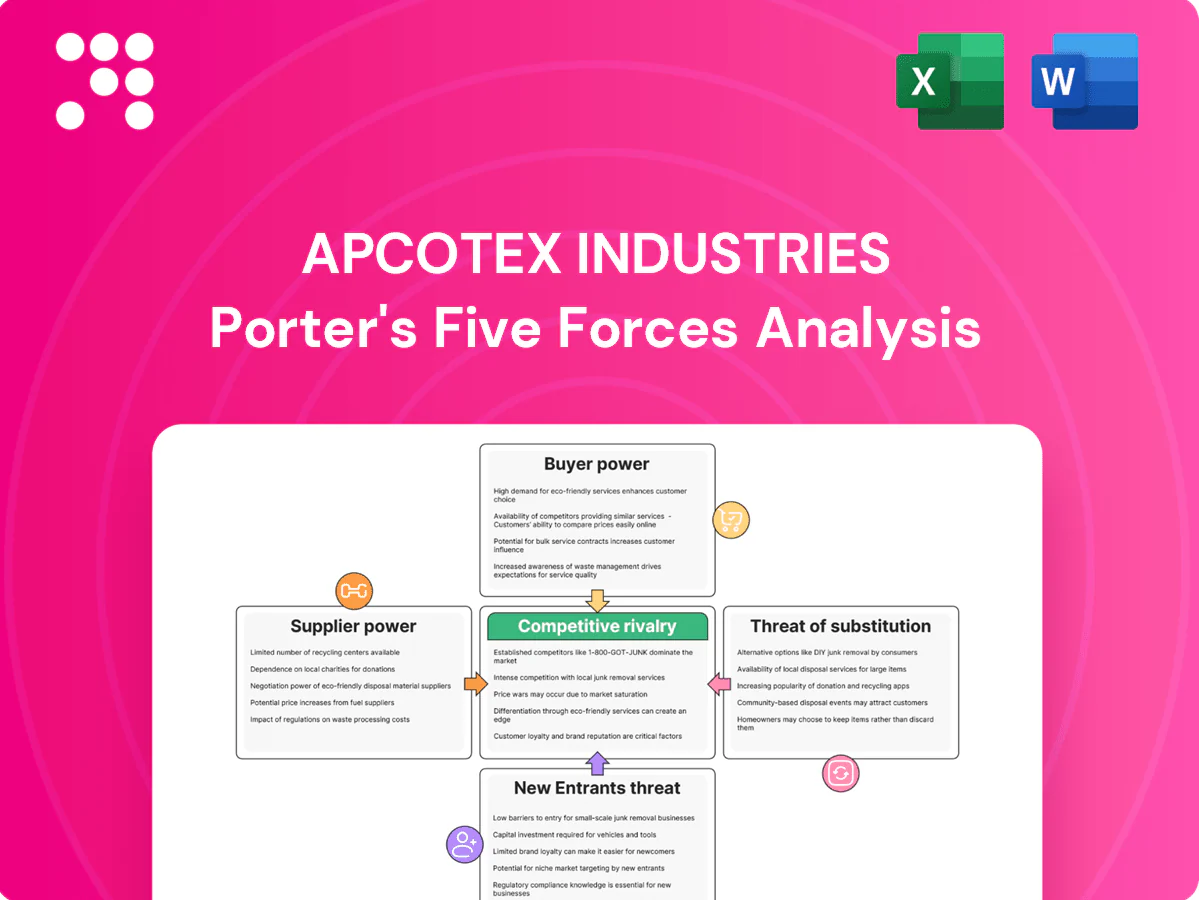
Apcotex Industries Porter's Five Forces Analysis

Go Beyond the Preview—Access the Full Strategic Report
Apcotex Industries faces moderate supplier power and concentrated buyer segments, while substitutes and regulatory shifts heighten strategic risk; rivalry among specialty polymer makers remains intense. This snapshot highlights key pressures shaping margins and growth. For force-by-force ratings, visuals and actionable tactics, unlock the full Porter's Five Forces Analysis to inform investment or strategic decisions.
Suppliers Bargaining Power

Petrochemical feedstock dependence
Monomers like butadiene, styrene and acrylonitrile are core inputs for Apcotex, linking feedstock costs to global petrochemical cycles and Brent crude (average ~85 USD/bbl in 2024), creating direct margin exposure. Price volatility and INR/USD swings have compressed margins episodically, with raw material spikes eroding EBITDA in cyclical months. Apcotex needs active hedging, flexible price pass-through clauses and limited backward integration keeps supplier leverage high.
Supplier concentration vs. alternatives
While multiple global and regional suppliers exist for key polymers and additives, technical specifications and logistics narrow practical sourcing options for Apcotex.
Approved-vendor lists and the need for consistent quality and certifications limit easy switching despite apparent supplier diversity.
Dual-sourcing reduces disruption risk but does not remove dependency on specialized suppliers, and long-term contracts improve reliability while carrying some price exposure.

Logistics and hazardous handling
Hazardous chemicals need specialized storage and transport, raising switching and transaction costs and often commanding a logistics premium (commonly up to 20%), which strengthens supplier leverage. Port congestion and inland logistics in India can add several days of delay, so suppliers guaranteeing timely delivery gain negotiating power. Holding buffer stocks of 1–2 months or using near-site terminals can materially offset this supplier power.

Additives and specialty chemicals
Certain emulsifiers, surfactants and specialty additives used by Apcotex have limited qualified vendors, and proprietary grades create micro-monopolies that elevate negotiation leverage for niche suppliers.
Supplier power intensified amid 2024 industry consolidation; the global specialty chemicals market was valued at about USD 713 billion in 2023, keeping niche suppliers strategically important for formulators.
Reformulation can reduce dependence but requires months of trials, scale-up and validation, increasing switching costs and timing risk for Apcotex.
- Limited vendors: higher supplier leverage
- Proprietary grades: micro-monopolies
- 2023 market size: ~USD 713B
- Reformulation: time- and cost-intensive
Sustainability and compliance constraints
- Restricted pool: fewer certified suppliers
- Premiums: higher prices for compliant inputs
- Friction: audits/documentation slow switching
- Mitigation: long‑term partnerships lower cost and risk
Feedstock tied to Brent ~85 USD/bbl; INR/USD swings raise supplier power
Core feedstock linkage to Brent (~85 USD/bbl in 2024) and volatile INR/USD drive high supplier leverage; limited qualified vendors, proprietary grades and stricter 2024 EHS/ESG rules raise switching costs. Long‑term contracts, hedging and 1–2 months buffer stock mitigate but do not eliminate power.
| Metric | Value |
|---|---|
| Brent (avg 2024) | ~85 USD/bbl |
| Specialty market (2023) | ~USD 713B |
| Logistics premium | up to 20% |
| Buffer stock | 1–2 months |
What is included in the product
 Detailed Word Document
Tailored Porter's Five Forces analysis for Apcotex Industries that uncovers key drivers of competition, supplier and buyer power, threat of new entrants and substitutes, and identifies disruptive forces and market entry barriers. Strategic commentary links these forces to pricing, profitability and defensive opportunities for investors and management.

 Customizable Excel Spreadsheet
A concise Porter's Five Forces snapshot for Apcotex Industries—clarifying supplier, buyer, rivalry, substitute, and entrant pressures to speed strategic decisions and reduce analysis friction.
Customers Bargaining Power

Diverse but concentrated end-markets
End-markets such as paper, paints, adhesives, construction and textiles include large, sophisticated buyers who extract volume discounts and contractual service levels from suppliers. Smaller buyers across these segments are typically price-takers with limited bargaining power. Apcotex’s diversified portfolio across these industries reduces exposure to any single-buyer leverage. This mix supports more stable margins despite concentrated customer negotiation pressure.
Performance and qualification needs
Product approvals, line trials and performance guarantees create meaningful switching costs for Apcotex customers but remain surmountable over time; rigorous rheology, solids content and binding-strength specs are the primary decision levers. Once a grade is qualified, supplier stickiness rises via repeat orders and reduced requalification frequency. However, widespread dual-qualification policies among major buyers preserve significant negotiating leverage.

Price sensitivity and TCO focus
Customers closely track feedstock and Brent crude movements—Brent averaged about 84 USD/bbl in 2024—and demand pass-throughs when petrochemical prices fall, pressing suppliers on price and TCO. Buyers push for value-in-use, lower coat weight and reduced defects to cut lifecycle cost. Strong service, technical support and reliable delivery can justify premiums, while commodity grades face the steepest (>10%) price pressure.

Availability of alternatives
Buyers can source imports or switch polymer families in some applications, and India remained a net importer of polymers in 2024, giving customers a credible outside option that strengthens bargaining power.
However, lead times and reformulation risks limit aggressive switching, so framework contracts with indexation are common to balance margins and supply security.
- Import availability: strengthens buyer leverage
- Reformulation risk: restrains rapid switching
- Framework contracts: indexation balances risk
Demand cyclicality
Demand cyclicality across construction, textiles, and paper shifts buyer urgency: during downturns buyers renegotiate prices and extend payment terms, while in tight markets service reliability often outweighs price. Apcotex’s operational flexibility and product mix enable it to moderate buyer leverage across cycles, preserving margins and contract continuity. This dynamic raises customer bargaining power unevenly across periods.
- Downturns: higher renegotiation pressure
- Tight markets: reliability > price
- Apcotex flexibility: moderates leverage
Large buyers win discounts; dual-qualification caps supplier leverage; Brent 84 USD/bbl, > 10%
Large industrial buyers extract volume discounts while smaller customers are price-takers; diversified end-markets reduce single-buyer risk. Switching costs from approvals create supplier stickiness but dual-qualification keeps leverage with buyers. Brent averaged about 84 USD/bbl in 2024 and commodity grades face >10% price pressure; imports and reformulation options strengthen buyer outside options.
| Metric | 2024 |
|---|---|
| Brent (avg) | 84 USD/bbl |
| Commodity price pressure | >10% |
Full Version Awaits
Apcotex Industries Porter's Five Forces Analysis
This Apcotex Industries Porter’s Five Forces analysis offers a clear assessment of competitive rivalry, supplier and buyer power, threat of substitutes, and barriers to entry. This preview shows the exact document you'll receive immediately after purchase—no surprises, no placeholders. The report is fully formatted and ready for download and use the moment you buy. Use it directly for strategy or valuation work.

Go Beyond the Preview—Access the Full Strategic Report
Apcotex Industries faces moderate supplier power and concentrated buyer segments, while substitutes and regulatory shifts heighten strategic risk; rivalry among specialty polymer makers remains intense. This snapshot highlights key pressures shaping margins and growth. For force-by-force ratings, visuals and actionable tactics, unlock the full Porter's Five Forces Analysis to inform investment or strategic decisions.
Suppliers Bargaining Power
Petrochemical feedstock dependence
Monomers like butadiene, styrene and acrylonitrile are core inputs for Apcotex, linking feedstock costs to global petrochemical cycles and Brent crude (average ~85 USD/bbl in 2024), creating direct margin exposure. Price volatility and INR/USD swings have compressed margins episodically, with raw material spikes eroding EBITDA in cyclical months. Apcotex needs active hedging, flexible price pass-through clauses and limited backward integration keeps supplier leverage high.
Supplier concentration vs. alternatives
While multiple global and regional suppliers exist for key polymers and additives, technical specifications and logistics narrow practical sourcing options for Apcotex.
Approved-vendor lists and the need for consistent quality and certifications limit easy switching despite apparent supplier diversity.
Dual-sourcing reduces disruption risk but does not remove dependency on specialized suppliers, and long-term contracts improve reliability while carrying some price exposure.
Logistics and hazardous handling
Hazardous chemicals need specialized storage and transport, raising switching and transaction costs and often commanding a logistics premium (commonly up to 20%), which strengthens supplier leverage. Port congestion and inland logistics in India can add several days of delay, so suppliers guaranteeing timely delivery gain negotiating power. Holding buffer stocks of 1–2 months or using near-site terminals can materially offset this supplier power.
Additives and specialty chemicals
Certain emulsifiers, surfactants and specialty additives used by Apcotex have limited qualified vendors, and proprietary grades create micro-monopolies that elevate negotiation leverage for niche suppliers.
Supplier power intensified amid 2024 industry consolidation; the global specialty chemicals market was valued at about USD 713 billion in 2023, keeping niche suppliers strategically important for formulators.
Reformulation can reduce dependence but requires months of trials, scale-up and validation, increasing switching costs and timing risk for Apcotex.
- Limited vendors: higher supplier leverage
- Proprietary grades: micro-monopolies
- 2023 market size: ~USD 713B
- Reformulation: time- and cost-intensive
Sustainability and compliance constraints
- Restricted pool: fewer certified suppliers
- Premiums: higher prices for compliant inputs
- Friction: audits/documentation slow switching
- Mitigation: long‑term partnerships lower cost and risk
Feedstock tied to Brent ~85 USD/bbl; INR/USD swings raise supplier power
Core feedstock linkage to Brent (~85 USD/bbl in 2024) and volatile INR/USD drive high supplier leverage; limited qualified vendors, proprietary grades and stricter 2024 EHS/ESG rules raise switching costs. Long‑term contracts, hedging and 1–2 months buffer stock mitigate but do not eliminate power.
| Metric | Value |
|---|---|
| Brent (avg 2024) | ~85 USD/bbl |
| Specialty market (2023) | ~USD 713B |
| Logistics premium | up to 20% |
| Buffer stock | 1–2 months |
What is included in the product
Detailed Word Document
Tailored Porter's Five Forces analysis for Apcotex Industries that uncovers key drivers of competition, supplier and buyer power, threat of new entrants and substitutes, and identifies disruptive forces and market entry barriers. Strategic commentary links these forces to pricing, profitability and defensive opportunities for investors and management.
Customizable Excel Spreadsheet
A concise Porter's Five Forces snapshot for Apcotex Industries—clarifying supplier, buyer, rivalry, substitute, and entrant pressures to speed strategic decisions and reduce analysis friction.
Customers Bargaining Power
Diverse but concentrated end-markets
End-markets such as paper, paints, adhesives, construction and textiles include large, sophisticated buyers who extract volume discounts and contractual service levels from suppliers. Smaller buyers across these segments are typically price-takers with limited bargaining power. Apcotex’s diversified portfolio across these industries reduces exposure to any single-buyer leverage. This mix supports more stable margins despite concentrated customer negotiation pressure.
Performance and qualification needs
Product approvals, line trials and performance guarantees create meaningful switching costs for Apcotex customers but remain surmountable over time; rigorous rheology, solids content and binding-strength specs are the primary decision levers. Once a grade is qualified, supplier stickiness rises via repeat orders and reduced requalification frequency. However, widespread dual-qualification policies among major buyers preserve significant negotiating leverage.
Price sensitivity and TCO focus
Customers closely track feedstock and Brent crude movements—Brent averaged about 84 USD/bbl in 2024—and demand pass-throughs when petrochemical prices fall, pressing suppliers on price and TCO. Buyers push for value-in-use, lower coat weight and reduced defects to cut lifecycle cost. Strong service, technical support and reliable delivery can justify premiums, while commodity grades face the steepest (>10%) price pressure.
Availability of alternatives
Buyers can source imports or switch polymer families in some applications, and India remained a net importer of polymers in 2024, giving customers a credible outside option that strengthens bargaining power.
However, lead times and reformulation risks limit aggressive switching, so framework contracts with indexation are common to balance margins and supply security.
- Import availability: strengthens buyer leverage
- Reformulation risk: restrains rapid switching
- Framework contracts: indexation balances risk
Demand cyclicality
Demand cyclicality across construction, textiles, and paper shifts buyer urgency: during downturns buyers renegotiate prices and extend payment terms, while in tight markets service reliability often outweighs price. Apcotex’s operational flexibility and product mix enable it to moderate buyer leverage across cycles, preserving margins and contract continuity. This dynamic raises customer bargaining power unevenly across periods.
- Downturns: higher renegotiation pressure
- Tight markets: reliability > price
- Apcotex flexibility: moderates leverage
Large buyers win discounts; dual-qualification caps supplier leverage; Brent 84 USD/bbl, > 10%
Large industrial buyers extract volume discounts while smaller customers are price-takers; diversified end-markets reduce single-buyer risk. Switching costs from approvals create supplier stickiness but dual-qualification keeps leverage with buyers. Brent averaged about 84 USD/bbl in 2024 and commodity grades face >10% price pressure; imports and reformulation options strengthen buyer outside options.
| Metric | 2024 |
|---|---|
| Brent (avg) | 84 USD/bbl |
| Commodity price pressure | >10% |
Full Version Awaits
Apcotex Industries Porter's Five Forces Analysis
This Apcotex Industries Porter’s Five Forces analysis offers a clear assessment of competitive rivalry, supplier and buyer power, threat of substitutes, and barriers to entry. This preview shows the exact document you'll receive immediately after purchase—no surprises, no placeholders. The report is fully formatted and ready for download and use the moment you buy. Use it directly for strategy or valuation work.
Description
Go Beyond the Preview—Access the Full Strategic Report
Apcotex Industries faces moderate supplier power and concentrated buyer segments, while substitutes and regulatory shifts heighten strategic risk; rivalry among specialty polymer makers remains intense. This snapshot highlights key pressures shaping margins and growth. For force-by-force ratings, visuals and actionable tactics, unlock the full Porter's Five Forces Analysis to inform investment or strategic decisions.
Suppliers Bargaining Power
Petrochemical feedstock dependence
Monomers like butadiene, styrene and acrylonitrile are core inputs for Apcotex, linking feedstock costs to global petrochemical cycles and Brent crude (average ~85 USD/bbl in 2024), creating direct margin exposure. Price volatility and INR/USD swings have compressed margins episodically, with raw material spikes eroding EBITDA in cyclical months. Apcotex needs active hedging, flexible price pass-through clauses and limited backward integration keeps supplier leverage high.
Supplier concentration vs. alternatives
While multiple global and regional suppliers exist for key polymers and additives, technical specifications and logistics narrow practical sourcing options for Apcotex.
Approved-vendor lists and the need for consistent quality and certifications limit easy switching despite apparent supplier diversity.
Dual-sourcing reduces disruption risk but does not remove dependency on specialized suppliers, and long-term contracts improve reliability while carrying some price exposure.
Logistics and hazardous handling
Hazardous chemicals need specialized storage and transport, raising switching and transaction costs and often commanding a logistics premium (commonly up to 20%), which strengthens supplier leverage. Port congestion and inland logistics in India can add several days of delay, so suppliers guaranteeing timely delivery gain negotiating power. Holding buffer stocks of 1–2 months or using near-site terminals can materially offset this supplier power.
Additives and specialty chemicals
Certain emulsifiers, surfactants and specialty additives used by Apcotex have limited qualified vendors, and proprietary grades create micro-monopolies that elevate negotiation leverage for niche suppliers.
Supplier power intensified amid 2024 industry consolidation; the global specialty chemicals market was valued at about USD 713 billion in 2023, keeping niche suppliers strategically important for formulators.
Reformulation can reduce dependence but requires months of trials, scale-up and validation, increasing switching costs and timing risk for Apcotex.
- Limited vendors: higher supplier leverage
- Proprietary grades: micro-monopolies
- 2023 market size: ~USD 713B
- Reformulation: time- and cost-intensive
Sustainability and compliance constraints
- Restricted pool: fewer certified suppliers
- Premiums: higher prices for compliant inputs
- Friction: audits/documentation slow switching
- Mitigation: long‑term partnerships lower cost and risk
Feedstock tied to Brent ~85 USD/bbl; INR/USD swings raise supplier power
Core feedstock linkage to Brent (~85 USD/bbl in 2024) and volatile INR/USD drive high supplier leverage; limited qualified vendors, proprietary grades and stricter 2024 EHS/ESG rules raise switching costs. Long‑term contracts, hedging and 1–2 months buffer stock mitigate but do not eliminate power.
| Metric | Value |
|---|---|
| Brent (avg 2024) | ~85 USD/bbl |
| Specialty market (2023) | ~USD 713B |
| Logistics premium | up to 20% |
| Buffer stock | 1–2 months |
What is included in the product
Detailed Word Document
Tailored Porter's Five Forces analysis for Apcotex Industries that uncovers key drivers of competition, supplier and buyer power, threat of new entrants and substitutes, and identifies disruptive forces and market entry barriers. Strategic commentary links these forces to pricing, profitability and defensive opportunities for investors and management.
Customizable Excel Spreadsheet
A concise Porter's Five Forces snapshot for Apcotex Industries—clarifying supplier, buyer, rivalry, substitute, and entrant pressures to speed strategic decisions and reduce analysis friction.
Customers Bargaining Power
Diverse but concentrated end-markets
End-markets such as paper, paints, adhesives, construction and textiles include large, sophisticated buyers who extract volume discounts and contractual service levels from suppliers. Smaller buyers across these segments are typically price-takers with limited bargaining power. Apcotex’s diversified portfolio across these industries reduces exposure to any single-buyer leverage. This mix supports more stable margins despite concentrated customer negotiation pressure.
Performance and qualification needs
Product approvals, line trials and performance guarantees create meaningful switching costs for Apcotex customers but remain surmountable over time; rigorous rheology, solids content and binding-strength specs are the primary decision levers. Once a grade is qualified, supplier stickiness rises via repeat orders and reduced requalification frequency. However, widespread dual-qualification policies among major buyers preserve significant negotiating leverage.
Price sensitivity and TCO focus
Customers closely track feedstock and Brent crude movements—Brent averaged about 84 USD/bbl in 2024—and demand pass-throughs when petrochemical prices fall, pressing suppliers on price and TCO. Buyers push for value-in-use, lower coat weight and reduced defects to cut lifecycle cost. Strong service, technical support and reliable delivery can justify premiums, while commodity grades face the steepest (>10%) price pressure.
Availability of alternatives
Buyers can source imports or switch polymer families in some applications, and India remained a net importer of polymers in 2024, giving customers a credible outside option that strengthens bargaining power.
However, lead times and reformulation risks limit aggressive switching, so framework contracts with indexation are common to balance margins and supply security.
- Import availability: strengthens buyer leverage
- Reformulation risk: restrains rapid switching
- Framework contracts: indexation balances risk
Demand cyclicality
Demand cyclicality across construction, textiles, and paper shifts buyer urgency: during downturns buyers renegotiate prices and extend payment terms, while in tight markets service reliability often outweighs price. Apcotex’s operational flexibility and product mix enable it to moderate buyer leverage across cycles, preserving margins and contract continuity. This dynamic raises customer bargaining power unevenly across periods.
- Downturns: higher renegotiation pressure
- Tight markets: reliability > price
- Apcotex flexibility: moderates leverage
Large buyers win discounts; dual-qualification caps supplier leverage; Brent 84 USD/bbl, > 10%
Large industrial buyers extract volume discounts while smaller customers are price-takers; diversified end-markets reduce single-buyer risk. Switching costs from approvals create supplier stickiness but dual-qualification keeps leverage with buyers. Brent averaged about 84 USD/bbl in 2024 and commodity grades face >10% price pressure; imports and reformulation options strengthen buyer outside options.
| Metric | 2024 |
|---|---|
| Brent (avg) | 84 USD/bbl |
| Commodity price pressure | >10% |
Full Version Awaits
Apcotex Industries Porter's Five Forces Analysis
This Apcotex Industries Porter’s Five Forces analysis offers a clear assessment of competitive rivalry, supplier and buyer power, threat of substitutes, and barriers to entry. This preview shows the exact document you'll receive immediately after purchase—no surprises, no placeholders. The report is fully formatted and ready for download and use the moment you buy. Use it directly for strategy or valuation work.











