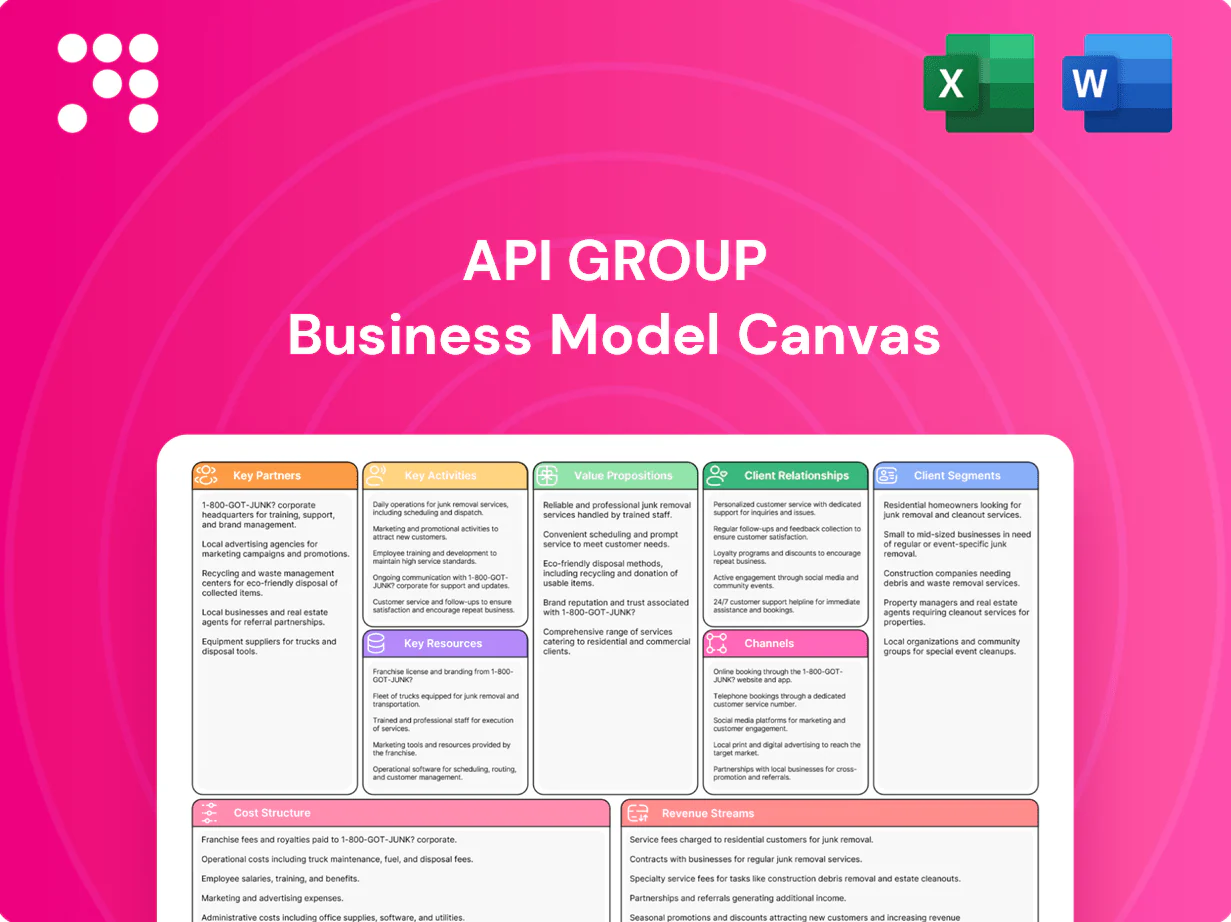
APi Group Business Model Canvas

Complete Business Model Canvas: Strategy, revenue streams, partnerships to protect and scale margins
Unlock the strategic blueprint behind APi Group with our concise Business Model Canvas — three to five sentences won’t cut it: this full version maps value propositions, key partnerships, revenue streams and cost structure to show how APi scales and protects margins. Ideal for investors, advisors and founders, the downloadable Word/Excel files make benchmarking and planning immediate. Purchase the complete canvas to put APi’s strategy to work for you.
Partnerships

OEMs and technology vendors
Partnerships with fire, security, alarm, and suppression OEMs secure certified equipment, training, and priority support, underpinning APi Group's field readiness and compliance; APi reported $10.5 billion revenue in 2024. These alliances enable access to the latest NFPA-compliant and EN-standard technologies and joint roadmaps improve system integration and lifecycle serviceability. Preferred pricing from vendors strengthens project margins across North America and Europe, enhancing competitive bids and ROI.
General contractors and EPC firms
Partnerships with general contractors and EPC firms feed APi’s installation backlog for new-builds and retrofits, typically spanning 6–18 months and supporting steady revenue recognition in 2024.
Coordinated bid teams position APi as the safety and specialty-trades leader on complex projects, improving win rates and margin capture on large EPC contracts.
Scheduling integration with GC/EPC partners reduces rework and delays, cutting change-order incidence and compressing cycle times on projects across sectors.
Multi-market collaboration extends APi’s reach into industrial, commercial, and infrastructure programs, leveraging a nationwide operating footprint to scale deployments in 2024.

Authorities Having Jurisdiction and insurers
Engagement with AHJs, code bodies, and insurers ensures compliance and smoother inspections by aligning scopes and documentation early. Early involvement de-risks permitting and accelerates occupancy approvals. Secure data sharing provides verifiable proof of maintenance and risk mitigation for underwriters. A strong compliance reputation drives higher renewal rates and referral business.

Supply chain, fabricators, and distributors
Strategic suppliers and in-house or partner fabricators stabilize lead times for pipe, valves, fittings, and specialty components, and in 2024 APi Group emphasized volume agreements to hedge inflation and component shortages; robust QC lowered field call-backs and warranty costs, supporting consistent project throughput.
- Supplier partnerships
- Volume agreements
- Regional hubs
- Quality control
Digital and monitoring partners
Alliances with monitoring centers, IoT platforms and software vendors deliver 24/7 visibility across sites, leveraging the rise to an estimated 25 billion connected devices by 2025 (Gartner) to scale monitoring and response. Integrated dashboards streamline compliance reporting for multi‑site clients and feed standardized metrics into reporting workflows. Open APIs enable direct data flows to client CMMS and co‑innovation with partners accelerates connected safety solutions.
- 24/7 visibility via monitoring partners
- Integrated dashboards for multi‑site compliance
- Open APIs → seamless CMMS integration
- Co‑innovation shortens time‑to‑market
OEM, GC/EPC and IoT alliances underpin compliance; $10.5B 2024 revenue
APi’s OEM, GC/EPC, AHJ, supplier and monitoring partnerships underwrite compliance, pipeline conversion and field readiness; APi reported $10.5 billion revenue in 2024. Strategic vendor agreements and regional hubs stabilized supply and margins, with typical new-build/retrofit backlog of 6–18 months. Monitoring and IoT alliances leverage Gartner’s ~25 billion connected devices by 2025 to scale 24/7 services.
| Metric | Value |
|---|---|
| 2024 Revenue | $10.5B |
| Backlog | 6–18 months |
| Connected devices (2025) | ~25B (Gartner) |
What is included in the product
 Detailed Word Document
A comprehensive, pre-written Business Model Canvas for APi Group detailing customer segments, channels, value propositions and the nine BMC blocks with real-world operations, competitive advantages and linked SWOT analysis—ideal for presentations, funding discussions and strategic decisions by entrepreneurs, analysts and investors.

 Customizable Excel Spreadsheet
Condenses APi Group's complex infrastructure services and fragmented project workflows into a clean, editable one-page canvas that saves hours of coordination, clarifies responsibilities, and accelerates decision-making across teams.
Activities

Design, engineering, and installation
End-to-end delivery covers design through commissioning for fire, life-safety, and specialty systems, with teams engineering to NFPA, EN, and applicable local codes (2024 editions). BIM and prefabrication compress schedules by 20–50% and improve installation quality and predictability. Prefab reduces on-site labor and rework while BIM coordinates clashes and documentation. Commissioning validates performance and documentation and can cut energy use and operating issues—DOE reports average energy savings of ~16% from commissioning.
Inspection, testing, and maintenance
Recurring ITM services keep assets compliant and reliable, aligning with ISO 9001 and regulatory audit requirements. Route-based technicians execute standardized procedures to ensure consistency across sites. Digital forms and photos create tamper-evident audit trails stored in centralized CMMS. Findings trigger corrective work orders and customer quotes for remediation and CAPEX planning.

Emergency service and repairs
24/7 dispatch addresses impairments and failures, ensuring crews are mobilized any hour. Stocked vans and regional parts hubs cut repair cycles by enabling immediate parts access. Temporary measures maintain protection until permanent fixes are completed. Rapid response upholds SLAs and drives customer retention.

Project management and fabrication
PM teams coordinate trades, materials, and site access to streamline sequencing and reduce delays, while shop fabrication raises consistency, safety, and cost predictability by shifting work to controlled environments. Kitting and just-in-time delivery cut on-site waste and inventory holding, and earned value tracking provides real-time cost/schedule visibility to keep projects on budget.
- PM coordination: trades, materials, access
- Shop fabrication: consistency, safety, cost control
- Kitting/JIT: waste and inventory reduction
- Earned value: real-time budget control
M&A integration and compliance management
Ongoing tuck-ins expand APi's footprint and capabilities through targeted acquisitions that close capability gaps and enter new geographies. Integration standardizes processes, safety protocols and IT systems to reduce variance and speed cross-selling. Central compliance teams handle credentials, licenses and training; synergies in 2024 supported higher service density alongside $11.6B revenue and ~70,000 employees.
- tuck-ins expand reach
- standardized safety & systems
- centralized credentials & training
- synergies boost margins & density
BIM+Prefab cut schedules 20–50%, save ~16% energy
End-to-end delivery (design→commissioning) uses BIM and prefabrication to cut schedules 20–50% and commissioning yields ~16% energy savings (DOE). Recurring ITM, CMMS and 24/7 dispatch ensure compliance, rapid repairs and SLA adherence. PM, kitting and tuck-ins drive cost predictability, service density and cross-sell across $11.6B revenue and ~70,000 employees.
| Activity | KPI/Stat | 2024 Value |
|---|---|---|
| BIM / Prefab | Schedule compression | 20–50% |
| Commissioning | Avg energy savings (DOE) | ~16% |
| Scale | Revenue / Employees | $11.6B / ~70,000 |
Preview Before You Purchase
Business Model Canvas
The APi Group Business Model Canvas you see here is the actual deliverable, not a mockup; it accurately reflects the complete document you’ll receive after purchase. When you buy, you’ll download this same file—fully formatted and editable in Word and Excel. No placeholders, no surprises—just the ready-to-use canvas for immediate application.

Complete Business Model Canvas: Strategy, revenue streams, partnerships to protect and scale margins
Unlock the strategic blueprint behind APi Group with our concise Business Model Canvas — three to five sentences won’t cut it: this full version maps value propositions, key partnerships, revenue streams and cost structure to show how APi scales and protects margins. Ideal for investors, advisors and founders, the downloadable Word/Excel files make benchmarking and planning immediate. Purchase the complete canvas to put APi’s strategy to work for you.
Partnerships
OEMs and technology vendors
Partnerships with fire, security, alarm, and suppression OEMs secure certified equipment, training, and priority support, underpinning APi Group's field readiness and compliance; APi reported $10.5 billion revenue in 2024. These alliances enable access to the latest NFPA-compliant and EN-standard technologies and joint roadmaps improve system integration and lifecycle serviceability. Preferred pricing from vendors strengthens project margins across North America and Europe, enhancing competitive bids and ROI.
General contractors and EPC firms
Partnerships with general contractors and EPC firms feed APi’s installation backlog for new-builds and retrofits, typically spanning 6–18 months and supporting steady revenue recognition in 2024.
Coordinated bid teams position APi as the safety and specialty-trades leader on complex projects, improving win rates and margin capture on large EPC contracts.
Scheduling integration with GC/EPC partners reduces rework and delays, cutting change-order incidence and compressing cycle times on projects across sectors.
Multi-market collaboration extends APi’s reach into industrial, commercial, and infrastructure programs, leveraging a nationwide operating footprint to scale deployments in 2024.
Authorities Having Jurisdiction and insurers
Engagement with AHJs, code bodies, and insurers ensures compliance and smoother inspections by aligning scopes and documentation early. Early involvement de-risks permitting and accelerates occupancy approvals. Secure data sharing provides verifiable proof of maintenance and risk mitigation for underwriters. A strong compliance reputation drives higher renewal rates and referral business.
Supply chain, fabricators, and distributors
Strategic suppliers and in-house or partner fabricators stabilize lead times for pipe, valves, fittings, and specialty components, and in 2024 APi Group emphasized volume agreements to hedge inflation and component shortages; robust QC lowered field call-backs and warranty costs, supporting consistent project throughput.
- Supplier partnerships
- Volume agreements
- Regional hubs
- Quality control
Digital and monitoring partners
Alliances with monitoring centers, IoT platforms and software vendors deliver 24/7 visibility across sites, leveraging the rise to an estimated 25 billion connected devices by 2025 (Gartner) to scale monitoring and response. Integrated dashboards streamline compliance reporting for multi‑site clients and feed standardized metrics into reporting workflows. Open APIs enable direct data flows to client CMMS and co‑innovation with partners accelerates connected safety solutions.
- 24/7 visibility via monitoring partners
- Integrated dashboards for multi‑site compliance
- Open APIs → seamless CMMS integration
- Co‑innovation shortens time‑to‑market
OEM, GC/EPC and IoT alliances underpin compliance; $10.5B 2024 revenue
APi’s OEM, GC/EPC, AHJ, supplier and monitoring partnerships underwrite compliance, pipeline conversion and field readiness; APi reported $10.5 billion revenue in 2024. Strategic vendor agreements and regional hubs stabilized supply and margins, with typical new-build/retrofit backlog of 6–18 months. Monitoring and IoT alliances leverage Gartner’s ~25 billion connected devices by 2025 to scale 24/7 services.
| Metric | Value |
|---|---|
| 2024 Revenue | $10.5B |
| Backlog | 6–18 months |
| Connected devices (2025) | ~25B (Gartner) |
What is included in the product
Detailed Word Document
A comprehensive, pre-written Business Model Canvas for APi Group detailing customer segments, channels, value propositions and the nine BMC blocks with real-world operations, competitive advantages and linked SWOT analysis—ideal for presentations, funding discussions and strategic decisions by entrepreneurs, analysts and investors.
Customizable Excel Spreadsheet
Condenses APi Group's complex infrastructure services and fragmented project workflows into a clean, editable one-page canvas that saves hours of coordination, clarifies responsibilities, and accelerates decision-making across teams.
Activities
Design, engineering, and installation
End-to-end delivery covers design through commissioning for fire, life-safety, and specialty systems, with teams engineering to NFPA, EN, and applicable local codes (2024 editions). BIM and prefabrication compress schedules by 20–50% and improve installation quality and predictability. Prefab reduces on-site labor and rework while BIM coordinates clashes and documentation. Commissioning validates performance and documentation and can cut energy use and operating issues—DOE reports average energy savings of ~16% from commissioning.
Inspection, testing, and maintenance
Recurring ITM services keep assets compliant and reliable, aligning with ISO 9001 and regulatory audit requirements. Route-based technicians execute standardized procedures to ensure consistency across sites. Digital forms and photos create tamper-evident audit trails stored in centralized CMMS. Findings trigger corrective work orders and customer quotes for remediation and CAPEX planning.
Emergency service and repairs
24/7 dispatch addresses impairments and failures, ensuring crews are mobilized any hour. Stocked vans and regional parts hubs cut repair cycles by enabling immediate parts access. Temporary measures maintain protection until permanent fixes are completed. Rapid response upholds SLAs and drives customer retention.
Project management and fabrication
PM teams coordinate trades, materials, and site access to streamline sequencing and reduce delays, while shop fabrication raises consistency, safety, and cost predictability by shifting work to controlled environments. Kitting and just-in-time delivery cut on-site waste and inventory holding, and earned value tracking provides real-time cost/schedule visibility to keep projects on budget.
- PM coordination: trades, materials, access
- Shop fabrication: consistency, safety, cost control
- Kitting/JIT: waste and inventory reduction
- Earned value: real-time budget control
M&A integration and compliance management
Ongoing tuck-ins expand APi's footprint and capabilities through targeted acquisitions that close capability gaps and enter new geographies. Integration standardizes processes, safety protocols and IT systems to reduce variance and speed cross-selling. Central compliance teams handle credentials, licenses and training; synergies in 2024 supported higher service density alongside $11.6B revenue and ~70,000 employees.
- tuck-ins expand reach
- standardized safety & systems
- centralized credentials & training
- synergies boost margins & density
BIM+Prefab cut schedules 20–50%, save ~16% energy
End-to-end delivery (design→commissioning) uses BIM and prefabrication to cut schedules 20–50% and commissioning yields ~16% energy savings (DOE). Recurring ITM, CMMS and 24/7 dispatch ensure compliance, rapid repairs and SLA adherence. PM, kitting and tuck-ins drive cost predictability, service density and cross-sell across $11.6B revenue and ~70,000 employees.
| Activity | KPI/Stat | 2024 Value |
|---|---|---|
| BIM / Prefab | Schedule compression | 20–50% |
| Commissioning | Avg energy savings (DOE) | ~16% |
| Scale | Revenue / Employees | $11.6B / ~70,000 |
Preview Before You Purchase
Business Model Canvas
The APi Group Business Model Canvas you see here is the actual deliverable, not a mockup; it accurately reflects the complete document you’ll receive after purchase. When you buy, you’ll download this same file—fully formatted and editable in Word and Excel. No placeholders, no surprises—just the ready-to-use canvas for immediate application.
Original: $10.00
-65%$10.00
$3.50Description
Complete Business Model Canvas: Strategy, revenue streams, partnerships to protect and scale margins
Unlock the strategic blueprint behind APi Group with our concise Business Model Canvas — three to five sentences won’t cut it: this full version maps value propositions, key partnerships, revenue streams and cost structure to show how APi scales and protects margins. Ideal for investors, advisors and founders, the downloadable Word/Excel files make benchmarking and planning immediate. Purchase the complete canvas to put APi’s strategy to work for you.
Partnerships
OEMs and technology vendors
Partnerships with fire, security, alarm, and suppression OEMs secure certified equipment, training, and priority support, underpinning APi Group's field readiness and compliance; APi reported $10.5 billion revenue in 2024. These alliances enable access to the latest NFPA-compliant and EN-standard technologies and joint roadmaps improve system integration and lifecycle serviceability. Preferred pricing from vendors strengthens project margins across North America and Europe, enhancing competitive bids and ROI.
General contractors and EPC firms
Partnerships with general contractors and EPC firms feed APi’s installation backlog for new-builds and retrofits, typically spanning 6–18 months and supporting steady revenue recognition in 2024.
Coordinated bid teams position APi as the safety and specialty-trades leader on complex projects, improving win rates and margin capture on large EPC contracts.
Scheduling integration with GC/EPC partners reduces rework and delays, cutting change-order incidence and compressing cycle times on projects across sectors.
Multi-market collaboration extends APi’s reach into industrial, commercial, and infrastructure programs, leveraging a nationwide operating footprint to scale deployments in 2024.
Authorities Having Jurisdiction and insurers
Engagement with AHJs, code bodies, and insurers ensures compliance and smoother inspections by aligning scopes and documentation early. Early involvement de-risks permitting and accelerates occupancy approvals. Secure data sharing provides verifiable proof of maintenance and risk mitigation for underwriters. A strong compliance reputation drives higher renewal rates and referral business.
Supply chain, fabricators, and distributors
Strategic suppliers and in-house or partner fabricators stabilize lead times for pipe, valves, fittings, and specialty components, and in 2024 APi Group emphasized volume agreements to hedge inflation and component shortages; robust QC lowered field call-backs and warranty costs, supporting consistent project throughput.
- Supplier partnerships
- Volume agreements
- Regional hubs
- Quality control
Digital and monitoring partners
Alliances with monitoring centers, IoT platforms and software vendors deliver 24/7 visibility across sites, leveraging the rise to an estimated 25 billion connected devices by 2025 (Gartner) to scale monitoring and response. Integrated dashboards streamline compliance reporting for multi‑site clients and feed standardized metrics into reporting workflows. Open APIs enable direct data flows to client CMMS and co‑innovation with partners accelerates connected safety solutions.
- 24/7 visibility via monitoring partners
- Integrated dashboards for multi‑site compliance
- Open APIs → seamless CMMS integration
- Co‑innovation shortens time‑to‑market
OEM, GC/EPC and IoT alliances underpin compliance; $10.5B 2024 revenue
APi’s OEM, GC/EPC, AHJ, supplier and monitoring partnerships underwrite compliance, pipeline conversion and field readiness; APi reported $10.5 billion revenue in 2024. Strategic vendor agreements and regional hubs stabilized supply and margins, with typical new-build/retrofit backlog of 6–18 months. Monitoring and IoT alliances leverage Gartner’s ~25 billion connected devices by 2025 to scale 24/7 services.
| Metric | Value |
|---|---|
| 2024 Revenue | $10.5B |
| Backlog | 6–18 months |
| Connected devices (2025) | ~25B (Gartner) |
What is included in the product
Detailed Word Document
A comprehensive, pre-written Business Model Canvas for APi Group detailing customer segments, channels, value propositions and the nine BMC blocks with real-world operations, competitive advantages and linked SWOT analysis—ideal for presentations, funding discussions and strategic decisions by entrepreneurs, analysts and investors.
Customizable Excel Spreadsheet
Condenses APi Group's complex infrastructure services and fragmented project workflows into a clean, editable one-page canvas that saves hours of coordination, clarifies responsibilities, and accelerates decision-making across teams.
Activities
Design, engineering, and installation
End-to-end delivery covers design through commissioning for fire, life-safety, and specialty systems, with teams engineering to NFPA, EN, and applicable local codes (2024 editions). BIM and prefabrication compress schedules by 20–50% and improve installation quality and predictability. Prefab reduces on-site labor and rework while BIM coordinates clashes and documentation. Commissioning validates performance and documentation and can cut energy use and operating issues—DOE reports average energy savings of ~16% from commissioning.
Inspection, testing, and maintenance
Recurring ITM services keep assets compliant and reliable, aligning with ISO 9001 and regulatory audit requirements. Route-based technicians execute standardized procedures to ensure consistency across sites. Digital forms and photos create tamper-evident audit trails stored in centralized CMMS. Findings trigger corrective work orders and customer quotes for remediation and CAPEX planning.
Emergency service and repairs
24/7 dispatch addresses impairments and failures, ensuring crews are mobilized any hour. Stocked vans and regional parts hubs cut repair cycles by enabling immediate parts access. Temporary measures maintain protection until permanent fixes are completed. Rapid response upholds SLAs and drives customer retention.
Project management and fabrication
PM teams coordinate trades, materials, and site access to streamline sequencing and reduce delays, while shop fabrication raises consistency, safety, and cost predictability by shifting work to controlled environments. Kitting and just-in-time delivery cut on-site waste and inventory holding, and earned value tracking provides real-time cost/schedule visibility to keep projects on budget.
- PM coordination: trades, materials, access
- Shop fabrication: consistency, safety, cost control
- Kitting/JIT: waste and inventory reduction
- Earned value: real-time budget control
M&A integration and compliance management
Ongoing tuck-ins expand APi's footprint and capabilities through targeted acquisitions that close capability gaps and enter new geographies. Integration standardizes processes, safety protocols and IT systems to reduce variance and speed cross-selling. Central compliance teams handle credentials, licenses and training; synergies in 2024 supported higher service density alongside $11.6B revenue and ~70,000 employees.
- tuck-ins expand reach
- standardized safety & systems
- centralized credentials & training
- synergies boost margins & density
BIM+Prefab cut schedules 20–50%, save ~16% energy
End-to-end delivery (design→commissioning) uses BIM and prefabrication to cut schedules 20–50% and commissioning yields ~16% energy savings (DOE). Recurring ITM, CMMS and 24/7 dispatch ensure compliance, rapid repairs and SLA adherence. PM, kitting and tuck-ins drive cost predictability, service density and cross-sell across $11.6B revenue and ~70,000 employees.
| Activity | KPI/Stat | 2024 Value |
|---|---|---|
| BIM / Prefab | Schedule compression | 20–50% |
| Commissioning | Avg energy savings (DOE) | ~16% |
| Scale | Revenue / Employees | $11.6B / ~70,000 |
Preview Before You Purchase
Business Model Canvas
The APi Group Business Model Canvas you see here is the actual deliverable, not a mockup; it accurately reflects the complete document you’ll receive after purchase. When you buy, you’ll download this same file—fully formatted and editable in Word and Excel. No placeholders, no surprises—just the ready-to-use canvas for immediate application.











