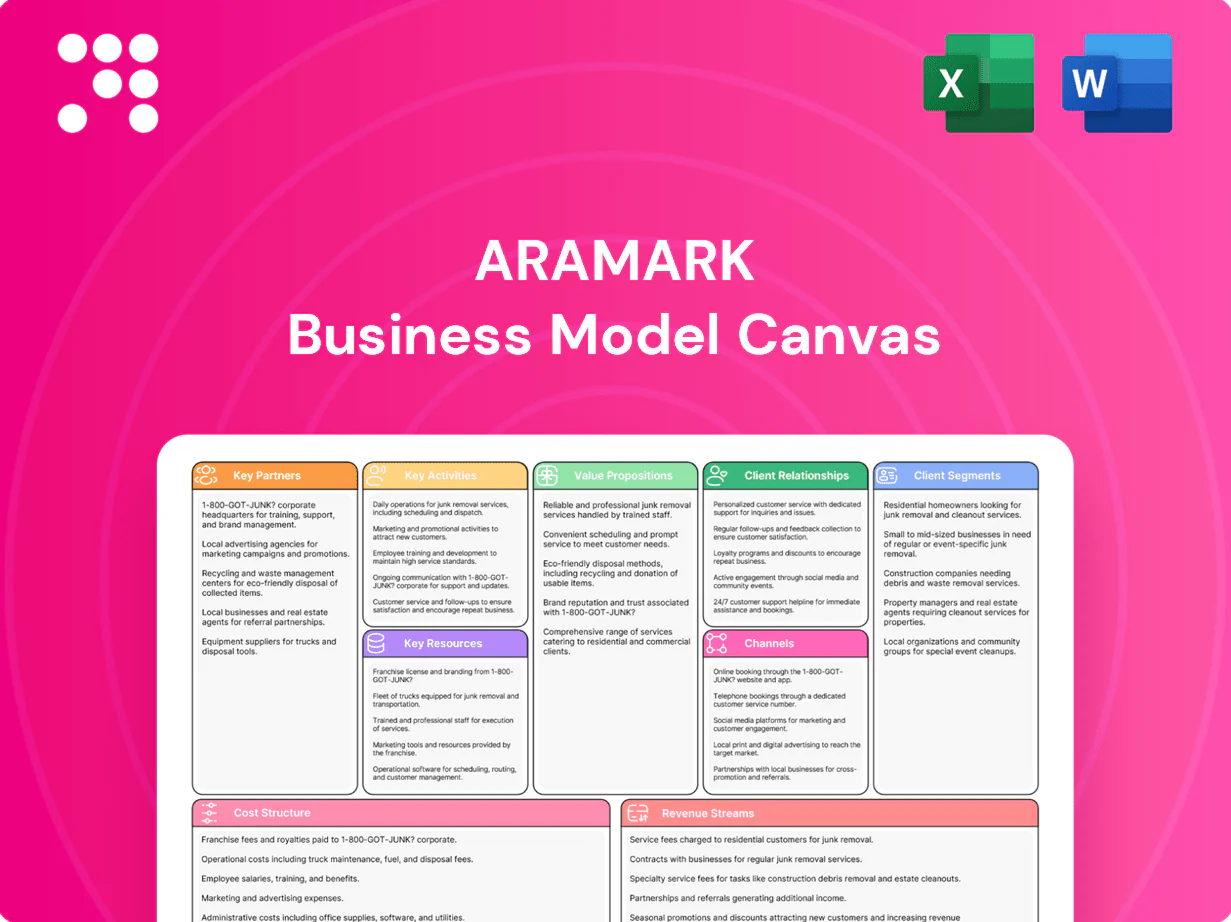
Aramark Business Model Canvas

Unlock the strategic Business Model Canvas for food services, facilities, and uniform solutions
Unlock the full strategic blueprint behind Aramark's business model. This in-depth Business Model Canvas reveals how the company drives value, scales operations, and sustains competitive advantage across food services, facilities and uniform solutions. Ideal for investors, consultants, and founders—download the editable Word & Excel canvases to benchmark strategy and accelerate decisions.
Partnerships

Global food and beverage suppliers
Large global distributors and manufacturers secure consistent ingredient quality, availability and pricing across regions for Aramark, whose network spans about 19 countries and reported $16.1 billion revenue in 2023; category partnerships cover staples, specialty items and beverages to manage roughly three core purchasing categories. Supplier scorecards and audits enforce food safety and ESG alignment, while strategic volumes unlock rebates and early access to supplier-led innovation.
Technology and systems vendors
POS, ordering, workforce and ERP platforms underpin Aramark operations and analytics, supporting a multinational workforce of roughly 200,000 and a multi-billion-dollar services business; integrations enable mobile ordering, kiosks, delivery and cashless payments—driving digital transaction mixes often exceeding 30% in high-volume sites. IoT and CMMS partners target >95% facilities uptime and lower preventive maintenance costs, while cybersecurity and data partners protect sensitive client data and compliance.

Venue, campus, and healthcare systems
Anchor clients such as stadiums, universities, and health systems act as co-creators of service models and menus, shaping on-site offerings and operational standards. Exclusive rights agreements at arenas and stadiums tie revenue directly to attendance, while university and hospital partnerships in 2024 emphasized wellness, nutrition, and patient satisfaction metrics. Joint marketing with these partners amplifies Aramark’s brand presence on-site and drives incremental sales.

Uniform and laundry ecosystem partners
Uniform and laundry ecosystem partners deliver durable textiles and 24–48 hour turnaround through global laundry networks; 2024 pilots report RFID reduces inventory errors up to 50% and loss by ~30%. Chemical and water-efficiency partners cut water use by ~30–40% and lower processing costs; compliance vendors ensure adherence to hygiene standards and avoid regulatory fines.
- Textile manufacturers: durability, lifecycle cost
- RFID/tracking: -50% errors, -30% losses
- Chemical/water partners: -30–40% water use
- Compliance vendors: hygiene & safety assurance
Local producers and sustainability partners
- Local sourcing: boosts community impact and diversity spend
- Waste partners: lower landfill and disposal costs
- Advisors: set carbon, energy, water targets
- Certifications: third-party validation of ESG gains
Global supply in 19 countries, IoT uptime > 95%, pilots cut errors 50%
Large global suppliers ensure consistent ingredients across 19 countries supporting Aramark’s $16.1B 2023 revenue; tech, POS and IoT partners back ~200,000 staff and >95% facilities uptime. Anchor clients co-create services; laundry/RFID pilots cut errors 50% and losses 30%. Water/chemical partners reduce use 30–40% and advance ESG targets.
| Partner | KPI | Impact |
|---|---|---|
| Suppliers | Global coverage | Consistent pricing/quality |
| Tech/IoT | Uptime >95% | Operational continuity |
| RFID/Laundry | -50% errors | -30% loss |
| Water/Chem | -30–40% water | Lower cost, ESG |
What is included in the product
 Detailed Word Document
A comprehensive Business Model Canvas for Aramark detailing customer segments, value propositions, channels, revenue streams, key partners, activities, resources, cost structure and governance—reflecting real-world foodservice, facilities and uniform services operations. Designed for presentations and investor discussions, it includes competitive advantages and linked SWOT insights to support strategy and decision-making.

 Customizable Excel Spreadsheet
High-level, editable one-page canvas that pinpoints Aramark’s operational pain points and streamlines solutions across catering, facilities, and uniform services for faster decision-making and implementation.
Activities

Contract dining and catering operations
Menu planning, production and service across cafeterias, retail and catering support Aramark’s contract dining operations, underpinning its $17.2B 2024 revenue and 275,000-strong workforce; centralized planning ensures consistency and cost control. Demand forecasting balances freshness and waste, targeting ~15% waste reduction. Event execution scales from box lunches to premium hospitality, while continuous feedback loops refine offerings and margins.
Comprehensive facilities management
Comprehensive facilities management—cleaning, maintenance, HVAC, grounds and energy services—keeps sites efficient and supported Aramark’s operations in FY2024 (revenue $17.4 billion). Preventive schedules cut unplanned downtime by up to 40% and extend asset life. Strict regulatory and safety protocols drive compliance and reduce penalties. Performance dashboards track SLAs and KPIs, boosting SLA adherence ~20% and enabling 10–25% energy savings.

Procurement and supply chain orchestration
Sourcing, contracting and logistics coordinate multi-site delivery across Aramark’s network that serves about 2 billion meals annually, enabling scale and supplier leverage. Robust inventory and waste management protect margins by cutting spoilage and shrink. Cold-chain protocols and traceability systems preserve quality and safety across perishables. Active supplier risk management ensures continuity amid supply shocks.

Workforce recruiting, training, and scheduling
- Hiring: culinary, service, technical
- Training: standardized safety & SOPs
- Scheduling: demand-driven labor planning
- Retention: engagement programs to lower turnover
Quality assurance, compliance, and analytics
- HACCP: >95% compliance
- Reporting: NPS, cost & outcomes tracked
- Analytics: 2–4% cost/labor gains (2024)
- CI: margin and experience focus
2B meals, $17.4B, ~15% waste, 10–25% energy
Menu planning, production and service run 2B meals, supporting $17.4B revenue and ~280,000 staff in 2024, targeting ~15% waste cuts and 2–4% menu/labor gains.
Facilities and preventive maintenance reduce unplanned downtime ~40%, improve SLA adherence ~20% and enable 10–25% energy savings.
Sourcing, cold-chain, QA/HACCP (>95% compliance) and analytics secure supply, safety and margin resilience.
| Metric | 2024 |
|---|---|
| Revenue | $17.4B |
| Meals | 2B |
| Employees | 280,000 |
| Waste reduction | ~15% |
| HACCP | >95% |
What You See Is What You Get
Business Model Canvas
The Aramark Business Model Canvas preview shown here is the actual deliverable, not a mockup. When you complete your purchase you’ll receive this exact document—fully formatted and editable—ready for presentation, analysis, or customization. No surprises; what you see is what you get.

Unlock the strategic Business Model Canvas for food services, facilities, and uniform solutions
Unlock the full strategic blueprint behind Aramark's business model. This in-depth Business Model Canvas reveals how the company drives value, scales operations, and sustains competitive advantage across food services, facilities and uniform solutions. Ideal for investors, consultants, and founders—download the editable Word & Excel canvases to benchmark strategy and accelerate decisions.
Partnerships
Global food and beverage suppliers
Large global distributors and manufacturers secure consistent ingredient quality, availability and pricing across regions for Aramark, whose network spans about 19 countries and reported $16.1 billion revenue in 2023; category partnerships cover staples, specialty items and beverages to manage roughly three core purchasing categories. Supplier scorecards and audits enforce food safety and ESG alignment, while strategic volumes unlock rebates and early access to supplier-led innovation.
Technology and systems vendors
POS, ordering, workforce and ERP platforms underpin Aramark operations and analytics, supporting a multinational workforce of roughly 200,000 and a multi-billion-dollar services business; integrations enable mobile ordering, kiosks, delivery and cashless payments—driving digital transaction mixes often exceeding 30% in high-volume sites. IoT and CMMS partners target >95% facilities uptime and lower preventive maintenance costs, while cybersecurity and data partners protect sensitive client data and compliance.
Venue, campus, and healthcare systems
Anchor clients such as stadiums, universities, and health systems act as co-creators of service models and menus, shaping on-site offerings and operational standards. Exclusive rights agreements at arenas and stadiums tie revenue directly to attendance, while university and hospital partnerships in 2024 emphasized wellness, nutrition, and patient satisfaction metrics. Joint marketing with these partners amplifies Aramark’s brand presence on-site and drives incremental sales.
Uniform and laundry ecosystem partners
Uniform and laundry ecosystem partners deliver durable textiles and 24–48 hour turnaround through global laundry networks; 2024 pilots report RFID reduces inventory errors up to 50% and loss by ~30%. Chemical and water-efficiency partners cut water use by ~30–40% and lower processing costs; compliance vendors ensure adherence to hygiene standards and avoid regulatory fines.
- Textile manufacturers: durability, lifecycle cost
- RFID/tracking: -50% errors, -30% losses
- Chemical/water partners: -30–40% water use
- Compliance vendors: hygiene & safety assurance
Local producers and sustainability partners
- Local sourcing: boosts community impact and diversity spend
- Waste partners: lower landfill and disposal costs
- Advisors: set carbon, energy, water targets
- Certifications: third-party validation of ESG gains
Global supply in 19 countries, IoT uptime > 95%, pilots cut errors 50%
Large global suppliers ensure consistent ingredients across 19 countries supporting Aramark’s $16.1B 2023 revenue; tech, POS and IoT partners back ~200,000 staff and >95% facilities uptime. Anchor clients co-create services; laundry/RFID pilots cut errors 50% and losses 30%. Water/chemical partners reduce use 30–40% and advance ESG targets.
| Partner | KPI | Impact |
|---|---|---|
| Suppliers | Global coverage | Consistent pricing/quality |
| Tech/IoT | Uptime >95% | Operational continuity |
| RFID/Laundry | -50% errors | -30% loss |
| Water/Chem | -30–40% water | Lower cost, ESG |
What is included in the product
Detailed Word Document
A comprehensive Business Model Canvas for Aramark detailing customer segments, value propositions, channels, revenue streams, key partners, activities, resources, cost structure and governance—reflecting real-world foodservice, facilities and uniform services operations. Designed for presentations and investor discussions, it includes competitive advantages and linked SWOT insights to support strategy and decision-making.
Customizable Excel Spreadsheet
High-level, editable one-page canvas that pinpoints Aramark’s operational pain points and streamlines solutions across catering, facilities, and uniform services for faster decision-making and implementation.
Activities
Contract dining and catering operations
Menu planning, production and service across cafeterias, retail and catering support Aramark’s contract dining operations, underpinning its $17.2B 2024 revenue and 275,000-strong workforce; centralized planning ensures consistency and cost control. Demand forecasting balances freshness and waste, targeting ~15% waste reduction. Event execution scales from box lunches to premium hospitality, while continuous feedback loops refine offerings and margins.
Comprehensive facilities management
Comprehensive facilities management—cleaning, maintenance, HVAC, grounds and energy services—keeps sites efficient and supported Aramark’s operations in FY2024 (revenue $17.4 billion). Preventive schedules cut unplanned downtime by up to 40% and extend asset life. Strict regulatory and safety protocols drive compliance and reduce penalties. Performance dashboards track SLAs and KPIs, boosting SLA adherence ~20% and enabling 10–25% energy savings.
Procurement and supply chain orchestration
Sourcing, contracting and logistics coordinate multi-site delivery across Aramark’s network that serves about 2 billion meals annually, enabling scale and supplier leverage. Robust inventory and waste management protect margins by cutting spoilage and shrink. Cold-chain protocols and traceability systems preserve quality and safety across perishables. Active supplier risk management ensures continuity amid supply shocks.
Workforce recruiting, training, and scheduling
- Hiring: culinary, service, technical
- Training: standardized safety & SOPs
- Scheduling: demand-driven labor planning
- Retention: engagement programs to lower turnover
Quality assurance, compliance, and analytics
- HACCP: >95% compliance
- Reporting: NPS, cost & outcomes tracked
- Analytics: 2–4% cost/labor gains (2024)
- CI: margin and experience focus
2B meals, $17.4B, ~15% waste, 10–25% energy
Menu planning, production and service run 2B meals, supporting $17.4B revenue and ~280,000 staff in 2024, targeting ~15% waste cuts and 2–4% menu/labor gains.
Facilities and preventive maintenance reduce unplanned downtime ~40%, improve SLA adherence ~20% and enable 10–25% energy savings.
Sourcing, cold-chain, QA/HACCP (>95% compliance) and analytics secure supply, safety and margin resilience.
| Metric | 2024 |
|---|---|
| Revenue | $17.4B |
| Meals | 2B |
| Employees | 280,000 |
| Waste reduction | ~15% |
| HACCP | >95% |
What You See Is What You Get
Business Model Canvas
The Aramark Business Model Canvas preview shown here is the actual deliverable, not a mockup. When you complete your purchase you’ll receive this exact document—fully formatted and editable—ready for presentation, analysis, or customization. No surprises; what you see is what you get.
Description
Unlock the strategic Business Model Canvas for food services, facilities, and uniform solutions
Unlock the full strategic blueprint behind Aramark's business model. This in-depth Business Model Canvas reveals how the company drives value, scales operations, and sustains competitive advantage across food services, facilities and uniform solutions. Ideal for investors, consultants, and founders—download the editable Word & Excel canvases to benchmark strategy and accelerate decisions.
Partnerships
Global food and beverage suppliers
Large global distributors and manufacturers secure consistent ingredient quality, availability and pricing across regions for Aramark, whose network spans about 19 countries and reported $16.1 billion revenue in 2023; category partnerships cover staples, specialty items and beverages to manage roughly three core purchasing categories. Supplier scorecards and audits enforce food safety and ESG alignment, while strategic volumes unlock rebates and early access to supplier-led innovation.
Technology and systems vendors
POS, ordering, workforce and ERP platforms underpin Aramark operations and analytics, supporting a multinational workforce of roughly 200,000 and a multi-billion-dollar services business; integrations enable mobile ordering, kiosks, delivery and cashless payments—driving digital transaction mixes often exceeding 30% in high-volume sites. IoT and CMMS partners target >95% facilities uptime and lower preventive maintenance costs, while cybersecurity and data partners protect sensitive client data and compliance.
Venue, campus, and healthcare systems
Anchor clients such as stadiums, universities, and health systems act as co-creators of service models and menus, shaping on-site offerings and operational standards. Exclusive rights agreements at arenas and stadiums tie revenue directly to attendance, while university and hospital partnerships in 2024 emphasized wellness, nutrition, and patient satisfaction metrics. Joint marketing with these partners amplifies Aramark’s brand presence on-site and drives incremental sales.
Uniform and laundry ecosystem partners
Uniform and laundry ecosystem partners deliver durable textiles and 24–48 hour turnaround through global laundry networks; 2024 pilots report RFID reduces inventory errors up to 50% and loss by ~30%. Chemical and water-efficiency partners cut water use by ~30–40% and lower processing costs; compliance vendors ensure adherence to hygiene standards and avoid regulatory fines.
- Textile manufacturers: durability, lifecycle cost
- RFID/tracking: -50% errors, -30% losses
- Chemical/water partners: -30–40% water use
- Compliance vendors: hygiene & safety assurance
Local producers and sustainability partners
- Local sourcing: boosts community impact and diversity spend
- Waste partners: lower landfill and disposal costs
- Advisors: set carbon, energy, water targets
- Certifications: third-party validation of ESG gains
Global supply in 19 countries, IoT uptime > 95%, pilots cut errors 50%
Large global suppliers ensure consistent ingredients across 19 countries supporting Aramark’s $16.1B 2023 revenue; tech, POS and IoT partners back ~200,000 staff and >95% facilities uptime. Anchor clients co-create services; laundry/RFID pilots cut errors 50% and losses 30%. Water/chemical partners reduce use 30–40% and advance ESG targets.
| Partner | KPI | Impact |
|---|---|---|
| Suppliers | Global coverage | Consistent pricing/quality |
| Tech/IoT | Uptime >95% | Operational continuity |
| RFID/Laundry | -50% errors | -30% loss |
| Water/Chem | -30–40% water | Lower cost, ESG |
What is included in the product
Detailed Word Document
A comprehensive Business Model Canvas for Aramark detailing customer segments, value propositions, channels, revenue streams, key partners, activities, resources, cost structure and governance—reflecting real-world foodservice, facilities and uniform services operations. Designed for presentations and investor discussions, it includes competitive advantages and linked SWOT insights to support strategy and decision-making.
Customizable Excel Spreadsheet
High-level, editable one-page canvas that pinpoints Aramark’s operational pain points and streamlines solutions across catering, facilities, and uniform services for faster decision-making and implementation.
Activities
Contract dining and catering operations
Menu planning, production and service across cafeterias, retail and catering support Aramark’s contract dining operations, underpinning its $17.2B 2024 revenue and 275,000-strong workforce; centralized planning ensures consistency and cost control. Demand forecasting balances freshness and waste, targeting ~15% waste reduction. Event execution scales from box lunches to premium hospitality, while continuous feedback loops refine offerings and margins.
Comprehensive facilities management
Comprehensive facilities management—cleaning, maintenance, HVAC, grounds and energy services—keeps sites efficient and supported Aramark’s operations in FY2024 (revenue $17.4 billion). Preventive schedules cut unplanned downtime by up to 40% and extend asset life. Strict regulatory and safety protocols drive compliance and reduce penalties. Performance dashboards track SLAs and KPIs, boosting SLA adherence ~20% and enabling 10–25% energy savings.
Procurement and supply chain orchestration
Sourcing, contracting and logistics coordinate multi-site delivery across Aramark’s network that serves about 2 billion meals annually, enabling scale and supplier leverage. Robust inventory and waste management protect margins by cutting spoilage and shrink. Cold-chain protocols and traceability systems preserve quality and safety across perishables. Active supplier risk management ensures continuity amid supply shocks.
Workforce recruiting, training, and scheduling
- Hiring: culinary, service, technical
- Training: standardized safety & SOPs
- Scheduling: demand-driven labor planning
- Retention: engagement programs to lower turnover
Quality assurance, compliance, and analytics
- HACCP: >95% compliance
- Reporting: NPS, cost & outcomes tracked
- Analytics: 2–4% cost/labor gains (2024)
- CI: margin and experience focus
2B meals, $17.4B, ~15% waste, 10–25% energy
Menu planning, production and service run 2B meals, supporting $17.4B revenue and ~280,000 staff in 2024, targeting ~15% waste cuts and 2–4% menu/labor gains.
Facilities and preventive maintenance reduce unplanned downtime ~40%, improve SLA adherence ~20% and enable 10–25% energy savings.
Sourcing, cold-chain, QA/HACCP (>95% compliance) and analytics secure supply, safety and margin resilience.
| Metric | 2024 |
|---|---|
| Revenue | $17.4B |
| Meals | 2B |
| Employees | 280,000 |
| Waste reduction | ~15% |
| HACCP | >95% |
What You See Is What You Get
Business Model Canvas
The Aramark Business Model Canvas preview shown here is the actual deliverable, not a mockup. When you complete your purchase you’ll receive this exact document—fully formatted and editable—ready for presentation, analysis, or customization. No surprises; what you see is what you get.











