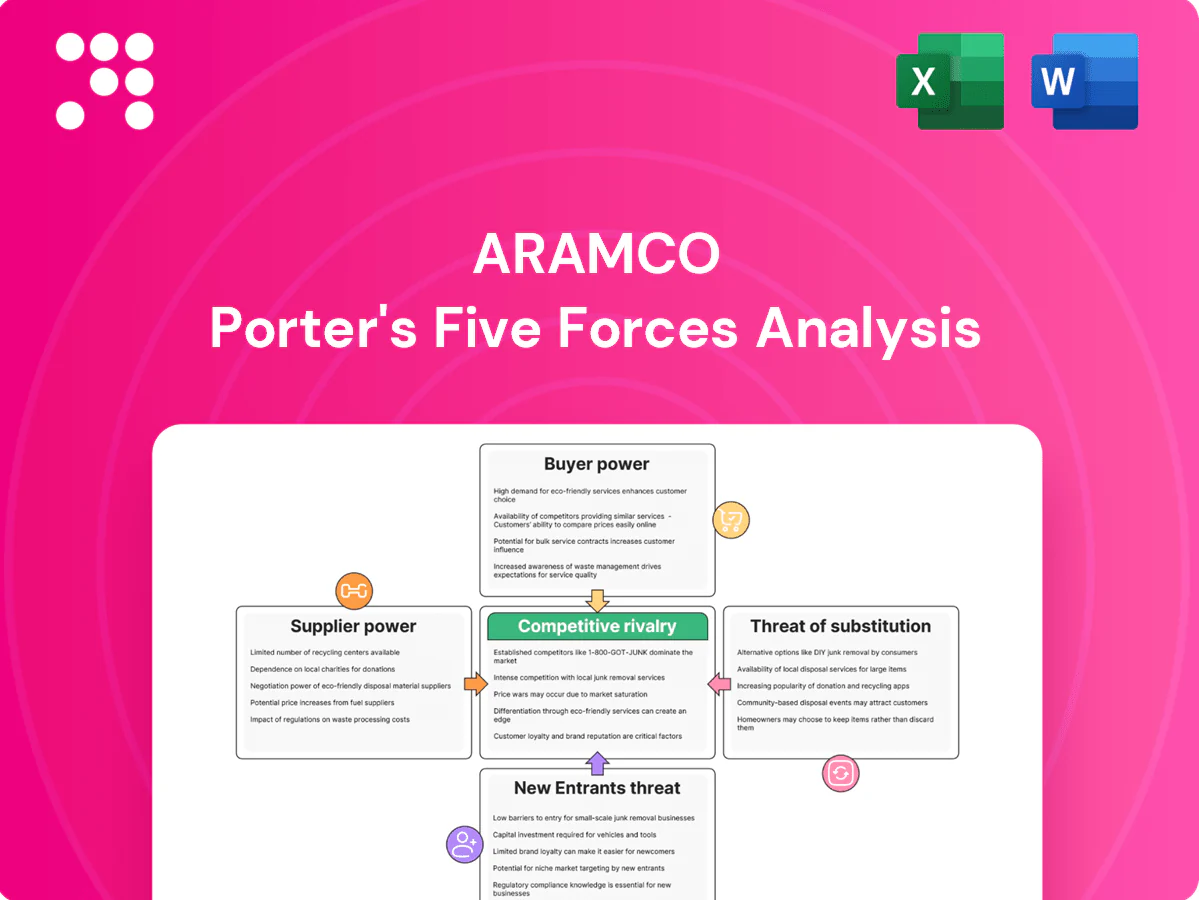
Aramco Porter's Five Forces Analysis

Go Beyond the Preview—Access the Full Strategic Report
Aramco operates within a capital-intensive, geopolitically sensitive oil market where supplier concentration, buyer bargaining through refiners and nations, and powerful substitutes from renewables shape margins and strategy. Vertical integration and state backing reduce new entrant risk but heighten regulatory and reputational pressures. This snapshot highlights these pressures and strategic levers. Unlock the full Porter's Five Forces Analysis to explore force-by-force ratings, visuals, and actionable insights.
Suppliers Bargaining Power

Concentrated specialized vendors
Aramco relies on a narrow set of oilfield service firms and EPC/catalyst OEMs—notably Schlumberger, Halliburton and Baker Hughes—giving suppliers measurable leverage on pricing and delivery. Aramco’s scale, producing around 12 million barrels per day, its strong reputation and strict vendor qualification processes reduce supplier power. Active multi-sourcing and global tenders further dilute single‑supplier dependence. Procurement and long‑term contracts limit short‑term pricing shocks.
Scale-driven bargaining leverage
As one of the world’s largest producers and refiners—reporting 2023 net income of $161.1 billion and maintaining a market value near $2 trillion in 2024—Aramco secures favorable supplier terms; high, predictable volumes enable volume discounts and priority allocations. Suppliers prize the marquee reference and steady work, making this scale advantage a structural dampener on supplier bargaining power.

In-house capabilities and integration
Strong in-house engineering, maintenance and R&D reduce supplier leverage: Aramco’s 2024 capex guidance of $35–40bn and a large internal workforce support partial substitution of external services. Backward integration into drilling, logistics and utilities limits reliance on specialist vendors, while technical standardization and SKU rationalization improve interchangeability of parts. Collectively these factors curb supplier switching costs and bargaining power.

Geopolitical and regulatory constraints
Export controls, sanctions and IP restrictions constrain Aramco's access to high-spec equipment, with niche Western or Asian OEMs exerting outsized leverage; in 2024 lead times for critical turbomachinery and control systems exceeded 24 months and supplier pricing firmed amid tight cycles. Strategic inventory buffers and multi-year framework agreements are used to mitigate risk and preserve project schedules.
- Export controls: limit suppliers
- Sanctions/IP: concentrated leverage
- Lead times: >24 months (2024)
- Mitigation: inventory + long-term contracts
Cyclical capacity tightness
Large producer scale (~12 mbpd) curbs supplier power despite >24-month lead times
Aramco faces moderate supplier power: dependency on a few specialized OEMs and service firms gives pockets of leverage, but Aramco’s scale (~12 mbpd), 2023 net income $161.1bn and 2024 market value ~ $2tn secure favorable terms. Long lead times (>24 months) for critical turbomachinery and 2024 capex $35–40bn raise supplier influence cyclically; multi-sourcing and long‑term contracts mitigate risk.
| Metric | Value |
|---|---|
| Production | ~12 mbpd |
| Net income (2023) | $161.1bn |
| Market value (2024) | ~$2tn |
| Capex guidance (2024) | $35–40bn |
| Lead times (critical) | >24 months |
What is included in the product
 Detailed Word Document
Tailored Porter’s Five Forces analysis for Aramco that uncovers key competitive drivers, supplier and buyer power, entry barriers, substitutes and disruptive threats, with strategic commentary to inform investor materials, internal strategy and academic reports.

 Customizable Excel Spreadsheet
A concise, one-sheet Porter’s Five Forces for Aramco highlighting supplier/customer bargaining, competitive rivalry, regulatory risk and entrant threats—ready to drop into decks, tweak for scenarios, and speed strategic decisions.
Customers Bargaining Power

Commodity pricing and transparency
Crude, refined products and many chemicals are globally priced commodities, with Brent averaging about $85/bbl in 2024, which amplifies price transparency and buyer leverage on terms and arbitrage. Aramco’s Official Selling Prices act as regional price anchors and benchmarks but must closely track spot markets to remain competitive. Limited grade differentiation for standardized crudes and fuels constrains Aramco’s unilateral pricing power.
Large strategic customers
Long-term Asian refiners, traders and NOCs purchase Aramco volumes in the millions of barrels per day, with Asia taking roughly two-thirds of Saudi crude exports in 2024, giving them scale and storage/logistics leverage in negotiations.
Offtake contracts balance supply certainty with formula-based pricing tied to regional benchmarks (Dubai/Oman, Platts), while depth of relationships and reliability premiums partially offset buyer bargaining power.

Switching and logistics frictions
Crude substitution is technically feasible but assay compatibility and refinery configurations create real frictions; Aramco produced about 12.7 million bpd in 2023 and ran roughly 12–13 million bpd in 2024, underscoring large-scale supply specificity. Pipeline, port slots and VLCC logistics (≈2 million barrels per VLCC) impose timing and operational switching costs. Aramco’s long track record of consistent blends and reliable deliveries reduces perceived buyer risk, dampening effective buyer bargaining power.

Downstream integration hedges
Aramco’s downstream stakes—70% of SABIC, 63.6% of S-Oil and full ownership of Motiva—create captive demand and internalize margins, reducing exposure to powerful external buyers; tailored supply and joint ventures align incentives and structurally lower buyer leverage.
- Captive demand via equity stakes
- Internalized margins = less external exposure
- JVs align incentives, lowering buyer bargaining power
Demand cyclicality and policy
During demand shocks buyers gain leverage via inventory drawdowns and spot deferrals, while tight markets erode buyer power as availability trumps price; global oil demand was about 102 mb/d in 2024 and Saudi Aramco has ~12 mb/d crude capacity, enabling allocation leverage. Carbon policies and fuel standards (EU/US tightening, IMO rules) shift demand mix and specs; Aramco mitigates via a diversified slate and flexible allocation.
- Buyers leverage: inventory drawdowns, spot deferrals
- Tight market effect: availability > price
- 2024 demand: ~102 mb/d
- Aramco capacity: ~12 mb/d
- Mitigation: diversified slate, flexible allocation
Higher Brent $85/bbl shifts buyer leverage as Asia takes ~66% of Saudi flows
Brent averaged about $85/bbl in 2024, increasing price transparency and buyer leverage. Asia bought ~two-thirds of Saudi crude exports in 2024, giving refiners scale in negotiations. Aramco ran ~12–13 mbpd in 2024 against global demand ~102 mbpd, limiting but not eliminating buyer bargaining power.
| Metric | 2024 |
|---|---|
| Brent | $85/bbl |
| Global demand | 102 mb/d |
| Aramco runrate | 12–13 mb/d |
| Asia share | ~66% |
What You See Is What You Get
Aramco Porter's Five Forces Analysis
This Aramco Porter’s Five Forces analysis assesses threat of new entrants, supplier and buyer bargaining power, rivalry among competitors and substitutes, and strategic implications for margins and growth. It includes concise conclusions and recommended actions. This preview is the exact professionally formatted document you’ll receive instantly after purchase.

Go Beyond the Preview—Access the Full Strategic Report
Aramco operates within a capital-intensive, geopolitically sensitive oil market where supplier concentration, buyer bargaining through refiners and nations, and powerful substitutes from renewables shape margins and strategy. Vertical integration and state backing reduce new entrant risk but heighten regulatory and reputational pressures. This snapshot highlights these pressures and strategic levers. Unlock the full Porter's Five Forces Analysis to explore force-by-force ratings, visuals, and actionable insights.
Suppliers Bargaining Power
Concentrated specialized vendors
Aramco relies on a narrow set of oilfield service firms and EPC/catalyst OEMs—notably Schlumberger, Halliburton and Baker Hughes—giving suppliers measurable leverage on pricing and delivery. Aramco’s scale, producing around 12 million barrels per day, its strong reputation and strict vendor qualification processes reduce supplier power. Active multi-sourcing and global tenders further dilute single‑supplier dependence. Procurement and long‑term contracts limit short‑term pricing shocks.
Scale-driven bargaining leverage
As one of the world’s largest producers and refiners—reporting 2023 net income of $161.1 billion and maintaining a market value near $2 trillion in 2024—Aramco secures favorable supplier terms; high, predictable volumes enable volume discounts and priority allocations. Suppliers prize the marquee reference and steady work, making this scale advantage a structural dampener on supplier bargaining power.
In-house capabilities and integration
Strong in-house engineering, maintenance and R&D reduce supplier leverage: Aramco’s 2024 capex guidance of $35–40bn and a large internal workforce support partial substitution of external services. Backward integration into drilling, logistics and utilities limits reliance on specialist vendors, while technical standardization and SKU rationalization improve interchangeability of parts. Collectively these factors curb supplier switching costs and bargaining power.
Geopolitical and regulatory constraints
Export controls, sanctions and IP restrictions constrain Aramco's access to high-spec equipment, with niche Western or Asian OEMs exerting outsized leverage; in 2024 lead times for critical turbomachinery and control systems exceeded 24 months and supplier pricing firmed amid tight cycles. Strategic inventory buffers and multi-year framework agreements are used to mitigate risk and preserve project schedules.
- Export controls: limit suppliers
- Sanctions/IP: concentrated leverage
- Lead times: >24 months (2024)
- Mitigation: inventory + long-term contracts
Cyclical capacity tightness
Large producer scale (~12 mbpd) curbs supplier power despite >24-month lead times
Aramco faces moderate supplier power: dependency on a few specialized OEMs and service firms gives pockets of leverage, but Aramco’s scale (~12 mbpd), 2023 net income $161.1bn and 2024 market value ~ $2tn secure favorable terms. Long lead times (>24 months) for critical turbomachinery and 2024 capex $35–40bn raise supplier influence cyclically; multi-sourcing and long‑term contracts mitigate risk.
| Metric | Value |
|---|---|
| Production | ~12 mbpd |
| Net income (2023) | $161.1bn |
| Market value (2024) | ~$2tn |
| Capex guidance (2024) | $35–40bn |
| Lead times (critical) | >24 months |
What is included in the product
Detailed Word Document
Tailored Porter’s Five Forces analysis for Aramco that uncovers key competitive drivers, supplier and buyer power, entry barriers, substitutes and disruptive threats, with strategic commentary to inform investor materials, internal strategy and academic reports.
Customizable Excel Spreadsheet
A concise, one-sheet Porter’s Five Forces for Aramco highlighting supplier/customer bargaining, competitive rivalry, regulatory risk and entrant threats—ready to drop into decks, tweak for scenarios, and speed strategic decisions.
Customers Bargaining Power
Commodity pricing and transparency
Crude, refined products and many chemicals are globally priced commodities, with Brent averaging about $85/bbl in 2024, which amplifies price transparency and buyer leverage on terms and arbitrage. Aramco’s Official Selling Prices act as regional price anchors and benchmarks but must closely track spot markets to remain competitive. Limited grade differentiation for standardized crudes and fuels constrains Aramco’s unilateral pricing power.
Large strategic customers
Long-term Asian refiners, traders and NOCs purchase Aramco volumes in the millions of barrels per day, with Asia taking roughly two-thirds of Saudi crude exports in 2024, giving them scale and storage/logistics leverage in negotiations.
Offtake contracts balance supply certainty with formula-based pricing tied to regional benchmarks (Dubai/Oman, Platts), while depth of relationships and reliability premiums partially offset buyer bargaining power.
Switching and logistics frictions
Crude substitution is technically feasible but assay compatibility and refinery configurations create real frictions; Aramco produced about 12.7 million bpd in 2023 and ran roughly 12–13 million bpd in 2024, underscoring large-scale supply specificity. Pipeline, port slots and VLCC logistics (≈2 million barrels per VLCC) impose timing and operational switching costs. Aramco’s long track record of consistent blends and reliable deliveries reduces perceived buyer risk, dampening effective buyer bargaining power.
Downstream integration hedges
Aramco’s downstream stakes—70% of SABIC, 63.6% of S-Oil and full ownership of Motiva—create captive demand and internalize margins, reducing exposure to powerful external buyers; tailored supply and joint ventures align incentives and structurally lower buyer leverage.
- Captive demand via equity stakes
- Internalized margins = less external exposure
- JVs align incentives, lowering buyer bargaining power
Demand cyclicality and policy
During demand shocks buyers gain leverage via inventory drawdowns and spot deferrals, while tight markets erode buyer power as availability trumps price; global oil demand was about 102 mb/d in 2024 and Saudi Aramco has ~12 mb/d crude capacity, enabling allocation leverage. Carbon policies and fuel standards (EU/US tightening, IMO rules) shift demand mix and specs; Aramco mitigates via a diversified slate and flexible allocation.
- Buyers leverage: inventory drawdowns, spot deferrals
- Tight market effect: availability > price
- 2024 demand: ~102 mb/d
- Aramco capacity: ~12 mb/d
- Mitigation: diversified slate, flexible allocation
Higher Brent $85/bbl shifts buyer leverage as Asia takes ~66% of Saudi flows
Brent averaged about $85/bbl in 2024, increasing price transparency and buyer leverage. Asia bought ~two-thirds of Saudi crude exports in 2024, giving refiners scale in negotiations. Aramco ran ~12–13 mbpd in 2024 against global demand ~102 mbpd, limiting but not eliminating buyer bargaining power.
| Metric | 2024 |
|---|---|
| Brent | $85/bbl |
| Global demand | 102 mb/d |
| Aramco runrate | 12–13 mb/d |
| Asia share | ~66% |
What You See Is What You Get
Aramco Porter's Five Forces Analysis
This Aramco Porter’s Five Forces analysis assesses threat of new entrants, supplier and buyer bargaining power, rivalry among competitors and substitutes, and strategic implications for margins and growth. It includes concise conclusions and recommended actions. This preview is the exact professionally formatted document you’ll receive instantly after purchase.
Description
Go Beyond the Preview—Access the Full Strategic Report
Aramco operates within a capital-intensive, geopolitically sensitive oil market where supplier concentration, buyer bargaining through refiners and nations, and powerful substitutes from renewables shape margins and strategy. Vertical integration and state backing reduce new entrant risk but heighten regulatory and reputational pressures. This snapshot highlights these pressures and strategic levers. Unlock the full Porter's Five Forces Analysis to explore force-by-force ratings, visuals, and actionable insights.
Suppliers Bargaining Power
Concentrated specialized vendors
Aramco relies on a narrow set of oilfield service firms and EPC/catalyst OEMs—notably Schlumberger, Halliburton and Baker Hughes—giving suppliers measurable leverage on pricing and delivery. Aramco’s scale, producing around 12 million barrels per day, its strong reputation and strict vendor qualification processes reduce supplier power. Active multi-sourcing and global tenders further dilute single‑supplier dependence. Procurement and long‑term contracts limit short‑term pricing shocks.
Scale-driven bargaining leverage
As one of the world’s largest producers and refiners—reporting 2023 net income of $161.1 billion and maintaining a market value near $2 trillion in 2024—Aramco secures favorable supplier terms; high, predictable volumes enable volume discounts and priority allocations. Suppliers prize the marquee reference and steady work, making this scale advantage a structural dampener on supplier bargaining power.
In-house capabilities and integration
Strong in-house engineering, maintenance and R&D reduce supplier leverage: Aramco’s 2024 capex guidance of $35–40bn and a large internal workforce support partial substitution of external services. Backward integration into drilling, logistics and utilities limits reliance on specialist vendors, while technical standardization and SKU rationalization improve interchangeability of parts. Collectively these factors curb supplier switching costs and bargaining power.
Geopolitical and regulatory constraints
Export controls, sanctions and IP restrictions constrain Aramco's access to high-spec equipment, with niche Western or Asian OEMs exerting outsized leverage; in 2024 lead times for critical turbomachinery and control systems exceeded 24 months and supplier pricing firmed amid tight cycles. Strategic inventory buffers and multi-year framework agreements are used to mitigate risk and preserve project schedules.
- Export controls: limit suppliers
- Sanctions/IP: concentrated leverage
- Lead times: >24 months (2024)
- Mitigation: inventory + long-term contracts
Cyclical capacity tightness
Large producer scale (~12 mbpd) curbs supplier power despite >24-month lead times
Aramco faces moderate supplier power: dependency on a few specialized OEMs and service firms gives pockets of leverage, but Aramco’s scale (~12 mbpd), 2023 net income $161.1bn and 2024 market value ~ $2tn secure favorable terms. Long lead times (>24 months) for critical turbomachinery and 2024 capex $35–40bn raise supplier influence cyclically; multi-sourcing and long‑term contracts mitigate risk.
| Metric | Value |
|---|---|
| Production | ~12 mbpd |
| Net income (2023) | $161.1bn |
| Market value (2024) | ~$2tn |
| Capex guidance (2024) | $35–40bn |
| Lead times (critical) | >24 months |
What is included in the product
Detailed Word Document
Tailored Porter’s Five Forces analysis for Aramco that uncovers key competitive drivers, supplier and buyer power, entry barriers, substitutes and disruptive threats, with strategic commentary to inform investor materials, internal strategy and academic reports.
Customizable Excel Spreadsheet
A concise, one-sheet Porter’s Five Forces for Aramco highlighting supplier/customer bargaining, competitive rivalry, regulatory risk and entrant threats—ready to drop into decks, tweak for scenarios, and speed strategic decisions.
Customers Bargaining Power
Commodity pricing and transparency
Crude, refined products and many chemicals are globally priced commodities, with Brent averaging about $85/bbl in 2024, which amplifies price transparency and buyer leverage on terms and arbitrage. Aramco’s Official Selling Prices act as regional price anchors and benchmarks but must closely track spot markets to remain competitive. Limited grade differentiation for standardized crudes and fuels constrains Aramco’s unilateral pricing power.
Large strategic customers
Long-term Asian refiners, traders and NOCs purchase Aramco volumes in the millions of barrels per day, with Asia taking roughly two-thirds of Saudi crude exports in 2024, giving them scale and storage/logistics leverage in negotiations.
Offtake contracts balance supply certainty with formula-based pricing tied to regional benchmarks (Dubai/Oman, Platts), while depth of relationships and reliability premiums partially offset buyer bargaining power.
Switching and logistics frictions
Crude substitution is technically feasible but assay compatibility and refinery configurations create real frictions; Aramco produced about 12.7 million bpd in 2023 and ran roughly 12–13 million bpd in 2024, underscoring large-scale supply specificity. Pipeline, port slots and VLCC logistics (≈2 million barrels per VLCC) impose timing and operational switching costs. Aramco’s long track record of consistent blends and reliable deliveries reduces perceived buyer risk, dampening effective buyer bargaining power.
Downstream integration hedges
Aramco’s downstream stakes—70% of SABIC, 63.6% of S-Oil and full ownership of Motiva—create captive demand and internalize margins, reducing exposure to powerful external buyers; tailored supply and joint ventures align incentives and structurally lower buyer leverage.
- Captive demand via equity stakes
- Internalized margins = less external exposure
- JVs align incentives, lowering buyer bargaining power
Demand cyclicality and policy
During demand shocks buyers gain leverage via inventory drawdowns and spot deferrals, while tight markets erode buyer power as availability trumps price; global oil demand was about 102 mb/d in 2024 and Saudi Aramco has ~12 mb/d crude capacity, enabling allocation leverage. Carbon policies and fuel standards (EU/US tightening, IMO rules) shift demand mix and specs; Aramco mitigates via a diversified slate and flexible allocation.
- Buyers leverage: inventory drawdowns, spot deferrals
- Tight market effect: availability > price
- 2024 demand: ~102 mb/d
- Aramco capacity: ~12 mb/d
- Mitigation: diversified slate, flexible allocation
Higher Brent $85/bbl shifts buyer leverage as Asia takes ~66% of Saudi flows
Brent averaged about $85/bbl in 2024, increasing price transparency and buyer leverage. Asia bought ~two-thirds of Saudi crude exports in 2024, giving refiners scale in negotiations. Aramco ran ~12–13 mbpd in 2024 against global demand ~102 mbpd, limiting but not eliminating buyer bargaining power.
| Metric | 2024 |
|---|---|
| Brent | $85/bbl |
| Global demand | 102 mb/d |
| Aramco runrate | 12–13 mb/d |
| Asia share | ~66% |
What You See Is What You Get
Aramco Porter's Five Forces Analysis
This Aramco Porter’s Five Forces analysis assesses threat of new entrants, supplier and buyer bargaining power, rivalry among competitors and substitutes, and strategic implications for margins and growth. It includes concise conclusions and recommended actions. This preview is the exact professionally formatted document you’ll receive instantly after purchase.











