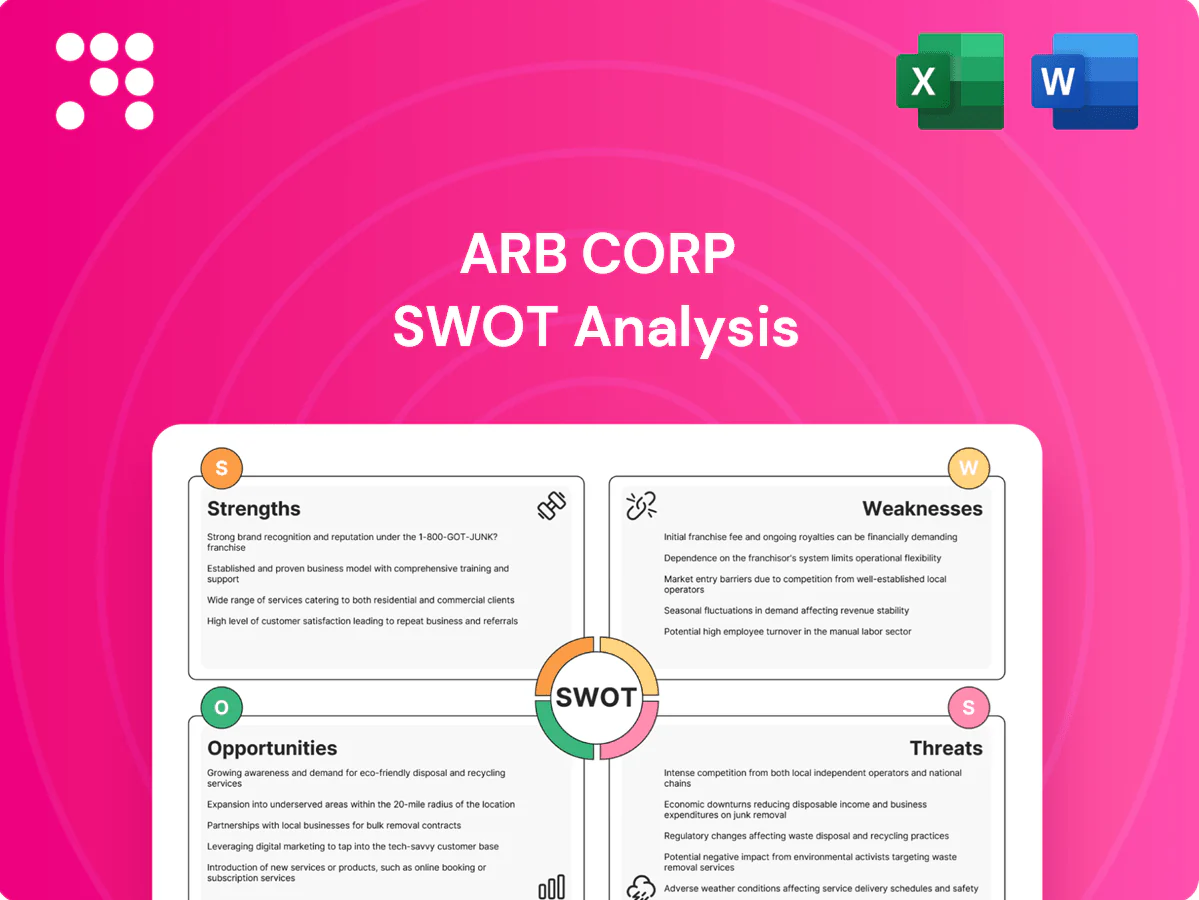
ARB Corp SWOT Analysis

Dive Deeper Into the Company’s Strategic Blueprint
ARB Corp’s strengths include a strong brand in 4x4 accessories, global distribution channels, and steady aftermarket demand, while weaknesses and risks center on supply-chain exposure, commodity cost pressure, and intensifying competition. Our full SWOT unpacks strategic implications, financial context, and actionable moves. Purchase the complete, editable SWOT (Word + Excel) to plan, pitch, or invest with confidence.
Strengths

Leading 4x4 accessories brand
ARB, founded in 1975, leverages 50 years of brand equity in off-road and overlanding niches, enabling pricing power and strong customer loyalty. Performance credibility and safety-tested products underpin trust, with exports to 100+ countries reinforcing recognition and lowering customer acquisition cost. Brand strength supports premium positioning and cross-selling across its product suite.
Vertically integrated design-to-retail
Vertically integrated design-to-retail gives ARB in-house design, manufacturing and distribution plus 130+ owned 4x4 Adventure Centres, enabling tight quality control and faster innovation. Integration compresses lead times and helped protect FY2024 gross margins around 37%, shielding channels and margins. Direct retail feeds tighter feedback loops from stores to engineering for quicker product updates. Owning production and retail limits channel conflict and protects IP.

Global dealer and store network
ARB's global dealer and store network, spanning more than 100 outlets across Australia and key export markets, diversifies revenue across regions and customer segments. Close proximity to enthusiasts and installers boosts service quality and attachment rates, while local inventory improves fulfilment and brand visibility. The dispersed footprint provides resilience against single-market shocks.

Diverse, engineered product portfolio
Diverse engineered portfolio spanning bull bars, suspension, roof racks and camping gear delivers multiple revenue streams and higher per-vehicle wallet share through fit-for-purpose SKUs that expand vehicle coverage and upsell opportunities, while category diversification smooths cyclical demand across off-road accessories.
- Multiple revenue streams
- Engineered fit-for-purpose SKUs
- Cyclical diversification
- Deeper wallet share per vehicle
Quality, safety, and compliance reputation
ARB Corp products are renowned for durability and strict compliance with global safety standards, which mitigates liability risk and supports premium pricing; this reliability lowers warranty costs and returns while reinforcing long-term contracts with OEMs and fleet customers.
- Durable product design
- Compliance mitigates liability
- Lower warranty/returns
- Stronger OEM and fleet relationships
50-year equity, 100+ markets, vertical design-to-retail, 37% margin
ARB leverages 50 years of brand equity and exports to 100+ countries, enabling pricing power and strong loyalty. Vertically integrated design-to-retail with 130+ Adventure Centres compresses lead times and supported FY2024 gross margin ~37%. Diverse engineered portfolio and durable, safety-compliant products drive higher per-vehicle wallet share and lower warranty costs.
| Metric | Value |
|---|---|
| Export reach | 100+ countries |
| Adventure Centres | 130+ |
| FY2024 gross margin | ~37% |
What is included in the product
 Detailed Word Document
Provides a concise SWOT analysis of ARB Corp, outlining its strengths in brand, product range and aftermarket leadership, weaknesses in supplier concentration and margin sensitivity, opportunities from international expansion, EV and accessory demand, and threats from supply‑chain disruption, currency volatility and intensifying competition.

 Customizable Excel Spreadsheet
Delivers a concise, visual SWOT matrix tailored to ARB Corp for rapid strategy alignment and executive briefings, enabling quick edits to reflect shifting market or product priorities.
Weaknesses

Exposure to discretionary spend cycles
Aftermarket accessories are non-essential and closely tied to consumer confidence; discretionary automotive spend can fall sharply in downturns, often by up to 25% in severe cycles.
High-cost manufacturing footprint
Significant production in Australia exposes ARB to higher labor (around A$45/hr) and industrial energy costs (approx A$150/MWh in 2024), inflating unit costs. This cost base squeezes margins in price-sensitive accessory segments and limits flexibility against low-cost imports. A stronger AUD in 2023–24 further reduced export competitiveness.

Inventory intensity and SKU complexity
Fitment-specific parts drive very large SKU counts and heavy working-capital needs across models and regions, making forecasting by vehicle model and geography highly challenging. Rapid model-cycle changes raise obsolescence risk for slow-moving SKUs, increasing write-downs and safety-stock requirements. Elevated carrying costs tied to inventory intensity can materially dampen free cash flow and constrain capital allocation.

Supplier and raw material dependence
ARB’s reliance on steel, aluminium and specialised components makes gross margins sensitive to raw-material price swings and freight cost volatility; hedging programs reduce but do not eliminate exposure. Concentrated suppliers and narrow logistics lanes increase the risk of disruption, while long lead times raise the chance of stock-outs or excess inventory.
- input exposure: steel/aluminium dependence
- supply concentration: single-route/logistics risk
- lead times: stock-out/overstock risk
- hedging: partial mitigation only
Limited EV-specific product readiness
- EV design gaps
- Higher testing/cert costs
- Share loss to innovators
Aftermarket accessories face 25% demand swings; Aussie costs and EV lag pressure margins
Aftermarket accessories are discretionary; demand can drop up to 25% in severe cycles, pressuring revenue and margins.
High Australian cost base (labour ~A$45/hr; industrial energy ~A$150/MWh in 2024) and stronger AUD in 2023–24 reduce price competitiveness versus low-cost imports.
High SKU/working-capital intensity, supply concentration and partial hedging raise inventory, lead-time and input-price risks; EV product readiness remains limited.
| Risk | Key metric |
|---|---|
| Demand cyclicality | Drop up to 25% |
| Labor | A$45/hr (est) |
| Energy 2024 | A$150/MWh |
| EV readiness | Limited |
Preview the Actual Deliverable
ARB Corp SWOT Analysis
This is the actual SWOT analysis document you’ll receive upon purchase—no surprises, just professional quality. The preview below is taken directly from the full ARB Corp SWOT report you'll get, and the complete, editable version is unlocked after payment. Buy to access the full, structured analysis ready for use.

Dive Deeper Into the Company’s Strategic Blueprint
ARB Corp’s strengths include a strong brand in 4x4 accessories, global distribution channels, and steady aftermarket demand, while weaknesses and risks center on supply-chain exposure, commodity cost pressure, and intensifying competition. Our full SWOT unpacks strategic implications, financial context, and actionable moves. Purchase the complete, editable SWOT (Word + Excel) to plan, pitch, or invest with confidence.
Strengths
Leading 4x4 accessories brand
ARB, founded in 1975, leverages 50 years of brand equity in off-road and overlanding niches, enabling pricing power and strong customer loyalty. Performance credibility and safety-tested products underpin trust, with exports to 100+ countries reinforcing recognition and lowering customer acquisition cost. Brand strength supports premium positioning and cross-selling across its product suite.
Vertically integrated design-to-retail
Vertically integrated design-to-retail gives ARB in-house design, manufacturing and distribution plus 130+ owned 4x4 Adventure Centres, enabling tight quality control and faster innovation. Integration compresses lead times and helped protect FY2024 gross margins around 37%, shielding channels and margins. Direct retail feeds tighter feedback loops from stores to engineering for quicker product updates. Owning production and retail limits channel conflict and protects IP.
Global dealer and store network
ARB's global dealer and store network, spanning more than 100 outlets across Australia and key export markets, diversifies revenue across regions and customer segments. Close proximity to enthusiasts and installers boosts service quality and attachment rates, while local inventory improves fulfilment and brand visibility. The dispersed footprint provides resilience against single-market shocks.
Diverse, engineered product portfolio
Diverse engineered portfolio spanning bull bars, suspension, roof racks and camping gear delivers multiple revenue streams and higher per-vehicle wallet share through fit-for-purpose SKUs that expand vehicle coverage and upsell opportunities, while category diversification smooths cyclical demand across off-road accessories.
- Multiple revenue streams
- Engineered fit-for-purpose SKUs
- Cyclical diversification
- Deeper wallet share per vehicle
Quality, safety, and compliance reputation
ARB Corp products are renowned for durability and strict compliance with global safety standards, which mitigates liability risk and supports premium pricing; this reliability lowers warranty costs and returns while reinforcing long-term contracts with OEMs and fleet customers.
- Durable product design
- Compliance mitigates liability
- Lower warranty/returns
- Stronger OEM and fleet relationships
50-year equity, 100+ markets, vertical design-to-retail, 37% margin
ARB leverages 50 years of brand equity and exports to 100+ countries, enabling pricing power and strong loyalty. Vertically integrated design-to-retail with 130+ Adventure Centres compresses lead times and supported FY2024 gross margin ~37%. Diverse engineered portfolio and durable, safety-compliant products drive higher per-vehicle wallet share and lower warranty costs.
| Metric | Value |
|---|---|
| Export reach | 100+ countries |
| Adventure Centres | 130+ |
| FY2024 gross margin | ~37% |
What is included in the product
Detailed Word Document
Provides a concise SWOT analysis of ARB Corp, outlining its strengths in brand, product range and aftermarket leadership, weaknesses in supplier concentration and margin sensitivity, opportunities from international expansion, EV and accessory demand, and threats from supply‑chain disruption, currency volatility and intensifying competition.
Customizable Excel Spreadsheet
Delivers a concise, visual SWOT matrix tailored to ARB Corp for rapid strategy alignment and executive briefings, enabling quick edits to reflect shifting market or product priorities.
Weaknesses
Exposure to discretionary spend cycles
Aftermarket accessories are non-essential and closely tied to consumer confidence; discretionary automotive spend can fall sharply in downturns, often by up to 25% in severe cycles.
High-cost manufacturing footprint
Significant production in Australia exposes ARB to higher labor (around A$45/hr) and industrial energy costs (approx A$150/MWh in 2024), inflating unit costs. This cost base squeezes margins in price-sensitive accessory segments and limits flexibility against low-cost imports. A stronger AUD in 2023–24 further reduced export competitiveness.
Inventory intensity and SKU complexity
Fitment-specific parts drive very large SKU counts and heavy working-capital needs across models and regions, making forecasting by vehicle model and geography highly challenging. Rapid model-cycle changes raise obsolescence risk for slow-moving SKUs, increasing write-downs and safety-stock requirements. Elevated carrying costs tied to inventory intensity can materially dampen free cash flow and constrain capital allocation.
Supplier and raw material dependence
ARB’s reliance on steel, aluminium and specialised components makes gross margins sensitive to raw-material price swings and freight cost volatility; hedging programs reduce but do not eliminate exposure. Concentrated suppliers and narrow logistics lanes increase the risk of disruption, while long lead times raise the chance of stock-outs or excess inventory.
- input exposure: steel/aluminium dependence
- supply concentration: single-route/logistics risk
- lead times: stock-out/overstock risk
- hedging: partial mitigation only
Limited EV-specific product readiness
- EV design gaps
- Higher testing/cert costs
- Share loss to innovators
Aftermarket accessories face 25% demand swings; Aussie costs and EV lag pressure margins
Aftermarket accessories are discretionary; demand can drop up to 25% in severe cycles, pressuring revenue and margins.
High Australian cost base (labour ~A$45/hr; industrial energy ~A$150/MWh in 2024) and stronger AUD in 2023–24 reduce price competitiveness versus low-cost imports.
High SKU/working-capital intensity, supply concentration and partial hedging raise inventory, lead-time and input-price risks; EV product readiness remains limited.
| Risk | Key metric |
|---|---|
| Demand cyclicality | Drop up to 25% |
| Labor | A$45/hr (est) |
| Energy 2024 | A$150/MWh |
| EV readiness | Limited |
Preview the Actual Deliverable
ARB Corp SWOT Analysis
This is the actual SWOT analysis document you’ll receive upon purchase—no surprises, just professional quality. The preview below is taken directly from the full ARB Corp SWOT report you'll get, and the complete, editable version is unlocked after payment. Buy to access the full, structured analysis ready for use.
Original: $10.00
-65%$10.00
$3.50Description
Dive Deeper Into the Company’s Strategic Blueprint
ARB Corp’s strengths include a strong brand in 4x4 accessories, global distribution channels, and steady aftermarket demand, while weaknesses and risks center on supply-chain exposure, commodity cost pressure, and intensifying competition. Our full SWOT unpacks strategic implications, financial context, and actionable moves. Purchase the complete, editable SWOT (Word + Excel) to plan, pitch, or invest with confidence.
Strengths
Leading 4x4 accessories brand
ARB, founded in 1975, leverages 50 years of brand equity in off-road and overlanding niches, enabling pricing power and strong customer loyalty. Performance credibility and safety-tested products underpin trust, with exports to 100+ countries reinforcing recognition and lowering customer acquisition cost. Brand strength supports premium positioning and cross-selling across its product suite.
Vertically integrated design-to-retail
Vertically integrated design-to-retail gives ARB in-house design, manufacturing and distribution plus 130+ owned 4x4 Adventure Centres, enabling tight quality control and faster innovation. Integration compresses lead times and helped protect FY2024 gross margins around 37%, shielding channels and margins. Direct retail feeds tighter feedback loops from stores to engineering for quicker product updates. Owning production and retail limits channel conflict and protects IP.
Global dealer and store network
ARB's global dealer and store network, spanning more than 100 outlets across Australia and key export markets, diversifies revenue across regions and customer segments. Close proximity to enthusiasts and installers boosts service quality and attachment rates, while local inventory improves fulfilment and brand visibility. The dispersed footprint provides resilience against single-market shocks.
Diverse, engineered product portfolio
Diverse engineered portfolio spanning bull bars, suspension, roof racks and camping gear delivers multiple revenue streams and higher per-vehicle wallet share through fit-for-purpose SKUs that expand vehicle coverage and upsell opportunities, while category diversification smooths cyclical demand across off-road accessories.
- Multiple revenue streams
- Engineered fit-for-purpose SKUs
- Cyclical diversification
- Deeper wallet share per vehicle
Quality, safety, and compliance reputation
ARB Corp products are renowned for durability and strict compliance with global safety standards, which mitigates liability risk and supports premium pricing; this reliability lowers warranty costs and returns while reinforcing long-term contracts with OEMs and fleet customers.
- Durable product design
- Compliance mitigates liability
- Lower warranty/returns
- Stronger OEM and fleet relationships
50-year equity, 100+ markets, vertical design-to-retail, 37% margin
ARB leverages 50 years of brand equity and exports to 100+ countries, enabling pricing power and strong loyalty. Vertically integrated design-to-retail with 130+ Adventure Centres compresses lead times and supported FY2024 gross margin ~37%. Diverse engineered portfolio and durable, safety-compliant products drive higher per-vehicle wallet share and lower warranty costs.
| Metric | Value |
|---|---|
| Export reach | 100+ countries |
| Adventure Centres | 130+ |
| FY2024 gross margin | ~37% |
What is included in the product
Detailed Word Document
Provides a concise SWOT analysis of ARB Corp, outlining its strengths in brand, product range and aftermarket leadership, weaknesses in supplier concentration and margin sensitivity, opportunities from international expansion, EV and accessory demand, and threats from supply‑chain disruption, currency volatility and intensifying competition.
Customizable Excel Spreadsheet
Delivers a concise, visual SWOT matrix tailored to ARB Corp for rapid strategy alignment and executive briefings, enabling quick edits to reflect shifting market or product priorities.
Weaknesses
Exposure to discretionary spend cycles
Aftermarket accessories are non-essential and closely tied to consumer confidence; discretionary automotive spend can fall sharply in downturns, often by up to 25% in severe cycles.
High-cost manufacturing footprint
Significant production in Australia exposes ARB to higher labor (around A$45/hr) and industrial energy costs (approx A$150/MWh in 2024), inflating unit costs. This cost base squeezes margins in price-sensitive accessory segments and limits flexibility against low-cost imports. A stronger AUD in 2023–24 further reduced export competitiveness.
Inventory intensity and SKU complexity
Fitment-specific parts drive very large SKU counts and heavy working-capital needs across models and regions, making forecasting by vehicle model and geography highly challenging. Rapid model-cycle changes raise obsolescence risk for slow-moving SKUs, increasing write-downs and safety-stock requirements. Elevated carrying costs tied to inventory intensity can materially dampen free cash flow and constrain capital allocation.
Supplier and raw material dependence
ARB’s reliance on steel, aluminium and specialised components makes gross margins sensitive to raw-material price swings and freight cost volatility; hedging programs reduce but do not eliminate exposure. Concentrated suppliers and narrow logistics lanes increase the risk of disruption, while long lead times raise the chance of stock-outs or excess inventory.
- input exposure: steel/aluminium dependence
- supply concentration: single-route/logistics risk
- lead times: stock-out/overstock risk
- hedging: partial mitigation only
Limited EV-specific product readiness
- EV design gaps
- Higher testing/cert costs
- Share loss to innovators
Aftermarket accessories face 25% demand swings; Aussie costs and EV lag pressure margins
Aftermarket accessories are discretionary; demand can drop up to 25% in severe cycles, pressuring revenue and margins.
High Australian cost base (labour ~A$45/hr; industrial energy ~A$150/MWh in 2024) and stronger AUD in 2023–24 reduce price competitiveness versus low-cost imports.
High SKU/working-capital intensity, supply concentration and partial hedging raise inventory, lead-time and input-price risks; EV product readiness remains limited.
| Risk | Key metric |
|---|---|
| Demand cyclicality | Drop up to 25% |
| Labor | A$45/hr (est) |
| Energy 2024 | A$150/MWh |
| EV readiness | Limited |
Preview the Actual Deliverable
ARB Corp SWOT Analysis
This is the actual SWOT analysis document you’ll receive upon purchase—no surprises, just professional quality. The preview below is taken directly from the full ARB Corp SWOT report you'll get, and the complete, editable version is unlocked after payment. Buy to access the full, structured analysis ready for use.











