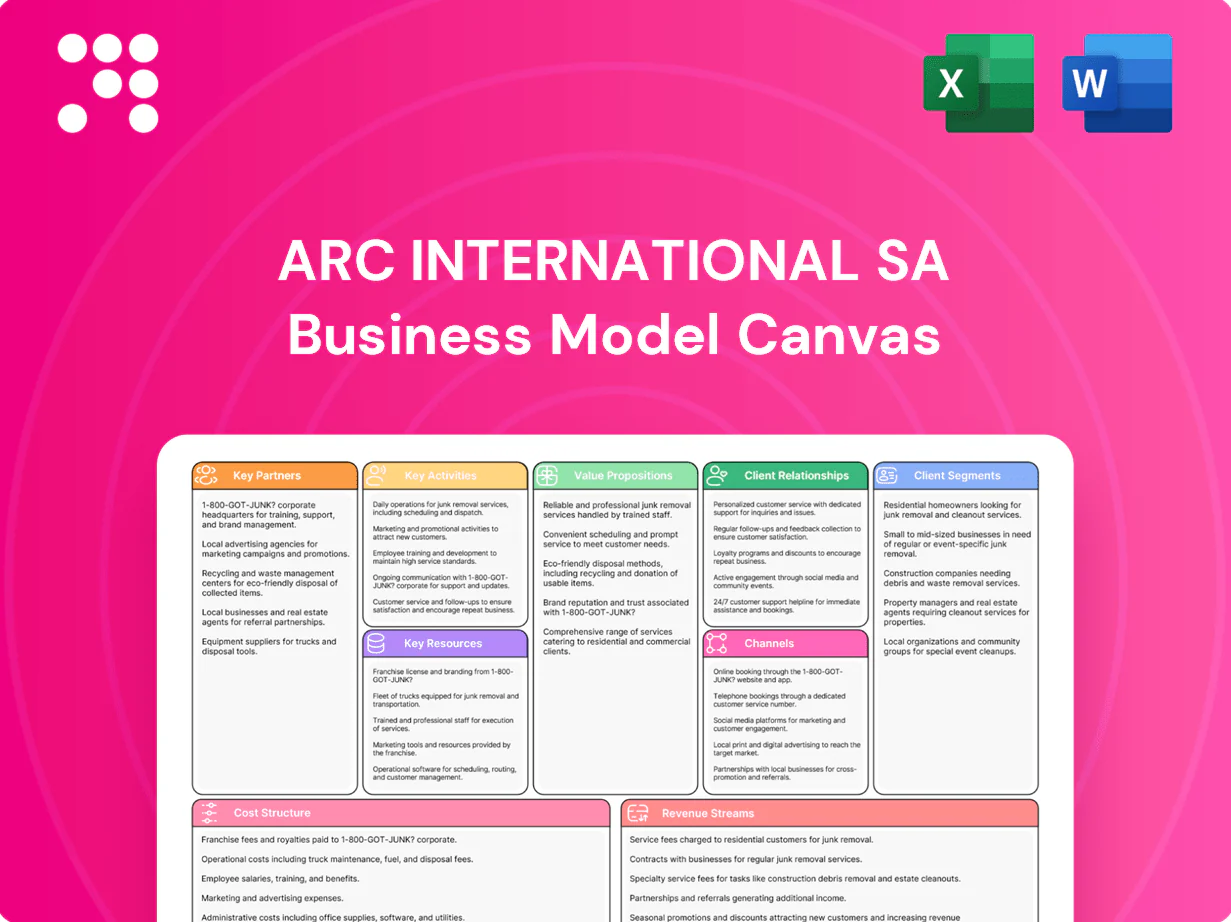
ARC International SA Business Model Canvas

Concise Business Model Canvas: Strategic Blueprint for Investors and Founders
Unlock the full strategic blueprint behind ARC International SA with our concise Business Model Canvas—detailing value propositions, customer segments, key partners and revenue streams. This actionable snapshot is ideal for investors, consultants, and founders seeking competitive advantage. Download the complete Word and Excel files to benchmark, adapt, and execute faster.
Partnerships

Raw material suppliers
Partnerships with silica sand, soda ash, limestone and chemical additive suppliers secure consistent quality and volume for ARC International, backed by multi-year 3–5 year contracts that reduce price volatility and supply risk. Regional diversification across Europe, North Africa and Asia ensures continuity during disruptions. Collaborative R&D with suppliers delivered industry-reported melt energy improvements of around 3–5% in 2024, enhancing glass properties and lowering costs.
Energy providers
Glass melting is energy‑intensive (≈4–5 GJ/ton) and needs stable gas and electricity; long‑term gas/electric contracts and CHP partners (cogeneration up to ≈80% efficiency) stabilize costs and uptime. Renewable PPAs support decarbonization while EU ETS prices (~€100/tCO2 in 2024) and demand‑response agreements limit peak pricing and outage risk.

Logistics and distributors
3PLs and freight forwarders manage ARC International SA inbound cullet/raws and outbound finished goods worldwide, leveraging a global 3PL market valued at about USD 1.1 trillion in 2024 to optimize capacity and cross-border compliance.
HoReCa distributors expand reach into hospitality networks, where foodservice channels accounted for a significant share of glassware B2B demand in 2024.
Retail distribution alliances secure shelf space and in-store execution, while cross-dock and consolidation partners cut breakage and freight cost by consolidating loads and reducing handling points.

Brand and licensing alliances
Brand and licensing alliances, including ARC International SA licensing Pyrex in EMEA, extend category reach and leverage existing consumer trust while ARC retains ownership of Arcoroc and Luminarc. Co-branding with chefs and designers refreshes collections and supports premium positioning. Partnerships on IP and trademarks protect brand equity while joint retailer promotions accelerate sell-through.
- Pyrex license in EMEA: extends reach
- Co-branding: product refresh
- IP partners: brand protection
- Retail promos: faster sell-through
Machinery and tech vendors
OEMs for furnaces, forming lines and tempering equipment are core to uptime and yield, with 2024 industry benchmarks showing modern lines can achieve >95% availability and yield improvements up to 10% after upgrades. Automation and vision-inspection partners boost quality and throughput—automation adoption rose across glass manufacturing in 2024 to over 60% of plants. ERP, CRM and e-commerce tech enable omnichannel sales and inventory visibility; strong maintenance partnerships cut mean time to repair by roughly 30% in 2024 case studies.
- OEMs: furnaces, forming, tempering — >95% availability
- Automation/vision — adoption >60% (2024)
- ERP/CRM/e-commerce — omnichannel inventory and sales sync
- Maintenance partners — ~30% faster repairs (2024)
3–5% energy, €100 ETS drives PPAs; 95%+
Multi‑year supplier contracts (3–5y) secure raw materials; supplier R&D cut melt energy ~3–5% in 2024. Energy needs ≈4–5 GJ/ton; EU ETS ≈€100/tCO2 (2024) drives PPAs and CHP. 3PL/global freight market ≈USD 1.1T (2024); automation adoption >60% and OEM upgrades enable >95% availability.
| Metric | 2024 |
|---|---|
| Melt energy saving | 3–5% |
| Energy intensity | 4–5 GJ/ton |
| EU ETS price | €100/tCO2 |
| 3PL market | USD 1.1T |
What is included in the product
 Detailed Word Document
A comprehensive Business Model Canvas for ARC International SA detailing customer segments, value propositions, channels, revenue streams, key resources, partners, activities, cost structure and governance. Tailored for investor presentations and strategic planning, it combines real-world operations, competitive advantages and linked SWOT insights to support decision-making and funding discussions.

 Customizable Excel Spreadsheet
High-level view of ARC International SA’s business model with editable cells, helping teams quickly pinpoint operational bottlenecks and streamline production-to-distribution pain points.
Activities

Glass forming and finishing
Batching, melting and forming (press, blow, press-blow) and annealing are core operations at ARC International SA, complemented by tempering, polishing and decoration to finalize performance and aesthetics. Rigorous QA—minimizing defects and breakage—reduces warranty and scrap costs. Continuous OEE improvement drives cost and service; the global glass packaging market was estimated at USD 51.2 billion in 2024.
Design and innovation
In-house studios at ARC International design functional, on-trend shapes and patterns, delivering rapid concept-to-production cycles and 3–5 seasonal collections yearly. Material R&D in 2024 improved strength and thermal shock resistance and clarity, yielding up to 15% lower breakage rates in trials. Co-creation with chefs and hotels tailors professional ranges, while sustainability-by-design reduces weight and energy per piece by around 15%.

Brand building and marketing
ARC International's portfolio—Arcoroc, Luminarc, Cristal d’Arques and Pyrex EMEA—targets distinct consumer and professional needs across retail, HoReCa and industrial channels, serving over 100 countries as of 2024. Trade marketing secures listings and planograms to drive shelf presence and retailer execution. Digital content and targeted campaigns expand D2C discovery and conversion. Events and trade fairs reinforce HoReCa credibility and specification.

Sales and key account management
Negotiating long-term frameworks with retail chains and hospitality groups secures shelf space and volume commitments, supporting ARC International SA core distribution; collaborative forecasting (CPFR) can cut inventory 10–30% and lift service levels by ~10–20% per industry studies. Customization and private-label programs, with private-label penetration in EU grocery near 38% in 2024, deepen partnerships and improve margins. Robust after-sales support sustains account loyalty and reduces churn.
- Negotiated frameworks: secured volume/shelf access
- Forecast collaboration: −10–30% inventory, +10–20% service
- Private label: ~38% EU penetration (2024)
- After-sales: loyalty retention, lower churn
Supply chain and S&OP
S&OP synchronizes seasonal demand peaks with furnace throughput and maintenance windows to maximize kiln utilization while avoiding overfiring. Inventory optimization cuts breakage and carrying costs by prioritizing SKU-level safety stock and cycle counts. Global logistics coordination targets OTIF above 95% and supplier risk management uses dual sourcing and 48-hour critical-part readiness to ensure continuity.
- OTIF >95%
- 48-hour critical-part readiness
- SKU-level safety stock
OEE-driven glass packaging: USD 51.2B, R&D -15%, OTIF >95%
Batching, forming (press/blow/press-blow), annealing and finishing (tempering, polishing, decoration) deliver consistent quality and OEE-driven cost reduction; global glass packaging market USD 51.2B (2024). In-house design and R&D cut breakage ~15% and reduce weight/energy ~15% per piece. S&OP, CPFR and dual sourcing support OTIF >95% and inventory −10–30%.
| Metric | Value (2024) |
|---|---|
| Market size | USD 51.2B |
| Breakage reduction (R&D) | ~15% |
| Weight/energy per piece | ~15% ↓ |
| OTIF target | >95% |
| Inventory impact (CPFR) | −10–30% |
| EU private-label penetration | ~38% |
Full Document Unlocks After Purchase
Business Model Canvas
The document you're previewing is the exact ARC International SA Business Model Canvas you will receive after purchase; it’s not a mockup or sample. When you complete your order, you’ll get this same fully formatted, ready-to-edit file in Word and Excel. No hidden sections or placeholders—what you see is the full deliverable, ready for presentation, analysis, or customization.

Concise Business Model Canvas: Strategic Blueprint for Investors and Founders
Unlock the full strategic blueprint behind ARC International SA with our concise Business Model Canvas—detailing value propositions, customer segments, key partners and revenue streams. This actionable snapshot is ideal for investors, consultants, and founders seeking competitive advantage. Download the complete Word and Excel files to benchmark, adapt, and execute faster.
Partnerships
Raw material suppliers
Partnerships with silica sand, soda ash, limestone and chemical additive suppliers secure consistent quality and volume for ARC International, backed by multi-year 3–5 year contracts that reduce price volatility and supply risk. Regional diversification across Europe, North Africa and Asia ensures continuity during disruptions. Collaborative R&D with suppliers delivered industry-reported melt energy improvements of around 3–5% in 2024, enhancing glass properties and lowering costs.
Energy providers
Glass melting is energy‑intensive (≈4–5 GJ/ton) and needs stable gas and electricity; long‑term gas/electric contracts and CHP partners (cogeneration up to ≈80% efficiency) stabilize costs and uptime. Renewable PPAs support decarbonization while EU ETS prices (~€100/tCO2 in 2024) and demand‑response agreements limit peak pricing and outage risk.
Logistics and distributors
3PLs and freight forwarders manage ARC International SA inbound cullet/raws and outbound finished goods worldwide, leveraging a global 3PL market valued at about USD 1.1 trillion in 2024 to optimize capacity and cross-border compliance.
HoReCa distributors expand reach into hospitality networks, where foodservice channels accounted for a significant share of glassware B2B demand in 2024.
Retail distribution alliances secure shelf space and in-store execution, while cross-dock and consolidation partners cut breakage and freight cost by consolidating loads and reducing handling points.
Brand and licensing alliances
Brand and licensing alliances, including ARC International SA licensing Pyrex in EMEA, extend category reach and leverage existing consumer trust while ARC retains ownership of Arcoroc and Luminarc. Co-branding with chefs and designers refreshes collections and supports premium positioning. Partnerships on IP and trademarks protect brand equity while joint retailer promotions accelerate sell-through.
- Pyrex license in EMEA: extends reach
- Co-branding: product refresh
- IP partners: brand protection
- Retail promos: faster sell-through
Machinery and tech vendors
OEMs for furnaces, forming lines and tempering equipment are core to uptime and yield, with 2024 industry benchmarks showing modern lines can achieve >95% availability and yield improvements up to 10% after upgrades. Automation and vision-inspection partners boost quality and throughput—automation adoption rose across glass manufacturing in 2024 to over 60% of plants. ERP, CRM and e-commerce tech enable omnichannel sales and inventory visibility; strong maintenance partnerships cut mean time to repair by roughly 30% in 2024 case studies.
- OEMs: furnaces, forming, tempering — >95% availability
- Automation/vision — adoption >60% (2024)
- ERP/CRM/e-commerce — omnichannel inventory and sales sync
- Maintenance partners — ~30% faster repairs (2024)
3–5% energy, €100 ETS drives PPAs; 95%+
Multi‑year supplier contracts (3–5y) secure raw materials; supplier R&D cut melt energy ~3–5% in 2024. Energy needs ≈4–5 GJ/ton; EU ETS ≈€100/tCO2 (2024) drives PPAs and CHP. 3PL/global freight market ≈USD 1.1T (2024); automation adoption >60% and OEM upgrades enable >95% availability.
| Metric | 2024 |
|---|---|
| Melt energy saving | 3–5% |
| Energy intensity | 4–5 GJ/ton |
| EU ETS price | €100/tCO2 |
| 3PL market | USD 1.1T |
What is included in the product
Detailed Word Document
A comprehensive Business Model Canvas for ARC International SA detailing customer segments, value propositions, channels, revenue streams, key resources, partners, activities, cost structure and governance. Tailored for investor presentations and strategic planning, it combines real-world operations, competitive advantages and linked SWOT insights to support decision-making and funding discussions.
Customizable Excel Spreadsheet
High-level view of ARC International SA’s business model with editable cells, helping teams quickly pinpoint operational bottlenecks and streamline production-to-distribution pain points.
Activities
Glass forming and finishing
Batching, melting and forming (press, blow, press-blow) and annealing are core operations at ARC International SA, complemented by tempering, polishing and decoration to finalize performance and aesthetics. Rigorous QA—minimizing defects and breakage—reduces warranty and scrap costs. Continuous OEE improvement drives cost and service; the global glass packaging market was estimated at USD 51.2 billion in 2024.
Design and innovation
In-house studios at ARC International design functional, on-trend shapes and patterns, delivering rapid concept-to-production cycles and 3–5 seasonal collections yearly. Material R&D in 2024 improved strength and thermal shock resistance and clarity, yielding up to 15% lower breakage rates in trials. Co-creation with chefs and hotels tailors professional ranges, while sustainability-by-design reduces weight and energy per piece by around 15%.
Brand building and marketing
ARC International's portfolio—Arcoroc, Luminarc, Cristal d’Arques and Pyrex EMEA—targets distinct consumer and professional needs across retail, HoReCa and industrial channels, serving over 100 countries as of 2024. Trade marketing secures listings and planograms to drive shelf presence and retailer execution. Digital content and targeted campaigns expand D2C discovery and conversion. Events and trade fairs reinforce HoReCa credibility and specification.
Sales and key account management
Negotiating long-term frameworks with retail chains and hospitality groups secures shelf space and volume commitments, supporting ARC International SA core distribution; collaborative forecasting (CPFR) can cut inventory 10–30% and lift service levels by ~10–20% per industry studies. Customization and private-label programs, with private-label penetration in EU grocery near 38% in 2024, deepen partnerships and improve margins. Robust after-sales support sustains account loyalty and reduces churn.
- Negotiated frameworks: secured volume/shelf access
- Forecast collaboration: −10–30% inventory, +10–20% service
- Private label: ~38% EU penetration (2024)
- After-sales: loyalty retention, lower churn
Supply chain and S&OP
S&OP synchronizes seasonal demand peaks with furnace throughput and maintenance windows to maximize kiln utilization while avoiding overfiring. Inventory optimization cuts breakage and carrying costs by prioritizing SKU-level safety stock and cycle counts. Global logistics coordination targets OTIF above 95% and supplier risk management uses dual sourcing and 48-hour critical-part readiness to ensure continuity.
- OTIF >95%
- 48-hour critical-part readiness
- SKU-level safety stock
OEE-driven glass packaging: USD 51.2B, R&D -15%, OTIF >95%
Batching, forming (press/blow/press-blow), annealing and finishing (tempering, polishing, decoration) deliver consistent quality and OEE-driven cost reduction; global glass packaging market USD 51.2B (2024). In-house design and R&D cut breakage ~15% and reduce weight/energy ~15% per piece. S&OP, CPFR and dual sourcing support OTIF >95% and inventory −10–30%.
| Metric | Value (2024) |
|---|---|
| Market size | USD 51.2B |
| Breakage reduction (R&D) | ~15% |
| Weight/energy per piece | ~15% ↓ |
| OTIF target | >95% |
| Inventory impact (CPFR) | −10–30% |
| EU private-label penetration | ~38% |
Full Document Unlocks After Purchase
Business Model Canvas
The document you're previewing is the exact ARC International SA Business Model Canvas you will receive after purchase; it’s not a mockup or sample. When you complete your order, you’ll get this same fully formatted, ready-to-edit file in Word and Excel. No hidden sections or placeholders—what you see is the full deliverable, ready for presentation, analysis, or customization.
Description
Concise Business Model Canvas: Strategic Blueprint for Investors and Founders
Unlock the full strategic blueprint behind ARC International SA with our concise Business Model Canvas—detailing value propositions, customer segments, key partners and revenue streams. This actionable snapshot is ideal for investors, consultants, and founders seeking competitive advantage. Download the complete Word and Excel files to benchmark, adapt, and execute faster.
Partnerships
Raw material suppliers
Partnerships with silica sand, soda ash, limestone and chemical additive suppliers secure consistent quality and volume for ARC International, backed by multi-year 3–5 year contracts that reduce price volatility and supply risk. Regional diversification across Europe, North Africa and Asia ensures continuity during disruptions. Collaborative R&D with suppliers delivered industry-reported melt energy improvements of around 3–5% in 2024, enhancing glass properties and lowering costs.
Energy providers
Glass melting is energy‑intensive (≈4–5 GJ/ton) and needs stable gas and electricity; long‑term gas/electric contracts and CHP partners (cogeneration up to ≈80% efficiency) stabilize costs and uptime. Renewable PPAs support decarbonization while EU ETS prices (~€100/tCO2 in 2024) and demand‑response agreements limit peak pricing and outage risk.
Logistics and distributors
3PLs and freight forwarders manage ARC International SA inbound cullet/raws and outbound finished goods worldwide, leveraging a global 3PL market valued at about USD 1.1 trillion in 2024 to optimize capacity and cross-border compliance.
HoReCa distributors expand reach into hospitality networks, where foodservice channels accounted for a significant share of glassware B2B demand in 2024.
Retail distribution alliances secure shelf space and in-store execution, while cross-dock and consolidation partners cut breakage and freight cost by consolidating loads and reducing handling points.
Brand and licensing alliances
Brand and licensing alliances, including ARC International SA licensing Pyrex in EMEA, extend category reach and leverage existing consumer trust while ARC retains ownership of Arcoroc and Luminarc. Co-branding with chefs and designers refreshes collections and supports premium positioning. Partnerships on IP and trademarks protect brand equity while joint retailer promotions accelerate sell-through.
- Pyrex license in EMEA: extends reach
- Co-branding: product refresh
- IP partners: brand protection
- Retail promos: faster sell-through
Machinery and tech vendors
OEMs for furnaces, forming lines and tempering equipment are core to uptime and yield, with 2024 industry benchmarks showing modern lines can achieve >95% availability and yield improvements up to 10% after upgrades. Automation and vision-inspection partners boost quality and throughput—automation adoption rose across glass manufacturing in 2024 to over 60% of plants. ERP, CRM and e-commerce tech enable omnichannel sales and inventory visibility; strong maintenance partnerships cut mean time to repair by roughly 30% in 2024 case studies.
- OEMs: furnaces, forming, tempering — >95% availability
- Automation/vision — adoption >60% (2024)
- ERP/CRM/e-commerce — omnichannel inventory and sales sync
- Maintenance partners — ~30% faster repairs (2024)
3–5% energy, €100 ETS drives PPAs; 95%+
Multi‑year supplier contracts (3–5y) secure raw materials; supplier R&D cut melt energy ~3–5% in 2024. Energy needs ≈4–5 GJ/ton; EU ETS ≈€100/tCO2 (2024) drives PPAs and CHP. 3PL/global freight market ≈USD 1.1T (2024); automation adoption >60% and OEM upgrades enable >95% availability.
| Metric | 2024 |
|---|---|
| Melt energy saving | 3–5% |
| Energy intensity | 4–5 GJ/ton |
| EU ETS price | €100/tCO2 |
| 3PL market | USD 1.1T |
What is included in the product
Detailed Word Document
A comprehensive Business Model Canvas for ARC International SA detailing customer segments, value propositions, channels, revenue streams, key resources, partners, activities, cost structure and governance. Tailored for investor presentations and strategic planning, it combines real-world operations, competitive advantages and linked SWOT insights to support decision-making and funding discussions.
Customizable Excel Spreadsheet
High-level view of ARC International SA’s business model with editable cells, helping teams quickly pinpoint operational bottlenecks and streamline production-to-distribution pain points.
Activities
Glass forming and finishing
Batching, melting and forming (press, blow, press-blow) and annealing are core operations at ARC International SA, complemented by tempering, polishing and decoration to finalize performance and aesthetics. Rigorous QA—minimizing defects and breakage—reduces warranty and scrap costs. Continuous OEE improvement drives cost and service; the global glass packaging market was estimated at USD 51.2 billion in 2024.
Design and innovation
In-house studios at ARC International design functional, on-trend shapes and patterns, delivering rapid concept-to-production cycles and 3–5 seasonal collections yearly. Material R&D in 2024 improved strength and thermal shock resistance and clarity, yielding up to 15% lower breakage rates in trials. Co-creation with chefs and hotels tailors professional ranges, while sustainability-by-design reduces weight and energy per piece by around 15%.
Brand building and marketing
ARC International's portfolio—Arcoroc, Luminarc, Cristal d’Arques and Pyrex EMEA—targets distinct consumer and professional needs across retail, HoReCa and industrial channels, serving over 100 countries as of 2024. Trade marketing secures listings and planograms to drive shelf presence and retailer execution. Digital content and targeted campaigns expand D2C discovery and conversion. Events and trade fairs reinforce HoReCa credibility and specification.
Sales and key account management
Negotiating long-term frameworks with retail chains and hospitality groups secures shelf space and volume commitments, supporting ARC International SA core distribution; collaborative forecasting (CPFR) can cut inventory 10–30% and lift service levels by ~10–20% per industry studies. Customization and private-label programs, with private-label penetration in EU grocery near 38% in 2024, deepen partnerships and improve margins. Robust after-sales support sustains account loyalty and reduces churn.
- Negotiated frameworks: secured volume/shelf access
- Forecast collaboration: −10–30% inventory, +10–20% service
- Private label: ~38% EU penetration (2024)
- After-sales: loyalty retention, lower churn
Supply chain and S&OP
S&OP synchronizes seasonal demand peaks with furnace throughput and maintenance windows to maximize kiln utilization while avoiding overfiring. Inventory optimization cuts breakage and carrying costs by prioritizing SKU-level safety stock and cycle counts. Global logistics coordination targets OTIF above 95% and supplier risk management uses dual sourcing and 48-hour critical-part readiness to ensure continuity.
- OTIF >95%
- 48-hour critical-part readiness
- SKU-level safety stock
OEE-driven glass packaging: USD 51.2B, R&D -15%, OTIF >95%
Batching, forming (press/blow/press-blow), annealing and finishing (tempering, polishing, decoration) deliver consistent quality and OEE-driven cost reduction; global glass packaging market USD 51.2B (2024). In-house design and R&D cut breakage ~15% and reduce weight/energy ~15% per piece. S&OP, CPFR and dual sourcing support OTIF >95% and inventory −10–30%.
| Metric | Value (2024) |
|---|---|
| Market size | USD 51.2B |
| Breakage reduction (R&D) | ~15% |
| Weight/energy per piece | ~15% ↓ |
| OTIF target | >95% |
| Inventory impact (CPFR) | −10–30% |
| EU private-label penetration | ~38% |
Full Document Unlocks After Purchase
Business Model Canvas
The document you're previewing is the exact ARC International SA Business Model Canvas you will receive after purchase; it’s not a mockup or sample. When you complete your order, you’ll get this same fully formatted, ready-to-edit file in Word and Excel. No hidden sections or placeholders—what you see is the full deliverable, ready for presentation, analysis, or customization.











