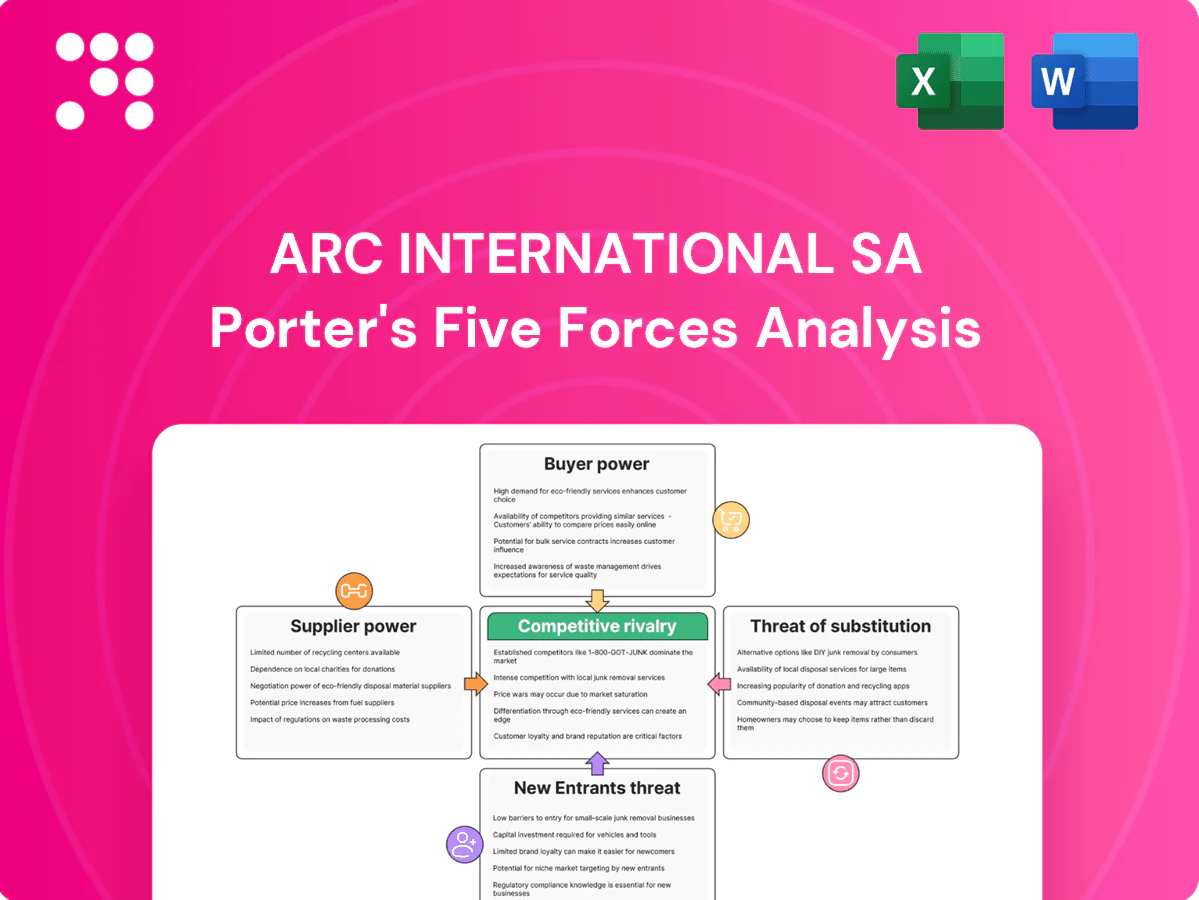
ARC International SA Porter's Five Forces Analysis

A Must-Have Tool for Decision-Makers
ARC International SA faces moderate supplier power, fragmented buyer segments, and steady rivalry from glassware and tabletop producers, while new entrants and substitutes exert variable pressure depending on product differentiation. This brief snapshot only scratches the surface. Unlock the full Porter's Five Forces Analysis to explore ARC International SA’s competitive dynamics and strategic advantages in detail.
Suppliers Bargaining Power

Concentrated raw inputs
Glass manufacture depends on high-purity silica sand, soda ash and limestone sourced from a narrow supplier base; global soda ash production was about 58 million tonnes in 2024 (USGS), highlighting concentrated supply. Supplier concentration for specialty grades elevates switching costs and can extend lead times beyond 12 weeks. ARC mitigates exposure through multi-sourcing and long-term contracts with regional quarries to reduce logistics and delivery risk.
Energy intensity exposure
Melting furnaces at ARC International are highly energy intensive, giving gas and power suppliers strong leverage over costs; Europe wholesale gas and power volatility in 2024, with EUA carbon prices around €95/t, amplified this effect. Energy price swings compressed margins and prompted customer surcharges during 2024. Hedging and efficiency upgrades reduced but did not eliminate exposure, while EU carbon costs further elevated supplier power.

Specialized equipment & molds
Precision molds, forming lines and furnace rebuilds are sourced from specialized OEMs, creating dependence on a small pool of qualified vendors and long lead times often measured in months; switching suppliers requires costly requalification and carries downtime risk, while strategic partnerships and proactive preventative maintenance programs materially reduce this supplier bargaining disadvantage.

Additives, coatings, packaging
Colorants, opacifiers, tempering chemicals and protective coatings are supplied by niche vendors, giving them localized pricing power; food-contact rules (EU Regulation (EC) No 1935/2004) narrow viable alternatives and can add validation costs of up to €30–50k per SKU and months to qualification timelines in 2024. Packaging inputs (cartons, pallets, inks) track pulp and petrochemical cycles—pulp indices moved ~‑10% in 2024 while Brent averaged about $85/bbl—so suppliers can pass volatility through price adjustments; framework contracts mitigate but do not eliminate spike exposure.
- Niche suppliers concentrate >60% of specialty additive supply
- Validation costs per SKU: €30–50k (2024)
- Pulp index change ~‑10% (2024) / Brent ≈ $85/bbl (2024)
- Framework contracts reduce variability but cannot offset acute spikes
Supply chain resilience
ARC International SA's global footprint exposes it to transport, geopolitical and port congestion risks; suppliers split between EMEA and APAC add diversification but increase coordination complexity, while inventory buffers and nearshoring blunt suppliers' disruption leverage.
- EMEA/APAC diversification
- Inventory buffers & nearshoring
- Digital vendor management visibility
Enhanced digital vendor management in 2024 improved visibility and bargaining position.
Supplier power elevated by scarce soda ash, high energy costs and costly validation
Supplier power for ARC is elevated: key raw materials (soda ash ~58 Mt global, 2024) and niche additives (>60% concentration) limit alternatives and raise switching costs. Energy suppliers exert strong leverage (EUA ~€95/t; Brent ≈ $85/bbl, 2024), compressing margins despite hedging. Validation costs (€30–50k/SKU) and long OEM lead times sustain supplier pricing power, partially offset by multi-sourcing and nearshoring.
| Metric | 2024 Value |
|---|---|
| Global soda ash | 58 Mt |
| EUA carbon price | ~€95/t |
| Brent | ≈ $85/bbl |
| Niche supplier share | >60% |
| Validation cost/SKU | €30–50k |
What is included in the product
 Detailed Word Document
Tailored Porter's Five Forces analysis for ARC International SA that uncovers competitive dynamics, supplier and buyer power, substitute threats, entry barriers, and strategic implications for profitability and market positioning.

 Customizable Excel Spreadsheet
One-sheet Porter's Five Forces for ARC International SA that maps supplier/buyer power, competitive rivalry and entry/substitute threats—customizable pressure levels and clean visuals make it ideal for rapid strategic decisions and boardroom slides.
Customers Bargaining Power

Retail consolidation
Large supermarkets, mass merchants and e-commerce platforms, led by Walmart (FY2024 revenue $611.3bn), command shelf access and growing online reach (global e-commerce ~24% of retail sales in 2024), forcing heavy trade spend, private-label requests and strict OTIF targets. Their easy brand-switching increases price pressure; ARC’s brand portfolio secures listings but leaves margins exposed to intense negotiation.
HoReCa procurement scale
HoReCa buyers purchase standardized glassware and tableware in bulk, with the global foodservice market estimated at about $3.5 trillion in 2023, concentrating purchasing power in large operators and distributors. Tenders and framework contracts intensify price competition and can compress margins. Service levels, breakage warranties and replenishment speed drive switching despite low product differentiation. ARC’s Arcoroc premium positioning supports value propositions beyond price through durability and design.

Low switching costs
Glassware in mid-market tiers is largely standardized, so buyers can shift among brands with minimal training or system changes; retailers typically refresh assortments seasonally (about 4 times per year), increasing switching opportunities. Growing consumer emphasis on sustainability—roughly 60% worldwide indicate it affects purchases—means differentiation via design, durability, and sustainability claims helps blunt buyer leverage.

Private label and OEM
Retailers pushing private label to capture margin increases buyer power, forcing ARC International SA to accept lower prices and tighter terms; OEM work helps fill capacity but typically comes at lower margins and greater customization burdens, eroding pricing leverage. Dependence on a few large accounts concentrates risk, while a balanced B2B/B2C channel mix mitigates concentration and stabilizes revenue.
- Private label: raises buyer leverage
- OEM: lower price, higher customization
- Top-account concentration: amplifies risk
- Balanced B2B/B2C: reduces concentration
Price transparency online
- Price transparency: global e‑commerce ~25% (2024)
- Dynamic pricing: increases price visibility and volatility
- Promotions: erode ASPs
- Brand moat: Luminarc, Cristal d’Arques sustain premiums
E‑commerce rise and major account pressure squeeze margins; diversify B2B/B2C to cut risk
Large retailers and e‑commerce (global e‑commerce ~25% of retail sales in 2024) exert strong price/terms pressure; ARC secures listings but margins face heavy trade spend and private‑label demands. HoReCa bulk buying (foodservice ≈$3.5tn 2023) and OEM work compress margins despite premium brands. Concentration in top accounts raises risk; balanced B2B/B2C mix mitigates it.
| Metric | Value |
|---|---|
| Walmart FY2024 revenue | $611.3bn |
| Global e‑commerce (2024) | ≈25% |
| Foodservice market (2023) | ≈$3.5tn |
Preview Before You Purchase
ARC International SA Porter's Five Forces Analysis
This preview shows the exact Porter's Five Forces analysis for ARC International SA you'll receive immediately after purchase—no placeholders. The document covers supplier power, buyer power, competitive rivalry, threat of substitutes, and barriers to entry with actionable insights. It's fully formatted and ready for immediate download after payment.

A Must-Have Tool for Decision-Makers
ARC International SA faces moderate supplier power, fragmented buyer segments, and steady rivalry from glassware and tabletop producers, while new entrants and substitutes exert variable pressure depending on product differentiation. This brief snapshot only scratches the surface. Unlock the full Porter's Five Forces Analysis to explore ARC International SA’s competitive dynamics and strategic advantages in detail.
Suppliers Bargaining Power
Concentrated raw inputs
Glass manufacture depends on high-purity silica sand, soda ash and limestone sourced from a narrow supplier base; global soda ash production was about 58 million tonnes in 2024 (USGS), highlighting concentrated supply. Supplier concentration for specialty grades elevates switching costs and can extend lead times beyond 12 weeks. ARC mitigates exposure through multi-sourcing and long-term contracts with regional quarries to reduce logistics and delivery risk.
Energy intensity exposure
Melting furnaces at ARC International are highly energy intensive, giving gas and power suppliers strong leverage over costs; Europe wholesale gas and power volatility in 2024, with EUA carbon prices around €95/t, amplified this effect. Energy price swings compressed margins and prompted customer surcharges during 2024. Hedging and efficiency upgrades reduced but did not eliminate exposure, while EU carbon costs further elevated supplier power.
Specialized equipment & molds
Precision molds, forming lines and furnace rebuilds are sourced from specialized OEMs, creating dependence on a small pool of qualified vendors and long lead times often measured in months; switching suppliers requires costly requalification and carries downtime risk, while strategic partnerships and proactive preventative maintenance programs materially reduce this supplier bargaining disadvantage.
Additives, coatings, packaging
Colorants, opacifiers, tempering chemicals and protective coatings are supplied by niche vendors, giving them localized pricing power; food-contact rules (EU Regulation (EC) No 1935/2004) narrow viable alternatives and can add validation costs of up to €30–50k per SKU and months to qualification timelines in 2024. Packaging inputs (cartons, pallets, inks) track pulp and petrochemical cycles—pulp indices moved ~‑10% in 2024 while Brent averaged about $85/bbl—so suppliers can pass volatility through price adjustments; framework contracts mitigate but do not eliminate spike exposure.
- Niche suppliers concentrate >60% of specialty additive supply
- Validation costs per SKU: €30–50k (2024)
- Pulp index change ~‑10% (2024) / Brent ≈ $85/bbl (2024)
- Framework contracts reduce variability but cannot offset acute spikes
Supply chain resilience
ARC International SA's global footprint exposes it to transport, geopolitical and port congestion risks; suppliers split between EMEA and APAC add diversification but increase coordination complexity, while inventory buffers and nearshoring blunt suppliers' disruption leverage.
- EMEA/APAC diversification
- Inventory buffers & nearshoring
- Digital vendor management visibility
Enhanced digital vendor management in 2024 improved visibility and bargaining position.
Supplier power elevated by scarce soda ash, high energy costs and costly validation
Supplier power for ARC is elevated: key raw materials (soda ash ~58 Mt global, 2024) and niche additives (>60% concentration) limit alternatives and raise switching costs. Energy suppliers exert strong leverage (EUA ~€95/t; Brent ≈ $85/bbl, 2024), compressing margins despite hedging. Validation costs (€30–50k/SKU) and long OEM lead times sustain supplier pricing power, partially offset by multi-sourcing and nearshoring.
| Metric | 2024 Value |
|---|---|
| Global soda ash | 58 Mt |
| EUA carbon price | ~€95/t |
| Brent | ≈ $85/bbl |
| Niche supplier share | >60% |
| Validation cost/SKU | €30–50k |
What is included in the product
Detailed Word Document
Tailored Porter's Five Forces analysis for ARC International SA that uncovers competitive dynamics, supplier and buyer power, substitute threats, entry barriers, and strategic implications for profitability and market positioning.
Customizable Excel Spreadsheet
One-sheet Porter's Five Forces for ARC International SA that maps supplier/buyer power, competitive rivalry and entry/substitute threats—customizable pressure levels and clean visuals make it ideal for rapid strategic decisions and boardroom slides.
Customers Bargaining Power
Retail consolidation
Large supermarkets, mass merchants and e-commerce platforms, led by Walmart (FY2024 revenue $611.3bn), command shelf access and growing online reach (global e-commerce ~24% of retail sales in 2024), forcing heavy trade spend, private-label requests and strict OTIF targets. Their easy brand-switching increases price pressure; ARC’s brand portfolio secures listings but leaves margins exposed to intense negotiation.
HoReCa procurement scale
HoReCa buyers purchase standardized glassware and tableware in bulk, with the global foodservice market estimated at about $3.5 trillion in 2023, concentrating purchasing power in large operators and distributors. Tenders and framework contracts intensify price competition and can compress margins. Service levels, breakage warranties and replenishment speed drive switching despite low product differentiation. ARC’s Arcoroc premium positioning supports value propositions beyond price through durability and design.
Low switching costs
Glassware in mid-market tiers is largely standardized, so buyers can shift among brands with minimal training or system changes; retailers typically refresh assortments seasonally (about 4 times per year), increasing switching opportunities. Growing consumer emphasis on sustainability—roughly 60% worldwide indicate it affects purchases—means differentiation via design, durability, and sustainability claims helps blunt buyer leverage.
Private label and OEM
Retailers pushing private label to capture margin increases buyer power, forcing ARC International SA to accept lower prices and tighter terms; OEM work helps fill capacity but typically comes at lower margins and greater customization burdens, eroding pricing leverage. Dependence on a few large accounts concentrates risk, while a balanced B2B/B2C channel mix mitigates concentration and stabilizes revenue.
- Private label: raises buyer leverage
- OEM: lower price, higher customization
- Top-account concentration: amplifies risk
- Balanced B2B/B2C: reduces concentration
Price transparency online
- Price transparency: global e‑commerce ~25% (2024)
- Dynamic pricing: increases price visibility and volatility
- Promotions: erode ASPs
- Brand moat: Luminarc, Cristal d’Arques sustain premiums
E‑commerce rise and major account pressure squeeze margins; diversify B2B/B2C to cut risk
Large retailers and e‑commerce (global e‑commerce ~25% of retail sales in 2024) exert strong price/terms pressure; ARC secures listings but margins face heavy trade spend and private‑label demands. HoReCa bulk buying (foodservice ≈$3.5tn 2023) and OEM work compress margins despite premium brands. Concentration in top accounts raises risk; balanced B2B/B2C mix mitigates it.
| Metric | Value |
|---|---|
| Walmart FY2024 revenue | $611.3bn |
| Global e‑commerce (2024) | ≈25% |
| Foodservice market (2023) | ≈$3.5tn |
Preview Before You Purchase
ARC International SA Porter's Five Forces Analysis
This preview shows the exact Porter's Five Forces analysis for ARC International SA you'll receive immediately after purchase—no placeholders. The document covers supplier power, buyer power, competitive rivalry, threat of substitutes, and barriers to entry with actionable insights. It's fully formatted and ready for immediate download after payment.
Original: $10.00
-65%$10.00
$3.50Description
A Must-Have Tool for Decision-Makers
ARC International SA faces moderate supplier power, fragmented buyer segments, and steady rivalry from glassware and tabletop producers, while new entrants and substitutes exert variable pressure depending on product differentiation. This brief snapshot only scratches the surface. Unlock the full Porter's Five Forces Analysis to explore ARC International SA’s competitive dynamics and strategic advantages in detail.
Suppliers Bargaining Power
Concentrated raw inputs
Glass manufacture depends on high-purity silica sand, soda ash and limestone sourced from a narrow supplier base; global soda ash production was about 58 million tonnes in 2024 (USGS), highlighting concentrated supply. Supplier concentration for specialty grades elevates switching costs and can extend lead times beyond 12 weeks. ARC mitigates exposure through multi-sourcing and long-term contracts with regional quarries to reduce logistics and delivery risk.
Energy intensity exposure
Melting furnaces at ARC International are highly energy intensive, giving gas and power suppliers strong leverage over costs; Europe wholesale gas and power volatility in 2024, with EUA carbon prices around €95/t, amplified this effect. Energy price swings compressed margins and prompted customer surcharges during 2024. Hedging and efficiency upgrades reduced but did not eliminate exposure, while EU carbon costs further elevated supplier power.
Specialized equipment & molds
Precision molds, forming lines and furnace rebuilds are sourced from specialized OEMs, creating dependence on a small pool of qualified vendors and long lead times often measured in months; switching suppliers requires costly requalification and carries downtime risk, while strategic partnerships and proactive preventative maintenance programs materially reduce this supplier bargaining disadvantage.
Additives, coatings, packaging
Colorants, opacifiers, tempering chemicals and protective coatings are supplied by niche vendors, giving them localized pricing power; food-contact rules (EU Regulation (EC) No 1935/2004) narrow viable alternatives and can add validation costs of up to €30–50k per SKU and months to qualification timelines in 2024. Packaging inputs (cartons, pallets, inks) track pulp and petrochemical cycles—pulp indices moved ~‑10% in 2024 while Brent averaged about $85/bbl—so suppliers can pass volatility through price adjustments; framework contracts mitigate but do not eliminate spike exposure.
- Niche suppliers concentrate >60% of specialty additive supply
- Validation costs per SKU: €30–50k (2024)
- Pulp index change ~‑10% (2024) / Brent ≈ $85/bbl (2024)
- Framework contracts reduce variability but cannot offset acute spikes
Supply chain resilience
ARC International SA's global footprint exposes it to transport, geopolitical and port congestion risks; suppliers split between EMEA and APAC add diversification but increase coordination complexity, while inventory buffers and nearshoring blunt suppliers' disruption leverage.
- EMEA/APAC diversification
- Inventory buffers & nearshoring
- Digital vendor management visibility
Enhanced digital vendor management in 2024 improved visibility and bargaining position.
Supplier power elevated by scarce soda ash, high energy costs and costly validation
Supplier power for ARC is elevated: key raw materials (soda ash ~58 Mt global, 2024) and niche additives (>60% concentration) limit alternatives and raise switching costs. Energy suppliers exert strong leverage (EUA ~€95/t; Brent ≈ $85/bbl, 2024), compressing margins despite hedging. Validation costs (€30–50k/SKU) and long OEM lead times sustain supplier pricing power, partially offset by multi-sourcing and nearshoring.
| Metric | 2024 Value |
|---|---|
| Global soda ash | 58 Mt |
| EUA carbon price | ~€95/t |
| Brent | ≈ $85/bbl |
| Niche supplier share | >60% |
| Validation cost/SKU | €30–50k |
What is included in the product
Detailed Word Document
Tailored Porter's Five Forces analysis for ARC International SA that uncovers competitive dynamics, supplier and buyer power, substitute threats, entry barriers, and strategic implications for profitability and market positioning.
Customizable Excel Spreadsheet
One-sheet Porter's Five Forces for ARC International SA that maps supplier/buyer power, competitive rivalry and entry/substitute threats—customizable pressure levels and clean visuals make it ideal for rapid strategic decisions and boardroom slides.
Customers Bargaining Power
Retail consolidation
Large supermarkets, mass merchants and e-commerce platforms, led by Walmart (FY2024 revenue $611.3bn), command shelf access and growing online reach (global e-commerce ~24% of retail sales in 2024), forcing heavy trade spend, private-label requests and strict OTIF targets. Their easy brand-switching increases price pressure; ARC’s brand portfolio secures listings but leaves margins exposed to intense negotiation.
HoReCa procurement scale
HoReCa buyers purchase standardized glassware and tableware in bulk, with the global foodservice market estimated at about $3.5 trillion in 2023, concentrating purchasing power in large operators and distributors. Tenders and framework contracts intensify price competition and can compress margins. Service levels, breakage warranties and replenishment speed drive switching despite low product differentiation. ARC’s Arcoroc premium positioning supports value propositions beyond price through durability and design.
Low switching costs
Glassware in mid-market tiers is largely standardized, so buyers can shift among brands with minimal training or system changes; retailers typically refresh assortments seasonally (about 4 times per year), increasing switching opportunities. Growing consumer emphasis on sustainability—roughly 60% worldwide indicate it affects purchases—means differentiation via design, durability, and sustainability claims helps blunt buyer leverage.
Private label and OEM
Retailers pushing private label to capture margin increases buyer power, forcing ARC International SA to accept lower prices and tighter terms; OEM work helps fill capacity but typically comes at lower margins and greater customization burdens, eroding pricing leverage. Dependence on a few large accounts concentrates risk, while a balanced B2B/B2C channel mix mitigates concentration and stabilizes revenue.
- Private label: raises buyer leverage
- OEM: lower price, higher customization
- Top-account concentration: amplifies risk
- Balanced B2B/B2C: reduces concentration
Price transparency online
- Price transparency: global e‑commerce ~25% (2024)
- Dynamic pricing: increases price visibility and volatility
- Promotions: erode ASPs
- Brand moat: Luminarc, Cristal d’Arques sustain premiums
E‑commerce rise and major account pressure squeeze margins; diversify B2B/B2C to cut risk
Large retailers and e‑commerce (global e‑commerce ~25% of retail sales in 2024) exert strong price/terms pressure; ARC secures listings but margins face heavy trade spend and private‑label demands. HoReCa bulk buying (foodservice ≈$3.5tn 2023) and OEM work compress margins despite premium brands. Concentration in top accounts raises risk; balanced B2B/B2C mix mitigates it.
| Metric | Value |
|---|---|
| Walmart FY2024 revenue | $611.3bn |
| Global e‑commerce (2024) | ≈25% |
| Foodservice market (2023) | ≈$3.5tn |
Preview Before You Purchase
ARC International SA Porter's Five Forces Analysis
This preview shows the exact Porter's Five Forces analysis for ARC International SA you'll receive immediately after purchase—no placeholders. The document covers supplier power, buyer power, competitive rivalry, threat of substitutes, and barriers to entry with actionable insights. It's fully formatted and ready for immediate download after payment.











