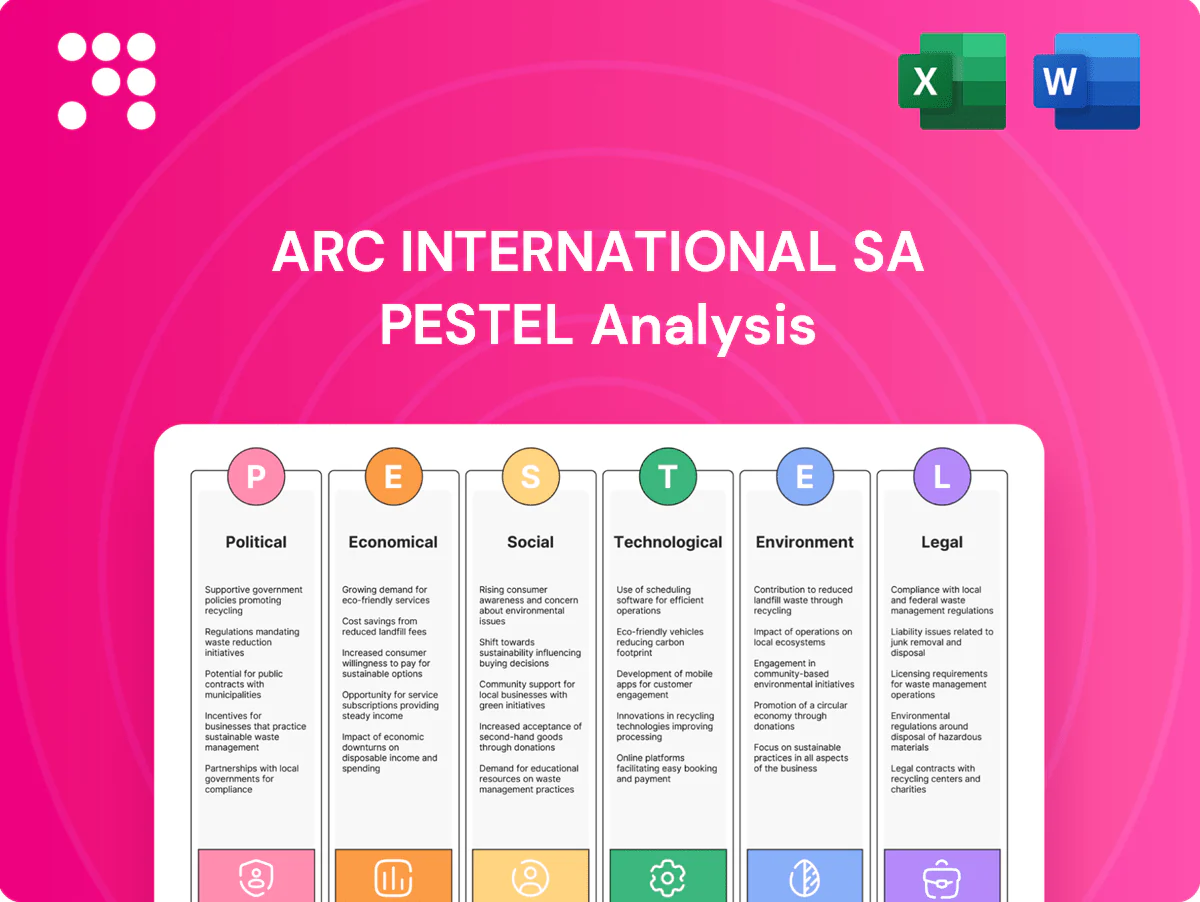
ARC International SA PESTLE Analysis

Plan Smarter. Present Sharper. Compete Stronger.
Gain a competitive edge with our targeted PESTLE analysis of ARC International SA — three to five concise insights showing how political, economic, social, technological, legal, and environmental forces shape its strategy. Ideal for investors and planners, this brief highlights key risks and opportunities. Purchase the full report for detailed, actionable intelligence and immediate download.
Political factors

Trade policies and tariffs
Glassware faces varying tariffs and anti-dumping measures—applied duties typically range 0–12% across markets and WTO recorded roughly 480 new trade remedies in 2023–24—so shifts in EU, US, MENA and Asian trade policy can move ARC’s landed costs and pricing power. Preferential agreements covering about 40% of global GDP can open HORECA channels, while rising protectionism favors local rivals; active compliance and diversified sourcing mitigate shocks.
Energy and industrial policy
Glass melting is highly energy‑intensive, often representing 20–30% of production costs, leaving ARC exposed to government price caps and carbon levies; EU ETS prices averaged around €100/tCO2 in 2024–25, materially raising fuel costs. EU industrial schemes — including the Innovation Fund (~€38bn pipeline to 2030) and REPowerEU hydrogen rollout — can subsidize electrification and furnace upgrades, lowering long‑term capex. Sudden removal of subsidies or caps would spike gas/electric bills and compress margins sharply. Active lobbying and participation in green industry programs are therefore strategic levers to secure funding and regulatory relief.

Geopolitical stability and logistics
Conflicts and sanctions — notably Red Sea attacks since late 2023 that forced vessel rerouting adding up to 14 days — and EU/US sanctions on Russia disrupt inbound raw material flows and outbound shipments, driving higher freight and lead times for B2B hospitality and retail clients; political risk in key regions slows public/private hospitality investment, making contingency inventory and multi-node distribution essential.

Public procurement and hospitality stimulus
Government tourism and hospitality stimulus, especially around major events, raises demand for durable tableware for contract catering; austerity or cuts to public catering budgets reduce large-volume orders. City expos and Paris 2024 created sizeable tenders for Arcoroc and Luminarc. Monitoring policy and tender calendars supports capacity planning.
- Tag: demand surge — events/tourism stimulus
- Tag: risk — public catering budget cuts
- Tag: opportunity — city tenders (Olympics/expos)
- Tag: action — monitor policy/tender calendars
Local content and investment incentives
Many markets favor local production through tax breaks or formal local-content rules; as of 2024 over 40 countries maintain such measures. Establishing regional finishing/packing can unlock incentives, reduce tariffs by up to 15% and cut lead times by 7–14 days, improving speed-to-market. Political shifts can alter eligibility and timelines, so flexible footprint planning preserves optionality.
- Over 40 countries with local-content measures (2024)
- Tariff savings up to 15% via regional finishing
- Lead-time reduction ~7–14 days
- Flexible footprint mitigates policy risk
Tariffs and remedies hit glassware; EU carbon €100/tCO2 raises costs
Glassware faces tariffs 0–12% and ~480 new trade remedies in 2023–24, while 40% of global GDP under preferential deals aids HORECA access; protectionism favors local rivals. Energy (20–30% of costs) is pressured by EU ETS ~€100/tCO2 in 2024–25. Red Sea disruptions since 2023 added up to 14 days; 40+ countries had local‑content rules in 2024.
| Tag | Value |
|---|---|
| Trade remedies | ~480 (2023–24) |
| Tariffs | 0–12% |
| Preferential GDP | ~40% |
| EU ETS | ~€100/tCO2 (2024–25) |
| Local‑content | 40+ countries (2024) |
What is included in the product
 Detailed Word Document
Explores how macro-environmental factors uniquely affect ARC International SA across Political, Economic, Social, Technological, Environmental and Legal dimensions, with data-driven subpoints and region/industry specificity; designed to support executives, consultants and investors with forward-looking insights, scenario planning and ready-to-insert findings for business plans, pitch decks and reports.

 Customizable Excel Spreadsheet
A concise, visually segmented PESTLE summary for ARC International SA that simplifies external risk assessment, can be dropped into presentations, annotated for local context, and easily shared across teams to speed strategy alignment and decision-making.
Economic factors

Consumer and hospitality cycles
ARC serves retail consumers and B2B HoReCa with distinct cycles: consumer recessions curb discretionary tableware spend while hotel/restaurant capex falls, whereas recoveries drive replacement and upgrade orders; international tourist arrivals reached about 88% of 2019 levels in 2023 (UNWTO), lifting HoReCa demand. Mix shifts between B2B and B2C materially affect margins and inventory turns, so scenario planning is used to smooth volatility.
Input costs: energy and raw materials
Input costs — soda ash, silica sand, packaging and especially energy — drive ARC International SA's COGS, with EU industrial electricity averaging ~€0.13/kWh in 2024 (Eurostat) and price spikes passing through with a lag that pressures gross margin. Long-term supply contracts and energy hedges smooth volatility but limit upside in downcycles. Productivity gains and higher cullet use offset inflation; Glass for Europe notes ~2–3% energy savings per 10ppt cullet increase.

FX fluctuations
ARC Internationals euro exposure vs USD and emerging-market currencies shapes export pricing and input costs; EUR/USD averaged about 1.09 in 2024, influencing competitiveness in the Americas while weaker emerging currencies raised local input costs in Asia. Currency swings produce material translation effects across EMEA, Americas and Asia revenues. Natural hedging through local sourcing and multi-currency invoicing plus active treasury policies (cash pooling, FX forwards) mitigate volatility.

Retail channel dynamics
Consolidation among mass retailers and e-commerce platforms raises buyer power, with Amazon holding about 38% of US e-commerce in 2023, pressuring terms for suppliers. Private label penetration in Western Europe hovered near 30% in 2023, compressing price points and shelf space. Premium lines like Cristal d’Arques can protect margins if differentiation is clear, and omnichannel execution broadens reach, lowering reliance on any single buyer.
- Buyer power: consolidated retailers/marketplaces
- Private label ≈30% Western Europe (2023)
- Premium branding defends margin
- Omnichannel reduces single-buyer dependency
Capital intensity and investment cycle
Furnace rebuilds and line automation require sizable capex with multi-year payback; financing and internal hurdle rates are sensitive to prevailing rates—US Fed funds 5.25–5.50% (2024–25) and ECB deposit rate around 4.00% in 2024—affecting lease/debt costs. Well-timed upgrades boost efficiency and product quality, supporting pricing, while delayed investment risks obsolescence and higher unit costs.
- Capex: multi-year payback for furnaces and automation
- Interest rates: Fed 5.25–5.50% (2024–25), ECB ~4.00% (2024)
- Benefit: efficiency/quality uplift supports pricing
- Risk: delay → obsolescence and higher unit costs
Tariffs and remedies hit glassware; EU carbon €100/tCO2 raises costs
Demand: consumer recessions hit tableware spend while HoReCa recovers with tourism ~88% of 2019 (UNWTO 2023), shifting margin mix.
Costs: energy (EU industrial ≈€0.13/kWh 2024) and raw materials drive COGS; cullet adds 2–3% energy savings per 10ppt (Glass for Europe).
Financials: EUR/USD ≈1.09 (2024), Fed 5.25–5.50% (2024–25), ECB ≈4.00% (2024) — affecting capex financing.
| Metric | Value |
|---|---|
| Tourism level vs 2019 | ~88% (2023) |
| EU industrial electricity | €0.13/kWh (2024) |
| EUR/USD | 1.09 (2024) |
| Fed funds | 5.25–5.50% (2024–25) |
| ECB deposit | ~4.00% (2024) |
Full Version Awaits
ARC International SA PESTLE Analysis
The ARC International SA PESTLE Analysis examines political, economic, social, technological, legal and environmental factors affecting the company and market positioning, with actionable implications for strategy and risk management. The preview shown here is the exact document you’ll receive after purchase—fully formatted and ready to use.

Plan Smarter. Present Sharper. Compete Stronger.
Gain a competitive edge with our targeted PESTLE analysis of ARC International SA — three to five concise insights showing how political, economic, social, technological, legal, and environmental forces shape its strategy. Ideal for investors and planners, this brief highlights key risks and opportunities. Purchase the full report for detailed, actionable intelligence and immediate download.
Political factors
Trade policies and tariffs
Glassware faces varying tariffs and anti-dumping measures—applied duties typically range 0–12% across markets and WTO recorded roughly 480 new trade remedies in 2023–24—so shifts in EU, US, MENA and Asian trade policy can move ARC’s landed costs and pricing power. Preferential agreements covering about 40% of global GDP can open HORECA channels, while rising protectionism favors local rivals; active compliance and diversified sourcing mitigate shocks.
Energy and industrial policy
Glass melting is highly energy‑intensive, often representing 20–30% of production costs, leaving ARC exposed to government price caps and carbon levies; EU ETS prices averaged around €100/tCO2 in 2024–25, materially raising fuel costs. EU industrial schemes — including the Innovation Fund (~€38bn pipeline to 2030) and REPowerEU hydrogen rollout — can subsidize electrification and furnace upgrades, lowering long‑term capex. Sudden removal of subsidies or caps would spike gas/electric bills and compress margins sharply. Active lobbying and participation in green industry programs are therefore strategic levers to secure funding and regulatory relief.
Geopolitical stability and logistics
Conflicts and sanctions — notably Red Sea attacks since late 2023 that forced vessel rerouting adding up to 14 days — and EU/US sanctions on Russia disrupt inbound raw material flows and outbound shipments, driving higher freight and lead times for B2B hospitality and retail clients; political risk in key regions slows public/private hospitality investment, making contingency inventory and multi-node distribution essential.
Public procurement and hospitality stimulus
Government tourism and hospitality stimulus, especially around major events, raises demand for durable tableware for contract catering; austerity or cuts to public catering budgets reduce large-volume orders. City expos and Paris 2024 created sizeable tenders for Arcoroc and Luminarc. Monitoring policy and tender calendars supports capacity planning.
- Tag: demand surge — events/tourism stimulus
- Tag: risk — public catering budget cuts
- Tag: opportunity — city tenders (Olympics/expos)
- Tag: action — monitor policy/tender calendars
Local content and investment incentives
Many markets favor local production through tax breaks or formal local-content rules; as of 2024 over 40 countries maintain such measures. Establishing regional finishing/packing can unlock incentives, reduce tariffs by up to 15% and cut lead times by 7–14 days, improving speed-to-market. Political shifts can alter eligibility and timelines, so flexible footprint planning preserves optionality.
- Over 40 countries with local-content measures (2024)
- Tariff savings up to 15% via regional finishing
- Lead-time reduction ~7–14 days
- Flexible footprint mitigates policy risk
Tariffs and remedies hit glassware; EU carbon €100/tCO2 raises costs
Glassware faces tariffs 0–12% and ~480 new trade remedies in 2023–24, while 40% of global GDP under preferential deals aids HORECA access; protectionism favors local rivals. Energy (20–30% of costs) is pressured by EU ETS ~€100/tCO2 in 2024–25. Red Sea disruptions since 2023 added up to 14 days; 40+ countries had local‑content rules in 2024.
| Tag | Value |
|---|---|
| Trade remedies | ~480 (2023–24) |
| Tariffs | 0–12% |
| Preferential GDP | ~40% |
| EU ETS | ~€100/tCO2 (2024–25) |
| Local‑content | 40+ countries (2024) |
What is included in the product
Detailed Word Document
Explores how macro-environmental factors uniquely affect ARC International SA across Political, Economic, Social, Technological, Environmental and Legal dimensions, with data-driven subpoints and region/industry specificity; designed to support executives, consultants and investors with forward-looking insights, scenario planning and ready-to-insert findings for business plans, pitch decks and reports.
Customizable Excel Spreadsheet
A concise, visually segmented PESTLE summary for ARC International SA that simplifies external risk assessment, can be dropped into presentations, annotated for local context, and easily shared across teams to speed strategy alignment and decision-making.
Economic factors
Consumer and hospitality cycles
ARC serves retail consumers and B2B HoReCa with distinct cycles: consumer recessions curb discretionary tableware spend while hotel/restaurant capex falls, whereas recoveries drive replacement and upgrade orders; international tourist arrivals reached about 88% of 2019 levels in 2023 (UNWTO), lifting HoReCa demand. Mix shifts between B2B and B2C materially affect margins and inventory turns, so scenario planning is used to smooth volatility.
Input costs: energy and raw materials
Input costs — soda ash, silica sand, packaging and especially energy — drive ARC International SA's COGS, with EU industrial electricity averaging ~€0.13/kWh in 2024 (Eurostat) and price spikes passing through with a lag that pressures gross margin. Long-term supply contracts and energy hedges smooth volatility but limit upside in downcycles. Productivity gains and higher cullet use offset inflation; Glass for Europe notes ~2–3% energy savings per 10ppt cullet increase.
FX fluctuations
ARC Internationals euro exposure vs USD and emerging-market currencies shapes export pricing and input costs; EUR/USD averaged about 1.09 in 2024, influencing competitiveness in the Americas while weaker emerging currencies raised local input costs in Asia. Currency swings produce material translation effects across EMEA, Americas and Asia revenues. Natural hedging through local sourcing and multi-currency invoicing plus active treasury policies (cash pooling, FX forwards) mitigate volatility.
Retail channel dynamics
Consolidation among mass retailers and e-commerce platforms raises buyer power, with Amazon holding about 38% of US e-commerce in 2023, pressuring terms for suppliers. Private label penetration in Western Europe hovered near 30% in 2023, compressing price points and shelf space. Premium lines like Cristal d’Arques can protect margins if differentiation is clear, and omnichannel execution broadens reach, lowering reliance on any single buyer.
- Buyer power: consolidated retailers/marketplaces
- Private label ≈30% Western Europe (2023)
- Premium branding defends margin
- Omnichannel reduces single-buyer dependency
Capital intensity and investment cycle
Furnace rebuilds and line automation require sizable capex with multi-year payback; financing and internal hurdle rates are sensitive to prevailing rates—US Fed funds 5.25–5.50% (2024–25) and ECB deposit rate around 4.00% in 2024—affecting lease/debt costs. Well-timed upgrades boost efficiency and product quality, supporting pricing, while delayed investment risks obsolescence and higher unit costs.
- Capex: multi-year payback for furnaces and automation
- Interest rates: Fed 5.25–5.50% (2024–25), ECB ~4.00% (2024)
- Benefit: efficiency/quality uplift supports pricing
- Risk: delay → obsolescence and higher unit costs
Tariffs and remedies hit glassware; EU carbon €100/tCO2 raises costs
Demand: consumer recessions hit tableware spend while HoReCa recovers with tourism ~88% of 2019 (UNWTO 2023), shifting margin mix.
Costs: energy (EU industrial ≈€0.13/kWh 2024) and raw materials drive COGS; cullet adds 2–3% energy savings per 10ppt (Glass for Europe).
Financials: EUR/USD ≈1.09 (2024), Fed 5.25–5.50% (2024–25), ECB ≈4.00% (2024) — affecting capex financing.
| Metric | Value |
|---|---|
| Tourism level vs 2019 | ~88% (2023) |
| EU industrial electricity | €0.13/kWh (2024) |
| EUR/USD | 1.09 (2024) |
| Fed funds | 5.25–5.50% (2024–25) |
| ECB deposit | ~4.00% (2024) |
Full Version Awaits
ARC International SA PESTLE Analysis
The ARC International SA PESTLE Analysis examines political, economic, social, technological, legal and environmental factors affecting the company and market positioning, with actionable implications for strategy and risk management. The preview shown here is the exact document you’ll receive after purchase—fully formatted and ready to use.
Description
Plan Smarter. Present Sharper. Compete Stronger.
Gain a competitive edge with our targeted PESTLE analysis of ARC International SA — three to five concise insights showing how political, economic, social, technological, legal, and environmental forces shape its strategy. Ideal for investors and planners, this brief highlights key risks and opportunities. Purchase the full report for detailed, actionable intelligence and immediate download.
Political factors
Trade policies and tariffs
Glassware faces varying tariffs and anti-dumping measures—applied duties typically range 0–12% across markets and WTO recorded roughly 480 new trade remedies in 2023–24—so shifts in EU, US, MENA and Asian trade policy can move ARC’s landed costs and pricing power. Preferential agreements covering about 40% of global GDP can open HORECA channels, while rising protectionism favors local rivals; active compliance and diversified sourcing mitigate shocks.
Energy and industrial policy
Glass melting is highly energy‑intensive, often representing 20–30% of production costs, leaving ARC exposed to government price caps and carbon levies; EU ETS prices averaged around €100/tCO2 in 2024–25, materially raising fuel costs. EU industrial schemes — including the Innovation Fund (~€38bn pipeline to 2030) and REPowerEU hydrogen rollout — can subsidize electrification and furnace upgrades, lowering long‑term capex. Sudden removal of subsidies or caps would spike gas/electric bills and compress margins sharply. Active lobbying and participation in green industry programs are therefore strategic levers to secure funding and regulatory relief.
Geopolitical stability and logistics
Conflicts and sanctions — notably Red Sea attacks since late 2023 that forced vessel rerouting adding up to 14 days — and EU/US sanctions on Russia disrupt inbound raw material flows and outbound shipments, driving higher freight and lead times for B2B hospitality and retail clients; political risk in key regions slows public/private hospitality investment, making contingency inventory and multi-node distribution essential.
Public procurement and hospitality stimulus
Government tourism and hospitality stimulus, especially around major events, raises demand for durable tableware for contract catering; austerity or cuts to public catering budgets reduce large-volume orders. City expos and Paris 2024 created sizeable tenders for Arcoroc and Luminarc. Monitoring policy and tender calendars supports capacity planning.
- Tag: demand surge — events/tourism stimulus
- Tag: risk — public catering budget cuts
- Tag: opportunity — city tenders (Olympics/expos)
- Tag: action — monitor policy/tender calendars
Local content and investment incentives
Many markets favor local production through tax breaks or formal local-content rules; as of 2024 over 40 countries maintain such measures. Establishing regional finishing/packing can unlock incentives, reduce tariffs by up to 15% and cut lead times by 7–14 days, improving speed-to-market. Political shifts can alter eligibility and timelines, so flexible footprint planning preserves optionality.
- Over 40 countries with local-content measures (2024)
- Tariff savings up to 15% via regional finishing
- Lead-time reduction ~7–14 days
- Flexible footprint mitigates policy risk
Tariffs and remedies hit glassware; EU carbon €100/tCO2 raises costs
Glassware faces tariffs 0–12% and ~480 new trade remedies in 2023–24, while 40% of global GDP under preferential deals aids HORECA access; protectionism favors local rivals. Energy (20–30% of costs) is pressured by EU ETS ~€100/tCO2 in 2024–25. Red Sea disruptions since 2023 added up to 14 days; 40+ countries had local‑content rules in 2024.
| Tag | Value |
|---|---|
| Trade remedies | ~480 (2023–24) |
| Tariffs | 0–12% |
| Preferential GDP | ~40% |
| EU ETS | ~€100/tCO2 (2024–25) |
| Local‑content | 40+ countries (2024) |
What is included in the product
Detailed Word Document
Explores how macro-environmental factors uniquely affect ARC International SA across Political, Economic, Social, Technological, Environmental and Legal dimensions, with data-driven subpoints and region/industry specificity; designed to support executives, consultants and investors with forward-looking insights, scenario planning and ready-to-insert findings for business plans, pitch decks and reports.
Customizable Excel Spreadsheet
A concise, visually segmented PESTLE summary for ARC International SA that simplifies external risk assessment, can be dropped into presentations, annotated for local context, and easily shared across teams to speed strategy alignment and decision-making.
Economic factors
Consumer and hospitality cycles
ARC serves retail consumers and B2B HoReCa with distinct cycles: consumer recessions curb discretionary tableware spend while hotel/restaurant capex falls, whereas recoveries drive replacement and upgrade orders; international tourist arrivals reached about 88% of 2019 levels in 2023 (UNWTO), lifting HoReCa demand. Mix shifts between B2B and B2C materially affect margins and inventory turns, so scenario planning is used to smooth volatility.
Input costs: energy and raw materials
Input costs — soda ash, silica sand, packaging and especially energy — drive ARC International SA's COGS, with EU industrial electricity averaging ~€0.13/kWh in 2024 (Eurostat) and price spikes passing through with a lag that pressures gross margin. Long-term supply contracts and energy hedges smooth volatility but limit upside in downcycles. Productivity gains and higher cullet use offset inflation; Glass for Europe notes ~2–3% energy savings per 10ppt cullet increase.
FX fluctuations
ARC Internationals euro exposure vs USD and emerging-market currencies shapes export pricing and input costs; EUR/USD averaged about 1.09 in 2024, influencing competitiveness in the Americas while weaker emerging currencies raised local input costs in Asia. Currency swings produce material translation effects across EMEA, Americas and Asia revenues. Natural hedging through local sourcing and multi-currency invoicing plus active treasury policies (cash pooling, FX forwards) mitigate volatility.
Retail channel dynamics
Consolidation among mass retailers and e-commerce platforms raises buyer power, with Amazon holding about 38% of US e-commerce in 2023, pressuring terms for suppliers. Private label penetration in Western Europe hovered near 30% in 2023, compressing price points and shelf space. Premium lines like Cristal d’Arques can protect margins if differentiation is clear, and omnichannel execution broadens reach, lowering reliance on any single buyer.
- Buyer power: consolidated retailers/marketplaces
- Private label ≈30% Western Europe (2023)
- Premium branding defends margin
- Omnichannel reduces single-buyer dependency
Capital intensity and investment cycle
Furnace rebuilds and line automation require sizable capex with multi-year payback; financing and internal hurdle rates are sensitive to prevailing rates—US Fed funds 5.25–5.50% (2024–25) and ECB deposit rate around 4.00% in 2024—affecting lease/debt costs. Well-timed upgrades boost efficiency and product quality, supporting pricing, while delayed investment risks obsolescence and higher unit costs.
- Capex: multi-year payback for furnaces and automation
- Interest rates: Fed 5.25–5.50% (2024–25), ECB ~4.00% (2024)
- Benefit: efficiency/quality uplift supports pricing
- Risk: delay → obsolescence and higher unit costs
Tariffs and remedies hit glassware; EU carbon €100/tCO2 raises costs
Demand: consumer recessions hit tableware spend while HoReCa recovers with tourism ~88% of 2019 (UNWTO 2023), shifting margin mix.
Costs: energy (EU industrial ≈€0.13/kWh 2024) and raw materials drive COGS; cullet adds 2–3% energy savings per 10ppt (Glass for Europe).
Financials: EUR/USD ≈1.09 (2024), Fed 5.25–5.50% (2024–25), ECB ≈4.00% (2024) — affecting capex financing.
| Metric | Value |
|---|---|
| Tourism level vs 2019 | ~88% (2023) |
| EU industrial electricity | €0.13/kWh (2024) |
| EUR/USD | 1.09 (2024) |
| Fed funds | 5.25–5.50% (2024–25) |
| ECB deposit | ~4.00% (2024) |
Full Version Awaits
ARC International SA PESTLE Analysis
The ARC International SA PESTLE Analysis examines political, economic, social, technological, legal and environmental factors affecting the company and market positioning, with actionable implications for strategy and risk management. The preview shown here is the exact document you’ll receive after purchase—fully formatted and ready to use.











