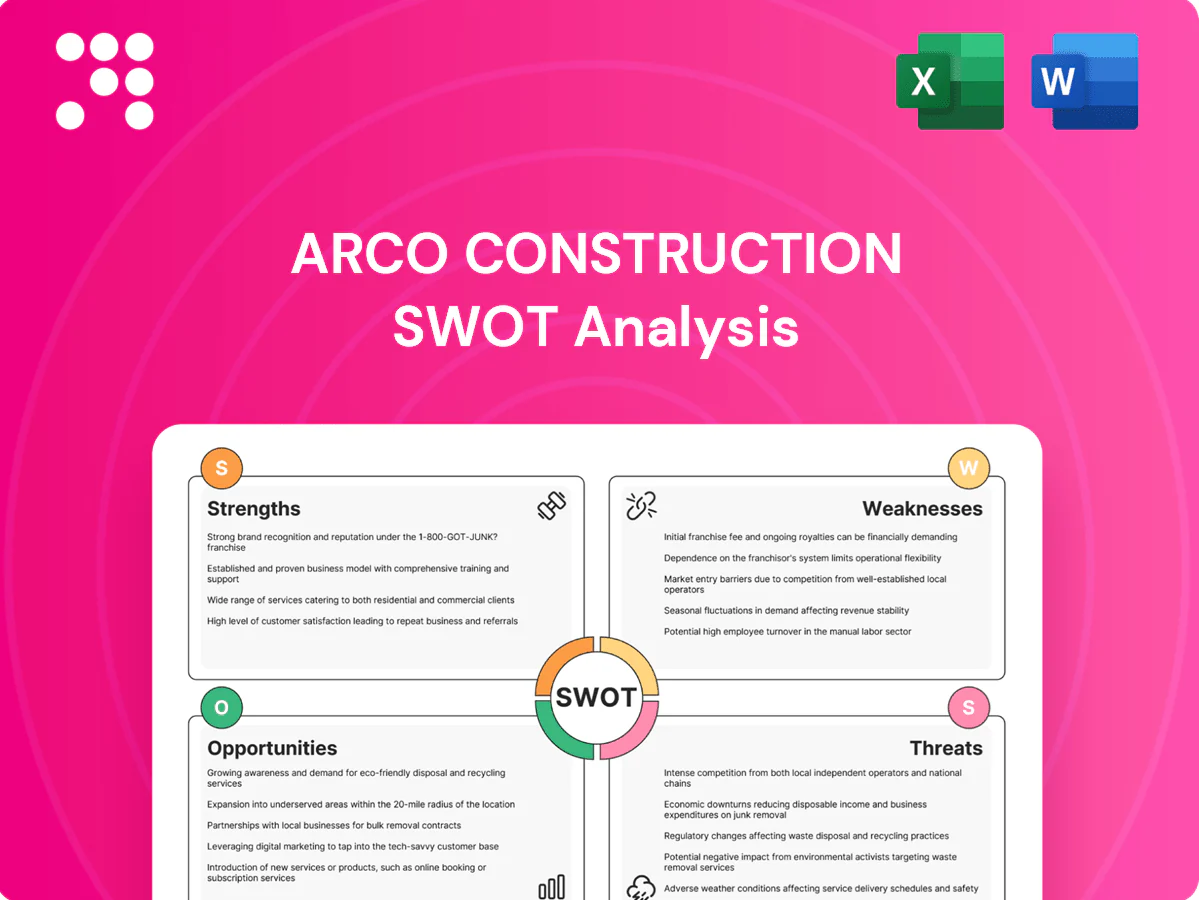
Arco Construction SWOT Analysis

Your Strategic Toolkit Starts Here
Arco Construction shows strong regional reputation and project execution capabilities, but faces margin pressure from rising material costs and tight competitive bidding. Our full SWOT reveals growth levers, risk mitigants, and strategic moves to enhance value. Purchase the complete Word+Excel report to plan, pitch, or invest with confidence.
Strengths

Integrated design-build model
Arco’s integrated design-build model reduces handoffs, compresses timelines, and minimizes scope gaps by delivering single-source responsibility; DBIA reported design-build captured about 48% of the U.S. nonresidential market in 2022. Fewer contracts and decision points streamline governance and lower transaction costs, improving procurement efficiency. One-party ownership of design, budget, and schedule enhances accountability and often yields higher predictability in cost and quality outcomes.
Multisector project expertise
Arco Construction’s experience across industrial, commercial, and multifamily diversifies revenue and helps smooth market cycles, aligning with a construction sector that represented about 4.1% of US GDP in 2023 (BEA). Cross-sector learnings boost constructability and value-engineering options, reducing change orders and cost overruns. Flexible resource allocation lets Arco shift crews and equipment as demand moves between end-markets. Clients benefit from a partner versed in varied codes, uses, and tenant requirements.

Cost and schedule efficiency
Arco’s lean planning and early contractor involvement cut rework and change orders, aligning with McKinsey findings that fragmented practices drive major overruns (large projects average ~20% schedule and ~80% cost overruns). Vendor bundling and standardized details deliver unit-cost advantages comparable to modular approaches that can reduce onsite time by up to ~40%. Parallel design, procurement and sitework accelerate schedules and improve predictability, boosting repeat-award rates and client satisfaction.

Strong subcontractor and supplier networks
Strong subcontractor and supplier networks give Arco Construction preferred trades that improve bid coverage, pricing certainty, and project quality; early commitments to key suppliers secure critical materials and reduce lead-time risks while relationship capital lets teams resolve field issues rapidly and extend geographic reach via vetted local partners.
- Preferred trades: better bids and consistent quality
- Early material commitments: lower lead-time risk
- Relationship capital: faster field problem resolution
- Vetted local partners: expanded geographic reach
Quality and safety focus
Process discipline at Arco raises workmanship and lifecycle performance, delivering lower rework rates and supporting an experience modifier rate (EMR) in the 0.6–0.9 range in 2024 versus industry averages closer to 1.0; a strong safety culture reduces incidents, delays, and insurance costs, while rigorous QA/QC limits warranty exposure and protects brand equity; clients pay premiums for low‑risk builders on occupied or complex sites.
- EMR 0.6–0.9 (2024)
- Lower rework/warranty claims
- Fewer delays, reduced insurance spend
- Preferred for occupied/complex sites
Design-build reduces handoffs, speeds delivery and steadies costs; EMR 0.6–0.9
Arco’s integrated design-build model reduces handoffs, shortens timelines and improves cost predictability. Cross-sector experience (industrial/commercial/multifamily) smooths revenue and enables flexible resourcing. Lean planning and supplier depth support low rework and a 2024 EMR of 0.6–0.9.
| Metric | Value |
|---|---|
| Design-build share | ~48% (2022) |
| EMR | 0.6–0.9 (2024) |
| Construction % GDP | 4.1% (2023) |
What is included in the product
 Detailed Word Document
Delivers a strategic overview of Arco Construction’s internal and external business factors, outlining strengths, weaknesses, opportunities, and threats to its market position and operational resilience.

 Customizable Excel Spreadsheet
Delivers a concise, Arco Construction–specific SWOT matrix for rapid strategy alignment and clear stakeholder presentations, streamlining decision-making and cross‑team communication.
Weaknesses

Design liability concentration
Owning both design and construction risk amplifies exposure when scope changes or performance issues arise, with industry rework commonly cited at 5–10% of contract value. Robust professional liability coverage and independent peer reviews are essential to limit claims and redesign costs. Complex MEP and life-safety integrations heighten error costs and coordination risk. Any design miss can cascade into schedule delays and budget overruns.
Margin pressure in competitive bids
Design-build bids tied to guaranteed maximum price often compress net margins to roughly 2–4%, while price-sensitive industrial and multifamily work sees winning bid cushions fall below 3%. Owners increasingly contest escalation allowances and cut contingencies to 1–2%, leaving little buffer against unforeseen conditions where change orders can exceed 5–10% of contract value.

Dependence on trade partner capacity
Execution quality hinges on subcontractor availability and performance, with 80% of contractors in a 2024 AGC survey reporting difficulty hiring skilled trades, increasing risk of defects and rework. Tight labor markets pushed industry-wide productivity down, contributing to average schedule slippages of 10–15% on complex projects in 2024. Overreliance on a few key trades raises concentration risk; regional variability—labor cost differentials up to 25% between states in 2024—complicates standardization.

Cyclicality of construction markets
Cyclicality of construction markets exposes Arco to delayed private developments and paused capex-heavy industrial builds during macro slowdowns; Fed funds at 5.25–5.50% (mid-2024) and 30-year mortgage rates near 7% have materially reduced multifamily and commercial pro formas, shrinking deal flow and tightening lending. Backlog visibility can deteriorate rapidly and overhead absorption becomes challenging in downturns, pressuring margins.
- Delayed private projects
- Higher rates cut pro formas and demand
- Rapid backlog erosion
- Fixed overheads pressure margins
Geographic and permitting complexity
Multi-jurisdictional code compliance strains Arco Construction’s preconstruction bandwidth, with permitting and inter-agency coordination frequently adding 6–12 months to timelines and complicating accurate bids. Lengthy entitlements erode design-build schedules and increase schedule risk; varying local labor rules and procurement norms drive administrative overhead. Missteps elevate compliance costs and rework, often inflating project costs by several percent.
- Permitting delays: 6–12 months
- Design-build schedule risk: high
- Local labor/procurement variance: significant
- Cost impact: rework adds multiple % to budgets
Design-build rework 5-10% and thin GMP 2-4% push schedules > 15%
Design-build exposure and rework (5–10% of contract value) concentrate risk and can cascade into >15% schedule slippages. Thin GMP margins (~2–4%) and owner cuts to contingencies (1–2%) leave minimal buffers; change orders frequently exceed 5–10%. Skilled-trade shortages (80% of contractors, AGC 2024) and permitting delays (6–12 months) amplify cost and backlog volatility amid higher rates.
| Metric | 2024–25 Value |
|---|---|
| Rework | 5–10% |
| GMP margins | 2–4% |
| Contractor hiring difficulty | 80% (AGC 2024) |
| Permitting delays | 6–12 months |
Same Document Delivered
Arco Construction SWOT Analysis
This is the actual Arco Construction SWOT Analysis document you’ll receive upon purchase—no surprises, just professional quality. The preview below is taken directly from the full report you'll get. Buy now to unlock the complete, editable version with full detail and actionable insights.

Your Strategic Toolkit Starts Here
Arco Construction shows strong regional reputation and project execution capabilities, but faces margin pressure from rising material costs and tight competitive bidding. Our full SWOT reveals growth levers, risk mitigants, and strategic moves to enhance value. Purchase the complete Word+Excel report to plan, pitch, or invest with confidence.
Strengths
Integrated design-build model
Arco’s integrated design-build model reduces handoffs, compresses timelines, and minimizes scope gaps by delivering single-source responsibility; DBIA reported design-build captured about 48% of the U.S. nonresidential market in 2022. Fewer contracts and decision points streamline governance and lower transaction costs, improving procurement efficiency. One-party ownership of design, budget, and schedule enhances accountability and often yields higher predictability in cost and quality outcomes.
Multisector project expertise
Arco Construction’s experience across industrial, commercial, and multifamily diversifies revenue and helps smooth market cycles, aligning with a construction sector that represented about 4.1% of US GDP in 2023 (BEA). Cross-sector learnings boost constructability and value-engineering options, reducing change orders and cost overruns. Flexible resource allocation lets Arco shift crews and equipment as demand moves between end-markets. Clients benefit from a partner versed in varied codes, uses, and tenant requirements.
Cost and schedule efficiency
Arco’s lean planning and early contractor involvement cut rework and change orders, aligning with McKinsey findings that fragmented practices drive major overruns (large projects average ~20% schedule and ~80% cost overruns). Vendor bundling and standardized details deliver unit-cost advantages comparable to modular approaches that can reduce onsite time by up to ~40%. Parallel design, procurement and sitework accelerate schedules and improve predictability, boosting repeat-award rates and client satisfaction.
Strong subcontractor and supplier networks
Strong subcontractor and supplier networks give Arco Construction preferred trades that improve bid coverage, pricing certainty, and project quality; early commitments to key suppliers secure critical materials and reduce lead-time risks while relationship capital lets teams resolve field issues rapidly and extend geographic reach via vetted local partners.
- Preferred trades: better bids and consistent quality
- Early material commitments: lower lead-time risk
- Relationship capital: faster field problem resolution
- Vetted local partners: expanded geographic reach
Quality and safety focus
Process discipline at Arco raises workmanship and lifecycle performance, delivering lower rework rates and supporting an experience modifier rate (EMR) in the 0.6–0.9 range in 2024 versus industry averages closer to 1.0; a strong safety culture reduces incidents, delays, and insurance costs, while rigorous QA/QC limits warranty exposure and protects brand equity; clients pay premiums for low‑risk builders on occupied or complex sites.
- EMR 0.6–0.9 (2024)
- Lower rework/warranty claims
- Fewer delays, reduced insurance spend
- Preferred for occupied/complex sites
Design-build reduces handoffs, speeds delivery and steadies costs; EMR 0.6–0.9
Arco’s integrated design-build model reduces handoffs, shortens timelines and improves cost predictability. Cross-sector experience (industrial/commercial/multifamily) smooths revenue and enables flexible resourcing. Lean planning and supplier depth support low rework and a 2024 EMR of 0.6–0.9.
| Metric | Value |
|---|---|
| Design-build share | ~48% (2022) |
| EMR | 0.6–0.9 (2024) |
| Construction % GDP | 4.1% (2023) |
What is included in the product
Detailed Word Document
Delivers a strategic overview of Arco Construction’s internal and external business factors, outlining strengths, weaknesses, opportunities, and threats to its market position and operational resilience.
Customizable Excel Spreadsheet
Delivers a concise, Arco Construction–specific SWOT matrix for rapid strategy alignment and clear stakeholder presentations, streamlining decision-making and cross‑team communication.
Weaknesses
Design liability concentration
Owning both design and construction risk amplifies exposure when scope changes or performance issues arise, with industry rework commonly cited at 5–10% of contract value. Robust professional liability coverage and independent peer reviews are essential to limit claims and redesign costs. Complex MEP and life-safety integrations heighten error costs and coordination risk. Any design miss can cascade into schedule delays and budget overruns.
Margin pressure in competitive bids
Design-build bids tied to guaranteed maximum price often compress net margins to roughly 2–4%, while price-sensitive industrial and multifamily work sees winning bid cushions fall below 3%. Owners increasingly contest escalation allowances and cut contingencies to 1–2%, leaving little buffer against unforeseen conditions where change orders can exceed 5–10% of contract value.
Dependence on trade partner capacity
Execution quality hinges on subcontractor availability and performance, with 80% of contractors in a 2024 AGC survey reporting difficulty hiring skilled trades, increasing risk of defects and rework. Tight labor markets pushed industry-wide productivity down, contributing to average schedule slippages of 10–15% on complex projects in 2024. Overreliance on a few key trades raises concentration risk; regional variability—labor cost differentials up to 25% between states in 2024—complicates standardization.
Cyclicality of construction markets
Cyclicality of construction markets exposes Arco to delayed private developments and paused capex-heavy industrial builds during macro slowdowns; Fed funds at 5.25–5.50% (mid-2024) and 30-year mortgage rates near 7% have materially reduced multifamily and commercial pro formas, shrinking deal flow and tightening lending. Backlog visibility can deteriorate rapidly and overhead absorption becomes challenging in downturns, pressuring margins.
- Delayed private projects
- Higher rates cut pro formas and demand
- Rapid backlog erosion
- Fixed overheads pressure margins
Geographic and permitting complexity
Multi-jurisdictional code compliance strains Arco Construction’s preconstruction bandwidth, with permitting and inter-agency coordination frequently adding 6–12 months to timelines and complicating accurate bids. Lengthy entitlements erode design-build schedules and increase schedule risk; varying local labor rules and procurement norms drive administrative overhead. Missteps elevate compliance costs and rework, often inflating project costs by several percent.
- Permitting delays: 6–12 months
- Design-build schedule risk: high
- Local labor/procurement variance: significant
- Cost impact: rework adds multiple % to budgets
Design-build rework 5-10% and thin GMP 2-4% push schedules > 15%
Design-build exposure and rework (5–10% of contract value) concentrate risk and can cascade into >15% schedule slippages. Thin GMP margins (~2–4%) and owner cuts to contingencies (1–2%) leave minimal buffers; change orders frequently exceed 5–10%. Skilled-trade shortages (80% of contractors, AGC 2024) and permitting delays (6–12 months) amplify cost and backlog volatility amid higher rates.
| Metric | 2024–25 Value |
|---|---|
| Rework | 5–10% |
| GMP margins | 2–4% |
| Contractor hiring difficulty | 80% (AGC 2024) |
| Permitting delays | 6–12 months |
Same Document Delivered
Arco Construction SWOT Analysis
This is the actual Arco Construction SWOT Analysis document you’ll receive upon purchase—no surprises, just professional quality. The preview below is taken directly from the full report you'll get. Buy now to unlock the complete, editable version with full detail and actionable insights.
Original: $10.00
-65%$10.00
$3.50Description
Your Strategic Toolkit Starts Here
Arco Construction shows strong regional reputation and project execution capabilities, but faces margin pressure from rising material costs and tight competitive bidding. Our full SWOT reveals growth levers, risk mitigants, and strategic moves to enhance value. Purchase the complete Word+Excel report to plan, pitch, or invest with confidence.
Strengths
Integrated design-build model
Arco’s integrated design-build model reduces handoffs, compresses timelines, and minimizes scope gaps by delivering single-source responsibility; DBIA reported design-build captured about 48% of the U.S. nonresidential market in 2022. Fewer contracts and decision points streamline governance and lower transaction costs, improving procurement efficiency. One-party ownership of design, budget, and schedule enhances accountability and often yields higher predictability in cost and quality outcomes.
Multisector project expertise
Arco Construction’s experience across industrial, commercial, and multifamily diversifies revenue and helps smooth market cycles, aligning with a construction sector that represented about 4.1% of US GDP in 2023 (BEA). Cross-sector learnings boost constructability and value-engineering options, reducing change orders and cost overruns. Flexible resource allocation lets Arco shift crews and equipment as demand moves between end-markets. Clients benefit from a partner versed in varied codes, uses, and tenant requirements.
Cost and schedule efficiency
Arco’s lean planning and early contractor involvement cut rework and change orders, aligning with McKinsey findings that fragmented practices drive major overruns (large projects average ~20% schedule and ~80% cost overruns). Vendor bundling and standardized details deliver unit-cost advantages comparable to modular approaches that can reduce onsite time by up to ~40%. Parallel design, procurement and sitework accelerate schedules and improve predictability, boosting repeat-award rates and client satisfaction.
Strong subcontractor and supplier networks
Strong subcontractor and supplier networks give Arco Construction preferred trades that improve bid coverage, pricing certainty, and project quality; early commitments to key suppliers secure critical materials and reduce lead-time risks while relationship capital lets teams resolve field issues rapidly and extend geographic reach via vetted local partners.
- Preferred trades: better bids and consistent quality
- Early material commitments: lower lead-time risk
- Relationship capital: faster field problem resolution
- Vetted local partners: expanded geographic reach
Quality and safety focus
Process discipline at Arco raises workmanship and lifecycle performance, delivering lower rework rates and supporting an experience modifier rate (EMR) in the 0.6–0.9 range in 2024 versus industry averages closer to 1.0; a strong safety culture reduces incidents, delays, and insurance costs, while rigorous QA/QC limits warranty exposure and protects brand equity; clients pay premiums for low‑risk builders on occupied or complex sites.
- EMR 0.6–0.9 (2024)
- Lower rework/warranty claims
- Fewer delays, reduced insurance spend
- Preferred for occupied/complex sites
Design-build reduces handoffs, speeds delivery and steadies costs; EMR 0.6–0.9
Arco’s integrated design-build model reduces handoffs, shortens timelines and improves cost predictability. Cross-sector experience (industrial/commercial/multifamily) smooths revenue and enables flexible resourcing. Lean planning and supplier depth support low rework and a 2024 EMR of 0.6–0.9.
| Metric | Value |
|---|---|
| Design-build share | ~48% (2022) |
| EMR | 0.6–0.9 (2024) |
| Construction % GDP | 4.1% (2023) |
What is included in the product
Detailed Word Document
Delivers a strategic overview of Arco Construction’s internal and external business factors, outlining strengths, weaknesses, opportunities, and threats to its market position and operational resilience.
Customizable Excel Spreadsheet
Delivers a concise, Arco Construction–specific SWOT matrix for rapid strategy alignment and clear stakeholder presentations, streamlining decision-making and cross‑team communication.
Weaknesses
Design liability concentration
Owning both design and construction risk amplifies exposure when scope changes or performance issues arise, with industry rework commonly cited at 5–10% of contract value. Robust professional liability coverage and independent peer reviews are essential to limit claims and redesign costs. Complex MEP and life-safety integrations heighten error costs and coordination risk. Any design miss can cascade into schedule delays and budget overruns.
Margin pressure in competitive bids
Design-build bids tied to guaranteed maximum price often compress net margins to roughly 2–4%, while price-sensitive industrial and multifamily work sees winning bid cushions fall below 3%. Owners increasingly contest escalation allowances and cut contingencies to 1–2%, leaving little buffer against unforeseen conditions where change orders can exceed 5–10% of contract value.
Dependence on trade partner capacity
Execution quality hinges on subcontractor availability and performance, with 80% of contractors in a 2024 AGC survey reporting difficulty hiring skilled trades, increasing risk of defects and rework. Tight labor markets pushed industry-wide productivity down, contributing to average schedule slippages of 10–15% on complex projects in 2024. Overreliance on a few key trades raises concentration risk; regional variability—labor cost differentials up to 25% between states in 2024—complicates standardization.
Cyclicality of construction markets
Cyclicality of construction markets exposes Arco to delayed private developments and paused capex-heavy industrial builds during macro slowdowns; Fed funds at 5.25–5.50% (mid-2024) and 30-year mortgage rates near 7% have materially reduced multifamily and commercial pro formas, shrinking deal flow and tightening lending. Backlog visibility can deteriorate rapidly and overhead absorption becomes challenging in downturns, pressuring margins.
- Delayed private projects
- Higher rates cut pro formas and demand
- Rapid backlog erosion
- Fixed overheads pressure margins
Geographic and permitting complexity
Multi-jurisdictional code compliance strains Arco Construction’s preconstruction bandwidth, with permitting and inter-agency coordination frequently adding 6–12 months to timelines and complicating accurate bids. Lengthy entitlements erode design-build schedules and increase schedule risk; varying local labor rules and procurement norms drive administrative overhead. Missteps elevate compliance costs and rework, often inflating project costs by several percent.
- Permitting delays: 6–12 months
- Design-build schedule risk: high
- Local labor/procurement variance: significant
- Cost impact: rework adds multiple % to budgets
Design-build rework 5-10% and thin GMP 2-4% push schedules > 15%
Design-build exposure and rework (5–10% of contract value) concentrate risk and can cascade into >15% schedule slippages. Thin GMP margins (~2–4%) and owner cuts to contingencies (1–2%) leave minimal buffers; change orders frequently exceed 5–10%. Skilled-trade shortages (80% of contractors, AGC 2024) and permitting delays (6–12 months) amplify cost and backlog volatility amid higher rates.
| Metric | 2024–25 Value |
|---|---|
| Rework | 5–10% |
| GMP margins | 2–4% |
| Contractor hiring difficulty | 80% (AGC 2024) |
| Permitting delays | 6–12 months |
Same Document Delivered
Arco Construction SWOT Analysis
This is the actual Arco Construction SWOT Analysis document you’ll receive upon purchase—no surprises, just professional quality. The preview below is taken directly from the full report you'll get. Buy now to unlock the complete, editable version with full detail and actionable insights.











