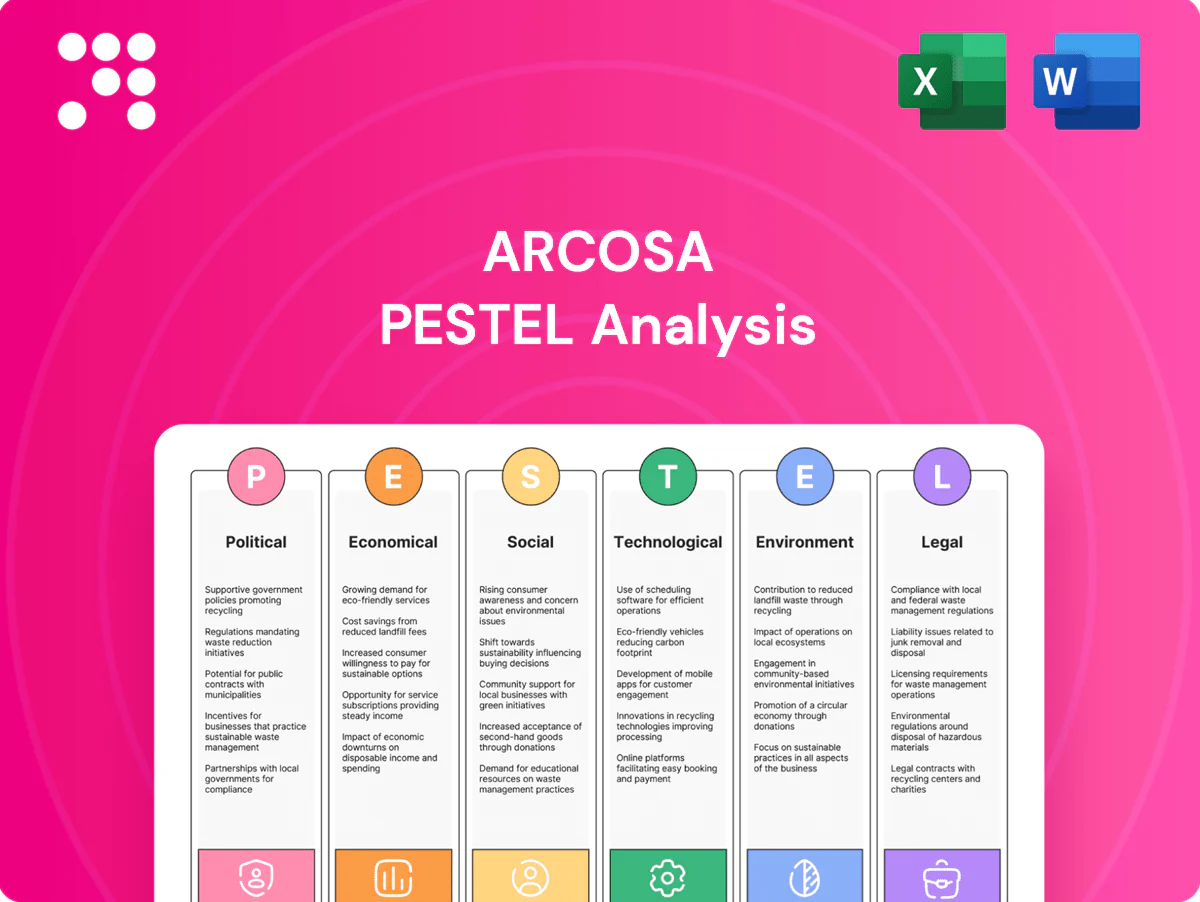
Arcosa PESTLE Analysis

Your Competitive Advantage Starts with This Report
Unlock how political shifts, economic cycles, and sustainability trends are reshaping Arcosa’s outlook with our concise PESTLE snapshot—designed for investors and strategists who need clarity fast. Dive deeper into regulatory risks, tech disruption, and market drivers in the full report. Purchase now for the complete, ready-to-use analysis.
Political factors

Infrastructure funding priorities
The 2021 Infrastructure Investment and Jobs Act commits roughly 1.2 trillion dollars, including about 550 billion in new spending and roughly 110 billion targeted to roads and bridges, which directly supports demand for aggregates and transportation products. Multi-year bills give Arcosa visibility for backlog and capacity planning. Shifts in Congressional control can change appropriations timing. Arcosa’s exposure to roads, bridges and water projects ties revenue timing to federal and state budget cycles.
Buy America provisions
Buy America provisions, expanded under the Bipartisan Infrastructure Law (about $550 billion in new spending), tighten domestic content rules that directly affect sourcing and competitiveness for steel- and concrete-intensive products. Compliance can be a market differentiator for Arcosa but may raise input costs. Enforcement intensity and waiver processes vary by agency. Arcosa stands to benefit if imports face stricter thresholds.

Trade and tariff exposure
Arcosa faces input-cost pressure from U.S. Section 232 tariffs of 25% on steel and 10% on aluminum and lingering Section 301 duties on China goods up to 25%, raising raw‑material and component prices. Policy volatility in U.S.–China and U.S.–Mexico relations increases risk of supply‑chain pauses and freight cost spikes. Retaliatory tariffs have previously targeted machinery and parts, squeezing margins. Strategic inventory buffers and diversified suppliers across North America reduce disruption risk.

Permitting and siting politics
Quarry, plant and wind/energy project permits for Arcosa hinge on local and state politics; U.S. onshore wind projects commonly face 2–7 year permitting timelines, and fast-track reforms can materially shorten lead times while organized opposition can stall new capacity. Multi-agency coordination adds layers of complexity; proactive stakeholder engagement measurably reduces political and schedule risk.
- Permitting timelines: 2–7 years; risk mitigated by stakeholder engagement and interagency coordination
Energy transition policy
Energy transition policy — especially the Inflation Reduction Act (roughly $369 billion in clean energy incentives) and expanded PTC/ITC through 2031 — boosts demand for wind towers and grid hardware; US wind capacity reached about 142 GW by end-2023. Pipeline rules and FERC interconnection reforms in 2023 shape project mix and timing, while Biden targets (50–52% emissions cut by 2030) can reweight markets and Arcosa’s portfolio can pivot to capture shifting demand.
- IRA $369B support
- US wind ~142 GW (end-2023)
- PTC/ITC extended to 2031
- FERC interconnection reforms (2023)
- Biden 50–52% by 2030
IIJA/IRA fuel multi-year demand for steel, aggregates and grid assets; permitting delays persist
Federal infrastructure and clean‑energy laws (IIJA ~$1.2T; ~$550B new; IRA ~$369B) drive multi‑year demand for aggregates, steel, wind towers and grid hardware but tie revenue timing to federal/state budgets and permitting cycles. Buy America expansions and Section 232/301 tariffs (steel 25%, aluminum 10%) raise input costs while creating domestic-competitive advantage. Permitting (2–7 years) and FERC/approval reforms materially affect project timing and backlog.
| Item | Key figure |
|---|---|
| IIJA total | $1.2T |
| IIJA new | $550B |
| IRA | $369B |
| Steel tariff | 25% |
| Permitting | 2–7 yrs |
What is included in the product
 Detailed Word Document
Explores how macro-environmental factors uniquely affect Arcosa across Political, Economic, Social, Technological, Environmental and Legal dimensions, with data-driven trends and sector-specific examples to identify risks and opportunities for executives, investors and strategists.

 Customizable Excel Spreadsheet
Concise, visually segmented PESTLE analysis of Arcosa that streamlines external risk assessment and market positioning for faster decision-making, and can be dropped into presentations or shared across teams for quick alignment.
Economic factors

Interest rates and capital costs
Higher benchmark rates (Fed funds around 5.25% and 10‑yr Treasury ~4.0% in mid‑2025) raise Arcosa’s WACC and depress private construction starts, though federally funded infrastructure programs and backlog have kept public projects relatively resilient. Customer financing costs for equipment and projects—with 30‑yr mortgage/term financing near 6.5–7% in 2024–25—delay buyer timing. Rate cuts could unlock pent‑up demand; hedging and disciplined pricing help protect margins.
Commodity price volatility
Steel, cement, aggregates and energy inputs (HRC ~ $900/ton in 2024, cement ~$145/ton, natural gas ~ $3/MMBtu) drive Arcosa’s COGS and create margin sensitivity to commodity swings; price pass-through timing can delay margin capture by quarters. Long-dated contracts therefore require escalation clauses indexed to input costs, while supplier partnerships and hedging programs (forward purchases, swaps) stabilize earnings and reduce volatility.

Infrastructure and freight cycles
Volumes in rail, barge and trucking closely track industrial output and freight demand, with North American tonnage rebounding after pandemic disruptions and demand patterns normalizing in 2024–25. Ongoing IIJA-funded public infrastructure projects through 2026 help offset private cyclical softness by sustaining order books. Mix shifts between heavy rail, inland barges and truck freight change utilization and operating leverage across Arcosa’s divisions. Scenario planning now emphasizes matching capacity to confirmed order intake to protect margins.

Labor availability and wage inflation
Tight skilled-trade markets drive higher wages and overtime for Arcosa, with production and construction wages rising roughly 4% year-over-year in 2024, lifting labor cost per ton and margin pressure. Expanded training pipelines and retention programs—reducing turnover by up to an estimated 15%—cut hiring costs, while capital investments in automation and productivity offset headcount limits. Regional wage differentials, notably higher West Coast and Gulf Coast labor costs, influence plant siting and logistics.
- Wage inflation ~4% YoY (2024)
- Turnover reduction ~15% via training
- Productivity capex offsets headcount
- Regional differentials shape plant footprint
Regional economic divergence
Sun Belt population and construction activity outpaced many Northern and Midwest markets through 2023–24, supporting stronger demand for Arcosa’s concrete, aggregates and metal products; slower Midwest/NE regions lag in project starts. State budget stress (2024 median rainy‑day fund coverage fell in several states) directly reduced public infrastructure awards. Arcosa’s geographic diversification smooths cyclicality while local supply concentration grants variable pricing power across markets.
- Sun Belt growth: higher construction demand
- Lagging regions: fewer project starts
- State budgets: influence public capex timing
- Diversification: reduces revenue volatility
- Localized pricing power: tied to supply concentration
IIJA/IRA fuel multi-year demand for steel, aggregates and grid assets; permitting delays persist
Higher rates (Fed funds ~5.25%, 10y ~4.0% mid‑2025) raise WACC and damp private starts; IIJA/public backlog cushions revenues. Commodity sensitivity (HRC ~$900/ton, cement ~$145/ton, gas ~$3/MMBtu) pressures COGS; pass‑through lags. Tight labor (+4% YoY wage inflation 2024; turnover -15% via training) raises costs but capex/automation offsets.
| Metric | Value |
|---|---|
| Fed funds | ~5.25% |
| 10‑yr Treasury | ~4.0% |
| HRC | $900/ton |
| Cement | $145/ton |
| Wage inflation | ~4% YoY (2024) |
Preview the Actual Deliverable
Arcosa PESTLE Analysis
The preview shown here is the exact Arcosa PESTLE Analysis document you’ll receive after purchase—fully formatted and ready to use. The content, layout, and insights visible are the final version with no placeholders. After payment you’ll instantly download this same professionally structured file. Use it immediately for strategic planning or investor review.

Your Competitive Advantage Starts with This Report
Unlock how political shifts, economic cycles, and sustainability trends are reshaping Arcosa’s outlook with our concise PESTLE snapshot—designed for investors and strategists who need clarity fast. Dive deeper into regulatory risks, tech disruption, and market drivers in the full report. Purchase now for the complete, ready-to-use analysis.
Political factors
Infrastructure funding priorities
The 2021 Infrastructure Investment and Jobs Act commits roughly 1.2 trillion dollars, including about 550 billion in new spending and roughly 110 billion targeted to roads and bridges, which directly supports demand for aggregates and transportation products. Multi-year bills give Arcosa visibility for backlog and capacity planning. Shifts in Congressional control can change appropriations timing. Arcosa’s exposure to roads, bridges and water projects ties revenue timing to federal and state budget cycles.
Buy America provisions
Buy America provisions, expanded under the Bipartisan Infrastructure Law (about $550 billion in new spending), tighten domestic content rules that directly affect sourcing and competitiveness for steel- and concrete-intensive products. Compliance can be a market differentiator for Arcosa but may raise input costs. Enforcement intensity and waiver processes vary by agency. Arcosa stands to benefit if imports face stricter thresholds.
Trade and tariff exposure
Arcosa faces input-cost pressure from U.S. Section 232 tariffs of 25% on steel and 10% on aluminum and lingering Section 301 duties on China goods up to 25%, raising raw‑material and component prices. Policy volatility in U.S.–China and U.S.–Mexico relations increases risk of supply‑chain pauses and freight cost spikes. Retaliatory tariffs have previously targeted machinery and parts, squeezing margins. Strategic inventory buffers and diversified suppliers across North America reduce disruption risk.
Permitting and siting politics
Quarry, plant and wind/energy project permits for Arcosa hinge on local and state politics; U.S. onshore wind projects commonly face 2–7 year permitting timelines, and fast-track reforms can materially shorten lead times while organized opposition can stall new capacity. Multi-agency coordination adds layers of complexity; proactive stakeholder engagement measurably reduces political and schedule risk.
- Permitting timelines: 2–7 years; risk mitigated by stakeholder engagement and interagency coordination
Energy transition policy
Energy transition policy — especially the Inflation Reduction Act (roughly $369 billion in clean energy incentives) and expanded PTC/ITC through 2031 — boosts demand for wind towers and grid hardware; US wind capacity reached about 142 GW by end-2023. Pipeline rules and FERC interconnection reforms in 2023 shape project mix and timing, while Biden targets (50–52% emissions cut by 2030) can reweight markets and Arcosa’s portfolio can pivot to capture shifting demand.
- IRA $369B support
- US wind ~142 GW (end-2023)
- PTC/ITC extended to 2031
- FERC interconnection reforms (2023)
- Biden 50–52% by 2030
IIJA/IRA fuel multi-year demand for steel, aggregates and grid assets; permitting delays persist
Federal infrastructure and clean‑energy laws (IIJA ~$1.2T; ~$550B new; IRA ~$369B) drive multi‑year demand for aggregates, steel, wind towers and grid hardware but tie revenue timing to federal/state budgets and permitting cycles. Buy America expansions and Section 232/301 tariffs (steel 25%, aluminum 10%) raise input costs while creating domestic-competitive advantage. Permitting (2–7 years) and FERC/approval reforms materially affect project timing and backlog.
| Item | Key figure |
|---|---|
| IIJA total | $1.2T |
| IIJA new | $550B |
| IRA | $369B |
| Steel tariff | 25% |
| Permitting | 2–7 yrs |
What is included in the product
Detailed Word Document
Explores how macro-environmental factors uniquely affect Arcosa across Political, Economic, Social, Technological, Environmental and Legal dimensions, with data-driven trends and sector-specific examples to identify risks and opportunities for executives, investors and strategists.
Customizable Excel Spreadsheet
Concise, visually segmented PESTLE analysis of Arcosa that streamlines external risk assessment and market positioning for faster decision-making, and can be dropped into presentations or shared across teams for quick alignment.
Economic factors
Interest rates and capital costs
Higher benchmark rates (Fed funds around 5.25% and 10‑yr Treasury ~4.0% in mid‑2025) raise Arcosa’s WACC and depress private construction starts, though federally funded infrastructure programs and backlog have kept public projects relatively resilient. Customer financing costs for equipment and projects—with 30‑yr mortgage/term financing near 6.5–7% in 2024–25—delay buyer timing. Rate cuts could unlock pent‑up demand; hedging and disciplined pricing help protect margins.
Commodity price volatility
Steel, cement, aggregates and energy inputs (HRC ~ $900/ton in 2024, cement ~$145/ton, natural gas ~ $3/MMBtu) drive Arcosa’s COGS and create margin sensitivity to commodity swings; price pass-through timing can delay margin capture by quarters. Long-dated contracts therefore require escalation clauses indexed to input costs, while supplier partnerships and hedging programs (forward purchases, swaps) stabilize earnings and reduce volatility.
Infrastructure and freight cycles
Volumes in rail, barge and trucking closely track industrial output and freight demand, with North American tonnage rebounding after pandemic disruptions and demand patterns normalizing in 2024–25. Ongoing IIJA-funded public infrastructure projects through 2026 help offset private cyclical softness by sustaining order books. Mix shifts between heavy rail, inland barges and truck freight change utilization and operating leverage across Arcosa’s divisions. Scenario planning now emphasizes matching capacity to confirmed order intake to protect margins.
Labor availability and wage inflation
Tight skilled-trade markets drive higher wages and overtime for Arcosa, with production and construction wages rising roughly 4% year-over-year in 2024, lifting labor cost per ton and margin pressure. Expanded training pipelines and retention programs—reducing turnover by up to an estimated 15%—cut hiring costs, while capital investments in automation and productivity offset headcount limits. Regional wage differentials, notably higher West Coast and Gulf Coast labor costs, influence plant siting and logistics.
- Wage inflation ~4% YoY (2024)
- Turnover reduction ~15% via training
- Productivity capex offsets headcount
- Regional differentials shape plant footprint
Regional economic divergence
Sun Belt population and construction activity outpaced many Northern and Midwest markets through 2023–24, supporting stronger demand for Arcosa’s concrete, aggregates and metal products; slower Midwest/NE regions lag in project starts. State budget stress (2024 median rainy‑day fund coverage fell in several states) directly reduced public infrastructure awards. Arcosa’s geographic diversification smooths cyclicality while local supply concentration grants variable pricing power across markets.
- Sun Belt growth: higher construction demand
- Lagging regions: fewer project starts
- State budgets: influence public capex timing
- Diversification: reduces revenue volatility
- Localized pricing power: tied to supply concentration
IIJA/IRA fuel multi-year demand for steel, aggregates and grid assets; permitting delays persist
Higher rates (Fed funds ~5.25%, 10y ~4.0% mid‑2025) raise WACC and damp private starts; IIJA/public backlog cushions revenues. Commodity sensitivity (HRC ~$900/ton, cement ~$145/ton, gas ~$3/MMBtu) pressures COGS; pass‑through lags. Tight labor (+4% YoY wage inflation 2024; turnover -15% via training) raises costs but capex/automation offsets.
| Metric | Value |
|---|---|
| Fed funds | ~5.25% |
| 10‑yr Treasury | ~4.0% |
| HRC | $900/ton |
| Cement | $145/ton |
| Wage inflation | ~4% YoY (2024) |
Preview the Actual Deliverable
Arcosa PESTLE Analysis
The preview shown here is the exact Arcosa PESTLE Analysis document you’ll receive after purchase—fully formatted and ready to use. The content, layout, and insights visible are the final version with no placeholders. After payment you’ll instantly download this same professionally structured file. Use it immediately for strategic planning or investor review.
Description
Your Competitive Advantage Starts with This Report
Unlock how political shifts, economic cycles, and sustainability trends are reshaping Arcosa’s outlook with our concise PESTLE snapshot—designed for investors and strategists who need clarity fast. Dive deeper into regulatory risks, tech disruption, and market drivers in the full report. Purchase now for the complete, ready-to-use analysis.
Political factors
Infrastructure funding priorities
The 2021 Infrastructure Investment and Jobs Act commits roughly 1.2 trillion dollars, including about 550 billion in new spending and roughly 110 billion targeted to roads and bridges, which directly supports demand for aggregates and transportation products. Multi-year bills give Arcosa visibility for backlog and capacity planning. Shifts in Congressional control can change appropriations timing. Arcosa’s exposure to roads, bridges and water projects ties revenue timing to federal and state budget cycles.
Buy America provisions
Buy America provisions, expanded under the Bipartisan Infrastructure Law (about $550 billion in new spending), tighten domestic content rules that directly affect sourcing and competitiveness for steel- and concrete-intensive products. Compliance can be a market differentiator for Arcosa but may raise input costs. Enforcement intensity and waiver processes vary by agency. Arcosa stands to benefit if imports face stricter thresholds.
Trade and tariff exposure
Arcosa faces input-cost pressure from U.S. Section 232 tariffs of 25% on steel and 10% on aluminum and lingering Section 301 duties on China goods up to 25%, raising raw‑material and component prices. Policy volatility in U.S.–China and U.S.–Mexico relations increases risk of supply‑chain pauses and freight cost spikes. Retaliatory tariffs have previously targeted machinery and parts, squeezing margins. Strategic inventory buffers and diversified suppliers across North America reduce disruption risk.
Permitting and siting politics
Quarry, plant and wind/energy project permits for Arcosa hinge on local and state politics; U.S. onshore wind projects commonly face 2–7 year permitting timelines, and fast-track reforms can materially shorten lead times while organized opposition can stall new capacity. Multi-agency coordination adds layers of complexity; proactive stakeholder engagement measurably reduces political and schedule risk.
- Permitting timelines: 2–7 years; risk mitigated by stakeholder engagement and interagency coordination
Energy transition policy
Energy transition policy — especially the Inflation Reduction Act (roughly $369 billion in clean energy incentives) and expanded PTC/ITC through 2031 — boosts demand for wind towers and grid hardware; US wind capacity reached about 142 GW by end-2023. Pipeline rules and FERC interconnection reforms in 2023 shape project mix and timing, while Biden targets (50–52% emissions cut by 2030) can reweight markets and Arcosa’s portfolio can pivot to capture shifting demand.
- IRA $369B support
- US wind ~142 GW (end-2023)
- PTC/ITC extended to 2031
- FERC interconnection reforms (2023)
- Biden 50–52% by 2030
IIJA/IRA fuel multi-year demand for steel, aggregates and grid assets; permitting delays persist
Federal infrastructure and clean‑energy laws (IIJA ~$1.2T; ~$550B new; IRA ~$369B) drive multi‑year demand for aggregates, steel, wind towers and grid hardware but tie revenue timing to federal/state budgets and permitting cycles. Buy America expansions and Section 232/301 tariffs (steel 25%, aluminum 10%) raise input costs while creating domestic-competitive advantage. Permitting (2–7 years) and FERC/approval reforms materially affect project timing and backlog.
| Item | Key figure |
|---|---|
| IIJA total | $1.2T |
| IIJA new | $550B |
| IRA | $369B |
| Steel tariff | 25% |
| Permitting | 2–7 yrs |
What is included in the product
Detailed Word Document
Explores how macro-environmental factors uniquely affect Arcosa across Political, Economic, Social, Technological, Environmental and Legal dimensions, with data-driven trends and sector-specific examples to identify risks and opportunities for executives, investors and strategists.
Customizable Excel Spreadsheet
Concise, visually segmented PESTLE analysis of Arcosa that streamlines external risk assessment and market positioning for faster decision-making, and can be dropped into presentations or shared across teams for quick alignment.
Economic factors
Interest rates and capital costs
Higher benchmark rates (Fed funds around 5.25% and 10‑yr Treasury ~4.0% in mid‑2025) raise Arcosa’s WACC and depress private construction starts, though federally funded infrastructure programs and backlog have kept public projects relatively resilient. Customer financing costs for equipment and projects—with 30‑yr mortgage/term financing near 6.5–7% in 2024–25—delay buyer timing. Rate cuts could unlock pent‑up demand; hedging and disciplined pricing help protect margins.
Commodity price volatility
Steel, cement, aggregates and energy inputs (HRC ~ $900/ton in 2024, cement ~$145/ton, natural gas ~ $3/MMBtu) drive Arcosa’s COGS and create margin sensitivity to commodity swings; price pass-through timing can delay margin capture by quarters. Long-dated contracts therefore require escalation clauses indexed to input costs, while supplier partnerships and hedging programs (forward purchases, swaps) stabilize earnings and reduce volatility.
Infrastructure and freight cycles
Volumes in rail, barge and trucking closely track industrial output and freight demand, with North American tonnage rebounding after pandemic disruptions and demand patterns normalizing in 2024–25. Ongoing IIJA-funded public infrastructure projects through 2026 help offset private cyclical softness by sustaining order books. Mix shifts between heavy rail, inland barges and truck freight change utilization and operating leverage across Arcosa’s divisions. Scenario planning now emphasizes matching capacity to confirmed order intake to protect margins.
Labor availability and wage inflation
Tight skilled-trade markets drive higher wages and overtime for Arcosa, with production and construction wages rising roughly 4% year-over-year in 2024, lifting labor cost per ton and margin pressure. Expanded training pipelines and retention programs—reducing turnover by up to an estimated 15%—cut hiring costs, while capital investments in automation and productivity offset headcount limits. Regional wage differentials, notably higher West Coast and Gulf Coast labor costs, influence plant siting and logistics.
- Wage inflation ~4% YoY (2024)
- Turnover reduction ~15% via training
- Productivity capex offsets headcount
- Regional differentials shape plant footprint
Regional economic divergence
Sun Belt population and construction activity outpaced many Northern and Midwest markets through 2023–24, supporting stronger demand for Arcosa’s concrete, aggregates and metal products; slower Midwest/NE regions lag in project starts. State budget stress (2024 median rainy‑day fund coverage fell in several states) directly reduced public infrastructure awards. Arcosa’s geographic diversification smooths cyclicality while local supply concentration grants variable pricing power across markets.
- Sun Belt growth: higher construction demand
- Lagging regions: fewer project starts
- State budgets: influence public capex timing
- Diversification: reduces revenue volatility
- Localized pricing power: tied to supply concentration
IIJA/IRA fuel multi-year demand for steel, aggregates and grid assets; permitting delays persist
Higher rates (Fed funds ~5.25%, 10y ~4.0% mid‑2025) raise WACC and damp private starts; IIJA/public backlog cushions revenues. Commodity sensitivity (HRC ~$900/ton, cement ~$145/ton, gas ~$3/MMBtu) pressures COGS; pass‑through lags. Tight labor (+4% YoY wage inflation 2024; turnover -15% via training) raises costs but capex/automation offsets.
| Metric | Value |
|---|---|
| Fed funds | ~5.25% |
| 10‑yr Treasury | ~4.0% |
| HRC | $900/ton |
| Cement | $145/ton |
| Wage inflation | ~4% YoY (2024) |
Preview the Actual Deliverable
Arcosa PESTLE Analysis
The preview shown here is the exact Arcosa PESTLE Analysis document you’ll receive after purchase—fully formatted and ready to use. The content, layout, and insights visible are the final version with no placeholders. After payment you’ll instantly download this same professionally structured file. Use it immediately for strategic planning or investor review.











