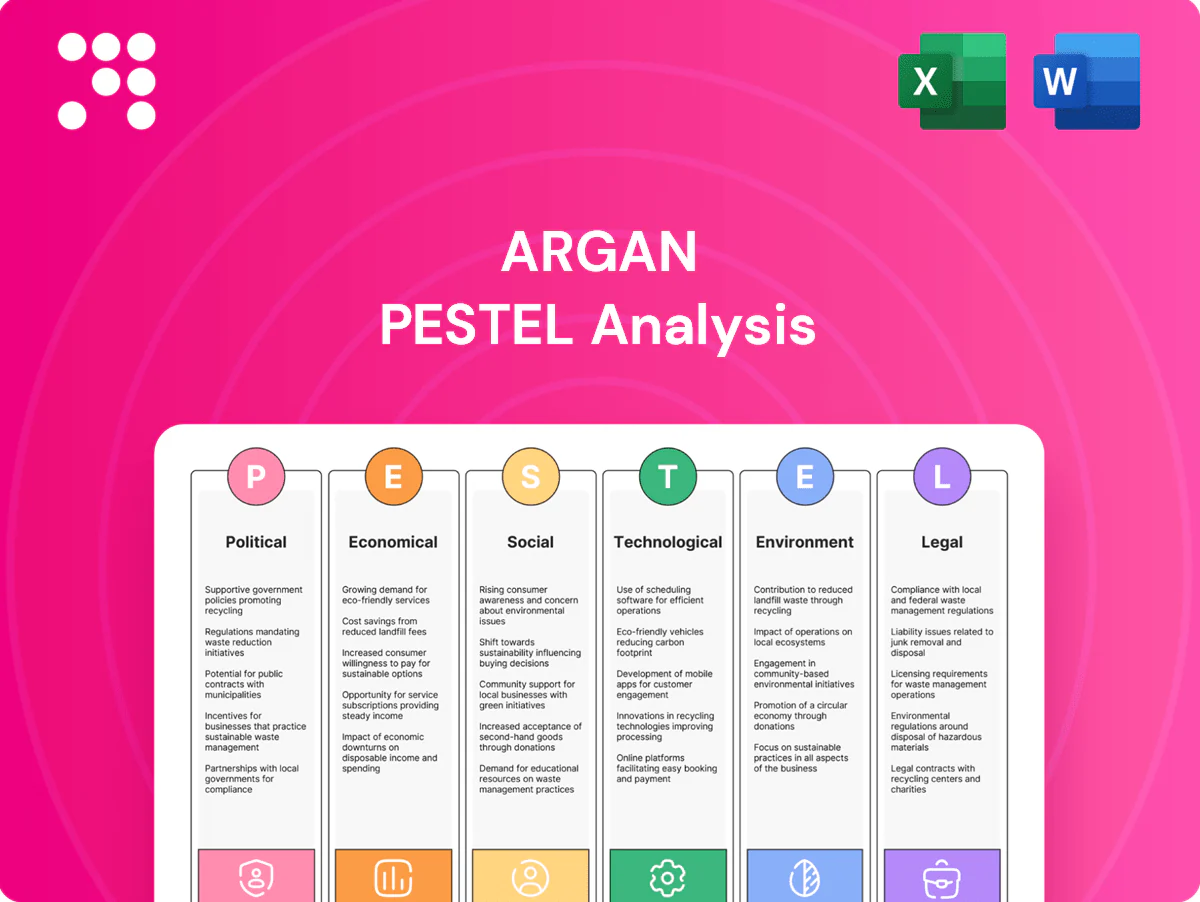
Argan PESTLE Analysis

Make Smarter Strategic Decisions with a Complete PESTEL View
Discover how political, economic, social, technological, legal, and environmental forces are reshaping Argan’s strategic horizon in this concise PESTLE snapshot; gain clarity on regulatory risks, market drivers, and innovation threats. Perfect for investors and strategists seeking actionable context. Purchase the full, editable PESTLE report to access detailed insights and data-ready recommendations now.
Political factors

Energy policy volatility
Shifts in national and state energy policy drive demand for gas-fired and renewable EPC work; natural gas supplied about 39% of US electricity in 2023 (EIA), keeping gas EPCs viable. Federal incentives under the Inflation Reduction Act (~$369B) and tax credits shape project pipelines and financing, while election cycles and shifting party control can delay approvals; Argan must diversify geographies to buffer policy swings.
Infrastructure spending priorities
Public funding under the Bipartisan Infrastructure Law (about 550 billion new dollars) and the $42.45 billion BEAD broadband program directly influence backlog across Argan subsidiaries by creating funded grid modernization and broadband opportunities. Federal and local budget allocations set timing for shovel-ready projects; the FY2024 defense topline (~858 billion) and rising healthcare outlays can crowd out capital. Close engagement with agencies and timing bids to funding windows is essential to capture earmarks and grant rounds.

Permitting and siting governance
Lengthy approvals for power plants, transmission and telecoms create schedule risk: DOE reports large transmission projects typically face 4–7 year siting and permitting timelines. Variability between federal, state and municipal authorities complicates compliance, while FCC shot clocks for small wireless facilities set 60/90 day targets but do not eliminate local hurdles. Community opposition can trigger political intervention and delays. Early stakeholder mapping reduces permitting bottlenecks and timeline uncertainty.

Trade and procurement exposure
Section 232 steel tariffs at 25% raise input costs for steel, electrical and telecom gear; geopolitical tensions have tightened OEM supply reliability since 2020; the $1.2 trillion Bipartisan Infrastructure Law and Buy American rules steer federal project sourcing; contract terms should allocate tariff and supply-risk between Argan and clients to protect margins.
Grid reliability and resilience agendas
Policy emphasis on grid reliability, wildfire mitigation and storm hardening under the Bipartisan Infrastructure Law and related programs (roughly 65 billion USD for grid and resilience-related investments) increases EPC opportunities for Argan to win utility and federal contracts; funding streams for microgrids and peaker replacement broaden addressable markets and bipartisan focus raises project visibility, enabling Argan to align offerings with critical infrastructure mandates.
- Policy focus: reliability, wildfire mitigation, storm hardening
- Funding scale: ~65 billion USD federal grid/resilience investment
- Market expansion: microgrids, peaker capacity
- Opportunity: align Argan solutions with critical infrastructure mandates
IRA, BIL, BEAD reshape EPC pipelines; tariffs and permitting raise costs, schedule risk
Federal energy policy and the IRA (~369B) plus BIL (1.2T) and BEAD (42.45B) expand EPC pipelines; natural gas supplied ~39% of US electricity in 2023 (EIA). Section 232 steel tariffs (25%) and post‑2020 supply tensions raise input costs. Permitting delays (4–7 years for major transmission) and election cycles add schedule risk; align bids to funding windows.
| Metric | Value |
|---|---|
| IRA | ~369B |
| BIL | 1.2T |
| BEAD | 42.45B |
| Gas share 2023 | 39% |
| Steel tariff | 25% |
What is included in the product
 Detailed Word Document
Explores how external macro-environmental factors uniquely affect Argan across six dimensions—Political, Economic, Social, Technological, Environmental and Legal—combining data and current trends for reliable evaluation. Designed for executives and investors, it includes region- and industry-specific insights, forward-looking scenarios, and ready-to-use formatting.

 Customizable Excel Spreadsheet
A concise, visually segmented Argan PESTLE analysis that distills external risks and opportunities into a shareable, slide-ready summary for quick alignment across teams. Ideal for meetings, strategy sessions, and client reports, it’s editable for region- or business-specific notes and supports faster decision-making.
Economic factors

Interest rate environment
Elevated policy rates (US fed funds ~5.25–5.50% mid‑2025; 10‑yr Treasury ~4.3%) raise project WACC and often delay FID on new plants. Higher financing costs for customers compress EPC award timing and size, while prospective rate cuts can unlock deferred projects and M&A optionality. Argan’s strong cash and bonding capacity provide resilience through these cycles.
Commodity and equipment inflation
Volatility in steel, copper, transformers and turbines squeezes margins as raw-material swings and supplier bottlenecks increase project costs. Long-lead items commonly face price escalations and allocation constraints with turbine lead times often 12–24 months and transformer lead times up to 18 months. Escalation clauses and hedging programs are used to mitigate exposure. Early procurement and framework agreements stabilize supply and lock pricing.

Power demand and capacity additions
Data center growth—responsible for around 1% of global electricity use—alongside electrification and reshoring is driving new generation and grid build opportunities for Argan across cloud, industrial and transport load pockets. Regional load growth determines where EPC demand materializes, concentrating bids in high-growth metros and industrial corridors. Accelerating coal and aging capacity retirements create replacement needs for efficient gas and renewables, so tight forecast alignment directly improves bid pipeline quality.

Labor market tightness
Skilled craft shortages raised average construction wages about 4.6% year-over-year in 2024 (BLS), tightening schedules and driving backlog inflation for Argan projects. Competition from oilfield and data-center infrastructure work has intensified bidding for experienced crews. Registered apprenticeship starts rose roughly 10% in 2024 (DOL), and expanded subcontractor networks plus productivity tools (BIM, prefabrication) are partially offsetting labor scarcity.
- Wage inflation: +4.6% y/y (BLS 2024)
- Apprenticeships: +10% starts (DOL 2024)
- Mitigants: subcontractor scaling, BIM/prefab
Customer capital discipline
Utilities and IPPs driving Argan projects demand strict customer capital discipline, often targeting ROIC of roughly 8–12%, which narrows acceptable project scope and phases. This pushes P3 and BOOT financing for large builds, while fixed-price contracting shifts execution risk to contractors. Selective bidding and explicit risk pricing safeguard returns.
- ROIC targets: 8–12%
- P3/BOOT financing for large projects
- Fixed-price transfers contractor risk
- Selective bidding, risk-loaded pricing
IRA, BIL, BEAD reshape EPC pipelines; tariffs and permitting raise costs, schedule risk
Elevated rates (US fed funds 5.25–5.50% mid‑2025; 10y ~4.3%) raise WACC and delay FIDs; Argan's cash/bonding cushions impact. Raw‑material volatility and long lead times (turbines 12–24m) squeeze margins; escalation clauses and early procurement mitigate. Wage inflation +4.6% y/y (BLS 2024) tightens labor supply.
| Metric | Value |
|---|---|
| Fed funds (mid‑2025) | 5.25–5.50% |
| 10‑yr Treasury | ~4.3% |
| Wage infl. (2024) | +4.6% y/y |
| Turbine lead time | 12–24 months |
What You See Is What You Get
Argan PESTLE Analysis
The Argan PESTLE Analysis preview shown here is the exact document you’ll receive after purchase—fully formatted and ready to use. This real screenshot reflects the complete, final file with no placeholders or teasers. The layout, content, and structure visible are delivered exactly as shown immediately after checkout.

Make Smarter Strategic Decisions with a Complete PESTEL View
Discover how political, economic, social, technological, legal, and environmental forces are reshaping Argan’s strategic horizon in this concise PESTLE snapshot; gain clarity on regulatory risks, market drivers, and innovation threats. Perfect for investors and strategists seeking actionable context. Purchase the full, editable PESTLE report to access detailed insights and data-ready recommendations now.
Political factors
Energy policy volatility
Shifts in national and state energy policy drive demand for gas-fired and renewable EPC work; natural gas supplied about 39% of US electricity in 2023 (EIA), keeping gas EPCs viable. Federal incentives under the Inflation Reduction Act (~$369B) and tax credits shape project pipelines and financing, while election cycles and shifting party control can delay approvals; Argan must diversify geographies to buffer policy swings.
Infrastructure spending priorities
Public funding under the Bipartisan Infrastructure Law (about 550 billion new dollars) and the $42.45 billion BEAD broadband program directly influence backlog across Argan subsidiaries by creating funded grid modernization and broadband opportunities. Federal and local budget allocations set timing for shovel-ready projects; the FY2024 defense topline (~858 billion) and rising healthcare outlays can crowd out capital. Close engagement with agencies and timing bids to funding windows is essential to capture earmarks and grant rounds.
Permitting and siting governance
Lengthy approvals for power plants, transmission and telecoms create schedule risk: DOE reports large transmission projects typically face 4–7 year siting and permitting timelines. Variability between federal, state and municipal authorities complicates compliance, while FCC shot clocks for small wireless facilities set 60/90 day targets but do not eliminate local hurdles. Community opposition can trigger political intervention and delays. Early stakeholder mapping reduces permitting bottlenecks and timeline uncertainty.
Trade and procurement exposure
Section 232 steel tariffs at 25% raise input costs for steel, electrical and telecom gear; geopolitical tensions have tightened OEM supply reliability since 2020; the $1.2 trillion Bipartisan Infrastructure Law and Buy American rules steer federal project sourcing; contract terms should allocate tariff and supply-risk between Argan and clients to protect margins.
Grid reliability and resilience agendas
Policy emphasis on grid reliability, wildfire mitigation and storm hardening under the Bipartisan Infrastructure Law and related programs (roughly 65 billion USD for grid and resilience-related investments) increases EPC opportunities for Argan to win utility and federal contracts; funding streams for microgrids and peaker replacement broaden addressable markets and bipartisan focus raises project visibility, enabling Argan to align offerings with critical infrastructure mandates.
- Policy focus: reliability, wildfire mitigation, storm hardening
- Funding scale: ~65 billion USD federal grid/resilience investment
- Market expansion: microgrids, peaker capacity
- Opportunity: align Argan solutions with critical infrastructure mandates
IRA, BIL, BEAD reshape EPC pipelines; tariffs and permitting raise costs, schedule risk
Federal energy policy and the IRA (~369B) plus BIL (1.2T) and BEAD (42.45B) expand EPC pipelines; natural gas supplied ~39% of US electricity in 2023 (EIA). Section 232 steel tariffs (25%) and post‑2020 supply tensions raise input costs. Permitting delays (4–7 years for major transmission) and election cycles add schedule risk; align bids to funding windows.
| Metric | Value |
|---|---|
| IRA | ~369B |
| BIL | 1.2T |
| BEAD | 42.45B |
| Gas share 2023 | 39% |
| Steel tariff | 25% |
What is included in the product
Detailed Word Document
Explores how external macro-environmental factors uniquely affect Argan across six dimensions—Political, Economic, Social, Technological, Environmental and Legal—combining data and current trends for reliable evaluation. Designed for executives and investors, it includes region- and industry-specific insights, forward-looking scenarios, and ready-to-use formatting.
Customizable Excel Spreadsheet
A concise, visually segmented Argan PESTLE analysis that distills external risks and opportunities into a shareable, slide-ready summary for quick alignment across teams. Ideal for meetings, strategy sessions, and client reports, it’s editable for region- or business-specific notes and supports faster decision-making.
Economic factors
Interest rate environment
Elevated policy rates (US fed funds ~5.25–5.50% mid‑2025; 10‑yr Treasury ~4.3%) raise project WACC and often delay FID on new plants. Higher financing costs for customers compress EPC award timing and size, while prospective rate cuts can unlock deferred projects and M&A optionality. Argan’s strong cash and bonding capacity provide resilience through these cycles.
Commodity and equipment inflation
Volatility in steel, copper, transformers and turbines squeezes margins as raw-material swings and supplier bottlenecks increase project costs. Long-lead items commonly face price escalations and allocation constraints with turbine lead times often 12–24 months and transformer lead times up to 18 months. Escalation clauses and hedging programs are used to mitigate exposure. Early procurement and framework agreements stabilize supply and lock pricing.
Power demand and capacity additions
Data center growth—responsible for around 1% of global electricity use—alongside electrification and reshoring is driving new generation and grid build opportunities for Argan across cloud, industrial and transport load pockets. Regional load growth determines where EPC demand materializes, concentrating bids in high-growth metros and industrial corridors. Accelerating coal and aging capacity retirements create replacement needs for efficient gas and renewables, so tight forecast alignment directly improves bid pipeline quality.
Labor market tightness
Skilled craft shortages raised average construction wages about 4.6% year-over-year in 2024 (BLS), tightening schedules and driving backlog inflation for Argan projects. Competition from oilfield and data-center infrastructure work has intensified bidding for experienced crews. Registered apprenticeship starts rose roughly 10% in 2024 (DOL), and expanded subcontractor networks plus productivity tools (BIM, prefabrication) are partially offsetting labor scarcity.
- Wage inflation: +4.6% y/y (BLS 2024)
- Apprenticeships: +10% starts (DOL 2024)
- Mitigants: subcontractor scaling, BIM/prefab
Customer capital discipline
Utilities and IPPs driving Argan projects demand strict customer capital discipline, often targeting ROIC of roughly 8–12%, which narrows acceptable project scope and phases. This pushes P3 and BOOT financing for large builds, while fixed-price contracting shifts execution risk to contractors. Selective bidding and explicit risk pricing safeguard returns.
- ROIC targets: 8–12%
- P3/BOOT financing for large projects
- Fixed-price transfers contractor risk
- Selective bidding, risk-loaded pricing
IRA, BIL, BEAD reshape EPC pipelines; tariffs and permitting raise costs, schedule risk
Elevated rates (US fed funds 5.25–5.50% mid‑2025; 10y ~4.3%) raise WACC and delay FIDs; Argan's cash/bonding cushions impact. Raw‑material volatility and long lead times (turbines 12–24m) squeeze margins; escalation clauses and early procurement mitigate. Wage inflation +4.6% y/y (BLS 2024) tightens labor supply.
| Metric | Value |
|---|---|
| Fed funds (mid‑2025) | 5.25–5.50% |
| 10‑yr Treasury | ~4.3% |
| Wage infl. (2024) | +4.6% y/y |
| Turbine lead time | 12–24 months |
What You See Is What You Get
Argan PESTLE Analysis
The Argan PESTLE Analysis preview shown here is the exact document you’ll receive after purchase—fully formatted and ready to use. This real screenshot reflects the complete, final file with no placeholders or teasers. The layout, content, and structure visible are delivered exactly as shown immediately after checkout.
Original: $10.00
-65%$10.00
$3.50Description
Make Smarter Strategic Decisions with a Complete PESTEL View
Discover how political, economic, social, technological, legal, and environmental forces are reshaping Argan’s strategic horizon in this concise PESTLE snapshot; gain clarity on regulatory risks, market drivers, and innovation threats. Perfect for investors and strategists seeking actionable context. Purchase the full, editable PESTLE report to access detailed insights and data-ready recommendations now.
Political factors
Energy policy volatility
Shifts in national and state energy policy drive demand for gas-fired and renewable EPC work; natural gas supplied about 39% of US electricity in 2023 (EIA), keeping gas EPCs viable. Federal incentives under the Inflation Reduction Act (~$369B) and tax credits shape project pipelines and financing, while election cycles and shifting party control can delay approvals; Argan must diversify geographies to buffer policy swings.
Infrastructure spending priorities
Public funding under the Bipartisan Infrastructure Law (about 550 billion new dollars) and the $42.45 billion BEAD broadband program directly influence backlog across Argan subsidiaries by creating funded grid modernization and broadband opportunities. Federal and local budget allocations set timing for shovel-ready projects; the FY2024 defense topline (~858 billion) and rising healthcare outlays can crowd out capital. Close engagement with agencies and timing bids to funding windows is essential to capture earmarks and grant rounds.
Permitting and siting governance
Lengthy approvals for power plants, transmission and telecoms create schedule risk: DOE reports large transmission projects typically face 4–7 year siting and permitting timelines. Variability between federal, state and municipal authorities complicates compliance, while FCC shot clocks for small wireless facilities set 60/90 day targets but do not eliminate local hurdles. Community opposition can trigger political intervention and delays. Early stakeholder mapping reduces permitting bottlenecks and timeline uncertainty.
Trade and procurement exposure
Section 232 steel tariffs at 25% raise input costs for steel, electrical and telecom gear; geopolitical tensions have tightened OEM supply reliability since 2020; the $1.2 trillion Bipartisan Infrastructure Law and Buy American rules steer federal project sourcing; contract terms should allocate tariff and supply-risk between Argan and clients to protect margins.
Grid reliability and resilience agendas
Policy emphasis on grid reliability, wildfire mitigation and storm hardening under the Bipartisan Infrastructure Law and related programs (roughly 65 billion USD for grid and resilience-related investments) increases EPC opportunities for Argan to win utility and federal contracts; funding streams for microgrids and peaker replacement broaden addressable markets and bipartisan focus raises project visibility, enabling Argan to align offerings with critical infrastructure mandates.
- Policy focus: reliability, wildfire mitigation, storm hardening
- Funding scale: ~65 billion USD federal grid/resilience investment
- Market expansion: microgrids, peaker capacity
- Opportunity: align Argan solutions with critical infrastructure mandates
IRA, BIL, BEAD reshape EPC pipelines; tariffs and permitting raise costs, schedule risk
Federal energy policy and the IRA (~369B) plus BIL (1.2T) and BEAD (42.45B) expand EPC pipelines; natural gas supplied ~39% of US electricity in 2023 (EIA). Section 232 steel tariffs (25%) and post‑2020 supply tensions raise input costs. Permitting delays (4–7 years for major transmission) and election cycles add schedule risk; align bids to funding windows.
| Metric | Value |
|---|---|
| IRA | ~369B |
| BIL | 1.2T |
| BEAD | 42.45B |
| Gas share 2023 | 39% |
| Steel tariff | 25% |
What is included in the product
Detailed Word Document
Explores how external macro-environmental factors uniquely affect Argan across six dimensions—Political, Economic, Social, Technological, Environmental and Legal—combining data and current trends for reliable evaluation. Designed for executives and investors, it includes region- and industry-specific insights, forward-looking scenarios, and ready-to-use formatting.
Customizable Excel Spreadsheet
A concise, visually segmented Argan PESTLE analysis that distills external risks and opportunities into a shareable, slide-ready summary for quick alignment across teams. Ideal for meetings, strategy sessions, and client reports, it’s editable for region- or business-specific notes and supports faster decision-making.
Economic factors
Interest rate environment
Elevated policy rates (US fed funds ~5.25–5.50% mid‑2025; 10‑yr Treasury ~4.3%) raise project WACC and often delay FID on new plants. Higher financing costs for customers compress EPC award timing and size, while prospective rate cuts can unlock deferred projects and M&A optionality. Argan’s strong cash and bonding capacity provide resilience through these cycles.
Commodity and equipment inflation
Volatility in steel, copper, transformers and turbines squeezes margins as raw-material swings and supplier bottlenecks increase project costs. Long-lead items commonly face price escalations and allocation constraints with turbine lead times often 12–24 months and transformer lead times up to 18 months. Escalation clauses and hedging programs are used to mitigate exposure. Early procurement and framework agreements stabilize supply and lock pricing.
Power demand and capacity additions
Data center growth—responsible for around 1% of global electricity use—alongside electrification and reshoring is driving new generation and grid build opportunities for Argan across cloud, industrial and transport load pockets. Regional load growth determines where EPC demand materializes, concentrating bids in high-growth metros and industrial corridors. Accelerating coal and aging capacity retirements create replacement needs for efficient gas and renewables, so tight forecast alignment directly improves bid pipeline quality.
Labor market tightness
Skilled craft shortages raised average construction wages about 4.6% year-over-year in 2024 (BLS), tightening schedules and driving backlog inflation for Argan projects. Competition from oilfield and data-center infrastructure work has intensified bidding for experienced crews. Registered apprenticeship starts rose roughly 10% in 2024 (DOL), and expanded subcontractor networks plus productivity tools (BIM, prefabrication) are partially offsetting labor scarcity.
- Wage inflation: +4.6% y/y (BLS 2024)
- Apprenticeships: +10% starts (DOL 2024)
- Mitigants: subcontractor scaling, BIM/prefab
Customer capital discipline
Utilities and IPPs driving Argan projects demand strict customer capital discipline, often targeting ROIC of roughly 8–12%, which narrows acceptable project scope and phases. This pushes P3 and BOOT financing for large builds, while fixed-price contracting shifts execution risk to contractors. Selective bidding and explicit risk pricing safeguard returns.
- ROIC targets: 8–12%
- P3/BOOT financing for large projects
- Fixed-price transfers contractor risk
- Selective bidding, risk-loaded pricing
IRA, BIL, BEAD reshape EPC pipelines; tariffs and permitting raise costs, schedule risk
Elevated rates (US fed funds 5.25–5.50% mid‑2025; 10y ~4.3%) raise WACC and delay FIDs; Argan's cash/bonding cushions impact. Raw‑material volatility and long lead times (turbines 12–24m) squeeze margins; escalation clauses and early procurement mitigate. Wage inflation +4.6% y/y (BLS 2024) tightens labor supply.
| Metric | Value |
|---|---|
| Fed funds (mid‑2025) | 5.25–5.50% |
| 10‑yr Treasury | ~4.3% |
| Wage infl. (2024) | +4.6% y/y |
| Turbine lead time | 12–24 months |
What You See Is What You Get
Argan PESTLE Analysis
The Argan PESTLE Analysis preview shown here is the exact document you’ll receive after purchase—fully formatted and ready to use. This real screenshot reflects the complete, final file with no placeholders or teasers. The layout, content, and structure visible are delivered exactly as shown immediately after checkout.











