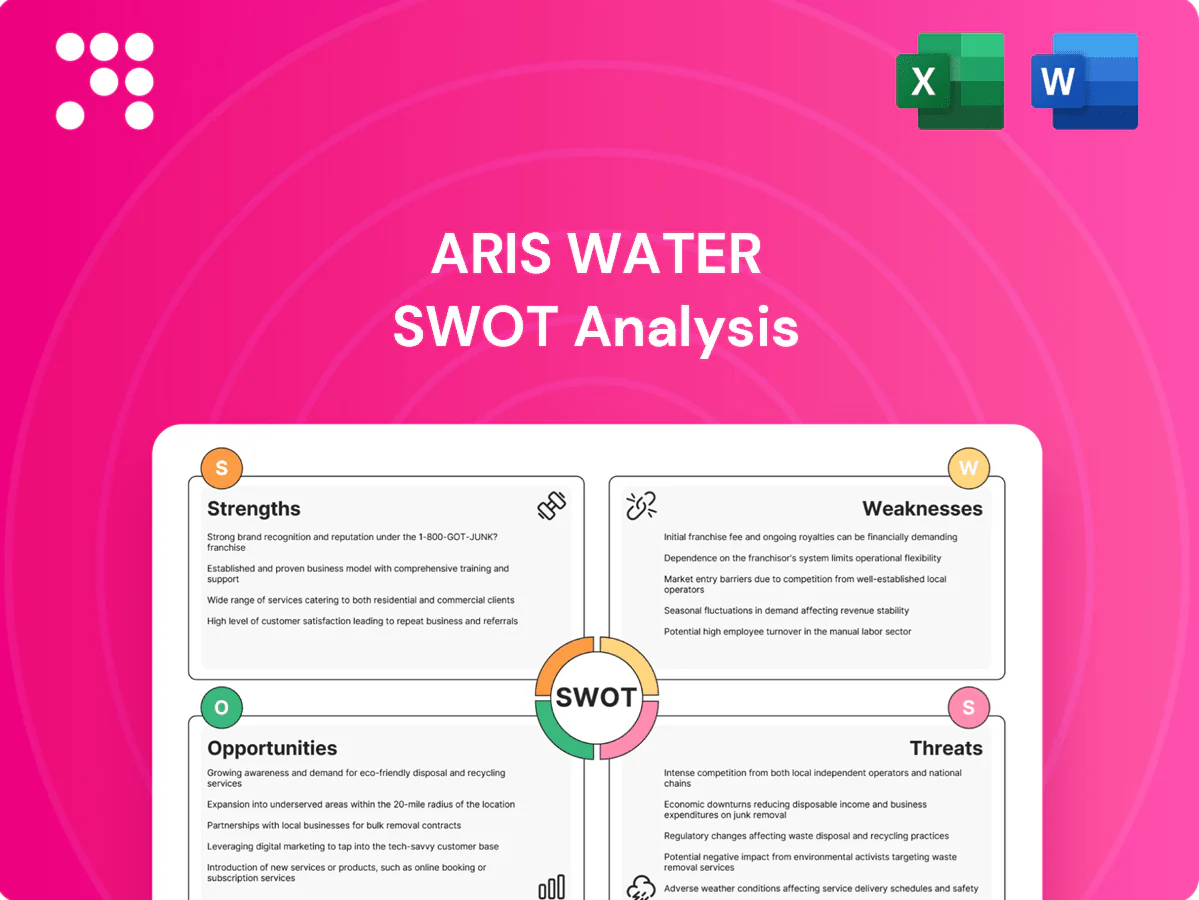
Aris Water SWOT Analysis

Dive Deeper Into the Company’s Strategic Blueprint
Aris Water’s SWOT analysis highlights resilient technical strengths, niche market positioning, and regulatory opportunities while flagging supply-chain and funding risks that could hinder scalability. Want the full strategic picture and actionable recommendations? Purchase the complete SWOT to get a professional, editable Word report plus an Excel matrix for investor-grade planning and presentations.
Strengths

Integrated pipeline network
Pipeline-based systems cut trucking costs and traffic by replacing millions of truck-miles; industry analyses show pipeline transport can lower unit hauling costs by up to 60% and lifecycle CO2 emissions by up to 70% versus truck haulage. Continuous flow boosts reliability and throughput compared with batch trucking, while integrated gathering, recycling and disposal unlock operational synergies and lower OPEX. Closed-loop design improves water balance for upstream customers, reducing freshwater draw and disposal volumes.
Closed-loop recycling capability
Aris Water’s closed-loop recycling cuts reliance on scarce freshwater in energy operations, addressing a US produced-water volume exceeding 21 billion barrels annually (USGS 2019). Consistent treatment delivers quality outputs that meet fracturing specifications, enabling onsite or near-site reuse that shortens cycle times and lowers logistics risk. The system’s reuse model also reduces freshwater withdrawals and supports customers’ ESG reporting and compliance.

Energy-sector specialization
Deep domain expertise in produced-water handling drives operational efficiency and cost reductions across drilling and completion cycles. Purpose-built assets are engineered to align with on-site workflows, minimizing mobilization time and complexity. Basin-specific chemistry and flow-pattern knowledge improves uptime and treatment yields, while trusted customer relationships support conversion to multi-year volume commitments.

Cost and ESG value proposition
Aris Water’s lower total water lifecycle cost is compelling across volatile commodity cycles, improving margin resilience and customer retention. Reduced trucking lowers Scope 1/3 emissions and road-safety risks, supporting ESG targets while transport accounted for ~27% of US GHG emissions (EPA 2022). Recycling and pipeline solutions help meet tightening reuse regulations and enable value-stacking for pricing power.
- Lower lifecycle cost → retention/price resilience
- Less trucking → emissions & safety benefits
- Recycling/pipelines → regulatory compliance
Scalable, network-effect assets
Aris Water's scalable, network-effect assets boost unit economics as customer density and aggregated volumes lower per-connection costs; incremental connections enhance stickiness and raise barriers to entry. Modular treatment capacity supports phased growth aligned with demand, while high replacement costs for buried infrastructure deter new entrants in established corridors.
- Density lowers unit cost
- New connections increase stickiness
- Modular capacity enables phased capex
- High replacement cost limits competition
Cut hauling costs up to 60% and lifecycle CO2 by 70%—enable onsite water reuse
Aris Water cuts hauling costs up to 60% and lifecycle CO2 by up to 70% versus trucking, enabling reliable onsite reuse that reduces freshwater withdrawals in a US produced-water market >21B barrels/year (USGS 2019). Pipeline networks and modular treatment deliver network effects and phased capex, raising barriers via high replacement costs for buried infrastructure and improving margin resilience.
| Metric | Value |
|---|---|
| US produced water | >21B bbl/yr (USGS 2019) |
| Transport cost reduction | up to 60% |
| Lifecycle CO2 reduction | up to 70% |
What is included in the product
 Detailed Word Document
Delivers a strategic overview of Aris Water’s internal and external factors, highlighting strengths, weaknesses, opportunities, and threats to its water treatment technology and service business to clarify competitive position and growth risks.

 Customizable Excel Spreadsheet
Provides a concise SWOT matrix tailored to Aris Water for rapid strategic alignment and stakeholder-ready summaries.
Weaknesses

Customer concentration risk
Revenues depend heavily on a limited set of E&P operators, leaving Aris Water exposed if one or more reduce orders; contract renegotiations or industry consolidations can force lower pricing. Project delays directly cut volumes and plant utilization, tightening margins. A single major customer switching suppliers or internalizing water handling could materially depress quarterly results.
Exposure to commodity cycles
Aris Water’s throughput closely tracks drilling activity; Baker Hughes reported a roughly 12% year‑over‑year decline in US rig count in 2024, shrinking produced‑water volumes and recycling demand. Oil and gas downturns and E&P budget cuts in 2024 deferred infrastructure tie‑ins, lowering utilization. As rig counts fall, Aris’s revenue visibility and backlog weaken, pressuring near‑term cash flow.

Capital-intensive business
Aris Water's model is capital intensive: pipelines, treatment plants and SWDs routinely require high upfront spend, with individual projects commonly exceeding $50–100 million. Returns depend on long-term volume commitments and sustained utilization; lapses in off-take can compress margins. Rising interest rates (US policy rate ~5.25–5.50% in mid‑2025) lift financing costs and hurdle rates. Project execution delays can erode IRR materially if timelines or budgets slip.

Regulatory and permitting complexity
Water handling, reuse and disposal face evolving federal and state rules that increase technical complexity; permitting timelines frequently exceed 12 months and can stall growth projects and well connections; monitoring and reporting requirements drive higher compliance spend; policy shifts are increasingly limiting certain disposal practices.
- Permitting delays: often >12 months
- Compliance cost pressure: higher monitoring/reporting
- Operational risk: restricted disposal methods
Geographic concentration
Clustering of Aris Water assets in select basins concentrates exposure to local risks, making regional shocks more impactful. Seismicity-driven permitting constraints or curtailments have in past years forced operational slowdowns in similarly concentrated operators. Extended droughts or basin-specific policy shifts can rapidly change water sourcing and disposal economics, and limited geographic diversification reduces resilience to these basin-specific shocks.
- Concentration: majority of operations in a few basins
- Seismic risk: potential for regulatory curtailments
- Hydro-policy: drought and local rule changes affect strategy
- Diversification: low buffer against basin-specific disruptions
Concentrated E&P exposure, -12% US rig count and lengthy permitting raise project risk
Revenue tied to few E&P customers and a ~12% YoY US rig‑count drop in 2024 reduce visibility; single‑customer loss or contract repricing can sharply cut volumes. Capital‑intensive projects ($50–100M+) and mid‑2025 policy rate ~5.25–5.50% raise financing costs and IRR hurdles. Permitting often exceeds 12 months and regional asset clustering concentrates basin risk.
| Metric | Value |
|---|---|
| US rig count (2024 YoY) | -12% |
| Project capex | $50–100M+ |
| Fed funds (mid‑2025) | 5.25–5.50% |
| Permitting | >12 months |
Same Document Delivered
Aris Water SWOT Analysis
This is the actual SWOT analysis document for Aris Water you’ll receive upon purchase—no surprises, just professional quality. The preview below is taken directly from the full report; buying unlocks the complete, editable version. You’re viewing a live excerpt of the real file ready for download after checkout.

Dive Deeper Into the Company’s Strategic Blueprint
Aris Water’s SWOT analysis highlights resilient technical strengths, niche market positioning, and regulatory opportunities while flagging supply-chain and funding risks that could hinder scalability. Want the full strategic picture and actionable recommendations? Purchase the complete SWOT to get a professional, editable Word report plus an Excel matrix for investor-grade planning and presentations.
Strengths
Integrated pipeline network
Pipeline-based systems cut trucking costs and traffic by replacing millions of truck-miles; industry analyses show pipeline transport can lower unit hauling costs by up to 60% and lifecycle CO2 emissions by up to 70% versus truck haulage. Continuous flow boosts reliability and throughput compared with batch trucking, while integrated gathering, recycling and disposal unlock operational synergies and lower OPEX. Closed-loop design improves water balance for upstream customers, reducing freshwater draw and disposal volumes.
Closed-loop recycling capability
Aris Water’s closed-loop recycling cuts reliance on scarce freshwater in energy operations, addressing a US produced-water volume exceeding 21 billion barrels annually (USGS 2019). Consistent treatment delivers quality outputs that meet fracturing specifications, enabling onsite or near-site reuse that shortens cycle times and lowers logistics risk. The system’s reuse model also reduces freshwater withdrawals and supports customers’ ESG reporting and compliance.
Energy-sector specialization
Deep domain expertise in produced-water handling drives operational efficiency and cost reductions across drilling and completion cycles. Purpose-built assets are engineered to align with on-site workflows, minimizing mobilization time and complexity. Basin-specific chemistry and flow-pattern knowledge improves uptime and treatment yields, while trusted customer relationships support conversion to multi-year volume commitments.
Cost and ESG value proposition
Aris Water’s lower total water lifecycle cost is compelling across volatile commodity cycles, improving margin resilience and customer retention. Reduced trucking lowers Scope 1/3 emissions and road-safety risks, supporting ESG targets while transport accounted for ~27% of US GHG emissions (EPA 2022). Recycling and pipeline solutions help meet tightening reuse regulations and enable value-stacking for pricing power.
- Lower lifecycle cost → retention/price resilience
- Less trucking → emissions & safety benefits
- Recycling/pipelines → regulatory compliance
Scalable, network-effect assets
Aris Water's scalable, network-effect assets boost unit economics as customer density and aggregated volumes lower per-connection costs; incremental connections enhance stickiness and raise barriers to entry. Modular treatment capacity supports phased growth aligned with demand, while high replacement costs for buried infrastructure deter new entrants in established corridors.
- Density lowers unit cost
- New connections increase stickiness
- Modular capacity enables phased capex
- High replacement cost limits competition
Cut hauling costs up to 60% and lifecycle CO2 by 70%—enable onsite water reuse
Aris Water cuts hauling costs up to 60% and lifecycle CO2 by up to 70% versus trucking, enabling reliable onsite reuse that reduces freshwater withdrawals in a US produced-water market >21B barrels/year (USGS 2019). Pipeline networks and modular treatment deliver network effects and phased capex, raising barriers via high replacement costs for buried infrastructure and improving margin resilience.
| Metric | Value |
|---|---|
| US produced water | >21B bbl/yr (USGS 2019) |
| Transport cost reduction | up to 60% |
| Lifecycle CO2 reduction | up to 70% |
What is included in the product
Detailed Word Document
Delivers a strategic overview of Aris Water’s internal and external factors, highlighting strengths, weaknesses, opportunities, and threats to its water treatment technology and service business to clarify competitive position and growth risks.
Customizable Excel Spreadsheet
Provides a concise SWOT matrix tailored to Aris Water for rapid strategic alignment and stakeholder-ready summaries.
Weaknesses
Customer concentration risk
Revenues depend heavily on a limited set of E&P operators, leaving Aris Water exposed if one or more reduce orders; contract renegotiations or industry consolidations can force lower pricing. Project delays directly cut volumes and plant utilization, tightening margins. A single major customer switching suppliers or internalizing water handling could materially depress quarterly results.
Exposure to commodity cycles
Aris Water’s throughput closely tracks drilling activity; Baker Hughes reported a roughly 12% year‑over‑year decline in US rig count in 2024, shrinking produced‑water volumes and recycling demand. Oil and gas downturns and E&P budget cuts in 2024 deferred infrastructure tie‑ins, lowering utilization. As rig counts fall, Aris’s revenue visibility and backlog weaken, pressuring near‑term cash flow.
Capital-intensive business
Aris Water's model is capital intensive: pipelines, treatment plants and SWDs routinely require high upfront spend, with individual projects commonly exceeding $50–100 million. Returns depend on long-term volume commitments and sustained utilization; lapses in off-take can compress margins. Rising interest rates (US policy rate ~5.25–5.50% in mid‑2025) lift financing costs and hurdle rates. Project execution delays can erode IRR materially if timelines or budgets slip.
Regulatory and permitting complexity
Water handling, reuse and disposal face evolving federal and state rules that increase technical complexity; permitting timelines frequently exceed 12 months and can stall growth projects and well connections; monitoring and reporting requirements drive higher compliance spend; policy shifts are increasingly limiting certain disposal practices.
- Permitting delays: often >12 months
- Compliance cost pressure: higher monitoring/reporting
- Operational risk: restricted disposal methods
Geographic concentration
Clustering of Aris Water assets in select basins concentrates exposure to local risks, making regional shocks more impactful. Seismicity-driven permitting constraints or curtailments have in past years forced operational slowdowns in similarly concentrated operators. Extended droughts or basin-specific policy shifts can rapidly change water sourcing and disposal economics, and limited geographic diversification reduces resilience to these basin-specific shocks.
- Concentration: majority of operations in a few basins
- Seismic risk: potential for regulatory curtailments
- Hydro-policy: drought and local rule changes affect strategy
- Diversification: low buffer against basin-specific disruptions
Concentrated E&P exposure, -12% US rig count and lengthy permitting raise project risk
Revenue tied to few E&P customers and a ~12% YoY US rig‑count drop in 2024 reduce visibility; single‑customer loss or contract repricing can sharply cut volumes. Capital‑intensive projects ($50–100M+) and mid‑2025 policy rate ~5.25–5.50% raise financing costs and IRR hurdles. Permitting often exceeds 12 months and regional asset clustering concentrates basin risk.
| Metric | Value |
|---|---|
| US rig count (2024 YoY) | -12% |
| Project capex | $50–100M+ |
| Fed funds (mid‑2025) | 5.25–5.50% |
| Permitting | >12 months |
Same Document Delivered
Aris Water SWOT Analysis
This is the actual SWOT analysis document for Aris Water you’ll receive upon purchase—no surprises, just professional quality. The preview below is taken directly from the full report; buying unlocks the complete, editable version. You’re viewing a live excerpt of the real file ready for download after checkout.
Original: $10.00
-65%$10.00
$3.50Description
Dive Deeper Into the Company’s Strategic Blueprint
Aris Water’s SWOT analysis highlights resilient technical strengths, niche market positioning, and regulatory opportunities while flagging supply-chain and funding risks that could hinder scalability. Want the full strategic picture and actionable recommendations? Purchase the complete SWOT to get a professional, editable Word report plus an Excel matrix for investor-grade planning and presentations.
Strengths
Integrated pipeline network
Pipeline-based systems cut trucking costs and traffic by replacing millions of truck-miles; industry analyses show pipeline transport can lower unit hauling costs by up to 60% and lifecycle CO2 emissions by up to 70% versus truck haulage. Continuous flow boosts reliability and throughput compared with batch trucking, while integrated gathering, recycling and disposal unlock operational synergies and lower OPEX. Closed-loop design improves water balance for upstream customers, reducing freshwater draw and disposal volumes.
Closed-loop recycling capability
Aris Water’s closed-loop recycling cuts reliance on scarce freshwater in energy operations, addressing a US produced-water volume exceeding 21 billion barrels annually (USGS 2019). Consistent treatment delivers quality outputs that meet fracturing specifications, enabling onsite or near-site reuse that shortens cycle times and lowers logistics risk. The system’s reuse model also reduces freshwater withdrawals and supports customers’ ESG reporting and compliance.
Energy-sector specialization
Deep domain expertise in produced-water handling drives operational efficiency and cost reductions across drilling and completion cycles. Purpose-built assets are engineered to align with on-site workflows, minimizing mobilization time and complexity. Basin-specific chemistry and flow-pattern knowledge improves uptime and treatment yields, while trusted customer relationships support conversion to multi-year volume commitments.
Cost and ESG value proposition
Aris Water’s lower total water lifecycle cost is compelling across volatile commodity cycles, improving margin resilience and customer retention. Reduced trucking lowers Scope 1/3 emissions and road-safety risks, supporting ESG targets while transport accounted for ~27% of US GHG emissions (EPA 2022). Recycling and pipeline solutions help meet tightening reuse regulations and enable value-stacking for pricing power.
- Lower lifecycle cost → retention/price resilience
- Less trucking → emissions & safety benefits
- Recycling/pipelines → regulatory compliance
Scalable, network-effect assets
Aris Water's scalable, network-effect assets boost unit economics as customer density and aggregated volumes lower per-connection costs; incremental connections enhance stickiness and raise barriers to entry. Modular treatment capacity supports phased growth aligned with demand, while high replacement costs for buried infrastructure deter new entrants in established corridors.
- Density lowers unit cost
- New connections increase stickiness
- Modular capacity enables phased capex
- High replacement cost limits competition
Cut hauling costs up to 60% and lifecycle CO2 by 70%—enable onsite water reuse
Aris Water cuts hauling costs up to 60% and lifecycle CO2 by up to 70% versus trucking, enabling reliable onsite reuse that reduces freshwater withdrawals in a US produced-water market >21B barrels/year (USGS 2019). Pipeline networks and modular treatment deliver network effects and phased capex, raising barriers via high replacement costs for buried infrastructure and improving margin resilience.
| Metric | Value |
|---|---|
| US produced water | >21B bbl/yr (USGS 2019) |
| Transport cost reduction | up to 60% |
| Lifecycle CO2 reduction | up to 70% |
What is included in the product
Detailed Word Document
Delivers a strategic overview of Aris Water’s internal and external factors, highlighting strengths, weaknesses, opportunities, and threats to its water treatment technology and service business to clarify competitive position and growth risks.
Customizable Excel Spreadsheet
Provides a concise SWOT matrix tailored to Aris Water for rapid strategic alignment and stakeholder-ready summaries.
Weaknesses
Customer concentration risk
Revenues depend heavily on a limited set of E&P operators, leaving Aris Water exposed if one or more reduce orders; contract renegotiations or industry consolidations can force lower pricing. Project delays directly cut volumes and plant utilization, tightening margins. A single major customer switching suppliers or internalizing water handling could materially depress quarterly results.
Exposure to commodity cycles
Aris Water’s throughput closely tracks drilling activity; Baker Hughes reported a roughly 12% year‑over‑year decline in US rig count in 2024, shrinking produced‑water volumes and recycling demand. Oil and gas downturns and E&P budget cuts in 2024 deferred infrastructure tie‑ins, lowering utilization. As rig counts fall, Aris’s revenue visibility and backlog weaken, pressuring near‑term cash flow.
Capital-intensive business
Aris Water's model is capital intensive: pipelines, treatment plants and SWDs routinely require high upfront spend, with individual projects commonly exceeding $50–100 million. Returns depend on long-term volume commitments and sustained utilization; lapses in off-take can compress margins. Rising interest rates (US policy rate ~5.25–5.50% in mid‑2025) lift financing costs and hurdle rates. Project execution delays can erode IRR materially if timelines or budgets slip.
Regulatory and permitting complexity
Water handling, reuse and disposal face evolving federal and state rules that increase technical complexity; permitting timelines frequently exceed 12 months and can stall growth projects and well connections; monitoring and reporting requirements drive higher compliance spend; policy shifts are increasingly limiting certain disposal practices.
- Permitting delays: often >12 months
- Compliance cost pressure: higher monitoring/reporting
- Operational risk: restricted disposal methods
Geographic concentration
Clustering of Aris Water assets in select basins concentrates exposure to local risks, making regional shocks more impactful. Seismicity-driven permitting constraints or curtailments have in past years forced operational slowdowns in similarly concentrated operators. Extended droughts or basin-specific policy shifts can rapidly change water sourcing and disposal economics, and limited geographic diversification reduces resilience to these basin-specific shocks.
- Concentration: majority of operations in a few basins
- Seismic risk: potential for regulatory curtailments
- Hydro-policy: drought and local rule changes affect strategy
- Diversification: low buffer against basin-specific disruptions
Concentrated E&P exposure, -12% US rig count and lengthy permitting raise project risk
Revenue tied to few E&P customers and a ~12% YoY US rig‑count drop in 2024 reduce visibility; single‑customer loss or contract repricing can sharply cut volumes. Capital‑intensive projects ($50–100M+) and mid‑2025 policy rate ~5.25–5.50% raise financing costs and IRR hurdles. Permitting often exceeds 12 months and regional asset clustering concentrates basin risk.
| Metric | Value |
|---|---|
| US rig count (2024 YoY) | -12% |
| Project capex | $50–100M+ |
| Fed funds (mid‑2025) | 5.25–5.50% |
| Permitting | >12 months |
Same Document Delivered
Aris Water SWOT Analysis
This is the actual SWOT analysis document for Aris Water you’ll receive upon purchase—no surprises, just professional quality. The preview below is taken directly from the full report; buying unlocks the complete, editable version. You’re viewing a live excerpt of the real file ready for download after checkout.











