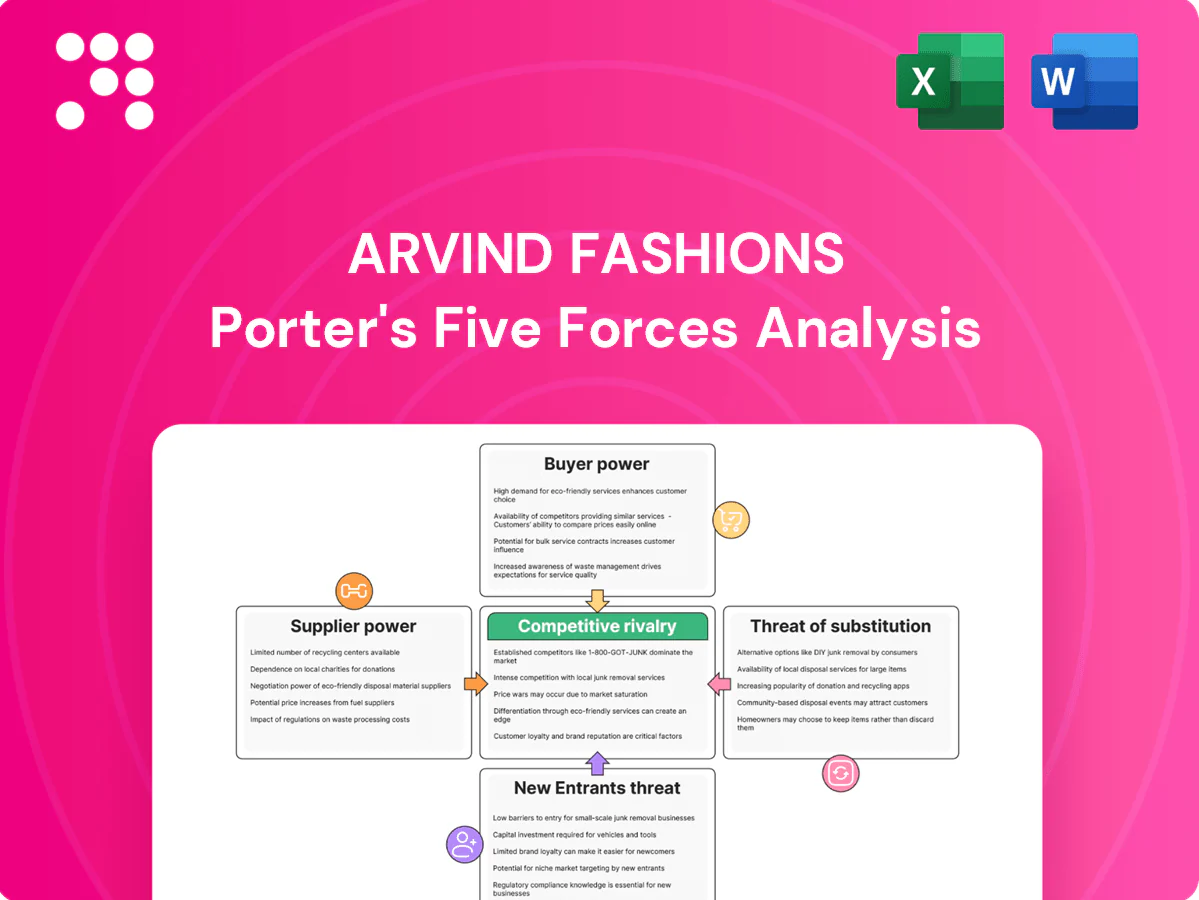
Arvind Fashions Porter's Five Forces Analysis

A Must-Have Tool for Decision-Makers
Arvind Fashions faces moderate buyer power, fierce retail competition, concentrated supplier leverage in some segments, and evolving substitute risks from fast fashion and e-commerce disruption. This snapshot highlights strategic pressures and opportunities. Unlock the full Porter's Five Forces Analysis to access force-by-force ratings, visuals, and actionable recommendations to guide investment or strategy.
Suppliers Bargaining Power

Diverse textile and component base
India is the world’s second-largest textile and apparel producer, offering a deep pool of fabric mills, dye houses, trim makers and contract manufacturers that limits individual supplier leverage. Arvind Fashions can multi-source standard materials to absorb price shocks, while approved-vendor lists and scarce premium fabrics, performance materials and specialty trims grant selective power to higher-spec compliant suppliers.
Quality, compliance, and ESG constraints
International licensed brands demand strict quality, social, and environmental standards (audits such as BSCI/Sedex, certifications SA8000, GOTS, ISO 14001) and in 2024 tightened traceability expectations, narrowing the supplier set and raising switching costs. Audits, certifications, and traceability elevate supplier bargaining power where compliant capacity is scarce. Non-compliant alternatives are not viable without risking brand equity.

Imported inputs and FX exposure
Imported fabrics, accessories and footwear components expose Arvind Fashions to FX and freight swings, which suppliers can pass through, tightening their bargaining power during constrained supply; hedging mitigates but does not remove this exposure, and logistics congestion in peak seasons further amplifies supplier leverage.

Scale-driven negotiation and SRM
Arvind Fashions leverages multi-brand scale to aggregate volumes and sign longer-term supplier contracts (typically 12–24 months in 2024), improving pricing, lead times and priority allocations with key vendors. Robust supplier relationship management and collaborative planning in 2024 reduced opportunistic behavior and inventory variability. This partially rebalances bargaining power away from fragmented suppliers.
- Scale: multi-brand volume aggregation
- Contracts: 12–24 months
- Benefits: better pricing, shorter lead times
- SRM: lowers opportunism, shifts power
Licensor dependencies for global brands
Licensors of international brands set sourcing norms, approve vendors and charge royalties, with global apparel royalty averages of 4–8% in 2024; their mandates can restrict Arvind Fashions’ supplier choice and constrain cost-engineering, effectively raising supplier power within licensed portfolios. Negotiated renewals and strict performance clauses are essential to rebalance margins and flexibility.
- Licensing royalties: 4–8% (2024 industry avg)
- Compliance/sustainability premiums: adds ~1–3% to COGS
- Vendor approval limits sourcing flexibility
- Renewals/performance clauses mitigate supplier leverage
Multi-sourcing, 12–24m contracts curb vendor leverage; royalties 4–8%, compliance 1–3% add COGS
Deep domestic supplier base limits single-vendor leverage; Arvind uses multi-sourcing and 12–24 month contracts to secure pricing and lead times. License rules, tighter 2024 traceability and royalties (4–8%) raise supplier power for compliant vendors. Imported inputs expose FX/freight risk; compliance premiums add ~1–3% to COGS.
| Metric (2024) | Value |
|---|---|
| Contracts | 12–24 months |
| Royalties | 4–8% |
| Compliance premium | 1–3% COGS |
What is included in the product
 Detailed Word Document
Tailored Porter's Five Forces analysis for Arvind Fashions uncovering key drivers of competition, buyer and supplier power, substitution threats, and entry barriers, with strategic insights on disruptive trends and implications for pricing, margins, and market positioning.

 Customizable Excel Spreadsheet
A clear one-sheet Porter's Five Forces for Arvind Fashions—instantly shows competitive pressure across suppliers, buyers, entrants, substitutes and rivals for quick decisions. Swap in your own sales, margin or market-share inputs and generate a radar view to update strategy without complex tools.
Customers Bargaining Power

Price transparency via e-commerce
Marketplaces and brand sites let shoppers compare prices instantly, with Amazon and Flipkart controlling over 60% of Indian marketplace GMV, enabling frictionless brand switching and raising customer bargaining power. Flash sales and festival discounts—often 30–50% off—train buyers to wait for promotions, compressing realized ASPs. For Arvind Fashions this translates into margin pressure and higher promotional intensity to defend volumes.
Multi-channel retail partners’ leverage
Department stores and large-format retailers negotiate margins, shelf space and returns, often extracting discounts that can compress brand margins by 5–15%; their footfall and POS data (millions of monthly transactions in major chains) give them disproportionate bargaining clout. Chargebacks and inventory buybacks can shift 1–5% of invoice value and working-capital risk onto brands. Brands must sustain sell-throughs of 50–60%+ in key windows to retain preferential terms.

Fashion sensitivity and switching ease
Trends, fit and design drive rapid preference shifts in fashion, with the global apparel market valued at about $1.5 trillion in 2024, increasing pressure on brands to refresh assortments. If collections miss, buyers readily switch to competitors or private labels, as low switching costs amplify buyer power in discretionary clothing. Fast replenishment cycles of 2–4 weeks and a steady design cadence are essential to retain customers and mitigate churn.

Loyalty programs and brand equity buffers
Loyalty ecosystems, memberships and exclusive drops reduce price elasticity for Arvind Fashions by driving repeat purchase and urgency; strong brand affinity in core labels like US Polo Assn. and Louis Philippe dampens buyer power and supports premium pricing. Benefits must be tangible to counter competitors, while CRM-led personalization improves full-price sell-through—industry studies in 2024 show personalization can lift purchase rates by up to 20%.
- loyalty-ecosystems
- memberships-exclusives
- brand-affinity-buffer
- tangible-benefits-needed
- crm-personalization:+up-to-20%-lift(2024)
Return policies and service expectations
Liberal return windows and omni-fulfillment raise service standards and operating costs; apparel e-commerce return rates averaged about 25% in 2024, forcing higher pick/pack and refund flows. Buyers treat hassle-free returns as a hygiene factor, increasing bargaining power while reverse logistics and shrinkage can erode margins if not tightly managed. Clear policies, accurate sizing data and virtual fit tools curb abuse with minimal CX impact.
- 2024 apparel return rate ~25%
- Reverse logistics can add 5–10% to operating costs
- Clear sizing fidelity reduces return frequency and shrinkage
Beat marketplace power: loyalty, personalization (+20%), faster restock
Customers have high bargaining power: marketplaces (Amazon+Flipkart >60% GMV) enable instant price/brand switching, while 30–50% festival discounts compress ASPs and margins. Large retailers extract 5–15% margin concessions and chargebacks, and 2024 apparel e‑commerce returns ~25% raise costs. Loyalty, personalization (up to +20% conversion) and faster replenishment are key defenses.
| Metric | 2024 Value |
|---|---|
| Marketplace share | >60% |
| Discount depth | 30–50% |
| Dept store margin hit | 5–15% |
| E‑comm return rate | ~25% |
| Personalization lift | +20% |
What You See Is What You Get
Arvind Fashions Porter's Five Forces Analysis
This preview shows the exact Arvind Fashions Porter's Five Forces Analysis you'll receive immediately after purchase—no placeholders or samples. The document is professionally formatted, fully referenced and ready for download and use upon payment. What you see is the deliverable.

A Must-Have Tool for Decision-Makers
Arvind Fashions faces moderate buyer power, fierce retail competition, concentrated supplier leverage in some segments, and evolving substitute risks from fast fashion and e-commerce disruption. This snapshot highlights strategic pressures and opportunities. Unlock the full Porter's Five Forces Analysis to access force-by-force ratings, visuals, and actionable recommendations to guide investment or strategy.
Suppliers Bargaining Power
Diverse textile and component base
India is the world’s second-largest textile and apparel producer, offering a deep pool of fabric mills, dye houses, trim makers and contract manufacturers that limits individual supplier leverage. Arvind Fashions can multi-source standard materials to absorb price shocks, while approved-vendor lists and scarce premium fabrics, performance materials and specialty trims grant selective power to higher-spec compliant suppliers.
Quality, compliance, and ESG constraints
International licensed brands demand strict quality, social, and environmental standards (audits such as BSCI/Sedex, certifications SA8000, GOTS, ISO 14001) and in 2024 tightened traceability expectations, narrowing the supplier set and raising switching costs. Audits, certifications, and traceability elevate supplier bargaining power where compliant capacity is scarce. Non-compliant alternatives are not viable without risking brand equity.
Imported inputs and FX exposure
Imported fabrics, accessories and footwear components expose Arvind Fashions to FX and freight swings, which suppliers can pass through, tightening their bargaining power during constrained supply; hedging mitigates but does not remove this exposure, and logistics congestion in peak seasons further amplifies supplier leverage.
Scale-driven negotiation and SRM
Arvind Fashions leverages multi-brand scale to aggregate volumes and sign longer-term supplier contracts (typically 12–24 months in 2024), improving pricing, lead times and priority allocations with key vendors. Robust supplier relationship management and collaborative planning in 2024 reduced opportunistic behavior and inventory variability. This partially rebalances bargaining power away from fragmented suppliers.
- Scale: multi-brand volume aggregation
- Contracts: 12–24 months
- Benefits: better pricing, shorter lead times
- SRM: lowers opportunism, shifts power
Licensor dependencies for global brands
Licensors of international brands set sourcing norms, approve vendors and charge royalties, with global apparel royalty averages of 4–8% in 2024; their mandates can restrict Arvind Fashions’ supplier choice and constrain cost-engineering, effectively raising supplier power within licensed portfolios. Negotiated renewals and strict performance clauses are essential to rebalance margins and flexibility.
- Licensing royalties: 4–8% (2024 industry avg)
- Compliance/sustainability premiums: adds ~1–3% to COGS
- Vendor approval limits sourcing flexibility
- Renewals/performance clauses mitigate supplier leverage
Multi-sourcing, 12–24m contracts curb vendor leverage; royalties 4–8%, compliance 1–3% add COGS
Deep domestic supplier base limits single-vendor leverage; Arvind uses multi-sourcing and 12–24 month contracts to secure pricing and lead times. License rules, tighter 2024 traceability and royalties (4–8%) raise supplier power for compliant vendors. Imported inputs expose FX/freight risk; compliance premiums add ~1–3% to COGS.
| Metric (2024) | Value |
|---|---|
| Contracts | 12–24 months |
| Royalties | 4–8% |
| Compliance premium | 1–3% COGS |
What is included in the product
Detailed Word Document
Tailored Porter's Five Forces analysis for Arvind Fashions uncovering key drivers of competition, buyer and supplier power, substitution threats, and entry barriers, with strategic insights on disruptive trends and implications for pricing, margins, and market positioning.
Customizable Excel Spreadsheet
A clear one-sheet Porter's Five Forces for Arvind Fashions—instantly shows competitive pressure across suppliers, buyers, entrants, substitutes and rivals for quick decisions. Swap in your own sales, margin or market-share inputs and generate a radar view to update strategy without complex tools.
Customers Bargaining Power
Price transparency via e-commerce
Marketplaces and brand sites let shoppers compare prices instantly, with Amazon and Flipkart controlling over 60% of Indian marketplace GMV, enabling frictionless brand switching and raising customer bargaining power. Flash sales and festival discounts—often 30–50% off—train buyers to wait for promotions, compressing realized ASPs. For Arvind Fashions this translates into margin pressure and higher promotional intensity to defend volumes.
Multi-channel retail partners’ leverage
Department stores and large-format retailers negotiate margins, shelf space and returns, often extracting discounts that can compress brand margins by 5–15%; their footfall and POS data (millions of monthly transactions in major chains) give them disproportionate bargaining clout. Chargebacks and inventory buybacks can shift 1–5% of invoice value and working-capital risk onto brands. Brands must sustain sell-throughs of 50–60%+ in key windows to retain preferential terms.
Fashion sensitivity and switching ease
Trends, fit and design drive rapid preference shifts in fashion, with the global apparel market valued at about $1.5 trillion in 2024, increasing pressure on brands to refresh assortments. If collections miss, buyers readily switch to competitors or private labels, as low switching costs amplify buyer power in discretionary clothing. Fast replenishment cycles of 2–4 weeks and a steady design cadence are essential to retain customers and mitigate churn.
Loyalty programs and brand equity buffers
Loyalty ecosystems, memberships and exclusive drops reduce price elasticity for Arvind Fashions by driving repeat purchase and urgency; strong brand affinity in core labels like US Polo Assn. and Louis Philippe dampens buyer power and supports premium pricing. Benefits must be tangible to counter competitors, while CRM-led personalization improves full-price sell-through—industry studies in 2024 show personalization can lift purchase rates by up to 20%.
- loyalty-ecosystems
- memberships-exclusives
- brand-affinity-buffer
- tangible-benefits-needed
- crm-personalization:+up-to-20%-lift(2024)
Return policies and service expectations
Liberal return windows and omni-fulfillment raise service standards and operating costs; apparel e-commerce return rates averaged about 25% in 2024, forcing higher pick/pack and refund flows. Buyers treat hassle-free returns as a hygiene factor, increasing bargaining power while reverse logistics and shrinkage can erode margins if not tightly managed. Clear policies, accurate sizing data and virtual fit tools curb abuse with minimal CX impact.
- 2024 apparel return rate ~25%
- Reverse logistics can add 5–10% to operating costs
- Clear sizing fidelity reduces return frequency and shrinkage
Beat marketplace power: loyalty, personalization (+20%), faster restock
Customers have high bargaining power: marketplaces (Amazon+Flipkart >60% GMV) enable instant price/brand switching, while 30–50% festival discounts compress ASPs and margins. Large retailers extract 5–15% margin concessions and chargebacks, and 2024 apparel e‑commerce returns ~25% raise costs. Loyalty, personalization (up to +20% conversion) and faster replenishment are key defenses.
| Metric | 2024 Value |
|---|---|
| Marketplace share | >60% |
| Discount depth | 30–50% |
| Dept store margin hit | 5–15% |
| E‑comm return rate | ~25% |
| Personalization lift | +20% |
What You See Is What You Get
Arvind Fashions Porter's Five Forces Analysis
This preview shows the exact Arvind Fashions Porter's Five Forces Analysis you'll receive immediately after purchase—no placeholders or samples. The document is professionally formatted, fully referenced and ready for download and use upon payment. What you see is the deliverable.
Original: $10.00
-65%$10.00
$3.50Description
A Must-Have Tool for Decision-Makers
Arvind Fashions faces moderate buyer power, fierce retail competition, concentrated supplier leverage in some segments, and evolving substitute risks from fast fashion and e-commerce disruption. This snapshot highlights strategic pressures and opportunities. Unlock the full Porter's Five Forces Analysis to access force-by-force ratings, visuals, and actionable recommendations to guide investment or strategy.
Suppliers Bargaining Power
Diverse textile and component base
India is the world’s second-largest textile and apparel producer, offering a deep pool of fabric mills, dye houses, trim makers and contract manufacturers that limits individual supplier leverage. Arvind Fashions can multi-source standard materials to absorb price shocks, while approved-vendor lists and scarce premium fabrics, performance materials and specialty trims grant selective power to higher-spec compliant suppliers.
Quality, compliance, and ESG constraints
International licensed brands demand strict quality, social, and environmental standards (audits such as BSCI/Sedex, certifications SA8000, GOTS, ISO 14001) and in 2024 tightened traceability expectations, narrowing the supplier set and raising switching costs. Audits, certifications, and traceability elevate supplier bargaining power where compliant capacity is scarce. Non-compliant alternatives are not viable without risking brand equity.
Imported inputs and FX exposure
Imported fabrics, accessories and footwear components expose Arvind Fashions to FX and freight swings, which suppliers can pass through, tightening their bargaining power during constrained supply; hedging mitigates but does not remove this exposure, and logistics congestion in peak seasons further amplifies supplier leverage.
Scale-driven negotiation and SRM
Arvind Fashions leverages multi-brand scale to aggregate volumes and sign longer-term supplier contracts (typically 12–24 months in 2024), improving pricing, lead times and priority allocations with key vendors. Robust supplier relationship management and collaborative planning in 2024 reduced opportunistic behavior and inventory variability. This partially rebalances bargaining power away from fragmented suppliers.
- Scale: multi-brand volume aggregation
- Contracts: 12–24 months
- Benefits: better pricing, shorter lead times
- SRM: lowers opportunism, shifts power
Licensor dependencies for global brands
Licensors of international brands set sourcing norms, approve vendors and charge royalties, with global apparel royalty averages of 4–8% in 2024; their mandates can restrict Arvind Fashions’ supplier choice and constrain cost-engineering, effectively raising supplier power within licensed portfolios. Negotiated renewals and strict performance clauses are essential to rebalance margins and flexibility.
- Licensing royalties: 4–8% (2024 industry avg)
- Compliance/sustainability premiums: adds ~1–3% to COGS
- Vendor approval limits sourcing flexibility
- Renewals/performance clauses mitigate supplier leverage
Multi-sourcing, 12–24m contracts curb vendor leverage; royalties 4–8%, compliance 1–3% add COGS
Deep domestic supplier base limits single-vendor leverage; Arvind uses multi-sourcing and 12–24 month contracts to secure pricing and lead times. License rules, tighter 2024 traceability and royalties (4–8%) raise supplier power for compliant vendors. Imported inputs expose FX/freight risk; compliance premiums add ~1–3% to COGS.
| Metric (2024) | Value |
|---|---|
| Contracts | 12–24 months |
| Royalties | 4–8% |
| Compliance premium | 1–3% COGS |
What is included in the product
Detailed Word Document
Tailored Porter's Five Forces analysis for Arvind Fashions uncovering key drivers of competition, buyer and supplier power, substitution threats, and entry barriers, with strategic insights on disruptive trends and implications for pricing, margins, and market positioning.
Customizable Excel Spreadsheet
A clear one-sheet Porter's Five Forces for Arvind Fashions—instantly shows competitive pressure across suppliers, buyers, entrants, substitutes and rivals for quick decisions. Swap in your own sales, margin or market-share inputs and generate a radar view to update strategy without complex tools.
Customers Bargaining Power
Price transparency via e-commerce
Marketplaces and brand sites let shoppers compare prices instantly, with Amazon and Flipkart controlling over 60% of Indian marketplace GMV, enabling frictionless brand switching and raising customer bargaining power. Flash sales and festival discounts—often 30–50% off—train buyers to wait for promotions, compressing realized ASPs. For Arvind Fashions this translates into margin pressure and higher promotional intensity to defend volumes.
Multi-channel retail partners’ leverage
Department stores and large-format retailers negotiate margins, shelf space and returns, often extracting discounts that can compress brand margins by 5–15%; their footfall and POS data (millions of monthly transactions in major chains) give them disproportionate bargaining clout. Chargebacks and inventory buybacks can shift 1–5% of invoice value and working-capital risk onto brands. Brands must sustain sell-throughs of 50–60%+ in key windows to retain preferential terms.
Fashion sensitivity and switching ease
Trends, fit and design drive rapid preference shifts in fashion, with the global apparel market valued at about $1.5 trillion in 2024, increasing pressure on brands to refresh assortments. If collections miss, buyers readily switch to competitors or private labels, as low switching costs amplify buyer power in discretionary clothing. Fast replenishment cycles of 2–4 weeks and a steady design cadence are essential to retain customers and mitigate churn.
Loyalty programs and brand equity buffers
Loyalty ecosystems, memberships and exclusive drops reduce price elasticity for Arvind Fashions by driving repeat purchase and urgency; strong brand affinity in core labels like US Polo Assn. and Louis Philippe dampens buyer power and supports premium pricing. Benefits must be tangible to counter competitors, while CRM-led personalization improves full-price sell-through—industry studies in 2024 show personalization can lift purchase rates by up to 20%.
- loyalty-ecosystems
- memberships-exclusives
- brand-affinity-buffer
- tangible-benefits-needed
- crm-personalization:+up-to-20%-lift(2024)
Return policies and service expectations
Liberal return windows and omni-fulfillment raise service standards and operating costs; apparel e-commerce return rates averaged about 25% in 2024, forcing higher pick/pack and refund flows. Buyers treat hassle-free returns as a hygiene factor, increasing bargaining power while reverse logistics and shrinkage can erode margins if not tightly managed. Clear policies, accurate sizing data and virtual fit tools curb abuse with minimal CX impact.
- 2024 apparel return rate ~25%
- Reverse logistics can add 5–10% to operating costs
- Clear sizing fidelity reduces return frequency and shrinkage
Beat marketplace power: loyalty, personalization (+20%), faster restock
Customers have high bargaining power: marketplaces (Amazon+Flipkart >60% GMV) enable instant price/brand switching, while 30–50% festival discounts compress ASPs and margins. Large retailers extract 5–15% margin concessions and chargebacks, and 2024 apparel e‑commerce returns ~25% raise costs. Loyalty, personalization (up to +20% conversion) and faster replenishment are key defenses.
| Metric | 2024 Value |
|---|---|
| Marketplace share | >60% |
| Discount depth | 30–50% |
| Dept store margin hit | 5–15% |
| E‑comm return rate | ~25% |
| Personalization lift | +20% |
What You See Is What You Get
Arvind Fashions Porter's Five Forces Analysis
This preview shows the exact Arvind Fashions Porter's Five Forces Analysis you'll receive immediately after purchase—no placeholders or samples. The document is professionally formatted, fully referenced and ready for download and use upon payment. What you see is the deliverable.











