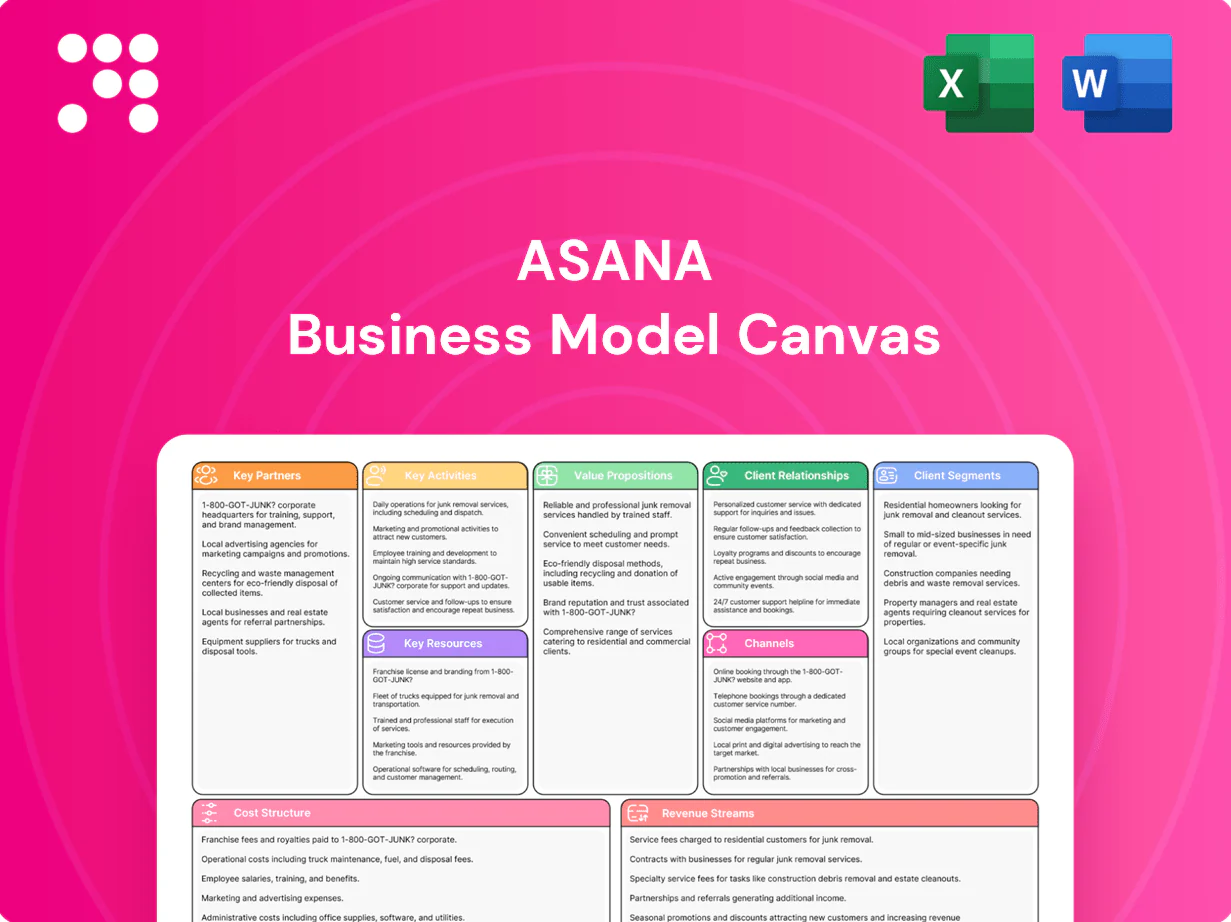
Asana Business Model Canvas

Collaboration-first SaaS Canvas: freemium-to-enterprise growth & integration levers
Explore Asana’s Business Model Canvas to see how its collaboration-first value proposition, freemium-to-enterprise revenue funnel, and integrations ecosystem drive retention and growth. This concise snapshot highlights key partners, channels, and cost levers—perfect for benchmarking. Ready for deeper, actionable insights? Purchase the full, editable Business Model Canvas to use in strategy, investor decks, or competitive analysis.
Partnerships

Cloud infrastructure providers
Dependable cloud partners (AWS 31%, Azure 23%, GCP 11% share of the 2024 global cloud market per Canalys) ensure SaaS scalability, 99.9%+ uptime SLAs and global low-latency performance. They enable rapid deployment, multi-region redundancy and cost-efficient compute via reserved/committed pricing. Advanced managed databases, security tooling and analytics reduce time-to-market and accelerate product innovation. Strategic multi-year agreements improve cost predictability and compliance coverage.
Productivity & collaboration integrations
Partnerships with Google Workspace (6M+ paying businesses in 2024), Microsoft 365 (300M+ commercial seats by 2024), Slack (~200k paid customers in 2024) and Zoom (300M daily meeting participants reported 2023) embed Asana into workflows, reducing friction and increasing stickiness; joint GTM expands reach across mutual customers, while API-based alignment enables faster maintenance when partners update platforms.

Enterprise security & compliance partners
Enterprise security and compliance partners — security vendors, SSO/IDP providers like Okta and Microsoft Entra, and independent auditors — help Asana meet SOC 2, ISO 27001, HIPAA and regional data regulations. Certifications and attestations build trust with regulated industries such as healthcare and finance. Co-selling with security partners streamlines procurement and risk reviews. These partnerships reduce adoption friction for large enterprises.

Solution integrators & channel resellers
Global SIs and VARs localize Asana deployments and drive enterprise adoption, providing change management, onboarding and custom workflows; Asana reported $462.6M revenue in FY2024, underscoring enterprise traction. Channel partners open doors to large accounts and complex RFPs, while revenue-sharing models align incentives to scale implementations.
- Localized deployments by SIs/VARs
- Change management & onboarding
- Access to large accounts/RFPs
- Revenue share aligns incentives
Developer ecosystem & marketplace apps
Third-party developers extend Asana with specialized apps and connectors. A thriving marketplace, with 300+ apps and integrations as of 2024, increases platform utility across niches. Co-marketing and technical support programs attract high-quality builders. Ecosystem breadth reduces churn by covering edge use cases.
- 300+ apps & integrations (2024)
- Co-marketing + developer support
- Broader coverage lowers churn
Cloud-backed work platform with AWS/Azure/GCP scale and $462.6M revenue
Cloud providers (AWS 31%, Azure 23%, GCP 11% Canalys 2024) ensure 99.9%+ uptime and global scale; productivity integrations (Google Workspace 6M paying businesses, Microsoft 365 300M seats, Slack 200k paid) embed Asana into workflows; security partners enable SOC 2/ISO/HIPAA compliance; SIs/VARs and 300+ apps drive enterprise adoption and reduce churn (Asana revenue $462.6M FY2024).
| Partner type | Key metric (2024) | Value |
|---|---|---|
| Cloud | AWS 31%/Azure 23%/GCP 11% | Scale, SLAs, cost predictability |
| Productivity | Google 6M/MS365 300M/Slack 200k | Workflow embedding |
| Security | SOC 2/ISO/HIPAA | Enterprise trust |
| Channels | $462.6M revenue | Enterprise reach |
| Developers | 300+ apps | Feature breadth |
What is included in the product
 Detailed Word Document
A complete Asana Business Model Canvas mapping nine BMC blocks—customer segments, channels, value propositions, revenue streams, key resources, partners, activities, cost structure and customer relationships—highlighting its freemium-to-enterprise SaaS model, integrations, competitive advantages and linked SWOT insights for investor-ready presentations and strategic decisions.

 Customizable Excel Spreadsheet
High-level view of Asana’s business model with editable cells that relieves planning bottlenecks and clarifies revenue drivers across teams. Great for quickly aligning product, sales, and operations to reduce miscommunication and accelerate decision-making.
Activities

Continuous product development
Iterative feature shipping (Asana ships hundreds of updates annually) sustains competitive differentiation while UX research and design keep onboarding intuitive for broad audiences; roadmap prioritization balances SMB and enterprise demands (serving over 147,000 paying customers in 2024) and rigorous QA underpins reliability at scale, supporting FY2024 revenue of $529.1M and strong enterprise adoption.
Platform reliability & security
SRE teams, monitoring, and incident response preserve Asana uptime and performance through automated runbooks and playbooks, minimizing mean time to recovery. Asana runs on AWS and, as of 2024, maintains SOC 2 Type II and ISO 27001 certifications to harden security, conduct pen tests, and manage vulnerabilities. Data protection and privacy controls align with regulatory obligations, and documented business continuity planning safeguards customer operations.

Ecosystem integrations & APIs
Building and maintaining 200+ ecosystem integrations embeds Asana across modern toolchains, driving adoption and stickiness. Stable APIs with clear documentation and SDKs empower partners and customers to build reliably. Webhooks and SDKs accelerate custom extensions, while backward compatibility and versioning policies minimize disruption during updates.

Go-to-market & product-led growth
Asana drives product-led growth via freemium, time-limited trials and in-product prompts that fuel self-serve expansion, contributing to platform momentum as revenue reached $495.7M in FY2024.
Marketing campaigns educate and convert across SMB to enterprise segments while targeted sales motions focus on mid-market and enterprise land-and-expand motions; pricing experiments steadily improve monetization and retention.
- Freemium-led conversion: self-serve expansion
- Trials & in-app prompts: boost activation
- Sales: mid-market and enterprise land-and-expand
- Pricing experiments: optimize ARPU and retention
Customer success & support
Customer success and support at Asana combine onboarding and training to accelerate time-to-value, with success plans and quarterly business reviews driving expansion and renewal; Asana reported FY2024 revenue $541.9M and a dollar-based net retention of 121%, underscoring impact. Multi-channel support resolves issues rapidly, while community programs surface best practices and advocacy.
- Onboarding & training
- QBRs & success plans
- Multi-channel support
- Community advocacy
Product-led roadmap serves SMB & enterprise: 147,000 customers, $529.1M revenue, 121% DBNR
Iterative feature shipping and UX research sustain product differentiation while roadmap prioritization balances SMB and enterprise, serving 147,000 paying customers and supporting FY2024 revenue of $529.1M with 121% dollar-based net retention. SRE, monitoring, SOC 2 Type II and ISO 27001 uphold uptime, security, and incident response. Building 200+ integrations and stable APIs embeds Asana across toolchains, driving stickiness.
| Metric | 2024 |
|---|---|
| Paying customers | 147,000 |
| FY2024 revenue | $529.1M |
| DBNR | 121% |
| Integrations | 200+ |
Full Document Unlocks After Purchase
Business Model Canvas
The Asana Business Model Canvas you’re previewing is the actual deliverable—not a mockup or teaser. When you purchase, you’ll receive this exact document in full, formatted and ready to edit. No surprises, no placeholders—just the same professional canvas shown here for immediate use.

Collaboration-first SaaS Canvas: freemium-to-enterprise growth & integration levers
Explore Asana’s Business Model Canvas to see how its collaboration-first value proposition, freemium-to-enterprise revenue funnel, and integrations ecosystem drive retention and growth. This concise snapshot highlights key partners, channels, and cost levers—perfect for benchmarking. Ready for deeper, actionable insights? Purchase the full, editable Business Model Canvas to use in strategy, investor decks, or competitive analysis.
Partnerships
Cloud infrastructure providers
Dependable cloud partners (AWS 31%, Azure 23%, GCP 11% share of the 2024 global cloud market per Canalys) ensure SaaS scalability, 99.9%+ uptime SLAs and global low-latency performance. They enable rapid deployment, multi-region redundancy and cost-efficient compute via reserved/committed pricing. Advanced managed databases, security tooling and analytics reduce time-to-market and accelerate product innovation. Strategic multi-year agreements improve cost predictability and compliance coverage.
Productivity & collaboration integrations
Partnerships with Google Workspace (6M+ paying businesses in 2024), Microsoft 365 (300M+ commercial seats by 2024), Slack (~200k paid customers in 2024) and Zoom (300M daily meeting participants reported 2023) embed Asana into workflows, reducing friction and increasing stickiness; joint GTM expands reach across mutual customers, while API-based alignment enables faster maintenance when partners update platforms.
Enterprise security & compliance partners
Enterprise security and compliance partners — security vendors, SSO/IDP providers like Okta and Microsoft Entra, and independent auditors — help Asana meet SOC 2, ISO 27001, HIPAA and regional data regulations. Certifications and attestations build trust with regulated industries such as healthcare and finance. Co-selling with security partners streamlines procurement and risk reviews. These partnerships reduce adoption friction for large enterprises.
Solution integrators & channel resellers
Global SIs and VARs localize Asana deployments and drive enterprise adoption, providing change management, onboarding and custom workflows; Asana reported $462.6M revenue in FY2024, underscoring enterprise traction. Channel partners open doors to large accounts and complex RFPs, while revenue-sharing models align incentives to scale implementations.
- Localized deployments by SIs/VARs
- Change management & onboarding
- Access to large accounts/RFPs
- Revenue share aligns incentives
Developer ecosystem & marketplace apps
Third-party developers extend Asana with specialized apps and connectors. A thriving marketplace, with 300+ apps and integrations as of 2024, increases platform utility across niches. Co-marketing and technical support programs attract high-quality builders. Ecosystem breadth reduces churn by covering edge use cases.
- 300+ apps & integrations (2024)
- Co-marketing + developer support
- Broader coverage lowers churn
Cloud-backed work platform with AWS/Azure/GCP scale and $462.6M revenue
Cloud providers (AWS 31%, Azure 23%, GCP 11% Canalys 2024) ensure 99.9%+ uptime and global scale; productivity integrations (Google Workspace 6M paying businesses, Microsoft 365 300M seats, Slack 200k paid) embed Asana into workflows; security partners enable SOC 2/ISO/HIPAA compliance; SIs/VARs and 300+ apps drive enterprise adoption and reduce churn (Asana revenue $462.6M FY2024).
| Partner type | Key metric (2024) | Value |
|---|---|---|
| Cloud | AWS 31%/Azure 23%/GCP 11% | Scale, SLAs, cost predictability |
| Productivity | Google 6M/MS365 300M/Slack 200k | Workflow embedding |
| Security | SOC 2/ISO/HIPAA | Enterprise trust |
| Channels | $462.6M revenue | Enterprise reach |
| Developers | 300+ apps | Feature breadth |
What is included in the product
Detailed Word Document
A complete Asana Business Model Canvas mapping nine BMC blocks—customer segments, channels, value propositions, revenue streams, key resources, partners, activities, cost structure and customer relationships—highlighting its freemium-to-enterprise SaaS model, integrations, competitive advantages and linked SWOT insights for investor-ready presentations and strategic decisions.
Customizable Excel Spreadsheet
High-level view of Asana’s business model with editable cells that relieves planning bottlenecks and clarifies revenue drivers across teams. Great for quickly aligning product, sales, and operations to reduce miscommunication and accelerate decision-making.
Activities
Continuous product development
Iterative feature shipping (Asana ships hundreds of updates annually) sustains competitive differentiation while UX research and design keep onboarding intuitive for broad audiences; roadmap prioritization balances SMB and enterprise demands (serving over 147,000 paying customers in 2024) and rigorous QA underpins reliability at scale, supporting FY2024 revenue of $529.1M and strong enterprise adoption.
Platform reliability & security
SRE teams, monitoring, and incident response preserve Asana uptime and performance through automated runbooks and playbooks, minimizing mean time to recovery. Asana runs on AWS and, as of 2024, maintains SOC 2 Type II and ISO 27001 certifications to harden security, conduct pen tests, and manage vulnerabilities. Data protection and privacy controls align with regulatory obligations, and documented business continuity planning safeguards customer operations.
Ecosystem integrations & APIs
Building and maintaining 200+ ecosystem integrations embeds Asana across modern toolchains, driving adoption and stickiness. Stable APIs with clear documentation and SDKs empower partners and customers to build reliably. Webhooks and SDKs accelerate custom extensions, while backward compatibility and versioning policies minimize disruption during updates.
Go-to-market & product-led growth
Asana drives product-led growth via freemium, time-limited trials and in-product prompts that fuel self-serve expansion, contributing to platform momentum as revenue reached $495.7M in FY2024.
Marketing campaigns educate and convert across SMB to enterprise segments while targeted sales motions focus on mid-market and enterprise land-and-expand motions; pricing experiments steadily improve monetization and retention.
- Freemium-led conversion: self-serve expansion
- Trials & in-app prompts: boost activation
- Sales: mid-market and enterprise land-and-expand
- Pricing experiments: optimize ARPU and retention
Customer success & support
Customer success and support at Asana combine onboarding and training to accelerate time-to-value, with success plans and quarterly business reviews driving expansion and renewal; Asana reported FY2024 revenue $541.9M and a dollar-based net retention of 121%, underscoring impact. Multi-channel support resolves issues rapidly, while community programs surface best practices and advocacy.
- Onboarding & training
- QBRs & success plans
- Multi-channel support
- Community advocacy
Product-led roadmap serves SMB & enterprise: 147,000 customers, $529.1M revenue, 121% DBNR
Iterative feature shipping and UX research sustain product differentiation while roadmap prioritization balances SMB and enterprise, serving 147,000 paying customers and supporting FY2024 revenue of $529.1M with 121% dollar-based net retention. SRE, monitoring, SOC 2 Type II and ISO 27001 uphold uptime, security, and incident response. Building 200+ integrations and stable APIs embeds Asana across toolchains, driving stickiness.
| Metric | 2024 |
|---|---|
| Paying customers | 147,000 |
| FY2024 revenue | $529.1M |
| DBNR | 121% |
| Integrations | 200+ |
Full Document Unlocks After Purchase
Business Model Canvas
The Asana Business Model Canvas you’re previewing is the actual deliverable—not a mockup or teaser. When you purchase, you’ll receive this exact document in full, formatted and ready to edit. No surprises, no placeholders—just the same professional canvas shown here for immediate use.
Original: $10.00
-65%$10.00
$3.50Description
Collaboration-first SaaS Canvas: freemium-to-enterprise growth & integration levers
Explore Asana’s Business Model Canvas to see how its collaboration-first value proposition, freemium-to-enterprise revenue funnel, and integrations ecosystem drive retention and growth. This concise snapshot highlights key partners, channels, and cost levers—perfect for benchmarking. Ready for deeper, actionable insights? Purchase the full, editable Business Model Canvas to use in strategy, investor decks, or competitive analysis.
Partnerships
Cloud infrastructure providers
Dependable cloud partners (AWS 31%, Azure 23%, GCP 11% share of the 2024 global cloud market per Canalys) ensure SaaS scalability, 99.9%+ uptime SLAs and global low-latency performance. They enable rapid deployment, multi-region redundancy and cost-efficient compute via reserved/committed pricing. Advanced managed databases, security tooling and analytics reduce time-to-market and accelerate product innovation. Strategic multi-year agreements improve cost predictability and compliance coverage.
Productivity & collaboration integrations
Partnerships with Google Workspace (6M+ paying businesses in 2024), Microsoft 365 (300M+ commercial seats by 2024), Slack (~200k paid customers in 2024) and Zoom (300M daily meeting participants reported 2023) embed Asana into workflows, reducing friction and increasing stickiness; joint GTM expands reach across mutual customers, while API-based alignment enables faster maintenance when partners update platforms.
Enterprise security & compliance partners
Enterprise security and compliance partners — security vendors, SSO/IDP providers like Okta and Microsoft Entra, and independent auditors — help Asana meet SOC 2, ISO 27001, HIPAA and regional data regulations. Certifications and attestations build trust with regulated industries such as healthcare and finance. Co-selling with security partners streamlines procurement and risk reviews. These partnerships reduce adoption friction for large enterprises.
Solution integrators & channel resellers
Global SIs and VARs localize Asana deployments and drive enterprise adoption, providing change management, onboarding and custom workflows; Asana reported $462.6M revenue in FY2024, underscoring enterprise traction. Channel partners open doors to large accounts and complex RFPs, while revenue-sharing models align incentives to scale implementations.
- Localized deployments by SIs/VARs
- Change management & onboarding
- Access to large accounts/RFPs
- Revenue share aligns incentives
Developer ecosystem & marketplace apps
Third-party developers extend Asana with specialized apps and connectors. A thriving marketplace, with 300+ apps and integrations as of 2024, increases platform utility across niches. Co-marketing and technical support programs attract high-quality builders. Ecosystem breadth reduces churn by covering edge use cases.
- 300+ apps & integrations (2024)
- Co-marketing + developer support
- Broader coverage lowers churn
Cloud-backed work platform with AWS/Azure/GCP scale and $462.6M revenue
Cloud providers (AWS 31%, Azure 23%, GCP 11% Canalys 2024) ensure 99.9%+ uptime and global scale; productivity integrations (Google Workspace 6M paying businesses, Microsoft 365 300M seats, Slack 200k paid) embed Asana into workflows; security partners enable SOC 2/ISO/HIPAA compliance; SIs/VARs and 300+ apps drive enterprise adoption and reduce churn (Asana revenue $462.6M FY2024).
| Partner type | Key metric (2024) | Value |
|---|---|---|
| Cloud | AWS 31%/Azure 23%/GCP 11% | Scale, SLAs, cost predictability |
| Productivity | Google 6M/MS365 300M/Slack 200k | Workflow embedding |
| Security | SOC 2/ISO/HIPAA | Enterprise trust |
| Channels | $462.6M revenue | Enterprise reach |
| Developers | 300+ apps | Feature breadth |
What is included in the product
Detailed Word Document
A complete Asana Business Model Canvas mapping nine BMC blocks—customer segments, channels, value propositions, revenue streams, key resources, partners, activities, cost structure and customer relationships—highlighting its freemium-to-enterprise SaaS model, integrations, competitive advantages and linked SWOT insights for investor-ready presentations and strategic decisions.
Customizable Excel Spreadsheet
High-level view of Asana’s business model with editable cells that relieves planning bottlenecks and clarifies revenue drivers across teams. Great for quickly aligning product, sales, and operations to reduce miscommunication and accelerate decision-making.
Activities
Continuous product development
Iterative feature shipping (Asana ships hundreds of updates annually) sustains competitive differentiation while UX research and design keep onboarding intuitive for broad audiences; roadmap prioritization balances SMB and enterprise demands (serving over 147,000 paying customers in 2024) and rigorous QA underpins reliability at scale, supporting FY2024 revenue of $529.1M and strong enterprise adoption.
Platform reliability & security
SRE teams, monitoring, and incident response preserve Asana uptime and performance through automated runbooks and playbooks, minimizing mean time to recovery. Asana runs on AWS and, as of 2024, maintains SOC 2 Type II and ISO 27001 certifications to harden security, conduct pen tests, and manage vulnerabilities. Data protection and privacy controls align with regulatory obligations, and documented business continuity planning safeguards customer operations.
Ecosystem integrations & APIs
Building and maintaining 200+ ecosystem integrations embeds Asana across modern toolchains, driving adoption and stickiness. Stable APIs with clear documentation and SDKs empower partners and customers to build reliably. Webhooks and SDKs accelerate custom extensions, while backward compatibility and versioning policies minimize disruption during updates.
Go-to-market & product-led growth
Asana drives product-led growth via freemium, time-limited trials and in-product prompts that fuel self-serve expansion, contributing to platform momentum as revenue reached $495.7M in FY2024.
Marketing campaigns educate and convert across SMB to enterprise segments while targeted sales motions focus on mid-market and enterprise land-and-expand motions; pricing experiments steadily improve monetization and retention.
- Freemium-led conversion: self-serve expansion
- Trials & in-app prompts: boost activation
- Sales: mid-market and enterprise land-and-expand
- Pricing experiments: optimize ARPU and retention
Customer success & support
Customer success and support at Asana combine onboarding and training to accelerate time-to-value, with success plans and quarterly business reviews driving expansion and renewal; Asana reported FY2024 revenue $541.9M and a dollar-based net retention of 121%, underscoring impact. Multi-channel support resolves issues rapidly, while community programs surface best practices and advocacy.
- Onboarding & training
- QBRs & success plans
- Multi-channel support
- Community advocacy
Product-led roadmap serves SMB & enterprise: 147,000 customers, $529.1M revenue, 121% DBNR
Iterative feature shipping and UX research sustain product differentiation while roadmap prioritization balances SMB and enterprise, serving 147,000 paying customers and supporting FY2024 revenue of $529.1M with 121% dollar-based net retention. SRE, monitoring, SOC 2 Type II and ISO 27001 uphold uptime, security, and incident response. Building 200+ integrations and stable APIs embeds Asana across toolchains, driving stickiness.
| Metric | 2024 |
|---|---|
| Paying customers | 147,000 |
| FY2024 revenue | $529.1M |
| DBNR | 121% |
| Integrations | 200+ |
Full Document Unlocks After Purchase
Business Model Canvas
The Asana Business Model Canvas you’re previewing is the actual deliverable—not a mockup or teaser. When you purchase, you’ll receive this exact document in full, formatted and ready to edit. No surprises, no placeholders—just the same professional canvas shown here for immediate use.











