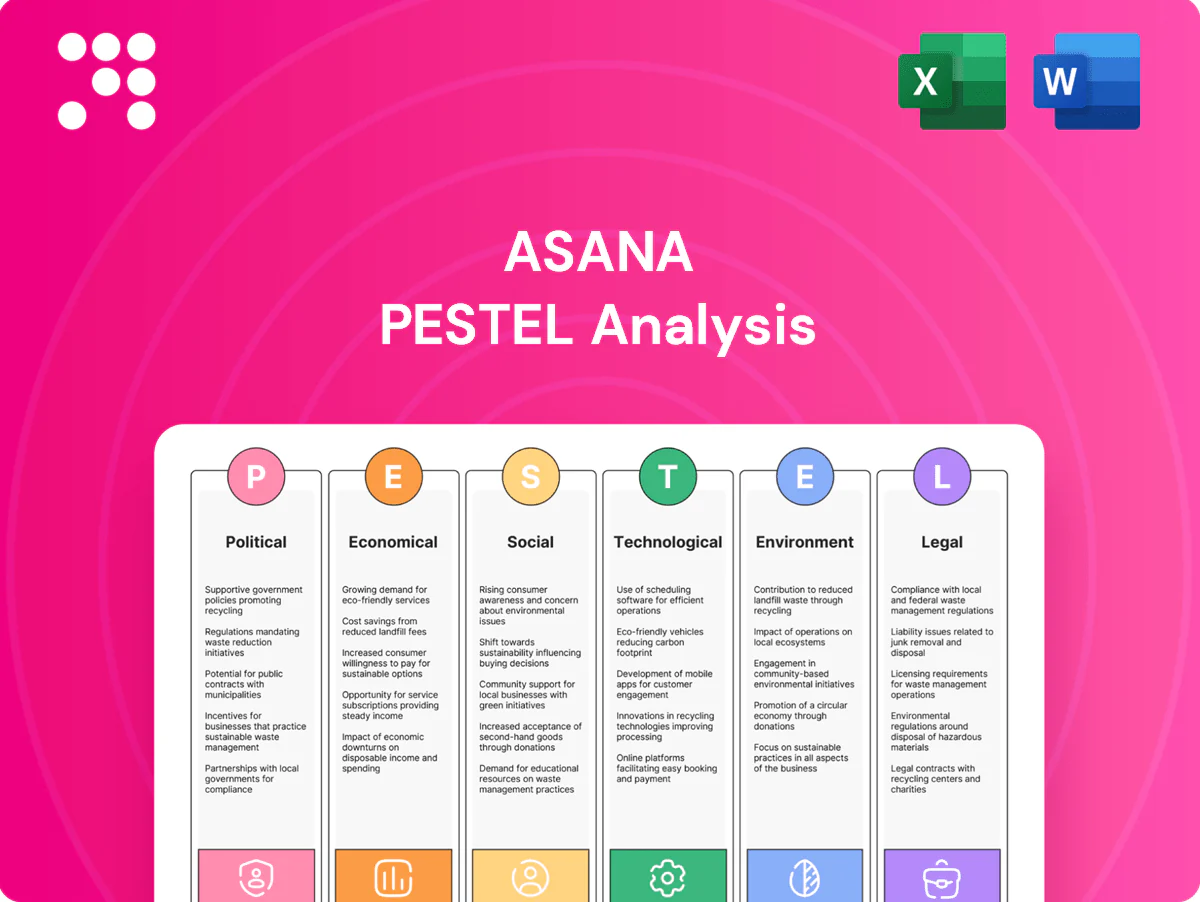
Asana PESTLE Analysis

Make Smarter Strategic Decisions with a Complete PESTEL View
Unlock strategic clarity with our Asana PESTLE Analysis—three concise sections revealing how political shifts, economic trends, and tech innovation shape its roadmap. Ideal for investors and strategists, it’s fully sourced and actionable. Purchase the full report to get detailed insights and ready-to-use visuals.
Political factors

Data sovereignty tides
Governments increasingly mandate local data storage and cross-border transfer controls, with 133 countries now having data protection laws per UNCTAD, pressuring multi-tenant SaaS architectures. Asana must maintain region-specific hosting and GovCloud options to win public-sector and regulated clients or face contract loss and regulatory penalties. Proactive data residency roadmaps reduce procurement friction and speed market access.
Public-sector procurement
Lengthy, compliance-heavy RFPs (commonly 6–18 months) shape pricing, security attestations, and roadmap commitments, adding procurement risk for Asana, which reported $548.1M revenue in FY2024. Winning government accounts requires FedRAMP/StateRAMP or equivalents; political budget cycles and policy shifts can accelerate or stall adoption. Building channel partners skilled in public procurement measurably improves win rates.

Geopolitical fragmentation
Geopolitical fragmentation—illustrated by US semiconductor export controls since Oct 2022 and China's long-standing block of Google Play—can constrain vendor ecosystems and API partners, forcing tighter supply-chain controls. Markets like China (about 1.05 billion internet users in 2023) drive localization demands for language, payments and support. Regional platform bans risk disrupting integrations; diversifying cloud infrastructure and partner networks reduces concentration risk.

Digital policy agendas
National productivity and digital-transformation programs (eg EU Digital Decade, US federal modernization) create clear tailwinds for Asana by expanding addressable market for work-management tools. Grants and tax incentives accelerate SMB software adoption—SMBs account for roughly half of global employment and GDP, magnifying impact. Tech skepticism can trigger stricter platform rules; active policy engagement aligns features with public priorities.
- Tailwinds: public digital programs expand addressable market
- SMB incentives: grants/tax breaks boost adoption
- Risk: regulatory tightening from tech skepticism
- Action: engage policymakers to shape priorities
Tax and subsidy regimes
Changes like the OECD Pillar Two 15% minimum tax and national corporate rate shifts (US 21%) plus variable SaaS VAT/GST and emerging DSTs materially affect Asana’s net pricing and margins; Gartner estimates cloud TCO reductions of 20–30%, while cloud adoption incentives (grants, tax credits) can lower buyer costs and drive demand.
- Tax: OECD Pillar Two 15%
- SaaS VAT/GST: cross-border variability raises compliance
- DSTs: added surcharge risk
- Procurement: transparent billing eases enterprise buy-in
Data-localization, geopolitics and tax shifts reshape region-specific SaaS deals
Rising data-localization (133 countries with data protection laws per UNCTAD) and lengthy 6–18 month RFPs force region-specific hosting and FedRAMP/StateRAMP for public deals. Geopolitical fragmentation (China 1.05B internet users) and export controls increase localization and partner diversification costs. Tax shifts (OECD Pillar Two 15%) and VAT/DST variability affect net pricing versus Asana’s $548.1M FY2024 revenue.
| Factor | Metric |
|---|---|
| Data laws | 133 countries |
| FY Revenue | $548.1M (FY2024) |
| Min tax | 15% Pillar Two |
What is included in the product
 Detailed Word Document
Explores how external macro-environmental factors uniquely affect the Asana across Political, Economic, Social, Technological, Environmental, and Legal dimensions, with each section backed by current data and trends. Designed for executives and investors, it reflects market and regulatory dynamics, offers forward-looking insights, and is formatted for direct insertion into reports or decks.

 Customizable Excel Spreadsheet
A concise, visually segmented PESTLE summary of Asana that distills external risks and opportunities for rapid review in meetings or presentations. Easily shared and editable so teams can align quickly and tailor insights to region, product line, or strategic planning sessions.
Economic factors

Macro IT spend cycles
Enterprise software budgets expand in growth cycles and tighten in downturns; Gartner estimated global IT spend near $4.7 trillion in 2024, underscoring cyclical demand shifts. As a subscription platform with subscription revenue over 90% of total, Asana benefits from durable recurring revenue but faces downgrades and seat churn during recessions. Value messaging shifts to ROI and consolidation in slowdowns, while land-and-expand depends on corporate headcount growth and hiring trends.
FX and pricing power
Currency volatility can swing Asana's reported revenue—FY2024 revenue was $548.3 million—while changing local affordability and conversion in EMEA/APAC. Tiered packaging and regional pricing protect conversion and retention across markets. Annual prepay and multi-year deals stabilize cash flow and deferred revenue, supported by strong renewal rates in FY2024. Hedging policies and USD billing reduce earnings noise.

SMB vs enterprise mix
SMB customers drive Asana’s volume and virality but show high price sensitivity and churn under macro stress, while enterprise accounts deliver materially higher ARPU, stickiness, and expansion—Asana reported fiscal 2024 revenue of about $548 million, reflecting this mix shift toward larger customers.

Competitive intensity
Competitive intensity in collaboration software forces price and feature races; Asana reported FY2024 revenue of 548.8 million, yet faces platform giants (Microsoft Teams ~280 million MAU) whose bundling compresses standalone willingness to pay. Asana leans on workflow differentiation, deep integrations and AI productivity features to resist commoditization. Efficient go-to-market and lower CAC are critical as digital ad costs rose in 2024.
- Crowded market → discounting & faster feature cadence
- Bundling by giants → lower WTP for standalone tools
- Differentiation: workflow, integrations, AI
- Efficient GTM lowers CAC amid rising ad costs
Labor productivity thesis
Organizations invest in tools like Asana to cut coordination costs and cycle time; Forrester TEI (2021) found a 397% ROI and 45% faster project completion, while McKinsey estimates digital collaboration can boost productivity 20–25%, which ties directly to throughput, time-to-market and error reduction that support upsell and pricing power; measurable outcomes drive executive sponsorship, and usage analytics plus benchmarks strengthen value proofs.
- ROI: Forrester TEI 2021 – 397% ROI
- Throughput/time-to-market: 45% faster project completion
- Productivity uplift: McKinsey 20–25%
- Value drivers: analytics, benchmarks, exec sponsorship
Data-localization, geopolitics and tax shifts reshape region-specific SaaS deals
Enterprise IT spend is cyclical—Gartner estimated global IT spend ~$4.7 trillion in 2024. Asana reported FY2024 revenue $548.3M with >90% subscription mix, giving recurring resilience but exposure to seat churn in recessions. Currency swings and regional pricing affect reported growth; shift to enterprise customers increases ARPU and retention.
| Metric | Value |
|---|---|
| Global IT spend (2024) | $4.7T |
| Asana FY2024 revenue | $548.3M |
| Subscription share | >90% |
| Forrester TEI ROI | 397% |
Full Version Awaits
Asana PESTLE Analysis
The preview shown here is the exact Asana PESTLE Analysis document you’ll receive after purchase—fully formatted and ready to use. The layout, insights, and structure in this preview match the final file available for instant download. No placeholders or edits: what you see is the finished, professionally structured report.

Make Smarter Strategic Decisions with a Complete PESTEL View
Unlock strategic clarity with our Asana PESTLE Analysis—three concise sections revealing how political shifts, economic trends, and tech innovation shape its roadmap. Ideal for investors and strategists, it’s fully sourced and actionable. Purchase the full report to get detailed insights and ready-to-use visuals.
Political factors
Data sovereignty tides
Governments increasingly mandate local data storage and cross-border transfer controls, with 133 countries now having data protection laws per UNCTAD, pressuring multi-tenant SaaS architectures. Asana must maintain region-specific hosting and GovCloud options to win public-sector and regulated clients or face contract loss and regulatory penalties. Proactive data residency roadmaps reduce procurement friction and speed market access.
Public-sector procurement
Lengthy, compliance-heavy RFPs (commonly 6–18 months) shape pricing, security attestations, and roadmap commitments, adding procurement risk for Asana, which reported $548.1M revenue in FY2024. Winning government accounts requires FedRAMP/StateRAMP or equivalents; political budget cycles and policy shifts can accelerate or stall adoption. Building channel partners skilled in public procurement measurably improves win rates.
Geopolitical fragmentation
Geopolitical fragmentation—illustrated by US semiconductor export controls since Oct 2022 and China's long-standing block of Google Play—can constrain vendor ecosystems and API partners, forcing tighter supply-chain controls. Markets like China (about 1.05 billion internet users in 2023) drive localization demands for language, payments and support. Regional platform bans risk disrupting integrations; diversifying cloud infrastructure and partner networks reduces concentration risk.
Digital policy agendas
National productivity and digital-transformation programs (eg EU Digital Decade, US federal modernization) create clear tailwinds for Asana by expanding addressable market for work-management tools. Grants and tax incentives accelerate SMB software adoption—SMBs account for roughly half of global employment and GDP, magnifying impact. Tech skepticism can trigger stricter platform rules; active policy engagement aligns features with public priorities.
- Tailwinds: public digital programs expand addressable market
- SMB incentives: grants/tax breaks boost adoption
- Risk: regulatory tightening from tech skepticism
- Action: engage policymakers to shape priorities
Tax and subsidy regimes
Changes like the OECD Pillar Two 15% minimum tax and national corporate rate shifts (US 21%) plus variable SaaS VAT/GST and emerging DSTs materially affect Asana’s net pricing and margins; Gartner estimates cloud TCO reductions of 20–30%, while cloud adoption incentives (grants, tax credits) can lower buyer costs and drive demand.
- Tax: OECD Pillar Two 15%
- SaaS VAT/GST: cross-border variability raises compliance
- DSTs: added surcharge risk
- Procurement: transparent billing eases enterprise buy-in
Data-localization, geopolitics and tax shifts reshape region-specific SaaS deals
Rising data-localization (133 countries with data protection laws per UNCTAD) and lengthy 6–18 month RFPs force region-specific hosting and FedRAMP/StateRAMP for public deals. Geopolitical fragmentation (China 1.05B internet users) and export controls increase localization and partner diversification costs. Tax shifts (OECD Pillar Two 15%) and VAT/DST variability affect net pricing versus Asana’s $548.1M FY2024 revenue.
| Factor | Metric |
|---|---|
| Data laws | 133 countries |
| FY Revenue | $548.1M (FY2024) |
| Min tax | 15% Pillar Two |
What is included in the product
Detailed Word Document
Explores how external macro-environmental factors uniquely affect the Asana across Political, Economic, Social, Technological, Environmental, and Legal dimensions, with each section backed by current data and trends. Designed for executives and investors, it reflects market and regulatory dynamics, offers forward-looking insights, and is formatted for direct insertion into reports or decks.
Customizable Excel Spreadsheet
A concise, visually segmented PESTLE summary of Asana that distills external risks and opportunities for rapid review in meetings or presentations. Easily shared and editable so teams can align quickly and tailor insights to region, product line, or strategic planning sessions.
Economic factors
Macro IT spend cycles
Enterprise software budgets expand in growth cycles and tighten in downturns; Gartner estimated global IT spend near $4.7 trillion in 2024, underscoring cyclical demand shifts. As a subscription platform with subscription revenue over 90% of total, Asana benefits from durable recurring revenue but faces downgrades and seat churn during recessions. Value messaging shifts to ROI and consolidation in slowdowns, while land-and-expand depends on corporate headcount growth and hiring trends.
FX and pricing power
Currency volatility can swing Asana's reported revenue—FY2024 revenue was $548.3 million—while changing local affordability and conversion in EMEA/APAC. Tiered packaging and regional pricing protect conversion and retention across markets. Annual prepay and multi-year deals stabilize cash flow and deferred revenue, supported by strong renewal rates in FY2024. Hedging policies and USD billing reduce earnings noise.
SMB vs enterprise mix
SMB customers drive Asana’s volume and virality but show high price sensitivity and churn under macro stress, while enterprise accounts deliver materially higher ARPU, stickiness, and expansion—Asana reported fiscal 2024 revenue of about $548 million, reflecting this mix shift toward larger customers.
Competitive intensity
Competitive intensity in collaboration software forces price and feature races; Asana reported FY2024 revenue of 548.8 million, yet faces platform giants (Microsoft Teams ~280 million MAU) whose bundling compresses standalone willingness to pay. Asana leans on workflow differentiation, deep integrations and AI productivity features to resist commoditization. Efficient go-to-market and lower CAC are critical as digital ad costs rose in 2024.
- Crowded market → discounting & faster feature cadence
- Bundling by giants → lower WTP for standalone tools
- Differentiation: workflow, integrations, AI
- Efficient GTM lowers CAC amid rising ad costs
Labor productivity thesis
Organizations invest in tools like Asana to cut coordination costs and cycle time; Forrester TEI (2021) found a 397% ROI and 45% faster project completion, while McKinsey estimates digital collaboration can boost productivity 20–25%, which ties directly to throughput, time-to-market and error reduction that support upsell and pricing power; measurable outcomes drive executive sponsorship, and usage analytics plus benchmarks strengthen value proofs.
- ROI: Forrester TEI 2021 – 397% ROI
- Throughput/time-to-market: 45% faster project completion
- Productivity uplift: McKinsey 20–25%
- Value drivers: analytics, benchmarks, exec sponsorship
Data-localization, geopolitics and tax shifts reshape region-specific SaaS deals
Enterprise IT spend is cyclical—Gartner estimated global IT spend ~$4.7 trillion in 2024. Asana reported FY2024 revenue $548.3M with >90% subscription mix, giving recurring resilience but exposure to seat churn in recessions. Currency swings and regional pricing affect reported growth; shift to enterprise customers increases ARPU and retention.
| Metric | Value |
|---|---|
| Global IT spend (2024) | $4.7T |
| Asana FY2024 revenue | $548.3M |
| Subscription share | >90% |
| Forrester TEI ROI | 397% |
Full Version Awaits
Asana PESTLE Analysis
The preview shown here is the exact Asana PESTLE Analysis document you’ll receive after purchase—fully formatted and ready to use. The layout, insights, and structure in this preview match the final file available for instant download. No placeholders or edits: what you see is the finished, professionally structured report.
Original: $10.00
-65%$10.00
$3.50Description
Make Smarter Strategic Decisions with a Complete PESTEL View
Unlock strategic clarity with our Asana PESTLE Analysis—three concise sections revealing how political shifts, economic trends, and tech innovation shape its roadmap. Ideal for investors and strategists, it’s fully sourced and actionable. Purchase the full report to get detailed insights and ready-to-use visuals.
Political factors
Data sovereignty tides
Governments increasingly mandate local data storage and cross-border transfer controls, with 133 countries now having data protection laws per UNCTAD, pressuring multi-tenant SaaS architectures. Asana must maintain region-specific hosting and GovCloud options to win public-sector and regulated clients or face contract loss and regulatory penalties. Proactive data residency roadmaps reduce procurement friction and speed market access.
Public-sector procurement
Lengthy, compliance-heavy RFPs (commonly 6–18 months) shape pricing, security attestations, and roadmap commitments, adding procurement risk for Asana, which reported $548.1M revenue in FY2024. Winning government accounts requires FedRAMP/StateRAMP or equivalents; political budget cycles and policy shifts can accelerate or stall adoption. Building channel partners skilled in public procurement measurably improves win rates.
Geopolitical fragmentation
Geopolitical fragmentation—illustrated by US semiconductor export controls since Oct 2022 and China's long-standing block of Google Play—can constrain vendor ecosystems and API partners, forcing tighter supply-chain controls. Markets like China (about 1.05 billion internet users in 2023) drive localization demands for language, payments and support. Regional platform bans risk disrupting integrations; diversifying cloud infrastructure and partner networks reduces concentration risk.
Digital policy agendas
National productivity and digital-transformation programs (eg EU Digital Decade, US federal modernization) create clear tailwinds for Asana by expanding addressable market for work-management tools. Grants and tax incentives accelerate SMB software adoption—SMBs account for roughly half of global employment and GDP, magnifying impact. Tech skepticism can trigger stricter platform rules; active policy engagement aligns features with public priorities.
- Tailwinds: public digital programs expand addressable market
- SMB incentives: grants/tax breaks boost adoption
- Risk: regulatory tightening from tech skepticism
- Action: engage policymakers to shape priorities
Tax and subsidy regimes
Changes like the OECD Pillar Two 15% minimum tax and national corporate rate shifts (US 21%) plus variable SaaS VAT/GST and emerging DSTs materially affect Asana’s net pricing and margins; Gartner estimates cloud TCO reductions of 20–30%, while cloud adoption incentives (grants, tax credits) can lower buyer costs and drive demand.
- Tax: OECD Pillar Two 15%
- SaaS VAT/GST: cross-border variability raises compliance
- DSTs: added surcharge risk
- Procurement: transparent billing eases enterprise buy-in
Data-localization, geopolitics and tax shifts reshape region-specific SaaS deals
Rising data-localization (133 countries with data protection laws per UNCTAD) and lengthy 6–18 month RFPs force region-specific hosting and FedRAMP/StateRAMP for public deals. Geopolitical fragmentation (China 1.05B internet users) and export controls increase localization and partner diversification costs. Tax shifts (OECD Pillar Two 15%) and VAT/DST variability affect net pricing versus Asana’s $548.1M FY2024 revenue.
| Factor | Metric |
|---|---|
| Data laws | 133 countries |
| FY Revenue | $548.1M (FY2024) |
| Min tax | 15% Pillar Two |
What is included in the product
Detailed Word Document
Explores how external macro-environmental factors uniquely affect the Asana across Political, Economic, Social, Technological, Environmental, and Legal dimensions, with each section backed by current data and trends. Designed for executives and investors, it reflects market and regulatory dynamics, offers forward-looking insights, and is formatted for direct insertion into reports or decks.
Customizable Excel Spreadsheet
A concise, visually segmented PESTLE summary of Asana that distills external risks and opportunities for rapid review in meetings or presentations. Easily shared and editable so teams can align quickly and tailor insights to region, product line, or strategic planning sessions.
Economic factors
Macro IT spend cycles
Enterprise software budgets expand in growth cycles and tighten in downturns; Gartner estimated global IT spend near $4.7 trillion in 2024, underscoring cyclical demand shifts. As a subscription platform with subscription revenue over 90% of total, Asana benefits from durable recurring revenue but faces downgrades and seat churn during recessions. Value messaging shifts to ROI and consolidation in slowdowns, while land-and-expand depends on corporate headcount growth and hiring trends.
FX and pricing power
Currency volatility can swing Asana's reported revenue—FY2024 revenue was $548.3 million—while changing local affordability and conversion in EMEA/APAC. Tiered packaging and regional pricing protect conversion and retention across markets. Annual prepay and multi-year deals stabilize cash flow and deferred revenue, supported by strong renewal rates in FY2024. Hedging policies and USD billing reduce earnings noise.
SMB vs enterprise mix
SMB customers drive Asana’s volume and virality but show high price sensitivity and churn under macro stress, while enterprise accounts deliver materially higher ARPU, stickiness, and expansion—Asana reported fiscal 2024 revenue of about $548 million, reflecting this mix shift toward larger customers.
Competitive intensity
Competitive intensity in collaboration software forces price and feature races; Asana reported FY2024 revenue of 548.8 million, yet faces platform giants (Microsoft Teams ~280 million MAU) whose bundling compresses standalone willingness to pay. Asana leans on workflow differentiation, deep integrations and AI productivity features to resist commoditization. Efficient go-to-market and lower CAC are critical as digital ad costs rose in 2024.
- Crowded market → discounting & faster feature cadence
- Bundling by giants → lower WTP for standalone tools
- Differentiation: workflow, integrations, AI
- Efficient GTM lowers CAC amid rising ad costs
Labor productivity thesis
Organizations invest in tools like Asana to cut coordination costs and cycle time; Forrester TEI (2021) found a 397% ROI and 45% faster project completion, while McKinsey estimates digital collaboration can boost productivity 20–25%, which ties directly to throughput, time-to-market and error reduction that support upsell and pricing power; measurable outcomes drive executive sponsorship, and usage analytics plus benchmarks strengthen value proofs.
- ROI: Forrester TEI 2021 – 397% ROI
- Throughput/time-to-market: 45% faster project completion
- Productivity uplift: McKinsey 20–25%
- Value drivers: analytics, benchmarks, exec sponsorship
Data-localization, geopolitics and tax shifts reshape region-specific SaaS deals
Enterprise IT spend is cyclical—Gartner estimated global IT spend ~$4.7 trillion in 2024. Asana reported FY2024 revenue $548.3M with >90% subscription mix, giving recurring resilience but exposure to seat churn in recessions. Currency swings and regional pricing affect reported growth; shift to enterprise customers increases ARPU and retention.
| Metric | Value |
|---|---|
| Global IT spend (2024) | $4.7T |
| Asana FY2024 revenue | $548.3M |
| Subscription share | >90% |
| Forrester TEI ROI | 397% |
Full Version Awaits
Asana PESTLE Analysis
The preview shown here is the exact Asana PESTLE Analysis document you’ll receive after purchase—fully formatted and ready to use. The layout, insights, and structure in this preview match the final file available for instant download. No placeholders or edits: what you see is the finished, professionally structured report.











