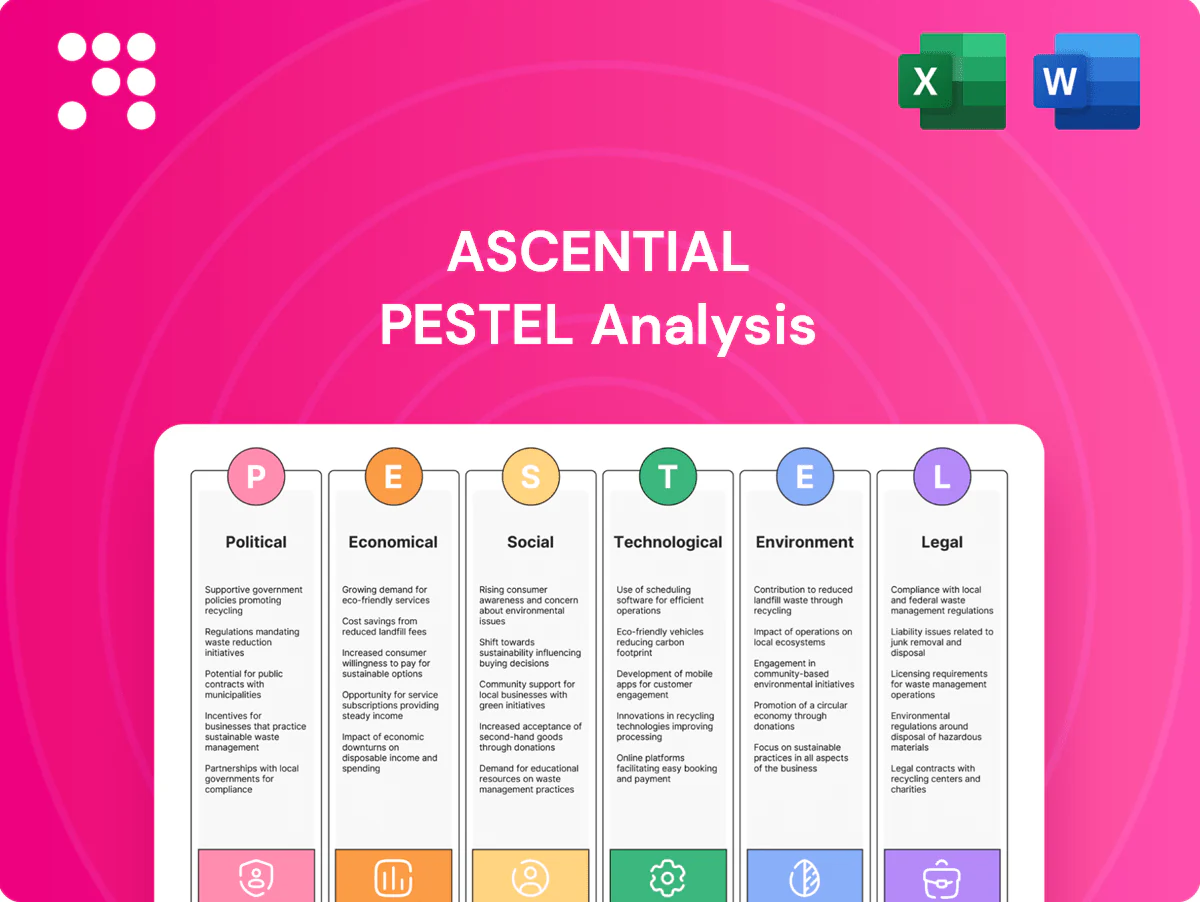
Ascential PESTLE Analysis

Skip the Research. Get the Strategy.
Gain actionable intelligence with our focused PESTLE Analysis of Ascential—three to five key themes revealing how political, economic, social, technological, legal and environmental forces shape its strategy and risk profile. Ideal for investors and strategists, it’s fully researched and ready to use. Purchase the full report to access the complete, editable breakdown and immediate insights.
Political factors

Geopolitical tensions
Heightened geopolitical friction can disrupt global brands’ expansion plans and the digital commerce flows Ascential supports, with global e-commerce exceeding $6 trillion in 2024. Sanctions and market-access restrictions—intensified since 2022—force platform strategy shifts and tighter client budgets. Scenario planning must adjust coverage, datasets and advisory for at-risk regions. Diversifying data sources and delivery hubs mitigates concentration risk.
Data localization policies
Governments in over 60 countries now mandate local data storage and processing, forcing insights platforms to rethink architecture and residency per jurisdiction. Ascential must adapt hosting, vendor selection and contracts regionally to preserve market access. Compliance-ready data pipelines are a clear commercial differentiator. Noncompliance risks service disruption, bid exclusion and fines up to 4% of global turnover.

Trade and digital tax regimes
Changes in digital services taxes (enacted at rates commonly from 2% to 7.5%) and the 2021 EU e‑commerce VAT rules (IOSS/OSS) shift landed costs and cross‑border VAT collection, altering marketplace economics for clients. Over 140 jurisdictions agreed to the 15% global minimum tax framework, forcing Ascential guidance to reflect evolving fees, margins and seller/channel mixes and require rapid product content refreshes.

Public sector tech investment
National digital strategies and 2024–25 AI funding streams have expanded public data infrastructure and pushed common standards, while EU Digital Decade targets 75% of enterprises using cloud by 2030, easing enterprise adoption. Alignment with government-backed interoperability and trust frameworks lowers integration friction. Policy sandboxes (FCA, UK and EU pilots) speed product validation, though political cycles drive budget volatility and irregular demand timing.
- 2024–25 AI funding expanded public data platforms
- EU target: 75% enterprises on cloud by 2030
- Regulatory sandboxes (FCA/EU) accelerate validation
- Political cycles cause budget and demand volatility
Regulatory stance on big platforms
Regulatory scrutiny of dominant marketplaces, accelerated by the EU Digital Markets Act (enforceable from March 2024), forces greater ranking transparency and can penalize gatekeepers up to 10 percent of global turnover, reshaping access, fees and data-sharing for Ascential clients.
Advisory must map platform compliance roadmaps and remedies so brands can rebalance channel risk exposure.
- DMA enforcement: fines up to 10 percent global turnover
- Impacts: changes to listings, ads, data-sharing rules
- Advisory role: compliance roadmaps, channel diversification
Geopolitics and taxes reshape $6T+ e‑commerce; platforms pivot
Heightened geopolitics and sanctions since 2022 disrupt $6T+ global e‑commerce (2024), forcing platform shifts and regional scenario planning. Data‑localization in 60+ countries and GDPR fines up to 4% of turnover raise hosting and compliance costs. Digital taxes (2–7.5%), 140+ jurisdictions on 15% global minimum tax, DMA fines up to 10% reshape fees, access and advisory demand.
| Metric | 2024–25 |
|---|---|
| Global e‑commerce | $6T+ |
| Data localization | 60+ countries |
| GDPR fines | Up to 4% turnover |
| Global minimum tax | 140+ jurisdictions, 15% |
| DMA fines | Up to 10% turnover |
What is included in the product
 Detailed Word Document
Provides a focused PESTLE review of how Political, Economic, Social, Technological, Environmental and Legal forces shape Ascential’s market positioning, with data-backed trends and forward-looking insights to inform strategy, risk mitigation and investor-grade reporting.

 Customizable Excel Spreadsheet
A concise, visually segmented PESTLE summary that relieves meeting‑prep pain by enabling quick interpretation, easy sharing and drop‑in use for presentations; editable notes let teams tailor insights to region or business line.
Economic factors

Ad spend and retail cycles
Marketing and e-commerce budgets are cyclical: global retail e-commerce sales reached about $6.3 trillion in 2023, driving continued demand for insights and consulting during growth phases. Downturns push clients toward performance channels and ROI-proof measurement products, while recoveries reopen spend on innovation and design. Packaging services to deliver rapid payback helps Ascential smooth revenue through these macro swings.
FX and revenue mix
Global billing exposes Ascential to GBP currency volatility, so reported sterling results can swing independently of underlying performance; management reports constant-currency growth to clarify true trends. Pricing actions, hedging programs and cost localization are used to stabilize margins. Multi-currency contracting and invoicing reduce client friction and FX pass-through in key markets.

E-commerce penetration
Structural e-commerce growth — global online sales projected at about $6.3 trillion in 2024 — expands Ascential’s addressable market, while marketplace-led volumes (≈60% of online sales in 2024) and rising DTC models force refreshed benchmarks and playbooks; varied vertical adoption rates guide segment prioritization and new seller cohorts drive demand for entry-level analytics tiers.

Client consolidation
Client consolidation driven by 2024–25 M&A among brands and agencies compresses vendor lists while enlarging average contract sizes, making land-and-expand across portfolios critical for revenue growth. Strong integration and API strategies increase switching costs, locking clients into larger, cross-portfolio deals. Demonstrable, measurable uplifts in KPIs post-merger materially support renewals and upsells.
- Compresses vendors, enlarges contracts (2024–25)
- Land-and-expand becomes primary growth play
- Integration/API depth raises switching costs
- Measurable uplifts drive renewals post-merger
Cost inflation
Cost inflation squeezes Ascential margins as wage inflation and rising cloud spend pressure data-platform gross margins; public cloud spend surpassed roughly $600bn in 2024, intensifying cost focus. Tiered pricing and value-based packaging preserve ARPU while automation and AI-assisted delivery cut unit costs. Vendor renegotiation and workload optimisation target COGS reduction.
- Wage + cloud = margin pressure
- Tiered pricing preserves ARPU
- AI automation lowers unit cost
- Vendor renegotiation trims COGS
Geopolitics and taxes reshape $6T+ e‑commerce; platforms pivot
Global e‑commerce ~ $6.3T (2024) and marketplaces ≈60% of online sales expand Ascential’s addressable market while cyclical budgets shift spend to ROI-proof products during downturns. FX volatility versus GBP and public cloud spend ≈ $600bn (2024) squeeze margins, making tiered pricing, AI automation and API-led integration critical.
| Metric | 2024 |
|---|---|
| Global e‑commerce | $6.3T |
| Marketplace share | ~60% |
| Public cloud spend | $600bn |
What You See Is What You Get
Ascential PESTLE Analysis
The preview shown here is the exact Ascential PESTLE Analysis document you’ll receive after purchase—fully formatted, professionally structured and ready to use. It contains the same content, layout and insights visible now. No placeholders or surprises; download begins immediately after checkout.

Skip the Research. Get the Strategy.
Gain actionable intelligence with our focused PESTLE Analysis of Ascential—three to five key themes revealing how political, economic, social, technological, legal and environmental forces shape its strategy and risk profile. Ideal for investors and strategists, it’s fully researched and ready to use. Purchase the full report to access the complete, editable breakdown and immediate insights.
Political factors
Geopolitical tensions
Heightened geopolitical friction can disrupt global brands’ expansion plans and the digital commerce flows Ascential supports, with global e-commerce exceeding $6 trillion in 2024. Sanctions and market-access restrictions—intensified since 2022—force platform strategy shifts and tighter client budgets. Scenario planning must adjust coverage, datasets and advisory for at-risk regions. Diversifying data sources and delivery hubs mitigates concentration risk.
Data localization policies
Governments in over 60 countries now mandate local data storage and processing, forcing insights platforms to rethink architecture and residency per jurisdiction. Ascential must adapt hosting, vendor selection and contracts regionally to preserve market access. Compliance-ready data pipelines are a clear commercial differentiator. Noncompliance risks service disruption, bid exclusion and fines up to 4% of global turnover.
Trade and digital tax regimes
Changes in digital services taxes (enacted at rates commonly from 2% to 7.5%) and the 2021 EU e‑commerce VAT rules (IOSS/OSS) shift landed costs and cross‑border VAT collection, altering marketplace economics for clients. Over 140 jurisdictions agreed to the 15% global minimum tax framework, forcing Ascential guidance to reflect evolving fees, margins and seller/channel mixes and require rapid product content refreshes.
Public sector tech investment
National digital strategies and 2024–25 AI funding streams have expanded public data infrastructure and pushed common standards, while EU Digital Decade targets 75% of enterprises using cloud by 2030, easing enterprise adoption. Alignment with government-backed interoperability and trust frameworks lowers integration friction. Policy sandboxes (FCA, UK and EU pilots) speed product validation, though political cycles drive budget volatility and irregular demand timing.
- 2024–25 AI funding expanded public data platforms
- EU target: 75% enterprises on cloud by 2030
- Regulatory sandboxes (FCA/EU) accelerate validation
- Political cycles cause budget and demand volatility
Regulatory stance on big platforms
Regulatory scrutiny of dominant marketplaces, accelerated by the EU Digital Markets Act (enforceable from March 2024), forces greater ranking transparency and can penalize gatekeepers up to 10 percent of global turnover, reshaping access, fees and data-sharing for Ascential clients.
Advisory must map platform compliance roadmaps and remedies so brands can rebalance channel risk exposure.
- DMA enforcement: fines up to 10 percent global turnover
- Impacts: changes to listings, ads, data-sharing rules
- Advisory role: compliance roadmaps, channel diversification
Geopolitics and taxes reshape $6T+ e‑commerce; platforms pivot
Heightened geopolitics and sanctions since 2022 disrupt $6T+ global e‑commerce (2024), forcing platform shifts and regional scenario planning. Data‑localization in 60+ countries and GDPR fines up to 4% of turnover raise hosting and compliance costs. Digital taxes (2–7.5%), 140+ jurisdictions on 15% global minimum tax, DMA fines up to 10% reshape fees, access and advisory demand.
| Metric | 2024–25 |
|---|---|
| Global e‑commerce | $6T+ |
| Data localization | 60+ countries |
| GDPR fines | Up to 4% turnover |
| Global minimum tax | 140+ jurisdictions, 15% |
| DMA fines | Up to 10% turnover |
What is included in the product
Detailed Word Document
Provides a focused PESTLE review of how Political, Economic, Social, Technological, Environmental and Legal forces shape Ascential’s market positioning, with data-backed trends and forward-looking insights to inform strategy, risk mitigation and investor-grade reporting.
Customizable Excel Spreadsheet
A concise, visually segmented PESTLE summary that relieves meeting‑prep pain by enabling quick interpretation, easy sharing and drop‑in use for presentations; editable notes let teams tailor insights to region or business line.
Economic factors
Ad spend and retail cycles
Marketing and e-commerce budgets are cyclical: global retail e-commerce sales reached about $6.3 trillion in 2023, driving continued demand for insights and consulting during growth phases. Downturns push clients toward performance channels and ROI-proof measurement products, while recoveries reopen spend on innovation and design. Packaging services to deliver rapid payback helps Ascential smooth revenue through these macro swings.
FX and revenue mix
Global billing exposes Ascential to GBP currency volatility, so reported sterling results can swing independently of underlying performance; management reports constant-currency growth to clarify true trends. Pricing actions, hedging programs and cost localization are used to stabilize margins. Multi-currency contracting and invoicing reduce client friction and FX pass-through in key markets.
E-commerce penetration
Structural e-commerce growth — global online sales projected at about $6.3 trillion in 2024 — expands Ascential’s addressable market, while marketplace-led volumes (≈60% of online sales in 2024) and rising DTC models force refreshed benchmarks and playbooks; varied vertical adoption rates guide segment prioritization and new seller cohorts drive demand for entry-level analytics tiers.
Client consolidation
Client consolidation driven by 2024–25 M&A among brands and agencies compresses vendor lists while enlarging average contract sizes, making land-and-expand across portfolios critical for revenue growth. Strong integration and API strategies increase switching costs, locking clients into larger, cross-portfolio deals. Demonstrable, measurable uplifts in KPIs post-merger materially support renewals and upsells.
- Compresses vendors, enlarges contracts (2024–25)
- Land-and-expand becomes primary growth play
- Integration/API depth raises switching costs
- Measurable uplifts drive renewals post-merger
Cost inflation
Cost inflation squeezes Ascential margins as wage inflation and rising cloud spend pressure data-platform gross margins; public cloud spend surpassed roughly $600bn in 2024, intensifying cost focus. Tiered pricing and value-based packaging preserve ARPU while automation and AI-assisted delivery cut unit costs. Vendor renegotiation and workload optimisation target COGS reduction.
- Wage + cloud = margin pressure
- Tiered pricing preserves ARPU
- AI automation lowers unit cost
- Vendor renegotiation trims COGS
Geopolitics and taxes reshape $6T+ e‑commerce; platforms pivot
Global e‑commerce ~ $6.3T (2024) and marketplaces ≈60% of online sales expand Ascential’s addressable market while cyclical budgets shift spend to ROI-proof products during downturns. FX volatility versus GBP and public cloud spend ≈ $600bn (2024) squeeze margins, making tiered pricing, AI automation and API-led integration critical.
| Metric | 2024 |
|---|---|
| Global e‑commerce | $6.3T |
| Marketplace share | ~60% |
| Public cloud spend | $600bn |
What You See Is What You Get
Ascential PESTLE Analysis
The preview shown here is the exact Ascential PESTLE Analysis document you’ll receive after purchase—fully formatted, professionally structured and ready to use. It contains the same content, layout and insights visible now. No placeholders or surprises; download begins immediately after checkout.
Description
Skip the Research. Get the Strategy.
Gain actionable intelligence with our focused PESTLE Analysis of Ascential—three to five key themes revealing how political, economic, social, technological, legal and environmental forces shape its strategy and risk profile. Ideal for investors and strategists, it’s fully researched and ready to use. Purchase the full report to access the complete, editable breakdown and immediate insights.
Political factors
Geopolitical tensions
Heightened geopolitical friction can disrupt global brands’ expansion plans and the digital commerce flows Ascential supports, with global e-commerce exceeding $6 trillion in 2024. Sanctions and market-access restrictions—intensified since 2022—force platform strategy shifts and tighter client budgets. Scenario planning must adjust coverage, datasets and advisory for at-risk regions. Diversifying data sources and delivery hubs mitigates concentration risk.
Data localization policies
Governments in over 60 countries now mandate local data storage and processing, forcing insights platforms to rethink architecture and residency per jurisdiction. Ascential must adapt hosting, vendor selection and contracts regionally to preserve market access. Compliance-ready data pipelines are a clear commercial differentiator. Noncompliance risks service disruption, bid exclusion and fines up to 4% of global turnover.
Trade and digital tax regimes
Changes in digital services taxes (enacted at rates commonly from 2% to 7.5%) and the 2021 EU e‑commerce VAT rules (IOSS/OSS) shift landed costs and cross‑border VAT collection, altering marketplace economics for clients. Over 140 jurisdictions agreed to the 15% global minimum tax framework, forcing Ascential guidance to reflect evolving fees, margins and seller/channel mixes and require rapid product content refreshes.
Public sector tech investment
National digital strategies and 2024–25 AI funding streams have expanded public data infrastructure and pushed common standards, while EU Digital Decade targets 75% of enterprises using cloud by 2030, easing enterprise adoption. Alignment with government-backed interoperability and trust frameworks lowers integration friction. Policy sandboxes (FCA, UK and EU pilots) speed product validation, though political cycles drive budget volatility and irregular demand timing.
- 2024–25 AI funding expanded public data platforms
- EU target: 75% enterprises on cloud by 2030
- Regulatory sandboxes (FCA/EU) accelerate validation
- Political cycles cause budget and demand volatility
Regulatory stance on big platforms
Regulatory scrutiny of dominant marketplaces, accelerated by the EU Digital Markets Act (enforceable from March 2024), forces greater ranking transparency and can penalize gatekeepers up to 10 percent of global turnover, reshaping access, fees and data-sharing for Ascential clients.
Advisory must map platform compliance roadmaps and remedies so brands can rebalance channel risk exposure.
- DMA enforcement: fines up to 10 percent global turnover
- Impacts: changes to listings, ads, data-sharing rules
- Advisory role: compliance roadmaps, channel diversification
Geopolitics and taxes reshape $6T+ e‑commerce; platforms pivot
Heightened geopolitics and sanctions since 2022 disrupt $6T+ global e‑commerce (2024), forcing platform shifts and regional scenario planning. Data‑localization in 60+ countries and GDPR fines up to 4% of turnover raise hosting and compliance costs. Digital taxes (2–7.5%), 140+ jurisdictions on 15% global minimum tax, DMA fines up to 10% reshape fees, access and advisory demand.
| Metric | 2024–25 |
|---|---|
| Global e‑commerce | $6T+ |
| Data localization | 60+ countries |
| GDPR fines | Up to 4% turnover |
| Global minimum tax | 140+ jurisdictions, 15% |
| DMA fines | Up to 10% turnover |
What is included in the product
Detailed Word Document
Provides a focused PESTLE review of how Political, Economic, Social, Technological, Environmental and Legal forces shape Ascential’s market positioning, with data-backed trends and forward-looking insights to inform strategy, risk mitigation and investor-grade reporting.
Customizable Excel Spreadsheet
A concise, visually segmented PESTLE summary that relieves meeting‑prep pain by enabling quick interpretation, easy sharing and drop‑in use for presentations; editable notes let teams tailor insights to region or business line.
Economic factors
Ad spend and retail cycles
Marketing and e-commerce budgets are cyclical: global retail e-commerce sales reached about $6.3 trillion in 2023, driving continued demand for insights and consulting during growth phases. Downturns push clients toward performance channels and ROI-proof measurement products, while recoveries reopen spend on innovation and design. Packaging services to deliver rapid payback helps Ascential smooth revenue through these macro swings.
FX and revenue mix
Global billing exposes Ascential to GBP currency volatility, so reported sterling results can swing independently of underlying performance; management reports constant-currency growth to clarify true trends. Pricing actions, hedging programs and cost localization are used to stabilize margins. Multi-currency contracting and invoicing reduce client friction and FX pass-through in key markets.
E-commerce penetration
Structural e-commerce growth — global online sales projected at about $6.3 trillion in 2024 — expands Ascential’s addressable market, while marketplace-led volumes (≈60% of online sales in 2024) and rising DTC models force refreshed benchmarks and playbooks; varied vertical adoption rates guide segment prioritization and new seller cohorts drive demand for entry-level analytics tiers.
Client consolidation
Client consolidation driven by 2024–25 M&A among brands and agencies compresses vendor lists while enlarging average contract sizes, making land-and-expand across portfolios critical for revenue growth. Strong integration and API strategies increase switching costs, locking clients into larger, cross-portfolio deals. Demonstrable, measurable uplifts in KPIs post-merger materially support renewals and upsells.
- Compresses vendors, enlarges contracts (2024–25)
- Land-and-expand becomes primary growth play
- Integration/API depth raises switching costs
- Measurable uplifts drive renewals post-merger
Cost inflation
Cost inflation squeezes Ascential margins as wage inflation and rising cloud spend pressure data-platform gross margins; public cloud spend surpassed roughly $600bn in 2024, intensifying cost focus. Tiered pricing and value-based packaging preserve ARPU while automation and AI-assisted delivery cut unit costs. Vendor renegotiation and workload optimisation target COGS reduction.
- Wage + cloud = margin pressure
- Tiered pricing preserves ARPU
- AI automation lowers unit cost
- Vendor renegotiation trims COGS
Geopolitics and taxes reshape $6T+ e‑commerce; platforms pivot
Global e‑commerce ~ $6.3T (2024) and marketplaces ≈60% of online sales expand Ascential’s addressable market while cyclical budgets shift spend to ROI-proof products during downturns. FX volatility versus GBP and public cloud spend ≈ $600bn (2024) squeeze margins, making tiered pricing, AI automation and API-led integration critical.
| Metric | 2024 |
|---|---|
| Global e‑commerce | $6.3T |
| Marketplace share | ~60% |
| Public cloud spend | $600bn |
What You See Is What You Get
Ascential PESTLE Analysis
The preview shown here is the exact Ascential PESTLE Analysis document you’ll receive after purchase—fully formatted, professionally structured and ready to use. It contains the same content, layout and insights visible now. No placeholders or surprises; download begins immediately after checkout.











