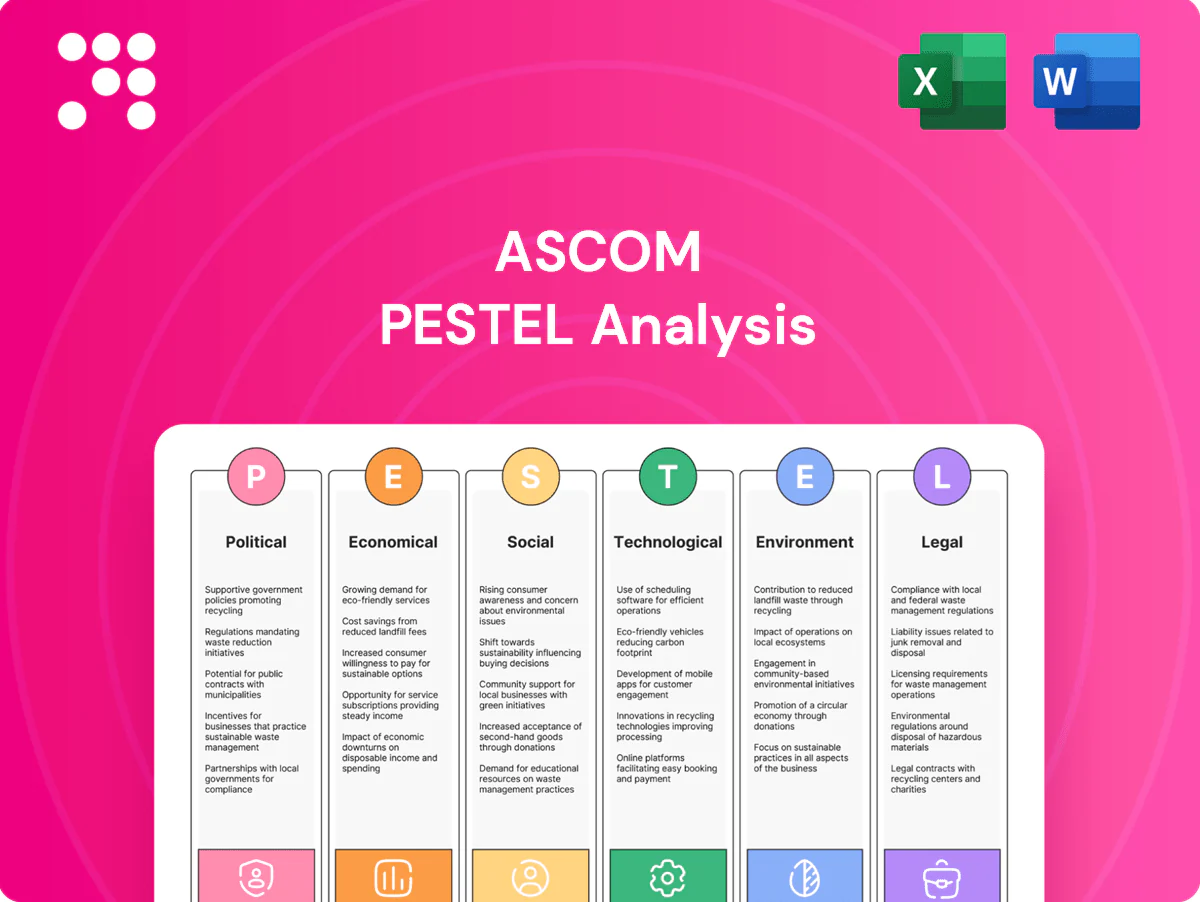
Ascom PESTLE Analysis

Plan Smarter. Present Sharper. Compete Stronger.
Discover how political regulations, economic cycles, social shifts, and rapid tech change are reshaping Ascom’s prospects in our concise PESTLE overview. This 3–5 sentence snapshot highlights key external risks and opportunities to inform your strategy. Buy the full PESTLE for a complete, actionable briefing and immediate download.
Political factors

Healthcare funding priorities
Government hospital budget allocations — OECD countries averaged 8.8% of GDP on health (2022) — directly shape ICT purchase cycles and project scope, with hospital ICT tending to follow fiscal years and capital plans. Stimulus for digital health and nursing efficiency (global digital health market ~USD 280bn in 2023) increases demand for mobile workflows for patient safety. Austerity or election-driven shifts can defer deployments by 6–18 months; Ascom must align proposals to national health strategies to secure tenders.
Public procurement and tender regimes
Framework agreements dominate hospital buying, often covering 50–70% of purchases within public systems; EU public procurement totaled about €2 trillion (~14% of GDP) in 2022. Awards hinge on local content and social value weightings (commonly 10–20%) and interoperability criteria, extending sales cycles to 12–24 months and requiring policy-savvy account management. Partnering with approved integrators measurably improves bid competitiveness and win rates.

Geopolitical supply chain risks
Trade tensions and export controls have disrupted component sourcing for devices and networking gear, pushing lead times up to 30% in peak periods; diversified suppliers and regional assembly in EMEA/APAC reduce exposure. Sanctions lists and country-of-origin rules constrain deployment in certain markets, and maintaining inventory buffers of 3–6 months helps mitigate lead-time volatility for clinical customers.

Digital health initiatives and incentives
National digital health programs (EHR modernization, alarm management, telehealth) open multi-hundred-million USD funding windows and push standards-based communication layers into procurement playbooks; political backing for HL7 FHIR and interoperability approaches grew through 2023–2025. Demonstrating outcomes tied to policy KPIs (reduced alarm rates, readmission drops) strengthens ROI cases, and early alignment with pilot sites shapes specs and shortens procurement cycles.
- Funding windows: multi-hundred-million USD
- Standards: HL7 FHIR political backing
- Outcomes: KPI-linked ROI strengthens bids
- Pilots: early alignment shapes procurement
Infrastructure and spectrum policies
Hospital adoption of private 5G, Wi‑Fi 6/7 and DECT hinges on national spectrum allocation and licensing models; GSMA reported private wireless deployments expanding rapidly through 2024, with over 1,000 enterprise/private network launches globally.
Building codes and public investment in campus fiber and power upgrades materially affect connectivity quality and uptime, influencing Ascom device ROI and total cost of ownership for hospital campuses.
Regulatory incentives to replace legacy paging with secure messaging (notably EU and US health IT funding programs in 2024–25) accelerate migrations; Ascom should track regulator roadmaps to future‑proof devices.
- Tag: spectrum — monitor national mid‑band allocations
- Tag: infrastructure — map campus upgrade needs
- Tag: incentives — track health IT funding 2024–25
- Tag: roadmap — align device roadmaps to regulator timelines
Public health budgets and digital health funding drive ICT procurement timing
Public health budgets (OECD avg 8.8% GDP, 2022) and digital health funding (global market ~USD 280bn, 2023) shape ICT demand and timing; framework agreements (EU procurement ~€2tn, 2022) lengthen 12–24m cycles. Export controls, spectrum rules and 1,000+ private wireless launches (GSMA 2024) affect supply and deployment risk; KPI‑linked pilots win tenders.
| Tag | Metric |
|---|---|
| Budget | OECD 8.8% GDP (2022) |
| Market | Digital health USD 280bn (2023) |
| Procurement | EU €2tn (2022) |
| Spectrum | 1,000+ private nets (GSMA 2024) |
What is included in the product
 Detailed Word Document
Explores how macro-environmental forces uniquely impact Ascom across Political, Economic, Social, Technological, Environmental, and Legal dimensions, with data-backed trends and forward-looking insights to reveal threats and opportunities for executives, investors, and strategists.

 Customizable Excel Spreadsheet
Concise, visually segmented PESTLE summary for Ascom that highlights key external risks and opportunities at a glance, making it easy to drop into presentations or use in planning sessions.
Economic factors

Hospital budget pressures
Hospital budgets face intense pressure from cost containment, nurse vacancy rates near 9–10% in 2024 (NSI) and healthcare inflation running ~4–5% in 2024, boosting demand for solutions that cut nursing time, reduce alarms and shorten length of stay. OpEx-friendly pricing (SaaS, leasing) helps bypass CapEx limits, and buyers require demonstrable payback within 12–24 months.
Macroeconomic cycles
Recessions tend to delay hospital capital projects and upgrades, while recoveries unlock deferred demand—IMF projected global growth around 3.0% for 2025, supporting renewed healthcare spending. Currency volatility, exemplified by notable CHF/USD and EUR moves in 2024–25, compresses cross-border pricing and margins for Swiss-based vendors. Hedging strategies and local pricing have helped stabilize revenue streams, and Ascom’s resilient installed base underpins recurring software and service income.

Total cost of ownership focus
Hospitals now prioritize total cost of ownership over upfront price, with the clinical communication market valued at about $4.1 billion in 2023, driving buyers to quantify lifecycle savings. Reliable devices, longer battery life and centralized management cut service overhead and downtime, often reducing maintenance events by double digits. Interoperability with EHRs and nurse-call systems lowers integration spend, and transparent ROI calculators speed procurement approvals.

Consolidation among providers
Consolidation among providers tightens purchasing: around 60% of hospitals in major markets are now in multi-hospital systems (2024), creating standardized specs and tougher price negotiations; winning system-wide standards lets a vendor scale rapidly across dozens of sites, while vendor rationalization can squeeze incumbents out of portfolios. Enterprise agreements and reference architectures have become decisive procurement gatekeepers.
- larger purchasing pools — ~60% hospitals in systems (2024)
- scale effects — rapid rollouts when standards won
- risk — vendor rationalization squeezes incumbents
- decisive tools — enterprise agreements, reference architectures
Workforce productivity economics
Global nurse shortfall projected at 5.9 million by 2030 (WHO) is driving demand for Ascom workflow automation and mobile collaboration; clinical automation can recover an estimated 10-15% of nursing time. Real-time location and alert routing have cut bed turnover and transfer delays by around 20% in published hospital implementations, producing measurable savings. Ascom can offer outcome-linked pricing, enabling sub-18-month payback claims in vendor case studies.
- nurse_shortfall_5.9M
- time_recovery_10-15%
- bed_turnover_improve_~20%
- payback_<18m
Public health budgets and digital health funding drive ICT procurement timing
Hospitals face tight budgets, nurse vacancies ~9–10% (NSI 2024) and healthcare inflation ~4–5% (2024), raising demand for time-saving, OpEx-friendly solutions with 12–24m payback. Global growth ~3.0% (IMF 2025) may restore deferred spend, while CHF/EUR moves in 2024–25 pressure Swiss margins. Provider consolidation (~60% in systems, 2024) favors vendors winning enterprise standards.
| Metric | Value | Source (yr) |
|---|---|---|
| Nurse vacancy | 9–10% | NSI 2024 |
| Healthcare inflation | 4–5% | 2024 |
| Clinical comm market | $4.1B | 2023 |
| Hospitals in systems | ~60% | 2024 |
Preview the Actual Deliverable
Ascom PESTLE Analysis
The preview shown here is the exact Ascom PESTLE Analysis document you’ll receive after purchase—fully formatted, professionally structured, and ready to use. It contains the complete political, economic, social, technological, legal, and environmental assessment as displayed. No placeholders or teasers—what you see is what you’ll download immediately after checkout.

Plan Smarter. Present Sharper. Compete Stronger.
Discover how political regulations, economic cycles, social shifts, and rapid tech change are reshaping Ascom’s prospects in our concise PESTLE overview. This 3–5 sentence snapshot highlights key external risks and opportunities to inform your strategy. Buy the full PESTLE for a complete, actionable briefing and immediate download.
Political factors
Healthcare funding priorities
Government hospital budget allocations — OECD countries averaged 8.8% of GDP on health (2022) — directly shape ICT purchase cycles and project scope, with hospital ICT tending to follow fiscal years and capital plans. Stimulus for digital health and nursing efficiency (global digital health market ~USD 280bn in 2023) increases demand for mobile workflows for patient safety. Austerity or election-driven shifts can defer deployments by 6–18 months; Ascom must align proposals to national health strategies to secure tenders.
Public procurement and tender regimes
Framework agreements dominate hospital buying, often covering 50–70% of purchases within public systems; EU public procurement totaled about €2 trillion (~14% of GDP) in 2022. Awards hinge on local content and social value weightings (commonly 10–20%) and interoperability criteria, extending sales cycles to 12–24 months and requiring policy-savvy account management. Partnering with approved integrators measurably improves bid competitiveness and win rates.
Geopolitical supply chain risks
Trade tensions and export controls have disrupted component sourcing for devices and networking gear, pushing lead times up to 30% in peak periods; diversified suppliers and regional assembly in EMEA/APAC reduce exposure. Sanctions lists and country-of-origin rules constrain deployment in certain markets, and maintaining inventory buffers of 3–6 months helps mitigate lead-time volatility for clinical customers.
Digital health initiatives and incentives
National digital health programs (EHR modernization, alarm management, telehealth) open multi-hundred-million USD funding windows and push standards-based communication layers into procurement playbooks; political backing for HL7 FHIR and interoperability approaches grew through 2023–2025. Demonstrating outcomes tied to policy KPIs (reduced alarm rates, readmission drops) strengthens ROI cases, and early alignment with pilot sites shapes specs and shortens procurement cycles.
- Funding windows: multi-hundred-million USD
- Standards: HL7 FHIR political backing
- Outcomes: KPI-linked ROI strengthens bids
- Pilots: early alignment shapes procurement
Infrastructure and spectrum policies
Hospital adoption of private 5G, Wi‑Fi 6/7 and DECT hinges on national spectrum allocation and licensing models; GSMA reported private wireless deployments expanding rapidly through 2024, with over 1,000 enterprise/private network launches globally.
Building codes and public investment in campus fiber and power upgrades materially affect connectivity quality and uptime, influencing Ascom device ROI and total cost of ownership for hospital campuses.
Regulatory incentives to replace legacy paging with secure messaging (notably EU and US health IT funding programs in 2024–25) accelerate migrations; Ascom should track regulator roadmaps to future‑proof devices.
- Tag: spectrum — monitor national mid‑band allocations
- Tag: infrastructure — map campus upgrade needs
- Tag: incentives — track health IT funding 2024–25
- Tag: roadmap — align device roadmaps to regulator timelines
Public health budgets and digital health funding drive ICT procurement timing
Public health budgets (OECD avg 8.8% GDP, 2022) and digital health funding (global market ~USD 280bn, 2023) shape ICT demand and timing; framework agreements (EU procurement ~€2tn, 2022) lengthen 12–24m cycles. Export controls, spectrum rules and 1,000+ private wireless launches (GSMA 2024) affect supply and deployment risk; KPI‑linked pilots win tenders.
| Tag | Metric |
|---|---|
| Budget | OECD 8.8% GDP (2022) |
| Market | Digital health USD 280bn (2023) |
| Procurement | EU €2tn (2022) |
| Spectrum | 1,000+ private nets (GSMA 2024) |
What is included in the product
Detailed Word Document
Explores how macro-environmental forces uniquely impact Ascom across Political, Economic, Social, Technological, Environmental, and Legal dimensions, with data-backed trends and forward-looking insights to reveal threats and opportunities for executives, investors, and strategists.
Customizable Excel Spreadsheet
Concise, visually segmented PESTLE summary for Ascom that highlights key external risks and opportunities at a glance, making it easy to drop into presentations or use in planning sessions.
Economic factors
Hospital budget pressures
Hospital budgets face intense pressure from cost containment, nurse vacancy rates near 9–10% in 2024 (NSI) and healthcare inflation running ~4–5% in 2024, boosting demand for solutions that cut nursing time, reduce alarms and shorten length of stay. OpEx-friendly pricing (SaaS, leasing) helps bypass CapEx limits, and buyers require demonstrable payback within 12–24 months.
Macroeconomic cycles
Recessions tend to delay hospital capital projects and upgrades, while recoveries unlock deferred demand—IMF projected global growth around 3.0% for 2025, supporting renewed healthcare spending. Currency volatility, exemplified by notable CHF/USD and EUR moves in 2024–25, compresses cross-border pricing and margins for Swiss-based vendors. Hedging strategies and local pricing have helped stabilize revenue streams, and Ascom’s resilient installed base underpins recurring software and service income.
Total cost of ownership focus
Hospitals now prioritize total cost of ownership over upfront price, with the clinical communication market valued at about $4.1 billion in 2023, driving buyers to quantify lifecycle savings. Reliable devices, longer battery life and centralized management cut service overhead and downtime, often reducing maintenance events by double digits. Interoperability with EHRs and nurse-call systems lowers integration spend, and transparent ROI calculators speed procurement approvals.
Consolidation among providers
Consolidation among providers tightens purchasing: around 60% of hospitals in major markets are now in multi-hospital systems (2024), creating standardized specs and tougher price negotiations; winning system-wide standards lets a vendor scale rapidly across dozens of sites, while vendor rationalization can squeeze incumbents out of portfolios. Enterprise agreements and reference architectures have become decisive procurement gatekeepers.
- larger purchasing pools — ~60% hospitals in systems (2024)
- scale effects — rapid rollouts when standards won
- risk — vendor rationalization squeezes incumbents
- decisive tools — enterprise agreements, reference architectures
Workforce productivity economics
Global nurse shortfall projected at 5.9 million by 2030 (WHO) is driving demand for Ascom workflow automation and mobile collaboration; clinical automation can recover an estimated 10-15% of nursing time. Real-time location and alert routing have cut bed turnover and transfer delays by around 20% in published hospital implementations, producing measurable savings. Ascom can offer outcome-linked pricing, enabling sub-18-month payback claims in vendor case studies.
- nurse_shortfall_5.9M
- time_recovery_10-15%
- bed_turnover_improve_~20%
- payback_<18m
Public health budgets and digital health funding drive ICT procurement timing
Hospitals face tight budgets, nurse vacancies ~9–10% (NSI 2024) and healthcare inflation ~4–5% (2024), raising demand for time-saving, OpEx-friendly solutions with 12–24m payback. Global growth ~3.0% (IMF 2025) may restore deferred spend, while CHF/EUR moves in 2024–25 pressure Swiss margins. Provider consolidation (~60% in systems, 2024) favors vendors winning enterprise standards.
| Metric | Value | Source (yr) |
|---|---|---|
| Nurse vacancy | 9–10% | NSI 2024 |
| Healthcare inflation | 4–5% | 2024 |
| Clinical comm market | $4.1B | 2023 |
| Hospitals in systems | ~60% | 2024 |
Preview the Actual Deliverable
Ascom PESTLE Analysis
The preview shown here is the exact Ascom PESTLE Analysis document you’ll receive after purchase—fully formatted, professionally structured, and ready to use. It contains the complete political, economic, social, technological, legal, and environmental assessment as displayed. No placeholders or teasers—what you see is what you’ll download immediately after checkout.
Description
Plan Smarter. Present Sharper. Compete Stronger.
Discover how political regulations, economic cycles, social shifts, and rapid tech change are reshaping Ascom’s prospects in our concise PESTLE overview. This 3–5 sentence snapshot highlights key external risks and opportunities to inform your strategy. Buy the full PESTLE for a complete, actionable briefing and immediate download.
Political factors
Healthcare funding priorities
Government hospital budget allocations — OECD countries averaged 8.8% of GDP on health (2022) — directly shape ICT purchase cycles and project scope, with hospital ICT tending to follow fiscal years and capital plans. Stimulus for digital health and nursing efficiency (global digital health market ~USD 280bn in 2023) increases demand for mobile workflows for patient safety. Austerity or election-driven shifts can defer deployments by 6–18 months; Ascom must align proposals to national health strategies to secure tenders.
Public procurement and tender regimes
Framework agreements dominate hospital buying, often covering 50–70% of purchases within public systems; EU public procurement totaled about €2 trillion (~14% of GDP) in 2022. Awards hinge on local content and social value weightings (commonly 10–20%) and interoperability criteria, extending sales cycles to 12–24 months and requiring policy-savvy account management. Partnering with approved integrators measurably improves bid competitiveness and win rates.
Geopolitical supply chain risks
Trade tensions and export controls have disrupted component sourcing for devices and networking gear, pushing lead times up to 30% in peak periods; diversified suppliers and regional assembly in EMEA/APAC reduce exposure. Sanctions lists and country-of-origin rules constrain deployment in certain markets, and maintaining inventory buffers of 3–6 months helps mitigate lead-time volatility for clinical customers.
Digital health initiatives and incentives
National digital health programs (EHR modernization, alarm management, telehealth) open multi-hundred-million USD funding windows and push standards-based communication layers into procurement playbooks; political backing for HL7 FHIR and interoperability approaches grew through 2023–2025. Demonstrating outcomes tied to policy KPIs (reduced alarm rates, readmission drops) strengthens ROI cases, and early alignment with pilot sites shapes specs and shortens procurement cycles.
- Funding windows: multi-hundred-million USD
- Standards: HL7 FHIR political backing
- Outcomes: KPI-linked ROI strengthens bids
- Pilots: early alignment shapes procurement
Infrastructure and spectrum policies
Hospital adoption of private 5G, Wi‑Fi 6/7 and DECT hinges on national spectrum allocation and licensing models; GSMA reported private wireless deployments expanding rapidly through 2024, with over 1,000 enterprise/private network launches globally.
Building codes and public investment in campus fiber and power upgrades materially affect connectivity quality and uptime, influencing Ascom device ROI and total cost of ownership for hospital campuses.
Regulatory incentives to replace legacy paging with secure messaging (notably EU and US health IT funding programs in 2024–25) accelerate migrations; Ascom should track regulator roadmaps to future‑proof devices.
- Tag: spectrum — monitor national mid‑band allocations
- Tag: infrastructure — map campus upgrade needs
- Tag: incentives — track health IT funding 2024–25
- Tag: roadmap — align device roadmaps to regulator timelines
Public health budgets and digital health funding drive ICT procurement timing
Public health budgets (OECD avg 8.8% GDP, 2022) and digital health funding (global market ~USD 280bn, 2023) shape ICT demand and timing; framework agreements (EU procurement ~€2tn, 2022) lengthen 12–24m cycles. Export controls, spectrum rules and 1,000+ private wireless launches (GSMA 2024) affect supply and deployment risk; KPI‑linked pilots win tenders.
| Tag | Metric |
|---|---|
| Budget | OECD 8.8% GDP (2022) |
| Market | Digital health USD 280bn (2023) |
| Procurement | EU €2tn (2022) |
| Spectrum | 1,000+ private nets (GSMA 2024) |
What is included in the product
Detailed Word Document
Explores how macro-environmental forces uniquely impact Ascom across Political, Economic, Social, Technological, Environmental, and Legal dimensions, with data-backed trends and forward-looking insights to reveal threats and opportunities for executives, investors, and strategists.
Customizable Excel Spreadsheet
Concise, visually segmented PESTLE summary for Ascom that highlights key external risks and opportunities at a glance, making it easy to drop into presentations or use in planning sessions.
Economic factors
Hospital budget pressures
Hospital budgets face intense pressure from cost containment, nurse vacancy rates near 9–10% in 2024 (NSI) and healthcare inflation running ~4–5% in 2024, boosting demand for solutions that cut nursing time, reduce alarms and shorten length of stay. OpEx-friendly pricing (SaaS, leasing) helps bypass CapEx limits, and buyers require demonstrable payback within 12–24 months.
Macroeconomic cycles
Recessions tend to delay hospital capital projects and upgrades, while recoveries unlock deferred demand—IMF projected global growth around 3.0% for 2025, supporting renewed healthcare spending. Currency volatility, exemplified by notable CHF/USD and EUR moves in 2024–25, compresses cross-border pricing and margins for Swiss-based vendors. Hedging strategies and local pricing have helped stabilize revenue streams, and Ascom’s resilient installed base underpins recurring software and service income.
Total cost of ownership focus
Hospitals now prioritize total cost of ownership over upfront price, with the clinical communication market valued at about $4.1 billion in 2023, driving buyers to quantify lifecycle savings. Reliable devices, longer battery life and centralized management cut service overhead and downtime, often reducing maintenance events by double digits. Interoperability with EHRs and nurse-call systems lowers integration spend, and transparent ROI calculators speed procurement approvals.
Consolidation among providers
Consolidation among providers tightens purchasing: around 60% of hospitals in major markets are now in multi-hospital systems (2024), creating standardized specs and tougher price negotiations; winning system-wide standards lets a vendor scale rapidly across dozens of sites, while vendor rationalization can squeeze incumbents out of portfolios. Enterprise agreements and reference architectures have become decisive procurement gatekeepers.
- larger purchasing pools — ~60% hospitals in systems (2024)
- scale effects — rapid rollouts when standards won
- risk — vendor rationalization squeezes incumbents
- decisive tools — enterprise agreements, reference architectures
Workforce productivity economics
Global nurse shortfall projected at 5.9 million by 2030 (WHO) is driving demand for Ascom workflow automation and mobile collaboration; clinical automation can recover an estimated 10-15% of nursing time. Real-time location and alert routing have cut bed turnover and transfer delays by around 20% in published hospital implementations, producing measurable savings. Ascom can offer outcome-linked pricing, enabling sub-18-month payback claims in vendor case studies.
- nurse_shortfall_5.9M
- time_recovery_10-15%
- bed_turnover_improve_~20%
- payback_<18m
Public health budgets and digital health funding drive ICT procurement timing
Hospitals face tight budgets, nurse vacancies ~9–10% (NSI 2024) and healthcare inflation ~4–5% (2024), raising demand for time-saving, OpEx-friendly solutions with 12–24m payback. Global growth ~3.0% (IMF 2025) may restore deferred spend, while CHF/EUR moves in 2024–25 pressure Swiss margins. Provider consolidation (~60% in systems, 2024) favors vendors winning enterprise standards.
| Metric | Value | Source (yr) |
|---|---|---|
| Nurse vacancy | 9–10% | NSI 2024 |
| Healthcare inflation | 4–5% | 2024 |
| Clinical comm market | $4.1B | 2023 |
| Hospitals in systems | ~60% | 2024 |
Preview the Actual Deliverable
Ascom PESTLE Analysis
The preview shown here is the exact Ascom PESTLE Analysis document you’ll receive after purchase—fully formatted, professionally structured, and ready to use. It contains the complete political, economic, social, technological, legal, and environmental assessment as displayed. No placeholders or teasers—what you see is what you’ll download immediately after checkout.











