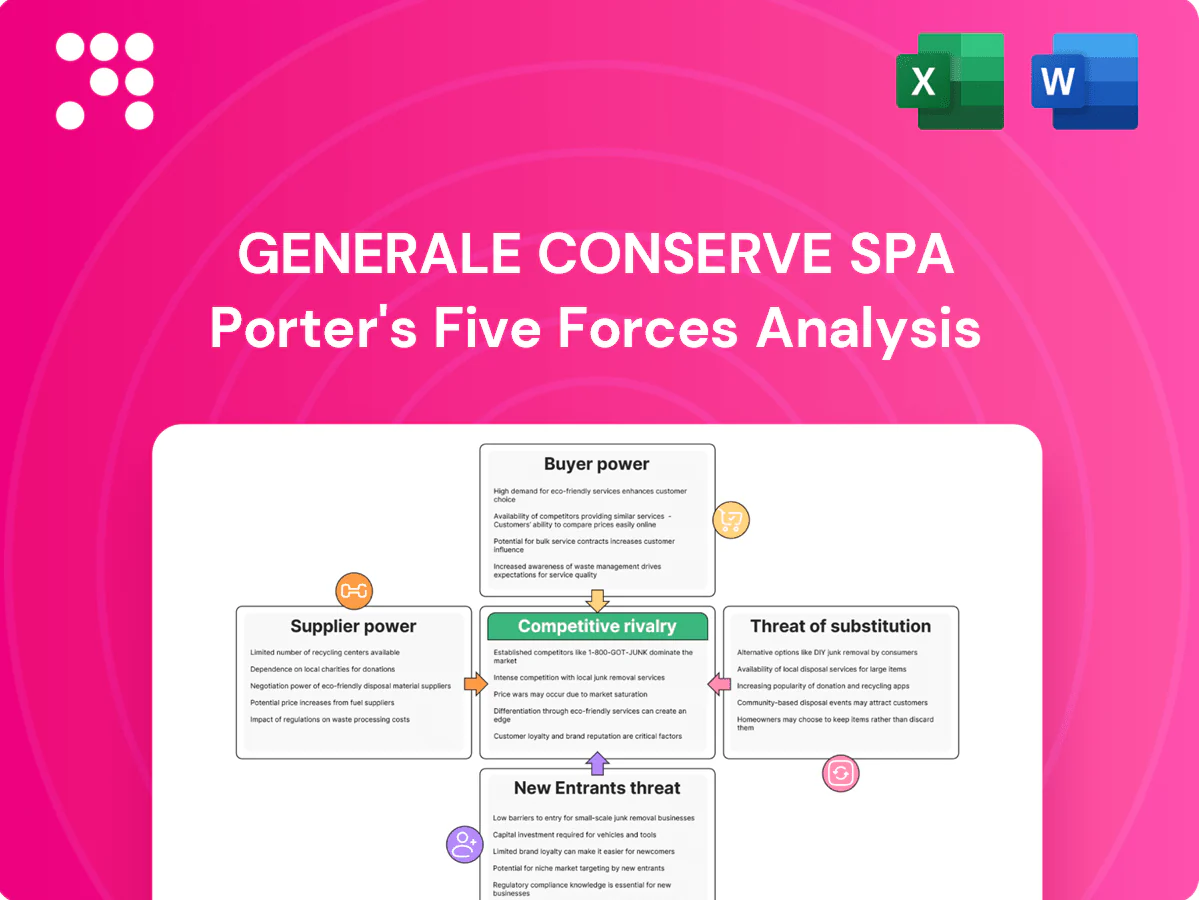
Generale Conserve SpA Porter's Five Forces Analysis

From Overview to Strategy Blueprint
Generale Conserve SpA faces moderate supplier leverage and fragmented buyer power amid intense supermarket rivalry, while substitutes and entry threats remain manageable due to scale and brand strength. This snapshot highlights key pressures shaping margins and growth. Ready to move beyond the basics? Get a full strategic breakdown of Generale Conserve SpA’s market position and external threats.
Suppliers Bargaining Power

Concentrated tuna fisheries
Wild-caught tuna is sourced from a relatively concentrated set of fleets and regions, giving upstream suppliers measurable leverage; skipjack makes up roughly 55–60% of the global canned-tuna raw material pool, with yellowfin a smaller but strategic share. Catch volatility from quotas, seasonality and climate-driven stock shifts tightens supply windows and spikes spot prices. Pressure on skipjack and yellowfin costs directly affects AsdoMar input margins. Long-term contracts and diversified sourcing reduce but do not eliminate supplier power.
Input price volatility
Raw tuna, olive oil and metal cans are commodity-linked, exposing Generale Conserve margins to input-price swings; 2024 market turbulence accentuated this risk. Oil price and freight-rate moves materially affect delivered costs and can lift input bills before retail prices adjust. Suppliers typically pass through spikes faster than brands can reprice on shelf, squeezing short-term margins. Hedging and inventory management mitigate exposure but add complexity and carrying cost.

Sustainability-certified supply scarcity
MSC and similar certifications cover roughly 15% of global marine catch (2024), narrowing eligible suppliers and boosting their bargaining power. Generale Conserve’s public sustainability stance increases reliance on compliant sources, limiting procurement flexibility and exposing it to certified-fishery premiums often reported at 10–25% in 2023–24 markets. In supply shocks certified suppliers can demand priority or higher prices, forcing trade-offs between cost and certification.

Switching costs and qualification
Qualifying new fisheries, canners and packaging vendors requires audits, compliance checks and product testing, often extending onboarding to several months and raising direct costs per supplier; stringent food‑safety, traceability and EU IUU rules add documentation and verification burdens. These factors raise switching costs and strengthen incumbent suppliers’ negotiating position, while multi‑sourcing strategies are used to reduce dependency.
- Onboarding time: several months
- Cost drivers: audits, testing, traceability systems
- Mitigation: multi‑sourcing to lower supplier risk
Geopolitical and regulatory constraints
Fishery access rights, tariffs and sanctions in 2024 tightened supplier options for Generale Conserve SpA, raising sourcing costs and delivery risks. Rapid RFMO quota adjustments and evolving EU import rules in 2024 can swiftly shift bargaining dynamics in favor of adaptable suppliers. Suppliers with flexible fleets or multi-flag operations therefore gain leverage, forcing buyers to embed regulatory risk clauses in contracts.
- 2024: RFMO/quota volatility increases supplier leverage
- Flexible fleets/multi-flag = higher bargaining power
- Contractual regulatory-risk management is essential
Supplier leverage rises - skipjack 55-60%, spot spikes ~30%
Suppliers hold measurable leverage due to concentrated wild‑catch fleets and seasonality, with skipjack ~55–60% of the raw tuna pool (2024) and certified sources ~15% of catch (2024). Input-price shocks (spot spikes up to ~30% in 2024) and certified premiums (10–25% in 2023–24) compress margins despite long contracts and hedging. Onboarding suppliers takes several months, raising switching costs and supplier power.
| Metric | Value |
|---|---|
| Skipjack share (2024) | 55–60% |
| Certified catch (MSC, 2024) | ~15% |
| Certified premium (2023–24) | 10–25% |
| Spot price spikes (2024) | up to ~30% |
| Onboarding time | several months |
What is included in the product
 Detailed Word Document
Tailored Porter's Five Forces analysis for Generale Conserve SpA uncovering competitive intensity, supplier and buyer power, threat of substitutes and new entrants, and highlighting disruptive risks and strategic levers to protect margins.

 Customizable Excel Spreadsheet
One-sheet Porter’s Five Forces for Generale Conserve SpA—instantly visualize supplier, buyer, substitute, entrant and rivalry pressures with a customizable radar chart, copy-ready for decks, no macros, plug in your data to model scenarios.
Customers Bargaining Power

Concentrated retail channels
Large European grocers and discounters—operating across a roughly €1 trillion food retail market—control shelf space and push hard on price, promotions and terms. Their scale enables aggressive private label roll-outs and strict slotting demands that squeeze suppliers. Generale Conserve must deliver velocity and clear product differentiation to defend margin and facings. Failure risks delisting or reduced shelf presence.
Private label alternatives
Retailers’ private labels, which reached roughly 30% penetration in European grocery by 2024, offer cheaper canned tuna options that increase buyer leverage against Generale Conserve SpA. Comparable perceived quality in staples like tuna intensifies price pressure and accelerates trade-downs. AsdoMar’s premium positioning must sustain a price spread through verifiable quality and sustainability credentials. Without that, channel mix shifts will erode margins and profitability.

High price sensitivity in staple category
Canned tuna is a frequent, highly price-visible grocery purchase with elastic demand; shoppers routinely switch brands on price gaps, making promotions the primary volume driver. Retailers in 2024 typically demand trade funding for flyers, end-caps and temporary price cuts, with industry trade spend averaging around 15% of sales. This persistent promotional environment compresses net pricing for Generale Conserve unless offset through premium SKUs and higher-margin variants.

Switching ease and low brand lock-in
Consumers can switch brands on shelf with minimal friction, and limited functional differentiation in conserves increases buyer leverage; Italian private-label penetration stood at about 20% in 2024, reinforcing retailer negotiation power. Packaging, provenance and sustainability storytelling are now decisive for Generale Conserve SpA to retain loyalty, while retailer loyalty schemes such as Coop and Conad cards shift value capture toward the channel.
- low-differentiation
- ~20% private-label (Italy, 2024)
- packaging & provenance
- retailer loyalty tilt
Quality and sustainability expectations
Buyers increasingly demand traceability, dolphin-safe labeling, and MSC/ASC credentials, with major European retailers in 2024 reportedly requiring formal sustainability credentials from over 70% of seafood suppliers, raising bargaining power over Generale Conserve SpA.
Retailers enforce standards via audits and scorecards; non-compliance risks penalties or delisting, driving suppliers to absorb higher compliance costs that erode margins but enable premium pricing and shelf access.
- Traceability required by >70% of EU retailers (2024)
- Audits/scorecards standard enforcement
- Non-compliance → penalties or delisting
- Higher compliance costs vs premium positioning
European grocers leverage ~30% private labels, >70% sustainability rules, ~15% trade spend
Large European retailers (food market ~€1tn) exert strong leverage via private labels (~30% EU, 2024; Italy ~20%) and require sustainability credentials (>70% of retailers, 2024), driving trade spend (~15% of sales) and compressing supplier margins.
| Metric | 2024 |
|---|---|
| EU private-label | ~30% |
| Italy private-label | ~20% |
| Retailers requiring credentials | >70% |
| Avg trade spend | ~15% sales |
Preview Before You Purchase
Generale Conserve SpA Porter's Five Forces Analysis
Generale Conserve SpA Porter's Five Forces analysis evaluates industry rivalry, supplier and buyer power, threats from substitutes and new entrants, and strategic implications for pricing, margins and growth. It highlights competitive intensity in the European canned food market, supplier concentration risks, shifting buyer preferences and potential substitute products. This preview shows the exact document you'll receive immediately after purchase—no surprises, no placeholders.

From Overview to Strategy Blueprint
Generale Conserve SpA faces moderate supplier leverage and fragmented buyer power amid intense supermarket rivalry, while substitutes and entry threats remain manageable due to scale and brand strength. This snapshot highlights key pressures shaping margins and growth. Ready to move beyond the basics? Get a full strategic breakdown of Generale Conserve SpA’s market position and external threats.
Suppliers Bargaining Power
Concentrated tuna fisheries
Wild-caught tuna is sourced from a relatively concentrated set of fleets and regions, giving upstream suppliers measurable leverage; skipjack makes up roughly 55–60% of the global canned-tuna raw material pool, with yellowfin a smaller but strategic share. Catch volatility from quotas, seasonality and climate-driven stock shifts tightens supply windows and spikes spot prices. Pressure on skipjack and yellowfin costs directly affects AsdoMar input margins. Long-term contracts and diversified sourcing reduce but do not eliminate supplier power.
Input price volatility
Raw tuna, olive oil and metal cans are commodity-linked, exposing Generale Conserve margins to input-price swings; 2024 market turbulence accentuated this risk. Oil price and freight-rate moves materially affect delivered costs and can lift input bills before retail prices adjust. Suppliers typically pass through spikes faster than brands can reprice on shelf, squeezing short-term margins. Hedging and inventory management mitigate exposure but add complexity and carrying cost.
Sustainability-certified supply scarcity
MSC and similar certifications cover roughly 15% of global marine catch (2024), narrowing eligible suppliers and boosting their bargaining power. Generale Conserve’s public sustainability stance increases reliance on compliant sources, limiting procurement flexibility and exposing it to certified-fishery premiums often reported at 10–25% in 2023–24 markets. In supply shocks certified suppliers can demand priority or higher prices, forcing trade-offs between cost and certification.
Switching costs and qualification
Qualifying new fisheries, canners and packaging vendors requires audits, compliance checks and product testing, often extending onboarding to several months and raising direct costs per supplier; stringent food‑safety, traceability and EU IUU rules add documentation and verification burdens. These factors raise switching costs and strengthen incumbent suppliers’ negotiating position, while multi‑sourcing strategies are used to reduce dependency.
- Onboarding time: several months
- Cost drivers: audits, testing, traceability systems
- Mitigation: multi‑sourcing to lower supplier risk
Geopolitical and regulatory constraints
Fishery access rights, tariffs and sanctions in 2024 tightened supplier options for Generale Conserve SpA, raising sourcing costs and delivery risks. Rapid RFMO quota adjustments and evolving EU import rules in 2024 can swiftly shift bargaining dynamics in favor of adaptable suppliers. Suppliers with flexible fleets or multi-flag operations therefore gain leverage, forcing buyers to embed regulatory risk clauses in contracts.
- 2024: RFMO/quota volatility increases supplier leverage
- Flexible fleets/multi-flag = higher bargaining power
- Contractual regulatory-risk management is essential
Supplier leverage rises - skipjack 55-60%, spot spikes ~30%
Suppliers hold measurable leverage due to concentrated wild‑catch fleets and seasonality, with skipjack ~55–60% of the raw tuna pool (2024) and certified sources ~15% of catch (2024). Input-price shocks (spot spikes up to ~30% in 2024) and certified premiums (10–25% in 2023–24) compress margins despite long contracts and hedging. Onboarding suppliers takes several months, raising switching costs and supplier power.
| Metric | Value |
|---|---|
| Skipjack share (2024) | 55–60% |
| Certified catch (MSC, 2024) | ~15% |
| Certified premium (2023–24) | 10–25% |
| Spot price spikes (2024) | up to ~30% |
| Onboarding time | several months |
What is included in the product
Detailed Word Document
Tailored Porter's Five Forces analysis for Generale Conserve SpA uncovering competitive intensity, supplier and buyer power, threat of substitutes and new entrants, and highlighting disruptive risks and strategic levers to protect margins.
Customizable Excel Spreadsheet
One-sheet Porter’s Five Forces for Generale Conserve SpA—instantly visualize supplier, buyer, substitute, entrant and rivalry pressures with a customizable radar chart, copy-ready for decks, no macros, plug in your data to model scenarios.
Customers Bargaining Power
Concentrated retail channels
Large European grocers and discounters—operating across a roughly €1 trillion food retail market—control shelf space and push hard on price, promotions and terms. Their scale enables aggressive private label roll-outs and strict slotting demands that squeeze suppliers. Generale Conserve must deliver velocity and clear product differentiation to defend margin and facings. Failure risks delisting or reduced shelf presence.
Private label alternatives
Retailers’ private labels, which reached roughly 30% penetration in European grocery by 2024, offer cheaper canned tuna options that increase buyer leverage against Generale Conserve SpA. Comparable perceived quality in staples like tuna intensifies price pressure and accelerates trade-downs. AsdoMar’s premium positioning must sustain a price spread through verifiable quality and sustainability credentials. Without that, channel mix shifts will erode margins and profitability.
High price sensitivity in staple category
Canned tuna is a frequent, highly price-visible grocery purchase with elastic demand; shoppers routinely switch brands on price gaps, making promotions the primary volume driver. Retailers in 2024 typically demand trade funding for flyers, end-caps and temporary price cuts, with industry trade spend averaging around 15% of sales. This persistent promotional environment compresses net pricing for Generale Conserve unless offset through premium SKUs and higher-margin variants.
Switching ease and low brand lock-in
Consumers can switch brands on shelf with minimal friction, and limited functional differentiation in conserves increases buyer leverage; Italian private-label penetration stood at about 20% in 2024, reinforcing retailer negotiation power. Packaging, provenance and sustainability storytelling are now decisive for Generale Conserve SpA to retain loyalty, while retailer loyalty schemes such as Coop and Conad cards shift value capture toward the channel.
- low-differentiation
- ~20% private-label (Italy, 2024)
- packaging & provenance
- retailer loyalty tilt
Quality and sustainability expectations
Buyers increasingly demand traceability, dolphin-safe labeling, and MSC/ASC credentials, with major European retailers in 2024 reportedly requiring formal sustainability credentials from over 70% of seafood suppliers, raising bargaining power over Generale Conserve SpA.
Retailers enforce standards via audits and scorecards; non-compliance risks penalties or delisting, driving suppliers to absorb higher compliance costs that erode margins but enable premium pricing and shelf access.
- Traceability required by >70% of EU retailers (2024)
- Audits/scorecards standard enforcement
- Non-compliance → penalties or delisting
- Higher compliance costs vs premium positioning
European grocers leverage ~30% private labels, >70% sustainability rules, ~15% trade spend
Large European retailers (food market ~€1tn) exert strong leverage via private labels (~30% EU, 2024; Italy ~20%) and require sustainability credentials (>70% of retailers, 2024), driving trade spend (~15% of sales) and compressing supplier margins.
| Metric | 2024 |
|---|---|
| EU private-label | ~30% |
| Italy private-label | ~20% |
| Retailers requiring credentials | >70% |
| Avg trade spend | ~15% sales |
Preview Before You Purchase
Generale Conserve SpA Porter's Five Forces Analysis
Generale Conserve SpA Porter's Five Forces analysis evaluates industry rivalry, supplier and buyer power, threats from substitutes and new entrants, and strategic implications for pricing, margins and growth. It highlights competitive intensity in the European canned food market, supplier concentration risks, shifting buyer preferences and potential substitute products. This preview shows the exact document you'll receive immediately after purchase—no surprises, no placeholders.
Description
From Overview to Strategy Blueprint
Generale Conserve SpA faces moderate supplier leverage and fragmented buyer power amid intense supermarket rivalry, while substitutes and entry threats remain manageable due to scale and brand strength. This snapshot highlights key pressures shaping margins and growth. Ready to move beyond the basics? Get a full strategic breakdown of Generale Conserve SpA’s market position and external threats.
Suppliers Bargaining Power
Concentrated tuna fisheries
Wild-caught tuna is sourced from a relatively concentrated set of fleets and regions, giving upstream suppliers measurable leverage; skipjack makes up roughly 55–60% of the global canned-tuna raw material pool, with yellowfin a smaller but strategic share. Catch volatility from quotas, seasonality and climate-driven stock shifts tightens supply windows and spikes spot prices. Pressure on skipjack and yellowfin costs directly affects AsdoMar input margins. Long-term contracts and diversified sourcing reduce but do not eliminate supplier power.
Input price volatility
Raw tuna, olive oil and metal cans are commodity-linked, exposing Generale Conserve margins to input-price swings; 2024 market turbulence accentuated this risk. Oil price and freight-rate moves materially affect delivered costs and can lift input bills before retail prices adjust. Suppliers typically pass through spikes faster than brands can reprice on shelf, squeezing short-term margins. Hedging and inventory management mitigate exposure but add complexity and carrying cost.
Sustainability-certified supply scarcity
MSC and similar certifications cover roughly 15% of global marine catch (2024), narrowing eligible suppliers and boosting their bargaining power. Generale Conserve’s public sustainability stance increases reliance on compliant sources, limiting procurement flexibility and exposing it to certified-fishery premiums often reported at 10–25% in 2023–24 markets. In supply shocks certified suppliers can demand priority or higher prices, forcing trade-offs between cost and certification.
Switching costs and qualification
Qualifying new fisheries, canners and packaging vendors requires audits, compliance checks and product testing, often extending onboarding to several months and raising direct costs per supplier; stringent food‑safety, traceability and EU IUU rules add documentation and verification burdens. These factors raise switching costs and strengthen incumbent suppliers’ negotiating position, while multi‑sourcing strategies are used to reduce dependency.
- Onboarding time: several months
- Cost drivers: audits, testing, traceability systems
- Mitigation: multi‑sourcing to lower supplier risk
Geopolitical and regulatory constraints
Fishery access rights, tariffs and sanctions in 2024 tightened supplier options for Generale Conserve SpA, raising sourcing costs and delivery risks. Rapid RFMO quota adjustments and evolving EU import rules in 2024 can swiftly shift bargaining dynamics in favor of adaptable suppliers. Suppliers with flexible fleets or multi-flag operations therefore gain leverage, forcing buyers to embed regulatory risk clauses in contracts.
- 2024: RFMO/quota volatility increases supplier leverage
- Flexible fleets/multi-flag = higher bargaining power
- Contractual regulatory-risk management is essential
Supplier leverage rises - skipjack 55-60%, spot spikes ~30%
Suppliers hold measurable leverage due to concentrated wild‑catch fleets and seasonality, with skipjack ~55–60% of the raw tuna pool (2024) and certified sources ~15% of catch (2024). Input-price shocks (spot spikes up to ~30% in 2024) and certified premiums (10–25% in 2023–24) compress margins despite long contracts and hedging. Onboarding suppliers takes several months, raising switching costs and supplier power.
| Metric | Value |
|---|---|
| Skipjack share (2024) | 55–60% |
| Certified catch (MSC, 2024) | ~15% |
| Certified premium (2023–24) | 10–25% |
| Spot price spikes (2024) | up to ~30% |
| Onboarding time | several months |
What is included in the product
Detailed Word Document
Tailored Porter's Five Forces analysis for Generale Conserve SpA uncovering competitive intensity, supplier and buyer power, threat of substitutes and new entrants, and highlighting disruptive risks and strategic levers to protect margins.
Customizable Excel Spreadsheet
One-sheet Porter’s Five Forces for Generale Conserve SpA—instantly visualize supplier, buyer, substitute, entrant and rivalry pressures with a customizable radar chart, copy-ready for decks, no macros, plug in your data to model scenarios.
Customers Bargaining Power
Concentrated retail channels
Large European grocers and discounters—operating across a roughly €1 trillion food retail market—control shelf space and push hard on price, promotions and terms. Their scale enables aggressive private label roll-outs and strict slotting demands that squeeze suppliers. Generale Conserve must deliver velocity and clear product differentiation to defend margin and facings. Failure risks delisting or reduced shelf presence.
Private label alternatives
Retailers’ private labels, which reached roughly 30% penetration in European grocery by 2024, offer cheaper canned tuna options that increase buyer leverage against Generale Conserve SpA. Comparable perceived quality in staples like tuna intensifies price pressure and accelerates trade-downs. AsdoMar’s premium positioning must sustain a price spread through verifiable quality and sustainability credentials. Without that, channel mix shifts will erode margins and profitability.
High price sensitivity in staple category
Canned tuna is a frequent, highly price-visible grocery purchase with elastic demand; shoppers routinely switch brands on price gaps, making promotions the primary volume driver. Retailers in 2024 typically demand trade funding for flyers, end-caps and temporary price cuts, with industry trade spend averaging around 15% of sales. This persistent promotional environment compresses net pricing for Generale Conserve unless offset through premium SKUs and higher-margin variants.
Switching ease and low brand lock-in
Consumers can switch brands on shelf with minimal friction, and limited functional differentiation in conserves increases buyer leverage; Italian private-label penetration stood at about 20% in 2024, reinforcing retailer negotiation power. Packaging, provenance and sustainability storytelling are now decisive for Generale Conserve SpA to retain loyalty, while retailer loyalty schemes such as Coop and Conad cards shift value capture toward the channel.
- low-differentiation
- ~20% private-label (Italy, 2024)
- packaging & provenance
- retailer loyalty tilt
Quality and sustainability expectations
Buyers increasingly demand traceability, dolphin-safe labeling, and MSC/ASC credentials, with major European retailers in 2024 reportedly requiring formal sustainability credentials from over 70% of seafood suppliers, raising bargaining power over Generale Conserve SpA.
Retailers enforce standards via audits and scorecards; non-compliance risks penalties or delisting, driving suppliers to absorb higher compliance costs that erode margins but enable premium pricing and shelf access.
- Traceability required by >70% of EU retailers (2024)
- Audits/scorecards standard enforcement
- Non-compliance → penalties or delisting
- Higher compliance costs vs premium positioning
European grocers leverage ~30% private labels, >70% sustainability rules, ~15% trade spend
Large European retailers (food market ~€1tn) exert strong leverage via private labels (~30% EU, 2024; Italy ~20%) and require sustainability credentials (>70% of retailers, 2024), driving trade spend (~15% of sales) and compressing supplier margins.
| Metric | 2024 |
|---|---|
| EU private-label | ~30% |
| Italy private-label | ~20% |
| Retailers requiring credentials | >70% |
| Avg trade spend | ~15% sales |
Preview Before You Purchase
Generale Conserve SpA Porter's Five Forces Analysis
Generale Conserve SpA Porter's Five Forces analysis evaluates industry rivalry, supplier and buyer power, threats from substitutes and new entrants, and strategic implications for pricing, margins and growth. It highlights competitive intensity in the European canned food market, supplier concentration risks, shifting buyer preferences and potential substitute products. This preview shows the exact document you'll receive immediately after purchase—no surprises, no placeholders.











