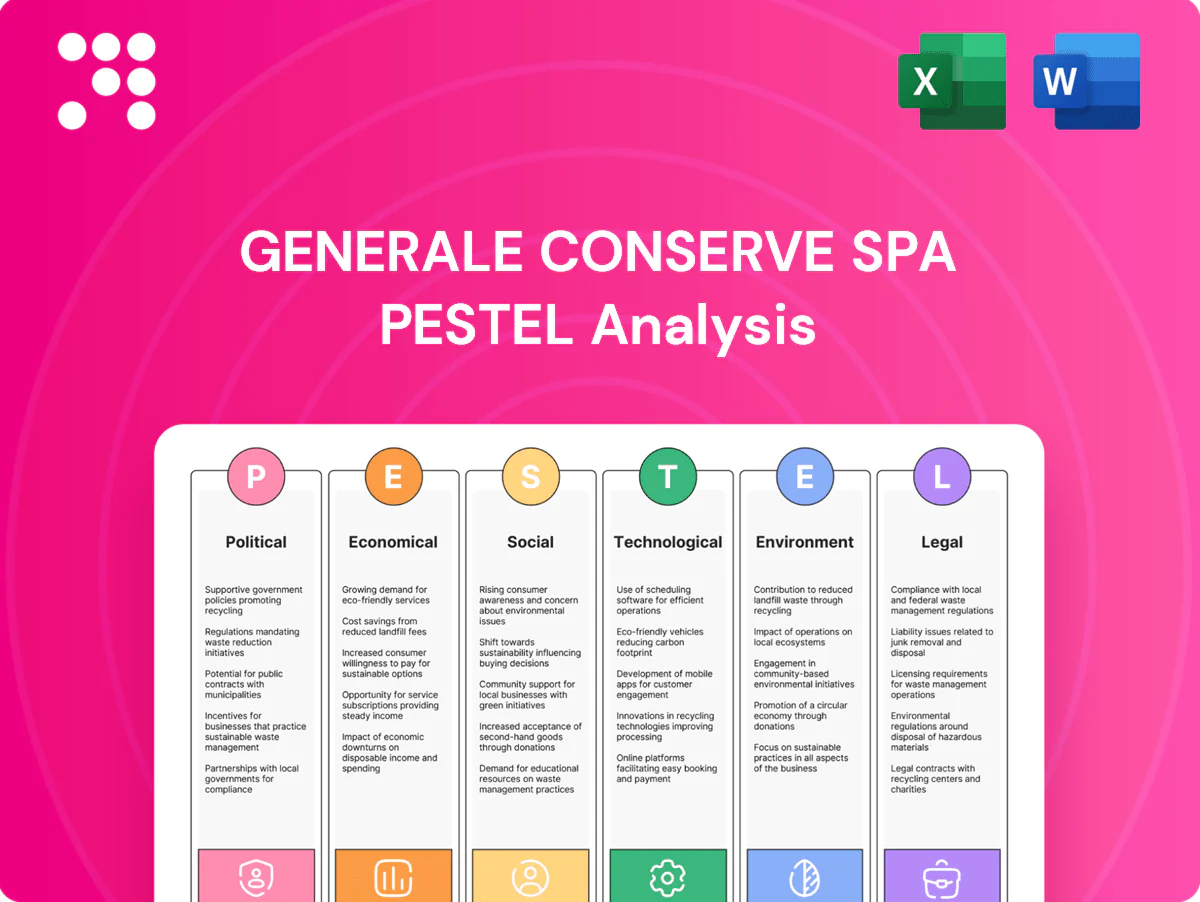
Generale Conserve SpA PESTLE Analysis

Plan Smarter. Present Sharper. Compete Stronger.
Gain a competitive edge with our concise PESTLE analysis of Generale Conserve SpA—three to five strategic insights show how political, economic, social, technological, legal and environmental forces are reshaping its market. Use this intel to refine forecasts and spot risks. Purchase the full report to access the complete, actionable breakdown instantly.
Political factors

EU fisheries policy
The EU Common Fisheries Policy sets quotas and sustainability rules that shape tuna sourcing options and costs for Generale Conserve SpA. Compliance with TACs and access rules affects catch availability and preferred suppliers, and shifts toward stricter stock management could tighten supply and raise raw material prices. Active engagement in MSC certification and EU policy forums can mitigate supply and regulatory risk.
Trade tariffs and access
Import duties on canned tuna and raw loins materially affect Generale Conserve SpA margins by raising landed cost volatility and compressing wholesale spreads. Changes in EU trade agreements with key fishing nations shift supplier competitiveness through quota access and tariff concessions tied to annual TACs. Post-Brexit rules mean the UK is a third country for seafood, adding customs, sanitary checks and stricter labeling that influence shelf-entry timing. Diversifying markets and suppliers reduces exposure to tariff and access shocks.

Geopolitical supply risks
Political instability in key fishing regions has already disrupted catches and logistics, notably Red Sea security incidents in 2023 that forced rerouting of vessels and affected supply schedules. Port closures or sanctions can delay inbound raw materials and drove war-risk insurance and freight premiums up to 300% on affected legs. Multi-origin sourcing and 2–3 months of buffer inventories are pragmatic hedges.

Italian policy and incentives
Italian policy supports agri-food via the PNRR (€191.5bn) and export promotion—Italian agri-food exports reached about €51bn in 2023—while energy relief measures since 2022 have eased operating costs; fiscal tightening or subsidy cuts would pressure margins and require tighter cost control; EU and national regional development funds frequently finance plant upgrades, so monitoring budget cycles is critical for investment timing.
- PNRR €191.5bn
- Agri‑food exports ≈€51bn (2023)
- Risk: subsidy cuts/fiscal tightening
- Action: track budget cycles for CAPEX
Public sustainability agendas
Governmental push for sustainable seafood procurement shapes retailer demands, especially in EU public tenders where procurement represents roughly 14% of GDP. Public campaigns raise certification thresholds, and alignment with MSC or equivalent (MSC has certified over 400 fisheries worldwide as of 2024) secures institutional channel access. Non-compliance risks reputational damage and loss of public contracts.
- Retailer demand driven by public procurement rules
- MSC/equivalent alignment secures institutional channels
- EU public procurement ~14% of GDP
- Non-compliance risks contract and reputation losses
EU fisheries quotas, import costs and war risks tighten tuna supply; PNRR backs CAPEX
EU Common Fisheries Policy quota rules and TACs drive raw-tuna availability and price; import duties and post-Brexit checks raise landed costs and timing risk. Regional instability (eg. Red Sea 2023) spiked war-risk premiums up to 300% and disrupted logistics. Italian PNRR (€191.5bn) and €51bn agri‑food exports (2023) support CAPEX but subsidy cuts would squeeze margins. Public procurement (~14% GDP) favors MSC alignment (400+ fisheries certified, 2024).
| Indicator | Value | Impact |
|---|---|---|
| CFP/TACs | EU-wide | Supply & price volatility |
| Import duties/Post-Brexit | Variable | Higher landed costs |
| PNRR | €191.5bn | CAPEX support |
| Agri‑food exports | ≈€51bn (2023) | Export demand |
| MSC certified | 400+ (2024) | Public tender access |
| Public procurement | ~14% GDP | Institutional sales |
What is included in the product
 Detailed Word Document
Explores how external macro-environmental factors uniquely affect Generale Conserve SpA across six dimensions—Political, Economic, Social, Technological, Environmental, and Legal. Each section offers data-backed trends and forward-looking insights to help executives and investors spot opportunities, mitigate risks, and inform strategic planning.

 Customizable Excel Spreadsheet
Visually segmented by PESTLE categories, the Generale Conserve SpA analysis delivers a concise, shareable summary for quick alignment in presentations and planning sessions.
Economic factors

Raw tuna price volatility
Skipjack (≈60% of global tuna catch) and yellowfin prices swing with catch volumes, fuel costs and climate shocks such as El Niño, increasing supply volatility. Fuel represents roughly 25% of purse-seiner operating costs, so fuel-driven price spikes quickly compress margins when Generale Conserve has limited pricing power. Long-term procurement contracts and financial hedging have been used to partially stabilize input costs, while product-mix optimization (higher‑value SKUs) protects overall profitability.
Exchange rate exposure
Sourcing often priced in USD while sales are in EUR, so EUR/USD swings materially affect input costs and reported earnings; 2024 average EUR/USD was about 1.09 and mid‑2025 spot near 1.08. Financial hedges and USD/EUR currency clauses in contracts are used to reduce P&L volatility. Geographic revenue balance across eurozone and export markets provides a natural hedge.

Consumer spending cycles
In downturns canned seafood acts as a value protein, with Statista reporting the global canned tuna market at about 11 billion USD in 2023, supporting sustained volumes; however Euromonitor 2024 shows European private‑label share near 25%, intensifying trading‑down. Premium lines such as fillets in olive oil see softer demand under weak sentiment, while price‑pack architecture and sharper promotion efficiency determine margin recovery.

Packaging and energy costs
Tinplate, aluminium and glass remain cyclical and energy-sensitive; global aluminium averaged about $2,400/t in 2024, amplifying input volatility for Generale Conserve SpA. Energy inflation has raised processing costs for cooking and sterilisation, squeezing margins in high-temperature lines. Long-term supply contracts and EU-backed energy-efficiency projects (potential savings up to 20%) help protect margins; alternative materials and higher aluminium recycling (~75% EU, 2022) offer cost and ESG upside.
- Input volatility: aluminium avg $2,400/t (2024)
- Energy impact: higher processing costs; efficiency projects save up to 20%
- Hedge: long-term supply contracts protect margins
- Alternatives: aluminium recycling ~75% (EU, 2022) — cost/ESG benefits
Retail channel dynamics
Modern-trade consolidation has concentrated buying power among fewer retailers, forcing Generale Conserve to negotiate tougher terms while leveraging scale—European grocers now control the majority of FMCG shelf space (2024 market reports).
Private-label growth compresses branded price elasticity, pressuring margins; Italian private-label penetration rose notably through 2023–24.
E-commerce and quick-commerce expand reach with higher cost-to-serve but faster turnover; joint business planning secures shelf and promo support, improving ROI on trade spend.
- Retailer bargaining: concentrated modern trade
- Pricing pressure: private-label expansion
- Channel mix: e‑commerce/quick‑commerce costs vs reach
- Mitigation: joint business planning
EU fisheries quotas, import costs and war risks tighten tuna supply; PNRR backs CAPEX
Generale Conserve faces input volatility: skipjack/yellowfin prices and fuel (≈25% of purse‑seiner costs) drive margin swings; aluminium averaged $2,400/t in 2024. Currency exposure matters: 2024 avg EUR/USD ≈1.09 (mid‑2025 ~1.08). Global canned tuna market ≈$11bn (2023) sustaining volumes while private‑label growth (Europe ~25% share) compresses branded pricing power.
Preview the Actual Deliverable
Generale Conserve SpA PESTLE Analysis
The preview shown here is the exact Generale Conserve SpA PESTLE Analysis you’ll receive after purchase—fully formatted and ready to use. It provides political, economic, social, technological, legal and environmental insights in the same layout displayed. No placeholders or edits; download the final file immediately after checkout.

Plan Smarter. Present Sharper. Compete Stronger.
Gain a competitive edge with our concise PESTLE analysis of Generale Conserve SpA—three to five strategic insights show how political, economic, social, technological, legal and environmental forces are reshaping its market. Use this intel to refine forecasts and spot risks. Purchase the full report to access the complete, actionable breakdown instantly.
Political factors
EU fisheries policy
The EU Common Fisheries Policy sets quotas and sustainability rules that shape tuna sourcing options and costs for Generale Conserve SpA. Compliance with TACs and access rules affects catch availability and preferred suppliers, and shifts toward stricter stock management could tighten supply and raise raw material prices. Active engagement in MSC certification and EU policy forums can mitigate supply and regulatory risk.
Trade tariffs and access
Import duties on canned tuna and raw loins materially affect Generale Conserve SpA margins by raising landed cost volatility and compressing wholesale spreads. Changes in EU trade agreements with key fishing nations shift supplier competitiveness through quota access and tariff concessions tied to annual TACs. Post-Brexit rules mean the UK is a third country for seafood, adding customs, sanitary checks and stricter labeling that influence shelf-entry timing. Diversifying markets and suppliers reduces exposure to tariff and access shocks.
Geopolitical supply risks
Political instability in key fishing regions has already disrupted catches and logistics, notably Red Sea security incidents in 2023 that forced rerouting of vessels and affected supply schedules. Port closures or sanctions can delay inbound raw materials and drove war-risk insurance and freight premiums up to 300% on affected legs. Multi-origin sourcing and 2–3 months of buffer inventories are pragmatic hedges.
Italian policy and incentives
Italian policy supports agri-food via the PNRR (€191.5bn) and export promotion—Italian agri-food exports reached about €51bn in 2023—while energy relief measures since 2022 have eased operating costs; fiscal tightening or subsidy cuts would pressure margins and require tighter cost control; EU and national regional development funds frequently finance plant upgrades, so monitoring budget cycles is critical for investment timing.
- PNRR €191.5bn
- Agri‑food exports ≈€51bn (2023)
- Risk: subsidy cuts/fiscal tightening
- Action: track budget cycles for CAPEX
Public sustainability agendas
Governmental push for sustainable seafood procurement shapes retailer demands, especially in EU public tenders where procurement represents roughly 14% of GDP. Public campaigns raise certification thresholds, and alignment with MSC or equivalent (MSC has certified over 400 fisheries worldwide as of 2024) secures institutional channel access. Non-compliance risks reputational damage and loss of public contracts.
- Retailer demand driven by public procurement rules
- MSC/equivalent alignment secures institutional channels
- EU public procurement ~14% of GDP
- Non-compliance risks contract and reputation losses
EU fisheries quotas, import costs and war risks tighten tuna supply; PNRR backs CAPEX
EU Common Fisheries Policy quota rules and TACs drive raw-tuna availability and price; import duties and post-Brexit checks raise landed costs and timing risk. Regional instability (eg. Red Sea 2023) spiked war-risk premiums up to 300% and disrupted logistics. Italian PNRR (€191.5bn) and €51bn agri‑food exports (2023) support CAPEX but subsidy cuts would squeeze margins. Public procurement (~14% GDP) favors MSC alignment (400+ fisheries certified, 2024).
| Indicator | Value | Impact |
|---|---|---|
| CFP/TACs | EU-wide | Supply & price volatility |
| Import duties/Post-Brexit | Variable | Higher landed costs |
| PNRR | €191.5bn | CAPEX support |
| Agri‑food exports | ≈€51bn (2023) | Export demand |
| MSC certified | 400+ (2024) | Public tender access |
| Public procurement | ~14% GDP | Institutional sales |
What is included in the product
Detailed Word Document
Explores how external macro-environmental factors uniquely affect Generale Conserve SpA across six dimensions—Political, Economic, Social, Technological, Environmental, and Legal. Each section offers data-backed trends and forward-looking insights to help executives and investors spot opportunities, mitigate risks, and inform strategic planning.
Customizable Excel Spreadsheet
Visually segmented by PESTLE categories, the Generale Conserve SpA analysis delivers a concise, shareable summary for quick alignment in presentations and planning sessions.
Economic factors
Raw tuna price volatility
Skipjack (≈60% of global tuna catch) and yellowfin prices swing with catch volumes, fuel costs and climate shocks such as El Niño, increasing supply volatility. Fuel represents roughly 25% of purse-seiner operating costs, so fuel-driven price spikes quickly compress margins when Generale Conserve has limited pricing power. Long-term procurement contracts and financial hedging have been used to partially stabilize input costs, while product-mix optimization (higher‑value SKUs) protects overall profitability.
Exchange rate exposure
Sourcing often priced in USD while sales are in EUR, so EUR/USD swings materially affect input costs and reported earnings; 2024 average EUR/USD was about 1.09 and mid‑2025 spot near 1.08. Financial hedges and USD/EUR currency clauses in contracts are used to reduce P&L volatility. Geographic revenue balance across eurozone and export markets provides a natural hedge.
Consumer spending cycles
In downturns canned seafood acts as a value protein, with Statista reporting the global canned tuna market at about 11 billion USD in 2023, supporting sustained volumes; however Euromonitor 2024 shows European private‑label share near 25%, intensifying trading‑down. Premium lines such as fillets in olive oil see softer demand under weak sentiment, while price‑pack architecture and sharper promotion efficiency determine margin recovery.
Packaging and energy costs
Tinplate, aluminium and glass remain cyclical and energy-sensitive; global aluminium averaged about $2,400/t in 2024, amplifying input volatility for Generale Conserve SpA. Energy inflation has raised processing costs for cooking and sterilisation, squeezing margins in high-temperature lines. Long-term supply contracts and EU-backed energy-efficiency projects (potential savings up to 20%) help protect margins; alternative materials and higher aluminium recycling (~75% EU, 2022) offer cost and ESG upside.
- Input volatility: aluminium avg $2,400/t (2024)
- Energy impact: higher processing costs; efficiency projects save up to 20%
- Hedge: long-term supply contracts protect margins
- Alternatives: aluminium recycling ~75% (EU, 2022) — cost/ESG benefits
Retail channel dynamics
Modern-trade consolidation has concentrated buying power among fewer retailers, forcing Generale Conserve to negotiate tougher terms while leveraging scale—European grocers now control the majority of FMCG shelf space (2024 market reports).
Private-label growth compresses branded price elasticity, pressuring margins; Italian private-label penetration rose notably through 2023–24.
E-commerce and quick-commerce expand reach with higher cost-to-serve but faster turnover; joint business planning secures shelf and promo support, improving ROI on trade spend.
- Retailer bargaining: concentrated modern trade
- Pricing pressure: private-label expansion
- Channel mix: e‑commerce/quick‑commerce costs vs reach
- Mitigation: joint business planning
EU fisheries quotas, import costs and war risks tighten tuna supply; PNRR backs CAPEX
Generale Conserve faces input volatility: skipjack/yellowfin prices and fuel (≈25% of purse‑seiner costs) drive margin swings; aluminium averaged $2,400/t in 2024. Currency exposure matters: 2024 avg EUR/USD ≈1.09 (mid‑2025 ~1.08). Global canned tuna market ≈$11bn (2023) sustaining volumes while private‑label growth (Europe ~25% share) compresses branded pricing power.
Preview the Actual Deliverable
Generale Conserve SpA PESTLE Analysis
The preview shown here is the exact Generale Conserve SpA PESTLE Analysis you’ll receive after purchase—fully formatted and ready to use. It provides political, economic, social, technological, legal and environmental insights in the same layout displayed. No placeholders or edits; download the final file immediately after checkout.
Description
Plan Smarter. Present Sharper. Compete Stronger.
Gain a competitive edge with our concise PESTLE analysis of Generale Conserve SpA—three to five strategic insights show how political, economic, social, technological, legal and environmental forces are reshaping its market. Use this intel to refine forecasts and spot risks. Purchase the full report to access the complete, actionable breakdown instantly.
Political factors
EU fisheries policy
The EU Common Fisheries Policy sets quotas and sustainability rules that shape tuna sourcing options and costs for Generale Conserve SpA. Compliance with TACs and access rules affects catch availability and preferred suppliers, and shifts toward stricter stock management could tighten supply and raise raw material prices. Active engagement in MSC certification and EU policy forums can mitigate supply and regulatory risk.
Trade tariffs and access
Import duties on canned tuna and raw loins materially affect Generale Conserve SpA margins by raising landed cost volatility and compressing wholesale spreads. Changes in EU trade agreements with key fishing nations shift supplier competitiveness through quota access and tariff concessions tied to annual TACs. Post-Brexit rules mean the UK is a third country for seafood, adding customs, sanitary checks and stricter labeling that influence shelf-entry timing. Diversifying markets and suppliers reduces exposure to tariff and access shocks.
Geopolitical supply risks
Political instability in key fishing regions has already disrupted catches and logistics, notably Red Sea security incidents in 2023 that forced rerouting of vessels and affected supply schedules. Port closures or sanctions can delay inbound raw materials and drove war-risk insurance and freight premiums up to 300% on affected legs. Multi-origin sourcing and 2–3 months of buffer inventories are pragmatic hedges.
Italian policy and incentives
Italian policy supports agri-food via the PNRR (€191.5bn) and export promotion—Italian agri-food exports reached about €51bn in 2023—while energy relief measures since 2022 have eased operating costs; fiscal tightening or subsidy cuts would pressure margins and require tighter cost control; EU and national regional development funds frequently finance plant upgrades, so monitoring budget cycles is critical for investment timing.
- PNRR €191.5bn
- Agri‑food exports ≈€51bn (2023)
- Risk: subsidy cuts/fiscal tightening
- Action: track budget cycles for CAPEX
Public sustainability agendas
Governmental push for sustainable seafood procurement shapes retailer demands, especially in EU public tenders where procurement represents roughly 14% of GDP. Public campaigns raise certification thresholds, and alignment with MSC or equivalent (MSC has certified over 400 fisheries worldwide as of 2024) secures institutional channel access. Non-compliance risks reputational damage and loss of public contracts.
- Retailer demand driven by public procurement rules
- MSC/equivalent alignment secures institutional channels
- EU public procurement ~14% of GDP
- Non-compliance risks contract and reputation losses
EU fisheries quotas, import costs and war risks tighten tuna supply; PNRR backs CAPEX
EU Common Fisheries Policy quota rules and TACs drive raw-tuna availability and price; import duties and post-Brexit checks raise landed costs and timing risk. Regional instability (eg. Red Sea 2023) spiked war-risk premiums up to 300% and disrupted logistics. Italian PNRR (€191.5bn) and €51bn agri‑food exports (2023) support CAPEX but subsidy cuts would squeeze margins. Public procurement (~14% GDP) favors MSC alignment (400+ fisheries certified, 2024).
| Indicator | Value | Impact |
|---|---|---|
| CFP/TACs | EU-wide | Supply & price volatility |
| Import duties/Post-Brexit | Variable | Higher landed costs |
| PNRR | €191.5bn | CAPEX support |
| Agri‑food exports | ≈€51bn (2023) | Export demand |
| MSC certified | 400+ (2024) | Public tender access |
| Public procurement | ~14% GDP | Institutional sales |
What is included in the product
Detailed Word Document
Explores how external macro-environmental factors uniquely affect Generale Conserve SpA across six dimensions—Political, Economic, Social, Technological, Environmental, and Legal. Each section offers data-backed trends and forward-looking insights to help executives and investors spot opportunities, mitigate risks, and inform strategic planning.
Customizable Excel Spreadsheet
Visually segmented by PESTLE categories, the Generale Conserve SpA analysis delivers a concise, shareable summary for quick alignment in presentations and planning sessions.
Economic factors
Raw tuna price volatility
Skipjack (≈60% of global tuna catch) and yellowfin prices swing with catch volumes, fuel costs and climate shocks such as El Niño, increasing supply volatility. Fuel represents roughly 25% of purse-seiner operating costs, so fuel-driven price spikes quickly compress margins when Generale Conserve has limited pricing power. Long-term procurement contracts and financial hedging have been used to partially stabilize input costs, while product-mix optimization (higher‑value SKUs) protects overall profitability.
Exchange rate exposure
Sourcing often priced in USD while sales are in EUR, so EUR/USD swings materially affect input costs and reported earnings; 2024 average EUR/USD was about 1.09 and mid‑2025 spot near 1.08. Financial hedges and USD/EUR currency clauses in contracts are used to reduce P&L volatility. Geographic revenue balance across eurozone and export markets provides a natural hedge.
Consumer spending cycles
In downturns canned seafood acts as a value protein, with Statista reporting the global canned tuna market at about 11 billion USD in 2023, supporting sustained volumes; however Euromonitor 2024 shows European private‑label share near 25%, intensifying trading‑down. Premium lines such as fillets in olive oil see softer demand under weak sentiment, while price‑pack architecture and sharper promotion efficiency determine margin recovery.
Packaging and energy costs
Tinplate, aluminium and glass remain cyclical and energy-sensitive; global aluminium averaged about $2,400/t in 2024, amplifying input volatility for Generale Conserve SpA. Energy inflation has raised processing costs for cooking and sterilisation, squeezing margins in high-temperature lines. Long-term supply contracts and EU-backed energy-efficiency projects (potential savings up to 20%) help protect margins; alternative materials and higher aluminium recycling (~75% EU, 2022) offer cost and ESG upside.
- Input volatility: aluminium avg $2,400/t (2024)
- Energy impact: higher processing costs; efficiency projects save up to 20%
- Hedge: long-term supply contracts protect margins
- Alternatives: aluminium recycling ~75% (EU, 2022) — cost/ESG benefits
Retail channel dynamics
Modern-trade consolidation has concentrated buying power among fewer retailers, forcing Generale Conserve to negotiate tougher terms while leveraging scale—European grocers now control the majority of FMCG shelf space (2024 market reports).
Private-label growth compresses branded price elasticity, pressuring margins; Italian private-label penetration rose notably through 2023–24.
E-commerce and quick-commerce expand reach with higher cost-to-serve but faster turnover; joint business planning secures shelf and promo support, improving ROI on trade spend.
- Retailer bargaining: concentrated modern trade
- Pricing pressure: private-label expansion
- Channel mix: e‑commerce/quick‑commerce costs vs reach
- Mitigation: joint business planning
EU fisheries quotas, import costs and war risks tighten tuna supply; PNRR backs CAPEX
Generale Conserve faces input volatility: skipjack/yellowfin prices and fuel (≈25% of purse‑seiner costs) drive margin swings; aluminium averaged $2,400/t in 2024. Currency exposure matters: 2024 avg EUR/USD ≈1.09 (mid‑2025 ~1.08). Global canned tuna market ≈$11bn (2023) sustaining volumes while private‑label growth (Europe ~25% share) compresses branded pricing power.
Preview the Actual Deliverable
Generale Conserve SpA PESTLE Analysis
The preview shown here is the exact Generale Conserve SpA PESTLE Analysis you’ll receive after purchase—fully formatted and ready to use. It provides political, economic, social, technological, legal and environmental insights in the same layout displayed. No placeholders or edits; download the final file immediately after checkout.











