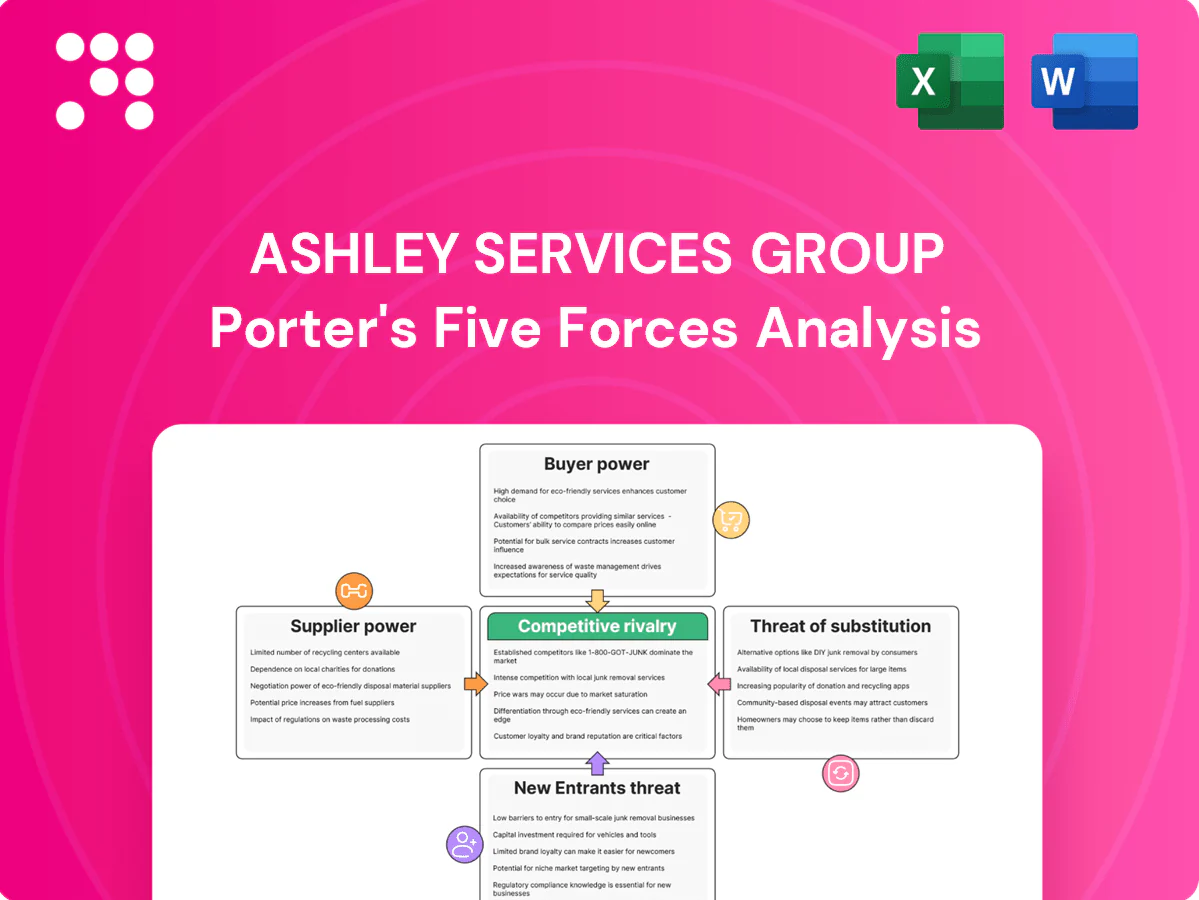
Ashley Services Group Porter's Five Forces Analysis

Go Beyond the Preview—Access the Full Strategic Report
Ashley Services Group faces moderate supplier power and variable buyer influence across its niche service segments, while barriers to entry and substitute threats hinge on scale and technology. Competitive rivalry is intense among regional players, creating margin pressure but also opportunities for differentiation through specialization. This snapshot only scratches the surface — unlock the full Porter's Five Forces Analysis to get force-by-force ratings, visuals, and actionable strategic recommendations tailored to Ashley Services Group.
Suppliers Bargaining Power

Tight labor supply in key skills
Qualified blue-collar trades, healthcare and technical roles remain scarce in 2024, giving workers and subcontractors leverage on rates and conditions; staffing surveys report 72% shortages. Competition among agencies rises, driving sourcing costs up ~18% and time-to-fill +22% year-over-year, with fall-offs and counteroffers climbing to about 29%.
Accredited trainers and assessors
RTO delivery relies on accredited trainers and assessors whose limited availability gives suppliers notable bargaining power; specialist trainers increasingly command higher fees and flexible scheduling. Their scarcity constrains class throughput and compresses margins, and losing key trainers risks non-compliance with standards and significant delivery delays. Industry surveys in 2024 highlighted trainer shortages as a central operational risk for RTOs.

Dependence on job boards and tech platforms
Aggregation platforms like LinkedIn (about 930 million members in 2024) and Seek give suppliers leverage through access fees and policy changes; the global ATS/VMS market was valued near US$3.2 billion in 2023, concentrating power. Price hikes or algorithm shifts can drive double‑digit increases in sourcing costs. Switching core platforms is disruptive, creating vendor lock‑in that compresses margins.

Compliance and accreditation bodies
Regulators and accreditation bodies function as suppliers of licences and standards for Ashley Services Group; in 2024 inspection activity rose about 12% year-on-year, raising audit burdens and squeezing margins.
Shifts in funding, audit regimes or compliance rules can raise delivery costs materially; non-compliance can stop training delivery, and this structural supplier power limits negotiation flexibility.
- Regulators = suppliers
- 2024 inspections +12%
- Compliance raises delivery costs
- Non-compliance can halt operations
Cleaning consumables and equipment vendors
Skilled roles squeeze: 72% shortfalls push sourcing +18%
Qualified trades, healthcare and technical roles face 72% reported shortages in 2024, boosting subcontractor leverage and pushing sourcing costs +18% and time-to-fill +22%, with fall-offs/counteroffers ~29%. Trainer scarcity and regulator activity (+12% inspections) raise compliance costs; platform fees (LinkedIn ~930M users; ATS/VMS ~$3.2B) and specialty chemicals (~$37B) further constrain margins.
| Metric | 2024 Value |
|---|---|
| Worker shortages | 72% |
| Sourcing cost change | +18% |
| Time-to-fill | +22% |
| Fall-offs/counteroffers | 29% |
| Inspections | +12% |
| LinkedIn users | 930M |
| ATS/VMS market | $3.2B |
| Cleaning chemicals market | $37B |
What is included in the product
 Detailed Word Document
Tailored Porter's Five Forces analysis for Ashley Services Group uncovering competitive intensity, buyer/supplier power, substitution risks, and entry barriers to assess pricing leverage and strategic vulnerabilities.

 Customizable Excel Spreadsheet
A concise one-sheet Porter's Five Forces for Ashley Services Group—customizable pressure levels and an instant spider chart so teams can quickly assess competitive threats and plug insights into decks or dashboards without complex tools.
Customers Bargaining Power

Enterprise tenders and MSP/VMS
Industry data (2024) shows MSP/VMS-run enterprise tenders now manage roughly 60% of large clients’ contingent labor spend, enabling buyers to extract 10–25% volume discounts and standardized rate cards that compress supplier margins. Clients enforce strict SLAs with penalties often reaching 5–10% of contract value. Retender cycles drive churn rates of about 20–30% per event, raising renewal risk.
Low switching costs in commoditized roles
For general labor and cleaning, clients can multi-source and switch easily, keeping customer bargaining power high. Limited differentiation drives price-based selection; renewal often hinges on rate reductions, with over 50% of facility buyers citing cost as primary criterion in 2024 procurement surveys. References and compliance improve win rates but do not lock in buyers; turnover in cleaning/general labor commonly exceeds 50% annually.

Demand cyclicality and budget sensitivity
Hiring volumes at Ashley Services Group swing with project cycles and macro conditions; US unemployment ticked to about 4.0% in late 2024, reflecting a softer labor market that reduces permanent hires. Clients increasingly favor temporary over permanent placements during downturns, pressuring margins. Corporate training budgets are often deferred or redirected to critical functions, and this demand volatility strengthens buyer negotiating leverage.

Data and transparency expectations
Clients now demand real-time metrics, compliance evidence, and safety performance dashboards; failure to deliver erodes Ashley Services Group bargaining power by making contracts easier to scrutinize and replace. Robust, auditable reporting supports premium pricing and contract renewal; weak reporting invites price pressure, short-term contracts, or termination.
- Real-time dashboards required
- Auditable compliance = pricing leverage
- Poor reporting → price pressure/termination
Cross-service bundling pressure
Buyers increasingly demand bundled staffing, training, and cleaning to simplify vendor management, forcing providers to offer blended pricing and accept margin compression while winning share; scope creep and KPI complexity heighten delivery risk, and negotiations routinely trade lower price for expanded footprint.
- Bundling simplifies procurement
- Blended discounts pressure margins
- Scope creep raises operational risk
- Price often exchanged for footprint
Buyers control ~60% spend; MSP/VMS extract 10–25% discounts, churn ~20%
Buyers wield high leverage: MSP/VMS control ~60% of large contingent spend, extracting 10–25% discounts and enforcing SLA penalties of 5–10%, with retender churn ~20–30%. Facility buyers cite cost as top criterion (>50%), and cleaning labor turnover exceeds 50%, keeping price pressure acute. Demand volatility (US unemployment ~4.0% in late 2024) further strengthens customer bargaining power.
| Metric | 2024 |
|---|---|
| MSP/VMS share | ~60% |
| Negotiated discounts | 10–25% |
| SLA penalties | 5–10% |
| Retender churn | 20–30% |
| Cost as top criterion | >50% |
| Cleaning turnover | >50% |
| US unemployment | ~4.0% |
Full Version Awaits
Ashley Services Group Porter's Five Forces Analysis
This preview is the exact Porter’s Five Forces analysis for Ashley Services Group you’ll receive after purchase—fully developed, professionally formatted, and ready to use. It assesses competitive rivalry, supplier and buyer power, threat of entrants, and substitutes with actionable insights. No placeholders or samples; the file available instantly on payment is this same document.

Go Beyond the Preview—Access the Full Strategic Report
Ashley Services Group faces moderate supplier power and variable buyer influence across its niche service segments, while barriers to entry and substitute threats hinge on scale and technology. Competitive rivalry is intense among regional players, creating margin pressure but also opportunities for differentiation through specialization. This snapshot only scratches the surface — unlock the full Porter's Five Forces Analysis to get force-by-force ratings, visuals, and actionable strategic recommendations tailored to Ashley Services Group.
Suppliers Bargaining Power
Tight labor supply in key skills
Qualified blue-collar trades, healthcare and technical roles remain scarce in 2024, giving workers and subcontractors leverage on rates and conditions; staffing surveys report 72% shortages. Competition among agencies rises, driving sourcing costs up ~18% and time-to-fill +22% year-over-year, with fall-offs and counteroffers climbing to about 29%.
Accredited trainers and assessors
RTO delivery relies on accredited trainers and assessors whose limited availability gives suppliers notable bargaining power; specialist trainers increasingly command higher fees and flexible scheduling. Their scarcity constrains class throughput and compresses margins, and losing key trainers risks non-compliance with standards and significant delivery delays. Industry surveys in 2024 highlighted trainer shortages as a central operational risk for RTOs.
Dependence on job boards and tech platforms
Aggregation platforms like LinkedIn (about 930 million members in 2024) and Seek give suppliers leverage through access fees and policy changes; the global ATS/VMS market was valued near US$3.2 billion in 2023, concentrating power. Price hikes or algorithm shifts can drive double‑digit increases in sourcing costs. Switching core platforms is disruptive, creating vendor lock‑in that compresses margins.
Compliance and accreditation bodies
Regulators and accreditation bodies function as suppliers of licences and standards for Ashley Services Group; in 2024 inspection activity rose about 12% year-on-year, raising audit burdens and squeezing margins.
Shifts in funding, audit regimes or compliance rules can raise delivery costs materially; non-compliance can stop training delivery, and this structural supplier power limits negotiation flexibility.
- Regulators = suppliers
- 2024 inspections +12%
- Compliance raises delivery costs
- Non-compliance can halt operations
Cleaning consumables and equipment vendors
Skilled roles squeeze: 72% shortfalls push sourcing +18%
Qualified trades, healthcare and technical roles face 72% reported shortages in 2024, boosting subcontractor leverage and pushing sourcing costs +18% and time-to-fill +22%, with fall-offs/counteroffers ~29%. Trainer scarcity and regulator activity (+12% inspections) raise compliance costs; platform fees (LinkedIn ~930M users; ATS/VMS ~$3.2B) and specialty chemicals (~$37B) further constrain margins.
| Metric | 2024 Value |
|---|---|
| Worker shortages | 72% |
| Sourcing cost change | +18% |
| Time-to-fill | +22% |
| Fall-offs/counteroffers | 29% |
| Inspections | +12% |
| LinkedIn users | 930M |
| ATS/VMS market | $3.2B |
| Cleaning chemicals market | $37B |
What is included in the product
Detailed Word Document
Tailored Porter's Five Forces analysis for Ashley Services Group uncovering competitive intensity, buyer/supplier power, substitution risks, and entry barriers to assess pricing leverage and strategic vulnerabilities.
Customizable Excel Spreadsheet
A concise one-sheet Porter's Five Forces for Ashley Services Group—customizable pressure levels and an instant spider chart so teams can quickly assess competitive threats and plug insights into decks or dashboards without complex tools.
Customers Bargaining Power
Enterprise tenders and MSP/VMS
Industry data (2024) shows MSP/VMS-run enterprise tenders now manage roughly 60% of large clients’ contingent labor spend, enabling buyers to extract 10–25% volume discounts and standardized rate cards that compress supplier margins. Clients enforce strict SLAs with penalties often reaching 5–10% of contract value. Retender cycles drive churn rates of about 20–30% per event, raising renewal risk.
Low switching costs in commoditized roles
For general labor and cleaning, clients can multi-source and switch easily, keeping customer bargaining power high. Limited differentiation drives price-based selection; renewal often hinges on rate reductions, with over 50% of facility buyers citing cost as primary criterion in 2024 procurement surveys. References and compliance improve win rates but do not lock in buyers; turnover in cleaning/general labor commonly exceeds 50% annually.
Demand cyclicality and budget sensitivity
Hiring volumes at Ashley Services Group swing with project cycles and macro conditions; US unemployment ticked to about 4.0% in late 2024, reflecting a softer labor market that reduces permanent hires. Clients increasingly favor temporary over permanent placements during downturns, pressuring margins. Corporate training budgets are often deferred or redirected to critical functions, and this demand volatility strengthens buyer negotiating leverage.
Data and transparency expectations
Clients now demand real-time metrics, compliance evidence, and safety performance dashboards; failure to deliver erodes Ashley Services Group bargaining power by making contracts easier to scrutinize and replace. Robust, auditable reporting supports premium pricing and contract renewal; weak reporting invites price pressure, short-term contracts, or termination.
- Real-time dashboards required
- Auditable compliance = pricing leverage
- Poor reporting → price pressure/termination
Cross-service bundling pressure
Buyers increasingly demand bundled staffing, training, and cleaning to simplify vendor management, forcing providers to offer blended pricing and accept margin compression while winning share; scope creep and KPI complexity heighten delivery risk, and negotiations routinely trade lower price for expanded footprint.
- Bundling simplifies procurement
- Blended discounts pressure margins
- Scope creep raises operational risk
- Price often exchanged for footprint
Buyers control ~60% spend; MSP/VMS extract 10–25% discounts, churn ~20%
Buyers wield high leverage: MSP/VMS control ~60% of large contingent spend, extracting 10–25% discounts and enforcing SLA penalties of 5–10%, with retender churn ~20–30%. Facility buyers cite cost as top criterion (>50%), and cleaning labor turnover exceeds 50%, keeping price pressure acute. Demand volatility (US unemployment ~4.0% in late 2024) further strengthens customer bargaining power.
| Metric | 2024 |
|---|---|
| MSP/VMS share | ~60% |
| Negotiated discounts | 10–25% |
| SLA penalties | 5–10% |
| Retender churn | 20–30% |
| Cost as top criterion | >50% |
| Cleaning turnover | >50% |
| US unemployment | ~4.0% |
Full Version Awaits
Ashley Services Group Porter's Five Forces Analysis
This preview is the exact Porter’s Five Forces analysis for Ashley Services Group you’ll receive after purchase—fully developed, professionally formatted, and ready to use. It assesses competitive rivalry, supplier and buyer power, threat of entrants, and substitutes with actionable insights. No placeholders or samples; the file available instantly on payment is this same document.
Original: $10.00
-65%$10.00
$3.50Description
Go Beyond the Preview—Access the Full Strategic Report
Ashley Services Group faces moderate supplier power and variable buyer influence across its niche service segments, while barriers to entry and substitute threats hinge on scale and technology. Competitive rivalry is intense among regional players, creating margin pressure but also opportunities for differentiation through specialization. This snapshot only scratches the surface — unlock the full Porter's Five Forces Analysis to get force-by-force ratings, visuals, and actionable strategic recommendations tailored to Ashley Services Group.
Suppliers Bargaining Power
Tight labor supply in key skills
Qualified blue-collar trades, healthcare and technical roles remain scarce in 2024, giving workers and subcontractors leverage on rates and conditions; staffing surveys report 72% shortages. Competition among agencies rises, driving sourcing costs up ~18% and time-to-fill +22% year-over-year, with fall-offs and counteroffers climbing to about 29%.
Accredited trainers and assessors
RTO delivery relies on accredited trainers and assessors whose limited availability gives suppliers notable bargaining power; specialist trainers increasingly command higher fees and flexible scheduling. Their scarcity constrains class throughput and compresses margins, and losing key trainers risks non-compliance with standards and significant delivery delays. Industry surveys in 2024 highlighted trainer shortages as a central operational risk for RTOs.
Dependence on job boards and tech platforms
Aggregation platforms like LinkedIn (about 930 million members in 2024) and Seek give suppliers leverage through access fees and policy changes; the global ATS/VMS market was valued near US$3.2 billion in 2023, concentrating power. Price hikes or algorithm shifts can drive double‑digit increases in sourcing costs. Switching core platforms is disruptive, creating vendor lock‑in that compresses margins.
Compliance and accreditation bodies
Regulators and accreditation bodies function as suppliers of licences and standards for Ashley Services Group; in 2024 inspection activity rose about 12% year-on-year, raising audit burdens and squeezing margins.
Shifts in funding, audit regimes or compliance rules can raise delivery costs materially; non-compliance can stop training delivery, and this structural supplier power limits negotiation flexibility.
- Regulators = suppliers
- 2024 inspections +12%
- Compliance raises delivery costs
- Non-compliance can halt operations
Cleaning consumables and equipment vendors
Skilled roles squeeze: 72% shortfalls push sourcing +18%
Qualified trades, healthcare and technical roles face 72% reported shortages in 2024, boosting subcontractor leverage and pushing sourcing costs +18% and time-to-fill +22%, with fall-offs/counteroffers ~29%. Trainer scarcity and regulator activity (+12% inspections) raise compliance costs; platform fees (LinkedIn ~930M users; ATS/VMS ~$3.2B) and specialty chemicals (~$37B) further constrain margins.
| Metric | 2024 Value |
|---|---|
| Worker shortages | 72% |
| Sourcing cost change | +18% |
| Time-to-fill | +22% |
| Fall-offs/counteroffers | 29% |
| Inspections | +12% |
| LinkedIn users | 930M |
| ATS/VMS market | $3.2B |
| Cleaning chemicals market | $37B |
What is included in the product
Detailed Word Document
Tailored Porter's Five Forces analysis for Ashley Services Group uncovering competitive intensity, buyer/supplier power, substitution risks, and entry barriers to assess pricing leverage and strategic vulnerabilities.
Customizable Excel Spreadsheet
A concise one-sheet Porter's Five Forces for Ashley Services Group—customizable pressure levels and an instant spider chart so teams can quickly assess competitive threats and plug insights into decks or dashboards without complex tools.
Customers Bargaining Power
Enterprise tenders and MSP/VMS
Industry data (2024) shows MSP/VMS-run enterprise tenders now manage roughly 60% of large clients’ contingent labor spend, enabling buyers to extract 10–25% volume discounts and standardized rate cards that compress supplier margins. Clients enforce strict SLAs with penalties often reaching 5–10% of contract value. Retender cycles drive churn rates of about 20–30% per event, raising renewal risk.
Low switching costs in commoditized roles
For general labor and cleaning, clients can multi-source and switch easily, keeping customer bargaining power high. Limited differentiation drives price-based selection; renewal often hinges on rate reductions, with over 50% of facility buyers citing cost as primary criterion in 2024 procurement surveys. References and compliance improve win rates but do not lock in buyers; turnover in cleaning/general labor commonly exceeds 50% annually.
Demand cyclicality and budget sensitivity
Hiring volumes at Ashley Services Group swing with project cycles and macro conditions; US unemployment ticked to about 4.0% in late 2024, reflecting a softer labor market that reduces permanent hires. Clients increasingly favor temporary over permanent placements during downturns, pressuring margins. Corporate training budgets are often deferred or redirected to critical functions, and this demand volatility strengthens buyer negotiating leverage.
Data and transparency expectations
Clients now demand real-time metrics, compliance evidence, and safety performance dashboards; failure to deliver erodes Ashley Services Group bargaining power by making contracts easier to scrutinize and replace. Robust, auditable reporting supports premium pricing and contract renewal; weak reporting invites price pressure, short-term contracts, or termination.
- Real-time dashboards required
- Auditable compliance = pricing leverage
- Poor reporting → price pressure/termination
Cross-service bundling pressure
Buyers increasingly demand bundled staffing, training, and cleaning to simplify vendor management, forcing providers to offer blended pricing and accept margin compression while winning share; scope creep and KPI complexity heighten delivery risk, and negotiations routinely trade lower price for expanded footprint.
- Bundling simplifies procurement
- Blended discounts pressure margins
- Scope creep raises operational risk
- Price often exchanged for footprint
Buyers control ~60% spend; MSP/VMS extract 10–25% discounts, churn ~20%
Buyers wield high leverage: MSP/VMS control ~60% of large contingent spend, extracting 10–25% discounts and enforcing SLA penalties of 5–10%, with retender churn ~20–30%. Facility buyers cite cost as top criterion (>50%), and cleaning labor turnover exceeds 50%, keeping price pressure acute. Demand volatility (US unemployment ~4.0% in late 2024) further strengthens customer bargaining power.
| Metric | 2024 |
|---|---|
| MSP/VMS share | ~60% |
| Negotiated discounts | 10–25% |
| SLA penalties | 5–10% |
| Retender churn | 20–30% |
| Cost as top criterion | >50% |
| Cleaning turnover | >50% |
| US unemployment | ~4.0% |
Full Version Awaits
Ashley Services Group Porter's Five Forces Analysis
This preview is the exact Porter’s Five Forces analysis for Ashley Services Group you’ll receive after purchase—fully developed, professionally formatted, and ready to use. It assesses competitive rivalry, supplier and buyer power, threat of entrants, and substitutes with actionable insights. No placeholders or samples; the file available instantly on payment is this same document.











