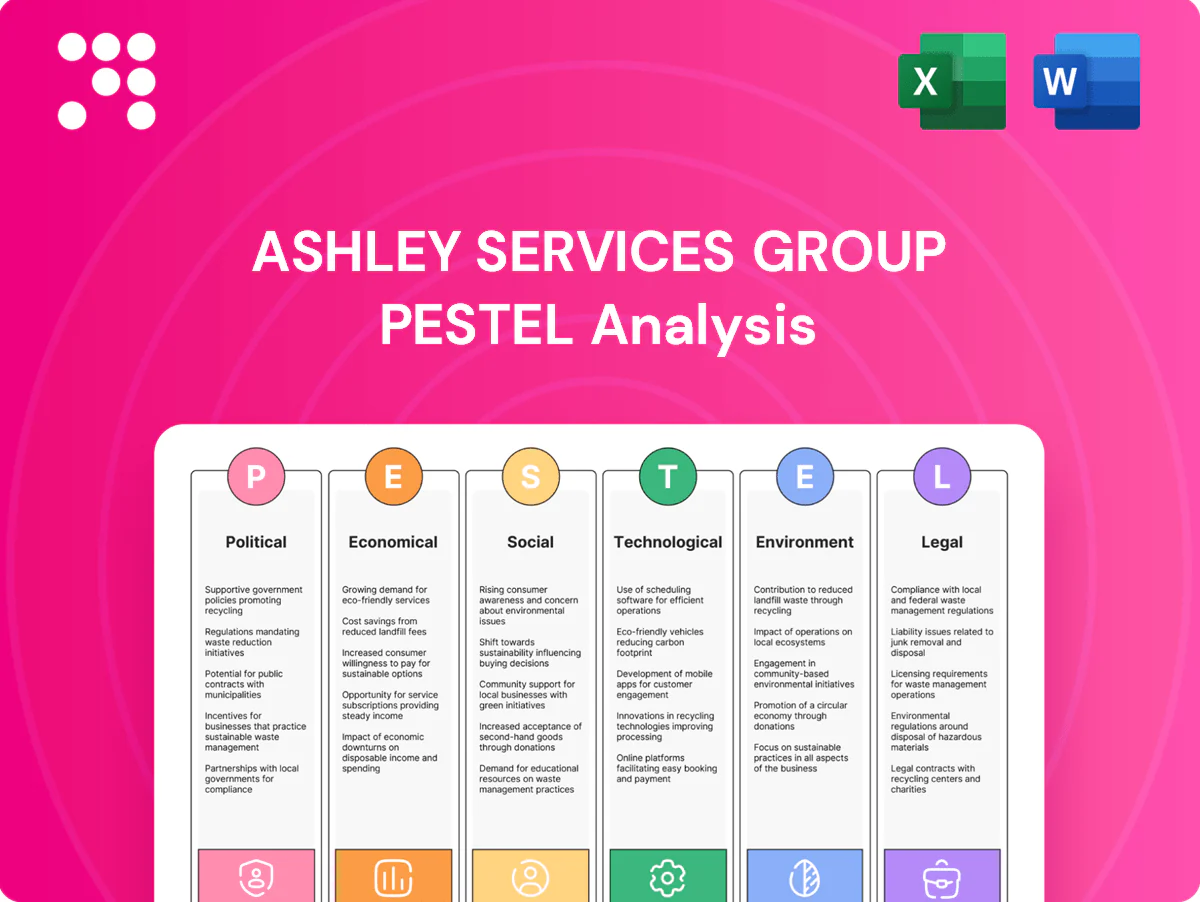
Ashley Services Group PESTLE Analysis

Your Shortcut to Market Insight Starts Here
Gain a competitive edge with our concise PESTLE analysis of Ashley Services Group. We map political, economic, social, technological, legal and environmental forces shaping strategy and risk, with actionable insights for investors and planners. Purchase the full version to access the complete, ready-to-use report.
Political factors

Government employment policy
Commonwealth and state employment programs—Workforce Australia replacing jobactive in July 2022—continue to drive hiring volumes across public and contractor supply chains for labour hire and VET providers. Shifts in apprenticeships funding and incentives alter candidate flow and training demand, affecting placement volumes and training service mix. Monitoring policy cycles and budget announcements helps Ashley Services time tenders and align offerings with government priorities.
Immigration and visas
Skilled and temporary migration settings shape talent supply for construction, logistics, cleaning and care; in 2023–24 the UK granted over 600,000 work-related visas, expanding candidate pools and reducing placement times.
Caps, priority lists and sponsorship rules directly tighten or loosen those pools; tightened sponsorship compliance since 2023 has raised onboarding costs for agencies by increasing vetting and record-keeping duties.
Faster visa processing in 2024 cut average placement lead times, while proactive engagement with migrant communities and targeted support programs helps offset sector shortages.

Infrastructure spend
Government-backed infrastructure pipelines, including the US Bipartisan Infrastructure Law's roughly $550 billion in new investment, drive sustained demand for blue-collar and technical labour that benefits Ashley Services Group. Schedule changes or cancellations ripple directly into utilisation and margin stability by creating short-term benching and hire costs. Regional projects require strong mobilization capability and local content compliance, increasing operational complexity and bid requirements. Multi-year visibility supports workforce planning and training cohorts to reduce hiring lag and credentialing costs.

VET funding and policy
The 2022 National Skills Agreement continues to shape funding settings and fee-subsidy allocations across jurisdictions, with NSW, Victoria and Queensland adjusting subsidies in 2024 to influence TAFE versus private RTO delivery and overall training volumes. Outcome-based funding reforms increasingly tie payments to completions and employment outcomes, altering course mix incentives and favouring shorter, priority-skill programs. Strengthened regulatory audits by ASQA and state regulators link funding to strict compliance, raising delivery costs and administrative burden; aligning offerings to government priority skills lists maximises funding capture and revenue stability.
- National Skills Agreement 2022 drives 2024 subsidy settings
- Outcome-based funding shifts payments toward completions
- Regulatory audits increase compliance costs
- Priority-skill alignment improves funding access
Public procurement rules
Public procurement now embeds social procurement and Indigenous participation requirements — Australia's Indigenous Procurement Policy sets a 3% target of eligible Commonwealth contracts for Indigenous businesses — influencing bid design, local jobs clauses and supplier selection. Labour-hire providers must evidence fair-work compliance and safety performance to win frameworks, while multi-tier subcontracting controls shift margin pressure and risk allocation; strong credentialing improves access to government panels.
- IPP target: 3% of eligible Commonwealth contracts
- Mandatory evidence: fair-work and WHS records for framework entry
- Risk: multi-tier subcontracting compresses margins
- Benefit: robust credentials increase framework access
Public hiring surge, skilled migration and US infrastructure funding reshape workforce and margins
Commonwealth programs (Workforce Australia from Jul 2022) and state subsidy shifts drive public-sector hiring and VET demand. Skilled migration expanding candidate pools (UK granted 600,000 work visas in 2023–24) while sponsorship compliance raises onboarding costs. Large infrastructure pipelines (US Bipartisan Infrastructure Law ~550 billion USD) and IPP 3% target shape bids, mobilization and margin pressure.
| Metric | Value |
|---|---|
| Workforce Australia | Jul 2022 |
| UK work visas | 600,000 (2023–24) |
| US infrastructure | ~550 bn USD |
| IPP target | 3% |
What is included in the product
 Detailed Word Document
Explores how external macro-environmental factors uniquely affect the Ashley Services Group across Political, Economic, Social, Technological, Environmental and Legal dimensions, with data-backed trends, forward-looking insights and actionable implications for strategy, risk management and funding.

 Customizable Excel Spreadsheet
A concise, visually segmented PESTLE snapshot of Ashley Services Group that eases stakeholder alignment, highlights external risks and opportunities for planning sessions, and can be dropped into decks or shared across teams for quick decision-making.
Economic factors

Labour market tightness
Labour market tightness in Australia, with unemployment near 4.0% and participation about 66.6%, directly dictates fill speed and pay rates. Tight markets raise sourcing costs but support higher margins, while slack markets pressure pricing. Sectoral swings in construction, mining and warehousing demand agile redeployment; real-time vacancy analytics cut time-to-fill and improve forecasting.
Wages, inflation, rates
Fair Work Commission wage rises (5.75% from 1 July 2024) and award increases push payroll pass-through and working capital needs higher for Ashley Services Group; RBA cash rate around 4.35% in mid‑2024 and elevated inflation pressure client hiring and candidate wage expectations. Indexation clauses in contracts help protect margins as costs rise, while strict cash‑flow discipline is critical under higher funding costs.

Skills shortages
Chronic shortages in trades, care and tech—highlighted by the Australian National Skills Commission 2024 shortage list—push Ashley Services to expand training and retention programmes and scale RPL and bridging pathways to widen eligible labour pools. Premium-skilled roles increase average bill rates and shift mix toward higher-value placements, raising gross margin potential. Strategic employer partnerships secure pipeline visibility and reduce vacancy lead times amid over 300,000 national job vacancies in recent years.

Business confidence
Business confidence drives Ashley Services Group hiring mix: weak confidence skews client demand to temporary and on-hire roles, stabilizing volumes, while strong confidence lifts permanent placements and training uptake. Diversification across mining, construction, and healthcare smooths cyclical swings. Australia's unemployment was about 3.9% in 2024 (ABS), supporting steady labour demand.
- Temp/on-hire focus when confidence low
- Permanent placements rise with confidence
- Diversification reduces revenue volatility
- ABS 2024 unemployment ~3.9%
Productivity pressures
Clients face margin compression and increasingly demand cost-efficient workforce solutions, driving uptake of onsite workforce management and rostering optimisation that reduce labour inefficiencies and agency premium spend. Outcome-based SLAs align incentives to productivity, improving measurable delivery against KPIs, while data-driven reporting strengthens renewals and supports cross-sell by evidencing savings and performance.
- Cost focus: higher demand for rostering optimisation
- SLAs: outcome-based pay aligns incentives
- Data: reporting boosts renewals & cross-sell
Public hiring surge, skilled migration and US infrastructure funding reshape workforce and margins
Labour market tightness (ABS 2024 unemployment 3.9%, participation 66.6%) raises pay and slows fill speeds. Fair Work wage rise 5.75% from 1 Jul 2024 and RBA cash rate ~4.35% increase payroll pass-through and working capital need. 300,000+ vacancies and skills shortages push training/RPL, raising bill rates and margin potential.
| Metric | Value |
|---|---|
| Unemployment (2024) | 3.9% |
| Participation | 66.6% |
| RBA cash rate | 4.35% |
| Fair Work increase | 5.75% |
| Job vacancies | 300,000+ |
Full Version Awaits
Ashley Services Group PESTLE Analysis
The preview shown here is the exact document you’ll receive after purchase—fully formatted and ready to use. This Ashley Services Group PESTLE Analysis provides concise political, economic, social, technological, legal, and environmental insights to inform strategy and investment decisions. No placeholders, no teasers—this is the final, download-ready file.

Your Shortcut to Market Insight Starts Here
Gain a competitive edge with our concise PESTLE analysis of Ashley Services Group. We map political, economic, social, technological, legal and environmental forces shaping strategy and risk, with actionable insights for investors and planners. Purchase the full version to access the complete, ready-to-use report.
Political factors
Government employment policy
Commonwealth and state employment programs—Workforce Australia replacing jobactive in July 2022—continue to drive hiring volumes across public and contractor supply chains for labour hire and VET providers. Shifts in apprenticeships funding and incentives alter candidate flow and training demand, affecting placement volumes and training service mix. Monitoring policy cycles and budget announcements helps Ashley Services time tenders and align offerings with government priorities.
Immigration and visas
Skilled and temporary migration settings shape talent supply for construction, logistics, cleaning and care; in 2023–24 the UK granted over 600,000 work-related visas, expanding candidate pools and reducing placement times.
Caps, priority lists and sponsorship rules directly tighten or loosen those pools; tightened sponsorship compliance since 2023 has raised onboarding costs for agencies by increasing vetting and record-keeping duties.
Faster visa processing in 2024 cut average placement lead times, while proactive engagement with migrant communities and targeted support programs helps offset sector shortages.
Infrastructure spend
Government-backed infrastructure pipelines, including the US Bipartisan Infrastructure Law's roughly $550 billion in new investment, drive sustained demand for blue-collar and technical labour that benefits Ashley Services Group. Schedule changes or cancellations ripple directly into utilisation and margin stability by creating short-term benching and hire costs. Regional projects require strong mobilization capability and local content compliance, increasing operational complexity and bid requirements. Multi-year visibility supports workforce planning and training cohorts to reduce hiring lag and credentialing costs.
VET funding and policy
The 2022 National Skills Agreement continues to shape funding settings and fee-subsidy allocations across jurisdictions, with NSW, Victoria and Queensland adjusting subsidies in 2024 to influence TAFE versus private RTO delivery and overall training volumes. Outcome-based funding reforms increasingly tie payments to completions and employment outcomes, altering course mix incentives and favouring shorter, priority-skill programs. Strengthened regulatory audits by ASQA and state regulators link funding to strict compliance, raising delivery costs and administrative burden; aligning offerings to government priority skills lists maximises funding capture and revenue stability.
- National Skills Agreement 2022 drives 2024 subsidy settings
- Outcome-based funding shifts payments toward completions
- Regulatory audits increase compliance costs
- Priority-skill alignment improves funding access
Public procurement rules
Public procurement now embeds social procurement and Indigenous participation requirements — Australia's Indigenous Procurement Policy sets a 3% target of eligible Commonwealth contracts for Indigenous businesses — influencing bid design, local jobs clauses and supplier selection. Labour-hire providers must evidence fair-work compliance and safety performance to win frameworks, while multi-tier subcontracting controls shift margin pressure and risk allocation; strong credentialing improves access to government panels.
- IPP target: 3% of eligible Commonwealth contracts
- Mandatory evidence: fair-work and WHS records for framework entry
- Risk: multi-tier subcontracting compresses margins
- Benefit: robust credentials increase framework access
Public hiring surge, skilled migration and US infrastructure funding reshape workforce and margins
Commonwealth programs (Workforce Australia from Jul 2022) and state subsidy shifts drive public-sector hiring and VET demand. Skilled migration expanding candidate pools (UK granted 600,000 work visas in 2023–24) while sponsorship compliance raises onboarding costs. Large infrastructure pipelines (US Bipartisan Infrastructure Law ~550 billion USD) and IPP 3% target shape bids, mobilization and margin pressure.
| Metric | Value |
|---|---|
| Workforce Australia | Jul 2022 |
| UK work visas | 600,000 (2023–24) |
| US infrastructure | ~550 bn USD |
| IPP target | 3% |
What is included in the product
Detailed Word Document
Explores how external macro-environmental factors uniquely affect the Ashley Services Group across Political, Economic, Social, Technological, Environmental and Legal dimensions, with data-backed trends, forward-looking insights and actionable implications for strategy, risk management and funding.
Customizable Excel Spreadsheet
A concise, visually segmented PESTLE snapshot of Ashley Services Group that eases stakeholder alignment, highlights external risks and opportunities for planning sessions, and can be dropped into decks or shared across teams for quick decision-making.
Economic factors
Labour market tightness
Labour market tightness in Australia, with unemployment near 4.0% and participation about 66.6%, directly dictates fill speed and pay rates. Tight markets raise sourcing costs but support higher margins, while slack markets pressure pricing. Sectoral swings in construction, mining and warehousing demand agile redeployment; real-time vacancy analytics cut time-to-fill and improve forecasting.
Wages, inflation, rates
Fair Work Commission wage rises (5.75% from 1 July 2024) and award increases push payroll pass-through and working capital needs higher for Ashley Services Group; RBA cash rate around 4.35% in mid‑2024 and elevated inflation pressure client hiring and candidate wage expectations. Indexation clauses in contracts help protect margins as costs rise, while strict cash‑flow discipline is critical under higher funding costs.
Skills shortages
Chronic shortages in trades, care and tech—highlighted by the Australian National Skills Commission 2024 shortage list—push Ashley Services to expand training and retention programmes and scale RPL and bridging pathways to widen eligible labour pools. Premium-skilled roles increase average bill rates and shift mix toward higher-value placements, raising gross margin potential. Strategic employer partnerships secure pipeline visibility and reduce vacancy lead times amid over 300,000 national job vacancies in recent years.
Business confidence
Business confidence drives Ashley Services Group hiring mix: weak confidence skews client demand to temporary and on-hire roles, stabilizing volumes, while strong confidence lifts permanent placements and training uptake. Diversification across mining, construction, and healthcare smooths cyclical swings. Australia's unemployment was about 3.9% in 2024 (ABS), supporting steady labour demand.
- Temp/on-hire focus when confidence low
- Permanent placements rise with confidence
- Diversification reduces revenue volatility
- ABS 2024 unemployment ~3.9%
Productivity pressures
Clients face margin compression and increasingly demand cost-efficient workforce solutions, driving uptake of onsite workforce management and rostering optimisation that reduce labour inefficiencies and agency premium spend. Outcome-based SLAs align incentives to productivity, improving measurable delivery against KPIs, while data-driven reporting strengthens renewals and supports cross-sell by evidencing savings and performance.
- Cost focus: higher demand for rostering optimisation
- SLAs: outcome-based pay aligns incentives
- Data: reporting boosts renewals & cross-sell
Public hiring surge, skilled migration and US infrastructure funding reshape workforce and margins
Labour market tightness (ABS 2024 unemployment 3.9%, participation 66.6%) raises pay and slows fill speeds. Fair Work wage rise 5.75% from 1 Jul 2024 and RBA cash rate ~4.35% increase payroll pass-through and working capital need. 300,000+ vacancies and skills shortages push training/RPL, raising bill rates and margin potential.
| Metric | Value |
|---|---|
| Unemployment (2024) | 3.9% |
| Participation | 66.6% |
| RBA cash rate | 4.35% |
| Fair Work increase | 5.75% |
| Job vacancies | 300,000+ |
Full Version Awaits
Ashley Services Group PESTLE Analysis
The preview shown here is the exact document you’ll receive after purchase—fully formatted and ready to use. This Ashley Services Group PESTLE Analysis provides concise political, economic, social, technological, legal, and environmental insights to inform strategy and investment decisions. No placeholders, no teasers—this is the final, download-ready file.
Original: $10.00
-65%$10.00
$3.50Description
Your Shortcut to Market Insight Starts Here
Gain a competitive edge with our concise PESTLE analysis of Ashley Services Group. We map political, economic, social, technological, legal and environmental forces shaping strategy and risk, with actionable insights for investors and planners. Purchase the full version to access the complete, ready-to-use report.
Political factors
Government employment policy
Commonwealth and state employment programs—Workforce Australia replacing jobactive in July 2022—continue to drive hiring volumes across public and contractor supply chains for labour hire and VET providers. Shifts in apprenticeships funding and incentives alter candidate flow and training demand, affecting placement volumes and training service mix. Monitoring policy cycles and budget announcements helps Ashley Services time tenders and align offerings with government priorities.
Immigration and visas
Skilled and temporary migration settings shape talent supply for construction, logistics, cleaning and care; in 2023–24 the UK granted over 600,000 work-related visas, expanding candidate pools and reducing placement times.
Caps, priority lists and sponsorship rules directly tighten or loosen those pools; tightened sponsorship compliance since 2023 has raised onboarding costs for agencies by increasing vetting and record-keeping duties.
Faster visa processing in 2024 cut average placement lead times, while proactive engagement with migrant communities and targeted support programs helps offset sector shortages.
Infrastructure spend
Government-backed infrastructure pipelines, including the US Bipartisan Infrastructure Law's roughly $550 billion in new investment, drive sustained demand for blue-collar and technical labour that benefits Ashley Services Group. Schedule changes or cancellations ripple directly into utilisation and margin stability by creating short-term benching and hire costs. Regional projects require strong mobilization capability and local content compliance, increasing operational complexity and bid requirements. Multi-year visibility supports workforce planning and training cohorts to reduce hiring lag and credentialing costs.
VET funding and policy
The 2022 National Skills Agreement continues to shape funding settings and fee-subsidy allocations across jurisdictions, with NSW, Victoria and Queensland adjusting subsidies in 2024 to influence TAFE versus private RTO delivery and overall training volumes. Outcome-based funding reforms increasingly tie payments to completions and employment outcomes, altering course mix incentives and favouring shorter, priority-skill programs. Strengthened regulatory audits by ASQA and state regulators link funding to strict compliance, raising delivery costs and administrative burden; aligning offerings to government priority skills lists maximises funding capture and revenue stability.
- National Skills Agreement 2022 drives 2024 subsidy settings
- Outcome-based funding shifts payments toward completions
- Regulatory audits increase compliance costs
- Priority-skill alignment improves funding access
Public procurement rules
Public procurement now embeds social procurement and Indigenous participation requirements — Australia's Indigenous Procurement Policy sets a 3% target of eligible Commonwealth contracts for Indigenous businesses — influencing bid design, local jobs clauses and supplier selection. Labour-hire providers must evidence fair-work compliance and safety performance to win frameworks, while multi-tier subcontracting controls shift margin pressure and risk allocation; strong credentialing improves access to government panels.
- IPP target: 3% of eligible Commonwealth contracts
- Mandatory evidence: fair-work and WHS records for framework entry
- Risk: multi-tier subcontracting compresses margins
- Benefit: robust credentials increase framework access
Public hiring surge, skilled migration and US infrastructure funding reshape workforce and margins
Commonwealth programs (Workforce Australia from Jul 2022) and state subsidy shifts drive public-sector hiring and VET demand. Skilled migration expanding candidate pools (UK granted 600,000 work visas in 2023–24) while sponsorship compliance raises onboarding costs. Large infrastructure pipelines (US Bipartisan Infrastructure Law ~550 billion USD) and IPP 3% target shape bids, mobilization and margin pressure.
| Metric | Value |
|---|---|
| Workforce Australia | Jul 2022 |
| UK work visas | 600,000 (2023–24) |
| US infrastructure | ~550 bn USD |
| IPP target | 3% |
What is included in the product
Detailed Word Document
Explores how external macro-environmental factors uniquely affect the Ashley Services Group across Political, Economic, Social, Technological, Environmental and Legal dimensions, with data-backed trends, forward-looking insights and actionable implications for strategy, risk management and funding.
Customizable Excel Spreadsheet
A concise, visually segmented PESTLE snapshot of Ashley Services Group that eases stakeholder alignment, highlights external risks and opportunities for planning sessions, and can be dropped into decks or shared across teams for quick decision-making.
Economic factors
Labour market tightness
Labour market tightness in Australia, with unemployment near 4.0% and participation about 66.6%, directly dictates fill speed and pay rates. Tight markets raise sourcing costs but support higher margins, while slack markets pressure pricing. Sectoral swings in construction, mining and warehousing demand agile redeployment; real-time vacancy analytics cut time-to-fill and improve forecasting.
Wages, inflation, rates
Fair Work Commission wage rises (5.75% from 1 July 2024) and award increases push payroll pass-through and working capital needs higher for Ashley Services Group; RBA cash rate around 4.35% in mid‑2024 and elevated inflation pressure client hiring and candidate wage expectations. Indexation clauses in contracts help protect margins as costs rise, while strict cash‑flow discipline is critical under higher funding costs.
Skills shortages
Chronic shortages in trades, care and tech—highlighted by the Australian National Skills Commission 2024 shortage list—push Ashley Services to expand training and retention programmes and scale RPL and bridging pathways to widen eligible labour pools. Premium-skilled roles increase average bill rates and shift mix toward higher-value placements, raising gross margin potential. Strategic employer partnerships secure pipeline visibility and reduce vacancy lead times amid over 300,000 national job vacancies in recent years.
Business confidence
Business confidence drives Ashley Services Group hiring mix: weak confidence skews client demand to temporary and on-hire roles, stabilizing volumes, while strong confidence lifts permanent placements and training uptake. Diversification across mining, construction, and healthcare smooths cyclical swings. Australia's unemployment was about 3.9% in 2024 (ABS), supporting steady labour demand.
- Temp/on-hire focus when confidence low
- Permanent placements rise with confidence
- Diversification reduces revenue volatility
- ABS 2024 unemployment ~3.9%
Productivity pressures
Clients face margin compression and increasingly demand cost-efficient workforce solutions, driving uptake of onsite workforce management and rostering optimisation that reduce labour inefficiencies and agency premium spend. Outcome-based SLAs align incentives to productivity, improving measurable delivery against KPIs, while data-driven reporting strengthens renewals and supports cross-sell by evidencing savings and performance.
- Cost focus: higher demand for rostering optimisation
- SLAs: outcome-based pay aligns incentives
- Data: reporting boosts renewals & cross-sell
Public hiring surge, skilled migration and US infrastructure funding reshape workforce and margins
Labour market tightness (ABS 2024 unemployment 3.9%, participation 66.6%) raises pay and slows fill speeds. Fair Work wage rise 5.75% from 1 Jul 2024 and RBA cash rate ~4.35% increase payroll pass-through and working capital need. 300,000+ vacancies and skills shortages push training/RPL, raising bill rates and margin potential.
| Metric | Value |
|---|---|
| Unemployment (2024) | 3.9% |
| Participation | 66.6% |
| RBA cash rate | 4.35% |
| Fair Work increase | 5.75% |
| Job vacancies | 300,000+ |
Full Version Awaits
Ashley Services Group PESTLE Analysis
The preview shown here is the exact document you’ll receive after purchase—fully formatted and ready to use. This Ashley Services Group PESTLE Analysis provides concise political, economic, social, technological, legal, and environmental insights to inform strategy and investment decisions. No placeholders, no teasers—this is the final, download-ready file.











