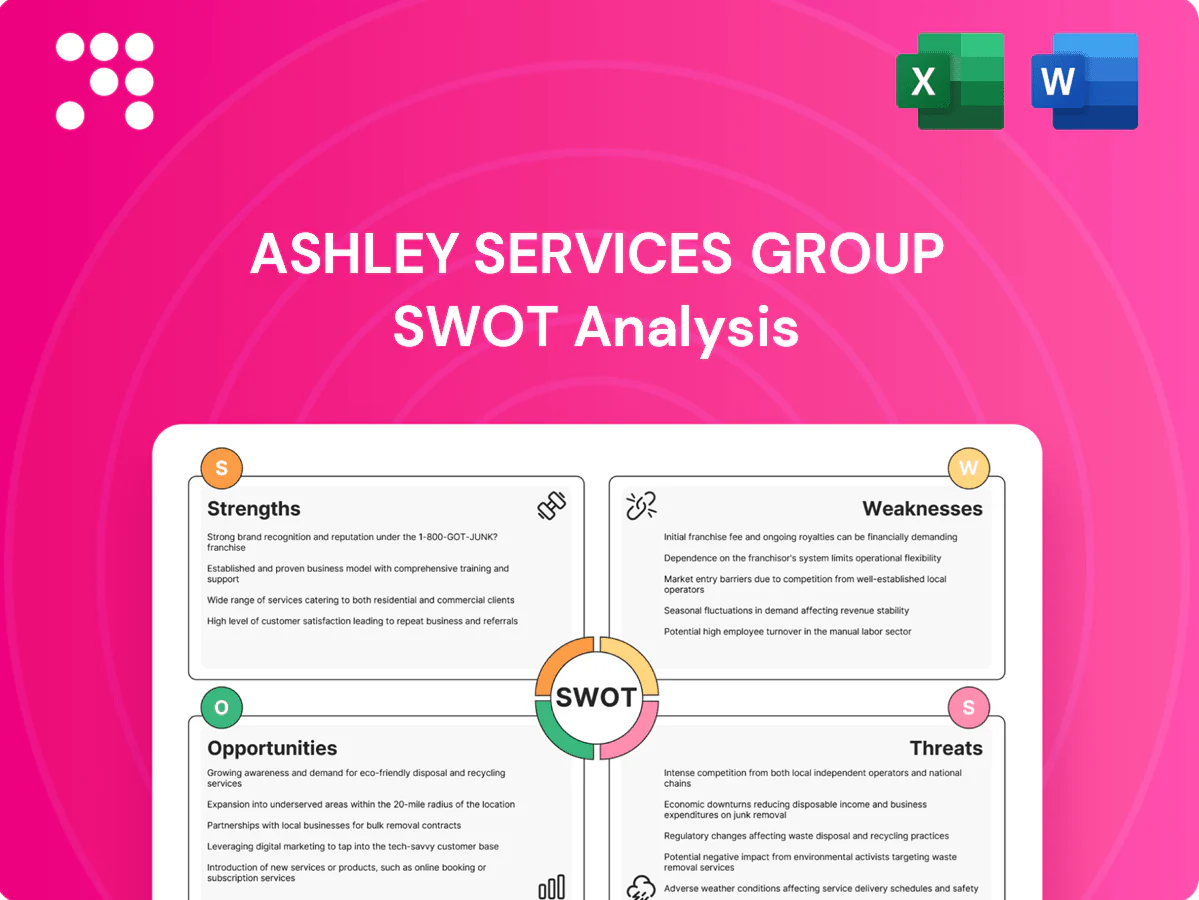
Ashley Services Group SWOT Analysis

Your Strategic Toolkit Starts Here
Ashley Services Group's SWOT preview highlights solid regional reputation and service breadth, but also exposure to labor costs and competitive pressure. Our full SWOT analysis delivers deep, research-backed insights, editable Word and Excel files, and strategic takeaways. Purchase the complete SWOT analysis to gain investor-ready, actionable intelligence.
Strengths

Diversified service portfolio
Diversified service portfolio across staffing, training and cleaning creates multiple revenue streams that reduce dependence on any single cycle and enable bundled, cross-functional solutions for clients, improving resilience through sector rotations and unlocking cross-sell opportunities that increase lifetime value per client.
Blue- and white-collar coverage
Coverage across industrial, trades and professional roles expands Ashley Services Group’s addressable market by servicing whole-of-workforce needs for enterprise clients across Australia and New Zealand. This breadth strengthens competitiveness for MSP and RPO mandates, where integrated supply can win larger, multi-year contracts. By spanning segments it mitigates cycle risk in any one area; temporary staffing represented roughly 3% of the Australian workforce (~400,000 workers) in 2024.

National footprint and local reach
Presence across all six Australian states and two territories boosts candidate sourcing and client responsiveness by offering local recruitment channels and faster mobilisations. Local knowledge ensures compliance with state-level labour-hire regimes and site-specific requirements. Proximity shortens time-to-fill and supports higher retention in infrastructure, resources, logistics and services corridors.

Integrated training (VET) capability
Owning VET pathways builds a direct talent pipeline for scarce skills, boosting upskilling, safety and compliance outcomes clients demand and improving candidate quality and redeployment rates versus pure-play recruiters. Embedded training reduces onboarding time and credential gaps, strengthening contractor retention and brand differentiation in competitive labour markets.
- Talent pipeline
- Upskilling & compliance
- Higher candidate quality
- Improved redeployment
Reputation in labour hire and cleaning
Ashley Services Group (ASX: ASH), operating across Australia and New Zealand, has a proven track record in high-volume labour solutions that underpins client credibility; its cleaning arm delivers steady contract-based cash flows and cross-site visibility, while rostering and safety expertise forms an operational moat that supports winning long-term facilities and site-based engagements.
- ASX: ASH
- Operations: Australia & New Zealand
- Strength: High-volume labour credibility
- Strength: Recurring cleaning contracts
- Strength: Rostering & safety moat
- Outcome: Favours long-term facilities/site wins
Multi-service staffing and VET pathways tap ~400,000 temporary workers across Australia
Diversified services (staffing, training, cleaning) create multiple revenue streams and cross-sell opportunities. Coverage across industrial, trades and professional roles and presence in all six states + two territories expands addressable market; temporary staffing ~3% of Australian workforce (~400,000 workers in 2024). Owning VET pathways provides direct talent pipelines and faster onboarding.
| Metric | Value |
|---|---|
| Addressable temp workforce (2024) | ~400,000 |
| Geographic coverage | 6 states + 2 territories |
| ASX ticker | ASH |
What is included in the product
 Detailed Word Document
Provides a concise SWOT analysis of Ashley Services Group, outlining internal strengths and weaknesses alongside external opportunities and threats to assess its competitive position and strategic growth prospects.

 Customizable Excel Spreadsheet
Delivers a concise SWOT matrix for rapid identification and mitigation of Ashley Services Group’s operational and market pain points, enabling focused action plans; editable format allows quick updates to reflect shifting client needs and priorities.
Weaknesses

Margin sensitivity
Staffing and cleaning operate on thin margins—commercial cleaning EBITDA typically 5–8%—so small price shifts or wage inflation materially compress returns. Australia's July 2024 minimum wage rise of 5.75% exemplifies how labor cost shocks hit EBITDA. Overtime, penalty rates and oncost miscalculations amplify risk, and scaling volume without automation often erodes profitability.
Exposure to economic cycles
Exposure to economic cycles hits Ashley Services as hiring volumes fall in downturns, pressuring both temporary and permanent revenues. Project delays in construction reduce blue-collar demand, while client hiring freezes cut white-collar placements. Cleaning contract renewals may hold but often rebase pricing downward. UK unemployment remained about 4.2% in 2024 (ONS), tightening demand for placements.

Compliance and safety burden
Labour-hire licensing and varying Fair Work obligations across multiple states increase legal complexity and compliance costs for Ashley Services Group, with Fair Work Ombudsman activity recovering over AU$100m in 2023–24. ASQA standards boost training compliance costs and audit risk, while safety incidents can draw fines and reputational harm; maintaining systems and documentation strains operational resources and margins.

Talent sourcing constraints
Tight labour markets are creating candidate shortages in trades and care, with the UK care sector reporting about 165,000 vacancies in 2023 (Skills for Care), while apprenticeship throughput and restrictive visa settings limit supply of qualified workers. Competition from gig platforms and direct-to-employer hiring further reduces talent access and depresses fill rates, squeezing client satisfaction and revenue.
- Care vacancies: ~165,000 (Skills for Care 2023)
- Visa/apprenticeship constraints limit supply
- Rising gig/direct hiring intensifies competition
- Lower fill-rates pressure client satisfaction and revenue
Client concentration risk
Ashley Services Group exhibits client concentration risk: revenue depends heavily on a small number of large contracts, creating volatility if spend patterns shift. Loss or rebasing of a top account can materially reduce margins and reported earnings. Regular contract tender cycles create cliff risk and grant major clients disproportionate negotiating leverage on rates and terms.
- Concentration-driven revenue volatility
- Top-account earnings sensitivity
- Tender-cycle cliff risk
- Client bargaining power on pricing
Thin cleaning margins, AU wage shock and compliance recoveries squeeze profits
Thin cleaning margins (EBITDA 5–8%) and Australia’s July 2024 minimum wage rise of 5.75% make wage shocks acutely profit-dilutive; overtime/penalty miscalculations and low automation further compress returns. Demand swings in downturns and project delays reduce placements, while compliance complexity (Fair Work recoveries >AU$100m in 2023–24) and UK care vacancies (~165,000 in 2023) tighten supply and raise costs.
| Issue | Metric |
|---|---|
| Cleaning EBITDA | 5–8% |
| AU min wage rise (Jul 2024) | 5.75% |
| Fair Work recoveries (2023–24) | >AU$100m |
| UK care vacancies | ~165,000 (2023) |
Preview Before You Purchase
Ashley Services Group SWOT Analysis
This is the actual SWOT analysis document you’ll receive upon purchase—no surprises, just professional quality. The preview below is taken directly from the full SWOT report you'll get. Once purchased, the complete, editable version will be available for immediate download.

Your Strategic Toolkit Starts Here
Ashley Services Group's SWOT preview highlights solid regional reputation and service breadth, but also exposure to labor costs and competitive pressure. Our full SWOT analysis delivers deep, research-backed insights, editable Word and Excel files, and strategic takeaways. Purchase the complete SWOT analysis to gain investor-ready, actionable intelligence.
Strengths
Diversified service portfolio
Diversified service portfolio across staffing, training and cleaning creates multiple revenue streams that reduce dependence on any single cycle and enable bundled, cross-functional solutions for clients, improving resilience through sector rotations and unlocking cross-sell opportunities that increase lifetime value per client.
Blue- and white-collar coverage
Coverage across industrial, trades and professional roles expands Ashley Services Group’s addressable market by servicing whole-of-workforce needs for enterprise clients across Australia and New Zealand. This breadth strengthens competitiveness for MSP and RPO mandates, where integrated supply can win larger, multi-year contracts. By spanning segments it mitigates cycle risk in any one area; temporary staffing represented roughly 3% of the Australian workforce (~400,000 workers) in 2024.
National footprint and local reach
Presence across all six Australian states and two territories boosts candidate sourcing and client responsiveness by offering local recruitment channels and faster mobilisations. Local knowledge ensures compliance with state-level labour-hire regimes and site-specific requirements. Proximity shortens time-to-fill and supports higher retention in infrastructure, resources, logistics and services corridors.
Integrated training (VET) capability
Owning VET pathways builds a direct talent pipeline for scarce skills, boosting upskilling, safety and compliance outcomes clients demand and improving candidate quality and redeployment rates versus pure-play recruiters. Embedded training reduces onboarding time and credential gaps, strengthening contractor retention and brand differentiation in competitive labour markets.
- Talent pipeline
- Upskilling & compliance
- Higher candidate quality
- Improved redeployment
Reputation in labour hire and cleaning
Ashley Services Group (ASX: ASH), operating across Australia and New Zealand, has a proven track record in high-volume labour solutions that underpins client credibility; its cleaning arm delivers steady contract-based cash flows and cross-site visibility, while rostering and safety expertise forms an operational moat that supports winning long-term facilities and site-based engagements.
- ASX: ASH
- Operations: Australia & New Zealand
- Strength: High-volume labour credibility
- Strength: Recurring cleaning contracts
- Strength: Rostering & safety moat
- Outcome: Favours long-term facilities/site wins
Multi-service staffing and VET pathways tap ~400,000 temporary workers across Australia
Diversified services (staffing, training, cleaning) create multiple revenue streams and cross-sell opportunities. Coverage across industrial, trades and professional roles and presence in all six states + two territories expands addressable market; temporary staffing ~3% of Australian workforce (~400,000 workers in 2024). Owning VET pathways provides direct talent pipelines and faster onboarding.
| Metric | Value |
|---|---|
| Addressable temp workforce (2024) | ~400,000 |
| Geographic coverage | 6 states + 2 territories |
| ASX ticker | ASH |
What is included in the product
Detailed Word Document
Provides a concise SWOT analysis of Ashley Services Group, outlining internal strengths and weaknesses alongside external opportunities and threats to assess its competitive position and strategic growth prospects.
Customizable Excel Spreadsheet
Delivers a concise SWOT matrix for rapid identification and mitigation of Ashley Services Group’s operational and market pain points, enabling focused action plans; editable format allows quick updates to reflect shifting client needs and priorities.
Weaknesses
Margin sensitivity
Staffing and cleaning operate on thin margins—commercial cleaning EBITDA typically 5–8%—so small price shifts or wage inflation materially compress returns. Australia's July 2024 minimum wage rise of 5.75% exemplifies how labor cost shocks hit EBITDA. Overtime, penalty rates and oncost miscalculations amplify risk, and scaling volume without automation often erodes profitability.
Exposure to economic cycles
Exposure to economic cycles hits Ashley Services as hiring volumes fall in downturns, pressuring both temporary and permanent revenues. Project delays in construction reduce blue-collar demand, while client hiring freezes cut white-collar placements. Cleaning contract renewals may hold but often rebase pricing downward. UK unemployment remained about 4.2% in 2024 (ONS), tightening demand for placements.
Compliance and safety burden
Labour-hire licensing and varying Fair Work obligations across multiple states increase legal complexity and compliance costs for Ashley Services Group, with Fair Work Ombudsman activity recovering over AU$100m in 2023–24. ASQA standards boost training compliance costs and audit risk, while safety incidents can draw fines and reputational harm; maintaining systems and documentation strains operational resources and margins.
Talent sourcing constraints
Tight labour markets are creating candidate shortages in trades and care, with the UK care sector reporting about 165,000 vacancies in 2023 (Skills for Care), while apprenticeship throughput and restrictive visa settings limit supply of qualified workers. Competition from gig platforms and direct-to-employer hiring further reduces talent access and depresses fill rates, squeezing client satisfaction and revenue.
- Care vacancies: ~165,000 (Skills for Care 2023)
- Visa/apprenticeship constraints limit supply
- Rising gig/direct hiring intensifies competition
- Lower fill-rates pressure client satisfaction and revenue
Client concentration risk
Ashley Services Group exhibits client concentration risk: revenue depends heavily on a small number of large contracts, creating volatility if spend patterns shift. Loss or rebasing of a top account can materially reduce margins and reported earnings. Regular contract tender cycles create cliff risk and grant major clients disproportionate negotiating leverage on rates and terms.
- Concentration-driven revenue volatility
- Top-account earnings sensitivity
- Tender-cycle cliff risk
- Client bargaining power on pricing
Thin cleaning margins, AU wage shock and compliance recoveries squeeze profits
Thin cleaning margins (EBITDA 5–8%) and Australia’s July 2024 minimum wage rise of 5.75% make wage shocks acutely profit-dilutive; overtime/penalty miscalculations and low automation further compress returns. Demand swings in downturns and project delays reduce placements, while compliance complexity (Fair Work recoveries >AU$100m in 2023–24) and UK care vacancies (~165,000 in 2023) tighten supply and raise costs.
| Issue | Metric |
|---|---|
| Cleaning EBITDA | 5–8% |
| AU min wage rise (Jul 2024) | 5.75% |
| Fair Work recoveries (2023–24) | >AU$100m |
| UK care vacancies | ~165,000 (2023) |
Preview Before You Purchase
Ashley Services Group SWOT Analysis
This is the actual SWOT analysis document you’ll receive upon purchase—no surprises, just professional quality. The preview below is taken directly from the full SWOT report you'll get. Once purchased, the complete, editable version will be available for immediate download.
Description
Your Strategic Toolkit Starts Here
Ashley Services Group's SWOT preview highlights solid regional reputation and service breadth, but also exposure to labor costs and competitive pressure. Our full SWOT analysis delivers deep, research-backed insights, editable Word and Excel files, and strategic takeaways. Purchase the complete SWOT analysis to gain investor-ready, actionable intelligence.
Strengths
Diversified service portfolio
Diversified service portfolio across staffing, training and cleaning creates multiple revenue streams that reduce dependence on any single cycle and enable bundled, cross-functional solutions for clients, improving resilience through sector rotations and unlocking cross-sell opportunities that increase lifetime value per client.
Blue- and white-collar coverage
Coverage across industrial, trades and professional roles expands Ashley Services Group’s addressable market by servicing whole-of-workforce needs for enterprise clients across Australia and New Zealand. This breadth strengthens competitiveness for MSP and RPO mandates, where integrated supply can win larger, multi-year contracts. By spanning segments it mitigates cycle risk in any one area; temporary staffing represented roughly 3% of the Australian workforce (~400,000 workers) in 2024.
National footprint and local reach
Presence across all six Australian states and two territories boosts candidate sourcing and client responsiveness by offering local recruitment channels and faster mobilisations. Local knowledge ensures compliance with state-level labour-hire regimes and site-specific requirements. Proximity shortens time-to-fill and supports higher retention in infrastructure, resources, logistics and services corridors.
Integrated training (VET) capability
Owning VET pathways builds a direct talent pipeline for scarce skills, boosting upskilling, safety and compliance outcomes clients demand and improving candidate quality and redeployment rates versus pure-play recruiters. Embedded training reduces onboarding time and credential gaps, strengthening contractor retention and brand differentiation in competitive labour markets.
- Talent pipeline
- Upskilling & compliance
- Higher candidate quality
- Improved redeployment
Reputation in labour hire and cleaning
Ashley Services Group (ASX: ASH), operating across Australia and New Zealand, has a proven track record in high-volume labour solutions that underpins client credibility; its cleaning arm delivers steady contract-based cash flows and cross-site visibility, while rostering and safety expertise forms an operational moat that supports winning long-term facilities and site-based engagements.
- ASX: ASH
- Operations: Australia & New Zealand
- Strength: High-volume labour credibility
- Strength: Recurring cleaning contracts
- Strength: Rostering & safety moat
- Outcome: Favours long-term facilities/site wins
Multi-service staffing and VET pathways tap ~400,000 temporary workers across Australia
Diversified services (staffing, training, cleaning) create multiple revenue streams and cross-sell opportunities. Coverage across industrial, trades and professional roles and presence in all six states + two territories expands addressable market; temporary staffing ~3% of Australian workforce (~400,000 workers in 2024). Owning VET pathways provides direct talent pipelines and faster onboarding.
| Metric | Value |
|---|---|
| Addressable temp workforce (2024) | ~400,000 |
| Geographic coverage | 6 states + 2 territories |
| ASX ticker | ASH |
What is included in the product
Detailed Word Document
Provides a concise SWOT analysis of Ashley Services Group, outlining internal strengths and weaknesses alongside external opportunities and threats to assess its competitive position and strategic growth prospects.
Customizable Excel Spreadsheet
Delivers a concise SWOT matrix for rapid identification and mitigation of Ashley Services Group’s operational and market pain points, enabling focused action plans; editable format allows quick updates to reflect shifting client needs and priorities.
Weaknesses
Margin sensitivity
Staffing and cleaning operate on thin margins—commercial cleaning EBITDA typically 5–8%—so small price shifts or wage inflation materially compress returns. Australia's July 2024 minimum wage rise of 5.75% exemplifies how labor cost shocks hit EBITDA. Overtime, penalty rates and oncost miscalculations amplify risk, and scaling volume without automation often erodes profitability.
Exposure to economic cycles
Exposure to economic cycles hits Ashley Services as hiring volumes fall in downturns, pressuring both temporary and permanent revenues. Project delays in construction reduce blue-collar demand, while client hiring freezes cut white-collar placements. Cleaning contract renewals may hold but often rebase pricing downward. UK unemployment remained about 4.2% in 2024 (ONS), tightening demand for placements.
Compliance and safety burden
Labour-hire licensing and varying Fair Work obligations across multiple states increase legal complexity and compliance costs for Ashley Services Group, with Fair Work Ombudsman activity recovering over AU$100m in 2023–24. ASQA standards boost training compliance costs and audit risk, while safety incidents can draw fines and reputational harm; maintaining systems and documentation strains operational resources and margins.
Talent sourcing constraints
Tight labour markets are creating candidate shortages in trades and care, with the UK care sector reporting about 165,000 vacancies in 2023 (Skills for Care), while apprenticeship throughput and restrictive visa settings limit supply of qualified workers. Competition from gig platforms and direct-to-employer hiring further reduces talent access and depresses fill rates, squeezing client satisfaction and revenue.
- Care vacancies: ~165,000 (Skills for Care 2023)
- Visa/apprenticeship constraints limit supply
- Rising gig/direct hiring intensifies competition
- Lower fill-rates pressure client satisfaction and revenue
Client concentration risk
Ashley Services Group exhibits client concentration risk: revenue depends heavily on a small number of large contracts, creating volatility if spend patterns shift. Loss or rebasing of a top account can materially reduce margins and reported earnings. Regular contract tender cycles create cliff risk and grant major clients disproportionate negotiating leverage on rates and terms.
- Concentration-driven revenue volatility
- Top-account earnings sensitivity
- Tender-cycle cliff risk
- Client bargaining power on pricing
Thin cleaning margins, AU wage shock and compliance recoveries squeeze profits
Thin cleaning margins (EBITDA 5–8%) and Australia’s July 2024 minimum wage rise of 5.75% make wage shocks acutely profit-dilutive; overtime/penalty miscalculations and low automation further compress returns. Demand swings in downturns and project delays reduce placements, while compliance complexity (Fair Work recoveries >AU$100m in 2023–24) and UK care vacancies (~165,000 in 2023) tighten supply and raise costs.
| Issue | Metric |
|---|---|
| Cleaning EBITDA | 5–8% |
| AU min wage rise (Jul 2024) | 5.75% |
| Fair Work recoveries (2023–24) | >AU$100m |
| UK care vacancies | ~165,000 (2023) |
Preview Before You Purchase
Ashley Services Group SWOT Analysis
This is the actual SWOT analysis document you’ll receive upon purchase—no surprises, just professional quality. The preview below is taken directly from the full SWOT report you'll get. Once purchased, the complete, editable version will be available for immediate download.











