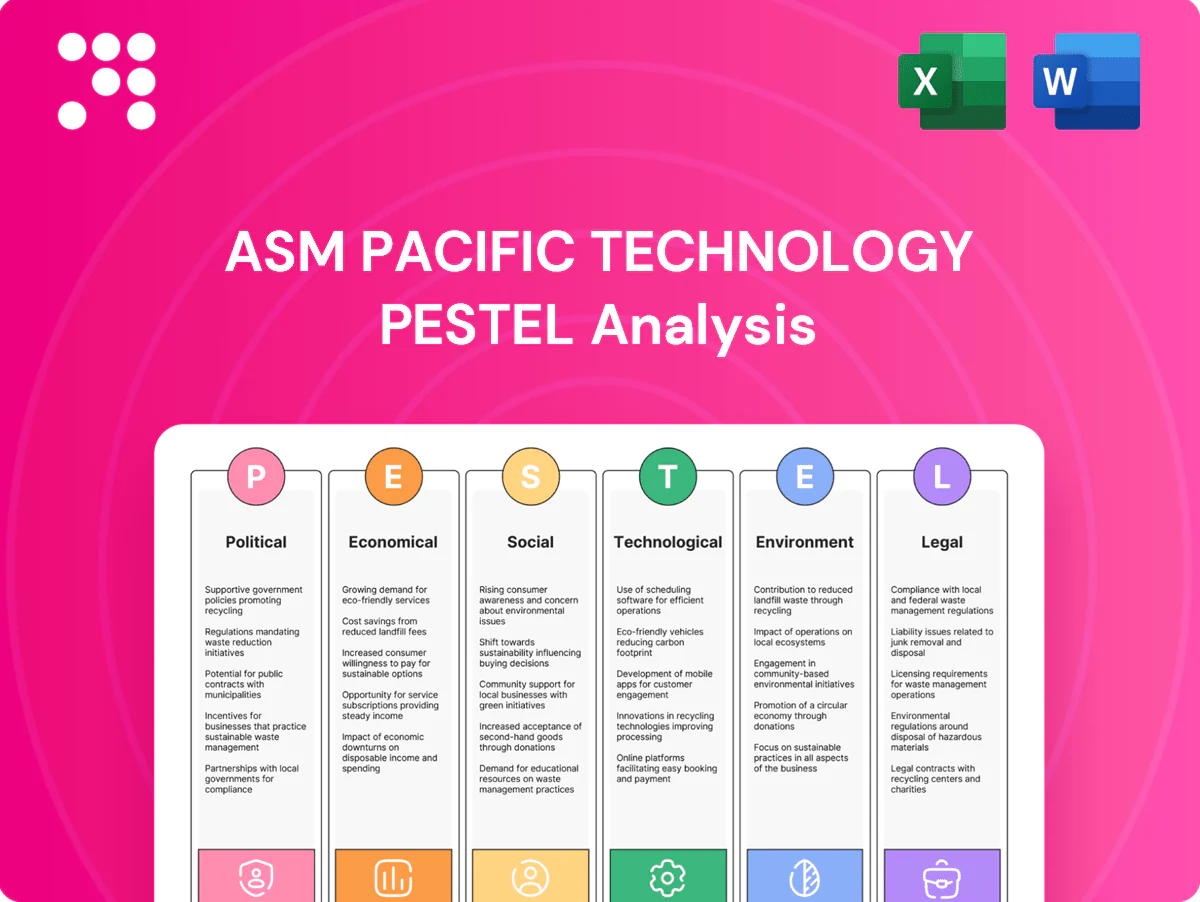
ASM Pacific Technology PESTLE Analysis

Your Competitive Advantage Starts with This Report
Discover how political shifts, economic cycles, social trends, and rapid technological advances are shaping ASM Pacific Technology’s strategic outlook in our concise PESTLE snapshot. This executive-ready analysis highlights regulatory risks, supply-chain pressures, and sustainability drivers to inform investment and planning decisions. Buy the full PESTLE for the complete, editable briefing and actionable intelligence you can use today.
Political factors

US–China tech controls
US controls on advanced semiconductors and advanced packaging tools tightened notably in October 2022 and expanded in October 2023; the CHIPS and Science Act directs about 52 billion USD for domestic semiconductor incentives, raising geopolitical trade risk. ASM Pacific Technology must design compliant tool variants, tighten end‑market screening, adopt agile order/inventory management, and pursue partnerships outside restricted geographies to offset displaced China demand.
Subsidy race (CHIPS/EU/Asia)
Global subsidy races such as the US CHIPS Act ($52 billion) and the EU Chips Act (mobilizing about €43 billion) shift customers’ capex location and timing, pulling forward demand for tools. ASMPT can gain by aligning sales and service footprints with subsidized fab and OSAT projects and meeting bid local-content and training requirements. Navigating multi-country grant rules raises administrative complexity but accelerates equipment procurement.

Trade tariffs and localization
Tariff regimes such as US Section 301 duties (up to 25% since 2018) and tightened export controls on advanced semiconductor gear materially affect ASMPT pricing, margins and sourcing choices. Customer demand for localized supply chains has risen, pushing ASMPT to diversify manufacturing and service hubs to cut political risk. Dual-sourcing and nearshoring stabilize deliveries but raise overhead and inventory costs, while contracts increasingly include tariff pass-through clauses.

Regional stability and cross-strait risk
Regional instability and cross-strait risk can disrupt Asian manufacturing corridors, delaying ASMPT installation schedules and spare-part logistics; insurance, inventory buffers and multi-node service networks are essential to maintain uptime. Scenario planning with customers helps prioritize critical programs and adjust service tiers, while political tensions can alter customer qualification pathways and sourcing decisions.
- Supply continuity: insurance and inventory buffers
- Resilience: multi-node service networks
- Customer coordination: scenario planning for critical programs
- Compliance risk: political influence on qualification paths
Government standards and industrial policy
National priorities in automotive, telecom and defense direct demand toward advanced packaging and SMT; ASMPT’s product mix targets these sectors as packaging market growth is estimated at ~6–7% CAGR (2024–2030) and telecom 5G infrastructure spend exceeded US$70bn in 2024.
Compliance with government-origin standards is often tender-required; ASMPT’s participation in industry consortia helps anticipate policy shifts and align roadmap, enhancing credibility in strategic sectors.
- Sector focus: automotive, telecom, defense
- Market trend: ~6–7% CAGR (2024–2030)
- Standards: prerequisite for tenders
- Strategy: consortia participation
Subsidies and export controls reshape chip supply chains: $52bn US, €43bn EU, $70bn+ 5G
Political risks: US export controls (expanded 2023) and CHIPS Act $52bn shift capex; EU Chips ~€43bn; ASMPT must localize, dual‑source, and screen customers. Subsidy-driven demand (packaging CAGR 6–7% 2024–2030; 5G spend >$70bn in 2024) creates opportunities but raises compliance and admin costs.
| Metric | Value |
|---|---|
| US CHIPS | $52bn |
| EU Chips | €43bn |
| 5G spend 2024 | $70bn+ |
What is included in the product
 Detailed Word Document
Explores how macro-environmental factors uniquely affect ASM Pacific Technology across Political, Economic, Social, Technological, Environmental and Legal dimensions, with data-driven trends and region-specific regulatory context; designed for executives and investors to identify threats, opportunities and forward-looking scenarios, formatted for direct insertion into reports, decks or plans.

 Customizable Excel Spreadsheet
A concise, visually segmented PESTLE summary of ASM Pacific Technology that’s easily dropped into presentations, editable for regional or business-line notes, and shareable across teams to streamline external risk discussions and strategic planning.
Economic factors

Cyclical capex swings
Semiconductor equipment demand is highly cyclical—memory and logic pricing/utilization drive capex swings—ASMPT reported a FY2024 backlog near HKD 3.5bn and must balance that visibility with flexible cost structures and adjustable production rates. Services, spares and software subscriptions (growing to roughly 20% of group revenue in 2024) help stabilize revenue between peaks, while diversification across consumer, automotive and foundry end-markets smooths volatility.
AI, automotive, and 5G mix
AI accelerators and automotive electronics are driving ASM Pacific Technology toward higher-value advanced packaging and high-reliability SMT tools, as content per device rises with complex ICs and system-in-package demand.
Over 1 billion 5G devices shipped in 2024, supporting higher ASPs for packaging equipment; longer qualification cycles in automotive and AI extend revenue durability.
Targeted AI/automotive 5G applications can outgrow the broader semiconductor cycle, offering ASMPT pockets of sustained growth.

FX and interest rate impacts
Multi-currency exposure (USD, CNY, EUR, HKD) materially affects ASMPT reported revenue and input costs; USD-HKD peg stabilises cashflows while CNY and EUR moves require active hedging and natural offsets. With US Fed funds at 5.25–5.50% and ECB deposit ~4.00% (end-2024), higher rates raise customer WACC, delaying capex and boosting leasing demand. Vendor financing thus can be a competitive differentiator to preserve margins and accelerate orders.

Supply chain costs and lead times
Component availability across precision mechatronics, optics and semiconductors directly affects ASMPT delivery schedules and working capital, making strategic inventory and supplier partnerships critical to reduce delays. Standardizing platforms drives scale economies, while stable lead times enable premium pricing and stronger customer retention.
- Inventory buffers minimize line stoppages
- Supplier alliances shorten lead times
- Platform standardization cuts unit costs
- Predictable delivery supports premium positioning
Aftermarket and recurring revenue
Installed base growth at ASM Pacific Technology drives higher services, upgrades and software attach, while predictive maintenance and remote support boost equipment uptime and customer stickiness. Recurring revenue from service contracts and software licenses improves margin resilience during downturns and smooths cash flow. KPIs should track utilization-linked monetization, attach rates and recurring-revenue mix to measure resilience.
- Installed-base expansion
- Predictive-maintenance uptime
- Recurring-revenue share
- Utilization-to-revenue KPIs
Subsidies and export controls reshape chip supply chains: $52bn US, €43bn EU, $70bn+ 5G
Semiconductor capex cyclicality drives ASMPT backlog management (FY2024 backlog near HKD 3.5bn) and requires flexible costs; services/spares/software (~20% of group revenue in 2024) stabilise cash flow. AI, automotive and 5G (1+bn devices shipped in 2024) increase content per IC, extending revenue durability. FX (USD,CNY,EUR,HKD) and higher rates (Fed 5.25–5.50%, ECB ~4.00% end-2024) affect customer capex timing and financing needs.
| Metric | Value (2024) |
|---|---|
| Backlog | HKD 3.5bn |
| Services share | ~20% revenue |
| 5G device shipments | 1+ billion |
| US Fed funds | 5.25–5.50% |
Full Version Awaits
ASM Pacific Technology PESTLE Analysis
The preview shown here is the exact PESTLE analysis of ASM Pacific Technology you’ll receive after purchase. The file is fully formatted, professionally structured, and ready to use. No placeholders or edits are required—what you see is what you’ll download. You’ll get immediate access to this final document upon payment.

Your Competitive Advantage Starts with This Report
Discover how political shifts, economic cycles, social trends, and rapid technological advances are shaping ASM Pacific Technology’s strategic outlook in our concise PESTLE snapshot. This executive-ready analysis highlights regulatory risks, supply-chain pressures, and sustainability drivers to inform investment and planning decisions. Buy the full PESTLE for the complete, editable briefing and actionable intelligence you can use today.
Political factors
US–China tech controls
US controls on advanced semiconductors and advanced packaging tools tightened notably in October 2022 and expanded in October 2023; the CHIPS and Science Act directs about 52 billion USD for domestic semiconductor incentives, raising geopolitical trade risk. ASM Pacific Technology must design compliant tool variants, tighten end‑market screening, adopt agile order/inventory management, and pursue partnerships outside restricted geographies to offset displaced China demand.
Subsidy race (CHIPS/EU/Asia)
Global subsidy races such as the US CHIPS Act ($52 billion) and the EU Chips Act (mobilizing about €43 billion) shift customers’ capex location and timing, pulling forward demand for tools. ASMPT can gain by aligning sales and service footprints with subsidized fab and OSAT projects and meeting bid local-content and training requirements. Navigating multi-country grant rules raises administrative complexity but accelerates equipment procurement.
Trade tariffs and localization
Tariff regimes such as US Section 301 duties (up to 25% since 2018) and tightened export controls on advanced semiconductor gear materially affect ASMPT pricing, margins and sourcing choices. Customer demand for localized supply chains has risen, pushing ASMPT to diversify manufacturing and service hubs to cut political risk. Dual-sourcing and nearshoring stabilize deliveries but raise overhead and inventory costs, while contracts increasingly include tariff pass-through clauses.
Regional stability and cross-strait risk
Regional instability and cross-strait risk can disrupt Asian manufacturing corridors, delaying ASMPT installation schedules and spare-part logistics; insurance, inventory buffers and multi-node service networks are essential to maintain uptime. Scenario planning with customers helps prioritize critical programs and adjust service tiers, while political tensions can alter customer qualification pathways and sourcing decisions.
- Supply continuity: insurance and inventory buffers
- Resilience: multi-node service networks
- Customer coordination: scenario planning for critical programs
- Compliance risk: political influence on qualification paths
Government standards and industrial policy
National priorities in automotive, telecom and defense direct demand toward advanced packaging and SMT; ASMPT’s product mix targets these sectors as packaging market growth is estimated at ~6–7% CAGR (2024–2030) and telecom 5G infrastructure spend exceeded US$70bn in 2024.
Compliance with government-origin standards is often tender-required; ASMPT’s participation in industry consortia helps anticipate policy shifts and align roadmap, enhancing credibility in strategic sectors.
- Sector focus: automotive, telecom, defense
- Market trend: ~6–7% CAGR (2024–2030)
- Standards: prerequisite for tenders
- Strategy: consortia participation
Subsidies and export controls reshape chip supply chains: $52bn US, €43bn EU, $70bn+ 5G
Political risks: US export controls (expanded 2023) and CHIPS Act $52bn shift capex; EU Chips ~€43bn; ASMPT must localize, dual‑source, and screen customers. Subsidy-driven demand (packaging CAGR 6–7% 2024–2030; 5G spend >$70bn in 2024) creates opportunities but raises compliance and admin costs.
| Metric | Value |
|---|---|
| US CHIPS | $52bn |
| EU Chips | €43bn |
| 5G spend 2024 | $70bn+ |
What is included in the product
Detailed Word Document
Explores how macro-environmental factors uniquely affect ASM Pacific Technology across Political, Economic, Social, Technological, Environmental and Legal dimensions, with data-driven trends and region-specific regulatory context; designed for executives and investors to identify threats, opportunities and forward-looking scenarios, formatted for direct insertion into reports, decks or plans.
Customizable Excel Spreadsheet
A concise, visually segmented PESTLE summary of ASM Pacific Technology that’s easily dropped into presentations, editable for regional or business-line notes, and shareable across teams to streamline external risk discussions and strategic planning.
Economic factors
Cyclical capex swings
Semiconductor equipment demand is highly cyclical—memory and logic pricing/utilization drive capex swings—ASMPT reported a FY2024 backlog near HKD 3.5bn and must balance that visibility with flexible cost structures and adjustable production rates. Services, spares and software subscriptions (growing to roughly 20% of group revenue in 2024) help stabilize revenue between peaks, while diversification across consumer, automotive and foundry end-markets smooths volatility.
AI, automotive, and 5G mix
AI accelerators and automotive electronics are driving ASM Pacific Technology toward higher-value advanced packaging and high-reliability SMT tools, as content per device rises with complex ICs and system-in-package demand.
Over 1 billion 5G devices shipped in 2024, supporting higher ASPs for packaging equipment; longer qualification cycles in automotive and AI extend revenue durability.
Targeted AI/automotive 5G applications can outgrow the broader semiconductor cycle, offering ASMPT pockets of sustained growth.
FX and interest rate impacts
Multi-currency exposure (USD, CNY, EUR, HKD) materially affects ASMPT reported revenue and input costs; USD-HKD peg stabilises cashflows while CNY and EUR moves require active hedging and natural offsets. With US Fed funds at 5.25–5.50% and ECB deposit ~4.00% (end-2024), higher rates raise customer WACC, delaying capex and boosting leasing demand. Vendor financing thus can be a competitive differentiator to preserve margins and accelerate orders.
Supply chain costs and lead times
Component availability across precision mechatronics, optics and semiconductors directly affects ASMPT delivery schedules and working capital, making strategic inventory and supplier partnerships critical to reduce delays. Standardizing platforms drives scale economies, while stable lead times enable premium pricing and stronger customer retention.
- Inventory buffers minimize line stoppages
- Supplier alliances shorten lead times
- Platform standardization cuts unit costs
- Predictable delivery supports premium positioning
Aftermarket and recurring revenue
Installed base growth at ASM Pacific Technology drives higher services, upgrades and software attach, while predictive maintenance and remote support boost equipment uptime and customer stickiness. Recurring revenue from service contracts and software licenses improves margin resilience during downturns and smooths cash flow. KPIs should track utilization-linked monetization, attach rates and recurring-revenue mix to measure resilience.
- Installed-base expansion
- Predictive-maintenance uptime
- Recurring-revenue share
- Utilization-to-revenue KPIs
Subsidies and export controls reshape chip supply chains: $52bn US, €43bn EU, $70bn+ 5G
Semiconductor capex cyclicality drives ASMPT backlog management (FY2024 backlog near HKD 3.5bn) and requires flexible costs; services/spares/software (~20% of group revenue in 2024) stabilise cash flow. AI, automotive and 5G (1+bn devices shipped in 2024) increase content per IC, extending revenue durability. FX (USD,CNY,EUR,HKD) and higher rates (Fed 5.25–5.50%, ECB ~4.00% end-2024) affect customer capex timing and financing needs.
| Metric | Value (2024) |
|---|---|
| Backlog | HKD 3.5bn |
| Services share | ~20% revenue |
| 5G device shipments | 1+ billion |
| US Fed funds | 5.25–5.50% |
Full Version Awaits
ASM Pacific Technology PESTLE Analysis
The preview shown here is the exact PESTLE analysis of ASM Pacific Technology you’ll receive after purchase. The file is fully formatted, professionally structured, and ready to use. No placeholders or edits are required—what you see is what you’ll download. You’ll get immediate access to this final document upon payment.
Original: $10.00
-65%$10.00
$3.50Description
Your Competitive Advantage Starts with This Report
Discover how political shifts, economic cycles, social trends, and rapid technological advances are shaping ASM Pacific Technology’s strategic outlook in our concise PESTLE snapshot. This executive-ready analysis highlights regulatory risks, supply-chain pressures, and sustainability drivers to inform investment and planning decisions. Buy the full PESTLE for the complete, editable briefing and actionable intelligence you can use today.
Political factors
US–China tech controls
US controls on advanced semiconductors and advanced packaging tools tightened notably in October 2022 and expanded in October 2023; the CHIPS and Science Act directs about 52 billion USD for domestic semiconductor incentives, raising geopolitical trade risk. ASM Pacific Technology must design compliant tool variants, tighten end‑market screening, adopt agile order/inventory management, and pursue partnerships outside restricted geographies to offset displaced China demand.
Subsidy race (CHIPS/EU/Asia)
Global subsidy races such as the US CHIPS Act ($52 billion) and the EU Chips Act (mobilizing about €43 billion) shift customers’ capex location and timing, pulling forward demand for tools. ASMPT can gain by aligning sales and service footprints with subsidized fab and OSAT projects and meeting bid local-content and training requirements. Navigating multi-country grant rules raises administrative complexity but accelerates equipment procurement.
Trade tariffs and localization
Tariff regimes such as US Section 301 duties (up to 25% since 2018) and tightened export controls on advanced semiconductor gear materially affect ASMPT pricing, margins and sourcing choices. Customer demand for localized supply chains has risen, pushing ASMPT to diversify manufacturing and service hubs to cut political risk. Dual-sourcing and nearshoring stabilize deliveries but raise overhead and inventory costs, while contracts increasingly include tariff pass-through clauses.
Regional stability and cross-strait risk
Regional instability and cross-strait risk can disrupt Asian manufacturing corridors, delaying ASMPT installation schedules and spare-part logistics; insurance, inventory buffers and multi-node service networks are essential to maintain uptime. Scenario planning with customers helps prioritize critical programs and adjust service tiers, while political tensions can alter customer qualification pathways and sourcing decisions.
- Supply continuity: insurance and inventory buffers
- Resilience: multi-node service networks
- Customer coordination: scenario planning for critical programs
- Compliance risk: political influence on qualification paths
Government standards and industrial policy
National priorities in automotive, telecom and defense direct demand toward advanced packaging and SMT; ASMPT’s product mix targets these sectors as packaging market growth is estimated at ~6–7% CAGR (2024–2030) and telecom 5G infrastructure spend exceeded US$70bn in 2024.
Compliance with government-origin standards is often tender-required; ASMPT’s participation in industry consortia helps anticipate policy shifts and align roadmap, enhancing credibility in strategic sectors.
- Sector focus: automotive, telecom, defense
- Market trend: ~6–7% CAGR (2024–2030)
- Standards: prerequisite for tenders
- Strategy: consortia participation
Subsidies and export controls reshape chip supply chains: $52bn US, €43bn EU, $70bn+ 5G
Political risks: US export controls (expanded 2023) and CHIPS Act $52bn shift capex; EU Chips ~€43bn; ASMPT must localize, dual‑source, and screen customers. Subsidy-driven demand (packaging CAGR 6–7% 2024–2030; 5G spend >$70bn in 2024) creates opportunities but raises compliance and admin costs.
| Metric | Value |
|---|---|
| US CHIPS | $52bn |
| EU Chips | €43bn |
| 5G spend 2024 | $70bn+ |
What is included in the product
Detailed Word Document
Explores how macro-environmental factors uniquely affect ASM Pacific Technology across Political, Economic, Social, Technological, Environmental and Legal dimensions, with data-driven trends and region-specific regulatory context; designed for executives and investors to identify threats, opportunities and forward-looking scenarios, formatted for direct insertion into reports, decks or plans.
Customizable Excel Spreadsheet
A concise, visually segmented PESTLE summary of ASM Pacific Technology that’s easily dropped into presentations, editable for regional or business-line notes, and shareable across teams to streamline external risk discussions and strategic planning.
Economic factors
Cyclical capex swings
Semiconductor equipment demand is highly cyclical—memory and logic pricing/utilization drive capex swings—ASMPT reported a FY2024 backlog near HKD 3.5bn and must balance that visibility with flexible cost structures and adjustable production rates. Services, spares and software subscriptions (growing to roughly 20% of group revenue in 2024) help stabilize revenue between peaks, while diversification across consumer, automotive and foundry end-markets smooths volatility.
AI, automotive, and 5G mix
AI accelerators and automotive electronics are driving ASM Pacific Technology toward higher-value advanced packaging and high-reliability SMT tools, as content per device rises with complex ICs and system-in-package demand.
Over 1 billion 5G devices shipped in 2024, supporting higher ASPs for packaging equipment; longer qualification cycles in automotive and AI extend revenue durability.
Targeted AI/automotive 5G applications can outgrow the broader semiconductor cycle, offering ASMPT pockets of sustained growth.
FX and interest rate impacts
Multi-currency exposure (USD, CNY, EUR, HKD) materially affects ASMPT reported revenue and input costs; USD-HKD peg stabilises cashflows while CNY and EUR moves require active hedging and natural offsets. With US Fed funds at 5.25–5.50% and ECB deposit ~4.00% (end-2024), higher rates raise customer WACC, delaying capex and boosting leasing demand. Vendor financing thus can be a competitive differentiator to preserve margins and accelerate orders.
Supply chain costs and lead times
Component availability across precision mechatronics, optics and semiconductors directly affects ASMPT delivery schedules and working capital, making strategic inventory and supplier partnerships critical to reduce delays. Standardizing platforms drives scale economies, while stable lead times enable premium pricing and stronger customer retention.
- Inventory buffers minimize line stoppages
- Supplier alliances shorten lead times
- Platform standardization cuts unit costs
- Predictable delivery supports premium positioning
Aftermarket and recurring revenue
Installed base growth at ASM Pacific Technology drives higher services, upgrades and software attach, while predictive maintenance and remote support boost equipment uptime and customer stickiness. Recurring revenue from service contracts and software licenses improves margin resilience during downturns and smooths cash flow. KPIs should track utilization-linked monetization, attach rates and recurring-revenue mix to measure resilience.
- Installed-base expansion
- Predictive-maintenance uptime
- Recurring-revenue share
- Utilization-to-revenue KPIs
Subsidies and export controls reshape chip supply chains: $52bn US, €43bn EU, $70bn+ 5G
Semiconductor capex cyclicality drives ASMPT backlog management (FY2024 backlog near HKD 3.5bn) and requires flexible costs; services/spares/software (~20% of group revenue in 2024) stabilise cash flow. AI, automotive and 5G (1+bn devices shipped in 2024) increase content per IC, extending revenue durability. FX (USD,CNY,EUR,HKD) and higher rates (Fed 5.25–5.50%, ECB ~4.00% end-2024) affect customer capex timing and financing needs.
| Metric | Value (2024) |
|---|---|
| Backlog | HKD 3.5bn |
| Services share | ~20% revenue |
| 5G device shipments | 1+ billion |
| US Fed funds | 5.25–5.50% |
Full Version Awaits
ASM Pacific Technology PESTLE Analysis
The preview shown here is the exact PESTLE analysis of ASM Pacific Technology you’ll receive after purchase. The file is fully formatted, professionally structured, and ready to use. No placeholders or edits are required—what you see is what you’ll download. You’ll get immediate access to this final document upon payment.











