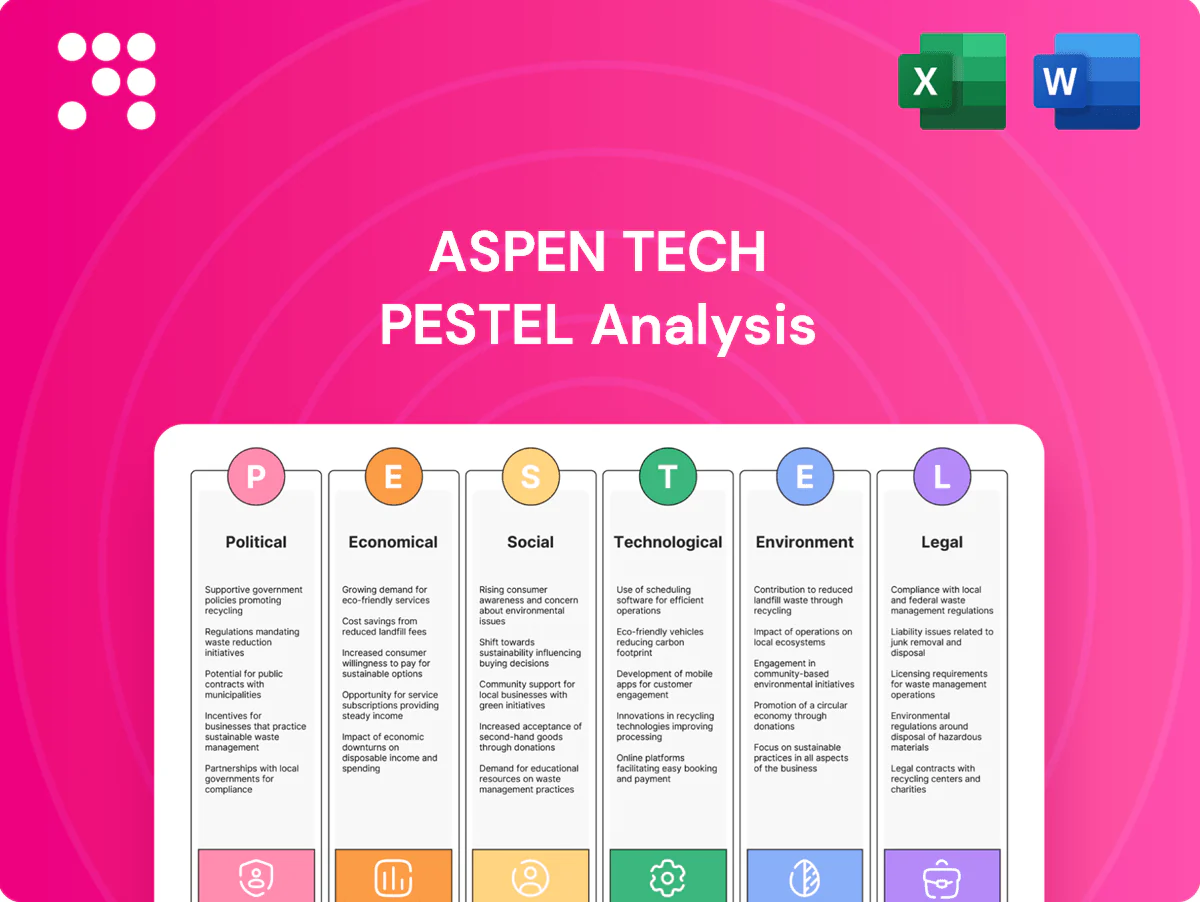
Aspen Tech PESTLE Analysis

Make Smarter Strategic Decisions with a Complete PESTEL View
Gain a competitive edge with our PESTLE analysis of Aspen Tech—concise, action-oriented insights into political, economic, social, technological, legal, and environmental drivers shaping its future. Perfect for investors and strategists; purchase the full report to access the complete, editable breakdown and actionable recommendations.
Political factors

Energy policy and subsidies
Government priorities on oil, gas and renewables direct customer capex for optimization software, with US Inflation Reduction Act’s $369 billion in clean-energy incentives shifting spend toward decarbonization tools. Subsidies and tax credits increase demand for modeling and planning platforms tied to funded projects. Policy reversals and election cycles can delay projects, elongating sales cycles by 6–18 months. AspenTech must align roadmaps with policy-driven programs to capture funded use cases.
Geopolitical volatility
Geopolitical volatility — sanctions, trade tensions, and regional conflicts — disrupt energy and chemical supply chains, prompting customers to pause investments or shift sites; AspenTech, with ~$1.1B revenue in 2024, faces export restrictions that can shrink addressable markets for advanced software; resilience demands multi-region delivery, partner networks, and compliance-ready configurations.

Government digitalization agendas
Public-sector pushes for Industry 4.0 and advanced manufacturing—backed by programmes like the EU Digital Europe €7.5B (2021–27) and the US CHIPS and Science Act $280B—are accelerating industrial software adoption; national grants and strategies have seeded pilots in process industries. Alignment with standards bodies boosts credibility in regulated sectors, and AspenTech can co-develop lighthouse projects with state-backed enterprises.

Infrastructure and industrial strategy
Investment in pipelines, LNG, refining and clean hydrogen drives demand for AspenTech APM and modeling as projects require integrated process optimization and predictive asset performance; national industrial policies shift feedstock mixes and force new optimization models. E&C project pipelines hinge on permitting speed and public approvals, increasing value for tools that compress timelines and improve IRRs.
- APM demand rises with infrastructure investments
- Policy-driven feedstock shifts require new models
- Permitting speed controls E&C pipelines and project returns
- AspenTech tools shorten schedules and boost IRRs
Data sovereignty rules
Governments increasingly mandate local data storage and control; over 60 countries now have data localization measures, forcing AspenTech to adapt cloud deployment architectures and vendor selection. Multi-tenant SaaS may face restrictions in sensitive process-data domains such as oil & gas and utilities. Hybrid and sovereign cloud options—adoption rose about 20% in 2023–24—help maintain political compliance while scaling.
- data localization: over 60 countries
- impact: multi-tenant SaaS limited in critical process industries
- response: hybrid/sovereign cloud adoption ~+20% (2023–24)
Clean-energy & industrial funding shift capex; geopolitics add 6-18m; data localization up
Government clean-energy incentives (US IRA $369B) and national industrial programs (CHIPS $280B, EU Digital Europe €7.5B) redirect capex to decarbonization and Industry 4.0 software, expanding AspenTech’s 2024 ~$1.1B market. Geopolitical risks and sanctions compress addressable markets and lengthen sales cycles by 6–18 months. Data-localization (>60 countries) and ~+20% hybrid/sovereign cloud uptake (2023–24) force deployment flexibility.
| Factor | Stat | Impact |
|---|---|---|
| Clean-energy incentives | IRA $369B | Push to decarbonization tools |
| Industrial programs | CHIPS $280B; Digital Europe €7.5B | Accelerates pilots |
| Data rules | >60 countries; +20% hybrid cloud | Require sovereign deployments |
What is included in the product
 Detailed Word Document
Explores how macro-environmental factors uniquely affect Aspen Tech across six dimensions—Political, Economic, Social, Technological, Environmental, and Legal—using current data and trends to identify risks and opportunities. Designed for executives and investors, it’s region- and industry-specific, forward-looking, and ready for inclusion in business plans or pitch decks.

 Customizable Excel Spreadsheet
A concise, visually segmented PESTLE summary for AspenTech that can be dropped into presentations, edited with region-specific notes, and easily shared across teams to streamline external risk discussions and strategic planning.
Economic factors

Commodity price cycles
Volatility in oil, gas and chemicals — Brent averaged about $85/bbl in 2024, swinging roughly $60–$95 — forces producers to reallocate budgets toward optimization tools that protect margins.
High price periods prioritize throughput and reliability projects; low-price phases shift focus to cost-cutting and efficiency, moving procurement from operations to finance-led buying centers.
AspenTech’s optimization software remains relevant across cycles; outcome-tied pricing (uptime or $/ton improvements) can smooth demand and shorten sales cycles.
Global capex and opex trends
Large capital projects tied to energy transition and petrochemicals drive AspenTech seat and services demand; IEA reported clean-energy investment reached about $1.8 trillion in 2023 and is forecast to top $2 trillion by 2025, sustaining project-driven software spend.
Opex-focused APM and scheduling tools show steadier budgets in downturns, often contracting far less than discretionary IT; macro slowdowns lengthen approval cycles and cut pilots, so targeting fast-payback use cases clears internal hurdle rates and accelerates adoption.

FX and emerging market exposure
Revenues from multi-currency geographies expose AspenTech to translation and transaction risk, especially as a stronger US dollar can compress reported international revenue; emerging markets, which grew an estimated 4.1% in 2024 (IMF), drive top-line expansion but raise credit and collection risk in higher-volatility jurisdictions. Local pricing power hinges on competitive intensity and procurement norms across regions; disciplined hedging, regional pricing adjustments, and channel strategy help mitigate earnings volatility and protect margins.

Cloud cost and IT budget dynamics
Rising cloud and cybersecurity costs are forcing CIOs to reallocate budgets toward OPEX: 68% of enterprises cite cloud cost optimization as a top priority (Flexera 2024) while global security spend was forecast at about $188B in 2024 (Gartner), driving preference for scalable subscriptions over heavy upfront licenses and making clear TCO/ROI cases essential to displace incumbents or spreadsheets.
- Flexible licensing eases budget constraints
- Modular adoption lowers initial capex
- Clear TCO/ROI required to win deals
Consolidation in process industries
Consolidation in process industries—2023–2024 energy and chemical M&A totaled roughly $180bn—drives standardization of toolsets across larger estates, raising stakes for vendor incumbency. Post-merger integration costs (often 5–10% of deal value) boost demand for unified planning and execution solutions; AspenTech can win by proving interoperability, migration ROI and enterprise-scale rollout value.
- Standardization: larger estates demand uniform toolsets
- Vendor risk: rationalization threatens incumbents
- Integration costs: 5–10% of deal value
- Opportunity: prove interoperability and migration ROI
Clean-energy & industrial funding shift capex; geopolitics add 6-18m; data localization up
Energy price swings (Brent ~$85/bbl in 2024) shift capex/opex mix, keeping AspenTech demand resilient; clean-energy capex (IEA $1.8T in 2023; ~$2T est 2025) fuels project software. Cloud/security cost pressure (68% cloud optimization priority; security ~$188B in 2024) favors subscription/OPEX models. FX and emerging-market growth (IMF 4.1% in 2024) raise translation and credit risk.
| Metric | Value |
|---|---|
| Brent 2024 | $85/bbl avg |
| Clean-energy spend | $1.8T (2023) → ~$2T (2025 est) |
| Cloud priority | 68% (Flexera 2024) |
| Security spend 2024 | $188B (Gartner) |
Same Document Delivered
Aspen Tech PESTLE Analysis
The preview shown here is the exact document you’ll receive after purchase—fully formatted and ready to use. This AspenTech PESTLE Analysis delivers concise political, economic, social, technological, legal, and environmental insights tailored for strategic decision-making. The layout, content, and structure visible here are exactly what you’ll be able to download immediately after buying.

Make Smarter Strategic Decisions with a Complete PESTEL View
Gain a competitive edge with our PESTLE analysis of Aspen Tech—concise, action-oriented insights into political, economic, social, technological, legal, and environmental drivers shaping its future. Perfect for investors and strategists; purchase the full report to access the complete, editable breakdown and actionable recommendations.
Political factors
Energy policy and subsidies
Government priorities on oil, gas and renewables direct customer capex for optimization software, with US Inflation Reduction Act’s $369 billion in clean-energy incentives shifting spend toward decarbonization tools. Subsidies and tax credits increase demand for modeling and planning platforms tied to funded projects. Policy reversals and election cycles can delay projects, elongating sales cycles by 6–18 months. AspenTech must align roadmaps with policy-driven programs to capture funded use cases.
Geopolitical volatility
Geopolitical volatility — sanctions, trade tensions, and regional conflicts — disrupt energy and chemical supply chains, prompting customers to pause investments or shift sites; AspenTech, with ~$1.1B revenue in 2024, faces export restrictions that can shrink addressable markets for advanced software; resilience demands multi-region delivery, partner networks, and compliance-ready configurations.
Government digitalization agendas
Public-sector pushes for Industry 4.0 and advanced manufacturing—backed by programmes like the EU Digital Europe €7.5B (2021–27) and the US CHIPS and Science Act $280B—are accelerating industrial software adoption; national grants and strategies have seeded pilots in process industries. Alignment with standards bodies boosts credibility in regulated sectors, and AspenTech can co-develop lighthouse projects with state-backed enterprises.
Infrastructure and industrial strategy
Investment in pipelines, LNG, refining and clean hydrogen drives demand for AspenTech APM and modeling as projects require integrated process optimization and predictive asset performance; national industrial policies shift feedstock mixes and force new optimization models. E&C project pipelines hinge on permitting speed and public approvals, increasing value for tools that compress timelines and improve IRRs.
- APM demand rises with infrastructure investments
- Policy-driven feedstock shifts require new models
- Permitting speed controls E&C pipelines and project returns
- AspenTech tools shorten schedules and boost IRRs
Data sovereignty rules
Governments increasingly mandate local data storage and control; over 60 countries now have data localization measures, forcing AspenTech to adapt cloud deployment architectures and vendor selection. Multi-tenant SaaS may face restrictions in sensitive process-data domains such as oil & gas and utilities. Hybrid and sovereign cloud options—adoption rose about 20% in 2023–24—help maintain political compliance while scaling.
- data localization: over 60 countries
- impact: multi-tenant SaaS limited in critical process industries
- response: hybrid/sovereign cloud adoption ~+20% (2023–24)
Clean-energy & industrial funding shift capex; geopolitics add 6-18m; data localization up
Government clean-energy incentives (US IRA $369B) and national industrial programs (CHIPS $280B, EU Digital Europe €7.5B) redirect capex to decarbonization and Industry 4.0 software, expanding AspenTech’s 2024 ~$1.1B market. Geopolitical risks and sanctions compress addressable markets and lengthen sales cycles by 6–18 months. Data-localization (>60 countries) and ~+20% hybrid/sovereign cloud uptake (2023–24) force deployment flexibility.
| Factor | Stat | Impact |
|---|---|---|
| Clean-energy incentives | IRA $369B | Push to decarbonization tools |
| Industrial programs | CHIPS $280B; Digital Europe €7.5B | Accelerates pilots |
| Data rules | >60 countries; +20% hybrid cloud | Require sovereign deployments |
What is included in the product
Detailed Word Document
Explores how macro-environmental factors uniquely affect Aspen Tech across six dimensions—Political, Economic, Social, Technological, Environmental, and Legal—using current data and trends to identify risks and opportunities. Designed for executives and investors, it’s region- and industry-specific, forward-looking, and ready for inclusion in business plans or pitch decks.
Customizable Excel Spreadsheet
A concise, visually segmented PESTLE summary for AspenTech that can be dropped into presentations, edited with region-specific notes, and easily shared across teams to streamline external risk discussions and strategic planning.
Economic factors
Commodity price cycles
Volatility in oil, gas and chemicals — Brent averaged about $85/bbl in 2024, swinging roughly $60–$95 — forces producers to reallocate budgets toward optimization tools that protect margins.
High price periods prioritize throughput and reliability projects; low-price phases shift focus to cost-cutting and efficiency, moving procurement from operations to finance-led buying centers.
AspenTech’s optimization software remains relevant across cycles; outcome-tied pricing (uptime or $/ton improvements) can smooth demand and shorten sales cycles.
Global capex and opex trends
Large capital projects tied to energy transition and petrochemicals drive AspenTech seat and services demand; IEA reported clean-energy investment reached about $1.8 trillion in 2023 and is forecast to top $2 trillion by 2025, sustaining project-driven software spend.
Opex-focused APM and scheduling tools show steadier budgets in downturns, often contracting far less than discretionary IT; macro slowdowns lengthen approval cycles and cut pilots, so targeting fast-payback use cases clears internal hurdle rates and accelerates adoption.
FX and emerging market exposure
Revenues from multi-currency geographies expose AspenTech to translation and transaction risk, especially as a stronger US dollar can compress reported international revenue; emerging markets, which grew an estimated 4.1% in 2024 (IMF), drive top-line expansion but raise credit and collection risk in higher-volatility jurisdictions. Local pricing power hinges on competitive intensity and procurement norms across regions; disciplined hedging, regional pricing adjustments, and channel strategy help mitigate earnings volatility and protect margins.
Cloud cost and IT budget dynamics
Rising cloud and cybersecurity costs are forcing CIOs to reallocate budgets toward OPEX: 68% of enterprises cite cloud cost optimization as a top priority (Flexera 2024) while global security spend was forecast at about $188B in 2024 (Gartner), driving preference for scalable subscriptions over heavy upfront licenses and making clear TCO/ROI cases essential to displace incumbents or spreadsheets.
- Flexible licensing eases budget constraints
- Modular adoption lowers initial capex
- Clear TCO/ROI required to win deals
Consolidation in process industries
Consolidation in process industries—2023–2024 energy and chemical M&A totaled roughly $180bn—drives standardization of toolsets across larger estates, raising stakes for vendor incumbency. Post-merger integration costs (often 5–10% of deal value) boost demand for unified planning and execution solutions; AspenTech can win by proving interoperability, migration ROI and enterprise-scale rollout value.
- Standardization: larger estates demand uniform toolsets
- Vendor risk: rationalization threatens incumbents
- Integration costs: 5–10% of deal value
- Opportunity: prove interoperability and migration ROI
Clean-energy & industrial funding shift capex; geopolitics add 6-18m; data localization up
Energy price swings (Brent ~$85/bbl in 2024) shift capex/opex mix, keeping AspenTech demand resilient; clean-energy capex (IEA $1.8T in 2023; ~$2T est 2025) fuels project software. Cloud/security cost pressure (68% cloud optimization priority; security ~$188B in 2024) favors subscription/OPEX models. FX and emerging-market growth (IMF 4.1% in 2024) raise translation and credit risk.
| Metric | Value |
|---|---|
| Brent 2024 | $85/bbl avg |
| Clean-energy spend | $1.8T (2023) → ~$2T (2025 est) |
| Cloud priority | 68% (Flexera 2024) |
| Security spend 2024 | $188B (Gartner) |
Same Document Delivered
Aspen Tech PESTLE Analysis
The preview shown here is the exact document you’ll receive after purchase—fully formatted and ready to use. This AspenTech PESTLE Analysis delivers concise political, economic, social, technological, legal, and environmental insights tailored for strategic decision-making. The layout, content, and structure visible here are exactly what you’ll be able to download immediately after buying.
Original: $10.00
-65%$10.00
$3.50Description
Make Smarter Strategic Decisions with a Complete PESTEL View
Gain a competitive edge with our PESTLE analysis of Aspen Tech—concise, action-oriented insights into political, economic, social, technological, legal, and environmental drivers shaping its future. Perfect for investors and strategists; purchase the full report to access the complete, editable breakdown and actionable recommendations.
Political factors
Energy policy and subsidies
Government priorities on oil, gas and renewables direct customer capex for optimization software, with US Inflation Reduction Act’s $369 billion in clean-energy incentives shifting spend toward decarbonization tools. Subsidies and tax credits increase demand for modeling and planning platforms tied to funded projects. Policy reversals and election cycles can delay projects, elongating sales cycles by 6–18 months. AspenTech must align roadmaps with policy-driven programs to capture funded use cases.
Geopolitical volatility
Geopolitical volatility — sanctions, trade tensions, and regional conflicts — disrupt energy and chemical supply chains, prompting customers to pause investments or shift sites; AspenTech, with ~$1.1B revenue in 2024, faces export restrictions that can shrink addressable markets for advanced software; resilience demands multi-region delivery, partner networks, and compliance-ready configurations.
Government digitalization agendas
Public-sector pushes for Industry 4.0 and advanced manufacturing—backed by programmes like the EU Digital Europe €7.5B (2021–27) and the US CHIPS and Science Act $280B—are accelerating industrial software adoption; national grants and strategies have seeded pilots in process industries. Alignment with standards bodies boosts credibility in regulated sectors, and AspenTech can co-develop lighthouse projects with state-backed enterprises.
Infrastructure and industrial strategy
Investment in pipelines, LNG, refining and clean hydrogen drives demand for AspenTech APM and modeling as projects require integrated process optimization and predictive asset performance; national industrial policies shift feedstock mixes and force new optimization models. E&C project pipelines hinge on permitting speed and public approvals, increasing value for tools that compress timelines and improve IRRs.
- APM demand rises with infrastructure investments
- Policy-driven feedstock shifts require new models
- Permitting speed controls E&C pipelines and project returns
- AspenTech tools shorten schedules and boost IRRs
Data sovereignty rules
Governments increasingly mandate local data storage and control; over 60 countries now have data localization measures, forcing AspenTech to adapt cloud deployment architectures and vendor selection. Multi-tenant SaaS may face restrictions in sensitive process-data domains such as oil & gas and utilities. Hybrid and sovereign cloud options—adoption rose about 20% in 2023–24—help maintain political compliance while scaling.
- data localization: over 60 countries
- impact: multi-tenant SaaS limited in critical process industries
- response: hybrid/sovereign cloud adoption ~+20% (2023–24)
Clean-energy & industrial funding shift capex; geopolitics add 6-18m; data localization up
Government clean-energy incentives (US IRA $369B) and national industrial programs (CHIPS $280B, EU Digital Europe €7.5B) redirect capex to decarbonization and Industry 4.0 software, expanding AspenTech’s 2024 ~$1.1B market. Geopolitical risks and sanctions compress addressable markets and lengthen sales cycles by 6–18 months. Data-localization (>60 countries) and ~+20% hybrid/sovereign cloud uptake (2023–24) force deployment flexibility.
| Factor | Stat | Impact |
|---|---|---|
| Clean-energy incentives | IRA $369B | Push to decarbonization tools |
| Industrial programs | CHIPS $280B; Digital Europe €7.5B | Accelerates pilots |
| Data rules | >60 countries; +20% hybrid cloud | Require sovereign deployments |
What is included in the product
Detailed Word Document
Explores how macro-environmental factors uniquely affect Aspen Tech across six dimensions—Political, Economic, Social, Technological, Environmental, and Legal—using current data and trends to identify risks and opportunities. Designed for executives and investors, it’s region- and industry-specific, forward-looking, and ready for inclusion in business plans or pitch decks.
Customizable Excel Spreadsheet
A concise, visually segmented PESTLE summary for AspenTech that can be dropped into presentations, edited with region-specific notes, and easily shared across teams to streamline external risk discussions and strategic planning.
Economic factors
Commodity price cycles
Volatility in oil, gas and chemicals — Brent averaged about $85/bbl in 2024, swinging roughly $60–$95 — forces producers to reallocate budgets toward optimization tools that protect margins.
High price periods prioritize throughput and reliability projects; low-price phases shift focus to cost-cutting and efficiency, moving procurement from operations to finance-led buying centers.
AspenTech’s optimization software remains relevant across cycles; outcome-tied pricing (uptime or $/ton improvements) can smooth demand and shorten sales cycles.
Global capex and opex trends
Large capital projects tied to energy transition and petrochemicals drive AspenTech seat and services demand; IEA reported clean-energy investment reached about $1.8 trillion in 2023 and is forecast to top $2 trillion by 2025, sustaining project-driven software spend.
Opex-focused APM and scheduling tools show steadier budgets in downturns, often contracting far less than discretionary IT; macro slowdowns lengthen approval cycles and cut pilots, so targeting fast-payback use cases clears internal hurdle rates and accelerates adoption.
FX and emerging market exposure
Revenues from multi-currency geographies expose AspenTech to translation and transaction risk, especially as a stronger US dollar can compress reported international revenue; emerging markets, which grew an estimated 4.1% in 2024 (IMF), drive top-line expansion but raise credit and collection risk in higher-volatility jurisdictions. Local pricing power hinges on competitive intensity and procurement norms across regions; disciplined hedging, regional pricing adjustments, and channel strategy help mitigate earnings volatility and protect margins.
Cloud cost and IT budget dynamics
Rising cloud and cybersecurity costs are forcing CIOs to reallocate budgets toward OPEX: 68% of enterprises cite cloud cost optimization as a top priority (Flexera 2024) while global security spend was forecast at about $188B in 2024 (Gartner), driving preference for scalable subscriptions over heavy upfront licenses and making clear TCO/ROI cases essential to displace incumbents or spreadsheets.
- Flexible licensing eases budget constraints
- Modular adoption lowers initial capex
- Clear TCO/ROI required to win deals
Consolidation in process industries
Consolidation in process industries—2023–2024 energy and chemical M&A totaled roughly $180bn—drives standardization of toolsets across larger estates, raising stakes for vendor incumbency. Post-merger integration costs (often 5–10% of deal value) boost demand for unified planning and execution solutions; AspenTech can win by proving interoperability, migration ROI and enterprise-scale rollout value.
- Standardization: larger estates demand uniform toolsets
- Vendor risk: rationalization threatens incumbents
- Integration costs: 5–10% of deal value
- Opportunity: prove interoperability and migration ROI
Clean-energy & industrial funding shift capex; geopolitics add 6-18m; data localization up
Energy price swings (Brent ~$85/bbl in 2024) shift capex/opex mix, keeping AspenTech demand resilient; clean-energy capex (IEA $1.8T in 2023; ~$2T est 2025) fuels project software. Cloud/security cost pressure (68% cloud optimization priority; security ~$188B in 2024) favors subscription/OPEX models. FX and emerging-market growth (IMF 4.1% in 2024) raise translation and credit risk.
| Metric | Value |
|---|---|
| Brent 2024 | $85/bbl avg |
| Clean-energy spend | $1.8T (2023) → ~$2T (2025 est) |
| Cloud priority | 68% (Flexera 2024) |
| Security spend 2024 | $188B (Gartner) |
Same Document Delivered
Aspen Tech PESTLE Analysis
The preview shown here is the exact document you’ll receive after purchase—fully formatted and ready to use. This AspenTech PESTLE Analysis delivers concise political, economic, social, technological, legal, and environmental insights tailored for strategic decision-making. The layout, content, and structure visible here are exactly what you’ll be able to download immediately after buying.











