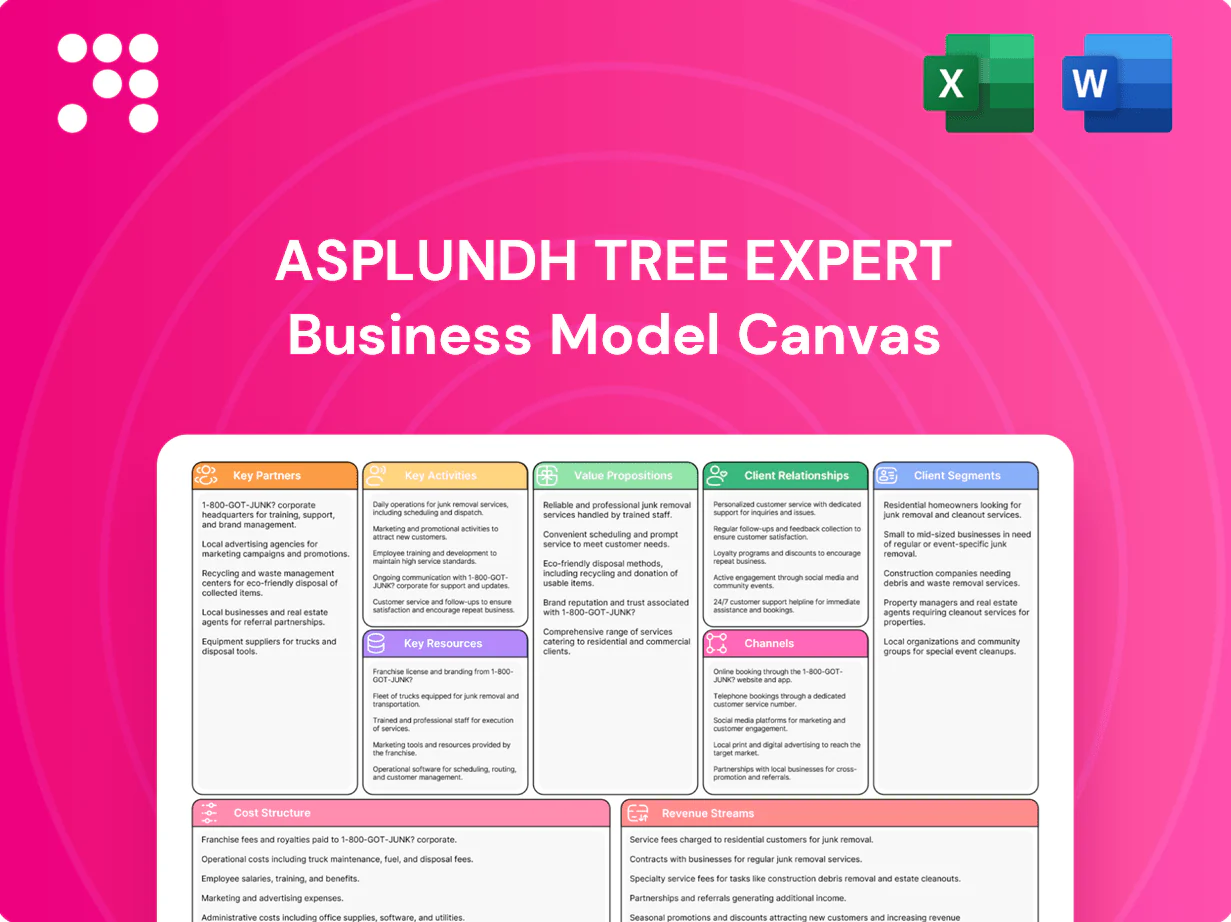
Asplundh Tree Expert Business Model Canvas

Unlock the Business Model Canvas of a leading tree-care services firm
Unlock the full strategic blueprint behind Asplundh Tree Expert's business model. This concise Business Model Canvas reveals how the firm creates value, scales operations, and secures recurring revenue. Ideal for investors, consultants, and founders seeking actionable insights. Download the complete, editable Canvas to apply its lessons.
Partnerships

Utility and transmission operators
Asplundh collaborates with electric, gas and telecom utilities to plan vegetation-management cycles, leveraging network maps, access permissions and outage priority lists provided by partners. Joint planning aligns crew deployment with utilities' reliability targets, supporting contract KPIs and storm-response metrics. Long-term master service agreements stabilize workload and standards and underpin operations of the firm's over 34,000 employees worldwide.
Equipment and fleet suppliers
Relationships with bucket truck, chipper, saw and herbicide applicator manufacturers ensure rapid replacement and high uptime, with bucket trucks costing $100,000–$250,000, chippers $50,000–$150,000 and applicators $5,000–$20,000 (market 2024). Preferred-supplier terms lower acquisition and operating costs through volume discounts and extended warranties. Ready access to parts and manufacturer maintenance training supports OSHA-aligned safety and productivity. Pilot programs validate new gear performance before fleet-scale deployment.

Herbicide and arboricultural product vendors
Specialized chemicals and application systems are sourced from vetted herbicide and arboricultural vendors to ensure product quality and label compliance. In 2024 these partnerships support adherence to evolving environmental regulations and best practices and include joint stewardship programs that document efficacy and mitigate operational risk. Vendors also provide field training and incident response support to crews.

Workforce training and safety organizations
Alliances with ISA, OSHA trainers and utility safety councils elevate crew competency and, per industry studies, standardized certifications can cut incident rates by about 20–30% and lower insurance premiums accordingly.
Shared safety audits create continuous improvement cycles; co-developed curricula target emerging grid and vegetation risks from increased extreme weather and distributed energy adoption in 2024.
- Certification impact: ~20–30% incident reduction
- Shared audits: faster corrective actions
- Co-developed curricula: addresses 2024 grid-vegetation risks
Emergency and storm-response networks
Coordination with mutual-assistance groups and public agencies accelerates mobilization after storms, reducing response times and enabling Asplundh to surge crews across regions; Asplundh reported roughly 30,000 field employees in 2024 to support widespread deployments. Pre‑negotiated staging areas and logistics partners enable rapid deployment, while information‑sharing improves situational awareness and crew safety.
- mutual-aid: faster mobilization
- staging/logistics: rapid deployment
- info-sharing: improved safety
- surge capacity: regional coverage
MSAs + OEMs stabilize 34,000; certs cut incidents 20-30%
Asplundh partners with electric/gas/telecom utilities for joint VM planning and MSAs, stabilizing work for over 34,000 employees worldwide and ~30,000 field staff in 2024. OEMs supply bucket trucks ($100k–$250k), chippers ($50k–$150k) and parts; preferred terms cut costs. Herbicide vendors and safety alliances support compliance; certifications reduce incidents ~20–30% (2024).
| Partner | Role | 2024 metric |
|---|---|---|
| Utilities | MSAs, planning | Workforce stability |
What is included in the product
 Detailed Word Document
A comprehensive, pre-written Business Model Canvas for Asplundh Tree Expert that maps all nine BMC blocks—customer segments, channels, value propositions, revenue streams, key partners, activities, resources, cost structure, and customer relationships—reflecting real-world operations and strategic plans. Ideal for presentations, funding discussions, and decision-making with integrated SWOT insights and competitive advantages.

 Customizable Excel Spreadsheet
High-level one-page canvas that condenses Asplundh’s field operations, safety protocols, and contract relationships into editable cells to quickly pinpoint inefficiencies and operational pain points. Shareable and adaptable for teams to streamline resource allocation, reduce downtime, and speed decision-making.
Activities

Vegetation clearance and ROW maintenance
Routine trimming, mowing, and targeted removals keep rights-of-way compliant and reduce vegetation-related outages, which utilities reported at about 30% of service interruptions in 2024. Work cycles are optimized by species, growth rates, and regulator guidelines to balance cost and reliability. Data-driven scheduling and GIS/asset-data integration minimize unplanned outages and can improve crew productivity by double-digit percentages. Detailed documentation demonstrates adherence to utility contracts and environmental permits.
Storm restoration and emergency response
Rapid mobilization clears debris and enables re-energization, with Asplundh leveraging a ~34,000-strong workforce (2024) to restore outages swiftly. Incident command structures guide safe operations under pressure, ensuring OSHA-aligned procedures and crew accountability. Cross-state crew dispatch expands capacity during major events via mutual-aid agreements. Post-event reviews use after-action data to refine protocols and readiness.

Inspection, risk assessment, and GIS mapping
Field surveys identify hazard trees, encroachments, and priority spans for mitigation, feeding GIS-enabled inventories that support prioritization and budgeting across service territories. Lidar and remote sensing augment ground truthing by detecting canopy height, species proxies, and growth trends along rights-of-way. Inspection reports are standardized and integrated directly with utility asset management systems for work order alignment and regulatory compliance.

Herbicide application and integrated vegetation management
Herbicide application and integrated vegetation management use selective treatments to promote compatible low-growing species while balancing efficacy, cost, and environmental stewardship; Asplundh deploys licensed applicators who follow strict handling and reporting rules and operate with approximately 34,000 employees. Monitoring verifies outcomes and typically guides retreatment intervals of 1–3 years.
- Selective species promotion
- Licensed applicators & reporting
- Monitoring-driven 1–3 year retreatment
Safety, compliance, and quality assurance
Daily tailboards, audits, and near-miss tracking reduce risk across Asplundh operations, supporting safety for a workforce of over 30,000 and lowering incident rates year-over-year. Compliance programs are structured to meet OSHA, DOT, and state requirements, with continuous training sustaining certifications and field performance. KPI dashboards align crews with client SLAs, targeting on-time and quality metrics for thousands of utility and municipal accounts.
- Daily tailboards: real-time hazards
- Audits & near-miss tracking: reduce incidents
- Compliance: OSHA/DOT/state-aligned
- Training: certification retention
- KPI dashboards: SLA alignment
Routine ROW trimming cuts ~30% outage risk; rapid restoration with ~34,000
Routine ROW trimming, targeted removals, GIS-driven scheduling and herbicide IVM sustain reliability, addressing ~30% of utility outages in 2024. Rapid mobilization and mutual-aid plus a ~34,000 workforce (2024) accelerate restoration. Field surveys, lidar, and standardized inspections feed asset systems; monitoring guides 1–3 year retreatment cycles and yields 10–20% crew productivity gains.
| Metric | 2024 Value |
|---|---|
| Workforce | ~34,000 |
| Utility outages linked to vegetation | ~30% |
| Crew productivity uplift | 10–20% |
| Retreatment interval | 1–3 years |
Full Version Awaits
Business Model Canvas
The document you're previewing is the actual Asplundh Tree Expert Business Model Canvas—not a mockup—and contains the same content you'll receive after purchase. Upon ordering you’ll download this exact, editable file in Word and Excel formats, fully formatted and ready to use.

Unlock the Business Model Canvas of a leading tree-care services firm
Unlock the full strategic blueprint behind Asplundh Tree Expert's business model. This concise Business Model Canvas reveals how the firm creates value, scales operations, and secures recurring revenue. Ideal for investors, consultants, and founders seeking actionable insights. Download the complete, editable Canvas to apply its lessons.
Partnerships
Utility and transmission operators
Asplundh collaborates with electric, gas and telecom utilities to plan vegetation-management cycles, leveraging network maps, access permissions and outage priority lists provided by partners. Joint planning aligns crew deployment with utilities' reliability targets, supporting contract KPIs and storm-response metrics. Long-term master service agreements stabilize workload and standards and underpin operations of the firm's over 34,000 employees worldwide.
Equipment and fleet suppliers
Relationships with bucket truck, chipper, saw and herbicide applicator manufacturers ensure rapid replacement and high uptime, with bucket trucks costing $100,000–$250,000, chippers $50,000–$150,000 and applicators $5,000–$20,000 (market 2024). Preferred-supplier terms lower acquisition and operating costs through volume discounts and extended warranties. Ready access to parts and manufacturer maintenance training supports OSHA-aligned safety and productivity. Pilot programs validate new gear performance before fleet-scale deployment.
Herbicide and arboricultural product vendors
Specialized chemicals and application systems are sourced from vetted herbicide and arboricultural vendors to ensure product quality and label compliance. In 2024 these partnerships support adherence to evolving environmental regulations and best practices and include joint stewardship programs that document efficacy and mitigate operational risk. Vendors also provide field training and incident response support to crews.
Workforce training and safety organizations
Alliances with ISA, OSHA trainers and utility safety councils elevate crew competency and, per industry studies, standardized certifications can cut incident rates by about 20–30% and lower insurance premiums accordingly.
Shared safety audits create continuous improvement cycles; co-developed curricula target emerging grid and vegetation risks from increased extreme weather and distributed energy adoption in 2024.
- Certification impact: ~20–30% incident reduction
- Shared audits: faster corrective actions
- Co-developed curricula: addresses 2024 grid-vegetation risks
Emergency and storm-response networks
Coordination with mutual-assistance groups and public agencies accelerates mobilization after storms, reducing response times and enabling Asplundh to surge crews across regions; Asplundh reported roughly 30,000 field employees in 2024 to support widespread deployments. Pre‑negotiated staging areas and logistics partners enable rapid deployment, while information‑sharing improves situational awareness and crew safety.
- mutual-aid: faster mobilization
- staging/logistics: rapid deployment
- info-sharing: improved safety
- surge capacity: regional coverage
MSAs + OEMs stabilize 34,000; certs cut incidents 20-30%
Asplundh partners with electric/gas/telecom utilities for joint VM planning and MSAs, stabilizing work for over 34,000 employees worldwide and ~30,000 field staff in 2024. OEMs supply bucket trucks ($100k–$250k), chippers ($50k–$150k) and parts; preferred terms cut costs. Herbicide vendors and safety alliances support compliance; certifications reduce incidents ~20–30% (2024).
| Partner | Role | 2024 metric |
|---|---|---|
| Utilities | MSAs, planning | Workforce stability |
What is included in the product
Detailed Word Document
A comprehensive, pre-written Business Model Canvas for Asplundh Tree Expert that maps all nine BMC blocks—customer segments, channels, value propositions, revenue streams, key partners, activities, resources, cost structure, and customer relationships—reflecting real-world operations and strategic plans. Ideal for presentations, funding discussions, and decision-making with integrated SWOT insights and competitive advantages.
Customizable Excel Spreadsheet
High-level one-page canvas that condenses Asplundh’s field operations, safety protocols, and contract relationships into editable cells to quickly pinpoint inefficiencies and operational pain points. Shareable and adaptable for teams to streamline resource allocation, reduce downtime, and speed decision-making.
Activities
Vegetation clearance and ROW maintenance
Routine trimming, mowing, and targeted removals keep rights-of-way compliant and reduce vegetation-related outages, which utilities reported at about 30% of service interruptions in 2024. Work cycles are optimized by species, growth rates, and regulator guidelines to balance cost and reliability. Data-driven scheduling and GIS/asset-data integration minimize unplanned outages and can improve crew productivity by double-digit percentages. Detailed documentation demonstrates adherence to utility contracts and environmental permits.
Storm restoration and emergency response
Rapid mobilization clears debris and enables re-energization, with Asplundh leveraging a ~34,000-strong workforce (2024) to restore outages swiftly. Incident command structures guide safe operations under pressure, ensuring OSHA-aligned procedures and crew accountability. Cross-state crew dispatch expands capacity during major events via mutual-aid agreements. Post-event reviews use after-action data to refine protocols and readiness.
Inspection, risk assessment, and GIS mapping
Field surveys identify hazard trees, encroachments, and priority spans for mitigation, feeding GIS-enabled inventories that support prioritization and budgeting across service territories. Lidar and remote sensing augment ground truthing by detecting canopy height, species proxies, and growth trends along rights-of-way. Inspection reports are standardized and integrated directly with utility asset management systems for work order alignment and regulatory compliance.
Herbicide application and integrated vegetation management
Herbicide application and integrated vegetation management use selective treatments to promote compatible low-growing species while balancing efficacy, cost, and environmental stewardship; Asplundh deploys licensed applicators who follow strict handling and reporting rules and operate with approximately 34,000 employees. Monitoring verifies outcomes and typically guides retreatment intervals of 1–3 years.
- Selective species promotion
- Licensed applicators & reporting
- Monitoring-driven 1–3 year retreatment
Safety, compliance, and quality assurance
Daily tailboards, audits, and near-miss tracking reduce risk across Asplundh operations, supporting safety for a workforce of over 30,000 and lowering incident rates year-over-year. Compliance programs are structured to meet OSHA, DOT, and state requirements, with continuous training sustaining certifications and field performance. KPI dashboards align crews with client SLAs, targeting on-time and quality metrics for thousands of utility and municipal accounts.
- Daily tailboards: real-time hazards
- Audits & near-miss tracking: reduce incidents
- Compliance: OSHA/DOT/state-aligned
- Training: certification retention
- KPI dashboards: SLA alignment
Routine ROW trimming cuts ~30% outage risk; rapid restoration with ~34,000
Routine ROW trimming, targeted removals, GIS-driven scheduling and herbicide IVM sustain reliability, addressing ~30% of utility outages in 2024. Rapid mobilization and mutual-aid plus a ~34,000 workforce (2024) accelerate restoration. Field surveys, lidar, and standardized inspections feed asset systems; monitoring guides 1–3 year retreatment cycles and yields 10–20% crew productivity gains.
| Metric | 2024 Value |
|---|---|
| Workforce | ~34,000 |
| Utility outages linked to vegetation | ~30% |
| Crew productivity uplift | 10–20% |
| Retreatment interval | 1–3 years |
Full Version Awaits
Business Model Canvas
The document you're previewing is the actual Asplundh Tree Expert Business Model Canvas—not a mockup—and contains the same content you'll receive after purchase. Upon ordering you’ll download this exact, editable file in Word and Excel formats, fully formatted and ready to use.
Original: $10.00
-65%$10.00
$3.50Description
Unlock the Business Model Canvas of a leading tree-care services firm
Unlock the full strategic blueprint behind Asplundh Tree Expert's business model. This concise Business Model Canvas reveals how the firm creates value, scales operations, and secures recurring revenue. Ideal for investors, consultants, and founders seeking actionable insights. Download the complete, editable Canvas to apply its lessons.
Partnerships
Utility and transmission operators
Asplundh collaborates with electric, gas and telecom utilities to plan vegetation-management cycles, leveraging network maps, access permissions and outage priority lists provided by partners. Joint planning aligns crew deployment with utilities' reliability targets, supporting contract KPIs and storm-response metrics. Long-term master service agreements stabilize workload and standards and underpin operations of the firm's over 34,000 employees worldwide.
Equipment and fleet suppliers
Relationships with bucket truck, chipper, saw and herbicide applicator manufacturers ensure rapid replacement and high uptime, with bucket trucks costing $100,000–$250,000, chippers $50,000–$150,000 and applicators $5,000–$20,000 (market 2024). Preferred-supplier terms lower acquisition and operating costs through volume discounts and extended warranties. Ready access to parts and manufacturer maintenance training supports OSHA-aligned safety and productivity. Pilot programs validate new gear performance before fleet-scale deployment.
Herbicide and arboricultural product vendors
Specialized chemicals and application systems are sourced from vetted herbicide and arboricultural vendors to ensure product quality and label compliance. In 2024 these partnerships support adherence to evolving environmental regulations and best practices and include joint stewardship programs that document efficacy and mitigate operational risk. Vendors also provide field training and incident response support to crews.
Workforce training and safety organizations
Alliances with ISA, OSHA trainers and utility safety councils elevate crew competency and, per industry studies, standardized certifications can cut incident rates by about 20–30% and lower insurance premiums accordingly.
Shared safety audits create continuous improvement cycles; co-developed curricula target emerging grid and vegetation risks from increased extreme weather and distributed energy adoption in 2024.
- Certification impact: ~20–30% incident reduction
- Shared audits: faster corrective actions
- Co-developed curricula: addresses 2024 grid-vegetation risks
Emergency and storm-response networks
Coordination with mutual-assistance groups and public agencies accelerates mobilization after storms, reducing response times and enabling Asplundh to surge crews across regions; Asplundh reported roughly 30,000 field employees in 2024 to support widespread deployments. Pre‑negotiated staging areas and logistics partners enable rapid deployment, while information‑sharing improves situational awareness and crew safety.
- mutual-aid: faster mobilization
- staging/logistics: rapid deployment
- info-sharing: improved safety
- surge capacity: regional coverage
MSAs + OEMs stabilize 34,000; certs cut incidents 20-30%
Asplundh partners with electric/gas/telecom utilities for joint VM planning and MSAs, stabilizing work for over 34,000 employees worldwide and ~30,000 field staff in 2024. OEMs supply bucket trucks ($100k–$250k), chippers ($50k–$150k) and parts; preferred terms cut costs. Herbicide vendors and safety alliances support compliance; certifications reduce incidents ~20–30% (2024).
| Partner | Role | 2024 metric |
|---|---|---|
| Utilities | MSAs, planning | Workforce stability |
What is included in the product
Detailed Word Document
A comprehensive, pre-written Business Model Canvas for Asplundh Tree Expert that maps all nine BMC blocks—customer segments, channels, value propositions, revenue streams, key partners, activities, resources, cost structure, and customer relationships—reflecting real-world operations and strategic plans. Ideal for presentations, funding discussions, and decision-making with integrated SWOT insights and competitive advantages.
Customizable Excel Spreadsheet
High-level one-page canvas that condenses Asplundh’s field operations, safety protocols, and contract relationships into editable cells to quickly pinpoint inefficiencies and operational pain points. Shareable and adaptable for teams to streamline resource allocation, reduce downtime, and speed decision-making.
Activities
Vegetation clearance and ROW maintenance
Routine trimming, mowing, and targeted removals keep rights-of-way compliant and reduce vegetation-related outages, which utilities reported at about 30% of service interruptions in 2024. Work cycles are optimized by species, growth rates, and regulator guidelines to balance cost and reliability. Data-driven scheduling and GIS/asset-data integration minimize unplanned outages and can improve crew productivity by double-digit percentages. Detailed documentation demonstrates adherence to utility contracts and environmental permits.
Storm restoration and emergency response
Rapid mobilization clears debris and enables re-energization, with Asplundh leveraging a ~34,000-strong workforce (2024) to restore outages swiftly. Incident command structures guide safe operations under pressure, ensuring OSHA-aligned procedures and crew accountability. Cross-state crew dispatch expands capacity during major events via mutual-aid agreements. Post-event reviews use after-action data to refine protocols and readiness.
Inspection, risk assessment, and GIS mapping
Field surveys identify hazard trees, encroachments, and priority spans for mitigation, feeding GIS-enabled inventories that support prioritization and budgeting across service territories. Lidar and remote sensing augment ground truthing by detecting canopy height, species proxies, and growth trends along rights-of-way. Inspection reports are standardized and integrated directly with utility asset management systems for work order alignment and regulatory compliance.
Herbicide application and integrated vegetation management
Herbicide application and integrated vegetation management use selective treatments to promote compatible low-growing species while balancing efficacy, cost, and environmental stewardship; Asplundh deploys licensed applicators who follow strict handling and reporting rules and operate with approximately 34,000 employees. Monitoring verifies outcomes and typically guides retreatment intervals of 1–3 years.
- Selective species promotion
- Licensed applicators & reporting
- Monitoring-driven 1–3 year retreatment
Safety, compliance, and quality assurance
Daily tailboards, audits, and near-miss tracking reduce risk across Asplundh operations, supporting safety for a workforce of over 30,000 and lowering incident rates year-over-year. Compliance programs are structured to meet OSHA, DOT, and state requirements, with continuous training sustaining certifications and field performance. KPI dashboards align crews with client SLAs, targeting on-time and quality metrics for thousands of utility and municipal accounts.
- Daily tailboards: real-time hazards
- Audits & near-miss tracking: reduce incidents
- Compliance: OSHA/DOT/state-aligned
- Training: certification retention
- KPI dashboards: SLA alignment
Routine ROW trimming cuts ~30% outage risk; rapid restoration with ~34,000
Routine ROW trimming, targeted removals, GIS-driven scheduling and herbicide IVM sustain reliability, addressing ~30% of utility outages in 2024. Rapid mobilization and mutual-aid plus a ~34,000 workforce (2024) accelerate restoration. Field surveys, lidar, and standardized inspections feed asset systems; monitoring guides 1–3 year retreatment cycles and yields 10–20% crew productivity gains.
| Metric | 2024 Value |
|---|---|
| Workforce | ~34,000 |
| Utility outages linked to vegetation | ~30% |
| Crew productivity uplift | 10–20% |
| Retreatment interval | 1–3 years |
Full Version Awaits
Business Model Canvas
The document you're previewing is the actual Asplundh Tree Expert Business Model Canvas—not a mockup—and contains the same content you'll receive after purchase. Upon ordering you’ll download this exact, editable file in Word and Excel formats, fully formatted and ready to use.











