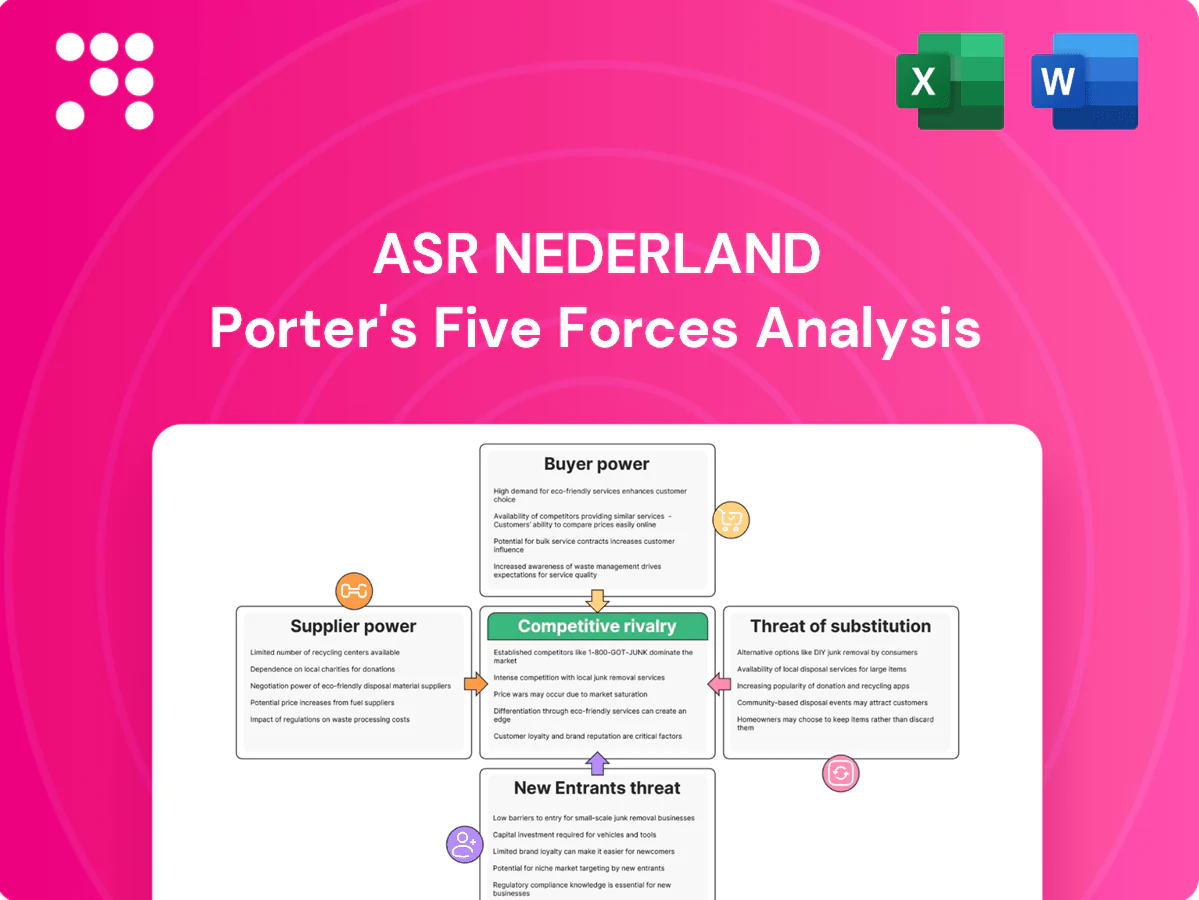
Asr Nederland Porter's Five Forces Analysis

Elevate Your Analysis with the Complete Porter's Five Forces Analysis
Asr Nederland faces moderate buyer power, regulatory constraints, and evolving digital threats that shape profitability and growth prospects; supplier and substitute pressures remain manageable but warrant monitoring. This snapshot highlights key competitive tensions and strategic levers you should consider now. Unlock the full Porter's Five Forces Analysis for force-by-force ratings, visuals, and actionable recommendations tailored to Asr Nederland.
Suppliers Bargaining Power

Reinsurer dependence
ASR relies on global reinsurers to manage catastrophic and longevity exposures, creating dependence on a concentrated supplier base dominated by major global players.
Concentration among leading reinsurers increases their leverage on pricing and contract terms, particularly during tightening cycles.
ASR’s scale and diversified portfolio enable multi-year, multi-partner panels that mitigate supplier power, though market cycles can still reduce capacity and push up reinsurance costs.
IT and data vendors
Core platforms, cloud providers, cybersecurity and analytics/data feeds are mission-critical inputs for ASR; hyperscalers dominate the market (AWS ~32%, Azure ~23%, Google Cloud ~11% in 2024), elevating supplier bargaining power. Switching costs remain high due to complex integrations and Solvency II resilience and data governance requirements. ASR mitigates risk via multi-vendor architectures and growing in-house capabilities.

Claims and repair networks
Garage networks, medical assessors, loss adjusters and contractors directly shape claims cost and customer experience; in 2024 ASR leaned on preferred networks to steer volumes and reduce cycle times. Local market fragmentation gives ASR buyer leverage through volume steering and preferred-provider agreements. Specialized services or peak-capacity events (storms, large-scale bodily-injury spikes) can spike supplier power. Contracted service levels and benchmarking help curb cost inflation and preserve service standards.

Distribution partners
Independent brokers, mortgage intermediaries and bank partners act as quasi-suppliers of demand; in the Dutch market brokers handled about 60% of mortgage flows in 2024, giving strong franchises negotiation leverage on commissions and product terms. ASR mitigates this via a multi-channel strategy and expanding direct digital distribution to cut dependency. Regulatory inducement rules (AFM/DNB) further cap extreme remuneration practices.
- Broker share ~60% (2024)
- Commission negotiation risk
- Multi-channel + digital reduces dependency
- Regulatory caps limit inducements
Capital and rating agencies
Capital and rating agencies affect ASR through Solvency II capital markets and subordinated debt investors; in 2024 ASR reported a Solvency II ratio of 214% which supports lower funding costs. Tighter credit cycles and greater rating sensitivities in 2024 pushed required subordinated spreads higher, but rating agencies still price ASR favorably due to its track record. Prudent ALM and diversification sustain access and limit supplier power.
- 2024 Solvency II ratio: 214%
- Subordinated spread pressure in 2024: higher market-driven spreads
- ALM/diversification: supports favorable access
ASR relies on reinsurers; hyperscalers dominate; brokers squeeze; Solvency II 214%
ASR depends on concentrated global reinsurers for catastrophe/longevity cover, giving suppliers pricing leverage in tightening cycles.
Hyperscaler dominance (AWS 32%, Azure 23%, GCP 11% in 2024) raises tech supplier power; multi-vendor strategy and in-house builds mitigate risk.
Brokers control ~60% of mortgage flows (2024), pressuring commissions; Solvency II ratio 214% (2024) improves ASR’s funding leverage.
| Supplier | 2024 metric | Impact |
|---|---|---|
| Reinsurers | Concentrated | Pricing leverage |
| Hyperscalers | AWS32%/Azure23%/GCP11% | High switching cost |
| Brokers | 60% mortgage share | Commission pressure |
| Capital | Solvency II 214% | Lower funding cost |
What is included in the product
 Detailed Word Document
Comprehensive Porter's Five Forces analysis tailored to ASR Nederland that uncovers competitive drivers, buyer and supplier influence on pricing, entry barriers shielding incumbents, and disruptive threats/substitutes—all delivered in an editable Word-ready format for strategic use.

 Customizable Excel Spreadsheet
One-sheet Porter's Five Forces for ASR Nederland that translates complex industry pressures into a clear, actionable snapshot for faster strategic decisions. Customize force levels, swap in your data, and export a clean radar chart to drop into decks or share with stakeholders instantly.
Customers Bargaining Power

Price-sensitive retail customers
Dutch retail buyers compare aggressively via online aggregators, with over 50% using comparison sites in 2024, boosting price sensitivity for commoditized non-life lines. Switching costs are moderate, intensifying price pressure on premiums and loss ratios. Brand trust and service quality can offset pure price plays, while loyalty programs and bundling cut churn.
Corporate and SME clients
Larger corporate and SME accounts in the Netherlands routinely use professional procurement and brokers to solicit bids from typically 3-5 carriers, creating intense price and service pressure; bespoke coverages and risk engineering requirements (often assessed over 3-5 years of loss history) give clients negotiation leverage, so ASR defends margins by competing on total cost of risk and strict service SLAs rather than price alone.

Pension and institutional buyers
Pension administration and life solutions face sophisticated, fee-sensitive institutional buyers; Dutch pension assets stood at about €1.9 trillion in 2024 (DNB), amplifying buyer leverage. Mandatory transparent performance, ESG integration and standardized reporting raise comparability and pressure on fees. ASR leverages scale, multi-decade track record and strong sustainability ratings to differentiate, while mandate concentration risk keeps emphasis on deep, bespoke relationships.

Mortgage borrowers
Mortgage borrowers shop rates and terms intensively, giving high bargaining power; Dutch outstanding mortgage debt was about €1.4 trillion (end-2024, DNB). Banks and non-banks maintain tight spreads, boosting buyer leverage; ASR competes on speed, underwriting consistency and responsible-lending features, while funding costs and risk-based pricing cap concessions.
- Comparison shopping elevates leverage
- Tight spreads limit lender margins
- ASR: speed, consistency, responsible lending
- Funding costs/risk pricing restrict concessions
Intermediated channels
Brokers aggregate end-customer demand and can reallocate volumes rapidly, evidencing strong negotiating leverage in 2024 as intermediary-driven sales remain pivotal for ASR’s retail and SME segments.
Commission structures and bespoke service SLAs reflect broker bargaining power, while ASR’s omnichannel distribution reduces dependency on any single broker.
Data-sharing agreements and co-developed propositions align incentives, improving retention and average revenue per customer.
- Broker switchability: rapid volume shifts
- Commissions & SLAs: reflect bargaining strength
- Omnichannel: lowers single-channel risk
- Data & co-development: align incentives
Retail >50% use comparison sites; pensions €1.9tn, mortgages €1.4tn
Dutch retail buyers: >50% used comparison sites in 2024, raising price sensitivity; switching costs moderate. Corporates/SMEs solicit 3-5 carriers, pushing competition on total cost of risk. Pension/institutional buyers (Dutch pension assets €1.9tn in 2024) demand fee transparency; mortgages (€1.4tn end‑2024) intensify rate shopping. Brokers retain strong leverage; ASR counters with SLAs, bundling and co-developed propositions.
| Segment | Metric | 2024 | ASR response |
|---|---|---|---|
| Retail | Comparison use | >50% | Bundling/loyalty |
| Pensions | Assets | €1.9tn | Scale/ESG |
| Mortgages | Outstanding | €1.4tn | Speed/underwriting |
Full Version Awaits
Asr Nederland Porter's Five Forces Analysis
This preview shows the exact ASR Nederland Porter's Five Forces Analysis you'll receive immediately after purchase—no placeholders. The document displayed is the final, professionally formatted analysis, ready for download and use the moment you buy. You're viewing the same deliverable that will be available to you instantly after payment.

Elevate Your Analysis with the Complete Porter's Five Forces Analysis
Asr Nederland faces moderate buyer power, regulatory constraints, and evolving digital threats that shape profitability and growth prospects; supplier and substitute pressures remain manageable but warrant monitoring. This snapshot highlights key competitive tensions and strategic levers you should consider now. Unlock the full Porter's Five Forces Analysis for force-by-force ratings, visuals, and actionable recommendations tailored to Asr Nederland.
Suppliers Bargaining Power
Reinsurer dependence
ASR relies on global reinsurers to manage catastrophic and longevity exposures, creating dependence on a concentrated supplier base dominated by major global players.
Concentration among leading reinsurers increases their leverage on pricing and contract terms, particularly during tightening cycles.
ASR’s scale and diversified portfolio enable multi-year, multi-partner panels that mitigate supplier power, though market cycles can still reduce capacity and push up reinsurance costs.
IT and data vendors
Core platforms, cloud providers, cybersecurity and analytics/data feeds are mission-critical inputs for ASR; hyperscalers dominate the market (AWS ~32%, Azure ~23%, Google Cloud ~11% in 2024), elevating supplier bargaining power. Switching costs remain high due to complex integrations and Solvency II resilience and data governance requirements. ASR mitigates risk via multi-vendor architectures and growing in-house capabilities.
Claims and repair networks
Garage networks, medical assessors, loss adjusters and contractors directly shape claims cost and customer experience; in 2024 ASR leaned on preferred networks to steer volumes and reduce cycle times. Local market fragmentation gives ASR buyer leverage through volume steering and preferred-provider agreements. Specialized services or peak-capacity events (storms, large-scale bodily-injury spikes) can spike supplier power. Contracted service levels and benchmarking help curb cost inflation and preserve service standards.
Distribution partners
Independent brokers, mortgage intermediaries and bank partners act as quasi-suppliers of demand; in the Dutch market brokers handled about 60% of mortgage flows in 2024, giving strong franchises negotiation leverage on commissions and product terms. ASR mitigates this via a multi-channel strategy and expanding direct digital distribution to cut dependency. Regulatory inducement rules (AFM/DNB) further cap extreme remuneration practices.
- Broker share ~60% (2024)
- Commission negotiation risk
- Multi-channel + digital reduces dependency
- Regulatory caps limit inducements
Capital and rating agencies
Capital and rating agencies affect ASR through Solvency II capital markets and subordinated debt investors; in 2024 ASR reported a Solvency II ratio of 214% which supports lower funding costs. Tighter credit cycles and greater rating sensitivities in 2024 pushed required subordinated spreads higher, but rating agencies still price ASR favorably due to its track record. Prudent ALM and diversification sustain access and limit supplier power.
- 2024 Solvency II ratio: 214%
- Subordinated spread pressure in 2024: higher market-driven spreads
- ALM/diversification: supports favorable access
ASR relies on reinsurers; hyperscalers dominate; brokers squeeze; Solvency II 214%
ASR depends on concentrated global reinsurers for catastrophe/longevity cover, giving suppliers pricing leverage in tightening cycles.
Hyperscaler dominance (AWS 32%, Azure 23%, GCP 11% in 2024) raises tech supplier power; multi-vendor strategy and in-house builds mitigate risk.
Brokers control ~60% of mortgage flows (2024), pressuring commissions; Solvency II ratio 214% (2024) improves ASR’s funding leverage.
| Supplier | 2024 metric | Impact |
|---|---|---|
| Reinsurers | Concentrated | Pricing leverage |
| Hyperscalers | AWS32%/Azure23%/GCP11% | High switching cost |
| Brokers | 60% mortgage share | Commission pressure |
| Capital | Solvency II 214% | Lower funding cost |
What is included in the product
Detailed Word Document
Comprehensive Porter's Five Forces analysis tailored to ASR Nederland that uncovers competitive drivers, buyer and supplier influence on pricing, entry barriers shielding incumbents, and disruptive threats/substitutes—all delivered in an editable Word-ready format for strategic use.
Customizable Excel Spreadsheet
One-sheet Porter's Five Forces for ASR Nederland that translates complex industry pressures into a clear, actionable snapshot for faster strategic decisions. Customize force levels, swap in your data, and export a clean radar chart to drop into decks or share with stakeholders instantly.
Customers Bargaining Power
Price-sensitive retail customers
Dutch retail buyers compare aggressively via online aggregators, with over 50% using comparison sites in 2024, boosting price sensitivity for commoditized non-life lines. Switching costs are moderate, intensifying price pressure on premiums and loss ratios. Brand trust and service quality can offset pure price plays, while loyalty programs and bundling cut churn.
Corporate and SME clients
Larger corporate and SME accounts in the Netherlands routinely use professional procurement and brokers to solicit bids from typically 3-5 carriers, creating intense price and service pressure; bespoke coverages and risk engineering requirements (often assessed over 3-5 years of loss history) give clients negotiation leverage, so ASR defends margins by competing on total cost of risk and strict service SLAs rather than price alone.
Pension and institutional buyers
Pension administration and life solutions face sophisticated, fee-sensitive institutional buyers; Dutch pension assets stood at about €1.9 trillion in 2024 (DNB), amplifying buyer leverage. Mandatory transparent performance, ESG integration and standardized reporting raise comparability and pressure on fees. ASR leverages scale, multi-decade track record and strong sustainability ratings to differentiate, while mandate concentration risk keeps emphasis on deep, bespoke relationships.
Mortgage borrowers
Mortgage borrowers shop rates and terms intensively, giving high bargaining power; Dutch outstanding mortgage debt was about €1.4 trillion (end-2024, DNB). Banks and non-banks maintain tight spreads, boosting buyer leverage; ASR competes on speed, underwriting consistency and responsible-lending features, while funding costs and risk-based pricing cap concessions.
- Comparison shopping elevates leverage
- Tight spreads limit lender margins
- ASR: speed, consistency, responsible lending
- Funding costs/risk pricing restrict concessions
Intermediated channels
Brokers aggregate end-customer demand and can reallocate volumes rapidly, evidencing strong negotiating leverage in 2024 as intermediary-driven sales remain pivotal for ASR’s retail and SME segments.
Commission structures and bespoke service SLAs reflect broker bargaining power, while ASR’s omnichannel distribution reduces dependency on any single broker.
Data-sharing agreements and co-developed propositions align incentives, improving retention and average revenue per customer.
- Broker switchability: rapid volume shifts
- Commissions & SLAs: reflect bargaining strength
- Omnichannel: lowers single-channel risk
- Data & co-development: align incentives
Retail >50% use comparison sites; pensions €1.9tn, mortgages €1.4tn
Dutch retail buyers: >50% used comparison sites in 2024, raising price sensitivity; switching costs moderate. Corporates/SMEs solicit 3-5 carriers, pushing competition on total cost of risk. Pension/institutional buyers (Dutch pension assets €1.9tn in 2024) demand fee transparency; mortgages (€1.4tn end‑2024) intensify rate shopping. Brokers retain strong leverage; ASR counters with SLAs, bundling and co-developed propositions.
| Segment | Metric | 2024 | ASR response |
|---|---|---|---|
| Retail | Comparison use | >50% | Bundling/loyalty |
| Pensions | Assets | €1.9tn | Scale/ESG |
| Mortgages | Outstanding | €1.4tn | Speed/underwriting |
Full Version Awaits
Asr Nederland Porter's Five Forces Analysis
This preview shows the exact ASR Nederland Porter's Five Forces Analysis you'll receive immediately after purchase—no placeholders. The document displayed is the final, professionally formatted analysis, ready for download and use the moment you buy. You're viewing the same deliverable that will be available to you instantly after payment.
Description
Elevate Your Analysis with the Complete Porter's Five Forces Analysis
Asr Nederland faces moderate buyer power, regulatory constraints, and evolving digital threats that shape profitability and growth prospects; supplier and substitute pressures remain manageable but warrant monitoring. This snapshot highlights key competitive tensions and strategic levers you should consider now. Unlock the full Porter's Five Forces Analysis for force-by-force ratings, visuals, and actionable recommendations tailored to Asr Nederland.
Suppliers Bargaining Power
Reinsurer dependence
ASR relies on global reinsurers to manage catastrophic and longevity exposures, creating dependence on a concentrated supplier base dominated by major global players.
Concentration among leading reinsurers increases their leverage on pricing and contract terms, particularly during tightening cycles.
ASR’s scale and diversified portfolio enable multi-year, multi-partner panels that mitigate supplier power, though market cycles can still reduce capacity and push up reinsurance costs.
IT and data vendors
Core platforms, cloud providers, cybersecurity and analytics/data feeds are mission-critical inputs for ASR; hyperscalers dominate the market (AWS ~32%, Azure ~23%, Google Cloud ~11% in 2024), elevating supplier bargaining power. Switching costs remain high due to complex integrations and Solvency II resilience and data governance requirements. ASR mitigates risk via multi-vendor architectures and growing in-house capabilities.
Claims and repair networks
Garage networks, medical assessors, loss adjusters and contractors directly shape claims cost and customer experience; in 2024 ASR leaned on preferred networks to steer volumes and reduce cycle times. Local market fragmentation gives ASR buyer leverage through volume steering and preferred-provider agreements. Specialized services or peak-capacity events (storms, large-scale bodily-injury spikes) can spike supplier power. Contracted service levels and benchmarking help curb cost inflation and preserve service standards.
Distribution partners
Independent brokers, mortgage intermediaries and bank partners act as quasi-suppliers of demand; in the Dutch market brokers handled about 60% of mortgage flows in 2024, giving strong franchises negotiation leverage on commissions and product terms. ASR mitigates this via a multi-channel strategy and expanding direct digital distribution to cut dependency. Regulatory inducement rules (AFM/DNB) further cap extreme remuneration practices.
- Broker share ~60% (2024)
- Commission negotiation risk
- Multi-channel + digital reduces dependency
- Regulatory caps limit inducements
Capital and rating agencies
Capital and rating agencies affect ASR through Solvency II capital markets and subordinated debt investors; in 2024 ASR reported a Solvency II ratio of 214% which supports lower funding costs. Tighter credit cycles and greater rating sensitivities in 2024 pushed required subordinated spreads higher, but rating agencies still price ASR favorably due to its track record. Prudent ALM and diversification sustain access and limit supplier power.
- 2024 Solvency II ratio: 214%
- Subordinated spread pressure in 2024: higher market-driven spreads
- ALM/diversification: supports favorable access
ASR relies on reinsurers; hyperscalers dominate; brokers squeeze; Solvency II 214%
ASR depends on concentrated global reinsurers for catastrophe/longevity cover, giving suppliers pricing leverage in tightening cycles.
Hyperscaler dominance (AWS 32%, Azure 23%, GCP 11% in 2024) raises tech supplier power; multi-vendor strategy and in-house builds mitigate risk.
Brokers control ~60% of mortgage flows (2024), pressuring commissions; Solvency II ratio 214% (2024) improves ASR’s funding leverage.
| Supplier | 2024 metric | Impact |
|---|---|---|
| Reinsurers | Concentrated | Pricing leverage |
| Hyperscalers | AWS32%/Azure23%/GCP11% | High switching cost |
| Brokers | 60% mortgage share | Commission pressure |
| Capital | Solvency II 214% | Lower funding cost |
What is included in the product
Detailed Word Document
Comprehensive Porter's Five Forces analysis tailored to ASR Nederland that uncovers competitive drivers, buyer and supplier influence on pricing, entry barriers shielding incumbents, and disruptive threats/substitutes—all delivered in an editable Word-ready format for strategic use.
Customizable Excel Spreadsheet
One-sheet Porter's Five Forces for ASR Nederland that translates complex industry pressures into a clear, actionable snapshot for faster strategic decisions. Customize force levels, swap in your data, and export a clean radar chart to drop into decks or share with stakeholders instantly.
Customers Bargaining Power
Price-sensitive retail customers
Dutch retail buyers compare aggressively via online aggregators, with over 50% using comparison sites in 2024, boosting price sensitivity for commoditized non-life lines. Switching costs are moderate, intensifying price pressure on premiums and loss ratios. Brand trust and service quality can offset pure price plays, while loyalty programs and bundling cut churn.
Corporate and SME clients
Larger corporate and SME accounts in the Netherlands routinely use professional procurement and brokers to solicit bids from typically 3-5 carriers, creating intense price and service pressure; bespoke coverages and risk engineering requirements (often assessed over 3-5 years of loss history) give clients negotiation leverage, so ASR defends margins by competing on total cost of risk and strict service SLAs rather than price alone.
Pension and institutional buyers
Pension administration and life solutions face sophisticated, fee-sensitive institutional buyers; Dutch pension assets stood at about €1.9 trillion in 2024 (DNB), amplifying buyer leverage. Mandatory transparent performance, ESG integration and standardized reporting raise comparability and pressure on fees. ASR leverages scale, multi-decade track record and strong sustainability ratings to differentiate, while mandate concentration risk keeps emphasis on deep, bespoke relationships.
Mortgage borrowers
Mortgage borrowers shop rates and terms intensively, giving high bargaining power; Dutch outstanding mortgage debt was about €1.4 trillion (end-2024, DNB). Banks and non-banks maintain tight spreads, boosting buyer leverage; ASR competes on speed, underwriting consistency and responsible-lending features, while funding costs and risk-based pricing cap concessions.
- Comparison shopping elevates leverage
- Tight spreads limit lender margins
- ASR: speed, consistency, responsible lending
- Funding costs/risk pricing restrict concessions
Intermediated channels
Brokers aggregate end-customer demand and can reallocate volumes rapidly, evidencing strong negotiating leverage in 2024 as intermediary-driven sales remain pivotal for ASR’s retail and SME segments.
Commission structures and bespoke service SLAs reflect broker bargaining power, while ASR’s omnichannel distribution reduces dependency on any single broker.
Data-sharing agreements and co-developed propositions align incentives, improving retention and average revenue per customer.
- Broker switchability: rapid volume shifts
- Commissions & SLAs: reflect bargaining strength
- Omnichannel: lowers single-channel risk
- Data & co-development: align incentives
Retail >50% use comparison sites; pensions €1.9tn, mortgages €1.4tn
Dutch retail buyers: >50% used comparison sites in 2024, raising price sensitivity; switching costs moderate. Corporates/SMEs solicit 3-5 carriers, pushing competition on total cost of risk. Pension/institutional buyers (Dutch pension assets €1.9tn in 2024) demand fee transparency; mortgages (€1.4tn end‑2024) intensify rate shopping. Brokers retain strong leverage; ASR counters with SLAs, bundling and co-developed propositions.
| Segment | Metric | 2024 | ASR response |
|---|---|---|---|
| Retail | Comparison use | >50% | Bundling/loyalty |
| Pensions | Assets | €1.9tn | Scale/ESG |
| Mortgages | Outstanding | €1.4tn | Speed/underwriting |
Full Version Awaits
Asr Nederland Porter's Five Forces Analysis
This preview shows the exact ASR Nederland Porter's Five Forces Analysis you'll receive immediately after purchase—no placeholders. The document displayed is the final, professionally formatted analysis, ready for download and use the moment you buy. You're viewing the same deliverable that will be available to you instantly after payment.











