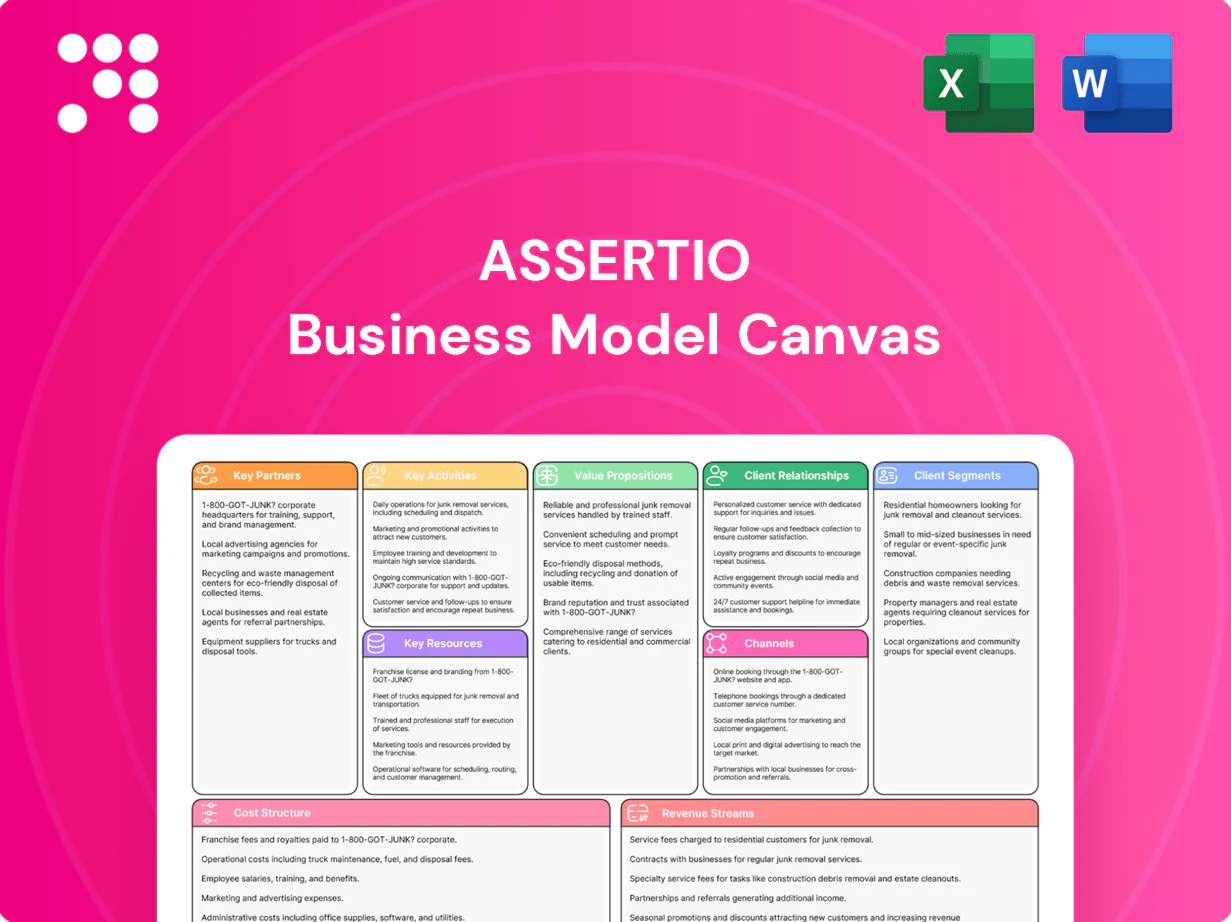
Assertio Business Model Canvas

Unlock the strategic Business Model Canvas investors and founders rely on—download now
Unlock Assertio’s strategic blueprint with our Business Model Canvas—three to five clear sentences won’t do it justice, so get the full version to see how value, channels, partnerships and revenue interlock. Perfect for investors, consultants, and founders seeking actionable, ready-to-use insights. Purchase the complete Word/Excel canvas to benchmark, strategize, and scale with confidence.
Partnerships

CDMOs and contract manufacturers
Third-party CDMOs and contract manufacturers let Assertio scale production reliably and compliantly, tapping a global CDMO market estimated at roughly $47 billion in 2024. They enable rapid tech transfers for acquired products, shortening time-to-revenue and preserving margin. Firm quality and supply agreements secure continuity and cost control, while dual-sourcing strategies mitigate shortages and recall-related disruptions.
CROs and clinical research partners
CROs support Assertio’s post-marketing studies and label-expansion programs, handling trial operations, data management and biostatistics. Evidence generated by CRO-led studies strengthens payer value dossiers and reimbursement negotiations. Timely readouts from CRO partnerships de-risk regulatory interactions and approvals. The global CRO market exceeded $60 billion in 2024, underscoring available capacity and expertise.

Licensing and acquisition partners
Originators and smaller biotechs supply Assertio with pipeline and in-market assets, particularly in neurology and pain. Deal structures commonly include upfronts of $1–50M, development and commercial milestones up to $500M, and royalties typically 5–20%. Rights acquisitions are prioritized for neurology and pain indications. Standardized integration playbooks can reduce commercialization time by roughly 30%.

Distributors, wholesalers, and specialty pharmacies
Channel partners expand Assertio’s national reach and service levels, managing inventory, cold chain logistics and chargebacks across retail and specialty channels. Data feeds from distributors and pharmacies improve demand forecasting and regulatory compliance, lowering stockouts and claims errors. In 2024 specialty medicines comprised about 55% of U.S. drug spend, underscoring specialty pharmacy importance for benefits verification and adherence programs.
- National reach: expanded service footprint
- Operations: inventory, cold chain, chargeback management
- Data: feeds → better forecasting & compliance
- Specialty pharmacies: benefits verification & adherence
Payers, PBMs, and GPOs
Payers, PBMs, and GPOs determine coverage, tiering, and rebates for Assertio products; the top three PBMs (CVS Caremark, Express Scripts, OptumRx) handle roughly 80% of U.S. prescription claims (2024), while the top four GPOs serve about 75% of hospitals (2024). Contracting aligns economics with outcomes via value-based terms and rebate triggers tied to utilization and clinical benchmarks. Ongoing analytics and RWE monitor adherence to contracts and sustain realized value.
- Coverage impact: top 3 PBMs ~80% (2024)
- Hospital access: top 4 GPOs ~75% (2024)
- Contract focus: outcomes-linked rebates and tiering
- Analytics: RWE to validate adherence and payment triggers
CDMO/CRO alliances, originator deals and PBM dominance reshape 2024 drug access
CDMOs ($47B 2024) and dual-sourcing secure supply and fast tech transfers; CROs ($60B 2024) deliver RWE and trials; originator deals (upfront $1–50M, milestones to $500M, royalties 5–20%) fuel neurology/pain pipeline; PBMs/GPOs (top3 PBMs ~80%, top4 GPOs ~75% 2024) and specialty pharmacies (55% of US drug spend 2024) control access and reimbursement.
| Partner | Role | 2024 Metric |
|---|---|---|
| CDMOs | Manufacturing/scale | $47B market |
| CROs | Trials/RWE | $60B market |
| PBMs/GPOs | Access/contracting | Top3 PBMs ~80%; Top4 GPOs ~75% |
| Biotechs | Assets/licensing | Deals: $1–50M upfront; milestones to $500M |
What is included in the product
 Detailed Word Document
A comprehensive Business Model Canvas for Assertio that maps its nine blocks with detailed customer segments, channels, value propositions, revenue streams and cost structure. Designed for investors and analysts, it includes competitive advantage analysis, linked SWOT insights, and practical validation using real company data for presentations and strategic planning.

 Customizable Excel Spreadsheet
High-level view of Assertio’s business model with editable cells, relieving pain by quickly surfacing commercialization gaps, patient access barriers, and cost drivers so teams can align on priorities.
Activities

Product acquisition and licensing
Sourcing targets with clear clinical and commercial differentiation is core, prioritizing assets with novel mechanisms or payer-relevant profiles. Diligence rigorously evaluates efficacy data, remaining patent life and market access scenarios; clinical attrition is approximately 90% from preclinical to approval. Deal execution balances risk via staged milestone payments and royalties. Integration activates supply chains, pricing strategies and field deployment to realize uptake.
Commercialization and field execution
Commercialization and field execution focus promotional efforts on neurology, hospital, and pain specialists, with account management driving formulary placement and pull-through across target sites. Non-personal promotion, now ~40% of pharma marketing spend in 2024, augments reach efficiently. Dedicated account teams and field reps use performance dashboards to guide territory actions and optimize ROI.

Regulatory and quality management
Assertio maintains approvals and ongoing post-market commitments across its portfolio; change controls and CMC governance protect continuity of supply. Safety reporting follows ICH/FDA expedited timelines (15 days for serious/unexpected cases) and PBRER annual cycles as of 2024. Inspection readiness is continuously maintained via SOPs, mock audits and corrective action tracking.

Market access and pricing strategy
Value dossiers and HEOR quantify clinical and economic impact to payers, while contracting shapes rebates and net pricing to protect margin. Copay assistance and patient assistance programs cut access friction and lower abandonment. Real-world evidence, endorsed in 2024 FDA and payer guidance, refines positioning and supports formulary decisions.
- HEOR: payer-facing value dossiers
- Contracting: rebate/net-price optimization
- Access: copay/PAP to reduce abandonment
- RWE: 2024-guided payer validation
Supply chain and demand planning
S&OP synchronizes forecasts, inventory and service-level targets to reduce stockouts while aiming to protect Assertio’s product availability; cross-functional plans use rolling 12‑month forecasts and monthly cadence. Vendor oversight audits capacity and quality to secure supply; contractual KPIs track fill rate and lead time. Risk buffers—safety stock and secondary sourcing—anticipate shortages and recalls. Serialization and regulatory compliance (EU FMD/US DSCSA) protect product integrity.
- S&OP: rolling 12‑month forecasts
- Vendor oversight: KPIs for fill rate/lead time
- Risk buffers: multi-sourcing, safety stock
- Serialization/compliance: EU FMD & US DSCSA coverage
Mitigate 90% attrition using HEOR, RWE and copay strategies
Sourcing prioritizes assets with novel mechanisms and payer-relevant profiles; preclinical-to-approval attrition is ~90%. Commercial execution mixes field reps and non-personal promotion (~40% of 2024 pharma spend) to drive formulary placement. Quality/S&OP use rolling 12‑month forecasts, vendor KPIs (target fill rate 95%) and multi-sourcing to secure supply. HEOR, RWE and copay programs (up to 30% reduction in abandonment) support access.
| Metric | 2024 Value |
|---|---|
| Clinical attrition | ~90% |
| Non-personal promotion | ~40% of spend |
| Target fill rate | 95% |
| Safety reporting | 15 days (serious) |
| Copay impact | ≤30% lower abandonment |
Full Document Unlocks After Purchase
Business Model Canvas
The document you're previewing is the exact Assertio Business Model Canvas you'll receive—no mockups or condensed samples. After purchase you'll get the full, editable file formatted exactly as shown, ready for editing, presenting, or sharing. Instant download in Word and Excel formats ensures seamless use.

Unlock the strategic Business Model Canvas investors and founders rely on—download now
Unlock Assertio’s strategic blueprint with our Business Model Canvas—three to five clear sentences won’t do it justice, so get the full version to see how value, channels, partnerships and revenue interlock. Perfect for investors, consultants, and founders seeking actionable, ready-to-use insights. Purchase the complete Word/Excel canvas to benchmark, strategize, and scale with confidence.
Partnerships
CDMOs and contract manufacturers
Third-party CDMOs and contract manufacturers let Assertio scale production reliably and compliantly, tapping a global CDMO market estimated at roughly $47 billion in 2024. They enable rapid tech transfers for acquired products, shortening time-to-revenue and preserving margin. Firm quality and supply agreements secure continuity and cost control, while dual-sourcing strategies mitigate shortages and recall-related disruptions.
CROs and clinical research partners
CROs support Assertio’s post-marketing studies and label-expansion programs, handling trial operations, data management and biostatistics. Evidence generated by CRO-led studies strengthens payer value dossiers and reimbursement negotiations. Timely readouts from CRO partnerships de-risk regulatory interactions and approvals. The global CRO market exceeded $60 billion in 2024, underscoring available capacity and expertise.
Licensing and acquisition partners
Originators and smaller biotechs supply Assertio with pipeline and in-market assets, particularly in neurology and pain. Deal structures commonly include upfronts of $1–50M, development and commercial milestones up to $500M, and royalties typically 5–20%. Rights acquisitions are prioritized for neurology and pain indications. Standardized integration playbooks can reduce commercialization time by roughly 30%.
Distributors, wholesalers, and specialty pharmacies
Channel partners expand Assertio’s national reach and service levels, managing inventory, cold chain logistics and chargebacks across retail and specialty channels. Data feeds from distributors and pharmacies improve demand forecasting and regulatory compliance, lowering stockouts and claims errors. In 2024 specialty medicines comprised about 55% of U.S. drug spend, underscoring specialty pharmacy importance for benefits verification and adherence programs.
- National reach: expanded service footprint
- Operations: inventory, cold chain, chargeback management
- Data: feeds → better forecasting & compliance
- Specialty pharmacies: benefits verification & adherence
Payers, PBMs, and GPOs
Payers, PBMs, and GPOs determine coverage, tiering, and rebates for Assertio products; the top three PBMs (CVS Caremark, Express Scripts, OptumRx) handle roughly 80% of U.S. prescription claims (2024), while the top four GPOs serve about 75% of hospitals (2024). Contracting aligns economics with outcomes via value-based terms and rebate triggers tied to utilization and clinical benchmarks. Ongoing analytics and RWE monitor adherence to contracts and sustain realized value.
- Coverage impact: top 3 PBMs ~80% (2024)
- Hospital access: top 4 GPOs ~75% (2024)
- Contract focus: outcomes-linked rebates and tiering
- Analytics: RWE to validate adherence and payment triggers
CDMO/CRO alliances, originator deals and PBM dominance reshape 2024 drug access
CDMOs ($47B 2024) and dual-sourcing secure supply and fast tech transfers; CROs ($60B 2024) deliver RWE and trials; originator deals (upfront $1–50M, milestones to $500M, royalties 5–20%) fuel neurology/pain pipeline; PBMs/GPOs (top3 PBMs ~80%, top4 GPOs ~75% 2024) and specialty pharmacies (55% of US drug spend 2024) control access and reimbursement.
| Partner | Role | 2024 Metric |
|---|---|---|
| CDMOs | Manufacturing/scale | $47B market |
| CROs | Trials/RWE | $60B market |
| PBMs/GPOs | Access/contracting | Top3 PBMs ~80%; Top4 GPOs ~75% |
| Biotechs | Assets/licensing | Deals: $1–50M upfront; milestones to $500M |
What is included in the product
Detailed Word Document
A comprehensive Business Model Canvas for Assertio that maps its nine blocks with detailed customer segments, channels, value propositions, revenue streams and cost structure. Designed for investors and analysts, it includes competitive advantage analysis, linked SWOT insights, and practical validation using real company data for presentations and strategic planning.
Customizable Excel Spreadsheet
High-level view of Assertio’s business model with editable cells, relieving pain by quickly surfacing commercialization gaps, patient access barriers, and cost drivers so teams can align on priorities.
Activities
Product acquisition and licensing
Sourcing targets with clear clinical and commercial differentiation is core, prioritizing assets with novel mechanisms or payer-relevant profiles. Diligence rigorously evaluates efficacy data, remaining patent life and market access scenarios; clinical attrition is approximately 90% from preclinical to approval. Deal execution balances risk via staged milestone payments and royalties. Integration activates supply chains, pricing strategies and field deployment to realize uptake.
Commercialization and field execution
Commercialization and field execution focus promotional efforts on neurology, hospital, and pain specialists, with account management driving formulary placement and pull-through across target sites. Non-personal promotion, now ~40% of pharma marketing spend in 2024, augments reach efficiently. Dedicated account teams and field reps use performance dashboards to guide territory actions and optimize ROI.
Regulatory and quality management
Assertio maintains approvals and ongoing post-market commitments across its portfolio; change controls and CMC governance protect continuity of supply. Safety reporting follows ICH/FDA expedited timelines (15 days for serious/unexpected cases) and PBRER annual cycles as of 2024. Inspection readiness is continuously maintained via SOPs, mock audits and corrective action tracking.
Market access and pricing strategy
Value dossiers and HEOR quantify clinical and economic impact to payers, while contracting shapes rebates and net pricing to protect margin. Copay assistance and patient assistance programs cut access friction and lower abandonment. Real-world evidence, endorsed in 2024 FDA and payer guidance, refines positioning and supports formulary decisions.
- HEOR: payer-facing value dossiers
- Contracting: rebate/net-price optimization
- Access: copay/PAP to reduce abandonment
- RWE: 2024-guided payer validation
Supply chain and demand planning
S&OP synchronizes forecasts, inventory and service-level targets to reduce stockouts while aiming to protect Assertio’s product availability; cross-functional plans use rolling 12‑month forecasts and monthly cadence. Vendor oversight audits capacity and quality to secure supply; contractual KPIs track fill rate and lead time. Risk buffers—safety stock and secondary sourcing—anticipate shortages and recalls. Serialization and regulatory compliance (EU FMD/US DSCSA) protect product integrity.
- S&OP: rolling 12‑month forecasts
- Vendor oversight: KPIs for fill rate/lead time
- Risk buffers: multi-sourcing, safety stock
- Serialization/compliance: EU FMD & US DSCSA coverage
Mitigate 90% attrition using HEOR, RWE and copay strategies
Sourcing prioritizes assets with novel mechanisms and payer-relevant profiles; preclinical-to-approval attrition is ~90%. Commercial execution mixes field reps and non-personal promotion (~40% of 2024 pharma spend) to drive formulary placement. Quality/S&OP use rolling 12‑month forecasts, vendor KPIs (target fill rate 95%) and multi-sourcing to secure supply. HEOR, RWE and copay programs (up to 30% reduction in abandonment) support access.
| Metric | 2024 Value |
|---|---|
| Clinical attrition | ~90% |
| Non-personal promotion | ~40% of spend |
| Target fill rate | 95% |
| Safety reporting | 15 days (serious) |
| Copay impact | ≤30% lower abandonment |
Full Document Unlocks After Purchase
Business Model Canvas
The document you're previewing is the exact Assertio Business Model Canvas you'll receive—no mockups or condensed samples. After purchase you'll get the full, editable file formatted exactly as shown, ready for editing, presenting, or sharing. Instant download in Word and Excel formats ensures seamless use.
Description
Unlock the strategic Business Model Canvas investors and founders rely on—download now
Unlock Assertio’s strategic blueprint with our Business Model Canvas—three to five clear sentences won’t do it justice, so get the full version to see how value, channels, partnerships and revenue interlock. Perfect for investors, consultants, and founders seeking actionable, ready-to-use insights. Purchase the complete Word/Excel canvas to benchmark, strategize, and scale with confidence.
Partnerships
CDMOs and contract manufacturers
Third-party CDMOs and contract manufacturers let Assertio scale production reliably and compliantly, tapping a global CDMO market estimated at roughly $47 billion in 2024. They enable rapid tech transfers for acquired products, shortening time-to-revenue and preserving margin. Firm quality and supply agreements secure continuity and cost control, while dual-sourcing strategies mitigate shortages and recall-related disruptions.
CROs and clinical research partners
CROs support Assertio’s post-marketing studies and label-expansion programs, handling trial operations, data management and biostatistics. Evidence generated by CRO-led studies strengthens payer value dossiers and reimbursement negotiations. Timely readouts from CRO partnerships de-risk regulatory interactions and approvals. The global CRO market exceeded $60 billion in 2024, underscoring available capacity and expertise.
Licensing and acquisition partners
Originators and smaller biotechs supply Assertio with pipeline and in-market assets, particularly in neurology and pain. Deal structures commonly include upfronts of $1–50M, development and commercial milestones up to $500M, and royalties typically 5–20%. Rights acquisitions are prioritized for neurology and pain indications. Standardized integration playbooks can reduce commercialization time by roughly 30%.
Distributors, wholesalers, and specialty pharmacies
Channel partners expand Assertio’s national reach and service levels, managing inventory, cold chain logistics and chargebacks across retail and specialty channels. Data feeds from distributors and pharmacies improve demand forecasting and regulatory compliance, lowering stockouts and claims errors. In 2024 specialty medicines comprised about 55% of U.S. drug spend, underscoring specialty pharmacy importance for benefits verification and adherence programs.
- National reach: expanded service footprint
- Operations: inventory, cold chain, chargeback management
- Data: feeds → better forecasting & compliance
- Specialty pharmacies: benefits verification & adherence
Payers, PBMs, and GPOs
Payers, PBMs, and GPOs determine coverage, tiering, and rebates for Assertio products; the top three PBMs (CVS Caremark, Express Scripts, OptumRx) handle roughly 80% of U.S. prescription claims (2024), while the top four GPOs serve about 75% of hospitals (2024). Contracting aligns economics with outcomes via value-based terms and rebate triggers tied to utilization and clinical benchmarks. Ongoing analytics and RWE monitor adherence to contracts and sustain realized value.
- Coverage impact: top 3 PBMs ~80% (2024)
- Hospital access: top 4 GPOs ~75% (2024)
- Contract focus: outcomes-linked rebates and tiering
- Analytics: RWE to validate adherence and payment triggers
CDMO/CRO alliances, originator deals and PBM dominance reshape 2024 drug access
CDMOs ($47B 2024) and dual-sourcing secure supply and fast tech transfers; CROs ($60B 2024) deliver RWE and trials; originator deals (upfront $1–50M, milestones to $500M, royalties 5–20%) fuel neurology/pain pipeline; PBMs/GPOs (top3 PBMs ~80%, top4 GPOs ~75% 2024) and specialty pharmacies (55% of US drug spend 2024) control access and reimbursement.
| Partner | Role | 2024 Metric |
|---|---|---|
| CDMOs | Manufacturing/scale | $47B market |
| CROs | Trials/RWE | $60B market |
| PBMs/GPOs | Access/contracting | Top3 PBMs ~80%; Top4 GPOs ~75% |
| Biotechs | Assets/licensing | Deals: $1–50M upfront; milestones to $500M |
What is included in the product
Detailed Word Document
A comprehensive Business Model Canvas for Assertio that maps its nine blocks with detailed customer segments, channels, value propositions, revenue streams and cost structure. Designed for investors and analysts, it includes competitive advantage analysis, linked SWOT insights, and practical validation using real company data for presentations and strategic planning.
Customizable Excel Spreadsheet
High-level view of Assertio’s business model with editable cells, relieving pain by quickly surfacing commercialization gaps, patient access barriers, and cost drivers so teams can align on priorities.
Activities
Product acquisition and licensing
Sourcing targets with clear clinical and commercial differentiation is core, prioritizing assets with novel mechanisms or payer-relevant profiles. Diligence rigorously evaluates efficacy data, remaining patent life and market access scenarios; clinical attrition is approximately 90% from preclinical to approval. Deal execution balances risk via staged milestone payments and royalties. Integration activates supply chains, pricing strategies and field deployment to realize uptake.
Commercialization and field execution
Commercialization and field execution focus promotional efforts on neurology, hospital, and pain specialists, with account management driving formulary placement and pull-through across target sites. Non-personal promotion, now ~40% of pharma marketing spend in 2024, augments reach efficiently. Dedicated account teams and field reps use performance dashboards to guide territory actions and optimize ROI.
Regulatory and quality management
Assertio maintains approvals and ongoing post-market commitments across its portfolio; change controls and CMC governance protect continuity of supply. Safety reporting follows ICH/FDA expedited timelines (15 days for serious/unexpected cases) and PBRER annual cycles as of 2024. Inspection readiness is continuously maintained via SOPs, mock audits and corrective action tracking.
Market access and pricing strategy
Value dossiers and HEOR quantify clinical and economic impact to payers, while contracting shapes rebates and net pricing to protect margin. Copay assistance and patient assistance programs cut access friction and lower abandonment. Real-world evidence, endorsed in 2024 FDA and payer guidance, refines positioning and supports formulary decisions.
- HEOR: payer-facing value dossiers
- Contracting: rebate/net-price optimization
- Access: copay/PAP to reduce abandonment
- RWE: 2024-guided payer validation
Supply chain and demand planning
S&OP synchronizes forecasts, inventory and service-level targets to reduce stockouts while aiming to protect Assertio’s product availability; cross-functional plans use rolling 12‑month forecasts and monthly cadence. Vendor oversight audits capacity and quality to secure supply; contractual KPIs track fill rate and lead time. Risk buffers—safety stock and secondary sourcing—anticipate shortages and recalls. Serialization and regulatory compliance (EU FMD/US DSCSA) protect product integrity.
- S&OP: rolling 12‑month forecasts
- Vendor oversight: KPIs for fill rate/lead time
- Risk buffers: multi-sourcing, safety stock
- Serialization/compliance: EU FMD & US DSCSA coverage
Mitigate 90% attrition using HEOR, RWE and copay strategies
Sourcing prioritizes assets with novel mechanisms and payer-relevant profiles; preclinical-to-approval attrition is ~90%. Commercial execution mixes field reps and non-personal promotion (~40% of 2024 pharma spend) to drive formulary placement. Quality/S&OP use rolling 12‑month forecasts, vendor KPIs (target fill rate 95%) and multi-sourcing to secure supply. HEOR, RWE and copay programs (up to 30% reduction in abandonment) support access.
| Metric | 2024 Value |
|---|---|
| Clinical attrition | ~90% |
| Non-personal promotion | ~40% of spend |
| Target fill rate | 95% |
| Safety reporting | 15 days (serious) |
| Copay impact | ≤30% lower abandonment |
Full Document Unlocks After Purchase
Business Model Canvas
The document you're previewing is the exact Assertio Business Model Canvas you'll receive—no mockups or condensed samples. After purchase you'll get the full, editable file formatted exactly as shown, ready for editing, presenting, or sharing. Instant download in Word and Excel formats ensures seamless use.











