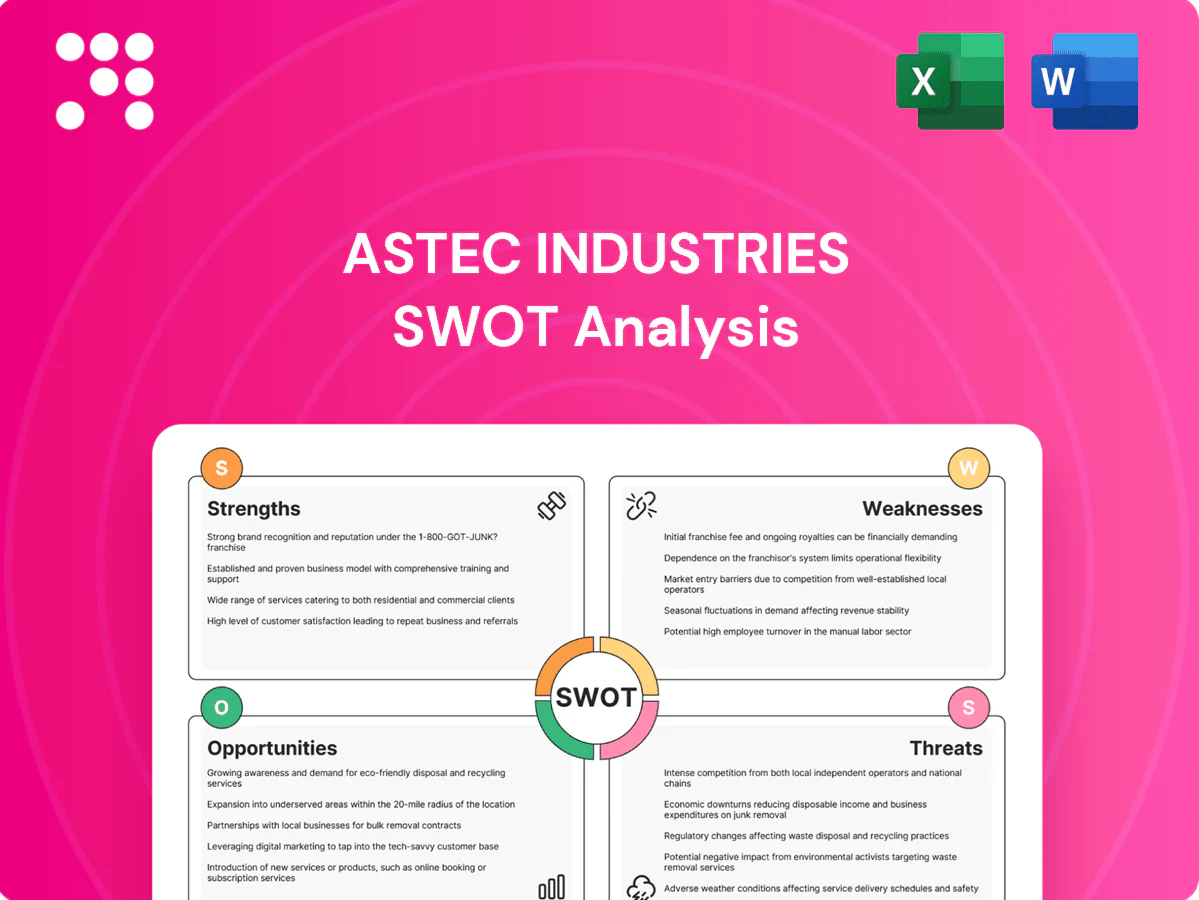
Astec Industries SWOT Analysis

Dive Deeper Into the Company’s Strategic Blueprint
Astec Industries’ SWOT highlights robust product diversification and strong aftermarket revenue, balanced by exposure to cyclical construction markets and raw material cost pressure. Discover detailed risks, strategic opportunities, and financial context to inform decisions. Purchase the full SWOT for a professionally formatted Word and Excel package to strategize and invest with confidence.
Strengths

Diverse product portfolio
Astec’s product range spans asphalt plants, crushing and screening, concrete plants and ancillary machinery, reducing reliance on any single niche.
This breadth enables cross-selling and integrated turnkey solutions for road building and materials processing, strengthening bid competitiveness on global tenders.
Portfolio diversity creates resilience across construction and mining cycles, smoothing revenue volatility and supporting long-term contract wins.
Global customer reach
Astec Industries serves customers across six continents and 70+ countries, spreading demand across regions and currencies. Its global distribution and service network—with dozens of regional service centers—boosts equipment uptime and lifetime value. Exposure to differing infrastructure cycles helps smooth revenue volatility and reinforces brand trust in mission-critical applications.

Strong infrastructure focus
Astec’s core alignment with roadbuilding and public works benefits directly from multi-year programs such as the Bipartisan Infrastructure Law (2021) totaling $1.2 trillion, which underpins sustained project pipelines. Government-backed infrastructure spending creates relatively visible demand that supports large backlog potential and repeat equipment orders. This specialization differentiates Astec in regulation-heavy, mission-critical applications.

Aftermarket and services
Astec’s parts, retrofits and maintenance drive recurring, higher-margin revenue—industry norms show aftermarket/service margins often 30–50% versus lower new-equipment margins—supporting gross profitability and stabilizing cash flow when new-equipment orders slow. Embedded service capability boosts machine utilization and retention, reducing client switching and lifecycle churn.
- Recurring revenue: higher margins
- Retention: embedded support lowers switching
- Utilization: improves uptime
- Stabilizes cashflow vs new-equipment cycles
Engineering and customization
Astec Industries (NYSE: ASTE) leverages deep engineering and plant customization to tailor systems to site specifications, creating a durable competitive moat that raises switching costs and supports higher project margins. This capability ensures compliance with local standards and environmental rules, enabling premium pricing on complex projects. In 2024 ASTE emphasized bespoke solutions across infrastructure and aggregate markets.
- Site-specific designs increase switching costs
- Customization drives margin uplift and premium positioning
- Enables regulatory and environmental compliance
Diversified infrastructure equipment reduces market risk and stabilizes cash flow
Astec’s diversified lineup across asphalt, crushing, concrete and services reduces single-market risk and enables turnkey bids. Its global footprint (70+ countries, six continents) and regional service centers raise uptime and retention. Aftermarket/maintenance (30–50% typical margins) stabilizes cash flow versus new-equipment cycles. Focus on bespoke plant engineering increases switching costs and supports premium pricing.
| Metric | Value |
|---|---|
| Global reach | 70+ countries, 6 continents |
| Aftermarket margins | 30–50% (industry norm) |
| Infrastructure support | $1.2T Bipartisan Infrastructure Law |
| Listing | NYSE: ASTE |
What is included in the product
 Detailed Word Document
Delivers a strategic overview of Astec Industries’s internal and external business factors, outlining strengths, weaknesses, opportunities, and threats that shape its competitive position in construction equipment and infrastructure markets.

 Customizable Excel Spreadsheet
Provides a concise, visual SWOT matrix for Astec Industries that streamlines strategic alignment and eases stakeholder briefings with an editable, at-a-glance snapshot.
Weaknesses

Cyclical end markets
Cyclical end markets in construction, aggregates, and mining mean demand moves with macro cycles and commodity prices, so equipment orders can be deferred rapidly in downturns; this cyclicality pressures utilization and compresses margins, and makes forecasting and capacity planning significantly more challenging.
High capital intensity
High capital intensity at Astec requires substantial investment in manufacturing plants, inventory and R&D, with equipment build cycles commonly spanning 6–18 months and project-based deliveries tying up working capital. Working capital swings have historically reached tens of millions in soft periods, compressing free cash flow and limiting flexibility for M&A or larger shareholder returns. This asset-heavy model constrains rapid reallocation of capital.

Complex supply chain
Astec Industries' complex supply chain, detailed in its 2024 Form 10-K, hinges on metals, engines, hydraulics and electronic controls, exposing the firm to raw-material and component price volatility. Supplier concentration and parts shortages have delayed deliveries and increased lead-time variability, straining project schedules. Periods of cost inflation have at times outpaced Astec's pricing power, pressuring margins and working capital.

Project execution risk
Large, customized systems expose Astec to engineering, installation, and commissioning risks that in 2024 coincided with $1.69B in revenue, where scope creep and site issues compressed gross margins on several project lines.
Warranty and performance guarantees created downside exposure, and execution missteps in 2024 hurt reputation and slowed cash conversion from a reported $376M backlog.
- Engineering/installation risk
- Scope creep erodes margins
- Warranty/performance exposure
- Execution hits reputation & cash conversion
Competitive pressure
Global OEMs and regional specialists pressure Astec on price, performance and after-sales service, forcing margin-sensitive responses; tender-driven sales in weak markets amplify discounting and reduce realized prices. Continuous R&D is required to defend differentiation, while customer consolidation raises bargaining power and lengthens payment and delivery negotiations.
- Competitive pricing pressure
- Tender-driven discounting
- Ongoing R&D cost burden
- Stronger customer bargaining
Cyclical construction/mining demand strains cash despite $1.69B
Astec faces severe cyclicality in construction/mining end markets, making orders and utilization volatile. High capital intensity ties up cash despite $1.69B revenue in 2024 and a $376M backlog, with working-capital swings of tens of millions. Complex supply chains and execution/warranty risks have compressed margins and lengthened cash conversion.
| Metric | Value |
|---|---|
| Revenue (2024) | $1.69B |
| Backlog (2024) | $376M |
| Working-capital swings | tens of millions |
What You See Is What You Get
Astec Industries SWOT Analysis
This is the actual SWOT analysis document for Astec Industries you’ll receive upon purchase—no surprises, just professional quality. The preview below is taken directly from the full report and reflects the same structured, editable content included in your download. Buy now to unlock the complete, in-depth version ready for immediate use.

Dive Deeper Into the Company’s Strategic Blueprint
Astec Industries’ SWOT highlights robust product diversification and strong aftermarket revenue, balanced by exposure to cyclical construction markets and raw material cost pressure. Discover detailed risks, strategic opportunities, and financial context to inform decisions. Purchase the full SWOT for a professionally formatted Word and Excel package to strategize and invest with confidence.
Strengths
Diverse product portfolio
Astec’s product range spans asphalt plants, crushing and screening, concrete plants and ancillary machinery, reducing reliance on any single niche.
This breadth enables cross-selling and integrated turnkey solutions for road building and materials processing, strengthening bid competitiveness on global tenders.
Portfolio diversity creates resilience across construction and mining cycles, smoothing revenue volatility and supporting long-term contract wins.
Global customer reach
Astec Industries serves customers across six continents and 70+ countries, spreading demand across regions and currencies. Its global distribution and service network—with dozens of regional service centers—boosts equipment uptime and lifetime value. Exposure to differing infrastructure cycles helps smooth revenue volatility and reinforces brand trust in mission-critical applications.
Strong infrastructure focus
Astec’s core alignment with roadbuilding and public works benefits directly from multi-year programs such as the Bipartisan Infrastructure Law (2021) totaling $1.2 trillion, which underpins sustained project pipelines. Government-backed infrastructure spending creates relatively visible demand that supports large backlog potential and repeat equipment orders. This specialization differentiates Astec in regulation-heavy, mission-critical applications.
Aftermarket and services
Astec’s parts, retrofits and maintenance drive recurring, higher-margin revenue—industry norms show aftermarket/service margins often 30–50% versus lower new-equipment margins—supporting gross profitability and stabilizing cash flow when new-equipment orders slow. Embedded service capability boosts machine utilization and retention, reducing client switching and lifecycle churn.
- Recurring revenue: higher margins
- Retention: embedded support lowers switching
- Utilization: improves uptime
- Stabilizes cashflow vs new-equipment cycles
Engineering and customization
Astec Industries (NYSE: ASTE) leverages deep engineering and plant customization to tailor systems to site specifications, creating a durable competitive moat that raises switching costs and supports higher project margins. This capability ensures compliance with local standards and environmental rules, enabling premium pricing on complex projects. In 2024 ASTE emphasized bespoke solutions across infrastructure and aggregate markets.
- Site-specific designs increase switching costs
- Customization drives margin uplift and premium positioning
- Enables regulatory and environmental compliance
Diversified infrastructure equipment reduces market risk and stabilizes cash flow
Astec’s diversified lineup across asphalt, crushing, concrete and services reduces single-market risk and enables turnkey bids. Its global footprint (70+ countries, six continents) and regional service centers raise uptime and retention. Aftermarket/maintenance (30–50% typical margins) stabilizes cash flow versus new-equipment cycles. Focus on bespoke plant engineering increases switching costs and supports premium pricing.
| Metric | Value |
|---|---|
| Global reach | 70+ countries, 6 continents |
| Aftermarket margins | 30–50% (industry norm) |
| Infrastructure support | $1.2T Bipartisan Infrastructure Law |
| Listing | NYSE: ASTE |
What is included in the product
Detailed Word Document
Delivers a strategic overview of Astec Industries’s internal and external business factors, outlining strengths, weaknesses, opportunities, and threats that shape its competitive position in construction equipment and infrastructure markets.
Customizable Excel Spreadsheet
Provides a concise, visual SWOT matrix for Astec Industries that streamlines strategic alignment and eases stakeholder briefings with an editable, at-a-glance snapshot.
Weaknesses
Cyclical end markets
Cyclical end markets in construction, aggregates, and mining mean demand moves with macro cycles and commodity prices, so equipment orders can be deferred rapidly in downturns; this cyclicality pressures utilization and compresses margins, and makes forecasting and capacity planning significantly more challenging.
High capital intensity
High capital intensity at Astec requires substantial investment in manufacturing plants, inventory and R&D, with equipment build cycles commonly spanning 6–18 months and project-based deliveries tying up working capital. Working capital swings have historically reached tens of millions in soft periods, compressing free cash flow and limiting flexibility for M&A or larger shareholder returns. This asset-heavy model constrains rapid reallocation of capital.
Complex supply chain
Astec Industries' complex supply chain, detailed in its 2024 Form 10-K, hinges on metals, engines, hydraulics and electronic controls, exposing the firm to raw-material and component price volatility. Supplier concentration and parts shortages have delayed deliveries and increased lead-time variability, straining project schedules. Periods of cost inflation have at times outpaced Astec's pricing power, pressuring margins and working capital.
Project execution risk
Large, customized systems expose Astec to engineering, installation, and commissioning risks that in 2024 coincided with $1.69B in revenue, where scope creep and site issues compressed gross margins on several project lines.
Warranty and performance guarantees created downside exposure, and execution missteps in 2024 hurt reputation and slowed cash conversion from a reported $376M backlog.
- Engineering/installation risk
- Scope creep erodes margins
- Warranty/performance exposure
- Execution hits reputation & cash conversion
Competitive pressure
Global OEMs and regional specialists pressure Astec on price, performance and after-sales service, forcing margin-sensitive responses; tender-driven sales in weak markets amplify discounting and reduce realized prices. Continuous R&D is required to defend differentiation, while customer consolidation raises bargaining power and lengthens payment and delivery negotiations.
- Competitive pricing pressure
- Tender-driven discounting
- Ongoing R&D cost burden
- Stronger customer bargaining
Cyclical construction/mining demand strains cash despite $1.69B
Astec faces severe cyclicality in construction/mining end markets, making orders and utilization volatile. High capital intensity ties up cash despite $1.69B revenue in 2024 and a $376M backlog, with working-capital swings of tens of millions. Complex supply chains and execution/warranty risks have compressed margins and lengthened cash conversion.
| Metric | Value |
|---|---|
| Revenue (2024) | $1.69B |
| Backlog (2024) | $376M |
| Working-capital swings | tens of millions |
What You See Is What You Get
Astec Industries SWOT Analysis
This is the actual SWOT analysis document for Astec Industries you’ll receive upon purchase—no surprises, just professional quality. The preview below is taken directly from the full report and reflects the same structured, editable content included in your download. Buy now to unlock the complete, in-depth version ready for immediate use.
Description
Dive Deeper Into the Company’s Strategic Blueprint
Astec Industries’ SWOT highlights robust product diversification and strong aftermarket revenue, balanced by exposure to cyclical construction markets and raw material cost pressure. Discover detailed risks, strategic opportunities, and financial context to inform decisions. Purchase the full SWOT for a professionally formatted Word and Excel package to strategize and invest with confidence.
Strengths
Diverse product portfolio
Astec’s product range spans asphalt plants, crushing and screening, concrete plants and ancillary machinery, reducing reliance on any single niche.
This breadth enables cross-selling and integrated turnkey solutions for road building and materials processing, strengthening bid competitiveness on global tenders.
Portfolio diversity creates resilience across construction and mining cycles, smoothing revenue volatility and supporting long-term contract wins.
Global customer reach
Astec Industries serves customers across six continents and 70+ countries, spreading demand across regions and currencies. Its global distribution and service network—with dozens of regional service centers—boosts equipment uptime and lifetime value. Exposure to differing infrastructure cycles helps smooth revenue volatility and reinforces brand trust in mission-critical applications.
Strong infrastructure focus
Astec’s core alignment with roadbuilding and public works benefits directly from multi-year programs such as the Bipartisan Infrastructure Law (2021) totaling $1.2 trillion, which underpins sustained project pipelines. Government-backed infrastructure spending creates relatively visible demand that supports large backlog potential and repeat equipment orders. This specialization differentiates Astec in regulation-heavy, mission-critical applications.
Aftermarket and services
Astec’s parts, retrofits and maintenance drive recurring, higher-margin revenue—industry norms show aftermarket/service margins often 30–50% versus lower new-equipment margins—supporting gross profitability and stabilizing cash flow when new-equipment orders slow. Embedded service capability boosts machine utilization and retention, reducing client switching and lifecycle churn.
- Recurring revenue: higher margins
- Retention: embedded support lowers switching
- Utilization: improves uptime
- Stabilizes cashflow vs new-equipment cycles
Engineering and customization
Astec Industries (NYSE: ASTE) leverages deep engineering and plant customization to tailor systems to site specifications, creating a durable competitive moat that raises switching costs and supports higher project margins. This capability ensures compliance with local standards and environmental rules, enabling premium pricing on complex projects. In 2024 ASTE emphasized bespoke solutions across infrastructure and aggregate markets.
- Site-specific designs increase switching costs
- Customization drives margin uplift and premium positioning
- Enables regulatory and environmental compliance
Diversified infrastructure equipment reduces market risk and stabilizes cash flow
Astec’s diversified lineup across asphalt, crushing, concrete and services reduces single-market risk and enables turnkey bids. Its global footprint (70+ countries, six continents) and regional service centers raise uptime and retention. Aftermarket/maintenance (30–50% typical margins) stabilizes cash flow versus new-equipment cycles. Focus on bespoke plant engineering increases switching costs and supports premium pricing.
| Metric | Value |
|---|---|
| Global reach | 70+ countries, 6 continents |
| Aftermarket margins | 30–50% (industry norm) |
| Infrastructure support | $1.2T Bipartisan Infrastructure Law |
| Listing | NYSE: ASTE |
What is included in the product
Detailed Word Document
Delivers a strategic overview of Astec Industries’s internal and external business factors, outlining strengths, weaknesses, opportunities, and threats that shape its competitive position in construction equipment and infrastructure markets.
Customizable Excel Spreadsheet
Provides a concise, visual SWOT matrix for Astec Industries that streamlines strategic alignment and eases stakeholder briefings with an editable, at-a-glance snapshot.
Weaknesses
Cyclical end markets
Cyclical end markets in construction, aggregates, and mining mean demand moves with macro cycles and commodity prices, so equipment orders can be deferred rapidly in downturns; this cyclicality pressures utilization and compresses margins, and makes forecasting and capacity planning significantly more challenging.
High capital intensity
High capital intensity at Astec requires substantial investment in manufacturing plants, inventory and R&D, with equipment build cycles commonly spanning 6–18 months and project-based deliveries tying up working capital. Working capital swings have historically reached tens of millions in soft periods, compressing free cash flow and limiting flexibility for M&A or larger shareholder returns. This asset-heavy model constrains rapid reallocation of capital.
Complex supply chain
Astec Industries' complex supply chain, detailed in its 2024 Form 10-K, hinges on metals, engines, hydraulics and electronic controls, exposing the firm to raw-material and component price volatility. Supplier concentration and parts shortages have delayed deliveries and increased lead-time variability, straining project schedules. Periods of cost inflation have at times outpaced Astec's pricing power, pressuring margins and working capital.
Project execution risk
Large, customized systems expose Astec to engineering, installation, and commissioning risks that in 2024 coincided with $1.69B in revenue, where scope creep and site issues compressed gross margins on several project lines.
Warranty and performance guarantees created downside exposure, and execution missteps in 2024 hurt reputation and slowed cash conversion from a reported $376M backlog.
- Engineering/installation risk
- Scope creep erodes margins
- Warranty/performance exposure
- Execution hits reputation & cash conversion
Competitive pressure
Global OEMs and regional specialists pressure Astec on price, performance and after-sales service, forcing margin-sensitive responses; tender-driven sales in weak markets amplify discounting and reduce realized prices. Continuous R&D is required to defend differentiation, while customer consolidation raises bargaining power and lengthens payment and delivery negotiations.
- Competitive pricing pressure
- Tender-driven discounting
- Ongoing R&D cost burden
- Stronger customer bargaining
Cyclical construction/mining demand strains cash despite $1.69B
Astec faces severe cyclicality in construction/mining end markets, making orders and utilization volatile. High capital intensity ties up cash despite $1.69B revenue in 2024 and a $376M backlog, with working-capital swings of tens of millions. Complex supply chains and execution/warranty risks have compressed margins and lengthened cash conversion.
| Metric | Value |
|---|---|
| Revenue (2024) | $1.69B |
| Backlog (2024) | $376M |
| Working-capital swings | tens of millions |
What You See Is What You Get
Astec Industries SWOT Analysis
This is the actual SWOT analysis document for Astec Industries you’ll receive upon purchase—no surprises, just professional quality. The preview below is taken directly from the full report and reflects the same structured, editable content included in your download. Buy now to unlock the complete, in-depth version ready for immediate use.











