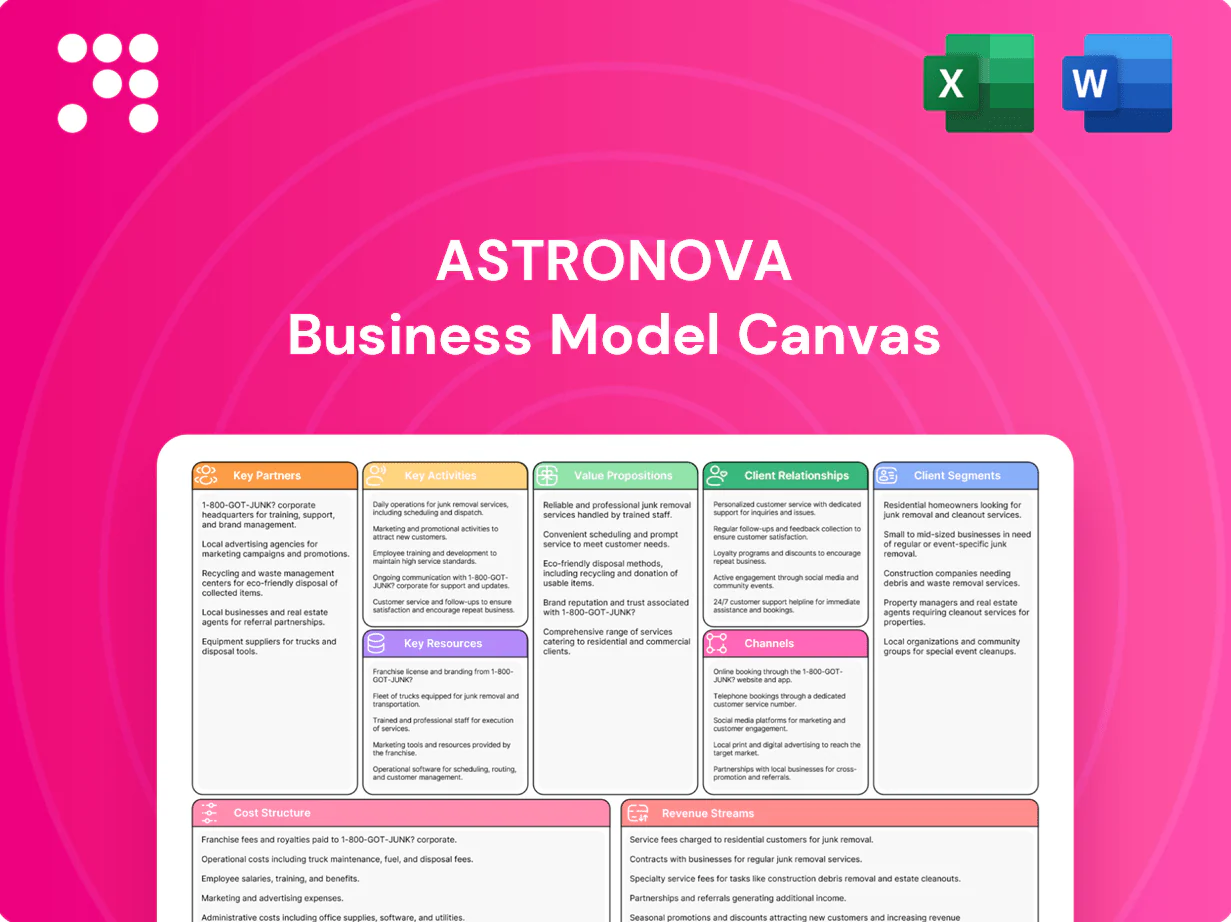
AstroNova Business Model Canvas

Strategic Business Model Canvas for Aerospace & Instrumentation Investors
Unlock AstroNova’s strategic blueprint with our Business Model Canvas — a concise, actionable map of its value propositions, revenue streams, key partners, and growth levers. Ideal for investors, consultants, and founders seeking practical insights. Download the full Word/Excel canvas to benchmark, plan, and capitalize on opportunities.
Partnerships

Critical Component Suppliers
Partnerships with printhead, sensor, electronics and specialty ink/media suppliers ensure product performance and supply continuity, with multi-sourcing across 2–3 qualified vendors reducing single-source exposure. Quality agreements and incoming inspection programs have cut defect escapes in similar OEMs by up to 40%. Joint development pilots have delivered ~10–12% BOM cost and performance gains. Long-term contracts often cover >70% of strategic spend to secure pricing and allocation.
Software & Firmware Ecosystem
Alliances with RIP, labeling, ERP/MES and analytics vendors create end-to-end workflows for AstroNova, leveraging a 2024 MES market (~$14.7B) to streamline factory integration. Robust APIs and SDKs enable deep embedding into customer stacks and reduced time-to-deploy. Co-development accelerates color management, variable-data printing and high-speed acquisition analytics. Certification programs reassure enterprise IT and regulated users.

Channel Partners & Distributors
Value-added resellers and regional distributors extend AstroNova’s market reach and provide local service, with channel-sourced orders representing roughly 30% of device shipments in 2024. Partner enablement ensures demos, trials, and technical support near the customer, cutting time-to-deploy by about 25%. Incentive programs align pipeline generation and install-base expansion, driving higher attach rates. Continuous feedback loops inform product roadmap and localization needs.

OEM/VAR Integrators
OEM/VAR integrators embed AstroNova printers and DAQ modules into bespoke systems and lines; co-branded or white-label deals enable niche verticals and large rollouts, with engineering collaboration across mechanical, electrical and software interfaces and shared service frameworks sustaining mission-critical uptime; industrial automation market ~$214B in 2024.
- OEM embedding: lowers integration time
- White-label: accelerates rollouts
- Engineering sync: ensures fit
- Shared services: boosts uptime
Standards, Compliance & Test Labs
Affiliations with regulatory bodies and accredited labs expedite certification, leveraging standards such as IEC 61000 and IEC 62368; ISO catalogs over 23,000 standards in 2024. Compliance to labeling, safety and EMC reduces buyer risk and warranty exposure. Pre-compliance testing accelerates market entry and lets AstroNova identify failures early.
- Standards: IEC 61000, IEC 62368
- Fact: ISO >23,000 standards (2024)
- Benefit: lower warranty risk via pre-compliance
Strategic partners secure supply, drive ~30% channel shipments and >70% spend coverage
Strategic suppliers, RIP/ERP partners, VARs and OEM integrators secure supply, accelerate deployments and drive ~30% channel shipments; long-term contracts cover >70% strategic spend (2024). Co-development saved ~10–12% BOM and cut defect escapes ~40% in analogous OEMs. Standards partnerships (IEC, ISO) reduce warranty risk and speed market entry.
| Partner Type | 2024 Metric |
|---|---|
| Channel | ~30% shipments |
| Strategic spend | >70% |
| BOM gains | 10–12% |
What is included in the product
 Detailed Word Document
A comprehensive, pre-written Business Model Canvas for AstroNova covering nine BMC blocks—customer segments, channels, value propositions, revenue streams and key partners—reflecting real operations, competitive advantages and SWOT-linked insights for investor-ready presentations.

 Customizable Excel Spreadsheet
AstroNova Business Model Canvas provides a high-level, editable one-page snapshot that relieves the pain of scattered strategy and endless formatting. It streamlines team collaboration, preserves structure for rapid comparison, and saves hours when creating board-ready summaries or teaching materials.
Activities

R&D for Printing and DAQ
Continuous innovation in print engines, inks/media and DAQ electronics drives measurable performance gains and supports AstroNova (NASDAQ: ALOT) product differentiation. Firmware and software development enable usability, analytics and enterprise integration across deployments. Prototyping and accelerated testing validate speed, accuracy and durability under target use cases. Roadmapping ties R&D milestones to customer requirements and regulatory trends.
Advanced Manufacturing & Assembly
Precision assembly yields sub-1% field failure rates, ensuring reliability across industrial duty cycles. Lean operations and vendor-management programs have cut lead times roughly 25% and reduced per-unit costs through vendor consolidation. Final calibration and QA maintain print accuracy and signal fidelity to spec. Configure-to-order enables rapid variants for media, interfaces, and form factors.

Quality, Compliance & Reliability Engineering
In 2024 environmental, vibration and lifecycle testing assure ruggedness for field use, replicating transport and operational stresses to reduce warranty costs. Documentation and traceability frameworks support audits across regulated industries and simplify supplier and customer compliance checks. Root-cause failure analysis drives continuous improvement and lowers field return rates through design changes. Ongoing certification maintenance keeps products market-access ready.

Go-to-Market & Enablement
Direct sales, partner training, and targeted marketing drove qualified demand for AstroNova in 2024, with enablement programs boosting win rates ~20%. Application engineering delivers tailored demos and PoCs to accelerate adoption. Dynamic pricing, bundling, and promotions shorten deal velocity. Ongoing competitive intelligence refines positioning vs incumbents and new entrants.
- Direct sales
- Partner training
- App engineering (demos/PoCs)
- Pricing, bundling, promotions
- Competitive intelligence
After-Sales Service & Support
Installation, training and onboarding shorten time-to-value by ensuring first-use productivity; standardized programs target ramp in days not weeks. Preventive maintenance and calibration preserve uptime and measurement accuracy and can cut unplanned downtime by up to 40%. Spare-parts logistics and regional repair centers reduce mean time to repair (target SLA <48 hours). Customer success drives renewals, cross-sell and consumables pull-through, often representing 30–50% of lifetime revenue.
- Installation & onboarding: rapid time-to-value
- Preventive maintenance: uptime & accuracy
- Spare parts & repairs: <48h MTTR goal
- Customer success: renewals, cross-sell, consumables revenue
Sub-1% failures, ~20% higher wins via R&D, lean ops
R&D advances in print engines, firmware and DAQ deliver differentiation and tie roadmaps to 2024 regulatory trends. Precision assembly, lean ops and QA yield sub-1% field failures and ~25% shorter lead times. Sales, app engineering and enablement increased win rates ~20%; service programs target <48h MTTR and up to 40% less unplanned downtime, with 30–50% lifetime revenue from renewals/consumables.
| Metric | 2024 Value |
|---|---|
| Field failure rate | sub-1% |
| Lead time reduction | ~25% |
| Win rate uplift | ~20% |
| MTTR target | <48 hours |
| Downtime reduction | up to 40% |
| Revenue from services | 30–50% |
Full Document Unlocks After Purchase
Business Model Canvas
The document you're previewing is the actual AstroNova Business Model Canvas, not a mockup or sample. When you purchase, you'll receive this exact file—complete, formatted, and ready to edit. Delivery includes Word and Excel versions so you can present, customize, and implement immediately.

Strategic Business Model Canvas for Aerospace & Instrumentation Investors
Unlock AstroNova’s strategic blueprint with our Business Model Canvas — a concise, actionable map of its value propositions, revenue streams, key partners, and growth levers. Ideal for investors, consultants, and founders seeking practical insights. Download the full Word/Excel canvas to benchmark, plan, and capitalize on opportunities.
Partnerships
Critical Component Suppliers
Partnerships with printhead, sensor, electronics and specialty ink/media suppliers ensure product performance and supply continuity, with multi-sourcing across 2–3 qualified vendors reducing single-source exposure. Quality agreements and incoming inspection programs have cut defect escapes in similar OEMs by up to 40%. Joint development pilots have delivered ~10–12% BOM cost and performance gains. Long-term contracts often cover >70% of strategic spend to secure pricing and allocation.
Software & Firmware Ecosystem
Alliances with RIP, labeling, ERP/MES and analytics vendors create end-to-end workflows for AstroNova, leveraging a 2024 MES market (~$14.7B) to streamline factory integration. Robust APIs and SDKs enable deep embedding into customer stacks and reduced time-to-deploy. Co-development accelerates color management, variable-data printing and high-speed acquisition analytics. Certification programs reassure enterprise IT and regulated users.
Channel Partners & Distributors
Value-added resellers and regional distributors extend AstroNova’s market reach and provide local service, with channel-sourced orders representing roughly 30% of device shipments in 2024. Partner enablement ensures demos, trials, and technical support near the customer, cutting time-to-deploy by about 25%. Incentive programs align pipeline generation and install-base expansion, driving higher attach rates. Continuous feedback loops inform product roadmap and localization needs.
OEM/VAR Integrators
OEM/VAR integrators embed AstroNova printers and DAQ modules into bespoke systems and lines; co-branded or white-label deals enable niche verticals and large rollouts, with engineering collaboration across mechanical, electrical and software interfaces and shared service frameworks sustaining mission-critical uptime; industrial automation market ~$214B in 2024.
- OEM embedding: lowers integration time
- White-label: accelerates rollouts
- Engineering sync: ensures fit
- Shared services: boosts uptime
Standards, Compliance & Test Labs
Affiliations with regulatory bodies and accredited labs expedite certification, leveraging standards such as IEC 61000 and IEC 62368; ISO catalogs over 23,000 standards in 2024. Compliance to labeling, safety and EMC reduces buyer risk and warranty exposure. Pre-compliance testing accelerates market entry and lets AstroNova identify failures early.
- Standards: IEC 61000, IEC 62368
- Fact: ISO >23,000 standards (2024)
- Benefit: lower warranty risk via pre-compliance
Strategic partners secure supply, drive ~30% channel shipments and >70% spend coverage
Strategic suppliers, RIP/ERP partners, VARs and OEM integrators secure supply, accelerate deployments and drive ~30% channel shipments; long-term contracts cover >70% strategic spend (2024). Co-development saved ~10–12% BOM and cut defect escapes ~40% in analogous OEMs. Standards partnerships (IEC, ISO) reduce warranty risk and speed market entry.
| Partner Type | 2024 Metric |
|---|---|
| Channel | ~30% shipments |
| Strategic spend | >70% |
| BOM gains | 10–12% |
What is included in the product
Detailed Word Document
A comprehensive, pre-written Business Model Canvas for AstroNova covering nine BMC blocks—customer segments, channels, value propositions, revenue streams and key partners—reflecting real operations, competitive advantages and SWOT-linked insights for investor-ready presentations.
Customizable Excel Spreadsheet
AstroNova Business Model Canvas provides a high-level, editable one-page snapshot that relieves the pain of scattered strategy and endless formatting. It streamlines team collaboration, preserves structure for rapid comparison, and saves hours when creating board-ready summaries or teaching materials.
Activities
R&D for Printing and DAQ
Continuous innovation in print engines, inks/media and DAQ electronics drives measurable performance gains and supports AstroNova (NASDAQ: ALOT) product differentiation. Firmware and software development enable usability, analytics and enterprise integration across deployments. Prototyping and accelerated testing validate speed, accuracy and durability under target use cases. Roadmapping ties R&D milestones to customer requirements and regulatory trends.
Advanced Manufacturing & Assembly
Precision assembly yields sub-1% field failure rates, ensuring reliability across industrial duty cycles. Lean operations and vendor-management programs have cut lead times roughly 25% and reduced per-unit costs through vendor consolidation. Final calibration and QA maintain print accuracy and signal fidelity to spec. Configure-to-order enables rapid variants for media, interfaces, and form factors.
Quality, Compliance & Reliability Engineering
In 2024 environmental, vibration and lifecycle testing assure ruggedness for field use, replicating transport and operational stresses to reduce warranty costs. Documentation and traceability frameworks support audits across regulated industries and simplify supplier and customer compliance checks. Root-cause failure analysis drives continuous improvement and lowers field return rates through design changes. Ongoing certification maintenance keeps products market-access ready.
Go-to-Market & Enablement
Direct sales, partner training, and targeted marketing drove qualified demand for AstroNova in 2024, with enablement programs boosting win rates ~20%. Application engineering delivers tailored demos and PoCs to accelerate adoption. Dynamic pricing, bundling, and promotions shorten deal velocity. Ongoing competitive intelligence refines positioning vs incumbents and new entrants.
- Direct sales
- Partner training
- App engineering (demos/PoCs)
- Pricing, bundling, promotions
- Competitive intelligence
After-Sales Service & Support
Installation, training and onboarding shorten time-to-value by ensuring first-use productivity; standardized programs target ramp in days not weeks. Preventive maintenance and calibration preserve uptime and measurement accuracy and can cut unplanned downtime by up to 40%. Spare-parts logistics and regional repair centers reduce mean time to repair (target SLA <48 hours). Customer success drives renewals, cross-sell and consumables pull-through, often representing 30–50% of lifetime revenue.
- Installation & onboarding: rapid time-to-value
- Preventive maintenance: uptime & accuracy
- Spare parts & repairs: <48h MTTR goal
- Customer success: renewals, cross-sell, consumables revenue
Sub-1% failures, ~20% higher wins via R&D, lean ops
R&D advances in print engines, firmware and DAQ deliver differentiation and tie roadmaps to 2024 regulatory trends. Precision assembly, lean ops and QA yield sub-1% field failures and ~25% shorter lead times. Sales, app engineering and enablement increased win rates ~20%; service programs target <48h MTTR and up to 40% less unplanned downtime, with 30–50% lifetime revenue from renewals/consumables.
| Metric | 2024 Value |
|---|---|
| Field failure rate | sub-1% |
| Lead time reduction | ~25% |
| Win rate uplift | ~20% |
| MTTR target | <48 hours |
| Downtime reduction | up to 40% |
| Revenue from services | 30–50% |
Full Document Unlocks After Purchase
Business Model Canvas
The document you're previewing is the actual AstroNova Business Model Canvas, not a mockup or sample. When you purchase, you'll receive this exact file—complete, formatted, and ready to edit. Delivery includes Word and Excel versions so you can present, customize, and implement immediately.
Description
Strategic Business Model Canvas for Aerospace & Instrumentation Investors
Unlock AstroNova’s strategic blueprint with our Business Model Canvas — a concise, actionable map of its value propositions, revenue streams, key partners, and growth levers. Ideal for investors, consultants, and founders seeking practical insights. Download the full Word/Excel canvas to benchmark, plan, and capitalize on opportunities.
Partnerships
Critical Component Suppliers
Partnerships with printhead, sensor, electronics and specialty ink/media suppliers ensure product performance and supply continuity, with multi-sourcing across 2–3 qualified vendors reducing single-source exposure. Quality agreements and incoming inspection programs have cut defect escapes in similar OEMs by up to 40%. Joint development pilots have delivered ~10–12% BOM cost and performance gains. Long-term contracts often cover >70% of strategic spend to secure pricing and allocation.
Software & Firmware Ecosystem
Alliances with RIP, labeling, ERP/MES and analytics vendors create end-to-end workflows for AstroNova, leveraging a 2024 MES market (~$14.7B) to streamline factory integration. Robust APIs and SDKs enable deep embedding into customer stacks and reduced time-to-deploy. Co-development accelerates color management, variable-data printing and high-speed acquisition analytics. Certification programs reassure enterprise IT and regulated users.
Channel Partners & Distributors
Value-added resellers and regional distributors extend AstroNova’s market reach and provide local service, with channel-sourced orders representing roughly 30% of device shipments in 2024. Partner enablement ensures demos, trials, and technical support near the customer, cutting time-to-deploy by about 25%. Incentive programs align pipeline generation and install-base expansion, driving higher attach rates. Continuous feedback loops inform product roadmap and localization needs.
OEM/VAR Integrators
OEM/VAR integrators embed AstroNova printers and DAQ modules into bespoke systems and lines; co-branded or white-label deals enable niche verticals and large rollouts, with engineering collaboration across mechanical, electrical and software interfaces and shared service frameworks sustaining mission-critical uptime; industrial automation market ~$214B in 2024.
- OEM embedding: lowers integration time
- White-label: accelerates rollouts
- Engineering sync: ensures fit
- Shared services: boosts uptime
Standards, Compliance & Test Labs
Affiliations with regulatory bodies and accredited labs expedite certification, leveraging standards such as IEC 61000 and IEC 62368; ISO catalogs over 23,000 standards in 2024. Compliance to labeling, safety and EMC reduces buyer risk and warranty exposure. Pre-compliance testing accelerates market entry and lets AstroNova identify failures early.
- Standards: IEC 61000, IEC 62368
- Fact: ISO >23,000 standards (2024)
- Benefit: lower warranty risk via pre-compliance
Strategic partners secure supply, drive ~30% channel shipments and >70% spend coverage
Strategic suppliers, RIP/ERP partners, VARs and OEM integrators secure supply, accelerate deployments and drive ~30% channel shipments; long-term contracts cover >70% strategic spend (2024). Co-development saved ~10–12% BOM and cut defect escapes ~40% in analogous OEMs. Standards partnerships (IEC, ISO) reduce warranty risk and speed market entry.
| Partner Type | 2024 Metric |
|---|---|
| Channel | ~30% shipments |
| Strategic spend | >70% |
| BOM gains | 10–12% |
What is included in the product
Detailed Word Document
A comprehensive, pre-written Business Model Canvas for AstroNova covering nine BMC blocks—customer segments, channels, value propositions, revenue streams and key partners—reflecting real operations, competitive advantages and SWOT-linked insights for investor-ready presentations.
Customizable Excel Spreadsheet
AstroNova Business Model Canvas provides a high-level, editable one-page snapshot that relieves the pain of scattered strategy and endless formatting. It streamlines team collaboration, preserves structure for rapid comparison, and saves hours when creating board-ready summaries or teaching materials.
Activities
R&D for Printing and DAQ
Continuous innovation in print engines, inks/media and DAQ electronics drives measurable performance gains and supports AstroNova (NASDAQ: ALOT) product differentiation. Firmware and software development enable usability, analytics and enterprise integration across deployments. Prototyping and accelerated testing validate speed, accuracy and durability under target use cases. Roadmapping ties R&D milestones to customer requirements and regulatory trends.
Advanced Manufacturing & Assembly
Precision assembly yields sub-1% field failure rates, ensuring reliability across industrial duty cycles. Lean operations and vendor-management programs have cut lead times roughly 25% and reduced per-unit costs through vendor consolidation. Final calibration and QA maintain print accuracy and signal fidelity to spec. Configure-to-order enables rapid variants for media, interfaces, and form factors.
Quality, Compliance & Reliability Engineering
In 2024 environmental, vibration and lifecycle testing assure ruggedness for field use, replicating transport and operational stresses to reduce warranty costs. Documentation and traceability frameworks support audits across regulated industries and simplify supplier and customer compliance checks. Root-cause failure analysis drives continuous improvement and lowers field return rates through design changes. Ongoing certification maintenance keeps products market-access ready.
Go-to-Market & Enablement
Direct sales, partner training, and targeted marketing drove qualified demand for AstroNova in 2024, with enablement programs boosting win rates ~20%. Application engineering delivers tailored demos and PoCs to accelerate adoption. Dynamic pricing, bundling, and promotions shorten deal velocity. Ongoing competitive intelligence refines positioning vs incumbents and new entrants.
- Direct sales
- Partner training
- App engineering (demos/PoCs)
- Pricing, bundling, promotions
- Competitive intelligence
After-Sales Service & Support
Installation, training and onboarding shorten time-to-value by ensuring first-use productivity; standardized programs target ramp in days not weeks. Preventive maintenance and calibration preserve uptime and measurement accuracy and can cut unplanned downtime by up to 40%. Spare-parts logistics and regional repair centers reduce mean time to repair (target SLA <48 hours). Customer success drives renewals, cross-sell and consumables pull-through, often representing 30–50% of lifetime revenue.
- Installation & onboarding: rapid time-to-value
- Preventive maintenance: uptime & accuracy
- Spare parts & repairs: <48h MTTR goal
- Customer success: renewals, cross-sell, consumables revenue
Sub-1% failures, ~20% higher wins via R&D, lean ops
R&D advances in print engines, firmware and DAQ deliver differentiation and tie roadmaps to 2024 regulatory trends. Precision assembly, lean ops and QA yield sub-1% field failures and ~25% shorter lead times. Sales, app engineering and enablement increased win rates ~20%; service programs target <48h MTTR and up to 40% less unplanned downtime, with 30–50% lifetime revenue from renewals/consumables.
| Metric | 2024 Value |
|---|---|
| Field failure rate | sub-1% |
| Lead time reduction | ~25% |
| Win rate uplift | ~20% |
| MTTR target | <48 hours |
| Downtime reduction | up to 40% |
| Revenue from services | 30–50% |
Full Document Unlocks After Purchase
Business Model Canvas
The document you're previewing is the actual AstroNova Business Model Canvas, not a mockup or sample. When you purchase, you'll receive this exact file—complete, formatted, and ready to edit. Delivery includes Word and Excel versions so you can present, customize, and implement immediately.











