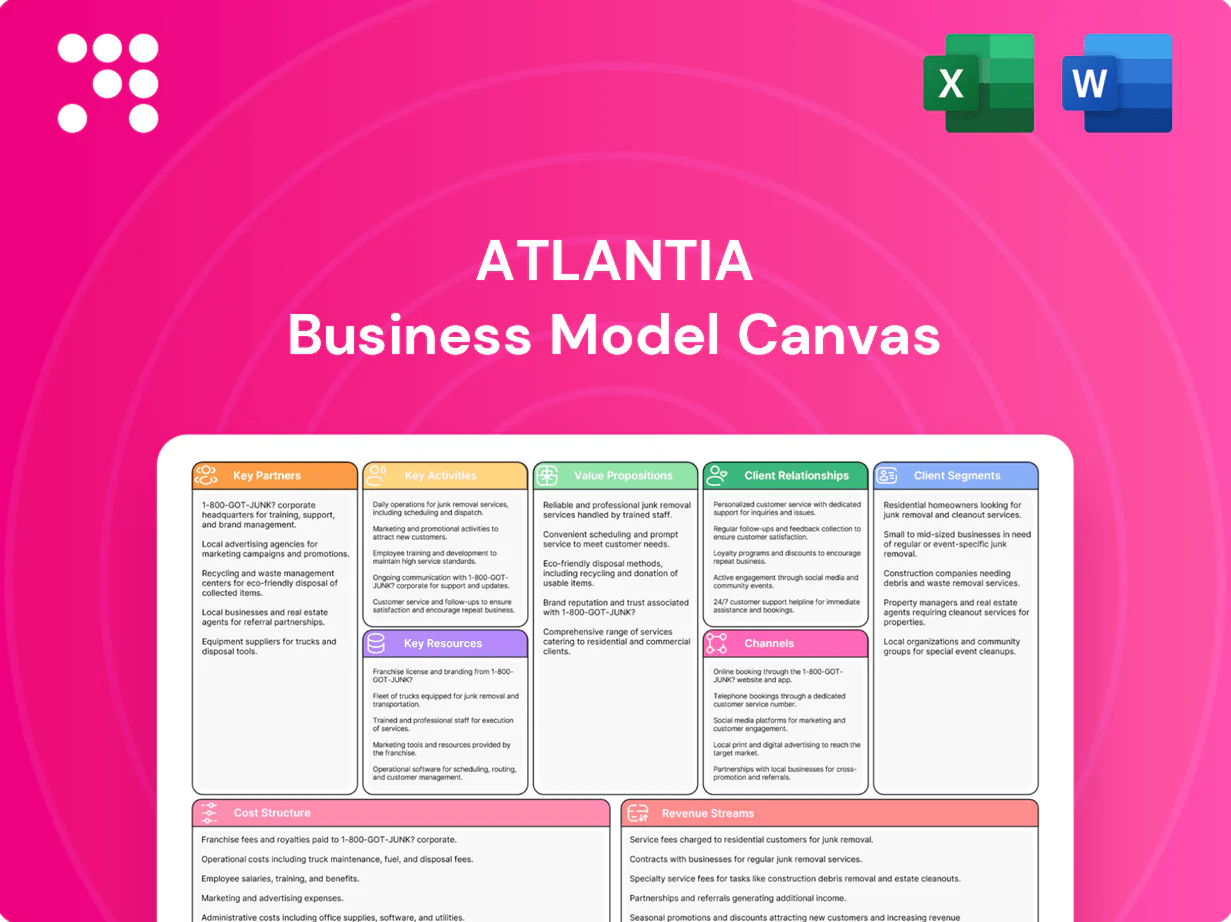
Atlantia Business Model Canvas

Unlock a leading infrastructure group's Business Model Canvas and revenue blueprint
Unlock Atlantia’s strategic blueprint with a concise Business Model Canvas that maps value propositions, key partnerships, and revenue streams. This in-depth canvas reveals how Atlantia scales infrastructure, manages risk, and captures long-term value. Download the full Word/Excel version for a section-by-section guide to replicate and benchmark their success.
Partnerships

Government concession grantors
Public authorities award and regulate long-term concessions for roads and airports, typically multi-decade (20–50 years), forming the backbone of Atlantia’s asset model. Strong ties with grantors secure license renewals, tariff frameworks and compliance alignment, directly affecting cash flows. Collaboration reduces regulatory risk and underpins expansion into new concessions. Transparent reporting and stakeholder engagement sustain trust and social license.
EPC and O&M contractors
EPC and O&M partners deliver engineering, procurement, construction and maintenance that enable capacity upgrades and continuous asset upkeep, with performance-based contracts targeting availability above 98% and measurable safety KPIs.
Large EPC consortia have cut project schedules by up to 25% and lowered build costs materially through scale procurement and modular methods.
Shared innovation — high-durability materials and resilient construction methods — reduces lifecycle CAPEX and improves uptime.

Technology and ITS providers
Technology and ITS partners supply tolling systems, sensors, analytics and cybersecurity, enabling Atlantia to scale free-flow tolling and real-time traffic management across its network. Joint roadmaps with vendors have reduced deployment cycles by up to 30% in pilot corridors, while 2024 ITS market estimates near €40 billion highlight accelerated vendor capacity. Data partnerships improve demand forecasting and incident response, cutting average clearance times and revenue leakage.

Financial institutions and investors
- Project finance: banks, bondholders, co-investors
- WACC impact: −50 to −150 bps; tenor: 20–30 years
- Risk-sharing: PPPs, multilaterals for greenfield
- ESG-linked: margin adjustments up to 50 bps
Airlines and retail concessionaires
Airlines determine aeronautical service levels and slot utilization, directly shaping Atlantia’s capacity planning and fee mix; in 2024 passenger traffic at Atlantia airports recovered to about 85% of 2019 levels (company data). Retail, F&B and parking partners drove non-aeronautical revenue — ~40% of commercial income in 2024 — while coordinated promotions lifted spend per passenger by roughly 12% year-on-year. Data sharing with tenants enabled optimized tenant mix and longer dwell times, improving commercial yields.
Concessions 20–50 years, >98% availability and ITS €40bn market stabilize cash flows
Long-term concessions (20–50 years) with public authorities secure tariff frameworks and renewals, underpinning stable cash flows. EPC/O&M and ITS partners drive availability >98%, cut build schedules ~25% and ITS deployment times ~30%; ITS market ~€40bn (2024). Banks/co-investors lower WACC −50 to −150 bps and extend tenor to 20–30 years; non-aero revenue ~40% of commercial income (2024).
What is included in the product
 Detailed Word Document
A concise, pre-written Business Model Canvas for Atlantia that maps customer segments, channels, value propositions and revenue streams across the 9 classic BMC blocks, reflecting real-world toll-road, airport and infrastructure operations; ideal for presentations and investor discussions, it includes competitive advantages, linked SWOT insights and actionable validation for strategic decision-making.

 Customizable Excel Spreadsheet
High-level view of Atlantia’s business model with editable cells; quickly identify core components like concessions, traffic risk exposure, and infrastructure investments in a one-page snapshot that saves hours of structuring and is perfect for boardrooms or teams.
Activities

Operate and maintain assets
Daily operation of Atlantia’s motorway network (over 3,000 km) and airport assets focuses on maximizing availability and safety through 24/7 traffic control, patrols and preventive inspections. Predictive maintenance programs leverage sensors and analytics to cut unplanned outages and lifecycle costs. Robust incident management protocols restore traffic flow rapidly, while continuous service-level monitoring ensures compliance with concession KPIs above 99% availability targets.
Asset expansion and upgrades
Asset expansion and upgrades focus on capacity additions, lane widening, terminal enhancement and technology retrofits, with Atlantia's 2024 capex envelope of about €1.2bn aligned to demand growth and pending regulatory approvals. Phased delivery across 2024–2026 minimizes traffic disruption and maintains service continuity. Rigorous value engineering targets a 200–300 basis point uplift in project IRR through procurement optimization and modular retrofits. Investment sequencing prioritizes high-return corridors and digital tolling rollouts.

Concession bidding and portfolio management
Sourcing, evaluating and bidding for global concessions focuses on high-quality assets such as the Autostrade per l'Italia network (≈3,000 km) to secure long-term cashflows and scale. Active portfolio rotation rebalances risk by geography and tenor, pruning non-core assets and pursuing higher-yield bids. Renegotiations target optimized tariff paths and capex commitments to protect IRRs, while rigorous due diligence and stress-testing preserve returns.

Safety, compliance, and ESG
Implementing strict standards for structural integrity, cybersecurity, and worker safety across Atlantia’s ~3,000 km toll-road and airport assets; environmental programs drive emissions and energy reductions consistent with Atlantia’s net-zero by 2040 commitment; community engagement limits social impact while regular audits secure regulatory conformity and transparency.
- structural integrity: asset inspections, maintenance cycles
- cybersecurity: continuous monitoring, incident response
- worker safety: training, ISO-aligned systems
- esg targets: net-zero by 2040
- audits: external regulatory and financial reviews
Digital and data optimization
Digital and data optimization deploys ITS, tolling and airport ops platforms to boost efficiency across Atlantia’s c.3,000 km motorway network. AI models provide traffic forecasting and dynamic resource allocation to reduce congestion and operating costs. Customer-facing apps streamline payments and travel information while data governance frameworks safeguard privacy and data reliability.
- ITS integration
- AI traffic forecasting
- App payments & info
- Data governance & privacy
Operate 3,000 km network with >99% availability, €1.2bn upgrades and AI-led ops
Operate and maintain c.3,000 km motorway and airport assets with >99% availability, 24/7 traffic control, predictive maintenance and incident response; 2024 capex ~€1.2bn for upgrades and digital tolling. Pursue concession bids, portfolio rotation and renegotiations to protect IRR; ESG focus: net-zero by 2040, safety and cybersecurity programs. Deploy ITS, AI forecasting and customer apps with strict data governance.
| Metric | 2024 Value |
|---|---|
| Network length | ≈3,000 km |
| Availability KPI | >99% |
| Capex envelope | €1.2bn |
| Net-zero target | 2040 |
Delivered as Displayed
Business Model Canvas
The Atlantia Business Model Canvas shown here is the real document, not a mockup or sample; it’s a direct snapshot of the exact file you’ll receive after purchase. When you complete your order, you’ll get this same professional, fully formatted canvas in editable Word and Excel formats. No extras, no surprises—what you preview is what you’ll download and use immediately.

Unlock a leading infrastructure group's Business Model Canvas and revenue blueprint
Unlock Atlantia’s strategic blueprint with a concise Business Model Canvas that maps value propositions, key partnerships, and revenue streams. This in-depth canvas reveals how Atlantia scales infrastructure, manages risk, and captures long-term value. Download the full Word/Excel version for a section-by-section guide to replicate and benchmark their success.
Partnerships
Government concession grantors
Public authorities award and regulate long-term concessions for roads and airports, typically multi-decade (20–50 years), forming the backbone of Atlantia’s asset model. Strong ties with grantors secure license renewals, tariff frameworks and compliance alignment, directly affecting cash flows. Collaboration reduces regulatory risk and underpins expansion into new concessions. Transparent reporting and stakeholder engagement sustain trust and social license.
EPC and O&M contractors
EPC and O&M partners deliver engineering, procurement, construction and maintenance that enable capacity upgrades and continuous asset upkeep, with performance-based contracts targeting availability above 98% and measurable safety KPIs.
Large EPC consortia have cut project schedules by up to 25% and lowered build costs materially through scale procurement and modular methods.
Shared innovation — high-durability materials and resilient construction methods — reduces lifecycle CAPEX and improves uptime.
Technology and ITS providers
Technology and ITS partners supply tolling systems, sensors, analytics and cybersecurity, enabling Atlantia to scale free-flow tolling and real-time traffic management across its network. Joint roadmaps with vendors have reduced deployment cycles by up to 30% in pilot corridors, while 2024 ITS market estimates near €40 billion highlight accelerated vendor capacity. Data partnerships improve demand forecasting and incident response, cutting average clearance times and revenue leakage.
Financial institutions and investors
- Project finance: banks, bondholders, co-investors
- WACC impact: −50 to −150 bps; tenor: 20–30 years
- Risk-sharing: PPPs, multilaterals for greenfield
- ESG-linked: margin adjustments up to 50 bps
Airlines and retail concessionaires
Airlines determine aeronautical service levels and slot utilization, directly shaping Atlantia’s capacity planning and fee mix; in 2024 passenger traffic at Atlantia airports recovered to about 85% of 2019 levels (company data). Retail, F&B and parking partners drove non-aeronautical revenue — ~40% of commercial income in 2024 — while coordinated promotions lifted spend per passenger by roughly 12% year-on-year. Data sharing with tenants enabled optimized tenant mix and longer dwell times, improving commercial yields.
Concessions 20–50 years, >98% availability and ITS €40bn market stabilize cash flows
Long-term concessions (20–50 years) with public authorities secure tariff frameworks and renewals, underpinning stable cash flows. EPC/O&M and ITS partners drive availability >98%, cut build schedules ~25% and ITS deployment times ~30%; ITS market ~€40bn (2024). Banks/co-investors lower WACC −50 to −150 bps and extend tenor to 20–30 years; non-aero revenue ~40% of commercial income (2024).
What is included in the product
Detailed Word Document
A concise, pre-written Business Model Canvas for Atlantia that maps customer segments, channels, value propositions and revenue streams across the 9 classic BMC blocks, reflecting real-world toll-road, airport and infrastructure operations; ideal for presentations and investor discussions, it includes competitive advantages, linked SWOT insights and actionable validation for strategic decision-making.
Customizable Excel Spreadsheet
High-level view of Atlantia’s business model with editable cells; quickly identify core components like concessions, traffic risk exposure, and infrastructure investments in a one-page snapshot that saves hours of structuring and is perfect for boardrooms or teams.
Activities
Operate and maintain assets
Daily operation of Atlantia’s motorway network (over 3,000 km) and airport assets focuses on maximizing availability and safety through 24/7 traffic control, patrols and preventive inspections. Predictive maintenance programs leverage sensors and analytics to cut unplanned outages and lifecycle costs. Robust incident management protocols restore traffic flow rapidly, while continuous service-level monitoring ensures compliance with concession KPIs above 99% availability targets.
Asset expansion and upgrades
Asset expansion and upgrades focus on capacity additions, lane widening, terminal enhancement and technology retrofits, with Atlantia's 2024 capex envelope of about €1.2bn aligned to demand growth and pending regulatory approvals. Phased delivery across 2024–2026 minimizes traffic disruption and maintains service continuity. Rigorous value engineering targets a 200–300 basis point uplift in project IRR through procurement optimization and modular retrofits. Investment sequencing prioritizes high-return corridors and digital tolling rollouts.
Concession bidding and portfolio management
Sourcing, evaluating and bidding for global concessions focuses on high-quality assets such as the Autostrade per l'Italia network (≈3,000 km) to secure long-term cashflows and scale. Active portfolio rotation rebalances risk by geography and tenor, pruning non-core assets and pursuing higher-yield bids. Renegotiations target optimized tariff paths and capex commitments to protect IRRs, while rigorous due diligence and stress-testing preserve returns.
Safety, compliance, and ESG
Implementing strict standards for structural integrity, cybersecurity, and worker safety across Atlantia’s ~3,000 km toll-road and airport assets; environmental programs drive emissions and energy reductions consistent with Atlantia’s net-zero by 2040 commitment; community engagement limits social impact while regular audits secure regulatory conformity and transparency.
- structural integrity: asset inspections, maintenance cycles
- cybersecurity: continuous monitoring, incident response
- worker safety: training, ISO-aligned systems
- esg targets: net-zero by 2040
- audits: external regulatory and financial reviews
Digital and data optimization
Digital and data optimization deploys ITS, tolling and airport ops platforms to boost efficiency across Atlantia’s c.3,000 km motorway network. AI models provide traffic forecasting and dynamic resource allocation to reduce congestion and operating costs. Customer-facing apps streamline payments and travel information while data governance frameworks safeguard privacy and data reliability.
- ITS integration
- AI traffic forecasting
- App payments & info
- Data governance & privacy
Operate 3,000 km network with >99% availability, €1.2bn upgrades and AI-led ops
Operate and maintain c.3,000 km motorway and airport assets with >99% availability, 24/7 traffic control, predictive maintenance and incident response; 2024 capex ~€1.2bn for upgrades and digital tolling. Pursue concession bids, portfolio rotation and renegotiations to protect IRR; ESG focus: net-zero by 2040, safety and cybersecurity programs. Deploy ITS, AI forecasting and customer apps with strict data governance.
| Metric | 2024 Value |
|---|---|
| Network length | ≈3,000 km |
| Availability KPI | >99% |
| Capex envelope | €1.2bn |
| Net-zero target | 2040 |
Delivered as Displayed
Business Model Canvas
The Atlantia Business Model Canvas shown here is the real document, not a mockup or sample; it’s a direct snapshot of the exact file you’ll receive after purchase. When you complete your order, you’ll get this same professional, fully formatted canvas in editable Word and Excel formats. No extras, no surprises—what you preview is what you’ll download and use immediately.
Description
Unlock a leading infrastructure group's Business Model Canvas and revenue blueprint
Unlock Atlantia’s strategic blueprint with a concise Business Model Canvas that maps value propositions, key partnerships, and revenue streams. This in-depth canvas reveals how Atlantia scales infrastructure, manages risk, and captures long-term value. Download the full Word/Excel version for a section-by-section guide to replicate and benchmark their success.
Partnerships
Government concession grantors
Public authorities award and regulate long-term concessions for roads and airports, typically multi-decade (20–50 years), forming the backbone of Atlantia’s asset model. Strong ties with grantors secure license renewals, tariff frameworks and compliance alignment, directly affecting cash flows. Collaboration reduces regulatory risk and underpins expansion into new concessions. Transparent reporting and stakeholder engagement sustain trust and social license.
EPC and O&M contractors
EPC and O&M partners deliver engineering, procurement, construction and maintenance that enable capacity upgrades and continuous asset upkeep, with performance-based contracts targeting availability above 98% and measurable safety KPIs.
Large EPC consortia have cut project schedules by up to 25% and lowered build costs materially through scale procurement and modular methods.
Shared innovation — high-durability materials and resilient construction methods — reduces lifecycle CAPEX and improves uptime.
Technology and ITS providers
Technology and ITS partners supply tolling systems, sensors, analytics and cybersecurity, enabling Atlantia to scale free-flow tolling and real-time traffic management across its network. Joint roadmaps with vendors have reduced deployment cycles by up to 30% in pilot corridors, while 2024 ITS market estimates near €40 billion highlight accelerated vendor capacity. Data partnerships improve demand forecasting and incident response, cutting average clearance times and revenue leakage.
Financial institutions and investors
- Project finance: banks, bondholders, co-investors
- WACC impact: −50 to −150 bps; tenor: 20–30 years
- Risk-sharing: PPPs, multilaterals for greenfield
- ESG-linked: margin adjustments up to 50 bps
Airlines and retail concessionaires
Airlines determine aeronautical service levels and slot utilization, directly shaping Atlantia’s capacity planning and fee mix; in 2024 passenger traffic at Atlantia airports recovered to about 85% of 2019 levels (company data). Retail, F&B and parking partners drove non-aeronautical revenue — ~40% of commercial income in 2024 — while coordinated promotions lifted spend per passenger by roughly 12% year-on-year. Data sharing with tenants enabled optimized tenant mix and longer dwell times, improving commercial yields.
Concessions 20–50 years, >98% availability and ITS €40bn market stabilize cash flows
Long-term concessions (20–50 years) with public authorities secure tariff frameworks and renewals, underpinning stable cash flows. EPC/O&M and ITS partners drive availability >98%, cut build schedules ~25% and ITS deployment times ~30%; ITS market ~€40bn (2024). Banks/co-investors lower WACC −50 to −150 bps and extend tenor to 20–30 years; non-aero revenue ~40% of commercial income (2024).
What is included in the product
Detailed Word Document
A concise, pre-written Business Model Canvas for Atlantia that maps customer segments, channels, value propositions and revenue streams across the 9 classic BMC blocks, reflecting real-world toll-road, airport and infrastructure operations; ideal for presentations and investor discussions, it includes competitive advantages, linked SWOT insights and actionable validation for strategic decision-making.
Customizable Excel Spreadsheet
High-level view of Atlantia’s business model with editable cells; quickly identify core components like concessions, traffic risk exposure, and infrastructure investments in a one-page snapshot that saves hours of structuring and is perfect for boardrooms or teams.
Activities
Operate and maintain assets
Daily operation of Atlantia’s motorway network (over 3,000 km) and airport assets focuses on maximizing availability and safety through 24/7 traffic control, patrols and preventive inspections. Predictive maintenance programs leverage sensors and analytics to cut unplanned outages and lifecycle costs. Robust incident management protocols restore traffic flow rapidly, while continuous service-level monitoring ensures compliance with concession KPIs above 99% availability targets.
Asset expansion and upgrades
Asset expansion and upgrades focus on capacity additions, lane widening, terminal enhancement and technology retrofits, with Atlantia's 2024 capex envelope of about €1.2bn aligned to demand growth and pending regulatory approvals. Phased delivery across 2024–2026 minimizes traffic disruption and maintains service continuity. Rigorous value engineering targets a 200–300 basis point uplift in project IRR through procurement optimization and modular retrofits. Investment sequencing prioritizes high-return corridors and digital tolling rollouts.
Concession bidding and portfolio management
Sourcing, evaluating and bidding for global concessions focuses on high-quality assets such as the Autostrade per l'Italia network (≈3,000 km) to secure long-term cashflows and scale. Active portfolio rotation rebalances risk by geography and tenor, pruning non-core assets and pursuing higher-yield bids. Renegotiations target optimized tariff paths and capex commitments to protect IRRs, while rigorous due diligence and stress-testing preserve returns.
Safety, compliance, and ESG
Implementing strict standards for structural integrity, cybersecurity, and worker safety across Atlantia’s ~3,000 km toll-road and airport assets; environmental programs drive emissions and energy reductions consistent with Atlantia’s net-zero by 2040 commitment; community engagement limits social impact while regular audits secure regulatory conformity and transparency.
- structural integrity: asset inspections, maintenance cycles
- cybersecurity: continuous monitoring, incident response
- worker safety: training, ISO-aligned systems
- esg targets: net-zero by 2040
- audits: external regulatory and financial reviews
Digital and data optimization
Digital and data optimization deploys ITS, tolling and airport ops platforms to boost efficiency across Atlantia’s c.3,000 km motorway network. AI models provide traffic forecasting and dynamic resource allocation to reduce congestion and operating costs. Customer-facing apps streamline payments and travel information while data governance frameworks safeguard privacy and data reliability.
- ITS integration
- AI traffic forecasting
- App payments & info
- Data governance & privacy
Operate 3,000 km network with >99% availability, €1.2bn upgrades and AI-led ops
Operate and maintain c.3,000 km motorway and airport assets with >99% availability, 24/7 traffic control, predictive maintenance and incident response; 2024 capex ~€1.2bn for upgrades and digital tolling. Pursue concession bids, portfolio rotation and renegotiations to protect IRR; ESG focus: net-zero by 2040, safety and cybersecurity programs. Deploy ITS, AI forecasting and customer apps with strict data governance.
| Metric | 2024 Value |
|---|---|
| Network length | ≈3,000 km |
| Availability KPI | >99% |
| Capex envelope | €1.2bn |
| Net-zero target | 2040 |
Delivered as Displayed
Business Model Canvas
The Atlantia Business Model Canvas shown here is the real document, not a mockup or sample; it’s a direct snapshot of the exact file you’ll receive after purchase. When you complete your order, you’ll get this same professional, fully formatted canvas in editable Word and Excel formats. No extras, no surprises—what you preview is what you’ll download and use immediately.











