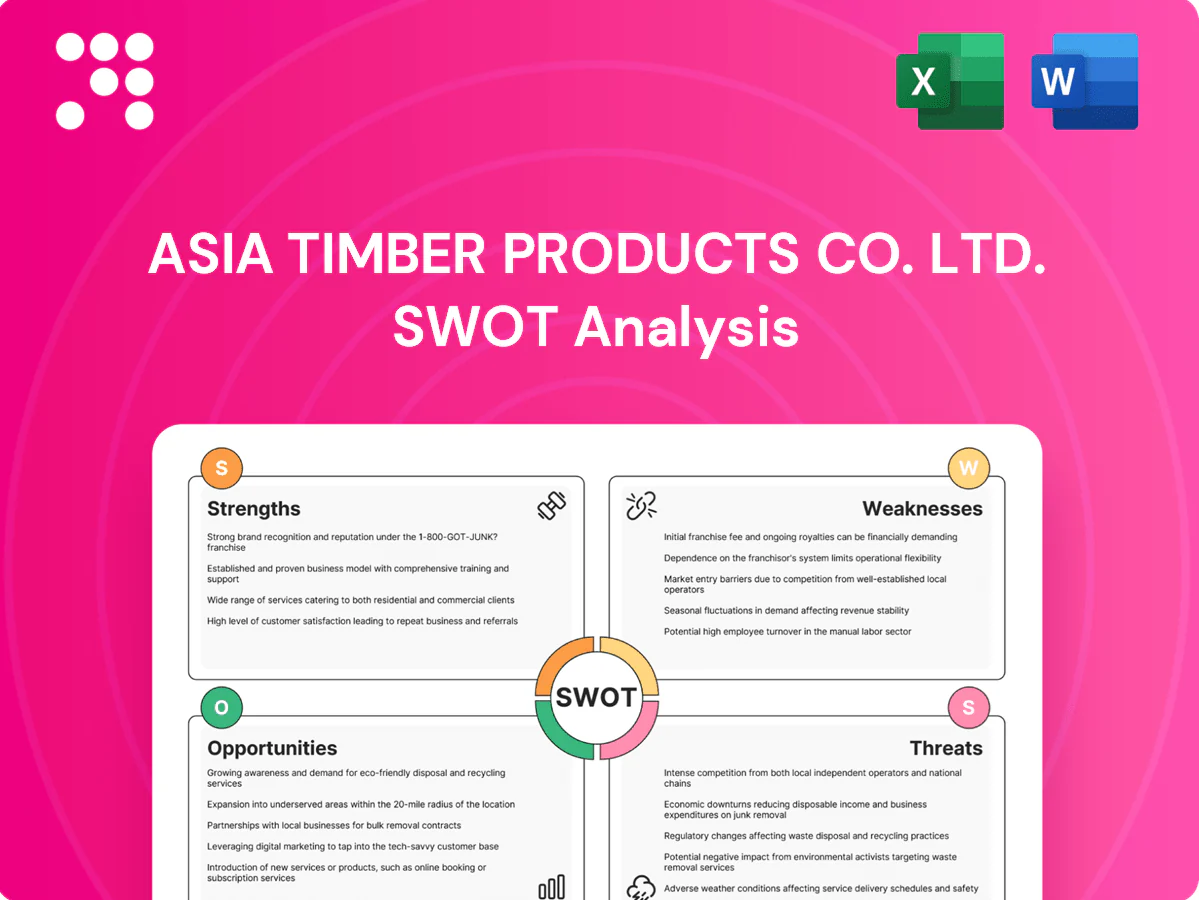
Asia Timber Products Co. Ltd. SWOT Analysis

Your Strategic Toolkit Starts Here
Asia Timber Products Co. Ltd.'s SWOT highlights solid manufacturing scale and export reach, offset by commodity-price exposure and regulatory risks; opportunities include sustainable product demand and regional construction growth. Want the full story behind the company’s strengths, risks, and growth drivers? Purchase the complete SWOT analysis to gain an editable, investor-ready report.
Strengths

Diversified wood panels portfolio
Offering MDF, particleboard, melamine-faced panels and laminate flooring reduces reliance on a single line and smooths demand volatility across end uses; the global wood-based panels market is projected to grow at about 5% CAGR to 2030, while Southeast Asia saw MDF/particleboard consumption rise roughly 3% in 2024, enabling cross-selling into doors, furniture, cabinets, countertops and flooring and supporting revenue resilience.
High-end MDF capability
High-end MDF capability delivers tighter process control and consistent surface quality, enabling ASP premiums roughly 10–20% versus standard panels and gross-margin uplifts around 200–400 basis points reported in industry studies (2024). This supports entry into furniture and interiors requiring superior finish, helps secure OEM and designer specifications, and strengthens brand credibility in competitive bids across SEA markets.

Multi-sector customer base
Supplying retail, commercial and residential customers reduces Asia Timber Products Co. Ltd.’s exposure to single-sector cycles, smoothing revenue swings across differing demand patterns. Strong commercial fit-out demand often offsets residential construction slowdowns, supporting steady order backlogs and higher-margin projects. Retail channels boost product visibility and throughput, while segment diversification stabilizes plant utilization and order flow.

Integrated manufacturing and distribution
Integrated manufacturing and distribution gives Asia Timber Products direct control over production and delivery, shortening lead times and improving service levels. Tight integration enables higher inventory turns and tailored cut-to-size offerings while reducing logistics costs and transit damage. Closer coordination across plants and transport enhances reliability for project timelines.
- Control: faster deliveries
- Inventory: tighter turns
- Customization: cut-to-size
- Costs: lower logistics/damage
- Reliability: improved project timing
Applications across interior value chain
Panels and flooring serve as core substrates for doors, cabinets, countertops and floors, embedding Asia Timber Products across multiple interior assemblies and increasing specification stickiness; this enables bundled offerings to developers and carpenters and captures both renovation and new-build demand.
- Cross-assembly integration
- Higher specification retention
- Bundle sales to trade
- Access to renovation + new-build markets
Diversified panels target ~5% CAGR, 10–20% MDF ASP
Diversified portfolio (MDF, particleboard, melamine panels, flooring) captures ~5% global panels CAGR to 2030 and SEA MDF/particle +3% in 2024, smoothing demand swings. High-end MDF yields 10–20% ASP premium and ~200–400 bps gross-margin uplift (2024 data), aiding OEM/design spec wins. Integrated manufacturing/distribution shortens lead times, raises turns and lowers logistics costs, stabilizing margins.
| Metric | Value (2024/2025) |
|---|---|
| Global panels CAGR to 2030 | ~5% |
| SEA MDF/particle consumption change (2024) | +3% |
| High-end MDF ASP premium | 10–20% |
| Gross-margin uplift (high-end MDF) | 200–400 bps |
What is included in the product
 Detailed Word Document
Provides a concise SWOT overview of Asia Timber Products Co. Ltd., highlighting its core strengths and operational weaknesses while mapping market opportunities and external threats shaping strategic decisions.

 Customizable Excel Spreadsheet
Provides a concise SWOT matrix tailored to Asia Timber Products Co. Ltd., enabling fast visual alignment of strategic priorities across sourcing, production, and market risks.
Weaknesses

Exposure to commodity pricing
MDF and particleboard face intense price-based competition, and industry reports showed finished-panel prices declined roughly 10–15% in 2023–24 in several Asian markets, compressing margins. Margin expansion at Asia Timber is constrained when added capacity forces market prices down, eroding gross margins. Differentiation beyond surface specs is limited, so price becomes the main lever, pressuring profitability during down cycles.
Raw material dependency
Wood fiber and urea-formaldehyde resins represent roughly 40–60% of COGS for panel manufacturers, so supply shocks or resin price spikes (resin costs rose >30% in 2021–22) directly pressure margins. Sourcing certified fiber typically adds a 10–20% premium and complexity in logistics and traceability. Limited backward integration leaves Asia Timber Products exposed to volatile input markets and procurement bottlenecks.

Cyclical end-market demand
Volumes at Asia Timber track residential and commercial construction cycles, with global policy rates averaging about 4.5% in 2024, so interest-rate shifts and swings in housing starts can quickly reduce orders. Retail sell-through varies with consumer confidence—APAC home goods spending slowed in 2024—so demand volatility feeds through to order timing. Plant utilization can drop sharply in downturns, pressuring margins and fixed-cost coverage.

Environmental compliance burden
Emissions limits are tightening (CARB/EPA ~0.05 ppm formaldehyde; EU E1 ~0.1 ppm), forcing Asia Timber to invest continuously in low‑formaldehyde resins, scrubbers and process upgrades. Certification regimes (FSC/PEFC) add recurring audit and documentation costs. Non‑compliance risks reputational damage and lost tenders in public and international markets.
- Compliance capex: resin reformulation, scrubbers, line upgrades
- Audit costs: recurring FSC/PEFC audits and documentation
- Risk: lost tenders, brand damage
Brand scale vs global majors
Asia Timber Products faces scale disadvantages versus multinational panel producers that achieve lower unit costs and wider distribution, limiting ATP’s ability to match global players on marketing spend and R&D; winning multinational OEM contracts is therefore more difficult and exposes ATP to regional price competition that can erode share.
- Smaller scale vs multinationals
- Lower marketing/R&D budget
- Difficulty securing OEM contracts
- Vulnerable to regional price wars
Asia timber margins squeezed by 10–15% panel price fall, resin spikes and regulation
Asia Timber suffers margin squeeze from panel price falls (≈10–15% in 2023–24) and limited product differentiation, high input exposure (wood fiber+resins ≈40–60% of COGS) with past resin spikes >30% (2021–22), demand sensitivity to construction/interest rates (~4.5% avg in 2024), and rising compliance costs to meet CARB/EPA (~0.05 ppm) and EU E1 (~0.1 ppm) standards.
| Metric | Value | Impact |
|---|---|---|
| Panel price decline | 10–15% (2023–24) | Margin compression |
| Resin spike | >30% (2021–22) | Cost volatility |
| Input share | 40–60% COGS | Profit sensitivity |
| Policy rates | ~4.5% (2024) | Demand volatility |
Preview Before You Purchase
Asia Timber Products Co. Ltd. SWOT Analysis
This is the actual SWOT analysis document you'll receive upon purchase—no surprises, just professional quality. The preview below is taken directly from the full SWOT report on Asia Timber Products Co. Ltd.; purchasing unlocks the complete, editable version with detailed strengths, weaknesses, opportunities, and threats. You're viewing a live preview of the real file; the full content becomes available after checkout.

Your Strategic Toolkit Starts Here
Asia Timber Products Co. Ltd.'s SWOT highlights solid manufacturing scale and export reach, offset by commodity-price exposure and regulatory risks; opportunities include sustainable product demand and regional construction growth. Want the full story behind the company’s strengths, risks, and growth drivers? Purchase the complete SWOT analysis to gain an editable, investor-ready report.
Strengths
Diversified wood panels portfolio
Offering MDF, particleboard, melamine-faced panels and laminate flooring reduces reliance on a single line and smooths demand volatility across end uses; the global wood-based panels market is projected to grow at about 5% CAGR to 2030, while Southeast Asia saw MDF/particleboard consumption rise roughly 3% in 2024, enabling cross-selling into doors, furniture, cabinets, countertops and flooring and supporting revenue resilience.
High-end MDF capability
High-end MDF capability delivers tighter process control and consistent surface quality, enabling ASP premiums roughly 10–20% versus standard panels and gross-margin uplifts around 200–400 basis points reported in industry studies (2024). This supports entry into furniture and interiors requiring superior finish, helps secure OEM and designer specifications, and strengthens brand credibility in competitive bids across SEA markets.
Multi-sector customer base
Supplying retail, commercial and residential customers reduces Asia Timber Products Co. Ltd.’s exposure to single-sector cycles, smoothing revenue swings across differing demand patterns. Strong commercial fit-out demand often offsets residential construction slowdowns, supporting steady order backlogs and higher-margin projects. Retail channels boost product visibility and throughput, while segment diversification stabilizes plant utilization and order flow.
Integrated manufacturing and distribution
Integrated manufacturing and distribution gives Asia Timber Products direct control over production and delivery, shortening lead times and improving service levels. Tight integration enables higher inventory turns and tailored cut-to-size offerings while reducing logistics costs and transit damage. Closer coordination across plants and transport enhances reliability for project timelines.
- Control: faster deliveries
- Inventory: tighter turns
- Customization: cut-to-size
- Costs: lower logistics/damage
- Reliability: improved project timing
Applications across interior value chain
Panels and flooring serve as core substrates for doors, cabinets, countertops and floors, embedding Asia Timber Products across multiple interior assemblies and increasing specification stickiness; this enables bundled offerings to developers and carpenters and captures both renovation and new-build demand.
- Cross-assembly integration
- Higher specification retention
- Bundle sales to trade
- Access to renovation + new-build markets
Diversified panels target ~5% CAGR, 10–20% MDF ASP
Diversified portfolio (MDF, particleboard, melamine panels, flooring) captures ~5% global panels CAGR to 2030 and SEA MDF/particle +3% in 2024, smoothing demand swings. High-end MDF yields 10–20% ASP premium and ~200–400 bps gross-margin uplift (2024 data), aiding OEM/design spec wins. Integrated manufacturing/distribution shortens lead times, raises turns and lowers logistics costs, stabilizing margins.
| Metric | Value (2024/2025) |
|---|---|
| Global panels CAGR to 2030 | ~5% |
| SEA MDF/particle consumption change (2024) | +3% |
| High-end MDF ASP premium | 10–20% |
| Gross-margin uplift (high-end MDF) | 200–400 bps |
What is included in the product
Detailed Word Document
Provides a concise SWOT overview of Asia Timber Products Co. Ltd., highlighting its core strengths and operational weaknesses while mapping market opportunities and external threats shaping strategic decisions.
Customizable Excel Spreadsheet
Provides a concise SWOT matrix tailored to Asia Timber Products Co. Ltd., enabling fast visual alignment of strategic priorities across sourcing, production, and market risks.
Weaknesses
Exposure to commodity pricing
MDF and particleboard face intense price-based competition, and industry reports showed finished-panel prices declined roughly 10–15% in 2023–24 in several Asian markets, compressing margins. Margin expansion at Asia Timber is constrained when added capacity forces market prices down, eroding gross margins. Differentiation beyond surface specs is limited, so price becomes the main lever, pressuring profitability during down cycles.
Raw material dependency
Wood fiber and urea-formaldehyde resins represent roughly 40–60% of COGS for panel manufacturers, so supply shocks or resin price spikes (resin costs rose >30% in 2021–22) directly pressure margins. Sourcing certified fiber typically adds a 10–20% premium and complexity in logistics and traceability. Limited backward integration leaves Asia Timber Products exposed to volatile input markets and procurement bottlenecks.
Cyclical end-market demand
Volumes at Asia Timber track residential and commercial construction cycles, with global policy rates averaging about 4.5% in 2024, so interest-rate shifts and swings in housing starts can quickly reduce orders. Retail sell-through varies with consumer confidence—APAC home goods spending slowed in 2024—so demand volatility feeds through to order timing. Plant utilization can drop sharply in downturns, pressuring margins and fixed-cost coverage.
Environmental compliance burden
Emissions limits are tightening (CARB/EPA ~0.05 ppm formaldehyde; EU E1 ~0.1 ppm), forcing Asia Timber to invest continuously in low‑formaldehyde resins, scrubbers and process upgrades. Certification regimes (FSC/PEFC) add recurring audit and documentation costs. Non‑compliance risks reputational damage and lost tenders in public and international markets.
- Compliance capex: resin reformulation, scrubbers, line upgrades
- Audit costs: recurring FSC/PEFC audits and documentation
- Risk: lost tenders, brand damage
Brand scale vs global majors
Asia Timber Products faces scale disadvantages versus multinational panel producers that achieve lower unit costs and wider distribution, limiting ATP’s ability to match global players on marketing spend and R&D; winning multinational OEM contracts is therefore more difficult and exposes ATP to regional price competition that can erode share.
- Smaller scale vs multinationals
- Lower marketing/R&D budget
- Difficulty securing OEM contracts
- Vulnerable to regional price wars
Asia timber margins squeezed by 10–15% panel price fall, resin spikes and regulation
Asia Timber suffers margin squeeze from panel price falls (≈10–15% in 2023–24) and limited product differentiation, high input exposure (wood fiber+resins ≈40–60% of COGS) with past resin spikes >30% (2021–22), demand sensitivity to construction/interest rates (~4.5% avg in 2024), and rising compliance costs to meet CARB/EPA (~0.05 ppm) and EU E1 (~0.1 ppm) standards.
| Metric | Value | Impact |
|---|---|---|
| Panel price decline | 10–15% (2023–24) | Margin compression |
| Resin spike | >30% (2021–22) | Cost volatility |
| Input share | 40–60% COGS | Profit sensitivity |
| Policy rates | ~4.5% (2024) | Demand volatility |
Preview Before You Purchase
Asia Timber Products Co. Ltd. SWOT Analysis
This is the actual SWOT analysis document you'll receive upon purchase—no surprises, just professional quality. The preview below is taken directly from the full SWOT report on Asia Timber Products Co. Ltd.; purchasing unlocks the complete, editable version with detailed strengths, weaknesses, opportunities, and threats. You're viewing a live preview of the real file; the full content becomes available after checkout.
Original: $10.00
-65%$10.00
$3.50Description
Your Strategic Toolkit Starts Here
Asia Timber Products Co. Ltd.'s SWOT highlights solid manufacturing scale and export reach, offset by commodity-price exposure and regulatory risks; opportunities include sustainable product demand and regional construction growth. Want the full story behind the company’s strengths, risks, and growth drivers? Purchase the complete SWOT analysis to gain an editable, investor-ready report.
Strengths
Diversified wood panels portfolio
Offering MDF, particleboard, melamine-faced panels and laminate flooring reduces reliance on a single line and smooths demand volatility across end uses; the global wood-based panels market is projected to grow at about 5% CAGR to 2030, while Southeast Asia saw MDF/particleboard consumption rise roughly 3% in 2024, enabling cross-selling into doors, furniture, cabinets, countertops and flooring and supporting revenue resilience.
High-end MDF capability
High-end MDF capability delivers tighter process control and consistent surface quality, enabling ASP premiums roughly 10–20% versus standard panels and gross-margin uplifts around 200–400 basis points reported in industry studies (2024). This supports entry into furniture and interiors requiring superior finish, helps secure OEM and designer specifications, and strengthens brand credibility in competitive bids across SEA markets.
Multi-sector customer base
Supplying retail, commercial and residential customers reduces Asia Timber Products Co. Ltd.’s exposure to single-sector cycles, smoothing revenue swings across differing demand patterns. Strong commercial fit-out demand often offsets residential construction slowdowns, supporting steady order backlogs and higher-margin projects. Retail channels boost product visibility and throughput, while segment diversification stabilizes plant utilization and order flow.
Integrated manufacturing and distribution
Integrated manufacturing and distribution gives Asia Timber Products direct control over production and delivery, shortening lead times and improving service levels. Tight integration enables higher inventory turns and tailored cut-to-size offerings while reducing logistics costs and transit damage. Closer coordination across plants and transport enhances reliability for project timelines.
- Control: faster deliveries
- Inventory: tighter turns
- Customization: cut-to-size
- Costs: lower logistics/damage
- Reliability: improved project timing
Applications across interior value chain
Panels and flooring serve as core substrates for doors, cabinets, countertops and floors, embedding Asia Timber Products across multiple interior assemblies and increasing specification stickiness; this enables bundled offerings to developers and carpenters and captures both renovation and new-build demand.
- Cross-assembly integration
- Higher specification retention
- Bundle sales to trade
- Access to renovation + new-build markets
Diversified panels target ~5% CAGR, 10–20% MDF ASP
Diversified portfolio (MDF, particleboard, melamine panels, flooring) captures ~5% global panels CAGR to 2030 and SEA MDF/particle +3% in 2024, smoothing demand swings. High-end MDF yields 10–20% ASP premium and ~200–400 bps gross-margin uplift (2024 data), aiding OEM/design spec wins. Integrated manufacturing/distribution shortens lead times, raises turns and lowers logistics costs, stabilizing margins.
| Metric | Value (2024/2025) |
|---|---|
| Global panels CAGR to 2030 | ~5% |
| SEA MDF/particle consumption change (2024) | +3% |
| High-end MDF ASP premium | 10–20% |
| Gross-margin uplift (high-end MDF) | 200–400 bps |
What is included in the product
Detailed Word Document
Provides a concise SWOT overview of Asia Timber Products Co. Ltd., highlighting its core strengths and operational weaknesses while mapping market opportunities and external threats shaping strategic decisions.
Customizable Excel Spreadsheet
Provides a concise SWOT matrix tailored to Asia Timber Products Co. Ltd., enabling fast visual alignment of strategic priorities across sourcing, production, and market risks.
Weaknesses
Exposure to commodity pricing
MDF and particleboard face intense price-based competition, and industry reports showed finished-panel prices declined roughly 10–15% in 2023–24 in several Asian markets, compressing margins. Margin expansion at Asia Timber is constrained when added capacity forces market prices down, eroding gross margins. Differentiation beyond surface specs is limited, so price becomes the main lever, pressuring profitability during down cycles.
Raw material dependency
Wood fiber and urea-formaldehyde resins represent roughly 40–60% of COGS for panel manufacturers, so supply shocks or resin price spikes (resin costs rose >30% in 2021–22) directly pressure margins. Sourcing certified fiber typically adds a 10–20% premium and complexity in logistics and traceability. Limited backward integration leaves Asia Timber Products exposed to volatile input markets and procurement bottlenecks.
Cyclical end-market demand
Volumes at Asia Timber track residential and commercial construction cycles, with global policy rates averaging about 4.5% in 2024, so interest-rate shifts and swings in housing starts can quickly reduce orders. Retail sell-through varies with consumer confidence—APAC home goods spending slowed in 2024—so demand volatility feeds through to order timing. Plant utilization can drop sharply in downturns, pressuring margins and fixed-cost coverage.
Environmental compliance burden
Emissions limits are tightening (CARB/EPA ~0.05 ppm formaldehyde; EU E1 ~0.1 ppm), forcing Asia Timber to invest continuously in low‑formaldehyde resins, scrubbers and process upgrades. Certification regimes (FSC/PEFC) add recurring audit and documentation costs. Non‑compliance risks reputational damage and lost tenders in public and international markets.
- Compliance capex: resin reformulation, scrubbers, line upgrades
- Audit costs: recurring FSC/PEFC audits and documentation
- Risk: lost tenders, brand damage
Brand scale vs global majors
Asia Timber Products faces scale disadvantages versus multinational panel producers that achieve lower unit costs and wider distribution, limiting ATP’s ability to match global players on marketing spend and R&D; winning multinational OEM contracts is therefore more difficult and exposes ATP to regional price competition that can erode share.
- Smaller scale vs multinationals
- Lower marketing/R&D budget
- Difficulty securing OEM contracts
- Vulnerable to regional price wars
Asia timber margins squeezed by 10–15% panel price fall, resin spikes and regulation
Asia Timber suffers margin squeeze from panel price falls (≈10–15% in 2023–24) and limited product differentiation, high input exposure (wood fiber+resins ≈40–60% of COGS) with past resin spikes >30% (2021–22), demand sensitivity to construction/interest rates (~4.5% avg in 2024), and rising compliance costs to meet CARB/EPA (~0.05 ppm) and EU E1 (~0.1 ppm) standards.
| Metric | Value | Impact |
|---|---|---|
| Panel price decline | 10–15% (2023–24) | Margin compression |
| Resin spike | >30% (2021–22) | Cost volatility |
| Input share | 40–60% COGS | Profit sensitivity |
| Policy rates | ~4.5% (2024) | Demand volatility |
Preview Before You Purchase
Asia Timber Products Co. Ltd. SWOT Analysis
This is the actual SWOT analysis document you'll receive upon purchase—no surprises, just professional quality. The preview below is taken directly from the full SWOT report on Asia Timber Products Co. Ltd.; purchasing unlocks the complete, editable version with detailed strengths, weaknesses, opportunities, and threats. You're viewing a live preview of the real file; the full content becomes available after checkout.











