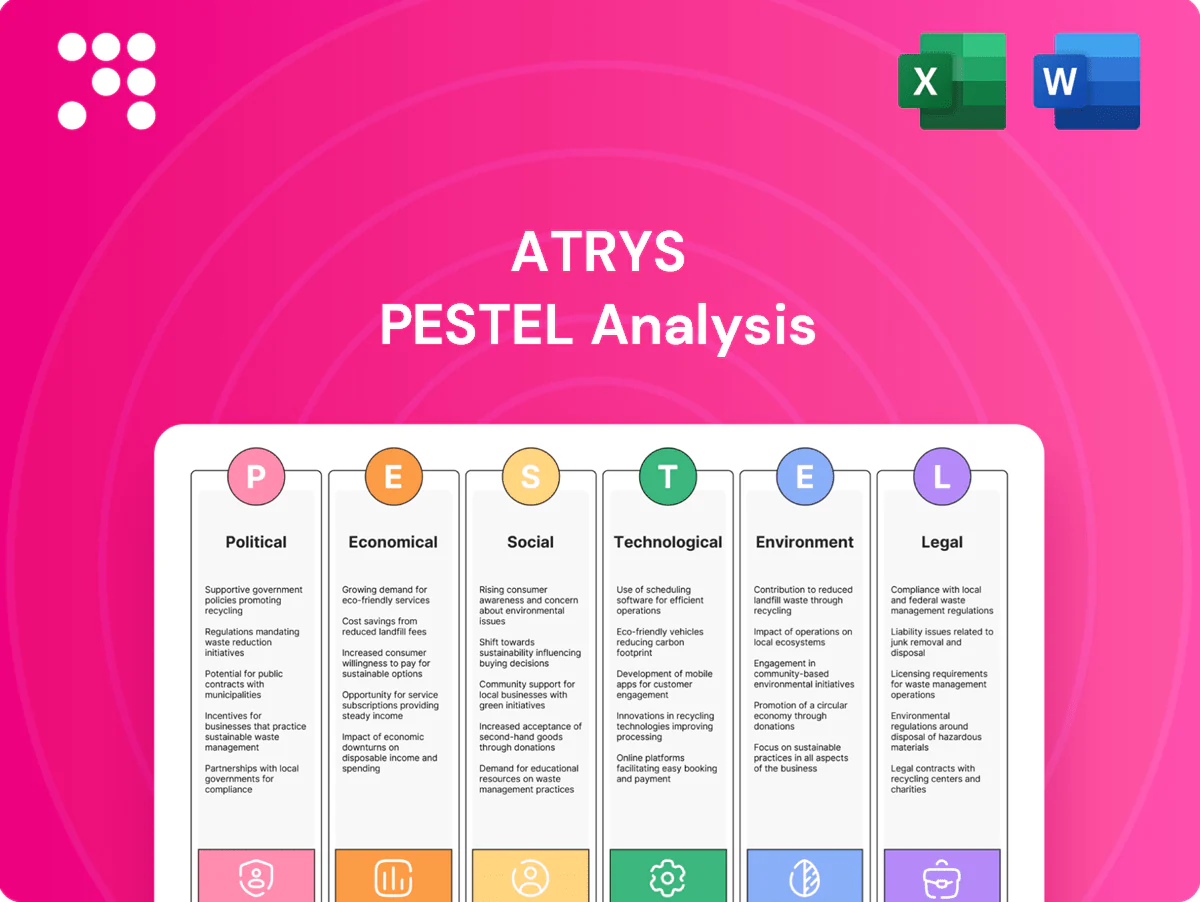
Atrys PESTLE Analysis

Plan Smarter. Present Sharper. Compete Stronger.
Unlock how political shifts, economic dynamics, social trends, technological advances, legal changes, and environmental risks are shaping Atrys’s future with our concise PESTLE snapshot—ideal for investors and strategists. Dive deeper into actionable insights, scenario-driven risks, and growth levers tailored to Atrys. Purchase the full PESTLE analysis now for an instantly downloadable, ready-to-use report.
Political factors

Healthcare reimbursement and funding stability
Government reimbursement policies dictate pricing power for diagnostics, radiotherapy and genomics, with public payors covering roughly 70% of health spending in Spain (OECD). Shifts in public health budgets or austerity can delay payments and squeeze margins, as seen in reimbursement delays across Europe in 2023. Proactive engagement with health ministries helps secure inclusion of precision medicine pathways. Diversifying geographically reduces single-country policy risk.
Public–private partnerships and tender dynamics
Winning national and regional tenders drives well over 50% of imaging and oncology service volumes for providers like Atrys, making award capture critical to growth; political pushes to cut wait times (e.g., national targets reducing diagnostic waits by 20–30% in some 2024 programs) expand outsourcing to private firms. Transparent procurement processes and local stakeholder alignment materially improve award odds, while policy reversals or protectionist rules can quickly change eligibility and contract share.

Cross-border healthcare integration in the EU/LatAm
Harmonization initiatives in the EU (27 states) and Latin America ease Atrys expansion, but fragmented clinical standards persist. Recognition of clinical credentials remains uneven despite EU Directive 2005/36/EC; GDPR and the EU adequacy decision for Brazil (2023) ease telemedicine data flows. EU HTA regulation (phased rollout 2025) and regional HTAs shape adoption timelines, while trade agreements affect equipment import speed and costs.

Data sovereignty and digital health strategies
National AI and e-health strategies—backed by rules such as the EU Data Act (2022) and initiatives like GAIA-X—drive data localization and interoperability requirements, constraining cross-border data flows. Political scrutiny of health-data use limits training datasets for AI models and raises compliance costs, while alignment with government cloud frameworks (eg ENS, GAIA-X) can unlock public tenders. Robust governance mitigates risks from shifting ministerial priorities.
- Data Act 2022: drives localization/interoperability
- Compliance (ENS/GAIA-X): gateway to public contracts
- Governance: reduces political/regulatory disruption
Oncology and genomics national priorities
Cancer plans increasingly earmark funds for screening, radiotherapy capacity and molecular testing; Spain’s 2021–2025 National Cancer Strategy explicitly prioritizes these areas and the IAEA recommends 4–8 radiotherapy units per million population to meet demand. Policy emphasis on precision medicine in 2024–25 has enabled reimbursement pilots and genomic registries, while early participation in national programs helps shape clinical guidelines; election cycles can reallocate timing and budgets.
- Screening/molecular testing funding prioritized in national plans
- IAEA target 4–8 RT units per million
- Reimbursement pilots and registries expanding in 2024–25
- Early program participation influences guidelines; elections can shift focus
Public payors ~70% of Spanish health spend; tenders >50% shape imaging/oncology
Public payors cover ~70% of Spanish health spend, making reimbursement policy central; 2023–24 reimbursement delays squeezed margins. National/regional tenders account for >50% imaging/oncology volumes; 2024 targets cutting waits expand outsourcing. EU HTA rollout (phased from 2025) and IAEA 4–8 RT units/million guide capacity planning; GDPR/2023 Brazil adequacy affect data flows.
| Metric | 2024–25 Value |
|---|---|
| Public payor share (Spain) | ~70% |
| Tenders share of volumes | >50% |
| IAEA RT units target | 4–8/million |
What is included in the product
 Detailed Word Document
Explores how macro-environmental factors uniquely affect Atrys across Political, Economic, Social, Technological, Environmental and Legal dimensions, with data-backed trends and forward-looking insights; designed for executives and investors, reflecting regional market and regulatory dynamics and delivered in clean, ready-to-use format to inform strategy and funding decisions.

 Customizable Excel Spreadsheet
Atrys PESTLE Analysis delivers a concise, visually segmented summary of external risks and opportunities that can be dropped into presentations or shared across teams for quick alignment. It’s editable for regional or business‑line notes, making strategy sessions and client reports faster and more focused.
Economic factors

Reimbursement rates and payer mix
Unit economics hinge on DRG/tariff levels across imaging, radiotherapy fractions and genomic panels. A favorable mix of public and private payers smooths cash flow; in Spain government/compulsory schemes cover about 71% of health spending (OECD). Value-based contracts can reward outcome improvements but remain nascent. Sustained price pressure necessitates tight operational efficiency.
Capital intensity and equipment refresh cycles
Linear accelerators (capex $2.5–6M), PET/CT scanners ($1.5–3M) and high-throughput sequencing platforms ($0.2–1M) carry heavy purchase and service costs, with annual maintenance often 5–15% of capex. Rising policy rates (Fed/ECB ~4.5–5.5% in 2024–25) push firms toward leasing and raise WACC, tightening project NPV. Standardized procurement and multi-site utilization can boost equipment ROI and utilization 10–30%, while vendor partnerships and managed-service leases commonly offset 20–50% of upfront spend.

Macroeconomic outlook and demand resilience
Healthcare is relatively defensive—OECD countries spend about 9.8% of GDP on health—yet diagnostics volumes can shrink in downturns, pressuring activity. Inflation in 2024–25 raises staff and consumables costs, compressing margins. Hedging and index-linked contracts help protect profitability. Geographic diversification across Europe and Latin America balances cyclical exposures while global growth is forecast near 3.0% in 2025.

M&A, consolidation, and scale advantages
Industry consolidation boosts Atrys bargaining power with suppliers and payers, enabling better procurement terms and reimbursement positioning; integration synergies hinge on IT interoperability and aligned clinical protocols to realize cost and quality gains. Bolt-on acquisitions have expanded regional footprints and service lines, notably across Spain and Latin America. Elevated leverage raises covenant strain risk in economic downturns.
- bargaining-power
- IT-interoperability
- clinical-protocols
- bolt-on-expansion
- leverage-risk
Currency and supply chain sensitivity
Imported equipment and reagents expose Atrys to FX volatility—each 1% currency move translates roughly to a 1% change in those import costs—while multi-currency revenues from Spain, LatAm and Portugal provide partial natural hedges; diversified suppliers and regional sourcing cut disruption risk, and strategic inventory buffers (safety stock covering several weeks of throughput) stabilize operations.
- FX sensitivity: ~1% cost per 1% FX move
- Revenue mix: multi-currency exposures
- Supply risk: diversified suppliers
- Operations: safety-stock buffers
Public payors ~70% of Spanish health spend; tenders >50% shape imaging/oncology
Unit economics depend on DRG/tariffs across imaging, radiotherapy and genomics; Spain public payers cover ~71% of health spending (OECD). Capex: linacs $2.5–6M, PET/CT $1.5–3M; 2024–25 policy rates ~4.5–5.5% raise WACC. FX moves ~1% ≈1% import cost change; inflation and leverage compress margins, consolidation improves procurement power.
| Metric | Value | Impact |
|---|---|---|
| Spain public share | 71% | Stable cashflow |
| OECD health spend | 9.8% GDP | Defensive demand |
| Linac capex | $2.5–6M | High CAPEX |
| Rates 2024–25 | 4.5–5.5% | Higher WACC |
| FX sensitivity | ~1%/1% | Cost volatility |
Same Document Delivered
Atrys PESTLE Analysis
The Atrys PESTLE Analysis preview shown here is the exact document you'll receive after purchase—fully formatted and ready to use. It contains the complete political, economic, social, technological, legal, and environmental assessment as displayed, with no placeholders or edits. After payment you'll instantly download this same professionally structured file.

Plan Smarter. Present Sharper. Compete Stronger.
Unlock how political shifts, economic dynamics, social trends, technological advances, legal changes, and environmental risks are shaping Atrys’s future with our concise PESTLE snapshot—ideal for investors and strategists. Dive deeper into actionable insights, scenario-driven risks, and growth levers tailored to Atrys. Purchase the full PESTLE analysis now for an instantly downloadable, ready-to-use report.
Political factors
Healthcare reimbursement and funding stability
Government reimbursement policies dictate pricing power for diagnostics, radiotherapy and genomics, with public payors covering roughly 70% of health spending in Spain (OECD). Shifts in public health budgets or austerity can delay payments and squeeze margins, as seen in reimbursement delays across Europe in 2023. Proactive engagement with health ministries helps secure inclusion of precision medicine pathways. Diversifying geographically reduces single-country policy risk.
Public–private partnerships and tender dynamics
Winning national and regional tenders drives well over 50% of imaging and oncology service volumes for providers like Atrys, making award capture critical to growth; political pushes to cut wait times (e.g., national targets reducing diagnostic waits by 20–30% in some 2024 programs) expand outsourcing to private firms. Transparent procurement processes and local stakeholder alignment materially improve award odds, while policy reversals or protectionist rules can quickly change eligibility and contract share.
Cross-border healthcare integration in the EU/LatAm
Harmonization initiatives in the EU (27 states) and Latin America ease Atrys expansion, but fragmented clinical standards persist. Recognition of clinical credentials remains uneven despite EU Directive 2005/36/EC; GDPR and the EU adequacy decision for Brazil (2023) ease telemedicine data flows. EU HTA regulation (phased rollout 2025) and regional HTAs shape adoption timelines, while trade agreements affect equipment import speed and costs.
Data sovereignty and digital health strategies
National AI and e-health strategies—backed by rules such as the EU Data Act (2022) and initiatives like GAIA-X—drive data localization and interoperability requirements, constraining cross-border data flows. Political scrutiny of health-data use limits training datasets for AI models and raises compliance costs, while alignment with government cloud frameworks (eg ENS, GAIA-X) can unlock public tenders. Robust governance mitigates risks from shifting ministerial priorities.
- Data Act 2022: drives localization/interoperability
- Compliance (ENS/GAIA-X): gateway to public contracts
- Governance: reduces political/regulatory disruption
Oncology and genomics national priorities
Cancer plans increasingly earmark funds for screening, radiotherapy capacity and molecular testing; Spain’s 2021–2025 National Cancer Strategy explicitly prioritizes these areas and the IAEA recommends 4–8 radiotherapy units per million population to meet demand. Policy emphasis on precision medicine in 2024–25 has enabled reimbursement pilots and genomic registries, while early participation in national programs helps shape clinical guidelines; election cycles can reallocate timing and budgets.
- Screening/molecular testing funding prioritized in national plans
- IAEA target 4–8 RT units per million
- Reimbursement pilots and registries expanding in 2024–25
- Early program participation influences guidelines; elections can shift focus
Public payors ~70% of Spanish health spend; tenders >50% shape imaging/oncology
Public payors cover ~70% of Spanish health spend, making reimbursement policy central; 2023–24 reimbursement delays squeezed margins. National/regional tenders account for >50% imaging/oncology volumes; 2024 targets cutting waits expand outsourcing. EU HTA rollout (phased from 2025) and IAEA 4–8 RT units/million guide capacity planning; GDPR/2023 Brazil adequacy affect data flows.
| Metric | 2024–25 Value |
|---|---|
| Public payor share (Spain) | ~70% |
| Tenders share of volumes | >50% |
| IAEA RT units target | 4–8/million |
What is included in the product
Detailed Word Document
Explores how macro-environmental factors uniquely affect Atrys across Political, Economic, Social, Technological, Environmental and Legal dimensions, with data-backed trends and forward-looking insights; designed for executives and investors, reflecting regional market and regulatory dynamics and delivered in clean, ready-to-use format to inform strategy and funding decisions.
Customizable Excel Spreadsheet
Atrys PESTLE Analysis delivers a concise, visually segmented summary of external risks and opportunities that can be dropped into presentations or shared across teams for quick alignment. It’s editable for regional or business‑line notes, making strategy sessions and client reports faster and more focused.
Economic factors
Reimbursement rates and payer mix
Unit economics hinge on DRG/tariff levels across imaging, radiotherapy fractions and genomic panels. A favorable mix of public and private payers smooths cash flow; in Spain government/compulsory schemes cover about 71% of health spending (OECD). Value-based contracts can reward outcome improvements but remain nascent. Sustained price pressure necessitates tight operational efficiency.
Capital intensity and equipment refresh cycles
Linear accelerators (capex $2.5–6M), PET/CT scanners ($1.5–3M) and high-throughput sequencing platforms ($0.2–1M) carry heavy purchase and service costs, with annual maintenance often 5–15% of capex. Rising policy rates (Fed/ECB ~4.5–5.5% in 2024–25) push firms toward leasing and raise WACC, tightening project NPV. Standardized procurement and multi-site utilization can boost equipment ROI and utilization 10–30%, while vendor partnerships and managed-service leases commonly offset 20–50% of upfront spend.
Macroeconomic outlook and demand resilience
Healthcare is relatively defensive—OECD countries spend about 9.8% of GDP on health—yet diagnostics volumes can shrink in downturns, pressuring activity. Inflation in 2024–25 raises staff and consumables costs, compressing margins. Hedging and index-linked contracts help protect profitability. Geographic diversification across Europe and Latin America balances cyclical exposures while global growth is forecast near 3.0% in 2025.
M&A, consolidation, and scale advantages
Industry consolidation boosts Atrys bargaining power with suppliers and payers, enabling better procurement terms and reimbursement positioning; integration synergies hinge on IT interoperability and aligned clinical protocols to realize cost and quality gains. Bolt-on acquisitions have expanded regional footprints and service lines, notably across Spain and Latin America. Elevated leverage raises covenant strain risk in economic downturns.
- bargaining-power
- IT-interoperability
- clinical-protocols
- bolt-on-expansion
- leverage-risk
Currency and supply chain sensitivity
Imported equipment and reagents expose Atrys to FX volatility—each 1% currency move translates roughly to a 1% change in those import costs—while multi-currency revenues from Spain, LatAm and Portugal provide partial natural hedges; diversified suppliers and regional sourcing cut disruption risk, and strategic inventory buffers (safety stock covering several weeks of throughput) stabilize operations.
- FX sensitivity: ~1% cost per 1% FX move
- Revenue mix: multi-currency exposures
- Supply risk: diversified suppliers
- Operations: safety-stock buffers
Public payors ~70% of Spanish health spend; tenders >50% shape imaging/oncology
Unit economics depend on DRG/tariffs across imaging, radiotherapy and genomics; Spain public payers cover ~71% of health spending (OECD). Capex: linacs $2.5–6M, PET/CT $1.5–3M; 2024–25 policy rates ~4.5–5.5% raise WACC. FX moves ~1% ≈1% import cost change; inflation and leverage compress margins, consolidation improves procurement power.
| Metric | Value | Impact |
|---|---|---|
| Spain public share | 71% | Stable cashflow |
| OECD health spend | 9.8% GDP | Defensive demand |
| Linac capex | $2.5–6M | High CAPEX |
| Rates 2024–25 | 4.5–5.5% | Higher WACC |
| FX sensitivity | ~1%/1% | Cost volatility |
Same Document Delivered
Atrys PESTLE Analysis
The Atrys PESTLE Analysis preview shown here is the exact document you'll receive after purchase—fully formatted and ready to use. It contains the complete political, economic, social, technological, legal, and environmental assessment as displayed, with no placeholders or edits. After payment you'll instantly download this same professionally structured file.
Original: $10.00
-65%$10.00
$3.50Description
Plan Smarter. Present Sharper. Compete Stronger.
Unlock how political shifts, economic dynamics, social trends, technological advances, legal changes, and environmental risks are shaping Atrys’s future with our concise PESTLE snapshot—ideal for investors and strategists. Dive deeper into actionable insights, scenario-driven risks, and growth levers tailored to Atrys. Purchase the full PESTLE analysis now for an instantly downloadable, ready-to-use report.
Political factors
Healthcare reimbursement and funding stability
Government reimbursement policies dictate pricing power for diagnostics, radiotherapy and genomics, with public payors covering roughly 70% of health spending in Spain (OECD). Shifts in public health budgets or austerity can delay payments and squeeze margins, as seen in reimbursement delays across Europe in 2023. Proactive engagement with health ministries helps secure inclusion of precision medicine pathways. Diversifying geographically reduces single-country policy risk.
Public–private partnerships and tender dynamics
Winning national and regional tenders drives well over 50% of imaging and oncology service volumes for providers like Atrys, making award capture critical to growth; political pushes to cut wait times (e.g., national targets reducing diagnostic waits by 20–30% in some 2024 programs) expand outsourcing to private firms. Transparent procurement processes and local stakeholder alignment materially improve award odds, while policy reversals or protectionist rules can quickly change eligibility and contract share.
Cross-border healthcare integration in the EU/LatAm
Harmonization initiatives in the EU (27 states) and Latin America ease Atrys expansion, but fragmented clinical standards persist. Recognition of clinical credentials remains uneven despite EU Directive 2005/36/EC; GDPR and the EU adequacy decision for Brazil (2023) ease telemedicine data flows. EU HTA regulation (phased rollout 2025) and regional HTAs shape adoption timelines, while trade agreements affect equipment import speed and costs.
Data sovereignty and digital health strategies
National AI and e-health strategies—backed by rules such as the EU Data Act (2022) and initiatives like GAIA-X—drive data localization and interoperability requirements, constraining cross-border data flows. Political scrutiny of health-data use limits training datasets for AI models and raises compliance costs, while alignment with government cloud frameworks (eg ENS, GAIA-X) can unlock public tenders. Robust governance mitigates risks from shifting ministerial priorities.
- Data Act 2022: drives localization/interoperability
- Compliance (ENS/GAIA-X): gateway to public contracts
- Governance: reduces political/regulatory disruption
Oncology and genomics national priorities
Cancer plans increasingly earmark funds for screening, radiotherapy capacity and molecular testing; Spain’s 2021–2025 National Cancer Strategy explicitly prioritizes these areas and the IAEA recommends 4–8 radiotherapy units per million population to meet demand. Policy emphasis on precision medicine in 2024–25 has enabled reimbursement pilots and genomic registries, while early participation in national programs helps shape clinical guidelines; election cycles can reallocate timing and budgets.
- Screening/molecular testing funding prioritized in national plans
- IAEA target 4–8 RT units per million
- Reimbursement pilots and registries expanding in 2024–25
- Early program participation influences guidelines; elections can shift focus
Public payors ~70% of Spanish health spend; tenders >50% shape imaging/oncology
Public payors cover ~70% of Spanish health spend, making reimbursement policy central; 2023–24 reimbursement delays squeezed margins. National/regional tenders account for >50% imaging/oncology volumes; 2024 targets cutting waits expand outsourcing. EU HTA rollout (phased from 2025) and IAEA 4–8 RT units/million guide capacity planning; GDPR/2023 Brazil adequacy affect data flows.
| Metric | 2024–25 Value |
|---|---|
| Public payor share (Spain) | ~70% |
| Tenders share of volumes | >50% |
| IAEA RT units target | 4–8/million |
What is included in the product
Detailed Word Document
Explores how macro-environmental factors uniquely affect Atrys across Political, Economic, Social, Technological, Environmental and Legal dimensions, with data-backed trends and forward-looking insights; designed for executives and investors, reflecting regional market and regulatory dynamics and delivered in clean, ready-to-use format to inform strategy and funding decisions.
Customizable Excel Spreadsheet
Atrys PESTLE Analysis delivers a concise, visually segmented summary of external risks and opportunities that can be dropped into presentations or shared across teams for quick alignment. It’s editable for regional or business‑line notes, making strategy sessions and client reports faster and more focused.
Economic factors
Reimbursement rates and payer mix
Unit economics hinge on DRG/tariff levels across imaging, radiotherapy fractions and genomic panels. A favorable mix of public and private payers smooths cash flow; in Spain government/compulsory schemes cover about 71% of health spending (OECD). Value-based contracts can reward outcome improvements but remain nascent. Sustained price pressure necessitates tight operational efficiency.
Capital intensity and equipment refresh cycles
Linear accelerators (capex $2.5–6M), PET/CT scanners ($1.5–3M) and high-throughput sequencing platforms ($0.2–1M) carry heavy purchase and service costs, with annual maintenance often 5–15% of capex. Rising policy rates (Fed/ECB ~4.5–5.5% in 2024–25) push firms toward leasing and raise WACC, tightening project NPV. Standardized procurement and multi-site utilization can boost equipment ROI and utilization 10–30%, while vendor partnerships and managed-service leases commonly offset 20–50% of upfront spend.
Macroeconomic outlook and demand resilience
Healthcare is relatively defensive—OECD countries spend about 9.8% of GDP on health—yet diagnostics volumes can shrink in downturns, pressuring activity. Inflation in 2024–25 raises staff and consumables costs, compressing margins. Hedging and index-linked contracts help protect profitability. Geographic diversification across Europe and Latin America balances cyclical exposures while global growth is forecast near 3.0% in 2025.
M&A, consolidation, and scale advantages
Industry consolidation boosts Atrys bargaining power with suppliers and payers, enabling better procurement terms and reimbursement positioning; integration synergies hinge on IT interoperability and aligned clinical protocols to realize cost and quality gains. Bolt-on acquisitions have expanded regional footprints and service lines, notably across Spain and Latin America. Elevated leverage raises covenant strain risk in economic downturns.
- bargaining-power
- IT-interoperability
- clinical-protocols
- bolt-on-expansion
- leverage-risk
Currency and supply chain sensitivity
Imported equipment and reagents expose Atrys to FX volatility—each 1% currency move translates roughly to a 1% change in those import costs—while multi-currency revenues from Spain, LatAm and Portugal provide partial natural hedges; diversified suppliers and regional sourcing cut disruption risk, and strategic inventory buffers (safety stock covering several weeks of throughput) stabilize operations.
- FX sensitivity: ~1% cost per 1% FX move
- Revenue mix: multi-currency exposures
- Supply risk: diversified suppliers
- Operations: safety-stock buffers
Public payors ~70% of Spanish health spend; tenders >50% shape imaging/oncology
Unit economics depend on DRG/tariffs across imaging, radiotherapy and genomics; Spain public payers cover ~71% of health spending (OECD). Capex: linacs $2.5–6M, PET/CT $1.5–3M; 2024–25 policy rates ~4.5–5.5% raise WACC. FX moves ~1% ≈1% import cost change; inflation and leverage compress margins, consolidation improves procurement power.
| Metric | Value | Impact |
|---|---|---|
| Spain public share | 71% | Stable cashflow |
| OECD health spend | 9.8% GDP | Defensive demand |
| Linac capex | $2.5–6M | High CAPEX |
| Rates 2024–25 | 4.5–5.5% | Higher WACC |
| FX sensitivity | ~1%/1% | Cost volatility |
Same Document Delivered
Atrys PESTLE Analysis
The Atrys PESTLE Analysis preview shown here is the exact document you'll receive after purchase—fully formatted and ready to use. It contains the complete political, economic, social, technological, legal, and environmental assessment as displayed, with no placeholders or edits. After payment you'll instantly download this same professionally structured file.











