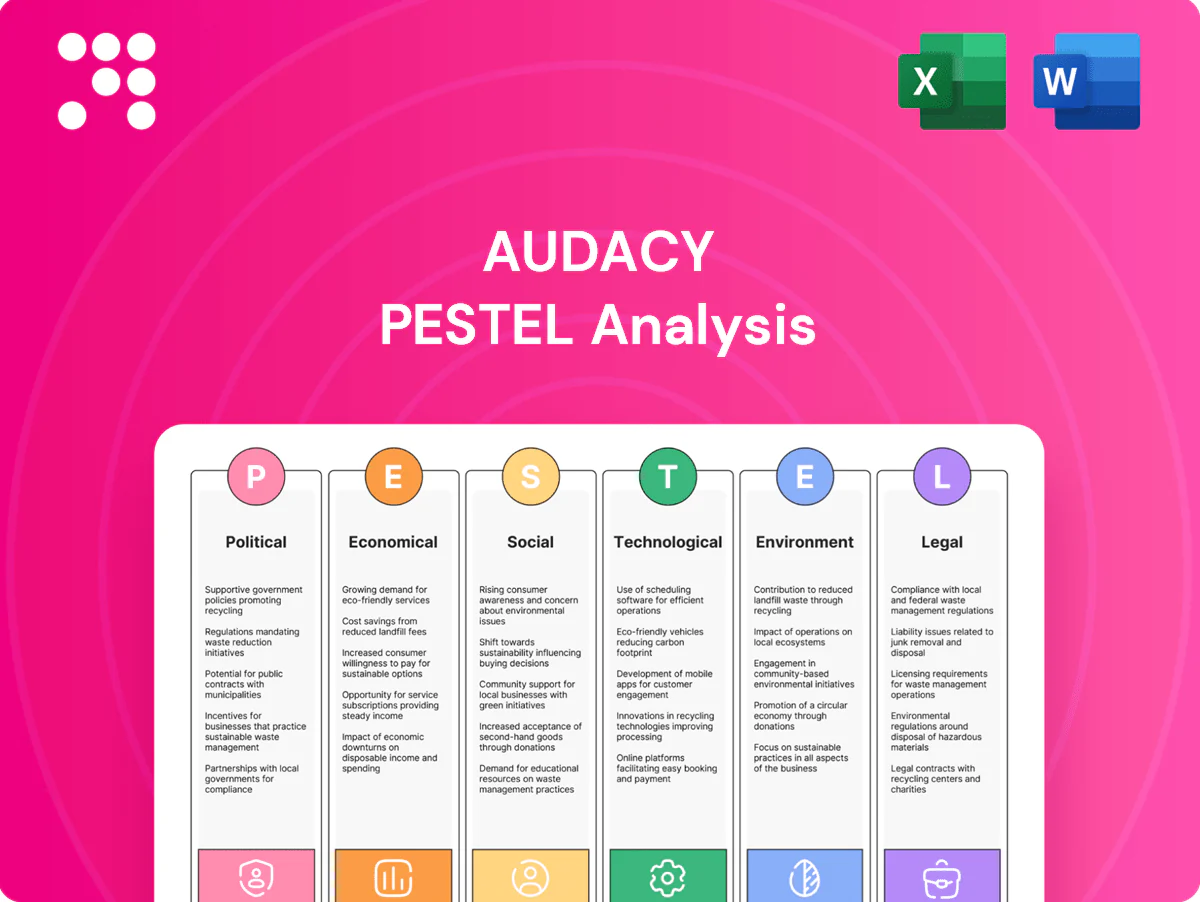
Audacy PESTLE Analysis

Make Smarter Strategic Decisions with a Complete PESTEL View
Unlock strategic clarity with our PESTLE Analysis of Audacy—three to five targeted insights that reveal how political, economic, and technological forces shape the company’s trajectory. Ideal for investors, advisors, and strategists, this brief highlights key external risks and opportunities you need now. Purchase the full, editable report to get comprehensive data and actionable recommendations for confident decision-making.
Political factors

FCC policy stability and media oversight
Regulatory priorities at the FCC can shift with administrations, affecting ownership caps, localism and content rules, which matters for Audacy’s approximately 235 stations across 48 markets. Stability supports multi-year planning for station portfolios and digital expansion and capital allocation. Policy swings could require divestitures or spur acquisitions, impacting M&A timing and valuation. Close monitoring and advocacy preserve operating flexibility and regulatory compliance.
Spectrum allocation and broadcast priorities
Decisions on spectrum use directly affect Audacy’s signal quality, coverage footprint and interference protections, shaping audience reach and ad revenue potential. Pressure to reallocate spectrum for broadband is intense—FCC Auction 110 (3.45 GHz) raised about $21.9 billion—showing high demand that can constrain broadcasters. Audacy must actively engage in FCC proceedings and industry coalitions to defend core spectrum assets. Long-term spectrum certainty underpins capex planning and market reach investments.

Political advertising cycles and rules
Election cycles drive seasonal lifts in news and talk demand—2024 political ad spending topped an estimated 10 billion USD, pushing spot rates and CPMs materially higher during peak windows. Equal-time and lowest unit rate rules force rigorous logging and rate management to avoid challenges and rebates. Changes in campaign finance and digital targeting shifted incremental dollars from traditional radio toward streaming and social. Building scalable political sales ops captures concentrated revenue surges.

Local and state media incentives
Some jurisdictions have pursued tax credits and grant programs to bolster local journalism and emergency broadcasting, and the federal Local Journalism Sustainability Act was proposed but not enacted in 2020–2021, leaving states and cities to act. Accessing these incentives can fund newsroom investments and public-service content, improving emergency reach and local reporting. Policy momentum varies by state and city; Audacy can pilot applications where benefits align with its market footprint.
- tags: incentives, grants, emergency-broadcasting
- tags: LJSA (proposed federal bill), state-level pilots
- tags: pilot opportunities aligned to markets
Geopolitical and trade factors on equipment costs
Geopolitical tensions and trade measures—notably US Section 301 tariffs of up to 25% and successive semiconductor export controls since 2019—raise costs for transmitters, antennas and networking gear, and contributed to supplier lead times that spiked past 20 weeks during 2020–21, complicating upgrades and maintenance across markets. Diversified sourcing and forward buying have been used to mitigate price volatility, while close collaboration with vendors shortens lead times and secures capacity.
- Tariffs: Section 301 up to 25%
- Export controls: tightened since 2019 (semiconductors, Huawei)
- Lead times: spiked past 20 weeks in 2020–21
- Mitigants: diversified sourcing, forward buying, vendor collaboration
FCC shifts reshape 235 stations; $21.9B spectrum boom alters M&A timing
Regulatory shifts at the FCC affect Audacy’s ~235 stations in 48 markets, influencing ownership, content and M&A timing; Auction 110 raised $21.9B highlighting spectrum value. 2024 political ad spend exceeded $10B, boosting CPMs but moving dollars to digital. Tariffs (Section 301 up to 25%) and semiconductor export controls raised equipment costs and pushed vendor lead times past 20 weeks.
| Issue | Metric |
|---|---|
| Stations/Markets | ~235 / 48 |
| Political ad spend (2024) | >$10B |
| Auction 110 | $21.9B |
| Tariffs | Section 301 up to 25% |
| Lead times | >20 weeks (2020–21) |
What is included in the product
 Detailed Word Document
Explores how external macro-environmental factors uniquely affect Audacy across Political, Economic, Social, Technological, Environmental and Legal dimensions, with data-driven examples tied to the U.S. radio, streaming and audio-advertising market. Designed for executives, investors and strategists, each category includes trend-backed subpoints and forward-looking insights to inform scenario planning, risk mitigation and growth opportunities.

 Customizable Excel Spreadsheet
A concise, visually segmented PESTLE summary for Audacy that can be dropped into presentations, annotated for local context, and easily shared across teams to streamline external risk discussions and accelerate strategic planning.
Economic factors

Advertising cycle sensitivity
Macro slowdowns quickly compress local and national ad budgets, driving CPMs and fill rates down—radio CPMs dropped roughly 15% during the 2023–24 downturn, pressuring Audacy’s spot revenue. Recovery phases typically generate strong rebounds in autos, retail and entertainment, with industry ad spend rising double digits in early 2024. Diversifying into digital audio and attribution-based offerings (digital audio growth ~19% YoY for many sellers) cushions volatility, while tight yield management preserves pricing power.
Interest rates and leverage
Higher policy rates (Fed funds 5.25–5.50% through mid‑2025) raise Audacy’s debt service and constrain discretionary investment and M&A flexibility. Refinancing windows and covenant headroom determine capital allocation, making maturity schedules and liquidity sources critical. Reducing leverage and extending maturities materially lowers default risk; disciplined cash flow management preserves programming and tech upgrade budgets across cycles.

Shifts to performance-based spend
Advertisers now prioritize measurable outcomes, with over $200 billion in US digital ad spend driving demand for attribution and closed-loop reporting; radio plus digital bundles with retargeting capture more share by linking audio reach to online conversions. Building first-party data and ROI case studies is critical to validate lift and justify spend. Sales enablement must pivot to outcome-focused pitches rather than impression counts.

Labor costs and talent market
On-air personalities, newsroom and engineering talent drive Audacy differentiation, with top radio and podcast hosts commanding higher pay as podcast ad revenue surpassed roughly 2.1 billion USD in 2023 and continued growth into 2024.
Wage inflation and competitive offers from streaming platforms and independent creators raise costs, while smart contracts and multi-market syndication spread content costs across markets.
Training programs and automation (AI-assisted production, RCS automation) reduce staffing gaps and churn without materially eroding content quality.
- Talent-driven margin pressure: rising host payouts
- Cost mitigation: syndication, smart contracts
- Efficiency gains: training + automation
Local market concentration and M&A dynamics
Local market concentration shapes Audacy’s pricing leverage with advertisers and agencies; operating about 235 radio stations in 48 markets strengthens bargaining power for CPMs and cross-platform packages. Consolidation can unlock cost synergies but attracts regulatory scrutiny on cluster ownership limits. Selective divestitures and station swaps optimize cluster economics while disciplined deals support deleveraging objectives.
- Stations: 235 across 48 markets
- Focus: cost synergies via consolidation
- Action: selective divestitures/swaps
- Goal: disciplined M&A to reduce leverage
FCC shifts reshape 235 stations; $21.9B spectrum boom alters M&A timing
Macro slowdowns cut radio CPMs ~15% in 2023–24, pressuring Audacy’s spot revenue while digital audio grew ~19% YoY, cushioning losses. Fed funds at 5.25–5.50% through mid‑2025 raise debt service and tighten M&A, making liquidity and maturities critical. Audacy’s 235 stations in 48 markets boost local pricing power; podcast ad revenue reached ~$2.1B in 2023, increasing demand for attribution-based bundles.
Full Version Awaits
Audacy PESTLE Analysis
The Audacy PESTLE Analysis preview shown here is the exact, fully formatted document you’ll receive after purchase. It contains the complete political, economic, social, technological, legal, and environmental assessment as displayed. No placeholders or teasers—this is the final, ready-to-use file. Download the same file instantly after checkout.

Make Smarter Strategic Decisions with a Complete PESTEL View
Unlock strategic clarity with our PESTLE Analysis of Audacy—three to five targeted insights that reveal how political, economic, and technological forces shape the company’s trajectory. Ideal for investors, advisors, and strategists, this brief highlights key external risks and opportunities you need now. Purchase the full, editable report to get comprehensive data and actionable recommendations for confident decision-making.
Political factors
FCC policy stability and media oversight
Regulatory priorities at the FCC can shift with administrations, affecting ownership caps, localism and content rules, which matters for Audacy’s approximately 235 stations across 48 markets. Stability supports multi-year planning for station portfolios and digital expansion and capital allocation. Policy swings could require divestitures or spur acquisitions, impacting M&A timing and valuation. Close monitoring and advocacy preserve operating flexibility and regulatory compliance.
Spectrum allocation and broadcast priorities
Decisions on spectrum use directly affect Audacy’s signal quality, coverage footprint and interference protections, shaping audience reach and ad revenue potential. Pressure to reallocate spectrum for broadband is intense—FCC Auction 110 (3.45 GHz) raised about $21.9 billion—showing high demand that can constrain broadcasters. Audacy must actively engage in FCC proceedings and industry coalitions to defend core spectrum assets. Long-term spectrum certainty underpins capex planning and market reach investments.
Political advertising cycles and rules
Election cycles drive seasonal lifts in news and talk demand—2024 political ad spending topped an estimated 10 billion USD, pushing spot rates and CPMs materially higher during peak windows. Equal-time and lowest unit rate rules force rigorous logging and rate management to avoid challenges and rebates. Changes in campaign finance and digital targeting shifted incremental dollars from traditional radio toward streaming and social. Building scalable political sales ops captures concentrated revenue surges.
Local and state media incentives
Some jurisdictions have pursued tax credits and grant programs to bolster local journalism and emergency broadcasting, and the federal Local Journalism Sustainability Act was proposed but not enacted in 2020–2021, leaving states and cities to act. Accessing these incentives can fund newsroom investments and public-service content, improving emergency reach and local reporting. Policy momentum varies by state and city; Audacy can pilot applications where benefits align with its market footprint.
- tags: incentives, grants, emergency-broadcasting
- tags: LJSA (proposed federal bill), state-level pilots
- tags: pilot opportunities aligned to markets
Geopolitical and trade factors on equipment costs
Geopolitical tensions and trade measures—notably US Section 301 tariffs of up to 25% and successive semiconductor export controls since 2019—raise costs for transmitters, antennas and networking gear, and contributed to supplier lead times that spiked past 20 weeks during 2020–21, complicating upgrades and maintenance across markets. Diversified sourcing and forward buying have been used to mitigate price volatility, while close collaboration with vendors shortens lead times and secures capacity.
- Tariffs: Section 301 up to 25%
- Export controls: tightened since 2019 (semiconductors, Huawei)
- Lead times: spiked past 20 weeks in 2020–21
- Mitigants: diversified sourcing, forward buying, vendor collaboration
FCC shifts reshape 235 stations; $21.9B spectrum boom alters M&A timing
Regulatory shifts at the FCC affect Audacy’s ~235 stations in 48 markets, influencing ownership, content and M&A timing; Auction 110 raised $21.9B highlighting spectrum value. 2024 political ad spend exceeded $10B, boosting CPMs but moving dollars to digital. Tariffs (Section 301 up to 25%) and semiconductor export controls raised equipment costs and pushed vendor lead times past 20 weeks.
| Issue | Metric |
|---|---|
| Stations/Markets | ~235 / 48 |
| Political ad spend (2024) | >$10B |
| Auction 110 | $21.9B |
| Tariffs | Section 301 up to 25% |
| Lead times | >20 weeks (2020–21) |
What is included in the product
Detailed Word Document
Explores how external macro-environmental factors uniquely affect Audacy across Political, Economic, Social, Technological, Environmental and Legal dimensions, with data-driven examples tied to the U.S. radio, streaming and audio-advertising market. Designed for executives, investors and strategists, each category includes trend-backed subpoints and forward-looking insights to inform scenario planning, risk mitigation and growth opportunities.
Customizable Excel Spreadsheet
A concise, visually segmented PESTLE summary for Audacy that can be dropped into presentations, annotated for local context, and easily shared across teams to streamline external risk discussions and accelerate strategic planning.
Economic factors
Advertising cycle sensitivity
Macro slowdowns quickly compress local and national ad budgets, driving CPMs and fill rates down—radio CPMs dropped roughly 15% during the 2023–24 downturn, pressuring Audacy’s spot revenue. Recovery phases typically generate strong rebounds in autos, retail and entertainment, with industry ad spend rising double digits in early 2024. Diversifying into digital audio and attribution-based offerings (digital audio growth ~19% YoY for many sellers) cushions volatility, while tight yield management preserves pricing power.
Interest rates and leverage
Higher policy rates (Fed funds 5.25–5.50% through mid‑2025) raise Audacy’s debt service and constrain discretionary investment and M&A flexibility. Refinancing windows and covenant headroom determine capital allocation, making maturity schedules and liquidity sources critical. Reducing leverage and extending maturities materially lowers default risk; disciplined cash flow management preserves programming and tech upgrade budgets across cycles.
Shifts to performance-based spend
Advertisers now prioritize measurable outcomes, with over $200 billion in US digital ad spend driving demand for attribution and closed-loop reporting; radio plus digital bundles with retargeting capture more share by linking audio reach to online conversions. Building first-party data and ROI case studies is critical to validate lift and justify spend. Sales enablement must pivot to outcome-focused pitches rather than impression counts.
Labor costs and talent market
On-air personalities, newsroom and engineering talent drive Audacy differentiation, with top radio and podcast hosts commanding higher pay as podcast ad revenue surpassed roughly 2.1 billion USD in 2023 and continued growth into 2024.
Wage inflation and competitive offers from streaming platforms and independent creators raise costs, while smart contracts and multi-market syndication spread content costs across markets.
Training programs and automation (AI-assisted production, RCS automation) reduce staffing gaps and churn without materially eroding content quality.
- Talent-driven margin pressure: rising host payouts
- Cost mitigation: syndication, smart contracts
- Efficiency gains: training + automation
Local market concentration and M&A dynamics
Local market concentration shapes Audacy’s pricing leverage with advertisers and agencies; operating about 235 radio stations in 48 markets strengthens bargaining power for CPMs and cross-platform packages. Consolidation can unlock cost synergies but attracts regulatory scrutiny on cluster ownership limits. Selective divestitures and station swaps optimize cluster economics while disciplined deals support deleveraging objectives.
- Stations: 235 across 48 markets
- Focus: cost synergies via consolidation
- Action: selective divestitures/swaps
- Goal: disciplined M&A to reduce leverage
FCC shifts reshape 235 stations; $21.9B spectrum boom alters M&A timing
Macro slowdowns cut radio CPMs ~15% in 2023–24, pressuring Audacy’s spot revenue while digital audio grew ~19% YoY, cushioning losses. Fed funds at 5.25–5.50% through mid‑2025 raise debt service and tighten M&A, making liquidity and maturities critical. Audacy’s 235 stations in 48 markets boost local pricing power; podcast ad revenue reached ~$2.1B in 2023, increasing demand for attribution-based bundles.
Full Version Awaits
Audacy PESTLE Analysis
The Audacy PESTLE Analysis preview shown here is the exact, fully formatted document you’ll receive after purchase. It contains the complete political, economic, social, technological, legal, and environmental assessment as displayed. No placeholders or teasers—this is the final, ready-to-use file. Download the same file instantly after checkout.
Original: $10.00
-65%$10.00
$3.50Description
Make Smarter Strategic Decisions with a Complete PESTEL View
Unlock strategic clarity with our PESTLE Analysis of Audacy—three to five targeted insights that reveal how political, economic, and technological forces shape the company’s trajectory. Ideal for investors, advisors, and strategists, this brief highlights key external risks and opportunities you need now. Purchase the full, editable report to get comprehensive data and actionable recommendations for confident decision-making.
Political factors
FCC policy stability and media oversight
Regulatory priorities at the FCC can shift with administrations, affecting ownership caps, localism and content rules, which matters for Audacy’s approximately 235 stations across 48 markets. Stability supports multi-year planning for station portfolios and digital expansion and capital allocation. Policy swings could require divestitures or spur acquisitions, impacting M&A timing and valuation. Close monitoring and advocacy preserve operating flexibility and regulatory compliance.
Spectrum allocation and broadcast priorities
Decisions on spectrum use directly affect Audacy’s signal quality, coverage footprint and interference protections, shaping audience reach and ad revenue potential. Pressure to reallocate spectrum for broadband is intense—FCC Auction 110 (3.45 GHz) raised about $21.9 billion—showing high demand that can constrain broadcasters. Audacy must actively engage in FCC proceedings and industry coalitions to defend core spectrum assets. Long-term spectrum certainty underpins capex planning and market reach investments.
Political advertising cycles and rules
Election cycles drive seasonal lifts in news and talk demand—2024 political ad spending topped an estimated 10 billion USD, pushing spot rates and CPMs materially higher during peak windows. Equal-time and lowest unit rate rules force rigorous logging and rate management to avoid challenges and rebates. Changes in campaign finance and digital targeting shifted incremental dollars from traditional radio toward streaming and social. Building scalable political sales ops captures concentrated revenue surges.
Local and state media incentives
Some jurisdictions have pursued tax credits and grant programs to bolster local journalism and emergency broadcasting, and the federal Local Journalism Sustainability Act was proposed but not enacted in 2020–2021, leaving states and cities to act. Accessing these incentives can fund newsroom investments and public-service content, improving emergency reach and local reporting. Policy momentum varies by state and city; Audacy can pilot applications where benefits align with its market footprint.
- tags: incentives, grants, emergency-broadcasting
- tags: LJSA (proposed federal bill), state-level pilots
- tags: pilot opportunities aligned to markets
Geopolitical and trade factors on equipment costs
Geopolitical tensions and trade measures—notably US Section 301 tariffs of up to 25% and successive semiconductor export controls since 2019—raise costs for transmitters, antennas and networking gear, and contributed to supplier lead times that spiked past 20 weeks during 2020–21, complicating upgrades and maintenance across markets. Diversified sourcing and forward buying have been used to mitigate price volatility, while close collaboration with vendors shortens lead times and secures capacity.
- Tariffs: Section 301 up to 25%
- Export controls: tightened since 2019 (semiconductors, Huawei)
- Lead times: spiked past 20 weeks in 2020–21
- Mitigants: diversified sourcing, forward buying, vendor collaboration
FCC shifts reshape 235 stations; $21.9B spectrum boom alters M&A timing
Regulatory shifts at the FCC affect Audacy’s ~235 stations in 48 markets, influencing ownership, content and M&A timing; Auction 110 raised $21.9B highlighting spectrum value. 2024 political ad spend exceeded $10B, boosting CPMs but moving dollars to digital. Tariffs (Section 301 up to 25%) and semiconductor export controls raised equipment costs and pushed vendor lead times past 20 weeks.
| Issue | Metric |
|---|---|
| Stations/Markets | ~235 / 48 |
| Political ad spend (2024) | >$10B |
| Auction 110 | $21.9B |
| Tariffs | Section 301 up to 25% |
| Lead times | >20 weeks (2020–21) |
What is included in the product
Detailed Word Document
Explores how external macro-environmental factors uniquely affect Audacy across Political, Economic, Social, Technological, Environmental and Legal dimensions, with data-driven examples tied to the U.S. radio, streaming and audio-advertising market. Designed for executives, investors and strategists, each category includes trend-backed subpoints and forward-looking insights to inform scenario planning, risk mitigation and growth opportunities.
Customizable Excel Spreadsheet
A concise, visually segmented PESTLE summary for Audacy that can be dropped into presentations, annotated for local context, and easily shared across teams to streamline external risk discussions and accelerate strategic planning.
Economic factors
Advertising cycle sensitivity
Macro slowdowns quickly compress local and national ad budgets, driving CPMs and fill rates down—radio CPMs dropped roughly 15% during the 2023–24 downturn, pressuring Audacy’s spot revenue. Recovery phases typically generate strong rebounds in autos, retail and entertainment, with industry ad spend rising double digits in early 2024. Diversifying into digital audio and attribution-based offerings (digital audio growth ~19% YoY for many sellers) cushions volatility, while tight yield management preserves pricing power.
Interest rates and leverage
Higher policy rates (Fed funds 5.25–5.50% through mid‑2025) raise Audacy’s debt service and constrain discretionary investment and M&A flexibility. Refinancing windows and covenant headroom determine capital allocation, making maturity schedules and liquidity sources critical. Reducing leverage and extending maturities materially lowers default risk; disciplined cash flow management preserves programming and tech upgrade budgets across cycles.
Shifts to performance-based spend
Advertisers now prioritize measurable outcomes, with over $200 billion in US digital ad spend driving demand for attribution and closed-loop reporting; radio plus digital bundles with retargeting capture more share by linking audio reach to online conversions. Building first-party data and ROI case studies is critical to validate lift and justify spend. Sales enablement must pivot to outcome-focused pitches rather than impression counts.
Labor costs and talent market
On-air personalities, newsroom and engineering talent drive Audacy differentiation, with top radio and podcast hosts commanding higher pay as podcast ad revenue surpassed roughly 2.1 billion USD in 2023 and continued growth into 2024.
Wage inflation and competitive offers from streaming platforms and independent creators raise costs, while smart contracts and multi-market syndication spread content costs across markets.
Training programs and automation (AI-assisted production, RCS automation) reduce staffing gaps and churn without materially eroding content quality.
- Talent-driven margin pressure: rising host payouts
- Cost mitigation: syndication, smart contracts
- Efficiency gains: training + automation
Local market concentration and M&A dynamics
Local market concentration shapes Audacy’s pricing leverage with advertisers and agencies; operating about 235 radio stations in 48 markets strengthens bargaining power for CPMs and cross-platform packages. Consolidation can unlock cost synergies but attracts regulatory scrutiny on cluster ownership limits. Selective divestitures and station swaps optimize cluster economics while disciplined deals support deleveraging objectives.
- Stations: 235 across 48 markets
- Focus: cost synergies via consolidation
- Action: selective divestitures/swaps
- Goal: disciplined M&A to reduce leverage
FCC shifts reshape 235 stations; $21.9B spectrum boom alters M&A timing
Macro slowdowns cut radio CPMs ~15% in 2023–24, pressuring Audacy’s spot revenue while digital audio grew ~19% YoY, cushioning losses. Fed funds at 5.25–5.50% through mid‑2025 raise debt service and tighten M&A, making liquidity and maturities critical. Audacy’s 235 stations in 48 markets boost local pricing power; podcast ad revenue reached ~$2.1B in 2023, increasing demand for attribution-based bundles.
Full Version Awaits
Audacy PESTLE Analysis
The Audacy PESTLE Analysis preview shown here is the exact, fully formatted document you’ll receive after purchase. It contains the complete political, economic, social, technological, legal, and environmental assessment as displayed. No placeholders or teasers—this is the final, ready-to-use file. Download the same file instantly after checkout.











