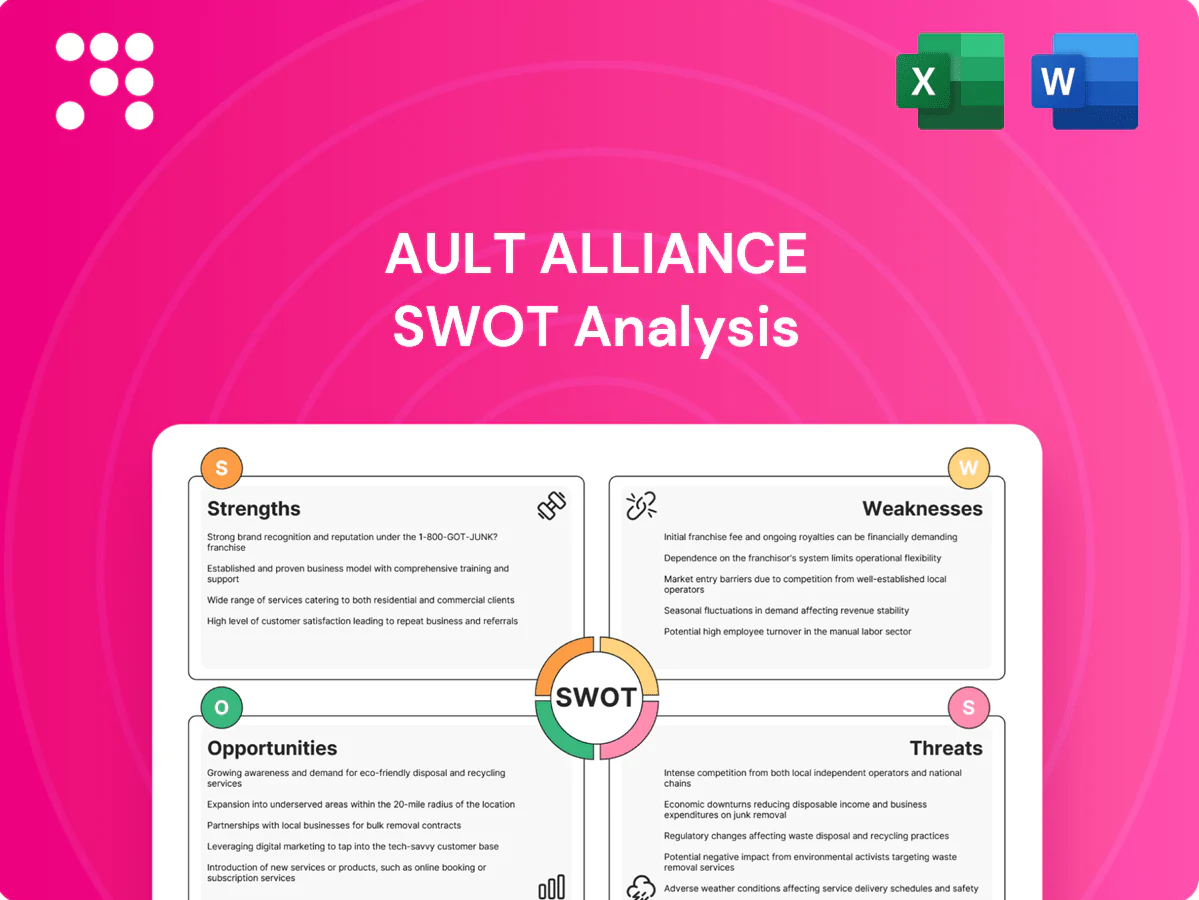
Ault Alliance SWOT Analysis

Your Strategic Toolkit Starts Here
Ault Alliance SWOT Analysis highlights the company’s differentiated digital offerings, capital-light model, and niche client base while flagging regulatory exposure and execution risks. Our full report unpacks market positioning, financial context, and growth levers. Ideal for investors and strategists seeking actionable insights. Purchase the complete, editable SWOT for presentation-ready Word and Excel deliverables.
Strengths

Diversified portfolio across tech and energy
Exposure to data centers, bitcoin mining and power solutions reduces reliance on a single revenue stream, helping Ault Alliance spread operational risk across infrastructure and crypto demand cycles. This mix can smooth cash flows through different market environments and enable cross-business synergies such as power sourcing for mining and reuse of data-center infrastructure to enhance returns. Diversification widens strategic optionality and potential exit paths for assets and business lines.
Vertical integration in power-intensive ops
Control over power supports cost efficiency for data centers and mining, with electricity comprising about 65% of Bitcoin mining operating costs per 2024 industry estimates. Energy procurement, load management and onsite generation shield margins from spot volatility—US wholesale power averaged near $40/MWh in 2024 (EIA). Vertical integration enables flexible scaling tied to market conditions, a clear edge versus operators reliant on retail power.

Active investment and turnaround approach
The strategy emphasizes acquiring, optimizing, and developing entities to unlock underappreciated asset value through operational enhancements. A hands-on posture enables faster pivots and tighter cost discipline, accelerating turnaround timelines. Value-creation levers include consolidation, targeted divestitures, and balance-sheet restructuring to crystallize gains.

Optionality to crypto upcycles
Bitcoin mining exposure gives Ault Alliance asymmetric upside in crypto bull cycles as miner revenues scale with price and network activity; recent halving dynamics in 2024 reinforced this leverage. Improved mining efficiency and capacity expansions compound earnings sensitivity, while portfolio reallocation ability lets Ault capture momentum across tokens and infrastructure.
- Torque: mining revenues amplify bull markets
- Leverage: efficiency raises margins
- Flexibility: portfolio reallocation captures momentum
Infrastructure footprint with scale potential
Existing data center and mining sites can be expanded or repurposed to host co-location, HPC or AI workloads, capturing part of a global data center market estimated at about $220 billion in 2024 and a growing colocation segment.
AI-ready retrofits and higher revenue-density workloads can materially raise ARR while physical assets enable asset-backed financing and JV partnerships; scale typically drives lower unit costs as utilization rises.
- expandability: reuse sites for AI/HPC
- monetization: higher revenue density via co-location
- finance: assets support secured capital/partnerships
Vertical power control + data center and bitcoin mining diversification unlocks AI/HPC growth
Diversified exposure to data centers, bitcoin mining and power reduces single-stream risk and enables cross-unit synergies. Vertical control of power (electricity ≈65% of mining opex) and US wholesale near $40/MWh in 2024 protects margins. Asset expansion into AI/HPC taps a $220B global data-center market (2024), enabling higher ARR and asset-backed finance.
| Metric | 2024 figure | Implication |
|---|---|---|
| Electricity share of mining opex | ≈65% | Margin leverage |
| US wholesale power | ≈$40/MWh | Cost advantage |
| Data-center market | $220B | Addressable demand |
What is included in the product
 Detailed Word Document
Provides a concise SWOT analysis of Ault Alliance, outlining internal strengths and weaknesses alongside external opportunities and threats to clarify its competitive position, growth drivers, and strategic risks.

 Customizable Excel Spreadsheet
Provides a compact, editable Ault Alliance SWOT matrix for fast strategic alignment and easy updates across teams. Ideal for executives and analysts needing a clear, visual snapshot to relieve planning bottlenecks and speed stakeholder buy-in.
Weaknesses

Conglomerate complexity and focus risk
Managing multiple verticals raises bandwidth demands and execution risk, and conglomerates like Ault Alliance often face a market-imposed conglomerate discount—commonly estimated at roughly 15–25%—which can depress valuation. Prioritization across heterogeneous assets can dilute strategic focus and capital allocation, while integration costs and longer decision cycles have been shown to pressure operating margins and slow growth realization.
High capex and opex intensity
High capex and opex intensity: data centers and crypto mining demand large upfront buildouts and continuous power, cooling and maintenance; IEA estimated data centers and data transmission used about 1% of global electricity in 2022, while Cambridge’s CBECI put Bitcoin mining near 100 TWh/year in 2024. Long payback horizons are highly sensitive to utilization and delays, and heavy asset bases raise depreciation and fixed-cost leverage, straining liquidity if costs overrun.

Exposure to crypto price volatility
Mining economics hinge on bitcoin price, network difficulty and halving events — the April 2024 halving cut the block reward from 6.25 to 3.125 BTC. Downcycles can compress margins rapidly: BTC fell ~65% from its Nov 2021 peak into 2022, forcing many rigs offline and margin squeeze. Hedging with forwards/options is imperfect and caps upside, leaving revenue less predictable than traditional cash-flow businesses.

Financing and dilution sensitivity
Capital-intensive growth for Ault Alliance often requires external equity or debt; with US federal funds around 5.25–5.50% in mid-2025, higher borrowing costs can raise WACC and increase dilution risk for existing shareholders. Tight credit markets and lender covenants restrict strategic agility, while swings in small-cap sentiment can abruptly worsen access and terms.
- Higher rates: Fed 5.25–5.50% (mid‑2025)
- Dilution risk: equity raises likely
- Covenants: limit operational flexibility
- Market sentiment: volatility hurts funding
Technology obsolescence risk
Mining rigs and data-center hardware typically become uncompetitive within 18–36 months as each ASIC generation improves energy efficiency roughly 30–50%, eroding margins and market share; continuous refresh cycles require recurrent capital outlays that compress operating cash flow and raise leverage, while mis-timed upgrades can lock in suboptimal returns when newer, more efficient machines arrive.
- Typical obsolescence: 18–36 months
- Efficiency gain per generation: ~30–50%
- Refresh = recurring capex pressure on cash flow
- Timing risk: upgrades can fix suboptimal ROI
Crypto-mining conglomerate risks: 15–25% discount, high energy use, halved BTC rewards
Managing diverse verticals creates execution risk and a 15–25% conglomerate discount; heavy capex/opex ties valuation to utilization with data centers ~1% global electricity (IEA 2022) and Bitcoin mining ~100 TWh/yr (CBECI 2024). Halving (Apr 2024) cut rewards to 3.125 BTC; Fed funds 5.25–5.50% (mid‑2025) raises funding costs; ASIC obsolescence 18–36 months (30–50% efficiency gains).
| Weakness | Metric | Latest |
|---|---|---|
| Conglomerate discount | Valuation hit | 15–25% |
| Energy intensity | Consumption | Data centers ~1% / Mining ~100 TWh |
| Funding | Rate | Fed 5.25–5.50% |
| Obsolescence | Cycle | 18–36 months |
Preview the Actual Deliverable
Ault Alliance SWOT Analysis
This is the actual SWOT analysis document you’ll receive upon purchase—no surprises, just professional quality. The preview below is taken directly from the full SWOT report you'll get; purchase unlocks the entire in-depth version. The file shown is the real SWOT analysis you'll download post-purchase, editable and ready to use.

Your Strategic Toolkit Starts Here
Ault Alliance SWOT Analysis highlights the company’s differentiated digital offerings, capital-light model, and niche client base while flagging regulatory exposure and execution risks. Our full report unpacks market positioning, financial context, and growth levers. Ideal for investors and strategists seeking actionable insights. Purchase the complete, editable SWOT for presentation-ready Word and Excel deliverables.
Strengths
Diversified portfolio across tech and energy
Exposure to data centers, bitcoin mining and power solutions reduces reliance on a single revenue stream, helping Ault Alliance spread operational risk across infrastructure and crypto demand cycles. This mix can smooth cash flows through different market environments and enable cross-business synergies such as power sourcing for mining and reuse of data-center infrastructure to enhance returns. Diversification widens strategic optionality and potential exit paths for assets and business lines.
Vertical integration in power-intensive ops
Control over power supports cost efficiency for data centers and mining, with electricity comprising about 65% of Bitcoin mining operating costs per 2024 industry estimates. Energy procurement, load management and onsite generation shield margins from spot volatility—US wholesale power averaged near $40/MWh in 2024 (EIA). Vertical integration enables flexible scaling tied to market conditions, a clear edge versus operators reliant on retail power.
Active investment and turnaround approach
The strategy emphasizes acquiring, optimizing, and developing entities to unlock underappreciated asset value through operational enhancements. A hands-on posture enables faster pivots and tighter cost discipline, accelerating turnaround timelines. Value-creation levers include consolidation, targeted divestitures, and balance-sheet restructuring to crystallize gains.
Optionality to crypto upcycles
Bitcoin mining exposure gives Ault Alliance asymmetric upside in crypto bull cycles as miner revenues scale with price and network activity; recent halving dynamics in 2024 reinforced this leverage. Improved mining efficiency and capacity expansions compound earnings sensitivity, while portfolio reallocation ability lets Ault capture momentum across tokens and infrastructure.
- Torque: mining revenues amplify bull markets
- Leverage: efficiency raises margins
- Flexibility: portfolio reallocation captures momentum
Infrastructure footprint with scale potential
Existing data center and mining sites can be expanded or repurposed to host co-location, HPC or AI workloads, capturing part of a global data center market estimated at about $220 billion in 2024 and a growing colocation segment.
AI-ready retrofits and higher revenue-density workloads can materially raise ARR while physical assets enable asset-backed financing and JV partnerships; scale typically drives lower unit costs as utilization rises.
- expandability: reuse sites for AI/HPC
- monetization: higher revenue density via co-location
- finance: assets support secured capital/partnerships
Vertical power control + data center and bitcoin mining diversification unlocks AI/HPC growth
Diversified exposure to data centers, bitcoin mining and power reduces single-stream risk and enables cross-unit synergies. Vertical control of power (electricity ≈65% of mining opex) and US wholesale near $40/MWh in 2024 protects margins. Asset expansion into AI/HPC taps a $220B global data-center market (2024), enabling higher ARR and asset-backed finance.
| Metric | 2024 figure | Implication |
|---|---|---|
| Electricity share of mining opex | ≈65% | Margin leverage |
| US wholesale power | ≈$40/MWh | Cost advantage |
| Data-center market | $220B | Addressable demand |
What is included in the product
Detailed Word Document
Provides a concise SWOT analysis of Ault Alliance, outlining internal strengths and weaknesses alongside external opportunities and threats to clarify its competitive position, growth drivers, and strategic risks.
Customizable Excel Spreadsheet
Provides a compact, editable Ault Alliance SWOT matrix for fast strategic alignment and easy updates across teams. Ideal for executives and analysts needing a clear, visual snapshot to relieve planning bottlenecks and speed stakeholder buy-in.
Weaknesses
Conglomerate complexity and focus risk
Managing multiple verticals raises bandwidth demands and execution risk, and conglomerates like Ault Alliance often face a market-imposed conglomerate discount—commonly estimated at roughly 15–25%—which can depress valuation. Prioritization across heterogeneous assets can dilute strategic focus and capital allocation, while integration costs and longer decision cycles have been shown to pressure operating margins and slow growth realization.
High capex and opex intensity
High capex and opex intensity: data centers and crypto mining demand large upfront buildouts and continuous power, cooling and maintenance; IEA estimated data centers and data transmission used about 1% of global electricity in 2022, while Cambridge’s CBECI put Bitcoin mining near 100 TWh/year in 2024. Long payback horizons are highly sensitive to utilization and delays, and heavy asset bases raise depreciation and fixed-cost leverage, straining liquidity if costs overrun.
Exposure to crypto price volatility
Mining economics hinge on bitcoin price, network difficulty and halving events — the April 2024 halving cut the block reward from 6.25 to 3.125 BTC. Downcycles can compress margins rapidly: BTC fell ~65% from its Nov 2021 peak into 2022, forcing many rigs offline and margin squeeze. Hedging with forwards/options is imperfect and caps upside, leaving revenue less predictable than traditional cash-flow businesses.
Financing and dilution sensitivity
Capital-intensive growth for Ault Alliance often requires external equity or debt; with US federal funds around 5.25–5.50% in mid-2025, higher borrowing costs can raise WACC and increase dilution risk for existing shareholders. Tight credit markets and lender covenants restrict strategic agility, while swings in small-cap sentiment can abruptly worsen access and terms.
- Higher rates: Fed 5.25–5.50% (mid‑2025)
- Dilution risk: equity raises likely
- Covenants: limit operational flexibility
- Market sentiment: volatility hurts funding
Technology obsolescence risk
Mining rigs and data-center hardware typically become uncompetitive within 18–36 months as each ASIC generation improves energy efficiency roughly 30–50%, eroding margins and market share; continuous refresh cycles require recurrent capital outlays that compress operating cash flow and raise leverage, while mis-timed upgrades can lock in suboptimal returns when newer, more efficient machines arrive.
- Typical obsolescence: 18–36 months
- Efficiency gain per generation: ~30–50%
- Refresh = recurring capex pressure on cash flow
- Timing risk: upgrades can fix suboptimal ROI
Crypto-mining conglomerate risks: 15–25% discount, high energy use, halved BTC rewards
Managing diverse verticals creates execution risk and a 15–25% conglomerate discount; heavy capex/opex ties valuation to utilization with data centers ~1% global electricity (IEA 2022) and Bitcoin mining ~100 TWh/yr (CBECI 2024). Halving (Apr 2024) cut rewards to 3.125 BTC; Fed funds 5.25–5.50% (mid‑2025) raises funding costs; ASIC obsolescence 18–36 months (30–50% efficiency gains).
| Weakness | Metric | Latest |
|---|---|---|
| Conglomerate discount | Valuation hit | 15–25% |
| Energy intensity | Consumption | Data centers ~1% / Mining ~100 TWh |
| Funding | Rate | Fed 5.25–5.50% |
| Obsolescence | Cycle | 18–36 months |
Preview the Actual Deliverable
Ault Alliance SWOT Analysis
This is the actual SWOT analysis document you’ll receive upon purchase—no surprises, just professional quality. The preview below is taken directly from the full SWOT report you'll get; purchase unlocks the entire in-depth version. The file shown is the real SWOT analysis you'll download post-purchase, editable and ready to use.
Description
Your Strategic Toolkit Starts Here
Ault Alliance SWOT Analysis highlights the company’s differentiated digital offerings, capital-light model, and niche client base while flagging regulatory exposure and execution risks. Our full report unpacks market positioning, financial context, and growth levers. Ideal for investors and strategists seeking actionable insights. Purchase the complete, editable SWOT for presentation-ready Word and Excel deliverables.
Strengths
Diversified portfolio across tech and energy
Exposure to data centers, bitcoin mining and power solutions reduces reliance on a single revenue stream, helping Ault Alliance spread operational risk across infrastructure and crypto demand cycles. This mix can smooth cash flows through different market environments and enable cross-business synergies such as power sourcing for mining and reuse of data-center infrastructure to enhance returns. Diversification widens strategic optionality and potential exit paths for assets and business lines.
Vertical integration in power-intensive ops
Control over power supports cost efficiency for data centers and mining, with electricity comprising about 65% of Bitcoin mining operating costs per 2024 industry estimates. Energy procurement, load management and onsite generation shield margins from spot volatility—US wholesale power averaged near $40/MWh in 2024 (EIA). Vertical integration enables flexible scaling tied to market conditions, a clear edge versus operators reliant on retail power.
Active investment and turnaround approach
The strategy emphasizes acquiring, optimizing, and developing entities to unlock underappreciated asset value through operational enhancements. A hands-on posture enables faster pivots and tighter cost discipline, accelerating turnaround timelines. Value-creation levers include consolidation, targeted divestitures, and balance-sheet restructuring to crystallize gains.
Optionality to crypto upcycles
Bitcoin mining exposure gives Ault Alliance asymmetric upside in crypto bull cycles as miner revenues scale with price and network activity; recent halving dynamics in 2024 reinforced this leverage. Improved mining efficiency and capacity expansions compound earnings sensitivity, while portfolio reallocation ability lets Ault capture momentum across tokens and infrastructure.
- Torque: mining revenues amplify bull markets
- Leverage: efficiency raises margins
- Flexibility: portfolio reallocation captures momentum
Infrastructure footprint with scale potential
Existing data center and mining sites can be expanded or repurposed to host co-location, HPC or AI workloads, capturing part of a global data center market estimated at about $220 billion in 2024 and a growing colocation segment.
AI-ready retrofits and higher revenue-density workloads can materially raise ARR while physical assets enable asset-backed financing and JV partnerships; scale typically drives lower unit costs as utilization rises.
- expandability: reuse sites for AI/HPC
- monetization: higher revenue density via co-location
- finance: assets support secured capital/partnerships
Vertical power control + data center and bitcoin mining diversification unlocks AI/HPC growth
Diversified exposure to data centers, bitcoin mining and power reduces single-stream risk and enables cross-unit synergies. Vertical control of power (electricity ≈65% of mining opex) and US wholesale near $40/MWh in 2024 protects margins. Asset expansion into AI/HPC taps a $220B global data-center market (2024), enabling higher ARR and asset-backed finance.
| Metric | 2024 figure | Implication |
|---|---|---|
| Electricity share of mining opex | ≈65% | Margin leverage |
| US wholesale power | ≈$40/MWh | Cost advantage |
| Data-center market | $220B | Addressable demand |
What is included in the product
Detailed Word Document
Provides a concise SWOT analysis of Ault Alliance, outlining internal strengths and weaknesses alongside external opportunities and threats to clarify its competitive position, growth drivers, and strategic risks.
Customizable Excel Spreadsheet
Provides a compact, editable Ault Alliance SWOT matrix for fast strategic alignment and easy updates across teams. Ideal for executives and analysts needing a clear, visual snapshot to relieve planning bottlenecks and speed stakeholder buy-in.
Weaknesses
Conglomerate complexity and focus risk
Managing multiple verticals raises bandwidth demands and execution risk, and conglomerates like Ault Alliance often face a market-imposed conglomerate discount—commonly estimated at roughly 15–25%—which can depress valuation. Prioritization across heterogeneous assets can dilute strategic focus and capital allocation, while integration costs and longer decision cycles have been shown to pressure operating margins and slow growth realization.
High capex and opex intensity
High capex and opex intensity: data centers and crypto mining demand large upfront buildouts and continuous power, cooling and maintenance; IEA estimated data centers and data transmission used about 1% of global electricity in 2022, while Cambridge’s CBECI put Bitcoin mining near 100 TWh/year in 2024. Long payback horizons are highly sensitive to utilization and delays, and heavy asset bases raise depreciation and fixed-cost leverage, straining liquidity if costs overrun.
Exposure to crypto price volatility
Mining economics hinge on bitcoin price, network difficulty and halving events — the April 2024 halving cut the block reward from 6.25 to 3.125 BTC. Downcycles can compress margins rapidly: BTC fell ~65% from its Nov 2021 peak into 2022, forcing many rigs offline and margin squeeze. Hedging with forwards/options is imperfect and caps upside, leaving revenue less predictable than traditional cash-flow businesses.
Financing and dilution sensitivity
Capital-intensive growth for Ault Alliance often requires external equity or debt; with US federal funds around 5.25–5.50% in mid-2025, higher borrowing costs can raise WACC and increase dilution risk for existing shareholders. Tight credit markets and lender covenants restrict strategic agility, while swings in small-cap sentiment can abruptly worsen access and terms.
- Higher rates: Fed 5.25–5.50% (mid‑2025)
- Dilution risk: equity raises likely
- Covenants: limit operational flexibility
- Market sentiment: volatility hurts funding
Technology obsolescence risk
Mining rigs and data-center hardware typically become uncompetitive within 18–36 months as each ASIC generation improves energy efficiency roughly 30–50%, eroding margins and market share; continuous refresh cycles require recurrent capital outlays that compress operating cash flow and raise leverage, while mis-timed upgrades can lock in suboptimal returns when newer, more efficient machines arrive.
- Typical obsolescence: 18–36 months
- Efficiency gain per generation: ~30–50%
- Refresh = recurring capex pressure on cash flow
- Timing risk: upgrades can fix suboptimal ROI
Crypto-mining conglomerate risks: 15–25% discount, high energy use, halved BTC rewards
Managing diverse verticals creates execution risk and a 15–25% conglomerate discount; heavy capex/opex ties valuation to utilization with data centers ~1% global electricity (IEA 2022) and Bitcoin mining ~100 TWh/yr (CBECI 2024). Halving (Apr 2024) cut rewards to 3.125 BTC; Fed funds 5.25–5.50% (mid‑2025) raises funding costs; ASIC obsolescence 18–36 months (30–50% efficiency gains).
| Weakness | Metric | Latest |
|---|---|---|
| Conglomerate discount | Valuation hit | 15–25% |
| Energy intensity | Consumption | Data centers ~1% / Mining ~100 TWh |
| Funding | Rate | Fed 5.25–5.50% |
| Obsolescence | Cycle | 18–36 months |
Preview the Actual Deliverable
Ault Alliance SWOT Analysis
This is the actual SWOT analysis document you’ll receive upon purchase—no surprises, just professional quality. The preview below is taken directly from the full SWOT report you'll get; purchase unlocks the entire in-depth version. The file shown is the real SWOT analysis you'll download post-purchase, editable and ready to use.











