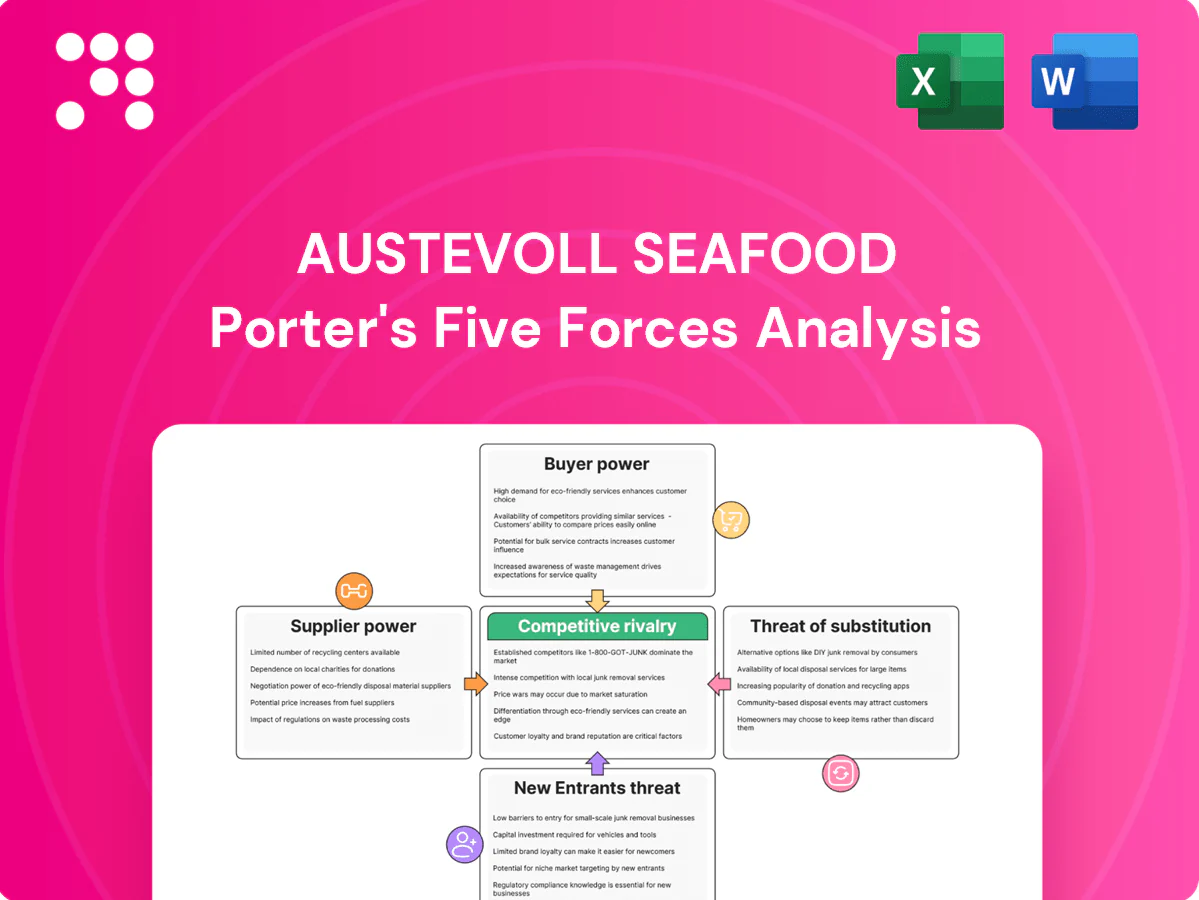
Austevoll Seafood Porter's Five Forces Analysis

Don't Miss the Bigger Picture
Austevoll Seafood faces moderate buyer power, significant supplier dynamics due to quota systems and feed costs, thin margins from commodity pricing, and competitive pressure from integrated global players and substitutes like aquaculture alternatives. This snapshot highlights strategic strengths in vertical integration and scale but also key vulnerabilities to input shocks and market consolidation. Unlock the full Porter's Five Forces Analysis to explore force-by-force ratings, visuals, and actionable implications for investment or strategy.
Suppliers Bargaining Power

Quota and license dependence
Regulators and quota holders effectively supply fishing access, placing bargaining power outside Austevoll Seafood’s control; Norway’s seafood exports were about NOK 124 billion in 2023, underlining sector sensitivity to quota shifts. Annual TAC adjustments and area closures can tighten raw-material availability and raise costs, while long-term relationships and strict compliance mitigate but do not remove variability. Vertical integration and own vessels reduce exposure, yet sudden policy shifts can hit procurement and margins quickly.
Concentrated feed suppliers
Lerøy’s salmon operations depend on a few global feed producers, giving suppliers switching costs and pricing leverage; feed typically represents about half of salmon farming’s variable costs. Commodity inputs such as fishmeal, fish oil and soy show high volatility (multi‑year swings often exceeding 20–30%), and formulation changes can alter biology and yields. Strategic sourcing and partial contract hedging reduce but do not remove this supplier risk.

Fuel, gear, and vessel inputs
Marine fuel (VLSFO averaged about $600/ton H1 2024) and specialized gear vendors materially affect Austevoll Seafood’s cost base, with fuel volatility from global markets plus local logistics and seasonal demand spikes driving short-term price surges. Technical service providers for vessels and processing equipment hold niche pricing power due to limited suppliers. Scale purchasing, long-term bunkering contracts and planned maintenance lower supplier clout and can reduce fuel and service spend by double-digit percentages.

Packaging and cold-chain logistics
Packaging and cold-chain logistics exert strong supplier power: food-grade packaging, specialty refrigerants and limited reefer container capacity tighten during peak seasons, pushing Austevoll Seafood to accept higher lead times and costs. Port congestion and scarcity of reefers empower carriers and cold-chain providers to demand premium rates, especially on key export lanes. Multi-year contracts and diversified routing reduce volatility but acute disruptions can still force spot premiums.
- Food-grade packaging scarcity increases lead times
- Reefer container shortages raise spot premiums
- Port congestion shifts bargaining power to carriers
- Multi-year deals and route diversification mitigate but don’t eliminate risk
Labor and specialized skills
Skilled crews, processing workers and aquaculture technicians are not perfectly substitutable, giving suppliers of labor bargaining power; Norway’s tight labor market (unemployment ~3.6% in 2024) and regulatory training requirements push wages higher. Company training programs and attractive coastal locations improve retention, while automation (growing investment in processing robotics) reduces but does not eliminate dependency.
- Labor not substitutable
- Wage pressure from tight market (~3.6% 2024)
- Training and location aid retention
- Automation lowers but not removes dependency
Salmon supply squeeze: feed ~50% costs, exports NOK 124b
Suppliers (quota holders, feed, fuel, packaging, labor) exert moderate-to-high power: Norway seafood exports NOK 124b (2023), feed ≈50% of salmon variable costs, VLSFO ~$600/ton H1 2024, unemployment ~3.6% (2024). Vertical integration, contracts and scale mitigate but policy shifts, commodity swings and reefer shortages create acute cost and supply risks.
| Input | 2023/24 metric |
|---|---|
| Exports | NOK 124b (2023) |
| Feed | ~50% variable cost |
| Fuel | $600/ton (H1 2024) |
| Unemployment | ~3.6% (2024) |
What is included in the product
 Detailed Word Document
Concise Porter's Five Forces analysis of Austevoll Seafood, assessing competitive rivalry, supplier and buyer power, substitution threats, and entry barriers to reveal key pressures on margins, strategic vulnerabilities, and opportunities for differentiation within global seafood and aquaculture markets.

 Customizable Excel Spreadsheet
One-sheet Porter's Five Forces for Austevoll Seafood—instantly visualizes competitive pressure with a customizable spider chart to simplify board-level decisions and adapt to changing market or regulatory scenarios.
Customers Bargaining Power

Concentrated retail and foodservice
Large European and global retailers wield strong volume-based negotiating power—by 2024 the top five grocery chains captured roughly 40% of regional grocery sales, squeezing suppliers on price and terms. Rising private-label penetration, around 30–40% in many EU markets in 2023–24, and centralized procurement amplify buyer leverage. Losing a major chain often cuts plant utilization by more than 10% for producers. Austevoll offsets this through multi-channel distribution and stronger branded propositions.
Specification and certification demands
Buyers demand MSC/ASC certification, end-to-end traceability and tight quality specs, driving up Austevoll’s compliance and operational costs. Retailers and food service customers can delist non-compliant lines rapidly, increasing revenue volatility for suppliers. Austevoll’s explicit sustainability focus helps retain market access and premium channels. However buyers can and do escalate requirements over time, pressuring ongoing investment.

Price sensitivity in commodity cuts
Pelagic and standard salmon cuts trade off benchmark prices with global salmon production at roughly 2.8 million tonnes in 2024, enabling buyers to substitute across origins and species. Large retailers and processors can reallocate volumes to mackerel, herring or other origins, increasing customer leverage. Higher-margin value-added products blunt direct price comparisons and preserve margins. Contracting and forward sales provide price and volume visibility, reducing spot exposure.

Switching ease across suppliers
Global seafood supply lets buyers dual-source and rotate suppliers, lowering dependence on Austevoll as comparable SKUs and integrated logistics networks reduce switching barriers. Differentiation through freshness, service and reliability increases customer stickiness, while strict performance KPIs (fill rate, lead time, spoilage) are pivotal to retain shelf space.
- Dual-sourcing enabled
- Low SKU differentiation
- Freshness & service drive loyalty
- KPI-driven retention
Demand seasonality and promotions
Holiday peaks and promotional windows concentrate bargaining power with retailers and foodservice buyers, forcing Austevoll Seafood to trade volume commitments for discounts and co-funded marketing to secure shelf space and seasonal throughput. Better forecasting raises plant utilization and lowers per-unit costs, while missed forecasts shift leverage to buyers during renegotiations, increasing spot-sales and margin volatility.
- Seasonal promotions concentrate negotiation timing
- Volume-for-discount and marketing support common
- Accurate planning improves utilization; misses shift power to buyers
Retail concentration (~40% top5) and private-label (30-40%) squeeze suppliers
Large European retailers (~40% market share top5 in 2024) and 30–40% private-label penetration give buyers strong price/term leverage; losing a major chain can cut producer utilization >10%. Buyers demand MSC/ASC/traceability, raising costs. Global salmon supply (~2.8mn t in 2024) enables substitution; value-added and contracts reduce spot exposure.
| Metric | 2024 |
|---|---|
| Top5 grocery share | ~40% |
| Private-label | 30–40% |
| Salmon production | 2.8M t |
What You See Is What You Get
Austevoll Seafood Porter's Five Forces Analysis
This Austevoll Seafood Porter's Five Forces Analysis provides a concise, professional assessment of industry rivalry, supplier and buyer power, threats of entry and substitutes. This preview is the exact document you'll receive upon purchase. No placeholders, edits or samples—just the ready-to-use file. Instant download and immediate access after payment.

Don't Miss the Bigger Picture
Austevoll Seafood faces moderate buyer power, significant supplier dynamics due to quota systems and feed costs, thin margins from commodity pricing, and competitive pressure from integrated global players and substitutes like aquaculture alternatives. This snapshot highlights strategic strengths in vertical integration and scale but also key vulnerabilities to input shocks and market consolidation. Unlock the full Porter's Five Forces Analysis to explore force-by-force ratings, visuals, and actionable implications for investment or strategy.
Suppliers Bargaining Power
Quota and license dependence
Regulators and quota holders effectively supply fishing access, placing bargaining power outside Austevoll Seafood’s control; Norway’s seafood exports were about NOK 124 billion in 2023, underlining sector sensitivity to quota shifts. Annual TAC adjustments and area closures can tighten raw-material availability and raise costs, while long-term relationships and strict compliance mitigate but do not remove variability. Vertical integration and own vessels reduce exposure, yet sudden policy shifts can hit procurement and margins quickly.
Concentrated feed suppliers
Lerøy’s salmon operations depend on a few global feed producers, giving suppliers switching costs and pricing leverage; feed typically represents about half of salmon farming’s variable costs. Commodity inputs such as fishmeal, fish oil and soy show high volatility (multi‑year swings often exceeding 20–30%), and formulation changes can alter biology and yields. Strategic sourcing and partial contract hedging reduce but do not remove this supplier risk.
Fuel, gear, and vessel inputs
Marine fuel (VLSFO averaged about $600/ton H1 2024) and specialized gear vendors materially affect Austevoll Seafood’s cost base, with fuel volatility from global markets plus local logistics and seasonal demand spikes driving short-term price surges. Technical service providers for vessels and processing equipment hold niche pricing power due to limited suppliers. Scale purchasing, long-term bunkering contracts and planned maintenance lower supplier clout and can reduce fuel and service spend by double-digit percentages.
Packaging and cold-chain logistics
Packaging and cold-chain logistics exert strong supplier power: food-grade packaging, specialty refrigerants and limited reefer container capacity tighten during peak seasons, pushing Austevoll Seafood to accept higher lead times and costs. Port congestion and scarcity of reefers empower carriers and cold-chain providers to demand premium rates, especially on key export lanes. Multi-year contracts and diversified routing reduce volatility but acute disruptions can still force spot premiums.
- Food-grade packaging scarcity increases lead times
- Reefer container shortages raise spot premiums
- Port congestion shifts bargaining power to carriers
- Multi-year deals and route diversification mitigate but don’t eliminate risk
Labor and specialized skills
Skilled crews, processing workers and aquaculture technicians are not perfectly substitutable, giving suppliers of labor bargaining power; Norway’s tight labor market (unemployment ~3.6% in 2024) and regulatory training requirements push wages higher. Company training programs and attractive coastal locations improve retention, while automation (growing investment in processing robotics) reduces but does not eliminate dependency.
- Labor not substitutable
- Wage pressure from tight market (~3.6% 2024)
- Training and location aid retention
- Automation lowers but not removes dependency
Salmon supply squeeze: feed ~50% costs, exports NOK 124b
Suppliers (quota holders, feed, fuel, packaging, labor) exert moderate-to-high power: Norway seafood exports NOK 124b (2023), feed ≈50% of salmon variable costs, VLSFO ~$600/ton H1 2024, unemployment ~3.6% (2024). Vertical integration, contracts and scale mitigate but policy shifts, commodity swings and reefer shortages create acute cost and supply risks.
| Input | 2023/24 metric |
|---|---|
| Exports | NOK 124b (2023) |
| Feed | ~50% variable cost |
| Fuel | $600/ton (H1 2024) |
| Unemployment | ~3.6% (2024) |
What is included in the product
Detailed Word Document
Concise Porter's Five Forces analysis of Austevoll Seafood, assessing competitive rivalry, supplier and buyer power, substitution threats, and entry barriers to reveal key pressures on margins, strategic vulnerabilities, and opportunities for differentiation within global seafood and aquaculture markets.
Customizable Excel Spreadsheet
One-sheet Porter's Five Forces for Austevoll Seafood—instantly visualizes competitive pressure with a customizable spider chart to simplify board-level decisions and adapt to changing market or regulatory scenarios.
Customers Bargaining Power
Concentrated retail and foodservice
Large European and global retailers wield strong volume-based negotiating power—by 2024 the top five grocery chains captured roughly 40% of regional grocery sales, squeezing suppliers on price and terms. Rising private-label penetration, around 30–40% in many EU markets in 2023–24, and centralized procurement amplify buyer leverage. Losing a major chain often cuts plant utilization by more than 10% for producers. Austevoll offsets this through multi-channel distribution and stronger branded propositions.
Specification and certification demands
Buyers demand MSC/ASC certification, end-to-end traceability and tight quality specs, driving up Austevoll’s compliance and operational costs. Retailers and food service customers can delist non-compliant lines rapidly, increasing revenue volatility for suppliers. Austevoll’s explicit sustainability focus helps retain market access and premium channels. However buyers can and do escalate requirements over time, pressuring ongoing investment.
Price sensitivity in commodity cuts
Pelagic and standard salmon cuts trade off benchmark prices with global salmon production at roughly 2.8 million tonnes in 2024, enabling buyers to substitute across origins and species. Large retailers and processors can reallocate volumes to mackerel, herring or other origins, increasing customer leverage. Higher-margin value-added products blunt direct price comparisons and preserve margins. Contracting and forward sales provide price and volume visibility, reducing spot exposure.
Switching ease across suppliers
Global seafood supply lets buyers dual-source and rotate suppliers, lowering dependence on Austevoll as comparable SKUs and integrated logistics networks reduce switching barriers. Differentiation through freshness, service and reliability increases customer stickiness, while strict performance KPIs (fill rate, lead time, spoilage) are pivotal to retain shelf space.
- Dual-sourcing enabled
- Low SKU differentiation
- Freshness & service drive loyalty
- KPI-driven retention
Demand seasonality and promotions
Holiday peaks and promotional windows concentrate bargaining power with retailers and foodservice buyers, forcing Austevoll Seafood to trade volume commitments for discounts and co-funded marketing to secure shelf space and seasonal throughput. Better forecasting raises plant utilization and lowers per-unit costs, while missed forecasts shift leverage to buyers during renegotiations, increasing spot-sales and margin volatility.
- Seasonal promotions concentrate negotiation timing
- Volume-for-discount and marketing support common
- Accurate planning improves utilization; misses shift power to buyers
Retail concentration (~40% top5) and private-label (30-40%) squeeze suppliers
Large European retailers (~40% market share top5 in 2024) and 30–40% private-label penetration give buyers strong price/term leverage; losing a major chain can cut producer utilization >10%. Buyers demand MSC/ASC/traceability, raising costs. Global salmon supply (~2.8mn t in 2024) enables substitution; value-added and contracts reduce spot exposure.
| Metric | 2024 |
|---|---|
| Top5 grocery share | ~40% |
| Private-label | 30–40% |
| Salmon production | 2.8M t |
What You See Is What You Get
Austevoll Seafood Porter's Five Forces Analysis
This Austevoll Seafood Porter's Five Forces Analysis provides a concise, professional assessment of industry rivalry, supplier and buyer power, threats of entry and substitutes. This preview is the exact document you'll receive upon purchase. No placeholders, edits or samples—just the ready-to-use file. Instant download and immediate access after payment.
Description
Don't Miss the Bigger Picture
Austevoll Seafood faces moderate buyer power, significant supplier dynamics due to quota systems and feed costs, thin margins from commodity pricing, and competitive pressure from integrated global players and substitutes like aquaculture alternatives. This snapshot highlights strategic strengths in vertical integration and scale but also key vulnerabilities to input shocks and market consolidation. Unlock the full Porter's Five Forces Analysis to explore force-by-force ratings, visuals, and actionable implications for investment or strategy.
Suppliers Bargaining Power
Quota and license dependence
Regulators and quota holders effectively supply fishing access, placing bargaining power outside Austevoll Seafood’s control; Norway’s seafood exports were about NOK 124 billion in 2023, underlining sector sensitivity to quota shifts. Annual TAC adjustments and area closures can tighten raw-material availability and raise costs, while long-term relationships and strict compliance mitigate but do not remove variability. Vertical integration and own vessels reduce exposure, yet sudden policy shifts can hit procurement and margins quickly.
Concentrated feed suppliers
Lerøy’s salmon operations depend on a few global feed producers, giving suppliers switching costs and pricing leverage; feed typically represents about half of salmon farming’s variable costs. Commodity inputs such as fishmeal, fish oil and soy show high volatility (multi‑year swings often exceeding 20–30%), and formulation changes can alter biology and yields. Strategic sourcing and partial contract hedging reduce but do not remove this supplier risk.
Fuel, gear, and vessel inputs
Marine fuel (VLSFO averaged about $600/ton H1 2024) and specialized gear vendors materially affect Austevoll Seafood’s cost base, with fuel volatility from global markets plus local logistics and seasonal demand spikes driving short-term price surges. Technical service providers for vessels and processing equipment hold niche pricing power due to limited suppliers. Scale purchasing, long-term bunkering contracts and planned maintenance lower supplier clout and can reduce fuel and service spend by double-digit percentages.
Packaging and cold-chain logistics
Packaging and cold-chain logistics exert strong supplier power: food-grade packaging, specialty refrigerants and limited reefer container capacity tighten during peak seasons, pushing Austevoll Seafood to accept higher lead times and costs. Port congestion and scarcity of reefers empower carriers and cold-chain providers to demand premium rates, especially on key export lanes. Multi-year contracts and diversified routing reduce volatility but acute disruptions can still force spot premiums.
- Food-grade packaging scarcity increases lead times
- Reefer container shortages raise spot premiums
- Port congestion shifts bargaining power to carriers
- Multi-year deals and route diversification mitigate but don’t eliminate risk
Labor and specialized skills
Skilled crews, processing workers and aquaculture technicians are not perfectly substitutable, giving suppliers of labor bargaining power; Norway’s tight labor market (unemployment ~3.6% in 2024) and regulatory training requirements push wages higher. Company training programs and attractive coastal locations improve retention, while automation (growing investment in processing robotics) reduces but does not eliminate dependency.
- Labor not substitutable
- Wage pressure from tight market (~3.6% 2024)
- Training and location aid retention
- Automation lowers but not removes dependency
Salmon supply squeeze: feed ~50% costs, exports NOK 124b
Suppliers (quota holders, feed, fuel, packaging, labor) exert moderate-to-high power: Norway seafood exports NOK 124b (2023), feed ≈50% of salmon variable costs, VLSFO ~$600/ton H1 2024, unemployment ~3.6% (2024). Vertical integration, contracts and scale mitigate but policy shifts, commodity swings and reefer shortages create acute cost and supply risks.
| Input | 2023/24 metric |
|---|---|
| Exports | NOK 124b (2023) |
| Feed | ~50% variable cost |
| Fuel | $600/ton (H1 2024) |
| Unemployment | ~3.6% (2024) |
What is included in the product
Detailed Word Document
Concise Porter's Five Forces analysis of Austevoll Seafood, assessing competitive rivalry, supplier and buyer power, substitution threats, and entry barriers to reveal key pressures on margins, strategic vulnerabilities, and opportunities for differentiation within global seafood and aquaculture markets.
Customizable Excel Spreadsheet
One-sheet Porter's Five Forces for Austevoll Seafood—instantly visualizes competitive pressure with a customizable spider chart to simplify board-level decisions and adapt to changing market or regulatory scenarios.
Customers Bargaining Power
Concentrated retail and foodservice
Large European and global retailers wield strong volume-based negotiating power—by 2024 the top five grocery chains captured roughly 40% of regional grocery sales, squeezing suppliers on price and terms. Rising private-label penetration, around 30–40% in many EU markets in 2023–24, and centralized procurement amplify buyer leverage. Losing a major chain often cuts plant utilization by more than 10% for producers. Austevoll offsets this through multi-channel distribution and stronger branded propositions.
Specification and certification demands
Buyers demand MSC/ASC certification, end-to-end traceability and tight quality specs, driving up Austevoll’s compliance and operational costs. Retailers and food service customers can delist non-compliant lines rapidly, increasing revenue volatility for suppliers. Austevoll’s explicit sustainability focus helps retain market access and premium channels. However buyers can and do escalate requirements over time, pressuring ongoing investment.
Price sensitivity in commodity cuts
Pelagic and standard salmon cuts trade off benchmark prices with global salmon production at roughly 2.8 million tonnes in 2024, enabling buyers to substitute across origins and species. Large retailers and processors can reallocate volumes to mackerel, herring or other origins, increasing customer leverage. Higher-margin value-added products blunt direct price comparisons and preserve margins. Contracting and forward sales provide price and volume visibility, reducing spot exposure.
Switching ease across suppliers
Global seafood supply lets buyers dual-source and rotate suppliers, lowering dependence on Austevoll as comparable SKUs and integrated logistics networks reduce switching barriers. Differentiation through freshness, service and reliability increases customer stickiness, while strict performance KPIs (fill rate, lead time, spoilage) are pivotal to retain shelf space.
- Dual-sourcing enabled
- Low SKU differentiation
- Freshness & service drive loyalty
- KPI-driven retention
Demand seasonality and promotions
Holiday peaks and promotional windows concentrate bargaining power with retailers and foodservice buyers, forcing Austevoll Seafood to trade volume commitments for discounts and co-funded marketing to secure shelf space and seasonal throughput. Better forecasting raises plant utilization and lowers per-unit costs, while missed forecasts shift leverage to buyers during renegotiations, increasing spot-sales and margin volatility.
- Seasonal promotions concentrate negotiation timing
- Volume-for-discount and marketing support common
- Accurate planning improves utilization; misses shift power to buyers
Retail concentration (~40% top5) and private-label (30-40%) squeeze suppliers
Large European retailers (~40% market share top5 in 2024) and 30–40% private-label penetration give buyers strong price/term leverage; losing a major chain can cut producer utilization >10%. Buyers demand MSC/ASC/traceability, raising costs. Global salmon supply (~2.8mn t in 2024) enables substitution; value-added and contracts reduce spot exposure.
| Metric | 2024 |
|---|---|
| Top5 grocery share | ~40% |
| Private-label | 30–40% |
| Salmon production | 2.8M t |
What You See Is What You Get
Austevoll Seafood Porter's Five Forces Analysis
This Austevoll Seafood Porter's Five Forces Analysis provides a concise, professional assessment of industry rivalry, supplier and buyer power, threats of entry and substitutes. This preview is the exact document you'll receive upon purchase. No placeholders, edits or samples—just the ready-to-use file. Instant download and immediate access after payment.











