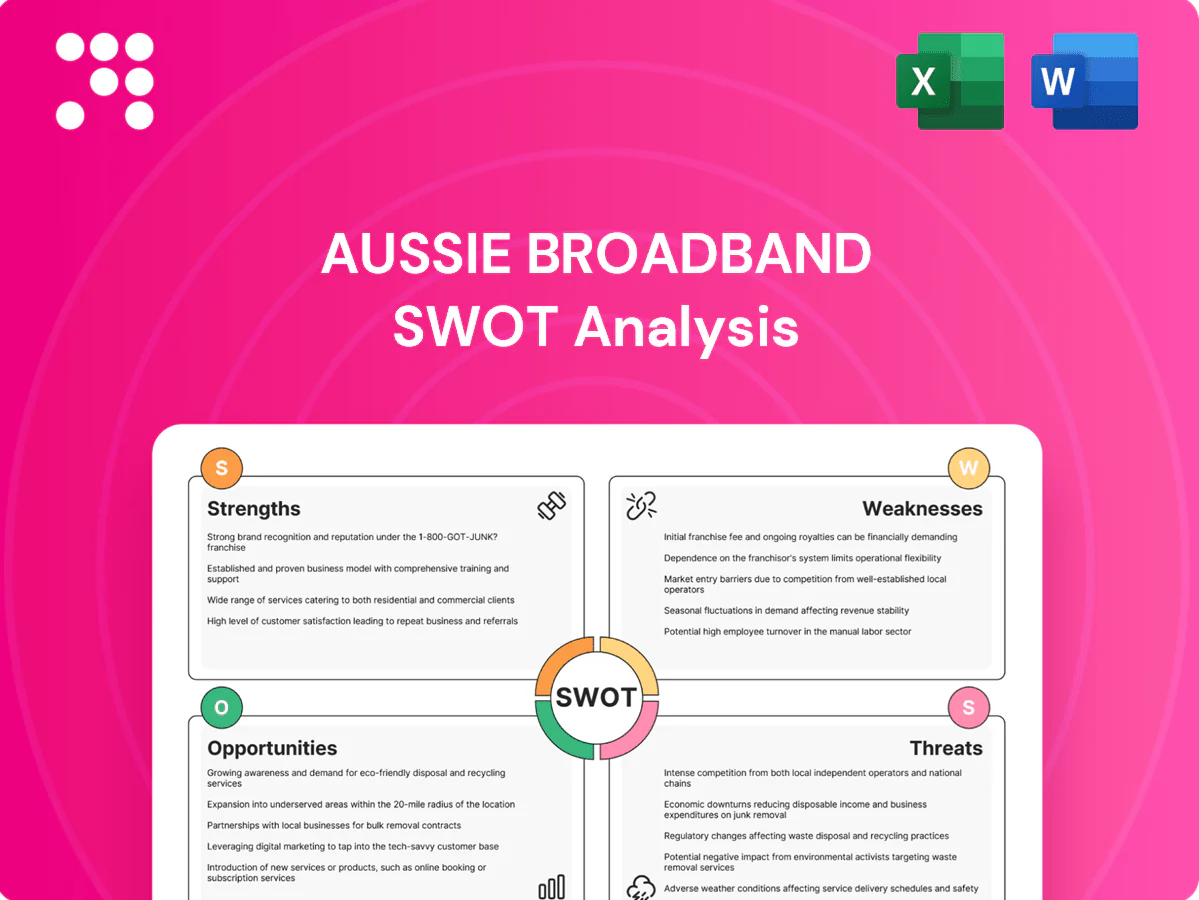
Aussie Broadband SWOT Analysis

Make Insightful Decisions Backed by Expert Research
Aussie Broadband's SWOT highlights strong customer service and network growth, balanced by intense competition and margin pressure; regulatory shifts and rural expansion present key opportunities and risks. Want the full story behind the company’s strengths, risks, and growth drivers? Purchase the complete SWOT analysis to gain access to a professionally written, fully editable report designed to support planning, pitches, and research.
Strengths

Robust network and peering
ASX: ABB operates significant backhaul, peering and transit infrastructure—supporting over 600,000 retail connections by FY2024—which reduces latency and boosts reliability. Direct routing enhances performance for gaming, streaming and SaaS versus resellers tied to wholesale, enabling more consistent, scalable customer experience and lower packet loss during peak periods.
Reputation for customer support
Aussie Broadband emphasizes responsive, Australia-based support and transparent communication, a strategy reflected in its reported ~660,000 retail customers by FY24 and nationwide call-centre staffing to handle peak demand.
High service quality drives strong NPS (reported in the high 60s) and substantial word-of-mouth referrals, supporting organic net adds without heavy marketing spend.
Consistent support reduces churn and service credits, enabling premium positioning and higher ARPU versus budget ISPs.

Diversified product set
Aussie Broadband’s diversified product set—residential NBN, business fibre, mobile, voice and managed services—spreads revenue and cross-sell lifts ARPU and contract depth; the group reported over 1.07 million active services at June 2024. Business fibre and managed services attract stickier, higher‑margin customers, while mobile and voice smooth consumer-demand swings and reduce revenue cyclicality.

Agility and innovation culture
Agility and a strong innovation culture let Aussie Broadband (ASX: ABB) roll out rapid plan changes and network tweaks, leveraging its mid-sized scale to implement targeted updates faster than big incumbents.
Transparent congestion reporting has improved customer trust and shortened feedback loops, while fast adoption of new NBN constructs and peering arrangements accelerates service improvements.
This nimbleness enables ABB to outmaneuver larger providers on niche customer needs and specialized product offerings.
- ASX: ABB
- Mid-sized scale = faster iteration
- Transparent congestion reporting = higher trust
- Quick NBN construct & peering adoption
Brand authenticity and transparency
Aussie Broadband (ASX: ABB) openly publishes network status and capacity management updates, and its clear pricing with minimal hidden fees resonates with informed buyers, strengthening trust and lowering customer acquisition costs while fostering long-term loyalty and a premium-but-fair brand identity.
- ASX: ABB
- Transparent network updates
- Clear pricing, low hidden fees
- Higher loyalty, lower acquisition cost
Owned backhaul and Aussie support power ~660,000 customers, high-60s NPS
ABB’s owned backhaul, peering and transit support 600,000+ retail connections (FY24), lowering latency and improving reliability versus wholesale-dependent resellers. Customer-centric Australia-based support and transparent reporting fuel ~660,000 retail customers (FY24) and an NPS in the high 60s, driving organic adds, lower churn and higher ARPU. Diversified services (1.07m active services Jun 2024) broaden revenue and improve stickiness.
| Metric | Value |
|---|---|
| Retail customers (FY24) | ~660,000 |
| Active services (Jun 2024) | 1.07 million |
| NPS | High 60s |
| Backhaul-supported retail | 600,000+ |
What is included in the product
 Detailed Word Document
Provides a concise strategic assessment of Aussie Broadband’s internal strengths and weaknesses and external opportunities and threats, highlighting competitive position, growth drivers, operational gaps, and market risks shaping its future.

 Customizable Excel Spreadsheet
Provides a concise SWOT matrix tailored to Aussie Broadband for fast strategic alignment, highlighting strengths, vulnerabilities, market threats and growth opportunities to relieve strategic pain points.
Weaknesses

Reliance on NBN wholesale
Access and bandwidth costs for Aussie Broadband are tied to NBN wholesale frameworks, with NBN Co reporting about $5.1 billion revenue in FY2024, making wholesale pricing the dominant input cost for RSPs. Margin pressure rises when NBN input charges shift, compressing Aussie Broadband’s gross margins and EBITDA. Limited control over last-mile faults on NBN infrastructure can degrade customer experience and increase support costs, and reliance on NBN constrains price flexibility in the mass market.
Limited international footprint
Aussie Broadband (ASX: ABB) operates exclusively in Australia, limiting scale economies versus global peers and leaving buying power benefits untapped; it reported a wholly domestic revenue base in FY2024 and served over 500,000 retail customers by mid‑2024. Enterprise multinationals often prefer providers with global footprints, so ABB’s growth depends on deeper domestic penetration and higher ARPU rather than international expansion.

Brand awareness vs incumbents
Telstra and Optus retain dominant mindshare and bundling power, holding well over half of Australian consumer telecom subscriptions combined, forcing Aussie Broadband to compete on price and service rather than reach. Marketing spend must work harder per lead, driving higher CAC as many households default to legacy providers for bundled services. This entrenched incumbency slows Aussie Broadband’s move-upmarket into higher-value consumer and SME segments.

Capital intensity of network
Aussie Broadband faces high capital intensity as ongoing backhaul, POPs and edge upgrades require significant recurring capex to keep latency and capacity competitive; peak-time capacity must be expanded ahead of traffic growth to avoid congestion. Payback on these investments depends on sustained subscriber additions and ARPU, so mis-forecasting demand or slower churn improvement can dilute returns and stretch ROI timelines.
- Backhaul/POPs/edge: recurring capex burden
- Peak capacity: must outpace traffic growth
- Returns: dependent on sustained subscriber growth
- Risk: demand mis-forecasting dilutes ROI
Exposure to support load
Exposure to support load is a growing weakness for Aussie Broadband as its support-led differentiator can become a cost burden; the company surpassed 1 million retail services by FY2024, increasing support demand and operating costs.
Ticket spikes from NBN outages periodically stress operations and elevate short-term churn risk, while scaling quality during aggressive customer growth remains challenging.
Efficiency tools and automation investments must keep pace to control service costs and preserve margins as volumes grow.
- support-costs
- ticket-spikes
- scaling-quality
- automation-gap
NBN wholesale pricing squeezes margins; limited domestic scale raises CAC, capex and churn risk
Aussie Broadband’s cost base is tightly linked to NBN wholesale pricing (NBN Co revenue ~$5.1bn FY2024), compressing gross margins and EBITDA; limited last‑mile control raises support costs and churn risk. Domestic-only scale (≈500k retail customers mid‑2024; >1.0m retail services FY2024) limits buying power versus Telstra/Optus, forcing higher CAC and recurring capex for backhaul/POPs.
| Metric | Value |
|---|---|
| NBN Co revenue FY2024 | $5.1bn |
| ABB retail customers (mid‑2024) | ≈500,000 |
| ABB retail services FY2024 | >1,000,000 |
Preview Before You Purchase
Aussie Broadband SWOT Analysis
This is the actual Aussie Broadband SWOT analysis document you’ll receive upon purchase—no surprises, just professional quality. The preview below is taken directly from the full report you'll get. Purchase unlocks the entire, editable version with full strengths, weaknesses, opportunities and threats.

Make Insightful Decisions Backed by Expert Research
Aussie Broadband's SWOT highlights strong customer service and network growth, balanced by intense competition and margin pressure; regulatory shifts and rural expansion present key opportunities and risks. Want the full story behind the company’s strengths, risks, and growth drivers? Purchase the complete SWOT analysis to gain access to a professionally written, fully editable report designed to support planning, pitches, and research.
Strengths
Robust network and peering
ASX: ABB operates significant backhaul, peering and transit infrastructure—supporting over 600,000 retail connections by FY2024—which reduces latency and boosts reliability. Direct routing enhances performance for gaming, streaming and SaaS versus resellers tied to wholesale, enabling more consistent, scalable customer experience and lower packet loss during peak periods.
Reputation for customer support
Aussie Broadband emphasizes responsive, Australia-based support and transparent communication, a strategy reflected in its reported ~660,000 retail customers by FY24 and nationwide call-centre staffing to handle peak demand.
High service quality drives strong NPS (reported in the high 60s) and substantial word-of-mouth referrals, supporting organic net adds without heavy marketing spend.
Consistent support reduces churn and service credits, enabling premium positioning and higher ARPU versus budget ISPs.
Diversified product set
Aussie Broadband’s diversified product set—residential NBN, business fibre, mobile, voice and managed services—spreads revenue and cross-sell lifts ARPU and contract depth; the group reported over 1.07 million active services at June 2024. Business fibre and managed services attract stickier, higher‑margin customers, while mobile and voice smooth consumer-demand swings and reduce revenue cyclicality.
Agility and innovation culture
Agility and a strong innovation culture let Aussie Broadband (ASX: ABB) roll out rapid plan changes and network tweaks, leveraging its mid-sized scale to implement targeted updates faster than big incumbents.
Transparent congestion reporting has improved customer trust and shortened feedback loops, while fast adoption of new NBN constructs and peering arrangements accelerates service improvements.
This nimbleness enables ABB to outmaneuver larger providers on niche customer needs and specialized product offerings.
- ASX: ABB
- Mid-sized scale = faster iteration
- Transparent congestion reporting = higher trust
- Quick NBN construct & peering adoption
Brand authenticity and transparency
Aussie Broadband (ASX: ABB) openly publishes network status and capacity management updates, and its clear pricing with minimal hidden fees resonates with informed buyers, strengthening trust and lowering customer acquisition costs while fostering long-term loyalty and a premium-but-fair brand identity.
- ASX: ABB
- Transparent network updates
- Clear pricing, low hidden fees
- Higher loyalty, lower acquisition cost
Owned backhaul and Aussie support power ~660,000 customers, high-60s NPS
ABB’s owned backhaul, peering and transit support 600,000+ retail connections (FY24), lowering latency and improving reliability versus wholesale-dependent resellers. Customer-centric Australia-based support and transparent reporting fuel ~660,000 retail customers (FY24) and an NPS in the high 60s, driving organic adds, lower churn and higher ARPU. Diversified services (1.07m active services Jun 2024) broaden revenue and improve stickiness.
| Metric | Value |
|---|---|
| Retail customers (FY24) | ~660,000 |
| Active services (Jun 2024) | 1.07 million |
| NPS | High 60s |
| Backhaul-supported retail | 600,000+ |
What is included in the product
Detailed Word Document
Provides a concise strategic assessment of Aussie Broadband’s internal strengths and weaknesses and external opportunities and threats, highlighting competitive position, growth drivers, operational gaps, and market risks shaping its future.
Customizable Excel Spreadsheet
Provides a concise SWOT matrix tailored to Aussie Broadband for fast strategic alignment, highlighting strengths, vulnerabilities, market threats and growth opportunities to relieve strategic pain points.
Weaknesses
Reliance on NBN wholesale
Access and bandwidth costs for Aussie Broadband are tied to NBN wholesale frameworks, with NBN Co reporting about $5.1 billion revenue in FY2024, making wholesale pricing the dominant input cost for RSPs. Margin pressure rises when NBN input charges shift, compressing Aussie Broadband’s gross margins and EBITDA. Limited control over last-mile faults on NBN infrastructure can degrade customer experience and increase support costs, and reliance on NBN constrains price flexibility in the mass market.
Limited international footprint
Aussie Broadband (ASX: ABB) operates exclusively in Australia, limiting scale economies versus global peers and leaving buying power benefits untapped; it reported a wholly domestic revenue base in FY2024 and served over 500,000 retail customers by mid‑2024. Enterprise multinationals often prefer providers with global footprints, so ABB’s growth depends on deeper domestic penetration and higher ARPU rather than international expansion.
Brand awareness vs incumbents
Telstra and Optus retain dominant mindshare and bundling power, holding well over half of Australian consumer telecom subscriptions combined, forcing Aussie Broadband to compete on price and service rather than reach. Marketing spend must work harder per lead, driving higher CAC as many households default to legacy providers for bundled services. This entrenched incumbency slows Aussie Broadband’s move-upmarket into higher-value consumer and SME segments.
Capital intensity of network
Aussie Broadband faces high capital intensity as ongoing backhaul, POPs and edge upgrades require significant recurring capex to keep latency and capacity competitive; peak-time capacity must be expanded ahead of traffic growth to avoid congestion. Payback on these investments depends on sustained subscriber additions and ARPU, so mis-forecasting demand or slower churn improvement can dilute returns and stretch ROI timelines.
- Backhaul/POPs/edge: recurring capex burden
- Peak capacity: must outpace traffic growth
- Returns: dependent on sustained subscriber growth
- Risk: demand mis-forecasting dilutes ROI
Exposure to support load
Exposure to support load is a growing weakness for Aussie Broadband as its support-led differentiator can become a cost burden; the company surpassed 1 million retail services by FY2024, increasing support demand and operating costs.
Ticket spikes from NBN outages periodically stress operations and elevate short-term churn risk, while scaling quality during aggressive customer growth remains challenging.
Efficiency tools and automation investments must keep pace to control service costs and preserve margins as volumes grow.
- support-costs
- ticket-spikes
- scaling-quality
- automation-gap
NBN wholesale pricing squeezes margins; limited domestic scale raises CAC, capex and churn risk
Aussie Broadband’s cost base is tightly linked to NBN wholesale pricing (NBN Co revenue ~$5.1bn FY2024), compressing gross margins and EBITDA; limited last‑mile control raises support costs and churn risk. Domestic-only scale (≈500k retail customers mid‑2024; >1.0m retail services FY2024) limits buying power versus Telstra/Optus, forcing higher CAC and recurring capex for backhaul/POPs.
| Metric | Value |
|---|---|
| NBN Co revenue FY2024 | $5.1bn |
| ABB retail customers (mid‑2024) | ≈500,000 |
| ABB retail services FY2024 | >1,000,000 |
Preview Before You Purchase
Aussie Broadband SWOT Analysis
This is the actual Aussie Broadband SWOT analysis document you’ll receive upon purchase—no surprises, just professional quality. The preview below is taken directly from the full report you'll get. Purchase unlocks the entire, editable version with full strengths, weaknesses, opportunities and threats.
Original: $10.00
-65%$10.00
$3.50Description
Make Insightful Decisions Backed by Expert Research
Aussie Broadband's SWOT highlights strong customer service and network growth, balanced by intense competition and margin pressure; regulatory shifts and rural expansion present key opportunities and risks. Want the full story behind the company’s strengths, risks, and growth drivers? Purchase the complete SWOT analysis to gain access to a professionally written, fully editable report designed to support planning, pitches, and research.
Strengths
Robust network and peering
ASX: ABB operates significant backhaul, peering and transit infrastructure—supporting over 600,000 retail connections by FY2024—which reduces latency and boosts reliability. Direct routing enhances performance for gaming, streaming and SaaS versus resellers tied to wholesale, enabling more consistent, scalable customer experience and lower packet loss during peak periods.
Reputation for customer support
Aussie Broadband emphasizes responsive, Australia-based support and transparent communication, a strategy reflected in its reported ~660,000 retail customers by FY24 and nationwide call-centre staffing to handle peak demand.
High service quality drives strong NPS (reported in the high 60s) and substantial word-of-mouth referrals, supporting organic net adds without heavy marketing spend.
Consistent support reduces churn and service credits, enabling premium positioning and higher ARPU versus budget ISPs.
Diversified product set
Aussie Broadband’s diversified product set—residential NBN, business fibre, mobile, voice and managed services—spreads revenue and cross-sell lifts ARPU and contract depth; the group reported over 1.07 million active services at June 2024. Business fibre and managed services attract stickier, higher‑margin customers, while mobile and voice smooth consumer-demand swings and reduce revenue cyclicality.
Agility and innovation culture
Agility and a strong innovation culture let Aussie Broadband (ASX: ABB) roll out rapid plan changes and network tweaks, leveraging its mid-sized scale to implement targeted updates faster than big incumbents.
Transparent congestion reporting has improved customer trust and shortened feedback loops, while fast adoption of new NBN constructs and peering arrangements accelerates service improvements.
This nimbleness enables ABB to outmaneuver larger providers on niche customer needs and specialized product offerings.
- ASX: ABB
- Mid-sized scale = faster iteration
- Transparent congestion reporting = higher trust
- Quick NBN construct & peering adoption
Brand authenticity and transparency
Aussie Broadband (ASX: ABB) openly publishes network status and capacity management updates, and its clear pricing with minimal hidden fees resonates with informed buyers, strengthening trust and lowering customer acquisition costs while fostering long-term loyalty and a premium-but-fair brand identity.
- ASX: ABB
- Transparent network updates
- Clear pricing, low hidden fees
- Higher loyalty, lower acquisition cost
Owned backhaul and Aussie support power ~660,000 customers, high-60s NPS
ABB’s owned backhaul, peering and transit support 600,000+ retail connections (FY24), lowering latency and improving reliability versus wholesale-dependent resellers. Customer-centric Australia-based support and transparent reporting fuel ~660,000 retail customers (FY24) and an NPS in the high 60s, driving organic adds, lower churn and higher ARPU. Diversified services (1.07m active services Jun 2024) broaden revenue and improve stickiness.
| Metric | Value |
|---|---|
| Retail customers (FY24) | ~660,000 |
| Active services (Jun 2024) | 1.07 million |
| NPS | High 60s |
| Backhaul-supported retail | 600,000+ |
What is included in the product
Detailed Word Document
Provides a concise strategic assessment of Aussie Broadband’s internal strengths and weaknesses and external opportunities and threats, highlighting competitive position, growth drivers, operational gaps, and market risks shaping its future.
Customizable Excel Spreadsheet
Provides a concise SWOT matrix tailored to Aussie Broadband for fast strategic alignment, highlighting strengths, vulnerabilities, market threats and growth opportunities to relieve strategic pain points.
Weaknesses
Reliance on NBN wholesale
Access and bandwidth costs for Aussie Broadband are tied to NBN wholesale frameworks, with NBN Co reporting about $5.1 billion revenue in FY2024, making wholesale pricing the dominant input cost for RSPs. Margin pressure rises when NBN input charges shift, compressing Aussie Broadband’s gross margins and EBITDA. Limited control over last-mile faults on NBN infrastructure can degrade customer experience and increase support costs, and reliance on NBN constrains price flexibility in the mass market.
Limited international footprint
Aussie Broadband (ASX: ABB) operates exclusively in Australia, limiting scale economies versus global peers and leaving buying power benefits untapped; it reported a wholly domestic revenue base in FY2024 and served over 500,000 retail customers by mid‑2024. Enterprise multinationals often prefer providers with global footprints, so ABB’s growth depends on deeper domestic penetration and higher ARPU rather than international expansion.
Brand awareness vs incumbents
Telstra and Optus retain dominant mindshare and bundling power, holding well over half of Australian consumer telecom subscriptions combined, forcing Aussie Broadband to compete on price and service rather than reach. Marketing spend must work harder per lead, driving higher CAC as many households default to legacy providers for bundled services. This entrenched incumbency slows Aussie Broadband’s move-upmarket into higher-value consumer and SME segments.
Capital intensity of network
Aussie Broadband faces high capital intensity as ongoing backhaul, POPs and edge upgrades require significant recurring capex to keep latency and capacity competitive; peak-time capacity must be expanded ahead of traffic growth to avoid congestion. Payback on these investments depends on sustained subscriber additions and ARPU, so mis-forecasting demand or slower churn improvement can dilute returns and stretch ROI timelines.
- Backhaul/POPs/edge: recurring capex burden
- Peak capacity: must outpace traffic growth
- Returns: dependent on sustained subscriber growth
- Risk: demand mis-forecasting dilutes ROI
Exposure to support load
Exposure to support load is a growing weakness for Aussie Broadband as its support-led differentiator can become a cost burden; the company surpassed 1 million retail services by FY2024, increasing support demand and operating costs.
Ticket spikes from NBN outages periodically stress operations and elevate short-term churn risk, while scaling quality during aggressive customer growth remains challenging.
Efficiency tools and automation investments must keep pace to control service costs and preserve margins as volumes grow.
- support-costs
- ticket-spikes
- scaling-quality
- automation-gap
NBN wholesale pricing squeezes margins; limited domestic scale raises CAC, capex and churn risk
Aussie Broadband’s cost base is tightly linked to NBN wholesale pricing (NBN Co revenue ~$5.1bn FY2024), compressing gross margins and EBITDA; limited last‑mile control raises support costs and churn risk. Domestic-only scale (≈500k retail customers mid‑2024; >1.0m retail services FY2024) limits buying power versus Telstra/Optus, forcing higher CAC and recurring capex for backhaul/POPs.
| Metric | Value |
|---|---|
| NBN Co revenue FY2024 | $5.1bn |
| ABB retail customers (mid‑2024) | ≈500,000 |
| ABB retail services FY2024 | >1,000,000 |
Preview Before You Purchase
Aussie Broadband SWOT Analysis
This is the actual Aussie Broadband SWOT analysis document you’ll receive upon purchase—no surprises, just professional quality. The preview below is taken directly from the full report you'll get. Purchase unlocks the entire, editable version with full strengths, weaknesses, opportunities and threats.











