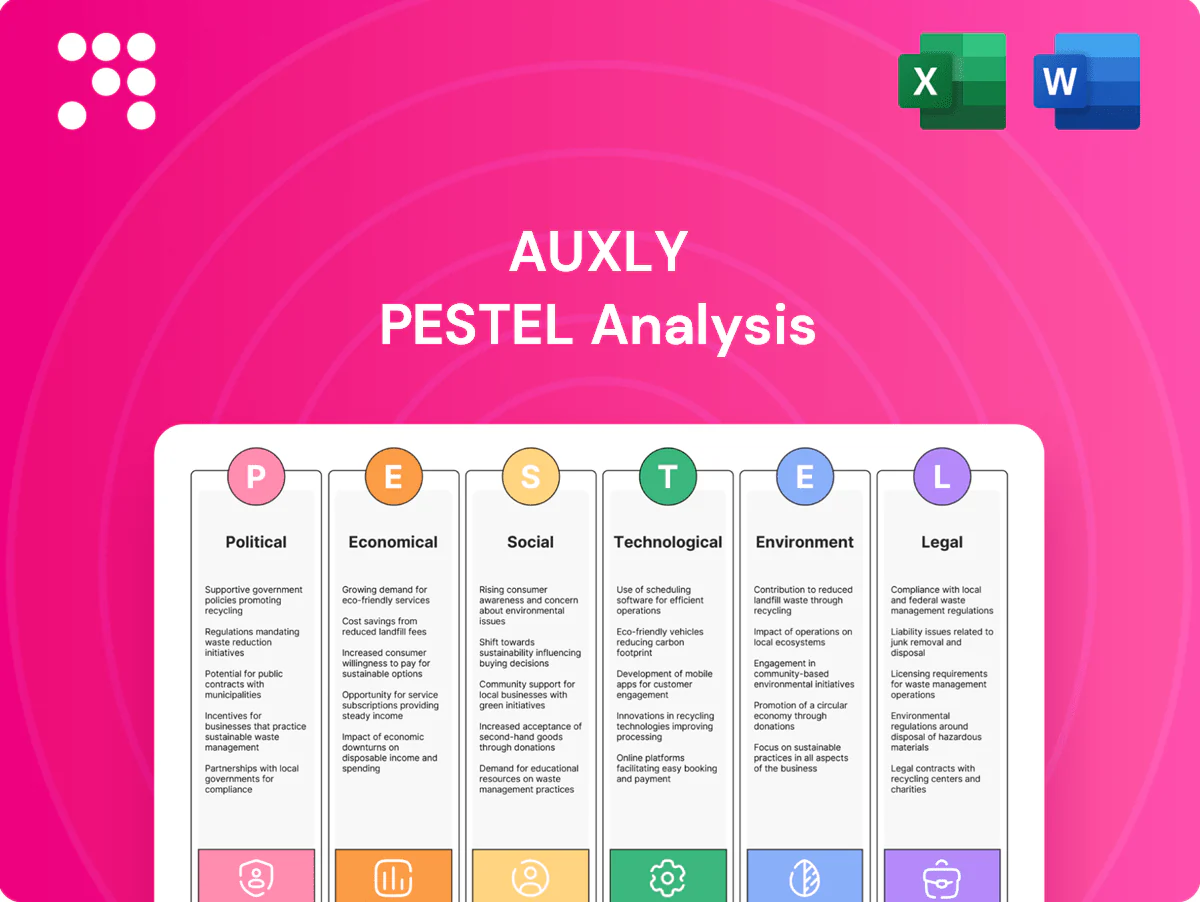
Auxly PESTLE Analysis

Your Shortcut to Market Insight Starts Here
Unlock how political shifts, economic cycles, social trends, and regulatory pressures shape Auxly’s prospects—our concise PESTLE highlights key external drivers and strategic risks. Ideal for investors and planners seeking clarity. Purchase the full analysis for the complete, actionable roadmap you can use today.
Political factors

Federal cannabis policy in Canada
Federal legalization on October 17, 2018 allows national production and sale under Health Canada oversight; the legal market reached about C$5.7 billion in retail sales in 2023. Stable federal policy underpins brand and manufacturing investment, though periodic reviews can tighten potency, packaging or product-form rules, so Auxly must stay aligned with evolving national priorities.
Provincial control and retail dynamics
Provinces set distribution, pricing bands, and retail models under the federal Cannabis Act, creating distinct channels from government-run to private retail. Shifts in wholesale markups or store licensing materially affect volumes and margins and have driven licensing rebalancing since 2018. Differences across provinces require tailored go-to-market tactics and Auxly’s portfolio needs flexibility to navigate regional variations.

International market access and trade
Export opportunities for Auxly depend on bilateral agreements and import regimes that vary by jurisdiction; as of 2024 over 100 countries permit medical cannabis, often under strict quota systems. Many markets restrict volumes and require nomination or tender processes, so political shifts can open or close channels rapidly. Auxly’s expansion therefore hinges on compliant export pathways and aligned local partners.

US federal status and cross-border constraints
US federal Schedule I status restricts Auxly's capital access and brand expansion, constraining US bank services and listings. Banking and stock-exchange access remain complicated for plant-touching firms, driving reliance on cash or limited merchant services. State-by-state legalization (about 24 adult-use and 38 medical states as of 2025) fragments opportunities. Auxly must weigh indirect routes, partnerships and compliance to mitigate risk.
- Federal illegality: limited banking/listings
- 24 adult-use / 38 medical states (2025)
- Fragmented market; state-specific risks
- Strategy: partnerships, ancillary play, compliance
Public health and harm-reduction priorities
Governments balance legalization with youth protection and public safety; global legal cannabis sales were roughly 30 billion USD in 2023, keeping political focus on limits to marketing and potency. Political pressure is driving stricter product and advertising restrictions, while meta-analyses estimate THC-related impairment raises crash risk by about 20–40%, informing policy. Auxly’s CPG strategy must highlight responsible use, clear dosing, and child-resistant packaging.
- Regulatory risk: tighter marketing and potency caps
- Public-safety data: THC impairment +20–40% crash risk
- Market scale: ~30B USD legal market (2023)
- Strategy: prioritize safety, dosing, youth protections
Canada C$5.7B market vs US Schedule I: provincial margins shape growth and access
Federal legalization (Oct 17, 2018) and C$5.7B Canadian retail sales (2023) provide policy stability but ongoing reviews can tighten potency, packaging or product-form rules. Provincial control of distribution/pricing creates materially different margins and go-to-market needs. US federal Schedule I (24 adult-use / 38 medical states, 2025) limits banking, listings and expansion.
| Factor | 2023/25 datapoint |
|---|---|
| Canada retail | C$5.7B (2023) |
| Global legal market | ~US$30B (2023) |
| US status | 24 AU / 38 Med (2025) |
What is included in the product
 Detailed Word Document
Explores how macro-environmental factors uniquely affect Auxly across Political, Economic, Social, Technological, Environmental and Legal dimensions, with data‑backed trends and region‑specific regulatory context; designed for executives and investors to identify risks, opportunities and scenario-driven strategies in the cannabis and wellness sector.

 Customizable Excel Spreadsheet
Concise Auxly PESTLE summary, visually segmented by category for quick interpretation, editable for regional or business-specific notes, and easily drop‑in ready for presentations or team alignment to streamline planning sessions.
Economic factors

Price compression and margin pressure
Intense competition and persistent oversupply in Canada and key export markets have compressed retail prices, shifting consumer demand toward value SKUs while premium segments lag. Excise and provincial taxes materially magnify margin pressure across the supply chain, reducing gross margins for producers and retailers. Auxly must optimize cost structure, product mix and scale operations to defend profitability and offset the ongoing price squeeze.
Capital availability and financing costs
Higher policy rates—Bank of Canada near 5% and US Fed around 5.25% in 2024–2025—plus investor risk aversion have tightened sector financing, reducing deal flow and raising cost of capital. Equity dilution and expensive debt compress growth runway for producers. Non-dilutive instruments and asset-light models therefore command premium. Auxly’s partnerships and contract-manufacturing leverage lower upfront capex and cut capital intensity.

Consumer spending and macro cycles
Persistently elevated inflation versus the Bank of Canada 2% target has put real-income pressure on consumers, shifting volumes toward lower-priced SKUs while premium niches survive only with clear differentiation.

Retail footprint and channel mix
Retail footprint and channel mix drive Auxly’s demand capture: Canada had over 5,000 retail cannabis stores by 2024, while e-commerce rules (province-run online platforms like OCS and BCLDB) dictate access and promo limits; provincial wholesalers control listings, replenishment cadence and fees, directly impacting gross margin and shelf presence.
High inventory days and slotting costs tie up working capital, so Auxly requires disciplined SKU rationalization and tighter demand planning to improve turns and cash flow.
- store-density: Canada >5,000 stores (2024)
- channel-control: provincial wholesalers (OCS, BCLDB) set listings/replenishment
- working-capital: slotting & inventory days reduce liquidity
- priority: SKU rationalization + demand planning
Supply chain costs and inputs
Energy, packaging and raw materials are primary drivers of Auxly’s COGS volatility, raising product costs and margin pressure; contract cultivation provides cost flexibility but increases sourcing and quality coordination requirements, while manufacturing scale lowers unit costs and material waste; Auxly can mitigate volatility through long-term supplier agreements and lean operations.
- Energy exposure
- Packaging/raw material risk
- Contract cultivation coordination
- Manufacturing scale efficiency
- Long-term supplier contracts
- Lean operations
Canada C$5.7B market vs US Schedule I: provincial margins shape growth and access
Intense competition and oversupply have compressed retail prices, shifting demand to value SKUs and pressuring margins. Policy rates near Bank of Canada 5% and US Fed 5.25% (2024–2025) tighten financing and raise cost of capital. Canada retail network >5,000 stores (2024) and provincial wholesalers (OCS, BCLDB) control listings; energy and packaging drive COGS volatility.
| Metric | Value | Impact |
|---|---|---|
| Retail stores | >5,000 (2024) | Distribution reach, competition |
| Policy rates | B0C ~5%, Fed 5.25% | Cost of capital |
| Channel control | Provincial wholesalers | Listings, fees |
| Cost drivers | Energy, packaging | COGS volatility |
Full Version Awaits
Auxly PESTLE Analysis
The preview shown is the exact Auxly PESTLE Analysis document you’ll receive after purchase—fully formatted and ready to use. This screenshot reflects the real file with complete content, structure, and professional layout, no placeholders or teasers. After payment you’ll be able to download this same finished document instantly.

Your Shortcut to Market Insight Starts Here
Unlock how political shifts, economic cycles, social trends, and regulatory pressures shape Auxly’s prospects—our concise PESTLE highlights key external drivers and strategic risks. Ideal for investors and planners seeking clarity. Purchase the full analysis for the complete, actionable roadmap you can use today.
Political factors
Federal cannabis policy in Canada
Federal legalization on October 17, 2018 allows national production and sale under Health Canada oversight; the legal market reached about C$5.7 billion in retail sales in 2023. Stable federal policy underpins brand and manufacturing investment, though periodic reviews can tighten potency, packaging or product-form rules, so Auxly must stay aligned with evolving national priorities.
Provincial control and retail dynamics
Provinces set distribution, pricing bands, and retail models under the federal Cannabis Act, creating distinct channels from government-run to private retail. Shifts in wholesale markups or store licensing materially affect volumes and margins and have driven licensing rebalancing since 2018. Differences across provinces require tailored go-to-market tactics and Auxly’s portfolio needs flexibility to navigate regional variations.
International market access and trade
Export opportunities for Auxly depend on bilateral agreements and import regimes that vary by jurisdiction; as of 2024 over 100 countries permit medical cannabis, often under strict quota systems. Many markets restrict volumes and require nomination or tender processes, so political shifts can open or close channels rapidly. Auxly’s expansion therefore hinges on compliant export pathways and aligned local partners.
US federal status and cross-border constraints
US federal Schedule I status restricts Auxly's capital access and brand expansion, constraining US bank services and listings. Banking and stock-exchange access remain complicated for plant-touching firms, driving reliance on cash or limited merchant services. State-by-state legalization (about 24 adult-use and 38 medical states as of 2025) fragments opportunities. Auxly must weigh indirect routes, partnerships and compliance to mitigate risk.
- Federal illegality: limited banking/listings
- 24 adult-use / 38 medical states (2025)
- Fragmented market; state-specific risks
- Strategy: partnerships, ancillary play, compliance
Public health and harm-reduction priorities
Governments balance legalization with youth protection and public safety; global legal cannabis sales were roughly 30 billion USD in 2023, keeping political focus on limits to marketing and potency. Political pressure is driving stricter product and advertising restrictions, while meta-analyses estimate THC-related impairment raises crash risk by about 20–40%, informing policy. Auxly’s CPG strategy must highlight responsible use, clear dosing, and child-resistant packaging.
- Regulatory risk: tighter marketing and potency caps
- Public-safety data: THC impairment +20–40% crash risk
- Market scale: ~30B USD legal market (2023)
- Strategy: prioritize safety, dosing, youth protections
Canada C$5.7B market vs US Schedule I: provincial margins shape growth and access
Federal legalization (Oct 17, 2018) and C$5.7B Canadian retail sales (2023) provide policy stability but ongoing reviews can tighten potency, packaging or product-form rules. Provincial control of distribution/pricing creates materially different margins and go-to-market needs. US federal Schedule I (24 adult-use / 38 medical states, 2025) limits banking, listings and expansion.
| Factor | 2023/25 datapoint |
|---|---|
| Canada retail | C$5.7B (2023) |
| Global legal market | ~US$30B (2023) |
| US status | 24 AU / 38 Med (2025) |
What is included in the product
Detailed Word Document
Explores how macro-environmental factors uniquely affect Auxly across Political, Economic, Social, Technological, Environmental and Legal dimensions, with data‑backed trends and region‑specific regulatory context; designed for executives and investors to identify risks, opportunities and scenario-driven strategies in the cannabis and wellness sector.
Customizable Excel Spreadsheet
Concise Auxly PESTLE summary, visually segmented by category for quick interpretation, editable for regional or business-specific notes, and easily drop‑in ready for presentations or team alignment to streamline planning sessions.
Economic factors
Price compression and margin pressure
Intense competition and persistent oversupply in Canada and key export markets have compressed retail prices, shifting consumer demand toward value SKUs while premium segments lag. Excise and provincial taxes materially magnify margin pressure across the supply chain, reducing gross margins for producers and retailers. Auxly must optimize cost structure, product mix and scale operations to defend profitability and offset the ongoing price squeeze.
Capital availability and financing costs
Higher policy rates—Bank of Canada near 5% and US Fed around 5.25% in 2024–2025—plus investor risk aversion have tightened sector financing, reducing deal flow and raising cost of capital. Equity dilution and expensive debt compress growth runway for producers. Non-dilutive instruments and asset-light models therefore command premium. Auxly’s partnerships and contract-manufacturing leverage lower upfront capex and cut capital intensity.
Consumer spending and macro cycles
Persistently elevated inflation versus the Bank of Canada 2% target has put real-income pressure on consumers, shifting volumes toward lower-priced SKUs while premium niches survive only with clear differentiation.
Retail footprint and channel mix
Retail footprint and channel mix drive Auxly’s demand capture: Canada had over 5,000 retail cannabis stores by 2024, while e-commerce rules (province-run online platforms like OCS and BCLDB) dictate access and promo limits; provincial wholesalers control listings, replenishment cadence and fees, directly impacting gross margin and shelf presence.
High inventory days and slotting costs tie up working capital, so Auxly requires disciplined SKU rationalization and tighter demand planning to improve turns and cash flow.
- store-density: Canada >5,000 stores (2024)
- channel-control: provincial wholesalers (OCS, BCLDB) set listings/replenishment
- working-capital: slotting & inventory days reduce liquidity
- priority: SKU rationalization + demand planning
Supply chain costs and inputs
Energy, packaging and raw materials are primary drivers of Auxly’s COGS volatility, raising product costs and margin pressure; contract cultivation provides cost flexibility but increases sourcing and quality coordination requirements, while manufacturing scale lowers unit costs and material waste; Auxly can mitigate volatility through long-term supplier agreements and lean operations.
- Energy exposure
- Packaging/raw material risk
- Contract cultivation coordination
- Manufacturing scale efficiency
- Long-term supplier contracts
- Lean operations
Canada C$5.7B market vs US Schedule I: provincial margins shape growth and access
Intense competition and oversupply have compressed retail prices, shifting demand to value SKUs and pressuring margins. Policy rates near Bank of Canada 5% and US Fed 5.25% (2024–2025) tighten financing and raise cost of capital. Canada retail network >5,000 stores (2024) and provincial wholesalers (OCS, BCLDB) control listings; energy and packaging drive COGS volatility.
| Metric | Value | Impact |
|---|---|---|
| Retail stores | >5,000 (2024) | Distribution reach, competition |
| Policy rates | B0C ~5%, Fed 5.25% | Cost of capital |
| Channel control | Provincial wholesalers | Listings, fees |
| Cost drivers | Energy, packaging | COGS volatility |
Full Version Awaits
Auxly PESTLE Analysis
The preview shown is the exact Auxly PESTLE Analysis document you’ll receive after purchase—fully formatted and ready to use. This screenshot reflects the real file with complete content, structure, and professional layout, no placeholders or teasers. After payment you’ll be able to download this same finished document instantly.
Original: $10.00
-65%$10.00
$3.50Description
Your Shortcut to Market Insight Starts Here
Unlock how political shifts, economic cycles, social trends, and regulatory pressures shape Auxly’s prospects—our concise PESTLE highlights key external drivers and strategic risks. Ideal for investors and planners seeking clarity. Purchase the full analysis for the complete, actionable roadmap you can use today.
Political factors
Federal cannabis policy in Canada
Federal legalization on October 17, 2018 allows national production and sale under Health Canada oversight; the legal market reached about C$5.7 billion in retail sales in 2023. Stable federal policy underpins brand and manufacturing investment, though periodic reviews can tighten potency, packaging or product-form rules, so Auxly must stay aligned with evolving national priorities.
Provincial control and retail dynamics
Provinces set distribution, pricing bands, and retail models under the federal Cannabis Act, creating distinct channels from government-run to private retail. Shifts in wholesale markups or store licensing materially affect volumes and margins and have driven licensing rebalancing since 2018. Differences across provinces require tailored go-to-market tactics and Auxly’s portfolio needs flexibility to navigate regional variations.
International market access and trade
Export opportunities for Auxly depend on bilateral agreements and import regimes that vary by jurisdiction; as of 2024 over 100 countries permit medical cannabis, often under strict quota systems. Many markets restrict volumes and require nomination or tender processes, so political shifts can open or close channels rapidly. Auxly’s expansion therefore hinges on compliant export pathways and aligned local partners.
US federal status and cross-border constraints
US federal Schedule I status restricts Auxly's capital access and brand expansion, constraining US bank services and listings. Banking and stock-exchange access remain complicated for plant-touching firms, driving reliance on cash or limited merchant services. State-by-state legalization (about 24 adult-use and 38 medical states as of 2025) fragments opportunities. Auxly must weigh indirect routes, partnerships and compliance to mitigate risk.
- Federal illegality: limited banking/listings
- 24 adult-use / 38 medical states (2025)
- Fragmented market; state-specific risks
- Strategy: partnerships, ancillary play, compliance
Public health and harm-reduction priorities
Governments balance legalization with youth protection and public safety; global legal cannabis sales were roughly 30 billion USD in 2023, keeping political focus on limits to marketing and potency. Political pressure is driving stricter product and advertising restrictions, while meta-analyses estimate THC-related impairment raises crash risk by about 20–40%, informing policy. Auxly’s CPG strategy must highlight responsible use, clear dosing, and child-resistant packaging.
- Regulatory risk: tighter marketing and potency caps
- Public-safety data: THC impairment +20–40% crash risk
- Market scale: ~30B USD legal market (2023)
- Strategy: prioritize safety, dosing, youth protections
Canada C$5.7B market vs US Schedule I: provincial margins shape growth and access
Federal legalization (Oct 17, 2018) and C$5.7B Canadian retail sales (2023) provide policy stability but ongoing reviews can tighten potency, packaging or product-form rules. Provincial control of distribution/pricing creates materially different margins and go-to-market needs. US federal Schedule I (24 adult-use / 38 medical states, 2025) limits banking, listings and expansion.
| Factor | 2023/25 datapoint |
|---|---|
| Canada retail | C$5.7B (2023) |
| Global legal market | ~US$30B (2023) |
| US status | 24 AU / 38 Med (2025) |
What is included in the product
Detailed Word Document
Explores how macro-environmental factors uniquely affect Auxly across Political, Economic, Social, Technological, Environmental and Legal dimensions, with data‑backed trends and region‑specific regulatory context; designed for executives and investors to identify risks, opportunities and scenario-driven strategies in the cannabis and wellness sector.
Customizable Excel Spreadsheet
Concise Auxly PESTLE summary, visually segmented by category for quick interpretation, editable for regional or business-specific notes, and easily drop‑in ready for presentations or team alignment to streamline planning sessions.
Economic factors
Price compression and margin pressure
Intense competition and persistent oversupply in Canada and key export markets have compressed retail prices, shifting consumer demand toward value SKUs while premium segments lag. Excise and provincial taxes materially magnify margin pressure across the supply chain, reducing gross margins for producers and retailers. Auxly must optimize cost structure, product mix and scale operations to defend profitability and offset the ongoing price squeeze.
Capital availability and financing costs
Higher policy rates—Bank of Canada near 5% and US Fed around 5.25% in 2024–2025—plus investor risk aversion have tightened sector financing, reducing deal flow and raising cost of capital. Equity dilution and expensive debt compress growth runway for producers. Non-dilutive instruments and asset-light models therefore command premium. Auxly’s partnerships and contract-manufacturing leverage lower upfront capex and cut capital intensity.
Consumer spending and macro cycles
Persistently elevated inflation versus the Bank of Canada 2% target has put real-income pressure on consumers, shifting volumes toward lower-priced SKUs while premium niches survive only with clear differentiation.
Retail footprint and channel mix
Retail footprint and channel mix drive Auxly’s demand capture: Canada had over 5,000 retail cannabis stores by 2024, while e-commerce rules (province-run online platforms like OCS and BCLDB) dictate access and promo limits; provincial wholesalers control listings, replenishment cadence and fees, directly impacting gross margin and shelf presence.
High inventory days and slotting costs tie up working capital, so Auxly requires disciplined SKU rationalization and tighter demand planning to improve turns and cash flow.
- store-density: Canada >5,000 stores (2024)
- channel-control: provincial wholesalers (OCS, BCLDB) set listings/replenishment
- working-capital: slotting & inventory days reduce liquidity
- priority: SKU rationalization + demand planning
Supply chain costs and inputs
Energy, packaging and raw materials are primary drivers of Auxly’s COGS volatility, raising product costs and margin pressure; contract cultivation provides cost flexibility but increases sourcing and quality coordination requirements, while manufacturing scale lowers unit costs and material waste; Auxly can mitigate volatility through long-term supplier agreements and lean operations.
- Energy exposure
- Packaging/raw material risk
- Contract cultivation coordination
- Manufacturing scale efficiency
- Long-term supplier contracts
- Lean operations
Canada C$5.7B market vs US Schedule I: provincial margins shape growth and access
Intense competition and oversupply have compressed retail prices, shifting demand to value SKUs and pressuring margins. Policy rates near Bank of Canada 5% and US Fed 5.25% (2024–2025) tighten financing and raise cost of capital. Canada retail network >5,000 stores (2024) and provincial wholesalers (OCS, BCLDB) control listings; energy and packaging drive COGS volatility.
| Metric | Value | Impact |
|---|---|---|
| Retail stores | >5,000 (2024) | Distribution reach, competition |
| Policy rates | B0C ~5%, Fed 5.25% | Cost of capital |
| Channel control | Provincial wholesalers | Listings, fees |
| Cost drivers | Energy, packaging | COGS volatility |
Full Version Awaits
Auxly PESTLE Analysis
The preview shown is the exact Auxly PESTLE Analysis document you’ll receive after purchase—fully formatted and ready to use. This screenshot reflects the real file with complete content, structure, and professional layout, no placeholders or teasers. After payment you’ll be able to download this same finished document instantly.











