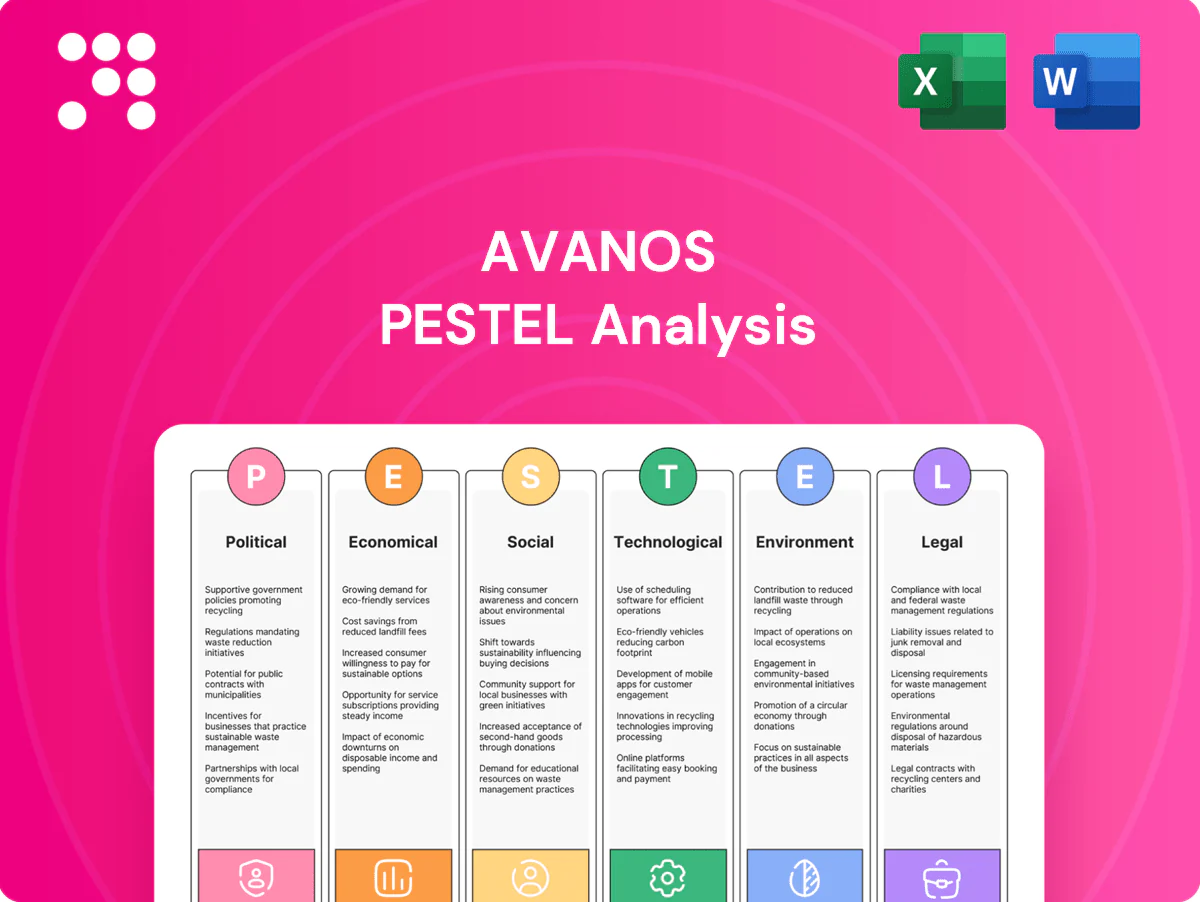
Avanos PESTLE Analysis

Your Shortcut to Market Insight Starts Here
Unlock strategic clarity with our focused PESTLE Analysis of Avanos—three to five actionable insights into political, economic, social, technological, legal, and environmental forces shaping its future. Ideal for investors, consultants, and executives seeking timely, decision-ready intelligence. Purchase the full report to access the complete breakdown, data sources, and editable charts for immediate use.
Political factors

Healthcare policy and funding shifts
Changes in government healthcare budgets — with US national health expenditures at about $4.5 trillion in 2023 — directly affect hospital and procurement spending on medical devices, influencing Avanos sales (~$1.5B revenue FY2024).
Shifts toward value-based care and Medicare Advantage growth (≈30 million enrollees in 2024) favor devices that cut complications and length of stay.
Avanos must align clinical evidence and pricing with payer priorities to retain formulary access; election cycles in 2024–2025 add policy volatility across key markets.
Regulatory agencies and approval timelines
FDA and EMA thresholds directly shape Avanos time-to-market: FDA PDUFA review targets ~10 months (Priority Review ~6 months) and EMA centralized review ~210 days, with national regulators adding local requirements. Accelerated pathways can shorten access for pain and respiratory innovations, but post‑pandemic scrutiny is elevated; proactive agency engagement and robust clinical data reduce delay risks that otherwise erode first‑mover advantage.

Trade policy, tariffs, and localization
Customs duties on medical components and finished goods compress Avanos margins and force price adjustments across markets. Incentives for local manufacturing in 2024 and 2025 continue to influence decisions on plant siting and capital allocation. Geopolitical tensions risk disrupting cross-border flows of resins, electronics, and sterilization inputs. Diversifying suppliers and nearshoring reduce exposure and improve resilience.

Public health priorities and preparedness
Public health initiatives since 2023 have driven renewed respiratory and critical care funding, pushing demand volatility for Avanos airways and consumables during surge periods; stockpiling policies and SNS replenishment cycles materially change procurement timing and volumes.
- Stockpiles drive spike-demand windows
- Procurement specs dictate tender success
- Preparedness alignment stabilizes volumes
Government scrutiny of pricing
Global price-transparency rules (eg CMS Hospital Price Transparency, effective 2021) and expanding OECD/reference-pricing frameworks increase scrutiny; WHO shows tendering can cut prices up to 50%, compressing hospital ASPs; demonstrating total cost-of-care reduction and using strategic contracting plus outcomes data are essential to preserve price realization.
- Reference pricing pressure on ASPs
- WHO: tenders can reduce prices up to 50%
- Value/outcomes data vital for contracting
Policy, payers and regulation reshape global device pricing and supply chains
US health spend ~$4.5T (2023) and Avanos revenue ~$1.5B (FY2024) link government budgets to device demand; Medicare Advantage ~30M enrollees (2024) favors outcomes‑reducing products. Regulatory timelines (FDA ~10 months, EMA ~210 days) and WHO tenders (price cuts up to 50%) drive access and ASP pressure. Customs duties, local manufacturing incentives and geopolitical risks push nearshoring and supplier diversification.
| Political factor | Metric | Commercial impact |
|---|---|---|
| Budget & payers | $4.5T; 30M MA | Demand/pricing |
What is included in the product
 Detailed Word Document
Explores how macro-environmental factors uniquely affect Avanos across Political, Economic, Social, Technological, Environmental, and Legal dimensions, with data-backed trends, scenario insights, and actionable implications to guide executives and investors in strategy, risk mitigation, and opportunity capture.

 Customizable Excel Spreadsheet
A concise, visually segmented PESTLE summary of Avanos that highlights regulatory, economic and technological risks for quick inclusion in presentations or strategy sessions, with editable notes so teams can tailor insights to their region or business line.
Economic factors

Hospital capital and operating budgets
Macro cycles drive hospital capex (~$110–120B US annual range in recent years) and opex for disposables; tight 2023–24 budgets pushed preference for proven, cost-effective devices with strong outcomes data. Deferred elective procedures shifted short-term demand between pain and GI portfolios, and contracting must flex for seasonal budget windows.
Inflation and input costs
Resin, packaging, sterilization and freight costs remain volatile—resin spot prices swung about 20% in 2023–24 and ocean freight rose roughly 15% Y/Y in 2024. Persistent wage inflation in healthcare and manufacturing (about 4–6% annual wage growth) pressures margins. Pricing actions and productivity programs target offsetting roughly 200–300 bps of cost creep. Long-term supplier agreements can lock pricing and stabilize economics.

Foreign exchange fluctuations
Avanos (AVNS) global sales expose the company to USD strength or weakness versus major currencies, with the US Dollar Index near 104 in mid‑2025 increasing translation volatility. FX swings can materially affect reported revenue, pricing competitiveness and COGS, reducing international margin. Natural hedges from local sourcing and local currency expenses partially dampen swings. Financial hedges are used where operational offsets are limited to protect earnings.

Procedure volumes and utilization
Elective procedure recovery reached roughly 90% of 2019 volumes by 2024, supporting demand for Avanos pain and digestive products, while respiratory volumes swing seasonally—winter peaks can be ~30–40% higher than summer—affecting airway product turnover. Persistent backlogs and staffing vacancies (single-digit to low-teens %) cap utilization despite demand; forecasts must model payer mix and throughput limits.
- Elective recovery ~90% (2024)
- Respiratory seasonality ±30–40%
- Staffing vacancies limit throughput
- Forecast on payer mix & capacity
M&A and capital access
Rising cost of capital—US federal funds at 5.25–5.50% and 10-year Treasury ~4.2% (mid‑2025)—raises hurdle rates for Avanos, constraining R&D, capacity expansion and acquisitive deals; consolidation among providers and distributors increases counterparty bargaining power, making selective tuck‑ins attractive to expand portfolio and channels. Maintaining low leverage preserves strategic flexibility.
- Cost of capital: Fed funds 5.25–5.50%
- 10‑yr Treasury ~4.2%
- Consolidation → higher bargaining power
- Selective tuck‑ins broaden reach
- Strong balance sheet = strategic optionality
Policy, payers and regulation reshape global device pricing and supply chains
Macro cycles and tight 2023–24 hospital budgets favor proven, cost‑effective devices amid ~$110–120B US annual hospital capex; elective recovery ~90% (2024). Input cost volatility (resin ±20%, ocean freight +15% Y/Y 2024, wages +4–6%) pressures margins; pricing/productivity target 200–300 bps offset. FX (DXY ~104 mid‑2025) and higher capital costs (Fed 5.25–5.50%, 10yr ~4.2%) constrain expansion.
| Metric | Value |
|---|---|
| US hospital capex | $110–120B |
| Elective recovery (2024) | ~90% |
| Resin price swing | ~±20% |
| Ocean freight Y/Y (2024) | +15% |
| Wage inflation | 4–6% |
| DXY | ~104 (mid‑2025) |
| Fed funds / 10yr | 5.25–5.50% / ~4.2% |
Same Document Delivered
Avanos PESTLE Analysis
The preview shown here is the exact Avanos PESTLE document you’ll receive after purchase—fully formatted and ready to use. The layout, content, and structure visible are identical to the downloadable file, with no placeholders or teasers. After payment you’ll instantly receive this final, professionally structured analysis.

Your Shortcut to Market Insight Starts Here
Unlock strategic clarity with our focused PESTLE Analysis of Avanos—three to five actionable insights into political, economic, social, technological, legal, and environmental forces shaping its future. Ideal for investors, consultants, and executives seeking timely, decision-ready intelligence. Purchase the full report to access the complete breakdown, data sources, and editable charts for immediate use.
Political factors
Healthcare policy and funding shifts
Changes in government healthcare budgets — with US national health expenditures at about $4.5 trillion in 2023 — directly affect hospital and procurement spending on medical devices, influencing Avanos sales (~$1.5B revenue FY2024).
Shifts toward value-based care and Medicare Advantage growth (≈30 million enrollees in 2024) favor devices that cut complications and length of stay.
Avanos must align clinical evidence and pricing with payer priorities to retain formulary access; election cycles in 2024–2025 add policy volatility across key markets.
Regulatory agencies and approval timelines
FDA and EMA thresholds directly shape Avanos time-to-market: FDA PDUFA review targets ~10 months (Priority Review ~6 months) and EMA centralized review ~210 days, with national regulators adding local requirements. Accelerated pathways can shorten access for pain and respiratory innovations, but post‑pandemic scrutiny is elevated; proactive agency engagement and robust clinical data reduce delay risks that otherwise erode first‑mover advantage.
Trade policy, tariffs, and localization
Customs duties on medical components and finished goods compress Avanos margins and force price adjustments across markets. Incentives for local manufacturing in 2024 and 2025 continue to influence decisions on plant siting and capital allocation. Geopolitical tensions risk disrupting cross-border flows of resins, electronics, and sterilization inputs. Diversifying suppliers and nearshoring reduce exposure and improve resilience.
Public health priorities and preparedness
Public health initiatives since 2023 have driven renewed respiratory and critical care funding, pushing demand volatility for Avanos airways and consumables during surge periods; stockpiling policies and SNS replenishment cycles materially change procurement timing and volumes.
- Stockpiles drive spike-demand windows
- Procurement specs dictate tender success
- Preparedness alignment stabilizes volumes
Government scrutiny of pricing
Global price-transparency rules (eg CMS Hospital Price Transparency, effective 2021) and expanding OECD/reference-pricing frameworks increase scrutiny; WHO shows tendering can cut prices up to 50%, compressing hospital ASPs; demonstrating total cost-of-care reduction and using strategic contracting plus outcomes data are essential to preserve price realization.
- Reference pricing pressure on ASPs
- WHO: tenders can reduce prices up to 50%
- Value/outcomes data vital for contracting
Policy, payers and regulation reshape global device pricing and supply chains
US health spend ~$4.5T (2023) and Avanos revenue ~$1.5B (FY2024) link government budgets to device demand; Medicare Advantage ~30M enrollees (2024) favors outcomes‑reducing products. Regulatory timelines (FDA ~10 months, EMA ~210 days) and WHO tenders (price cuts up to 50%) drive access and ASP pressure. Customs duties, local manufacturing incentives and geopolitical risks push nearshoring and supplier diversification.
| Political factor | Metric | Commercial impact |
|---|---|---|
| Budget & payers | $4.5T; 30M MA | Demand/pricing |
What is included in the product
Detailed Word Document
Explores how macro-environmental factors uniquely affect Avanos across Political, Economic, Social, Technological, Environmental, and Legal dimensions, with data-backed trends, scenario insights, and actionable implications to guide executives and investors in strategy, risk mitigation, and opportunity capture.
Customizable Excel Spreadsheet
A concise, visually segmented PESTLE summary of Avanos that highlights regulatory, economic and technological risks for quick inclusion in presentations or strategy sessions, with editable notes so teams can tailor insights to their region or business line.
Economic factors
Hospital capital and operating budgets
Macro cycles drive hospital capex (~$110–120B US annual range in recent years) and opex for disposables; tight 2023–24 budgets pushed preference for proven, cost-effective devices with strong outcomes data. Deferred elective procedures shifted short-term demand between pain and GI portfolios, and contracting must flex for seasonal budget windows.
Inflation and input costs
Resin, packaging, sterilization and freight costs remain volatile—resin spot prices swung about 20% in 2023–24 and ocean freight rose roughly 15% Y/Y in 2024. Persistent wage inflation in healthcare and manufacturing (about 4–6% annual wage growth) pressures margins. Pricing actions and productivity programs target offsetting roughly 200–300 bps of cost creep. Long-term supplier agreements can lock pricing and stabilize economics.
Foreign exchange fluctuations
Avanos (AVNS) global sales expose the company to USD strength or weakness versus major currencies, with the US Dollar Index near 104 in mid‑2025 increasing translation volatility. FX swings can materially affect reported revenue, pricing competitiveness and COGS, reducing international margin. Natural hedges from local sourcing and local currency expenses partially dampen swings. Financial hedges are used where operational offsets are limited to protect earnings.
Procedure volumes and utilization
Elective procedure recovery reached roughly 90% of 2019 volumes by 2024, supporting demand for Avanos pain and digestive products, while respiratory volumes swing seasonally—winter peaks can be ~30–40% higher than summer—affecting airway product turnover. Persistent backlogs and staffing vacancies (single-digit to low-teens %) cap utilization despite demand; forecasts must model payer mix and throughput limits.
- Elective recovery ~90% (2024)
- Respiratory seasonality ±30–40%
- Staffing vacancies limit throughput
- Forecast on payer mix & capacity
M&A and capital access
Rising cost of capital—US federal funds at 5.25–5.50% and 10-year Treasury ~4.2% (mid‑2025)—raises hurdle rates for Avanos, constraining R&D, capacity expansion and acquisitive deals; consolidation among providers and distributors increases counterparty bargaining power, making selective tuck‑ins attractive to expand portfolio and channels. Maintaining low leverage preserves strategic flexibility.
- Cost of capital: Fed funds 5.25–5.50%
- 10‑yr Treasury ~4.2%
- Consolidation → higher bargaining power
- Selective tuck‑ins broaden reach
- Strong balance sheet = strategic optionality
Policy, payers and regulation reshape global device pricing and supply chains
Macro cycles and tight 2023–24 hospital budgets favor proven, cost‑effective devices amid ~$110–120B US annual hospital capex; elective recovery ~90% (2024). Input cost volatility (resin ±20%, ocean freight +15% Y/Y 2024, wages +4–6%) pressures margins; pricing/productivity target 200–300 bps offset. FX (DXY ~104 mid‑2025) and higher capital costs (Fed 5.25–5.50%, 10yr ~4.2%) constrain expansion.
| Metric | Value |
|---|---|
| US hospital capex | $110–120B |
| Elective recovery (2024) | ~90% |
| Resin price swing | ~±20% |
| Ocean freight Y/Y (2024) | +15% |
| Wage inflation | 4–6% |
| DXY | ~104 (mid‑2025) |
| Fed funds / 10yr | 5.25–5.50% / ~4.2% |
Same Document Delivered
Avanos PESTLE Analysis
The preview shown here is the exact Avanos PESTLE document you’ll receive after purchase—fully formatted and ready to use. The layout, content, and structure visible are identical to the downloadable file, with no placeholders or teasers. After payment you’ll instantly receive this final, professionally structured analysis.
Original: $10.00
-65%$10.00
$3.50Description
Your Shortcut to Market Insight Starts Here
Unlock strategic clarity with our focused PESTLE Analysis of Avanos—three to five actionable insights into political, economic, social, technological, legal, and environmental forces shaping its future. Ideal for investors, consultants, and executives seeking timely, decision-ready intelligence. Purchase the full report to access the complete breakdown, data sources, and editable charts for immediate use.
Political factors
Healthcare policy and funding shifts
Changes in government healthcare budgets — with US national health expenditures at about $4.5 trillion in 2023 — directly affect hospital and procurement spending on medical devices, influencing Avanos sales (~$1.5B revenue FY2024).
Shifts toward value-based care and Medicare Advantage growth (≈30 million enrollees in 2024) favor devices that cut complications and length of stay.
Avanos must align clinical evidence and pricing with payer priorities to retain formulary access; election cycles in 2024–2025 add policy volatility across key markets.
Regulatory agencies and approval timelines
FDA and EMA thresholds directly shape Avanos time-to-market: FDA PDUFA review targets ~10 months (Priority Review ~6 months) and EMA centralized review ~210 days, with national regulators adding local requirements. Accelerated pathways can shorten access for pain and respiratory innovations, but post‑pandemic scrutiny is elevated; proactive agency engagement and robust clinical data reduce delay risks that otherwise erode first‑mover advantage.
Trade policy, tariffs, and localization
Customs duties on medical components and finished goods compress Avanos margins and force price adjustments across markets. Incentives for local manufacturing in 2024 and 2025 continue to influence decisions on plant siting and capital allocation. Geopolitical tensions risk disrupting cross-border flows of resins, electronics, and sterilization inputs. Diversifying suppliers and nearshoring reduce exposure and improve resilience.
Public health priorities and preparedness
Public health initiatives since 2023 have driven renewed respiratory and critical care funding, pushing demand volatility for Avanos airways and consumables during surge periods; stockpiling policies and SNS replenishment cycles materially change procurement timing and volumes.
- Stockpiles drive spike-demand windows
- Procurement specs dictate tender success
- Preparedness alignment stabilizes volumes
Government scrutiny of pricing
Global price-transparency rules (eg CMS Hospital Price Transparency, effective 2021) and expanding OECD/reference-pricing frameworks increase scrutiny; WHO shows tendering can cut prices up to 50%, compressing hospital ASPs; demonstrating total cost-of-care reduction and using strategic contracting plus outcomes data are essential to preserve price realization.
- Reference pricing pressure on ASPs
- WHO: tenders can reduce prices up to 50%
- Value/outcomes data vital for contracting
Policy, payers and regulation reshape global device pricing and supply chains
US health spend ~$4.5T (2023) and Avanos revenue ~$1.5B (FY2024) link government budgets to device demand; Medicare Advantage ~30M enrollees (2024) favors outcomes‑reducing products. Regulatory timelines (FDA ~10 months, EMA ~210 days) and WHO tenders (price cuts up to 50%) drive access and ASP pressure. Customs duties, local manufacturing incentives and geopolitical risks push nearshoring and supplier diversification.
| Political factor | Metric | Commercial impact |
|---|---|---|
| Budget & payers | $4.5T; 30M MA | Demand/pricing |
What is included in the product
Detailed Word Document
Explores how macro-environmental factors uniquely affect Avanos across Political, Economic, Social, Technological, Environmental, and Legal dimensions, with data-backed trends, scenario insights, and actionable implications to guide executives and investors in strategy, risk mitigation, and opportunity capture.
Customizable Excel Spreadsheet
A concise, visually segmented PESTLE summary of Avanos that highlights regulatory, economic and technological risks for quick inclusion in presentations or strategy sessions, with editable notes so teams can tailor insights to their region or business line.
Economic factors
Hospital capital and operating budgets
Macro cycles drive hospital capex (~$110–120B US annual range in recent years) and opex for disposables; tight 2023–24 budgets pushed preference for proven, cost-effective devices with strong outcomes data. Deferred elective procedures shifted short-term demand between pain and GI portfolios, and contracting must flex for seasonal budget windows.
Inflation and input costs
Resin, packaging, sterilization and freight costs remain volatile—resin spot prices swung about 20% in 2023–24 and ocean freight rose roughly 15% Y/Y in 2024. Persistent wage inflation in healthcare and manufacturing (about 4–6% annual wage growth) pressures margins. Pricing actions and productivity programs target offsetting roughly 200–300 bps of cost creep. Long-term supplier agreements can lock pricing and stabilize economics.
Foreign exchange fluctuations
Avanos (AVNS) global sales expose the company to USD strength or weakness versus major currencies, with the US Dollar Index near 104 in mid‑2025 increasing translation volatility. FX swings can materially affect reported revenue, pricing competitiveness and COGS, reducing international margin. Natural hedges from local sourcing and local currency expenses partially dampen swings. Financial hedges are used where operational offsets are limited to protect earnings.
Procedure volumes and utilization
Elective procedure recovery reached roughly 90% of 2019 volumes by 2024, supporting demand for Avanos pain and digestive products, while respiratory volumes swing seasonally—winter peaks can be ~30–40% higher than summer—affecting airway product turnover. Persistent backlogs and staffing vacancies (single-digit to low-teens %) cap utilization despite demand; forecasts must model payer mix and throughput limits.
- Elective recovery ~90% (2024)
- Respiratory seasonality ±30–40%
- Staffing vacancies limit throughput
- Forecast on payer mix & capacity
M&A and capital access
Rising cost of capital—US federal funds at 5.25–5.50% and 10-year Treasury ~4.2% (mid‑2025)—raises hurdle rates for Avanos, constraining R&D, capacity expansion and acquisitive deals; consolidation among providers and distributors increases counterparty bargaining power, making selective tuck‑ins attractive to expand portfolio and channels. Maintaining low leverage preserves strategic flexibility.
- Cost of capital: Fed funds 5.25–5.50%
- 10‑yr Treasury ~4.2%
- Consolidation → higher bargaining power
- Selective tuck‑ins broaden reach
- Strong balance sheet = strategic optionality
Policy, payers and regulation reshape global device pricing and supply chains
Macro cycles and tight 2023–24 hospital budgets favor proven, cost‑effective devices amid ~$110–120B US annual hospital capex; elective recovery ~90% (2024). Input cost volatility (resin ±20%, ocean freight +15% Y/Y 2024, wages +4–6%) pressures margins; pricing/productivity target 200–300 bps offset. FX (DXY ~104 mid‑2025) and higher capital costs (Fed 5.25–5.50%, 10yr ~4.2%) constrain expansion.
| Metric | Value |
|---|---|
| US hospital capex | $110–120B |
| Elective recovery (2024) | ~90% |
| Resin price swing | ~±20% |
| Ocean freight Y/Y (2024) | +15% |
| Wage inflation | 4–6% |
| DXY | ~104 (mid‑2025) |
| Fed funds / 10yr | 5.25–5.50% / ~4.2% |
Same Document Delivered
Avanos PESTLE Analysis
The preview shown here is the exact Avanos PESTLE document you’ll receive after purchase—fully formatted and ready to use. The layout, content, and structure visible are identical to the downloadable file, with no placeholders or teasers. After payment you’ll instantly receive this final, professionally structured analysis.











