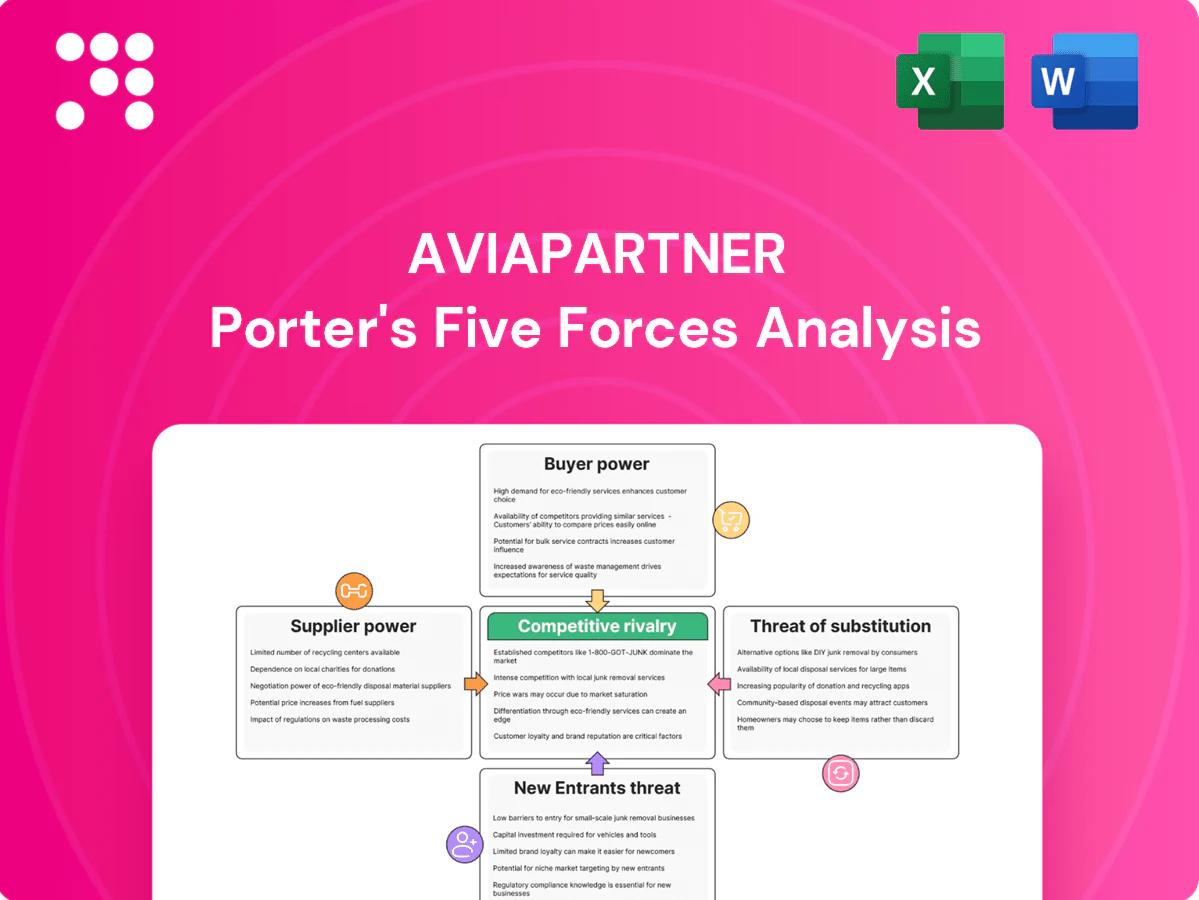
Aviapartner Porter's Five Forces Analysis

From Overview to Strategy Blueprint
Aviapartner’s Porter’s Five Forces snapshot highlights concentrated buyer power, significant supplier and regulatory pressures, moderate threat of substitutes, and high rivalry from global ground‑handling competitors. Strategic assets like global contracts and scale mitigate some risks but margin pressure persists. This brief view points to key vulnerabilities and advantages. Unlock the full Porter's Five Forces Analysis to explore force‑by‑force ratings, visuals, and actionable insights.
Suppliers Bargaining Power

Airport access and licenses
Airport operators control ramp access, gateside permits and handling licenses, creating a clear bottleneck that can restrict operations. Fees, operating windows and allocation of aprons or gates can be adjusted to favor or pressure handlers. Service delivery is 100% dependent on airside access, so negotiation leverage tilts toward airports, especially at congested hubs such as Heathrow and Schiphol.
Labor and unions
Skilled ramp, passenger and cargo agents in Europe are often unionized, giving labor significant leverage over Aviapartner through wage demands, rostering limits and strike risks. Wage inflation in 2024 remained elevated at roughly 5% y/y in several EU transport subsectors (Eurostat), raising operating costs. Certification and recurrent training create high switching costs for staffing. Tight post-peak labor markets further strengthen unions’ bargaining power.

Ground support equipment OEMs
Ground support equipment (loaders, tugs, de-icers) is supplied by a handful of OEMs, giving suppliers noticeable leverage; in 2024 lead times commonly exceed 6 months and can stretch to a year for custom specs. Spare-part pricing and electrification retrofits increase capex/opex pressures, while third-party maintenance providers create added dependency during peak season. Standardization lowers switching costs, but airport-specific requirements and bespoke interfaces limit viable alternatives.

IT systems and integrations
IT systems like DCS, turnaround coordination and baggage systems require certified integrations with airlines and airports, creating high switching friction across multi-airport operations. Vendors of mission-critical software exert pricing power as clients face switch risks; IT downtime often costs about $5,600 per minute and the average data-breach cost was $4.45M in 2023 (IBM). Downtime penalties and rising cybersecurity/compliance requirements further increase supplier leverage.
- Certified integrations required
- High switch costs → vendor pricing power
- $5,600 per minute downtime
- $4.45M avg breach cost (2023)
- Vendor lock-in common in multi-airport setups
De-icing fluids and consumables
Seasonal spikes concentrate more than 80% of annual glycol and specialized consumable demand into the three winter months, creating acute short-term buying power for suppliers.
- Supply shocks and tighter 2024 environmental controls have pushed price swings up to 30% year-on-year
- Storage and compliance costs limit substitution
- Ground handlers absorb volatile costs that are difficult to pass through mid-contract
Airport fees, union wages ~5% y/y, 6-12m OEM lead times, $5,600/min IT downtime
Airport access, unionized labor and airport-set fees give suppliers and airport operators strong leverage; wage inflation ~5% y/y in 2024 and union risks raise operating costs. OEM lead times of 6–12 months and vendor lock-in for IT increase switching costs; IT downtime ~ $5,600/min and avg breach cost $4.45M (2023). Seasonal buying concentrates ~80% glycol demand into three months, driving price swings up to 30% y/y.
| Metric | 2024 Value |
|---|---|
| Wage inflation (EU transport subsectors) | ~5% y/y |
| IT downtime cost | $5,600 / minute |
| Avg data breach cost | $4.45M (2023) |
| Seasonal glycol demand | ~80% in 3 months |
| OEM lead times | 6–12 months |
| Price volatility | Up to 30% y/y |
What is included in the product
 Detailed Word Document
Tailored exclusively for Aviapartner, this Porter's Five Forces analysis uncovers key drivers of competition, buyer and supplier influence, and barriers to entry while identifying disruptive threats and substitutes that impact pricing, profitability, and market share.

 Customizable Excel Spreadsheet
A clear, one-sheet Aviapartner Porter's Five Forces summary that instantly highlights competitive pressures with a ready-made radar chart—customize force levels, swap in your data, and drop directly into pitch decks or dashboards for rapid, boardroom-ready decision-making.
Customers Bargaining Power

Airline concentration and scale
Major LCCs and legacy carriers negotiate multi-station, multi-year handling contracts (typically 3–7 years) and, in Europe, LCCs provided about 40% of short‑haul seat capacity in 2024. Volume bundling and alliance leverage drive price pressure and stringent SLAs, with volume discounts reported up to 20%. Losing a key airline can cut station revenues sharply; coordinated tenders across airports further amplify buyer power.
Price sensitivity and thin margins
Ground handling is a low-margin, highly comparable cost center for airlines, typically representing under 5% of airline operating costs, so small price differences often decide contract awards and drive discounting in 2024. Contractual penalties for delays and mishandling (frequently specified per-incident fees) tighten effective pricing and force providers to absorb operational risk. Without explicit fuel or inflation pass-through clauses, cost pass-through to airlines is limited, compressing margins further.

Switching and dual-sourcing
While transitions are complex, airlines routinely re-tender and split ground-handling contracts—industry reports in 2024 noted about one quarter of major contracts entered retender cycles—reducing supplier lock-in. Standardized overlap periods of months and established handover processes lower perceived switching costs. Real-time performance dashboards make KPIs comparable across providers. This transparency sustains buyers credible threat to change or dual-source providers.

Backward integration and self-handling
Some airlines, notably major LCCs such as Ryanair and Wizz Air, continue self-handling at many European bases in 2024, using it as a benchmark or negotiating lever; at airports with self-handling rights carriers gain real alternatives, and the mere threat of in-sourcing disciplines handler pricing and service. Handlers must demonstrate clear cost and reliability advantages to prevent loss of contracts.
- Self-handling as leverage
- Rights expand carrier options
- Threat enforces pricing discipline
- Handlers need superior cost/reliability
Service scope and SLA customization
Airlines demand tailored service packages across passenger, ramp and cargo, pushing Aviapartner to absorb higher operational complexity and risk allocation; OAG reported global on-time performance at about 72% in 2024, making OTP guarantees material to contracts. Data-sharing requirements and KPI-linked payments shift accountability and cashflow risk to handlers, enabling buyers to withhold fees when targets are missed.
- Tailored SLAs raise handler risk
- OTP guarantees tie payment to performance
- Data sharing increases transparency and liability
- Buyers gain leverage via KPI-linked fees
LCCs 40% drive discounts up to 20% in tenders
Airline buyers exert strong bargaining power: LCCs held about 40% of European short‑haul seats in 2024, driving multi‑station, multi‑year tenders and volume discounts up to 20%. Ground handling is under 5% of airline costs, so small price differences decide awards; ~25% of major contracts retendered in 2024. OTP at ~72% makes KPI‑linked fees and penalties material.
| Metric | 2024 |
|---|---|
| LCC share Europe short‑haul | 40% |
| Typical discount | up to 20% |
| Ground handling of airline costs | <5% |
| Contracts retendered | ~25% |
| Global OTP | 72% |
Same Document Delivered
Aviapartner Porter's Five Forces Analysis
This preview shows the exact Aviapartner Porter's Five Forces Analysis you'll receive immediately after purchase—no surprises, no placeholders. The document displayed is the professionally written, fully formatted file ready for download and use the moment you buy. You're looking at the actual deliverable; once payment is complete, you’ll get instant access to this same analysis.

From Overview to Strategy Blueprint
Aviapartner’s Porter’s Five Forces snapshot highlights concentrated buyer power, significant supplier and regulatory pressures, moderate threat of substitutes, and high rivalry from global ground‑handling competitors. Strategic assets like global contracts and scale mitigate some risks but margin pressure persists. This brief view points to key vulnerabilities and advantages. Unlock the full Porter's Five Forces Analysis to explore force‑by‑force ratings, visuals, and actionable insights.
Suppliers Bargaining Power
Airport access and licenses
Airport operators control ramp access, gateside permits and handling licenses, creating a clear bottleneck that can restrict operations. Fees, operating windows and allocation of aprons or gates can be adjusted to favor or pressure handlers. Service delivery is 100% dependent on airside access, so negotiation leverage tilts toward airports, especially at congested hubs such as Heathrow and Schiphol.
Labor and unions
Skilled ramp, passenger and cargo agents in Europe are often unionized, giving labor significant leverage over Aviapartner through wage demands, rostering limits and strike risks. Wage inflation in 2024 remained elevated at roughly 5% y/y in several EU transport subsectors (Eurostat), raising operating costs. Certification and recurrent training create high switching costs for staffing. Tight post-peak labor markets further strengthen unions’ bargaining power.
Ground support equipment OEMs
Ground support equipment (loaders, tugs, de-icers) is supplied by a handful of OEMs, giving suppliers noticeable leverage; in 2024 lead times commonly exceed 6 months and can stretch to a year for custom specs. Spare-part pricing and electrification retrofits increase capex/opex pressures, while third-party maintenance providers create added dependency during peak season. Standardization lowers switching costs, but airport-specific requirements and bespoke interfaces limit viable alternatives.
IT systems and integrations
IT systems like DCS, turnaround coordination and baggage systems require certified integrations with airlines and airports, creating high switching friction across multi-airport operations. Vendors of mission-critical software exert pricing power as clients face switch risks; IT downtime often costs about $5,600 per minute and the average data-breach cost was $4.45M in 2023 (IBM). Downtime penalties and rising cybersecurity/compliance requirements further increase supplier leverage.
- Certified integrations required
- High switch costs → vendor pricing power
- $5,600 per minute downtime
- $4.45M avg breach cost (2023)
- Vendor lock-in common in multi-airport setups
De-icing fluids and consumables
Seasonal spikes concentrate more than 80% of annual glycol and specialized consumable demand into the three winter months, creating acute short-term buying power for suppliers.
- Supply shocks and tighter 2024 environmental controls have pushed price swings up to 30% year-on-year
- Storage and compliance costs limit substitution
- Ground handlers absorb volatile costs that are difficult to pass through mid-contract
Airport fees, union wages ~5% y/y, 6-12m OEM lead times, $5,600/min IT downtime
Airport access, unionized labor and airport-set fees give suppliers and airport operators strong leverage; wage inflation ~5% y/y in 2024 and union risks raise operating costs. OEM lead times of 6–12 months and vendor lock-in for IT increase switching costs; IT downtime ~ $5,600/min and avg breach cost $4.45M (2023). Seasonal buying concentrates ~80% glycol demand into three months, driving price swings up to 30% y/y.
| Metric | 2024 Value |
|---|---|
| Wage inflation (EU transport subsectors) | ~5% y/y |
| IT downtime cost | $5,600 / minute |
| Avg data breach cost | $4.45M (2023) |
| Seasonal glycol demand | ~80% in 3 months |
| OEM lead times | 6–12 months |
| Price volatility | Up to 30% y/y |
What is included in the product
Detailed Word Document
Tailored exclusively for Aviapartner, this Porter's Five Forces analysis uncovers key drivers of competition, buyer and supplier influence, and barriers to entry while identifying disruptive threats and substitutes that impact pricing, profitability, and market share.
Customizable Excel Spreadsheet
A clear, one-sheet Aviapartner Porter's Five Forces summary that instantly highlights competitive pressures with a ready-made radar chart—customize force levels, swap in your data, and drop directly into pitch decks or dashboards for rapid, boardroom-ready decision-making.
Customers Bargaining Power
Airline concentration and scale
Major LCCs and legacy carriers negotiate multi-station, multi-year handling contracts (typically 3–7 years) and, in Europe, LCCs provided about 40% of short‑haul seat capacity in 2024. Volume bundling and alliance leverage drive price pressure and stringent SLAs, with volume discounts reported up to 20%. Losing a key airline can cut station revenues sharply; coordinated tenders across airports further amplify buyer power.
Price sensitivity and thin margins
Ground handling is a low-margin, highly comparable cost center for airlines, typically representing under 5% of airline operating costs, so small price differences often decide contract awards and drive discounting in 2024. Contractual penalties for delays and mishandling (frequently specified per-incident fees) tighten effective pricing and force providers to absorb operational risk. Without explicit fuel or inflation pass-through clauses, cost pass-through to airlines is limited, compressing margins further.
Switching and dual-sourcing
While transitions are complex, airlines routinely re-tender and split ground-handling contracts—industry reports in 2024 noted about one quarter of major contracts entered retender cycles—reducing supplier lock-in. Standardized overlap periods of months and established handover processes lower perceived switching costs. Real-time performance dashboards make KPIs comparable across providers. This transparency sustains buyers credible threat to change or dual-source providers.
Backward integration and self-handling
Some airlines, notably major LCCs such as Ryanair and Wizz Air, continue self-handling at many European bases in 2024, using it as a benchmark or negotiating lever; at airports with self-handling rights carriers gain real alternatives, and the mere threat of in-sourcing disciplines handler pricing and service. Handlers must demonstrate clear cost and reliability advantages to prevent loss of contracts.
- Self-handling as leverage
- Rights expand carrier options
- Threat enforces pricing discipline
- Handlers need superior cost/reliability
Service scope and SLA customization
Airlines demand tailored service packages across passenger, ramp and cargo, pushing Aviapartner to absorb higher operational complexity and risk allocation; OAG reported global on-time performance at about 72% in 2024, making OTP guarantees material to contracts. Data-sharing requirements and KPI-linked payments shift accountability and cashflow risk to handlers, enabling buyers to withhold fees when targets are missed.
- Tailored SLAs raise handler risk
- OTP guarantees tie payment to performance
- Data sharing increases transparency and liability
- Buyers gain leverage via KPI-linked fees
LCCs 40% drive discounts up to 20% in tenders
Airline buyers exert strong bargaining power: LCCs held about 40% of European short‑haul seats in 2024, driving multi‑station, multi‑year tenders and volume discounts up to 20%. Ground handling is under 5% of airline costs, so small price differences decide awards; ~25% of major contracts retendered in 2024. OTP at ~72% makes KPI‑linked fees and penalties material.
| Metric | 2024 |
|---|---|
| LCC share Europe short‑haul | 40% |
| Typical discount | up to 20% |
| Ground handling of airline costs | <5% |
| Contracts retendered | ~25% |
| Global OTP | 72% |
Same Document Delivered
Aviapartner Porter's Five Forces Analysis
This preview shows the exact Aviapartner Porter's Five Forces Analysis you'll receive immediately after purchase—no surprises, no placeholders. The document displayed is the professionally written, fully formatted file ready for download and use the moment you buy. You're looking at the actual deliverable; once payment is complete, you’ll get instant access to this same analysis.
Original: $10.00
-65%$10.00
$3.50Description
From Overview to Strategy Blueprint
Aviapartner’s Porter’s Five Forces snapshot highlights concentrated buyer power, significant supplier and regulatory pressures, moderate threat of substitutes, and high rivalry from global ground‑handling competitors. Strategic assets like global contracts and scale mitigate some risks but margin pressure persists. This brief view points to key vulnerabilities and advantages. Unlock the full Porter's Five Forces Analysis to explore force‑by‑force ratings, visuals, and actionable insights.
Suppliers Bargaining Power
Airport access and licenses
Airport operators control ramp access, gateside permits and handling licenses, creating a clear bottleneck that can restrict operations. Fees, operating windows and allocation of aprons or gates can be adjusted to favor or pressure handlers. Service delivery is 100% dependent on airside access, so negotiation leverage tilts toward airports, especially at congested hubs such as Heathrow and Schiphol.
Labor and unions
Skilled ramp, passenger and cargo agents in Europe are often unionized, giving labor significant leverage over Aviapartner through wage demands, rostering limits and strike risks. Wage inflation in 2024 remained elevated at roughly 5% y/y in several EU transport subsectors (Eurostat), raising operating costs. Certification and recurrent training create high switching costs for staffing. Tight post-peak labor markets further strengthen unions’ bargaining power.
Ground support equipment OEMs
Ground support equipment (loaders, tugs, de-icers) is supplied by a handful of OEMs, giving suppliers noticeable leverage; in 2024 lead times commonly exceed 6 months and can stretch to a year for custom specs. Spare-part pricing and electrification retrofits increase capex/opex pressures, while third-party maintenance providers create added dependency during peak season. Standardization lowers switching costs, but airport-specific requirements and bespoke interfaces limit viable alternatives.
IT systems and integrations
IT systems like DCS, turnaround coordination and baggage systems require certified integrations with airlines and airports, creating high switching friction across multi-airport operations. Vendors of mission-critical software exert pricing power as clients face switch risks; IT downtime often costs about $5,600 per minute and the average data-breach cost was $4.45M in 2023 (IBM). Downtime penalties and rising cybersecurity/compliance requirements further increase supplier leverage.
- Certified integrations required
- High switch costs → vendor pricing power
- $5,600 per minute downtime
- $4.45M avg breach cost (2023)
- Vendor lock-in common in multi-airport setups
De-icing fluids and consumables
Seasonal spikes concentrate more than 80% of annual glycol and specialized consumable demand into the three winter months, creating acute short-term buying power for suppliers.
- Supply shocks and tighter 2024 environmental controls have pushed price swings up to 30% year-on-year
- Storage and compliance costs limit substitution
- Ground handlers absorb volatile costs that are difficult to pass through mid-contract
Airport fees, union wages ~5% y/y, 6-12m OEM lead times, $5,600/min IT downtime
Airport access, unionized labor and airport-set fees give suppliers and airport operators strong leverage; wage inflation ~5% y/y in 2024 and union risks raise operating costs. OEM lead times of 6–12 months and vendor lock-in for IT increase switching costs; IT downtime ~ $5,600/min and avg breach cost $4.45M (2023). Seasonal buying concentrates ~80% glycol demand into three months, driving price swings up to 30% y/y.
| Metric | 2024 Value |
|---|---|
| Wage inflation (EU transport subsectors) | ~5% y/y |
| IT downtime cost | $5,600 / minute |
| Avg data breach cost | $4.45M (2023) |
| Seasonal glycol demand | ~80% in 3 months |
| OEM lead times | 6–12 months |
| Price volatility | Up to 30% y/y |
What is included in the product
Detailed Word Document
Tailored exclusively for Aviapartner, this Porter's Five Forces analysis uncovers key drivers of competition, buyer and supplier influence, and barriers to entry while identifying disruptive threats and substitutes that impact pricing, profitability, and market share.
Customizable Excel Spreadsheet
A clear, one-sheet Aviapartner Porter's Five Forces summary that instantly highlights competitive pressures with a ready-made radar chart—customize force levels, swap in your data, and drop directly into pitch decks or dashboards for rapid, boardroom-ready decision-making.
Customers Bargaining Power
Airline concentration and scale
Major LCCs and legacy carriers negotiate multi-station, multi-year handling contracts (typically 3–7 years) and, in Europe, LCCs provided about 40% of short‑haul seat capacity in 2024. Volume bundling and alliance leverage drive price pressure and stringent SLAs, with volume discounts reported up to 20%. Losing a key airline can cut station revenues sharply; coordinated tenders across airports further amplify buyer power.
Price sensitivity and thin margins
Ground handling is a low-margin, highly comparable cost center for airlines, typically representing under 5% of airline operating costs, so small price differences often decide contract awards and drive discounting in 2024. Contractual penalties for delays and mishandling (frequently specified per-incident fees) tighten effective pricing and force providers to absorb operational risk. Without explicit fuel or inflation pass-through clauses, cost pass-through to airlines is limited, compressing margins further.
Switching and dual-sourcing
While transitions are complex, airlines routinely re-tender and split ground-handling contracts—industry reports in 2024 noted about one quarter of major contracts entered retender cycles—reducing supplier lock-in. Standardized overlap periods of months and established handover processes lower perceived switching costs. Real-time performance dashboards make KPIs comparable across providers. This transparency sustains buyers credible threat to change or dual-source providers.
Backward integration and self-handling
Some airlines, notably major LCCs such as Ryanair and Wizz Air, continue self-handling at many European bases in 2024, using it as a benchmark or negotiating lever; at airports with self-handling rights carriers gain real alternatives, and the mere threat of in-sourcing disciplines handler pricing and service. Handlers must demonstrate clear cost and reliability advantages to prevent loss of contracts.
- Self-handling as leverage
- Rights expand carrier options
- Threat enforces pricing discipline
- Handlers need superior cost/reliability
Service scope and SLA customization
Airlines demand tailored service packages across passenger, ramp and cargo, pushing Aviapartner to absorb higher operational complexity and risk allocation; OAG reported global on-time performance at about 72% in 2024, making OTP guarantees material to contracts. Data-sharing requirements and KPI-linked payments shift accountability and cashflow risk to handlers, enabling buyers to withhold fees when targets are missed.
- Tailored SLAs raise handler risk
- OTP guarantees tie payment to performance
- Data sharing increases transparency and liability
- Buyers gain leverage via KPI-linked fees
LCCs 40% drive discounts up to 20% in tenders
Airline buyers exert strong bargaining power: LCCs held about 40% of European short‑haul seats in 2024, driving multi‑station, multi‑year tenders and volume discounts up to 20%. Ground handling is under 5% of airline costs, so small price differences decide awards; ~25% of major contracts retendered in 2024. OTP at ~72% makes KPI‑linked fees and penalties material.
| Metric | 2024 |
|---|---|
| LCC share Europe short‑haul | 40% |
| Typical discount | up to 20% |
| Ground handling of airline costs | <5% |
| Contracts retendered | ~25% |
| Global OTP | 72% |
Same Document Delivered
Aviapartner Porter's Five Forces Analysis
This preview shows the exact Aviapartner Porter's Five Forces Analysis you'll receive immediately after purchase—no surprises, no placeholders. The document displayed is the professionally written, fully formatted file ready for download and use the moment you buy. You're looking at the actual deliverable; once payment is complete, you’ll get instant access to this same analysis.











