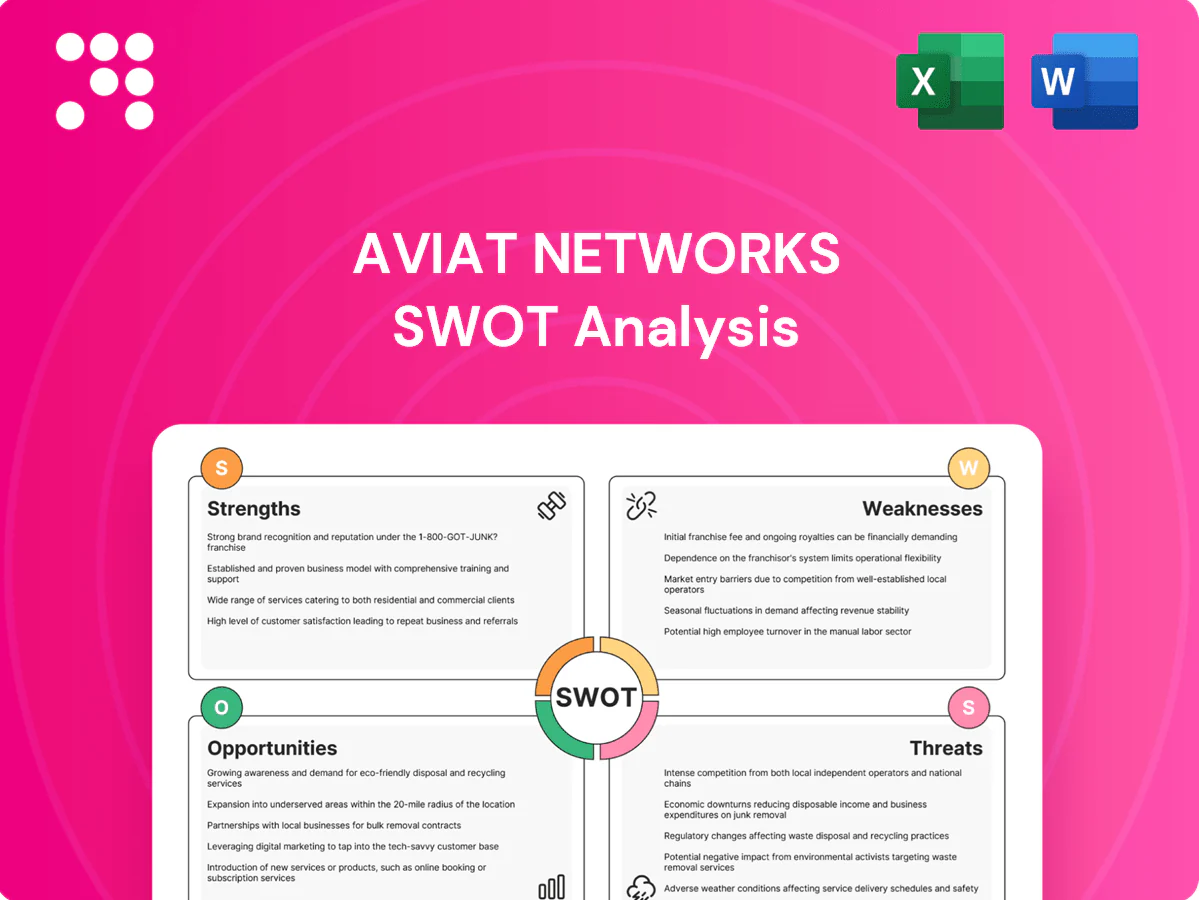
Aviat Networks SWOT Analysis

Elevate Your Analysis with the Complete SWOT Report
Aviat Networks shows strong niche expertise in wireless backhaul and growing 5G opportunities, but faces supply-chain pressure and intense competition; regulatory shifts and tech cycles create both risks and expansion windows. Want the full picture with actionable financial context and editable Word/Excel deliverables? Purchase the complete SWOT analysis to plan, pitch, or invest with confidence.
Strengths

Deep microwave networking specialization
30+ years of focused microwave backhaul engineering gives Aviat proven RF design, path planning and link optimization expertise that supports carrier-grade high availability and low-latency performance in harsh environments. Customers in public safety, utilities and defense cite this domain know-how for mission-critical uptime and retention. The deep specialization raises barriers to entry against generalist vendors.
End-to-end portfolio and services
Aviat offers radios, antennas, network software, engineering, installation and lifecycle services, delivering an end-to-end solution that reduces integration risk and shortens time-to-deploy. One-throat-to-choke delivery improves project predictability and lowers total cost of ownership for operators. Services create stickiness and recurring revenue streams that boost lifetime customer value. Full-solution offerings command premium pricing and enhance retention.

Diverse customer base
Diverse customer base spanning mobile operators, governments, utilities and ISPs spreads demand across segments and reduces reliance on any single market. Public safety and critical infrastructure clients prioritize reliability and long-term support over lowest price, enabling higher-margin opportunities. Diversification cushions Aviat against carrier capex cycles and referenceable missions bolster global credibility.

High-capacity, long-reach connectivity
Microwave and E-band links deliver multi-Gbps capacity (E-band up to 10 Gbps) where fiber is costly or slow; Aviat’s platforms support 4G/5G backhaul SLAs and private networks with millisecond-class latency, enabling rollouts in weeks for rural or difficult terrain versus months for fiber. Around 37% of the global population remains underserved, positioning Aviat to capture growth in those geographies.
- High throughput: E-band up to 10 Gbps
- Rapid rollouts: weeks vs months for fiber
- SLA-grade: supports 4G/5G/enterprise private networks
- Market opportunity: ~37% globally underserved
Global footprint and installed base
Aviat Networks leverages a broad global installed base to drive upgrade cycles and cross-sell high-margin software and services, while extensive field experience across diverse climates and regulatory environments shortens deployment timelines and reduces operational risk. Strong local partner networks and on-the-ground support raise win rates in competitive bids, and scale in niche microwave and transport categories enhances procurement leverage and unit-cost efficiency.
30+ years microwave backhaul expertise; E-band to 10 Gbps for critical networks
30+ years of microwave backhaul expertise, end-to-end product+services stack and large installed base drive high retention, cross-sell and premium pricing. Platforms support 4G/5G and E-band multi-Gbps links (E-band up to 10 Gbps) enabling SLA-grade backhaul with rapid weeks-scale deployments. Diverse customers across public safety, utilities, carriers and enterprise reduce cyclicality and raise margin stability.
| Metric | Value |
|---|---|
| Experience | 30+ years |
| E-band throughput | Up to 10 Gbps |
| Underserved market | ~37% global population |
What is included in the product
 Detailed Word Document
Delivers a strategic overview of Aviat Networks’s internal and external business factors, outlining strengths, weaknesses, opportunities, and threats to assess its competitive position, growth drivers, operational gaps, and market risks.

 Customizable Excel Spreadsheet
Provides a concise SWOT matrix tailored to Aviat Networks for fast, visual strategy alignment and tactical prioritization. Editable format allows quick updates to reflect changing network market dynamics and supports clean integration into reports and stakeholder presentations.
Weaknesses

Exposure to carrier capex cycles
Mobile operator spending is highly lumpy and often tied to macro cycles and spectrum auctions, with global operator capex around $190 billion in 2024, creating timing swings that hit vendors like Aviat. Project delays or auction-driven shifts can quickly erode revenue visibility and defer multi-million dollar orders. Large, discrete contracts make forecasting harder and can push margins and working capital under pressure.
Niche versus fiber alternatives
Fiber remains the gold standard for capacity and future-proofing in dense urban areas, with DWDM fiber systems delivering multiple terabits per second. Modern microwave (E‑band/V‑band) links typically provide single to tens of gigabits per second per link (roughly 1–40 Gbps), so where trenching is feasible fiber can displace microwave. Even where TCO favors wireless, perception risk and customer preference for fiber narrow addressable markets in many metros.

Hardware supply chain dependencies
Specialized RF components and semiconductors expose Aviat to lead-time shocks—global semiconductor sales reached about $556 billion in 2023, and chip lead times remained elevated versus pre-pandemic norms, slowing deliveries. Logistics disruptions lift freight and handling costs and elongate deployments, while single- or limited-source parts concentrate supply risk. Maintaining inventory buffers ties up cash and risks obsolescence as tech cycles shorten.

Long sales cycles and procurement hurdles
Government and utility bids for Aviat often require lengthy certifications and tendering (commonly 6–18 months), while technical evaluations and site surveys typically add 1–3 months and incremental cost. Revenue conversion is milestone-dependent, frequently deferring cash collection by 3–9 months versus faster-recognizing software peers, reducing agility and time-to-market.
- Procurement cycle: 6–18 months
- Technical add-on: 1–3 months
- Payment lag: 3–9 months
Brand scale versus Tier-1 rivals
Competing with Ericsson, Huawei and Nokia — plus entrenched fiber incumbents — erodes Aviat Networks’ mindshare; Tier‑1 vendors hold about 80% combined global RAN market share (2023–24). These rivals bundle end‑to‑end RAN/core/backhaul solutions, constraining Aviat’s pricing power in head‑to‑head bids and limiting margin expansion.
- Mindshare pressure vs Tier‑1s
- Bundled end‑to‑end competition
- Constrained pricing in bids
- Smaller marketing/channel reach
Capex swings, supply-chain shocks and fiber competition compress microwave market visibility
Revenue volatility from lumpy operator capex (~$190B global 2024) and auction timing reduces visibility; fiber displacement risk in metros (DWDM terabits vs microwave 1–40 Gbps) narrows addressable markets. Supply-chain shocks (semiconductors $556B 2023) raise lead times and inventory costs. Long public tender cycles (6–18 months) and Tier‑1 competition (~80% RAN share) constrain pricing and growth.
| Weakness | Key Data |
|---|---|
| Capex volatility | $190B global operator capex 2024 |
| Fiber competition | DWDM: Tbps; Microwave: 1–40 Gbps |
| Supply risk | Semiconductor sales $556B 2023; long lead times |
| Tender lag | Procurement 6–18 months |
| Competitive pressure | Tier‑1 RAN ~80% share |
Same Document Delivered
Aviat Networks SWOT Analysis
This is the actual Aviat Networks SWOT analysis document you’ll receive upon purchase—no surprises, just professional quality. The preview below is taken directly from the full report and reflects the same structured, editable file included with your download. Buy now to unlock the complete, detailed version immediately after payment.

Elevate Your Analysis with the Complete SWOT Report
Aviat Networks shows strong niche expertise in wireless backhaul and growing 5G opportunities, but faces supply-chain pressure and intense competition; regulatory shifts and tech cycles create both risks and expansion windows. Want the full picture with actionable financial context and editable Word/Excel deliverables? Purchase the complete SWOT analysis to plan, pitch, or invest with confidence.
Strengths
Deep microwave networking specialization
30+ years of focused microwave backhaul engineering gives Aviat proven RF design, path planning and link optimization expertise that supports carrier-grade high availability and low-latency performance in harsh environments. Customers in public safety, utilities and defense cite this domain know-how for mission-critical uptime and retention. The deep specialization raises barriers to entry against generalist vendors.
End-to-end portfolio and services
Aviat offers radios, antennas, network software, engineering, installation and lifecycle services, delivering an end-to-end solution that reduces integration risk and shortens time-to-deploy. One-throat-to-choke delivery improves project predictability and lowers total cost of ownership for operators. Services create stickiness and recurring revenue streams that boost lifetime customer value. Full-solution offerings command premium pricing and enhance retention.
Diverse customer base
Diverse customer base spanning mobile operators, governments, utilities and ISPs spreads demand across segments and reduces reliance on any single market. Public safety and critical infrastructure clients prioritize reliability and long-term support over lowest price, enabling higher-margin opportunities. Diversification cushions Aviat against carrier capex cycles and referenceable missions bolster global credibility.
High-capacity, long-reach connectivity
Microwave and E-band links deliver multi-Gbps capacity (E-band up to 10 Gbps) where fiber is costly or slow; Aviat’s platforms support 4G/5G backhaul SLAs and private networks with millisecond-class latency, enabling rollouts in weeks for rural or difficult terrain versus months for fiber. Around 37% of the global population remains underserved, positioning Aviat to capture growth in those geographies.
- High throughput: E-band up to 10 Gbps
- Rapid rollouts: weeks vs months for fiber
- SLA-grade: supports 4G/5G/enterprise private networks
- Market opportunity: ~37% globally underserved
Global footprint and installed base
Aviat Networks leverages a broad global installed base to drive upgrade cycles and cross-sell high-margin software and services, while extensive field experience across diverse climates and regulatory environments shortens deployment timelines and reduces operational risk. Strong local partner networks and on-the-ground support raise win rates in competitive bids, and scale in niche microwave and transport categories enhances procurement leverage and unit-cost efficiency.
30+ years microwave backhaul expertise; E-band to 10 Gbps for critical networks
30+ years of microwave backhaul expertise, end-to-end product+services stack and large installed base drive high retention, cross-sell and premium pricing. Platforms support 4G/5G and E-band multi-Gbps links (E-band up to 10 Gbps) enabling SLA-grade backhaul with rapid weeks-scale deployments. Diverse customers across public safety, utilities, carriers and enterprise reduce cyclicality and raise margin stability.
| Metric | Value |
|---|---|
| Experience | 30+ years |
| E-band throughput | Up to 10 Gbps |
| Underserved market | ~37% global population |
What is included in the product
Detailed Word Document
Delivers a strategic overview of Aviat Networks’s internal and external business factors, outlining strengths, weaknesses, opportunities, and threats to assess its competitive position, growth drivers, operational gaps, and market risks.
Customizable Excel Spreadsheet
Provides a concise SWOT matrix tailored to Aviat Networks for fast, visual strategy alignment and tactical prioritization. Editable format allows quick updates to reflect changing network market dynamics and supports clean integration into reports and stakeholder presentations.
Weaknesses
Exposure to carrier capex cycles
Mobile operator spending is highly lumpy and often tied to macro cycles and spectrum auctions, with global operator capex around $190 billion in 2024, creating timing swings that hit vendors like Aviat. Project delays or auction-driven shifts can quickly erode revenue visibility and defer multi-million dollar orders. Large, discrete contracts make forecasting harder and can push margins and working capital under pressure.
Niche versus fiber alternatives
Fiber remains the gold standard for capacity and future-proofing in dense urban areas, with DWDM fiber systems delivering multiple terabits per second. Modern microwave (E‑band/V‑band) links typically provide single to tens of gigabits per second per link (roughly 1–40 Gbps), so where trenching is feasible fiber can displace microwave. Even where TCO favors wireless, perception risk and customer preference for fiber narrow addressable markets in many metros.
Hardware supply chain dependencies
Specialized RF components and semiconductors expose Aviat to lead-time shocks—global semiconductor sales reached about $556 billion in 2023, and chip lead times remained elevated versus pre-pandemic norms, slowing deliveries. Logistics disruptions lift freight and handling costs and elongate deployments, while single- or limited-source parts concentrate supply risk. Maintaining inventory buffers ties up cash and risks obsolescence as tech cycles shorten.
Long sales cycles and procurement hurdles
Government and utility bids for Aviat often require lengthy certifications and tendering (commonly 6–18 months), while technical evaluations and site surveys typically add 1–3 months and incremental cost. Revenue conversion is milestone-dependent, frequently deferring cash collection by 3–9 months versus faster-recognizing software peers, reducing agility and time-to-market.
- Procurement cycle: 6–18 months
- Technical add-on: 1–3 months
- Payment lag: 3–9 months
Brand scale versus Tier-1 rivals
Competing with Ericsson, Huawei and Nokia — plus entrenched fiber incumbents — erodes Aviat Networks’ mindshare; Tier‑1 vendors hold about 80% combined global RAN market share (2023–24). These rivals bundle end‑to‑end RAN/core/backhaul solutions, constraining Aviat’s pricing power in head‑to‑head bids and limiting margin expansion.
- Mindshare pressure vs Tier‑1s
- Bundled end‑to‑end competition
- Constrained pricing in bids
- Smaller marketing/channel reach
Capex swings, supply-chain shocks and fiber competition compress microwave market visibility
Revenue volatility from lumpy operator capex (~$190B global 2024) and auction timing reduces visibility; fiber displacement risk in metros (DWDM terabits vs microwave 1–40 Gbps) narrows addressable markets. Supply-chain shocks (semiconductors $556B 2023) raise lead times and inventory costs. Long public tender cycles (6–18 months) and Tier‑1 competition (~80% RAN share) constrain pricing and growth.
| Weakness | Key Data |
|---|---|
| Capex volatility | $190B global operator capex 2024 |
| Fiber competition | DWDM: Tbps; Microwave: 1–40 Gbps |
| Supply risk | Semiconductor sales $556B 2023; long lead times |
| Tender lag | Procurement 6–18 months |
| Competitive pressure | Tier‑1 RAN ~80% share |
Same Document Delivered
Aviat Networks SWOT Analysis
This is the actual Aviat Networks SWOT analysis document you’ll receive upon purchase—no surprises, just professional quality. The preview below is taken directly from the full report and reflects the same structured, editable file included with your download. Buy now to unlock the complete, detailed version immediately after payment.
Original: $10.00
-65%$10.00
$3.50Description
Elevate Your Analysis with the Complete SWOT Report
Aviat Networks shows strong niche expertise in wireless backhaul and growing 5G opportunities, but faces supply-chain pressure and intense competition; regulatory shifts and tech cycles create both risks and expansion windows. Want the full picture with actionable financial context and editable Word/Excel deliverables? Purchase the complete SWOT analysis to plan, pitch, or invest with confidence.
Strengths
Deep microwave networking specialization
30+ years of focused microwave backhaul engineering gives Aviat proven RF design, path planning and link optimization expertise that supports carrier-grade high availability and low-latency performance in harsh environments. Customers in public safety, utilities and defense cite this domain know-how for mission-critical uptime and retention. The deep specialization raises barriers to entry against generalist vendors.
End-to-end portfolio and services
Aviat offers radios, antennas, network software, engineering, installation and lifecycle services, delivering an end-to-end solution that reduces integration risk and shortens time-to-deploy. One-throat-to-choke delivery improves project predictability and lowers total cost of ownership for operators. Services create stickiness and recurring revenue streams that boost lifetime customer value. Full-solution offerings command premium pricing and enhance retention.
Diverse customer base
Diverse customer base spanning mobile operators, governments, utilities and ISPs spreads demand across segments and reduces reliance on any single market. Public safety and critical infrastructure clients prioritize reliability and long-term support over lowest price, enabling higher-margin opportunities. Diversification cushions Aviat against carrier capex cycles and referenceable missions bolster global credibility.
High-capacity, long-reach connectivity
Microwave and E-band links deliver multi-Gbps capacity (E-band up to 10 Gbps) where fiber is costly or slow; Aviat’s platforms support 4G/5G backhaul SLAs and private networks with millisecond-class latency, enabling rollouts in weeks for rural or difficult terrain versus months for fiber. Around 37% of the global population remains underserved, positioning Aviat to capture growth in those geographies.
- High throughput: E-band up to 10 Gbps
- Rapid rollouts: weeks vs months for fiber
- SLA-grade: supports 4G/5G/enterprise private networks
- Market opportunity: ~37% globally underserved
Global footprint and installed base
Aviat Networks leverages a broad global installed base to drive upgrade cycles and cross-sell high-margin software and services, while extensive field experience across diverse climates and regulatory environments shortens deployment timelines and reduces operational risk. Strong local partner networks and on-the-ground support raise win rates in competitive bids, and scale in niche microwave and transport categories enhances procurement leverage and unit-cost efficiency.
30+ years microwave backhaul expertise; E-band to 10 Gbps for critical networks
30+ years of microwave backhaul expertise, end-to-end product+services stack and large installed base drive high retention, cross-sell and premium pricing. Platforms support 4G/5G and E-band multi-Gbps links (E-band up to 10 Gbps) enabling SLA-grade backhaul with rapid weeks-scale deployments. Diverse customers across public safety, utilities, carriers and enterprise reduce cyclicality and raise margin stability.
| Metric | Value |
|---|---|
| Experience | 30+ years |
| E-band throughput | Up to 10 Gbps |
| Underserved market | ~37% global population |
What is included in the product
Detailed Word Document
Delivers a strategic overview of Aviat Networks’s internal and external business factors, outlining strengths, weaknesses, opportunities, and threats to assess its competitive position, growth drivers, operational gaps, and market risks.
Customizable Excel Spreadsheet
Provides a concise SWOT matrix tailored to Aviat Networks for fast, visual strategy alignment and tactical prioritization. Editable format allows quick updates to reflect changing network market dynamics and supports clean integration into reports and stakeholder presentations.
Weaknesses
Exposure to carrier capex cycles
Mobile operator spending is highly lumpy and often tied to macro cycles and spectrum auctions, with global operator capex around $190 billion in 2024, creating timing swings that hit vendors like Aviat. Project delays or auction-driven shifts can quickly erode revenue visibility and defer multi-million dollar orders. Large, discrete contracts make forecasting harder and can push margins and working capital under pressure.
Niche versus fiber alternatives
Fiber remains the gold standard for capacity and future-proofing in dense urban areas, with DWDM fiber systems delivering multiple terabits per second. Modern microwave (E‑band/V‑band) links typically provide single to tens of gigabits per second per link (roughly 1–40 Gbps), so where trenching is feasible fiber can displace microwave. Even where TCO favors wireless, perception risk and customer preference for fiber narrow addressable markets in many metros.
Hardware supply chain dependencies
Specialized RF components and semiconductors expose Aviat to lead-time shocks—global semiconductor sales reached about $556 billion in 2023, and chip lead times remained elevated versus pre-pandemic norms, slowing deliveries. Logistics disruptions lift freight and handling costs and elongate deployments, while single- or limited-source parts concentrate supply risk. Maintaining inventory buffers ties up cash and risks obsolescence as tech cycles shorten.
Long sales cycles and procurement hurdles
Government and utility bids for Aviat often require lengthy certifications and tendering (commonly 6–18 months), while technical evaluations and site surveys typically add 1–3 months and incremental cost. Revenue conversion is milestone-dependent, frequently deferring cash collection by 3–9 months versus faster-recognizing software peers, reducing agility and time-to-market.
- Procurement cycle: 6–18 months
- Technical add-on: 1–3 months
- Payment lag: 3–9 months
Brand scale versus Tier-1 rivals
Competing with Ericsson, Huawei and Nokia — plus entrenched fiber incumbents — erodes Aviat Networks’ mindshare; Tier‑1 vendors hold about 80% combined global RAN market share (2023–24). These rivals bundle end‑to‑end RAN/core/backhaul solutions, constraining Aviat’s pricing power in head‑to‑head bids and limiting margin expansion.
- Mindshare pressure vs Tier‑1s
- Bundled end‑to‑end competition
- Constrained pricing in bids
- Smaller marketing/channel reach
Capex swings, supply-chain shocks and fiber competition compress microwave market visibility
Revenue volatility from lumpy operator capex (~$190B global 2024) and auction timing reduces visibility; fiber displacement risk in metros (DWDM terabits vs microwave 1–40 Gbps) narrows addressable markets. Supply-chain shocks (semiconductors $556B 2023) raise lead times and inventory costs. Long public tender cycles (6–18 months) and Tier‑1 competition (~80% RAN share) constrain pricing and growth.
| Weakness | Key Data |
|---|---|
| Capex volatility | $190B global operator capex 2024 |
| Fiber competition | DWDM: Tbps; Microwave: 1–40 Gbps |
| Supply risk | Semiconductor sales $556B 2023; long lead times |
| Tender lag | Procurement 6–18 months |
| Competitive pressure | Tier‑1 RAN ~80% share |
Same Document Delivered
Aviat Networks SWOT Analysis
This is the actual Aviat Networks SWOT analysis document you’ll receive upon purchase—no surprises, just professional quality. The preview below is taken directly from the full report and reflects the same structured, editable file included with your download. Buy now to unlock the complete, detailed version immediately after payment.











