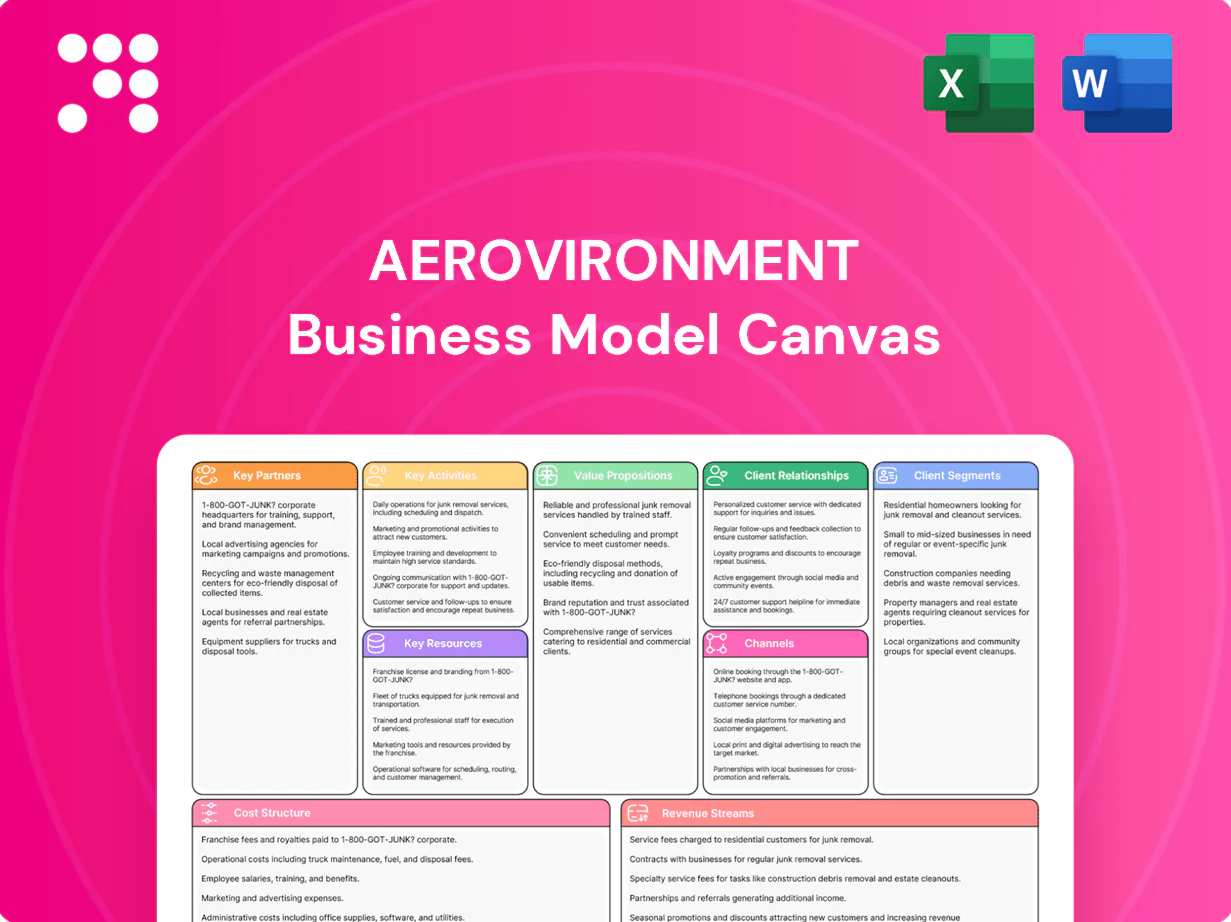
AeroVironment Business Model Canvas

Unlock a strategic Business Model Canvas: value propositions, partners, revenue drivers
Unlock AeroVironment’s strategic blueprint with our Business Model Canvas: discover core value propositions, key partners, revenue drivers and cost structure in a ready-to-use format. Perfect for investors, consultants, and founders seeking actionable insights—download the full, editable Canvas now.
Partnerships

U.S. DoD & agencies
U.S. DoD and agencies serve as primary program partners for requirements definition, funding, and deployment, anchoring product roadmaps to operational needs. Close collaboration with combatant commands and services ensures mission-fit specifications and rapid fielding. Long-term contracts and IDIQ vehicles create predictable demand, while security certifications and accreditations sustain sustained operational use within the FY2024 U.S. defense budget of about 858 billion USD.
Allied governments
Ministries of Defense across NATO and partner nations expand AeroVironment’s market reach into 31 NATO members and a collective defense spending that exceeded $1 trillion in 2023. Foreign Military Sales streamline procurement and interoperability for coalition deployments. Local offset partners provide in‑country sustainment and regulatory compliance. Dozens of joint exercises annually validate systems in coalition missions.

Defense primes
Integration with defense primes (eg Lockheed, Northrop) enables AeroVironment to embed small UAS into larger programs of record and system-of-systems, covering payload integration, comms, and C2 interoperability; co-bidding with primes historically increases competitiveness on complex procurements, aligning shared roadmaps for technology evolution amid a FY2024 US defense budget of about 858 billion USD.

Suppliers & OEMs
Avionics, sensors, propulsion and materials vendors underpin AeroVironment product performance and unit cost, with tight supplier specs driving reliability and margins. Dual-source strategies mitigate single-vendor disruptions and shorten lead times. ITAR-compliant, quality-certified suppliers preserve program schedules and exportability, while long-term agreements lock pricing and capacity.
- Supply focus: avionics, sensors, propulsion, materials
- Risk control: dual-source strategies
- Compliance: ITAR and quality certifications
- Stability: long-term pricing and availability agreements
R&D & test ecosystem
Universities, national labs and dedicated test ranges accelerate innovation and validation, supplying prototype platforms and peer-reviewed research that shortens development cycles for AeroVironment.
FAA and DoD ranges enable flight testing and certification at scale, supporting repeated sortie campaigns and compliance with airworthiness standards.
AI/edge-computing and cybersecurity partners strengthen autonomy stacks and hardening, aiding real-world deployments and accreditation processes.
- Universities & labs: prototype validation and grants
- FAA/DoD ranges: large-scale flight testing & certification
- AI/Edge partners: on-board autonomy compute
- Cybersecurity firms: system hardening & accreditation
Partners power defense buys: DoD $858B, NATO $1T reach
Core partners: U.S. DoD (FY2024 budget ~$858B) and combatant commands drive requirements and funded buys; NATO/ministry partners extend reach across 31 members (collective defense spend >$1T in 2023). Primes enable systems integration; certified suppliers, labs, FAA/DoD ranges and AI/cyber firms secure production, testing and fielding.
| Partner | Role | Key stat |
|---|---|---|
| U.S. DoD | Funding/reqs | $858B FY2024 |
| NATO | Export/ops | 31 members; >$1T 2023 |
| Primes/suppliers | Integration/supply | Long-term contracts |
What is included in the product
 Detailed Word Document
A comprehensive Business Model Canvas for AeroVironment detailing its nine blocks—customer segments (military, commercial, industrial), value propositions (small UAS, electric propulsion, tactical ISR), channels, revenue streams, cost structure, key partners, activities, resources, and customer relationships—aligned with competitive advantages and SWOT insights to support investor presentations and strategic decisions.

 Customizable Excel Spreadsheet
High-level, editable one-page snapshot of AeroVironment’s business model that quickly identifies core components and pain points, saving hours of formatting while enabling team collaboration and fast executive summaries for strategy or investor discussions.
Activities

R&D and prototyping
Continuous design of UAS, loitering munitions, and autonomy software drives iterative roadmaps that prioritize modular airframes and open-architecture guidance stacks. Rapid prototyping reduces cycle time through quick airframe, payload, and guidance iterations supported by additive manufacturing. Modeling, simulation, and HWIL testing de-risk performance across flight envelopes. Compliance engineering ensures MIL-STD and airworthiness alignment.
Manufacturing & QA
Low-to-mid rate production of unmanned air vehicles and tactical missiles focuses on tens to low-hundreds of units annually, aligning with defense contract cadence. Lean manufacturing and tight supplier coordination optimize throughput and reduce lead times. Environmental and stress testing follow MIL-STD protocols to ensure reliability. Rigorous configuration control preserves traceability and ISO/AS9100-quality standards.

System integration
Integrating sensors, communications and C2 into customer networks enables seamless mission data flow; designs adhere to NATO STANAG 4586 for interoperability across NATO's 30 member nations (2024). Modular payload swaps provide rapid multi-mission flexibility, while data links employ AES-256 encryption and frequency-hopping waveforms to maintain integrity in contested environments.

Training & support
Training & support centers on operator training, field service and deployment assistance to maintain ISR and tactical UAS readiness; spares, repairs and depot-level maintenance sustain availability, while software updates and firmware patches enhance capability. Mission planning and post-mission analytics close the loop for improved mission outcomes in 2024.
- Operator training
- Field service & deployment assistance
- Spares, repairs & depot maintenance
- Software updates & firmware patches
- Mission planning & post-mission analytics
Business development
Business development focuses on capture management for domestic and FMS opportunities, aligning proposal development with FAR/DFARS and agency acquisition rules; AeroVironment joined RTX in 2023, leveraging RTX scale to pursue larger FMS packages. Strategic partnerships and live demonstrations drive adoption, while lifecycle pricing and sustainment planning secure win-to-sustain revenue streams.
- Capture: domestic + FMS
- Compliance: FAR/DFARS
- Partnerships & demos: adoption
- Lifecycle pricing: sustainment wins
Continuous UAS & loitering munitions: rapid prototyping, STANAG 4586 interoperability, AES-256
Continuous UAS, loitering munition and autonomy development with rapid prototyping; low-to-mid rate production ~tens–low-hundreds units/year; interoperability per STANAG 4586 (NATO 30 members in 2024) and AES-256 links; training, field service, sustainment and FMS capture leveraging AeroVironment's 2023 integration into RTX.
| Metric | 2024 Value |
|---|---|
| Annual production | tens–low-hundreds units |
| NATO members | 30 |
| Corporate | Joined RTX (2023) |
| Encryption | AES-256 |
Delivered as Displayed
Business Model Canvas
The AeroVironment Business Model Canvas shown here is the actual deliverable, not a mockup. When you purchase, you’ll receive this exact, fully editable file—formatted and structured exactly as previewed. No hidden pages or placeholders; it’s ready to download, edit, present, and apply immediately.

Unlock a strategic Business Model Canvas: value propositions, partners, revenue drivers
Unlock AeroVironment’s strategic blueprint with our Business Model Canvas: discover core value propositions, key partners, revenue drivers and cost structure in a ready-to-use format. Perfect for investors, consultants, and founders seeking actionable insights—download the full, editable Canvas now.
Partnerships
U.S. DoD & agencies
U.S. DoD and agencies serve as primary program partners for requirements definition, funding, and deployment, anchoring product roadmaps to operational needs. Close collaboration with combatant commands and services ensures mission-fit specifications and rapid fielding. Long-term contracts and IDIQ vehicles create predictable demand, while security certifications and accreditations sustain sustained operational use within the FY2024 U.S. defense budget of about 858 billion USD.
Allied governments
Ministries of Defense across NATO and partner nations expand AeroVironment’s market reach into 31 NATO members and a collective defense spending that exceeded $1 trillion in 2023. Foreign Military Sales streamline procurement and interoperability for coalition deployments. Local offset partners provide in‑country sustainment and regulatory compliance. Dozens of joint exercises annually validate systems in coalition missions.
Defense primes
Integration with defense primes (eg Lockheed, Northrop) enables AeroVironment to embed small UAS into larger programs of record and system-of-systems, covering payload integration, comms, and C2 interoperability; co-bidding with primes historically increases competitiveness on complex procurements, aligning shared roadmaps for technology evolution amid a FY2024 US defense budget of about 858 billion USD.
Suppliers & OEMs
Avionics, sensors, propulsion and materials vendors underpin AeroVironment product performance and unit cost, with tight supplier specs driving reliability and margins. Dual-source strategies mitigate single-vendor disruptions and shorten lead times. ITAR-compliant, quality-certified suppliers preserve program schedules and exportability, while long-term agreements lock pricing and capacity.
- Supply focus: avionics, sensors, propulsion, materials
- Risk control: dual-source strategies
- Compliance: ITAR and quality certifications
- Stability: long-term pricing and availability agreements
R&D & test ecosystem
Universities, national labs and dedicated test ranges accelerate innovation and validation, supplying prototype platforms and peer-reviewed research that shortens development cycles for AeroVironment.
FAA and DoD ranges enable flight testing and certification at scale, supporting repeated sortie campaigns and compliance with airworthiness standards.
AI/edge-computing and cybersecurity partners strengthen autonomy stacks and hardening, aiding real-world deployments and accreditation processes.
- Universities & labs: prototype validation and grants
- FAA/DoD ranges: large-scale flight testing & certification
- AI/Edge partners: on-board autonomy compute
- Cybersecurity firms: system hardening & accreditation
Partners power defense buys: DoD $858B, NATO $1T reach
Core partners: U.S. DoD (FY2024 budget ~$858B) and combatant commands drive requirements and funded buys; NATO/ministry partners extend reach across 31 members (collective defense spend >$1T in 2023). Primes enable systems integration; certified suppliers, labs, FAA/DoD ranges and AI/cyber firms secure production, testing and fielding.
| Partner | Role | Key stat |
|---|---|---|
| U.S. DoD | Funding/reqs | $858B FY2024 |
| NATO | Export/ops | 31 members; >$1T 2023 |
| Primes/suppliers | Integration/supply | Long-term contracts |
What is included in the product
Detailed Word Document
A comprehensive Business Model Canvas for AeroVironment detailing its nine blocks—customer segments (military, commercial, industrial), value propositions (small UAS, electric propulsion, tactical ISR), channels, revenue streams, cost structure, key partners, activities, resources, and customer relationships—aligned with competitive advantages and SWOT insights to support investor presentations and strategic decisions.
Customizable Excel Spreadsheet
High-level, editable one-page snapshot of AeroVironment’s business model that quickly identifies core components and pain points, saving hours of formatting while enabling team collaboration and fast executive summaries for strategy or investor discussions.
Activities
R&D and prototyping
Continuous design of UAS, loitering munitions, and autonomy software drives iterative roadmaps that prioritize modular airframes and open-architecture guidance stacks. Rapid prototyping reduces cycle time through quick airframe, payload, and guidance iterations supported by additive manufacturing. Modeling, simulation, and HWIL testing de-risk performance across flight envelopes. Compliance engineering ensures MIL-STD and airworthiness alignment.
Manufacturing & QA
Low-to-mid rate production of unmanned air vehicles and tactical missiles focuses on tens to low-hundreds of units annually, aligning with defense contract cadence. Lean manufacturing and tight supplier coordination optimize throughput and reduce lead times. Environmental and stress testing follow MIL-STD protocols to ensure reliability. Rigorous configuration control preserves traceability and ISO/AS9100-quality standards.
System integration
Integrating sensors, communications and C2 into customer networks enables seamless mission data flow; designs adhere to NATO STANAG 4586 for interoperability across NATO's 30 member nations (2024). Modular payload swaps provide rapid multi-mission flexibility, while data links employ AES-256 encryption and frequency-hopping waveforms to maintain integrity in contested environments.
Training & support
Training & support centers on operator training, field service and deployment assistance to maintain ISR and tactical UAS readiness; spares, repairs and depot-level maintenance sustain availability, while software updates and firmware patches enhance capability. Mission planning and post-mission analytics close the loop for improved mission outcomes in 2024.
- Operator training
- Field service & deployment assistance
- Spares, repairs & depot maintenance
- Software updates & firmware patches
- Mission planning & post-mission analytics
Business development
Business development focuses on capture management for domestic and FMS opportunities, aligning proposal development with FAR/DFARS and agency acquisition rules; AeroVironment joined RTX in 2023, leveraging RTX scale to pursue larger FMS packages. Strategic partnerships and live demonstrations drive adoption, while lifecycle pricing and sustainment planning secure win-to-sustain revenue streams.
- Capture: domestic + FMS
- Compliance: FAR/DFARS
- Partnerships & demos: adoption
- Lifecycle pricing: sustainment wins
Continuous UAS & loitering munitions: rapid prototyping, STANAG 4586 interoperability, AES-256
Continuous UAS, loitering munition and autonomy development with rapid prototyping; low-to-mid rate production ~tens–low-hundreds units/year; interoperability per STANAG 4586 (NATO 30 members in 2024) and AES-256 links; training, field service, sustainment and FMS capture leveraging AeroVironment's 2023 integration into RTX.
| Metric | 2024 Value |
|---|---|
| Annual production | tens–low-hundreds units |
| NATO members | 30 |
| Corporate | Joined RTX (2023) |
| Encryption | AES-256 |
Delivered as Displayed
Business Model Canvas
The AeroVironment Business Model Canvas shown here is the actual deliverable, not a mockup. When you purchase, you’ll receive this exact, fully editable file—formatted and structured exactly as previewed. No hidden pages or placeholders; it’s ready to download, edit, present, and apply immediately.
Original: $10.00
-65%$10.00
$3.50Description
Unlock a strategic Business Model Canvas: value propositions, partners, revenue drivers
Unlock AeroVironment’s strategic blueprint with our Business Model Canvas: discover core value propositions, key partners, revenue drivers and cost structure in a ready-to-use format. Perfect for investors, consultants, and founders seeking actionable insights—download the full, editable Canvas now.
Partnerships
U.S. DoD & agencies
U.S. DoD and agencies serve as primary program partners for requirements definition, funding, and deployment, anchoring product roadmaps to operational needs. Close collaboration with combatant commands and services ensures mission-fit specifications and rapid fielding. Long-term contracts and IDIQ vehicles create predictable demand, while security certifications and accreditations sustain sustained operational use within the FY2024 U.S. defense budget of about 858 billion USD.
Allied governments
Ministries of Defense across NATO and partner nations expand AeroVironment’s market reach into 31 NATO members and a collective defense spending that exceeded $1 trillion in 2023. Foreign Military Sales streamline procurement and interoperability for coalition deployments. Local offset partners provide in‑country sustainment and regulatory compliance. Dozens of joint exercises annually validate systems in coalition missions.
Defense primes
Integration with defense primes (eg Lockheed, Northrop) enables AeroVironment to embed small UAS into larger programs of record and system-of-systems, covering payload integration, comms, and C2 interoperability; co-bidding with primes historically increases competitiveness on complex procurements, aligning shared roadmaps for technology evolution amid a FY2024 US defense budget of about 858 billion USD.
Suppliers & OEMs
Avionics, sensors, propulsion and materials vendors underpin AeroVironment product performance and unit cost, with tight supplier specs driving reliability and margins. Dual-source strategies mitigate single-vendor disruptions and shorten lead times. ITAR-compliant, quality-certified suppliers preserve program schedules and exportability, while long-term agreements lock pricing and capacity.
- Supply focus: avionics, sensors, propulsion, materials
- Risk control: dual-source strategies
- Compliance: ITAR and quality certifications
- Stability: long-term pricing and availability agreements
R&D & test ecosystem
Universities, national labs and dedicated test ranges accelerate innovation and validation, supplying prototype platforms and peer-reviewed research that shortens development cycles for AeroVironment.
FAA and DoD ranges enable flight testing and certification at scale, supporting repeated sortie campaigns and compliance with airworthiness standards.
AI/edge-computing and cybersecurity partners strengthen autonomy stacks and hardening, aiding real-world deployments and accreditation processes.
- Universities & labs: prototype validation and grants
- FAA/DoD ranges: large-scale flight testing & certification
- AI/Edge partners: on-board autonomy compute
- Cybersecurity firms: system hardening & accreditation
Partners power defense buys: DoD $858B, NATO $1T reach
Core partners: U.S. DoD (FY2024 budget ~$858B) and combatant commands drive requirements and funded buys; NATO/ministry partners extend reach across 31 members (collective defense spend >$1T in 2023). Primes enable systems integration; certified suppliers, labs, FAA/DoD ranges and AI/cyber firms secure production, testing and fielding.
| Partner | Role | Key stat |
|---|---|---|
| U.S. DoD | Funding/reqs | $858B FY2024 |
| NATO | Export/ops | 31 members; >$1T 2023 |
| Primes/suppliers | Integration/supply | Long-term contracts |
What is included in the product
Detailed Word Document
A comprehensive Business Model Canvas for AeroVironment detailing its nine blocks—customer segments (military, commercial, industrial), value propositions (small UAS, electric propulsion, tactical ISR), channels, revenue streams, cost structure, key partners, activities, resources, and customer relationships—aligned with competitive advantages and SWOT insights to support investor presentations and strategic decisions.
Customizable Excel Spreadsheet
High-level, editable one-page snapshot of AeroVironment’s business model that quickly identifies core components and pain points, saving hours of formatting while enabling team collaboration and fast executive summaries for strategy or investor discussions.
Activities
R&D and prototyping
Continuous design of UAS, loitering munitions, and autonomy software drives iterative roadmaps that prioritize modular airframes and open-architecture guidance stacks. Rapid prototyping reduces cycle time through quick airframe, payload, and guidance iterations supported by additive manufacturing. Modeling, simulation, and HWIL testing de-risk performance across flight envelopes. Compliance engineering ensures MIL-STD and airworthiness alignment.
Manufacturing & QA
Low-to-mid rate production of unmanned air vehicles and tactical missiles focuses on tens to low-hundreds of units annually, aligning with defense contract cadence. Lean manufacturing and tight supplier coordination optimize throughput and reduce lead times. Environmental and stress testing follow MIL-STD protocols to ensure reliability. Rigorous configuration control preserves traceability and ISO/AS9100-quality standards.
System integration
Integrating sensors, communications and C2 into customer networks enables seamless mission data flow; designs adhere to NATO STANAG 4586 for interoperability across NATO's 30 member nations (2024). Modular payload swaps provide rapid multi-mission flexibility, while data links employ AES-256 encryption and frequency-hopping waveforms to maintain integrity in contested environments.
Training & support
Training & support centers on operator training, field service and deployment assistance to maintain ISR and tactical UAS readiness; spares, repairs and depot-level maintenance sustain availability, while software updates and firmware patches enhance capability. Mission planning and post-mission analytics close the loop for improved mission outcomes in 2024.
- Operator training
- Field service & deployment assistance
- Spares, repairs & depot maintenance
- Software updates & firmware patches
- Mission planning & post-mission analytics
Business development
Business development focuses on capture management for domestic and FMS opportunities, aligning proposal development with FAR/DFARS and agency acquisition rules; AeroVironment joined RTX in 2023, leveraging RTX scale to pursue larger FMS packages. Strategic partnerships and live demonstrations drive adoption, while lifecycle pricing and sustainment planning secure win-to-sustain revenue streams.
- Capture: domestic + FMS
- Compliance: FAR/DFARS
- Partnerships & demos: adoption
- Lifecycle pricing: sustainment wins
Continuous UAS & loitering munitions: rapid prototyping, STANAG 4586 interoperability, AES-256
Continuous UAS, loitering munition and autonomy development with rapid prototyping; low-to-mid rate production ~tens–low-hundreds units/year; interoperability per STANAG 4586 (NATO 30 members in 2024) and AES-256 links; training, field service, sustainment and FMS capture leveraging AeroVironment's 2023 integration into RTX.
| Metric | 2024 Value |
|---|---|
| Annual production | tens–low-hundreds units |
| NATO members | 30 |
| Corporate | Joined RTX (2023) |
| Encryption | AES-256 |
Delivered as Displayed
Business Model Canvas
The AeroVironment Business Model Canvas shown here is the actual deliverable, not a mockup. When you purchase, you’ll receive this exact, fully editable file—formatted and structured exactly as previewed. No hidden pages or placeholders; it’s ready to download, edit, present, and apply immediately.











