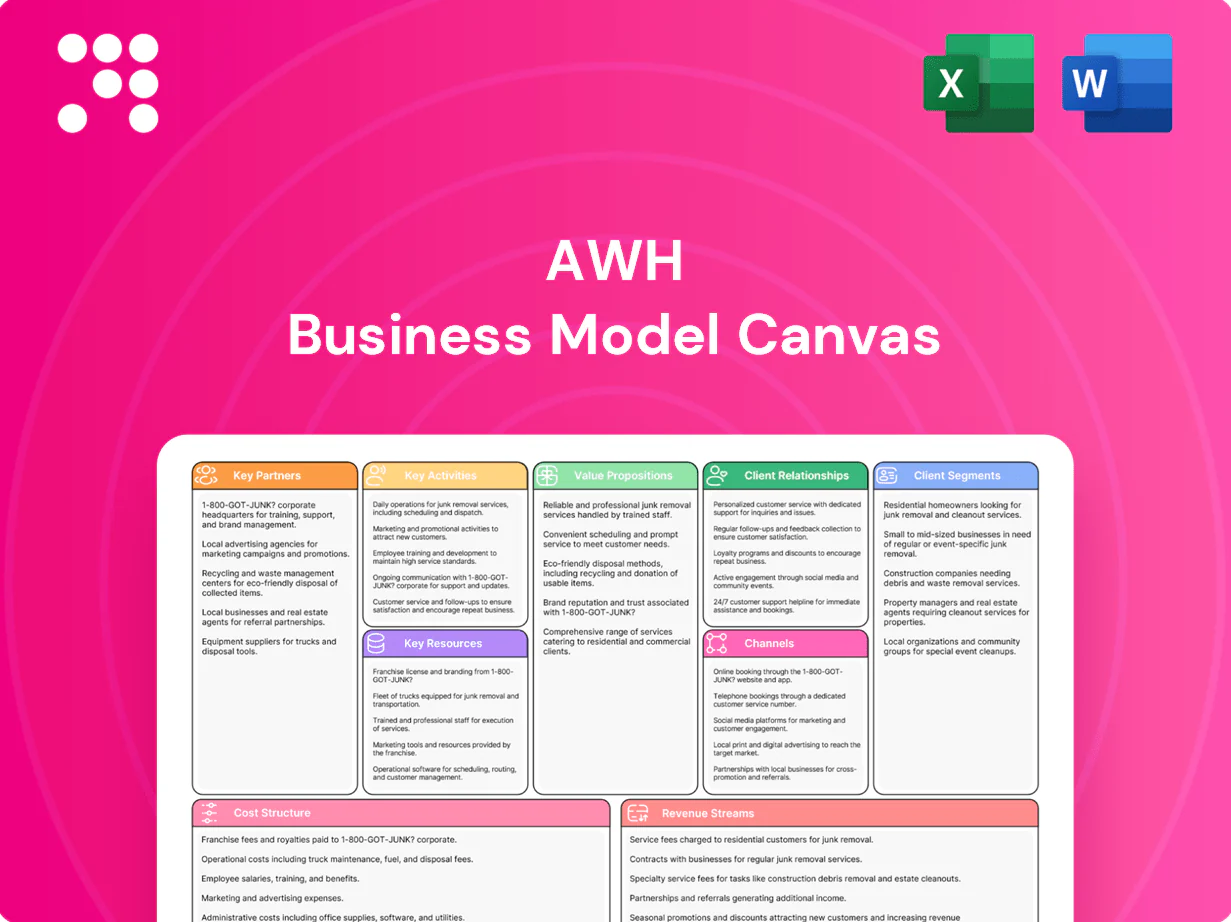
AWH Business Model Canvas

Business Model Canvas: Strategic Blueprint for Value, Revenue, Partners and Growth
Unlock the full strategic blueprint behind AWH’s business model in our detailed Business Model Canvas. This concise, actionable snapshot reveals value propositions, revenue streams, key partners and growth levers. Perfect for investors, founders, and consultants—download the full Word/Excel package to benchmark, adapt, and scale with confidence.
Partnerships

Licensed cultivators
Partner with regional licensed cultivators to cover 20–40% of peak demand during product launches, co-develop exclusive phenotypes and seasonal strains to capture premium margins, align on testing and compliance to achieve >98% batch pass rates under 2024 state regulations, and maintain >=25% redundant capacity to mitigate crop risk and harvest variability.
Manufacturing and co-packing
Collaborate with licensed extractors and food-grade co-packers to produce edibles and concentrates under GMP-compliant facilities, enabling scalable runs of 50,000+ units for limited editions. Share R&D resources to develop fast-acting gummies and solventless rosin, accelerating time-to-market and reducing reformulation costs. Drive line-efficiency improvements and procurement leverage to cut cost per unit by up to 20%. Monitor batch-level yield and OEE to sustain margins.

Regulatory and compliance advisors
Engage legal counsel and compliance consultants across states for licensing and audits, noting that as of 2024 24 states allow adult-use and 38 have medical programs, which drives complex multi-state licensing strategies. Monitor evolving cannabis regulations, packaging and labeling rules to avoid state-level penalties that can reach six figures. Prepare for inspections, mitigate compliance risks, and support market entries, renewals, and corporate transactions with expert oversight.

Retail partners and marketplaces
Partner with third-party dispensaries and delivery platforms to expand distribution — U.S. legal cannabis retail sales reached about $33 billion in 2024, underscoring market scale — negotiate shelf placement and promotional calendars to capture high-visibility slots and peak-buying periods, integrate inventory feeds and menu data for real-time availability, and coordinate loyalty and brand-education events to drive repeat purchase and higher basket size.
- Third-party reach: expand listings and delivery
- Shelf/promotions: secure high-visibility placement
- Inventory integration: real-time menu sync
- Events: loyalty and brand education
Technology and logistics providers
- Traceability: seed-to-sale + POS + CRM
- Secure transport & cold-chain
- Legal last-mile delivery
- Demand sensing: −30% stockouts, +20–50% forecast accuracy
Partner cultivators, GMP co-packing, 98% pass, 20% unit cost cut
Partner with regional cultivators (20–40% peak), co-develop exclusives, maintain >98% batch pass and ≥25% redundant capacity. Use GMP extractors/co-packers for 50k+ unit runs, cut unit costs up to 20%. Use counsel for multi-state compliance (24 adult-use/38 medical in 2024). Integrate seed-to-sale, POS and logistics to cut stockouts −30% and boost forecast accuracy +20–50%.
| Partnership | KPI | 2024 |
|---|---|---|
| Cultivators | Share of peak | 20–40% |
| Co-packers | Run size/cost | 50k/+20% cost↓ |
| Compliance | States | 24/38 |
What is included in the product
 Detailed Word Document
A comprehensive, pre-written Business Model Canvas for AWH that outlines nine classic BMC blocks with detailed customer segments, value propositions, channels, revenue and cost structures, plus competitive advantages and linked SWOT analysis to support investor presentations and strategic validation.

 Customizable Excel Spreadsheet
AWH Business Model Canvas provides a clean, editable one-page snapshot that saves hours of formatting and lets teams quickly identify and resolve strategic pain points for faster, aligned decision-making.
Activities

Cultivation and genetics
Pheno-hunt and stabilize high-THC (target 20–30%) and balanced cannabinoid chemotypes over 4–6 generations; aim indoor yields of 500–700 g/m2. Manage indoor and hybrid grows with staggered biweekly cohorts and 8–10 week flowering to align harvests with monthly retail cycles. Implement IPM, fertigation and closed-loop environmental controls to ensure consistency and quality.
Manufacturing and extraction
AWH manufactures vapes, concentrates and edibles under strict SOPs, operating hydrocarbon, CO2 or solventless extraction by product tier to optimize yield and flavor. Potency and terpene profiles are standardized for brand consistency. QA/QC includes batch testing and maintained compliance records; as of 2024, 23 US states allow adult-use cannabis and 38 have medical programs, driving stringent testing requirements.

Retail operations
Operate dispensaries staffed with trained budtenders and curated menus; US legal cannabis retail sales reached about 30 billion USD in 2024, with online orders ~20% in mature markets. Optimize merchandising, pricing and promotions to lift basket size and conversion. Execute online ordering, pickup and delivery where permitted. Maintain tight inventory controls to target 8–12 turns/year and limit shrink to 2–4%.

Branding and product innovation
Develop three-tier product lines (value, core, premium) to capture broad price segments; plan 4 limited drops/collabs yearly to spike demand. Use consumer panels and A/B testing to optimize formulations and conversion; refresh packaging to meet 2024 regulatory updates and improve shelf impact.
- tiers: 3
- drops/year: 4
- method: A/B testing
- packaging: 2024 compliance
Regulatory compliance and reporting
AWH maintains continuous seed-to-sale tracking with daily METRC updates and monthly tax filings, ensuring compliance with all regulated US cannabis programs as of 2024. SOPs, staff training, and audit readiness are updated quarterly with incident logs and CI cycles; packaging, labeling, and marketing are validated to avoid regulatory penalties that commonly reach five figures.
- seed-to-sale (METRC) daily updates
- monthly tax filings
- SOPs, quarterly training, audit readiness
- packaging/labeling/marketing compliance
- incident logs + continuous improvement
Compliant cannabis scale: 20–30% THC, 500–700 g/m2, monthly harvests
Breed 20–30% THC chemotypes to 500–700 g/m2; staggered 8–10 wk flowering cohorts for monthly harvests. Extract vapes/concentrates/edibles with SOPs, batch QA and terpene/potency standardization; 23 US adult‑use states in 2024 drive strict testing. Operate dispensaries (US retail ~$30B in 2024, ~20% online), target 8–12 turns/yr, 2–4% shrink, METRC daily and monthly tax filings.
| Metric | Target / 2024 |
|---|---|
| THC | 20–30% |
| Yield | 500–700 g/m2 |
| US adult‑use states | 23 (2024) |
| Retail sales | $30B (2024) |
| Online mix | ~20% |
| Inventory turns | 8–12/yr |
| Shrink | 2–4% |
| Compliance | METRC daily, monthly taxes |
What You See Is What You Get
Business Model Canvas
The AWH Business Model Canvas preview shown here is the actual deliverable, not a mockup or sample. When you purchase, you’ll receive this exact document—complete, formatted and ready to edit—in both Word and Excel. No surprises; what you see is what you get.

Business Model Canvas: Strategic Blueprint for Value, Revenue, Partners and Growth
Unlock the full strategic blueprint behind AWH’s business model in our detailed Business Model Canvas. This concise, actionable snapshot reveals value propositions, revenue streams, key partners and growth levers. Perfect for investors, founders, and consultants—download the full Word/Excel package to benchmark, adapt, and scale with confidence.
Partnerships
Licensed cultivators
Partner with regional licensed cultivators to cover 20–40% of peak demand during product launches, co-develop exclusive phenotypes and seasonal strains to capture premium margins, align on testing and compliance to achieve >98% batch pass rates under 2024 state regulations, and maintain >=25% redundant capacity to mitigate crop risk and harvest variability.
Manufacturing and co-packing
Collaborate with licensed extractors and food-grade co-packers to produce edibles and concentrates under GMP-compliant facilities, enabling scalable runs of 50,000+ units for limited editions. Share R&D resources to develop fast-acting gummies and solventless rosin, accelerating time-to-market and reducing reformulation costs. Drive line-efficiency improvements and procurement leverage to cut cost per unit by up to 20%. Monitor batch-level yield and OEE to sustain margins.
Regulatory and compliance advisors
Engage legal counsel and compliance consultants across states for licensing and audits, noting that as of 2024 24 states allow adult-use and 38 have medical programs, which drives complex multi-state licensing strategies. Monitor evolving cannabis regulations, packaging and labeling rules to avoid state-level penalties that can reach six figures. Prepare for inspections, mitigate compliance risks, and support market entries, renewals, and corporate transactions with expert oversight.
Retail partners and marketplaces
Partner with third-party dispensaries and delivery platforms to expand distribution — U.S. legal cannabis retail sales reached about $33 billion in 2024, underscoring market scale — negotiate shelf placement and promotional calendars to capture high-visibility slots and peak-buying periods, integrate inventory feeds and menu data for real-time availability, and coordinate loyalty and brand-education events to drive repeat purchase and higher basket size.
- Third-party reach: expand listings and delivery
- Shelf/promotions: secure high-visibility placement
- Inventory integration: real-time menu sync
- Events: loyalty and brand education
Technology and logistics providers
- Traceability: seed-to-sale + POS + CRM
- Secure transport & cold-chain
- Legal last-mile delivery
- Demand sensing: −30% stockouts, +20–50% forecast accuracy
Partner cultivators, GMP co-packing, 98% pass, 20% unit cost cut
Partner with regional cultivators (20–40% peak), co-develop exclusives, maintain >98% batch pass and ≥25% redundant capacity. Use GMP extractors/co-packers for 50k+ unit runs, cut unit costs up to 20%. Use counsel for multi-state compliance (24 adult-use/38 medical in 2024). Integrate seed-to-sale, POS and logistics to cut stockouts −30% and boost forecast accuracy +20–50%.
| Partnership | KPI | 2024 |
|---|---|---|
| Cultivators | Share of peak | 20–40% |
| Co-packers | Run size/cost | 50k/+20% cost↓ |
| Compliance | States | 24/38 |
What is included in the product
Detailed Word Document
A comprehensive, pre-written Business Model Canvas for AWH that outlines nine classic BMC blocks with detailed customer segments, value propositions, channels, revenue and cost structures, plus competitive advantages and linked SWOT analysis to support investor presentations and strategic validation.
Customizable Excel Spreadsheet
AWH Business Model Canvas provides a clean, editable one-page snapshot that saves hours of formatting and lets teams quickly identify and resolve strategic pain points for faster, aligned decision-making.
Activities
Cultivation and genetics
Pheno-hunt and stabilize high-THC (target 20–30%) and balanced cannabinoid chemotypes over 4–6 generations; aim indoor yields of 500–700 g/m2. Manage indoor and hybrid grows with staggered biweekly cohorts and 8–10 week flowering to align harvests with monthly retail cycles. Implement IPM, fertigation and closed-loop environmental controls to ensure consistency and quality.
Manufacturing and extraction
AWH manufactures vapes, concentrates and edibles under strict SOPs, operating hydrocarbon, CO2 or solventless extraction by product tier to optimize yield and flavor. Potency and terpene profiles are standardized for brand consistency. QA/QC includes batch testing and maintained compliance records; as of 2024, 23 US states allow adult-use cannabis and 38 have medical programs, driving stringent testing requirements.
Retail operations
Operate dispensaries staffed with trained budtenders and curated menus; US legal cannabis retail sales reached about 30 billion USD in 2024, with online orders ~20% in mature markets. Optimize merchandising, pricing and promotions to lift basket size and conversion. Execute online ordering, pickup and delivery where permitted. Maintain tight inventory controls to target 8–12 turns/year and limit shrink to 2–4%.
Branding and product innovation
Develop three-tier product lines (value, core, premium) to capture broad price segments; plan 4 limited drops/collabs yearly to spike demand. Use consumer panels and A/B testing to optimize formulations and conversion; refresh packaging to meet 2024 regulatory updates and improve shelf impact.
- tiers: 3
- drops/year: 4
- method: A/B testing
- packaging: 2024 compliance
Regulatory compliance and reporting
AWH maintains continuous seed-to-sale tracking with daily METRC updates and monthly tax filings, ensuring compliance with all regulated US cannabis programs as of 2024. SOPs, staff training, and audit readiness are updated quarterly with incident logs and CI cycles; packaging, labeling, and marketing are validated to avoid regulatory penalties that commonly reach five figures.
- seed-to-sale (METRC) daily updates
- monthly tax filings
- SOPs, quarterly training, audit readiness
- packaging/labeling/marketing compliance
- incident logs + continuous improvement
Compliant cannabis scale: 20–30% THC, 500–700 g/m2, monthly harvests
Breed 20–30% THC chemotypes to 500–700 g/m2; staggered 8–10 wk flowering cohorts for monthly harvests. Extract vapes/concentrates/edibles with SOPs, batch QA and terpene/potency standardization; 23 US adult‑use states in 2024 drive strict testing. Operate dispensaries (US retail ~$30B in 2024, ~20% online), target 8–12 turns/yr, 2–4% shrink, METRC daily and monthly tax filings.
| Metric | Target / 2024 |
|---|---|
| THC | 20–30% |
| Yield | 500–700 g/m2 |
| US adult‑use states | 23 (2024) |
| Retail sales | $30B (2024) |
| Online mix | ~20% |
| Inventory turns | 8–12/yr |
| Shrink | 2–4% |
| Compliance | METRC daily, monthly taxes |
What You See Is What You Get
Business Model Canvas
The AWH Business Model Canvas preview shown here is the actual deliverable, not a mockup or sample. When you purchase, you’ll receive this exact document—complete, formatted and ready to edit—in both Word and Excel. No surprises; what you see is what you get.
Original: $10.00
-65%$10.00
$3.50Description
Business Model Canvas: Strategic Blueprint for Value, Revenue, Partners and Growth
Unlock the full strategic blueprint behind AWH’s business model in our detailed Business Model Canvas. This concise, actionable snapshot reveals value propositions, revenue streams, key partners and growth levers. Perfect for investors, founders, and consultants—download the full Word/Excel package to benchmark, adapt, and scale with confidence.
Partnerships
Licensed cultivators
Partner with regional licensed cultivators to cover 20–40% of peak demand during product launches, co-develop exclusive phenotypes and seasonal strains to capture premium margins, align on testing and compliance to achieve >98% batch pass rates under 2024 state regulations, and maintain >=25% redundant capacity to mitigate crop risk and harvest variability.
Manufacturing and co-packing
Collaborate with licensed extractors and food-grade co-packers to produce edibles and concentrates under GMP-compliant facilities, enabling scalable runs of 50,000+ units for limited editions. Share R&D resources to develop fast-acting gummies and solventless rosin, accelerating time-to-market and reducing reformulation costs. Drive line-efficiency improvements and procurement leverage to cut cost per unit by up to 20%. Monitor batch-level yield and OEE to sustain margins.
Regulatory and compliance advisors
Engage legal counsel and compliance consultants across states for licensing and audits, noting that as of 2024 24 states allow adult-use and 38 have medical programs, which drives complex multi-state licensing strategies. Monitor evolving cannabis regulations, packaging and labeling rules to avoid state-level penalties that can reach six figures. Prepare for inspections, mitigate compliance risks, and support market entries, renewals, and corporate transactions with expert oversight.
Retail partners and marketplaces
Partner with third-party dispensaries and delivery platforms to expand distribution — U.S. legal cannabis retail sales reached about $33 billion in 2024, underscoring market scale — negotiate shelf placement and promotional calendars to capture high-visibility slots and peak-buying periods, integrate inventory feeds and menu data for real-time availability, and coordinate loyalty and brand-education events to drive repeat purchase and higher basket size.
- Third-party reach: expand listings and delivery
- Shelf/promotions: secure high-visibility placement
- Inventory integration: real-time menu sync
- Events: loyalty and brand education
Technology and logistics providers
- Traceability: seed-to-sale + POS + CRM
- Secure transport & cold-chain
- Legal last-mile delivery
- Demand sensing: −30% stockouts, +20–50% forecast accuracy
Partner cultivators, GMP co-packing, 98% pass, 20% unit cost cut
Partner with regional cultivators (20–40% peak), co-develop exclusives, maintain >98% batch pass and ≥25% redundant capacity. Use GMP extractors/co-packers for 50k+ unit runs, cut unit costs up to 20%. Use counsel for multi-state compliance (24 adult-use/38 medical in 2024). Integrate seed-to-sale, POS and logistics to cut stockouts −30% and boost forecast accuracy +20–50%.
| Partnership | KPI | 2024 |
|---|---|---|
| Cultivators | Share of peak | 20–40% |
| Co-packers | Run size/cost | 50k/+20% cost↓ |
| Compliance | States | 24/38 |
What is included in the product
Detailed Word Document
A comprehensive, pre-written Business Model Canvas for AWH that outlines nine classic BMC blocks with detailed customer segments, value propositions, channels, revenue and cost structures, plus competitive advantages and linked SWOT analysis to support investor presentations and strategic validation.
Customizable Excel Spreadsheet
AWH Business Model Canvas provides a clean, editable one-page snapshot that saves hours of formatting and lets teams quickly identify and resolve strategic pain points for faster, aligned decision-making.
Activities
Cultivation and genetics
Pheno-hunt and stabilize high-THC (target 20–30%) and balanced cannabinoid chemotypes over 4–6 generations; aim indoor yields of 500–700 g/m2. Manage indoor and hybrid grows with staggered biweekly cohorts and 8–10 week flowering to align harvests with monthly retail cycles. Implement IPM, fertigation and closed-loop environmental controls to ensure consistency and quality.
Manufacturing and extraction
AWH manufactures vapes, concentrates and edibles under strict SOPs, operating hydrocarbon, CO2 or solventless extraction by product tier to optimize yield and flavor. Potency and terpene profiles are standardized for brand consistency. QA/QC includes batch testing and maintained compliance records; as of 2024, 23 US states allow adult-use cannabis and 38 have medical programs, driving stringent testing requirements.
Retail operations
Operate dispensaries staffed with trained budtenders and curated menus; US legal cannabis retail sales reached about 30 billion USD in 2024, with online orders ~20% in mature markets. Optimize merchandising, pricing and promotions to lift basket size and conversion. Execute online ordering, pickup and delivery where permitted. Maintain tight inventory controls to target 8–12 turns/year and limit shrink to 2–4%.
Branding and product innovation
Develop three-tier product lines (value, core, premium) to capture broad price segments; plan 4 limited drops/collabs yearly to spike demand. Use consumer panels and A/B testing to optimize formulations and conversion; refresh packaging to meet 2024 regulatory updates and improve shelf impact.
- tiers: 3
- drops/year: 4
- method: A/B testing
- packaging: 2024 compliance
Regulatory compliance and reporting
AWH maintains continuous seed-to-sale tracking with daily METRC updates and monthly tax filings, ensuring compliance with all regulated US cannabis programs as of 2024. SOPs, staff training, and audit readiness are updated quarterly with incident logs and CI cycles; packaging, labeling, and marketing are validated to avoid regulatory penalties that commonly reach five figures.
- seed-to-sale (METRC) daily updates
- monthly tax filings
- SOPs, quarterly training, audit readiness
- packaging/labeling/marketing compliance
- incident logs + continuous improvement
Compliant cannabis scale: 20–30% THC, 500–700 g/m2, monthly harvests
Breed 20–30% THC chemotypes to 500–700 g/m2; staggered 8–10 wk flowering cohorts for monthly harvests. Extract vapes/concentrates/edibles with SOPs, batch QA and terpene/potency standardization; 23 US adult‑use states in 2024 drive strict testing. Operate dispensaries (US retail ~$30B in 2024, ~20% online), target 8–12 turns/yr, 2–4% shrink, METRC daily and monthly tax filings.
| Metric | Target / 2024 |
|---|---|
| THC | 20–30% |
| Yield | 500–700 g/m2 |
| US adult‑use states | 23 (2024) |
| Retail sales | $30B (2024) |
| Online mix | ~20% |
| Inventory turns | 8–12/yr |
| Shrink | 2–4% |
| Compliance | METRC daily, monthly taxes |
What You See Is What You Get
Business Model Canvas
The AWH Business Model Canvas preview shown here is the actual deliverable, not a mockup or sample. When you purchase, you’ll receive this exact document—complete, formatted and ready to edit—in both Word and Excel. No surprises; what you see is what you get.











