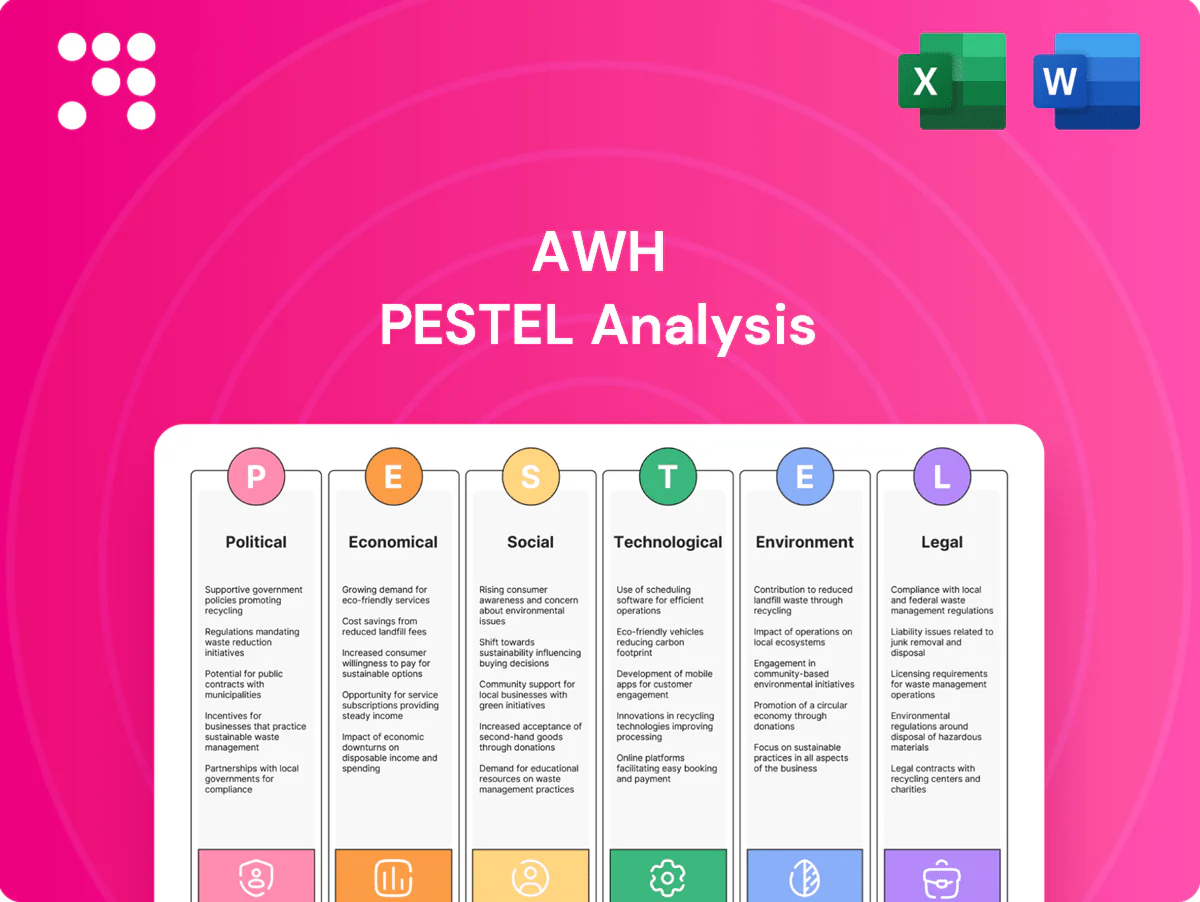
AWH PESTLE Analysis

Your Shortcut to Market Insight Starts Here
Gain a strategic edge with our AWH PESTLE Analysis—three to five expert-level perspectives on political, economic, social, technological, legal, and environmental forces shaping AWH today. Quickly spot risks and growth opportunities to inform investment and strategy. Purchase the full report for the complete, downloadable breakdown and actionable recommendations.
Political factors

Federal rescheduling trajectory
Federal movement toward Schedule III could cut 280E impact and stigma, potentially lowering effective federal tax rates for cannabis firms that currently run roughly 50–70% higher than standard corporate rates and freeing capital for a US legal market of about $30bn in 2024. Timing and scope remain uncertain, creating planning ambiguity; AWH should scenario-plan for rapid compliance updates and improved bank access. Active engagement with regulators and trade groups can help shape practical rules.
State-by-state legalization map
State-by-state adult-use legalization now covers 24 states plus DC while medical programs exist in 38 states, driving incremental market entry and footprint timing; tax regimes vary widely (retail excise up to 37% in WA), complicating unit economics. Divergent licensing, packaging and testing rules across MSO states hinder standardized operations, forcing AWH to allocate lobbying to ~5 priority states with active 2025 legalization pushes. Local political sentiment and municipal opt-outs—exceeding 30% in some states—directly affect dispensary siting and rollout speed.

Banking and capital access reforms
Potential movement on cannabis banking reform would reduce cash-handling risks and lower financing spreads; industry reports indicate over 50% of operators remain underbanked, raising cash security and compliance costs. Absent reform, relationships with compliant banks stay fragile and expensive, so AWH should diversify across 3-5 banking partners and ready traditional lending entry. Targeted political advocacy can accelerate pragmatic banking guidance from regulators.

Interstate commerce constraints
Federal prohibition of interstate cannabis commerce (federal CSA still bars interstate transfers) sustains state-by-state supply silos and duplicative capex across markets; as of 2024, 23 states plus DC have legalized adult-use and about 38 have medical programs, keeping trade intrastate. Political change enabling interstate trade would reshape cultivation footprint and margins, so AWH needs flexible capacity planning to pivot if borders open; current policy favors localized vertical integration near demand centers.
- Interstate ban: federal CSA blocks cross-border trade
- Market footprint: 23 adult-use states + DC, ~38 medical (2024)
- Strategic priority: modular/convertible cultivation capacity
Local governance and community relations
City councils and county boards set zoning, license counts and operating hours; in the US this occurs across 3,142 counties and roughly 19,500 municipal governments, concentrating permitting power locally. Political turnover in 2023–24 shifted several municipal policies, demonstrating rules can tighten or relax between election cycles. AWH should fund community benefits and public-safety partnerships and sustain transparent dialogue to reduce NIMBY resistance and aid renewals.
- Local control: 3,142 counties, ~19,500 municipalities
- Risk: policy change each election cycle
- Action: proactive benefits + public-safety MOUs
- Outcome: transparency improves license renewals
Political shifts threaten margins; scenario-plan, diversify 3-5 banks, lobby 5 priority states
Political shifts (federal, state, local) create tax, banking and interstate-trade uncertainty that can materially affect AWH margins and rollout; federal rescheduling talks could reduce 280E burden for a US market ~30bn (2024). 24 adult-use states + DC, 38 medical (2024); >50% operators underbanked. AWH should scenario-plan, diversify 3–5 banks and focus lobbying in ~5 priority states.
| Factor | Metric (2024/25) | AWH implication |
|---|---|---|
| Federal rescheduling | Market $30bn (2024); 280E raises taxes ~50–70% vs norm | Plan rapid compliance, tax modeling |
| State legal status | 24 adult-use + DC; 38 medical | Staggered entry timing, prioritize 5 states |
| Banking | >50% operators underbanked | Diversify 3–5 banks, prep lending |
What is included in the product
 Detailed Word Document
Explores how macro-environmental factors affect AWH across Political, Economic, Social, Technological, Environmental and Legal dimensions, with data-backed, region- and industry-specific insights, forward-looking scenarios and practical recommendations to support executives, investors and strategy planning.

 Customizable Excel Spreadsheet
A concise, visually segmented AWH PESTLE summary that relieves meeting prep pain by highlighting key external risks and opportunities for quick slide insertion and team alignment; editable notes allow localization for region or business line.
Economic factors

Wholesale price compression
Sustained oversupply in key states pushed national wholesale flower prices down about 30% YoY in 2024 and bulk oil roughly 18%, compressing margins. Margin resilience will hinge on retail mix, brand strength and tight cost controls; AWH must optimize SKU economics and shift toward higher‑value formats. Dynamic pricing and faster inventory turns are critical levers to restore gross margins.
Consumer spending and elasticity
Macro headwinds and 2024 inflation (U.S. CPI ~3.3% YoY) have compressed basket size and raised trade-down behavior, with NielsenIQ reporting discretionary downgrade trends across grocery categories. Value tiers and loyalty programs historically defend volume—loyalty members now account for ~40–60% of retailer sales in mature markets. AWH should segment customers by price sensitivity and tailor targeted offers to protect share and cash flow. Monitoring cross-price elasticity will refine promotions and assortment decisions.

Capital scarcity and cost of funds
Limited institutional capital keeps borrowing costs elevated—US 10-year at 4.2% and investment-grade spreads near 160 bps (July 2025) press AWHs cost of funds. Improving policy outlook could compress spreads but timing is unclear. AWH should prioritize cash generation, lean capex and asset-light moves. Sale-leasebacks and JV structures can prudently bridge funding gaps.

Illicit market competition
Illicit market competition—WHO estimates illicit tobacco at 11.6% of global consumption—undercuts legal pricing and erodes excise revenues, pressuring margins for AWH and reducing fiscal tax receipts. Strong compliance, verified quality and convenient retail can win share from untaxed suppliers; AWH should press for enforcement parity and balanced taxation to remove illicit advantage. Consumer education highlighting safety of tested products supports conversion back to regulated channels.
- Undercut pricing
- 11.6% illicit share (WHO)
- Enforcement parity
- Balanced taxation
- Safety education
Operating leverage and scale
Vertical integration lets AWH capture upstream margins but raises fixed-cost exposure; firms with high operating leverage saw EBITDA volatility widen by ~15% during 2020–24 supply shocks. Scale drives procurement savings and broader distribution reach; studies in 2024 show procurement-led COGS reductions of 3–7% at scale. AWH must match capacity to demand to avoid stranded assets; shared services and automation can improve unit economics, with automation adoption cutting unit costs up to ~20% in some 2024 industry reports.
- Margin capture vs fixed-cost risk
- Procurement savings 3–7% (2024)
- Avoid stranded assets; calibrate capacity
- Automation can cut unit costs ~20% (2024)
Political shifts threaten margins; scenario-plan, diversify 3-5 banks, lobby 5 priority states
Sustained oversupply cut wholesale flower prices ~30% YoY (2024) and bulk oil ~18%, squeezing margins; AWH must shift to higher‑value SKUs and dynamic pricing. 2024 US CPI ~3.3% drove trade‑down; loyalty now 40–60% of sales, so targeted offers are vital. Funding costs remain elevated (US 10Y 4.2%, IG spreads ~160bps Jul 2025); prioritize cash, lean capex, sale‑leasebacks.
| Metric | Value |
|---|---|
| Wholesale price decline | −30% (2024) |
| Bulk oil | −18% (2024) |
| US CPI | 3.3% (2024) |
| 10Y yield | 4.2% (Jul 2025) |
| Illicit share | 11.6% (WHO) |
Preview the Actual Deliverable
AWH PESTLE Analysis
The AWH PESTLE Analysis provides a concise, professionally structured review of political, economic, social, technological, legal and environmental factors affecting AWH. The preview shown here is the exact document you’ll receive after purchase—fully formatted and ready to use. No placeholders or teasers; after payment you’ll download the finished file exactly as displayed.

Your Shortcut to Market Insight Starts Here
Gain a strategic edge with our AWH PESTLE Analysis—three to five expert-level perspectives on political, economic, social, technological, legal, and environmental forces shaping AWH today. Quickly spot risks and growth opportunities to inform investment and strategy. Purchase the full report for the complete, downloadable breakdown and actionable recommendations.
Political factors
Federal rescheduling trajectory
Federal movement toward Schedule III could cut 280E impact and stigma, potentially lowering effective federal tax rates for cannabis firms that currently run roughly 50–70% higher than standard corporate rates and freeing capital for a US legal market of about $30bn in 2024. Timing and scope remain uncertain, creating planning ambiguity; AWH should scenario-plan for rapid compliance updates and improved bank access. Active engagement with regulators and trade groups can help shape practical rules.
State-by-state legalization map
State-by-state adult-use legalization now covers 24 states plus DC while medical programs exist in 38 states, driving incremental market entry and footprint timing; tax regimes vary widely (retail excise up to 37% in WA), complicating unit economics. Divergent licensing, packaging and testing rules across MSO states hinder standardized operations, forcing AWH to allocate lobbying to ~5 priority states with active 2025 legalization pushes. Local political sentiment and municipal opt-outs—exceeding 30% in some states—directly affect dispensary siting and rollout speed.
Banking and capital access reforms
Potential movement on cannabis banking reform would reduce cash-handling risks and lower financing spreads; industry reports indicate over 50% of operators remain underbanked, raising cash security and compliance costs. Absent reform, relationships with compliant banks stay fragile and expensive, so AWH should diversify across 3-5 banking partners and ready traditional lending entry. Targeted political advocacy can accelerate pragmatic banking guidance from regulators.
Interstate commerce constraints
Federal prohibition of interstate cannabis commerce (federal CSA still bars interstate transfers) sustains state-by-state supply silos and duplicative capex across markets; as of 2024, 23 states plus DC have legalized adult-use and about 38 have medical programs, keeping trade intrastate. Political change enabling interstate trade would reshape cultivation footprint and margins, so AWH needs flexible capacity planning to pivot if borders open; current policy favors localized vertical integration near demand centers.
- Interstate ban: federal CSA blocks cross-border trade
- Market footprint: 23 adult-use states + DC, ~38 medical (2024)
- Strategic priority: modular/convertible cultivation capacity
Local governance and community relations
City councils and county boards set zoning, license counts and operating hours; in the US this occurs across 3,142 counties and roughly 19,500 municipal governments, concentrating permitting power locally. Political turnover in 2023–24 shifted several municipal policies, demonstrating rules can tighten or relax between election cycles. AWH should fund community benefits and public-safety partnerships and sustain transparent dialogue to reduce NIMBY resistance and aid renewals.
- Local control: 3,142 counties, ~19,500 municipalities
- Risk: policy change each election cycle
- Action: proactive benefits + public-safety MOUs
- Outcome: transparency improves license renewals
Political shifts threaten margins; scenario-plan, diversify 3-5 banks, lobby 5 priority states
Political shifts (federal, state, local) create tax, banking and interstate-trade uncertainty that can materially affect AWH margins and rollout; federal rescheduling talks could reduce 280E burden for a US market ~30bn (2024). 24 adult-use states + DC, 38 medical (2024); >50% operators underbanked. AWH should scenario-plan, diversify 3–5 banks and focus lobbying in ~5 priority states.
| Factor | Metric (2024/25) | AWH implication |
|---|---|---|
| Federal rescheduling | Market $30bn (2024); 280E raises taxes ~50–70% vs norm | Plan rapid compliance, tax modeling |
| State legal status | 24 adult-use + DC; 38 medical | Staggered entry timing, prioritize 5 states |
| Banking | >50% operators underbanked | Diversify 3–5 banks, prep lending |
What is included in the product
Detailed Word Document
Explores how macro-environmental factors affect AWH across Political, Economic, Social, Technological, Environmental and Legal dimensions, with data-backed, region- and industry-specific insights, forward-looking scenarios and practical recommendations to support executives, investors and strategy planning.
Customizable Excel Spreadsheet
A concise, visually segmented AWH PESTLE summary that relieves meeting prep pain by highlighting key external risks and opportunities for quick slide insertion and team alignment; editable notes allow localization for region or business line.
Economic factors
Wholesale price compression
Sustained oversupply in key states pushed national wholesale flower prices down about 30% YoY in 2024 and bulk oil roughly 18%, compressing margins. Margin resilience will hinge on retail mix, brand strength and tight cost controls; AWH must optimize SKU economics and shift toward higher‑value formats. Dynamic pricing and faster inventory turns are critical levers to restore gross margins.
Consumer spending and elasticity
Macro headwinds and 2024 inflation (U.S. CPI ~3.3% YoY) have compressed basket size and raised trade-down behavior, with NielsenIQ reporting discretionary downgrade trends across grocery categories. Value tiers and loyalty programs historically defend volume—loyalty members now account for ~40–60% of retailer sales in mature markets. AWH should segment customers by price sensitivity and tailor targeted offers to protect share and cash flow. Monitoring cross-price elasticity will refine promotions and assortment decisions.
Capital scarcity and cost of funds
Limited institutional capital keeps borrowing costs elevated—US 10-year at 4.2% and investment-grade spreads near 160 bps (July 2025) press AWHs cost of funds. Improving policy outlook could compress spreads but timing is unclear. AWH should prioritize cash generation, lean capex and asset-light moves. Sale-leasebacks and JV structures can prudently bridge funding gaps.
Illicit market competition
Illicit market competition—WHO estimates illicit tobacco at 11.6% of global consumption—undercuts legal pricing and erodes excise revenues, pressuring margins for AWH and reducing fiscal tax receipts. Strong compliance, verified quality and convenient retail can win share from untaxed suppliers; AWH should press for enforcement parity and balanced taxation to remove illicit advantage. Consumer education highlighting safety of tested products supports conversion back to regulated channels.
- Undercut pricing
- 11.6% illicit share (WHO)
- Enforcement parity
- Balanced taxation
- Safety education
Operating leverage and scale
Vertical integration lets AWH capture upstream margins but raises fixed-cost exposure; firms with high operating leverage saw EBITDA volatility widen by ~15% during 2020–24 supply shocks. Scale drives procurement savings and broader distribution reach; studies in 2024 show procurement-led COGS reductions of 3–7% at scale. AWH must match capacity to demand to avoid stranded assets; shared services and automation can improve unit economics, with automation adoption cutting unit costs up to ~20% in some 2024 industry reports.
- Margin capture vs fixed-cost risk
- Procurement savings 3–7% (2024)
- Avoid stranded assets; calibrate capacity
- Automation can cut unit costs ~20% (2024)
Political shifts threaten margins; scenario-plan, diversify 3-5 banks, lobby 5 priority states
Sustained oversupply cut wholesale flower prices ~30% YoY (2024) and bulk oil ~18%, squeezing margins; AWH must shift to higher‑value SKUs and dynamic pricing. 2024 US CPI ~3.3% drove trade‑down; loyalty now 40–60% of sales, so targeted offers are vital. Funding costs remain elevated (US 10Y 4.2%, IG spreads ~160bps Jul 2025); prioritize cash, lean capex, sale‑leasebacks.
| Metric | Value |
|---|---|
| Wholesale price decline | −30% (2024) |
| Bulk oil | −18% (2024) |
| US CPI | 3.3% (2024) |
| 10Y yield | 4.2% (Jul 2025) |
| Illicit share | 11.6% (WHO) |
Preview the Actual Deliverable
AWH PESTLE Analysis
The AWH PESTLE Analysis provides a concise, professionally structured review of political, economic, social, technological, legal and environmental factors affecting AWH. The preview shown here is the exact document you’ll receive after purchase—fully formatted and ready to use. No placeholders or teasers; after payment you’ll download the finished file exactly as displayed.
Original: $10.00
-65%$10.00
$3.50Description
Your Shortcut to Market Insight Starts Here
Gain a strategic edge with our AWH PESTLE Analysis—three to five expert-level perspectives on political, economic, social, technological, legal, and environmental forces shaping AWH today. Quickly spot risks and growth opportunities to inform investment and strategy. Purchase the full report for the complete, downloadable breakdown and actionable recommendations.
Political factors
Federal rescheduling trajectory
Federal movement toward Schedule III could cut 280E impact and stigma, potentially lowering effective federal tax rates for cannabis firms that currently run roughly 50–70% higher than standard corporate rates and freeing capital for a US legal market of about $30bn in 2024. Timing and scope remain uncertain, creating planning ambiguity; AWH should scenario-plan for rapid compliance updates and improved bank access. Active engagement with regulators and trade groups can help shape practical rules.
State-by-state legalization map
State-by-state adult-use legalization now covers 24 states plus DC while medical programs exist in 38 states, driving incremental market entry and footprint timing; tax regimes vary widely (retail excise up to 37% in WA), complicating unit economics. Divergent licensing, packaging and testing rules across MSO states hinder standardized operations, forcing AWH to allocate lobbying to ~5 priority states with active 2025 legalization pushes. Local political sentiment and municipal opt-outs—exceeding 30% in some states—directly affect dispensary siting and rollout speed.
Banking and capital access reforms
Potential movement on cannabis banking reform would reduce cash-handling risks and lower financing spreads; industry reports indicate over 50% of operators remain underbanked, raising cash security and compliance costs. Absent reform, relationships with compliant banks stay fragile and expensive, so AWH should diversify across 3-5 banking partners and ready traditional lending entry. Targeted political advocacy can accelerate pragmatic banking guidance from regulators.
Interstate commerce constraints
Federal prohibition of interstate cannabis commerce (federal CSA still bars interstate transfers) sustains state-by-state supply silos and duplicative capex across markets; as of 2024, 23 states plus DC have legalized adult-use and about 38 have medical programs, keeping trade intrastate. Political change enabling interstate trade would reshape cultivation footprint and margins, so AWH needs flexible capacity planning to pivot if borders open; current policy favors localized vertical integration near demand centers.
- Interstate ban: federal CSA blocks cross-border trade
- Market footprint: 23 adult-use states + DC, ~38 medical (2024)
- Strategic priority: modular/convertible cultivation capacity
Local governance and community relations
City councils and county boards set zoning, license counts and operating hours; in the US this occurs across 3,142 counties and roughly 19,500 municipal governments, concentrating permitting power locally. Political turnover in 2023–24 shifted several municipal policies, demonstrating rules can tighten or relax between election cycles. AWH should fund community benefits and public-safety partnerships and sustain transparent dialogue to reduce NIMBY resistance and aid renewals.
- Local control: 3,142 counties, ~19,500 municipalities
- Risk: policy change each election cycle
- Action: proactive benefits + public-safety MOUs
- Outcome: transparency improves license renewals
Political shifts threaten margins; scenario-plan, diversify 3-5 banks, lobby 5 priority states
Political shifts (federal, state, local) create tax, banking and interstate-trade uncertainty that can materially affect AWH margins and rollout; federal rescheduling talks could reduce 280E burden for a US market ~30bn (2024). 24 adult-use states + DC, 38 medical (2024); >50% operators underbanked. AWH should scenario-plan, diversify 3–5 banks and focus lobbying in ~5 priority states.
| Factor | Metric (2024/25) | AWH implication |
|---|---|---|
| Federal rescheduling | Market $30bn (2024); 280E raises taxes ~50–70% vs norm | Plan rapid compliance, tax modeling |
| State legal status | 24 adult-use + DC; 38 medical | Staggered entry timing, prioritize 5 states |
| Banking | >50% operators underbanked | Diversify 3–5 banks, prep lending |
What is included in the product
Detailed Word Document
Explores how macro-environmental factors affect AWH across Political, Economic, Social, Technological, Environmental and Legal dimensions, with data-backed, region- and industry-specific insights, forward-looking scenarios and practical recommendations to support executives, investors and strategy planning.
Customizable Excel Spreadsheet
A concise, visually segmented AWH PESTLE summary that relieves meeting prep pain by highlighting key external risks and opportunities for quick slide insertion and team alignment; editable notes allow localization for region or business line.
Economic factors
Wholesale price compression
Sustained oversupply in key states pushed national wholesale flower prices down about 30% YoY in 2024 and bulk oil roughly 18%, compressing margins. Margin resilience will hinge on retail mix, brand strength and tight cost controls; AWH must optimize SKU economics and shift toward higher‑value formats. Dynamic pricing and faster inventory turns are critical levers to restore gross margins.
Consumer spending and elasticity
Macro headwinds and 2024 inflation (U.S. CPI ~3.3% YoY) have compressed basket size and raised trade-down behavior, with NielsenIQ reporting discretionary downgrade trends across grocery categories. Value tiers and loyalty programs historically defend volume—loyalty members now account for ~40–60% of retailer sales in mature markets. AWH should segment customers by price sensitivity and tailor targeted offers to protect share and cash flow. Monitoring cross-price elasticity will refine promotions and assortment decisions.
Capital scarcity and cost of funds
Limited institutional capital keeps borrowing costs elevated—US 10-year at 4.2% and investment-grade spreads near 160 bps (July 2025) press AWHs cost of funds. Improving policy outlook could compress spreads but timing is unclear. AWH should prioritize cash generation, lean capex and asset-light moves. Sale-leasebacks and JV structures can prudently bridge funding gaps.
Illicit market competition
Illicit market competition—WHO estimates illicit tobacco at 11.6% of global consumption—undercuts legal pricing and erodes excise revenues, pressuring margins for AWH and reducing fiscal tax receipts. Strong compliance, verified quality and convenient retail can win share from untaxed suppliers; AWH should press for enforcement parity and balanced taxation to remove illicit advantage. Consumer education highlighting safety of tested products supports conversion back to regulated channels.
- Undercut pricing
- 11.6% illicit share (WHO)
- Enforcement parity
- Balanced taxation
- Safety education
Operating leverage and scale
Vertical integration lets AWH capture upstream margins but raises fixed-cost exposure; firms with high operating leverage saw EBITDA volatility widen by ~15% during 2020–24 supply shocks. Scale drives procurement savings and broader distribution reach; studies in 2024 show procurement-led COGS reductions of 3–7% at scale. AWH must match capacity to demand to avoid stranded assets; shared services and automation can improve unit economics, with automation adoption cutting unit costs up to ~20% in some 2024 industry reports.
- Margin capture vs fixed-cost risk
- Procurement savings 3–7% (2024)
- Avoid stranded assets; calibrate capacity
- Automation can cut unit costs ~20% (2024)
Political shifts threaten margins; scenario-plan, diversify 3-5 banks, lobby 5 priority states
Sustained oversupply cut wholesale flower prices ~30% YoY (2024) and bulk oil ~18%, squeezing margins; AWH must shift to higher‑value SKUs and dynamic pricing. 2024 US CPI ~3.3% drove trade‑down; loyalty now 40–60% of sales, so targeted offers are vital. Funding costs remain elevated (US 10Y 4.2%, IG spreads ~160bps Jul 2025); prioritize cash, lean capex, sale‑leasebacks.
| Metric | Value |
|---|---|
| Wholesale price decline | −30% (2024) |
| Bulk oil | −18% (2024) |
| US CPI | 3.3% (2024) |
| 10Y yield | 4.2% (Jul 2025) |
| Illicit share | 11.6% (WHO) |
Preview the Actual Deliverable
AWH PESTLE Analysis
The AWH PESTLE Analysis provides a concise, professionally structured review of political, economic, social, technological, legal and environmental factors affecting AWH. The preview shown here is the exact document you’ll receive after purchase—fully formatted and ready to use. No placeholders or teasers; after payment you’ll download the finished file exactly as displayed.











