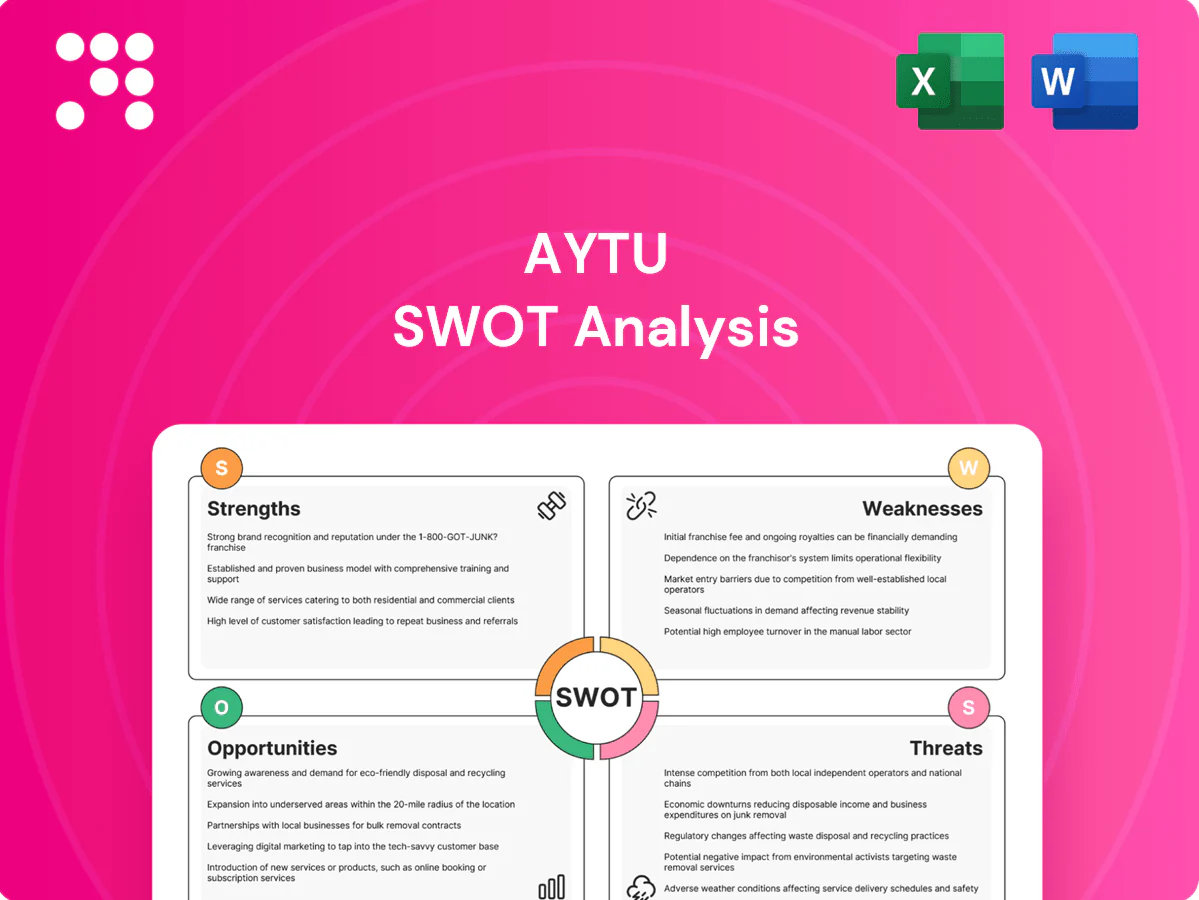
Aytu SWOT Analysis

Make Insightful Decisions Backed by Expert Research
Discover Aytu BioPharma’s strategic position with our concise SWOT preview—highlighting clinical assets, niche market focus, and capital risks. Want deeper, actionable insight? Purchase the full SWOT analysis for a research-backed, editable Word and Excel package to support investor diligence, strategic planning, and pitches.
Strengths

Diversified Rx portfolio
Aytu built a mix of primary care and pediatric prescription brands that reduces single-asset dependency and diversifies revenue sources. A broader lineup helps smooth revenue volatility as individual products cycle, improving predictability for investors. Product breadth strengthens payer negotiations by offering basket value and enables targeted cross-promotions across overlapping prescriber bases.
Commercial execution capability
Aytu (NASDAQ: AYTU) has built specialty sales, market access, and distribution competencies tailored to community prescribers, enabling faster uptake of in-licensed brands among pediatricians and PCPs. Established relationships with frontline clinicians reduce launch risk for new SKUs, while data-driven targeting improves promotional efficiency and ROI.

Pipeline and in-licensing optionality
Aytu combines in-house development with in-licensing, historically sourcing external assets to fill pipeline gaps and accelerate time-to-market; this hybrid model raises the odds of adding near-term revenue contributors while keeping capital intensity lower than pure-play R&D and enabling portfolio refresh as products mature.

Post-merger scale benefits
Post-merger scale with Alimera expands therapeutic reach and operating leverage by combining commercial footprints and clinical portfolios, enabling potential SG&A synergies across sales, payer access, and broader formulary coverage to support improved margins.
- Shared medical, supply chain, compliance functions
- SG&A cost consolidation
- Stronger negotiating power with wholesalers and PBMs
Established distribution footprint
Established distribution footprint: Aytu’s relationships with wholesalers, specialty pharmacies, and GPOs ensure reliable product availability, reducing stockouts and supporting higher refill rates and patient adherence, which lowers friction for prescribers and improves persistency.
- Wholesale + specialty pharmacy access
- Improved refill/adherence
- Lower prescriber/patient friction
- Enables rapid product rollouts
Diversified pediatric and primary-care portfolio reduces single-asset risk, accelerates launches
Aytu’s diversified pediatric and primary-care portfolio reduces single-asset risk and smooths revenue cycles. Established specialty sales, payer access, and distributor relationships accelerate launches and improve refill/adherence. Hybrid in-licensing plus in-house development lowers capital intensity and supports faster time-to-market.
| Strength | Evidence |
|---|---|
| Portfolio diversity | Multiple pediatric/PCP prescription brands |
| Commercial reach | Wholesalers, specialty pharmacies, GPOs |
| Business model | In-licensing + internal development |
What is included in the product
 Detailed Word Document
Delivers a strategic overview of Aytu’s internal and external business factors, outlining strengths, weaknesses, opportunities, and threats to assess competitive position and future risks.

 Customizable Excel Spreadsheet
Provides a concise, visual SWOT for Aytu to quickly surface strengths, weaknesses, opportunities, and threats, streamlining strategic decisions and stakeholder alignment.
Weaknesses

Small-cap resource constraints
As a small-cap (market cap < $2B), Aytu faces constrained balance sheet flexibility that can limit R&D, promotion and lifecycle investments; limited capital often forces prioritization of near-term, quick-payback projects. Budget pressure raises vulnerability to reimbursement setbacks, with less cushion for pricing shocks. Talent attraction and retention lag larger peers that can offer higher cash comp and longer runways.
Concentration risk in few brands
Aytu BioPharma (Nasdaq: AYTU) remains exposed by reliance on a narrow set of brands, making revenue vulnerable to competitive entry or supply disruptions. Formulary exclusion of a key product could materially dent sales and margins, especially given pronounced seasonality in pediatric categories that can amplify quarter-to-quarter swings. Meaningful diversification will require additional capital and time to develop or acquire new, scalable product lines.

Integration execution risk
M&A studies show roughly 70% of deals fail to deliver projected synergies and integration costs often run 20–30% above plan. Merging systems, cultures, and field forces post-Alimera raises complexity that can delay cost- and revenue synergies, increasing cash burn and potential capex. Distraction may slow commercial momentum, while IT, quality, and pharmacovigilance harmonization will demand disciplined governance and added regulatory spend.

Reimbursement and pricing exposure
Aytu faces significant reimbursement and pricing exposure: heavy reliance on PBMs and payers creates volatility in net pricing, while step-edits and prior authorizations can meaningfully suppress prescription volume; rising rebate demands compress gross margins and broader patient affordability programs shift costs into higher COGS-to-net burdens.
- PBM/payer dependence
- Step‑edits/prior auth volume risk
- Rising rebate pressure
- Affordability programs ↑ COGS-to-net
Limited global footprint
Limited global footprint constrains Aytu’s access to ex-US growth and new market revenue streams, with no material international sales disclosed through FY2024. This U.S.-centric profile heightens exposure to domestic policy and reimbursement shifts, reducing geographic diversification. Building overseas channels will require partnerships and compliance investment, and delays can slow scale realization.
- Constrained ex-US expansion
- Higher U.S. policy concentration risk
- Requires partnership & compliance spend
Small-cap pharma (<$2B) faces tight balance sheet, concentrated revenue, high M&A risk
Aytu (market cap < $2B) has constrained balance-sheet flexibility limiting R&D and commercial scale, with no material ex‑US sales disclosed through FY2024. Revenue concentration across few brands increases vulnerability to PBM/formulary actions and seasonality. Post‑deal integration risk is elevated (M&A success ~30%; integration overruns 20–30%). Rising rebate and affordability pressures compress net pricing.
| Metric | Fact |
|---|---|
| Market cap | < $2B |
| International sales | No material ex‑US sales through FY2024 |
| M&A success | ~30% deliver synergies |
What You See Is What You Get
Aytu SWOT Analysis
This is the actual Aytu SWOT analysis document you’ll receive upon purchase—no surprises, just professional quality. The preview below is taken directly from the full SWOT report you'll get; purchasing unlocks the complete, editable file. Use it immediately for strategy, valuation, or presentations.

Make Insightful Decisions Backed by Expert Research
Discover Aytu BioPharma’s strategic position with our concise SWOT preview—highlighting clinical assets, niche market focus, and capital risks. Want deeper, actionable insight? Purchase the full SWOT analysis for a research-backed, editable Word and Excel package to support investor diligence, strategic planning, and pitches.
Strengths
Diversified Rx portfolio
Aytu built a mix of primary care and pediatric prescription brands that reduces single-asset dependency and diversifies revenue sources. A broader lineup helps smooth revenue volatility as individual products cycle, improving predictability for investors. Product breadth strengthens payer negotiations by offering basket value and enables targeted cross-promotions across overlapping prescriber bases.
Commercial execution capability
Aytu (NASDAQ: AYTU) has built specialty sales, market access, and distribution competencies tailored to community prescribers, enabling faster uptake of in-licensed brands among pediatricians and PCPs. Established relationships with frontline clinicians reduce launch risk for new SKUs, while data-driven targeting improves promotional efficiency and ROI.
Pipeline and in-licensing optionality
Aytu combines in-house development with in-licensing, historically sourcing external assets to fill pipeline gaps and accelerate time-to-market; this hybrid model raises the odds of adding near-term revenue contributors while keeping capital intensity lower than pure-play R&D and enabling portfolio refresh as products mature.
Post-merger scale benefits
Post-merger scale with Alimera expands therapeutic reach and operating leverage by combining commercial footprints and clinical portfolios, enabling potential SG&A synergies across sales, payer access, and broader formulary coverage to support improved margins.
- Shared medical, supply chain, compliance functions
- SG&A cost consolidation
- Stronger negotiating power with wholesalers and PBMs
Established distribution footprint
Established distribution footprint: Aytu’s relationships with wholesalers, specialty pharmacies, and GPOs ensure reliable product availability, reducing stockouts and supporting higher refill rates and patient adherence, which lowers friction for prescribers and improves persistency.
- Wholesale + specialty pharmacy access
- Improved refill/adherence
- Lower prescriber/patient friction
- Enables rapid product rollouts
Diversified pediatric and primary-care portfolio reduces single-asset risk, accelerates launches
Aytu’s diversified pediatric and primary-care portfolio reduces single-asset risk and smooths revenue cycles. Established specialty sales, payer access, and distributor relationships accelerate launches and improve refill/adherence. Hybrid in-licensing plus in-house development lowers capital intensity and supports faster time-to-market.
| Strength | Evidence |
|---|---|
| Portfolio diversity | Multiple pediatric/PCP prescription brands |
| Commercial reach | Wholesalers, specialty pharmacies, GPOs |
| Business model | In-licensing + internal development |
What is included in the product
Detailed Word Document
Delivers a strategic overview of Aytu’s internal and external business factors, outlining strengths, weaknesses, opportunities, and threats to assess competitive position and future risks.
Customizable Excel Spreadsheet
Provides a concise, visual SWOT for Aytu to quickly surface strengths, weaknesses, opportunities, and threats, streamlining strategic decisions and stakeholder alignment.
Weaknesses
Small-cap resource constraints
As a small-cap (market cap < $2B), Aytu faces constrained balance sheet flexibility that can limit R&D, promotion and lifecycle investments; limited capital often forces prioritization of near-term, quick-payback projects. Budget pressure raises vulnerability to reimbursement setbacks, with less cushion for pricing shocks. Talent attraction and retention lag larger peers that can offer higher cash comp and longer runways.
Concentration risk in few brands
Aytu BioPharma (Nasdaq: AYTU) remains exposed by reliance on a narrow set of brands, making revenue vulnerable to competitive entry or supply disruptions. Formulary exclusion of a key product could materially dent sales and margins, especially given pronounced seasonality in pediatric categories that can amplify quarter-to-quarter swings. Meaningful diversification will require additional capital and time to develop or acquire new, scalable product lines.
Integration execution risk
M&A studies show roughly 70% of deals fail to deliver projected synergies and integration costs often run 20–30% above plan. Merging systems, cultures, and field forces post-Alimera raises complexity that can delay cost- and revenue synergies, increasing cash burn and potential capex. Distraction may slow commercial momentum, while IT, quality, and pharmacovigilance harmonization will demand disciplined governance and added regulatory spend.
Reimbursement and pricing exposure
Aytu faces significant reimbursement and pricing exposure: heavy reliance on PBMs and payers creates volatility in net pricing, while step-edits and prior authorizations can meaningfully suppress prescription volume; rising rebate demands compress gross margins and broader patient affordability programs shift costs into higher COGS-to-net burdens.
- PBM/payer dependence
- Step‑edits/prior auth volume risk
- Rising rebate pressure
- Affordability programs ↑ COGS-to-net
Limited global footprint
Limited global footprint constrains Aytu’s access to ex-US growth and new market revenue streams, with no material international sales disclosed through FY2024. This U.S.-centric profile heightens exposure to domestic policy and reimbursement shifts, reducing geographic diversification. Building overseas channels will require partnerships and compliance investment, and delays can slow scale realization.
- Constrained ex-US expansion
- Higher U.S. policy concentration risk
- Requires partnership & compliance spend
Small-cap pharma (<$2B) faces tight balance sheet, concentrated revenue, high M&A risk
Aytu (market cap < $2B) has constrained balance-sheet flexibility limiting R&D and commercial scale, with no material ex‑US sales disclosed through FY2024. Revenue concentration across few brands increases vulnerability to PBM/formulary actions and seasonality. Post‑deal integration risk is elevated (M&A success ~30%; integration overruns 20–30%). Rising rebate and affordability pressures compress net pricing.
| Metric | Fact |
|---|---|
| Market cap | < $2B |
| International sales | No material ex‑US sales through FY2024 |
| M&A success | ~30% deliver synergies |
What You See Is What You Get
Aytu SWOT Analysis
This is the actual Aytu SWOT analysis document you’ll receive upon purchase—no surprises, just professional quality. The preview below is taken directly from the full SWOT report you'll get; purchasing unlocks the complete, editable file. Use it immediately for strategy, valuation, or presentations.
Description
Make Insightful Decisions Backed by Expert Research
Discover Aytu BioPharma’s strategic position with our concise SWOT preview—highlighting clinical assets, niche market focus, and capital risks. Want deeper, actionable insight? Purchase the full SWOT analysis for a research-backed, editable Word and Excel package to support investor diligence, strategic planning, and pitches.
Strengths
Diversified Rx portfolio
Aytu built a mix of primary care and pediatric prescription brands that reduces single-asset dependency and diversifies revenue sources. A broader lineup helps smooth revenue volatility as individual products cycle, improving predictability for investors. Product breadth strengthens payer negotiations by offering basket value and enables targeted cross-promotions across overlapping prescriber bases.
Commercial execution capability
Aytu (NASDAQ: AYTU) has built specialty sales, market access, and distribution competencies tailored to community prescribers, enabling faster uptake of in-licensed brands among pediatricians and PCPs. Established relationships with frontline clinicians reduce launch risk for new SKUs, while data-driven targeting improves promotional efficiency and ROI.
Pipeline and in-licensing optionality
Aytu combines in-house development with in-licensing, historically sourcing external assets to fill pipeline gaps and accelerate time-to-market; this hybrid model raises the odds of adding near-term revenue contributors while keeping capital intensity lower than pure-play R&D and enabling portfolio refresh as products mature.
Post-merger scale benefits
Post-merger scale with Alimera expands therapeutic reach and operating leverage by combining commercial footprints and clinical portfolios, enabling potential SG&A synergies across sales, payer access, and broader formulary coverage to support improved margins.
- Shared medical, supply chain, compliance functions
- SG&A cost consolidation
- Stronger negotiating power with wholesalers and PBMs
Established distribution footprint
Established distribution footprint: Aytu’s relationships with wholesalers, specialty pharmacies, and GPOs ensure reliable product availability, reducing stockouts and supporting higher refill rates and patient adherence, which lowers friction for prescribers and improves persistency.
- Wholesale + specialty pharmacy access
- Improved refill/adherence
- Lower prescriber/patient friction
- Enables rapid product rollouts
Diversified pediatric and primary-care portfolio reduces single-asset risk, accelerates launches
Aytu’s diversified pediatric and primary-care portfolio reduces single-asset risk and smooths revenue cycles. Established specialty sales, payer access, and distributor relationships accelerate launches and improve refill/adherence. Hybrid in-licensing plus in-house development lowers capital intensity and supports faster time-to-market.
| Strength | Evidence |
|---|---|
| Portfolio diversity | Multiple pediatric/PCP prescription brands |
| Commercial reach | Wholesalers, specialty pharmacies, GPOs |
| Business model | In-licensing + internal development |
What is included in the product
Detailed Word Document
Delivers a strategic overview of Aytu’s internal and external business factors, outlining strengths, weaknesses, opportunities, and threats to assess competitive position and future risks.
Customizable Excel Spreadsheet
Provides a concise, visual SWOT for Aytu to quickly surface strengths, weaknesses, opportunities, and threats, streamlining strategic decisions and stakeholder alignment.
Weaknesses
Small-cap resource constraints
As a small-cap (market cap < $2B), Aytu faces constrained balance sheet flexibility that can limit R&D, promotion and lifecycle investments; limited capital often forces prioritization of near-term, quick-payback projects. Budget pressure raises vulnerability to reimbursement setbacks, with less cushion for pricing shocks. Talent attraction and retention lag larger peers that can offer higher cash comp and longer runways.
Concentration risk in few brands
Aytu BioPharma (Nasdaq: AYTU) remains exposed by reliance on a narrow set of brands, making revenue vulnerable to competitive entry or supply disruptions. Formulary exclusion of a key product could materially dent sales and margins, especially given pronounced seasonality in pediatric categories that can amplify quarter-to-quarter swings. Meaningful diversification will require additional capital and time to develop or acquire new, scalable product lines.
Integration execution risk
M&A studies show roughly 70% of deals fail to deliver projected synergies and integration costs often run 20–30% above plan. Merging systems, cultures, and field forces post-Alimera raises complexity that can delay cost- and revenue synergies, increasing cash burn and potential capex. Distraction may slow commercial momentum, while IT, quality, and pharmacovigilance harmonization will demand disciplined governance and added regulatory spend.
Reimbursement and pricing exposure
Aytu faces significant reimbursement and pricing exposure: heavy reliance on PBMs and payers creates volatility in net pricing, while step-edits and prior authorizations can meaningfully suppress prescription volume; rising rebate demands compress gross margins and broader patient affordability programs shift costs into higher COGS-to-net burdens.
- PBM/payer dependence
- Step‑edits/prior auth volume risk
- Rising rebate pressure
- Affordability programs ↑ COGS-to-net
Limited global footprint
Limited global footprint constrains Aytu’s access to ex-US growth and new market revenue streams, with no material international sales disclosed through FY2024. This U.S.-centric profile heightens exposure to domestic policy and reimbursement shifts, reducing geographic diversification. Building overseas channels will require partnerships and compliance investment, and delays can slow scale realization.
- Constrained ex-US expansion
- Higher U.S. policy concentration risk
- Requires partnership & compliance spend
Small-cap pharma (<$2B) faces tight balance sheet, concentrated revenue, high M&A risk
Aytu (market cap < $2B) has constrained balance-sheet flexibility limiting R&D and commercial scale, with no material ex‑US sales disclosed through FY2024. Revenue concentration across few brands increases vulnerability to PBM/formulary actions and seasonality. Post‑deal integration risk is elevated (M&A success ~30%; integration overruns 20–30%). Rising rebate and affordability pressures compress net pricing.
| Metric | Fact |
|---|---|
| Market cap | < $2B |
| International sales | No material ex‑US sales through FY2024 |
| M&A success | ~30% deliver synergies |
What You See Is What You Get
Aytu SWOT Analysis
This is the actual Aytu SWOT analysis document you’ll receive upon purchase—no surprises, just professional quality. The preview below is taken directly from the full SWOT report you'll get; purchasing unlocks the complete, editable file. Use it immediately for strategy, valuation, or presentations.











