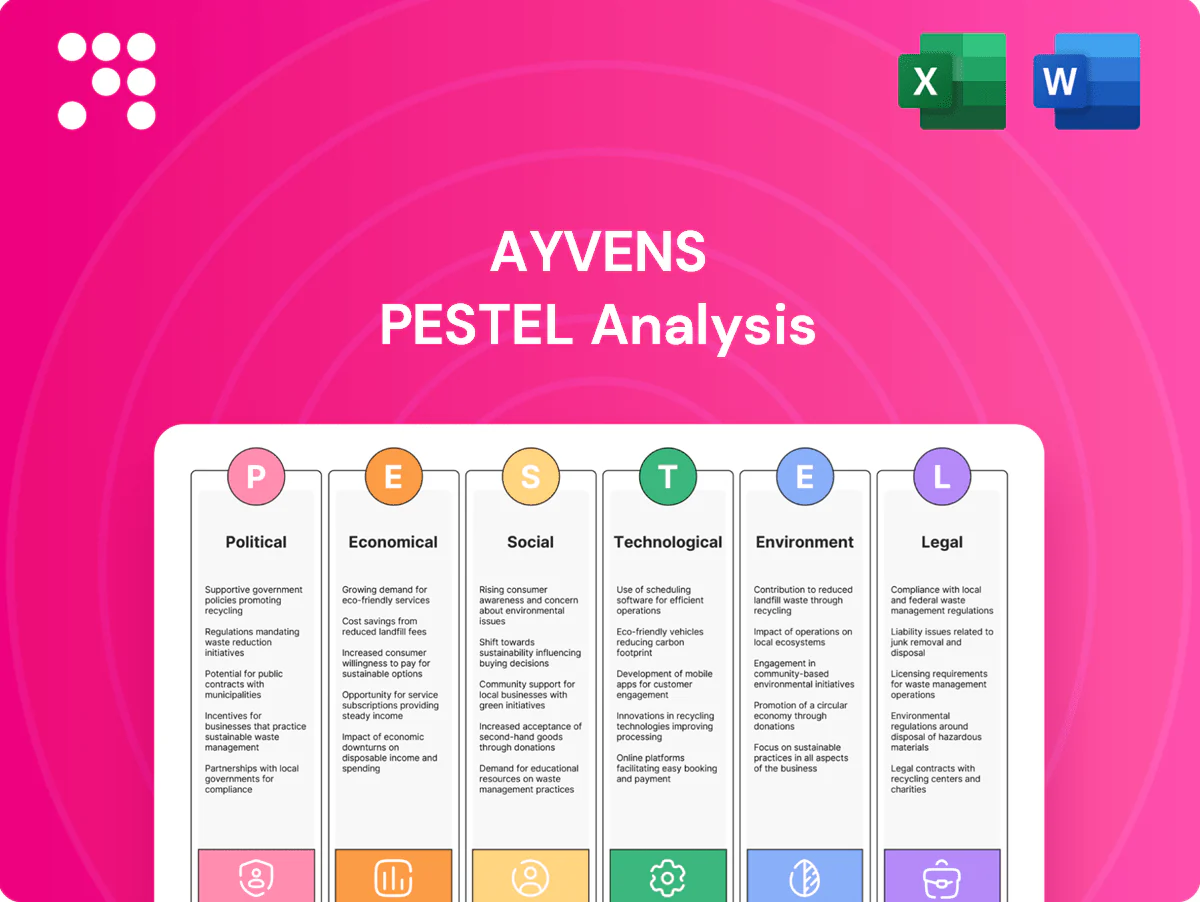
Ayvens PESTLE Analysis

Skip the Research. Get the Strategy.
Our targeted PESTLE Analysis for Ayvens reveals how political, economic, social, technological, legal, and environmental forces are reshaping its competitive landscape and risk profile. Designed for investors, strategists, and advisors, this concise briefing highlights actionable threats and opportunities you can apply immediately. Purchase the full report to access the complete, editable breakdown and strategic recommendations for confident decision-making.
Political factors

EV incentives and phase-out dynamics
Shifts in national subsidies, tax credits, and bonus–malus schemes directly change TCO and fleet uptake; China ended national EV purchase subsidies in 2023 while the US Inflation Reduction Act retains up to 7,500 USD tax credits under eligibility rules.
Sudden cuts triggered short-term sales dips in China in 2023, whereas enhanced credits in the US/EU lifted corporate procurement and order books.
Ayvens must hedge policy volatility across markets, revise pricing/advisory, and run scenario planning for step-downs and sunsets to protect margins and retention.
Urban mobility and low-emission zone policies
City-level LEZ/ULEZ expansions, exemplified by Greater London’s August 2023 ULEZ covering 7.5 million residents, accelerate fleet electrification and right-sizing.
Access restrictions and congestion charges shift demand toward zero-emission and micro-mobility options; electric vehicles accounted for about 14% of global car sales in 2023 (IEA).
Ayvens can use policy maps to guide clients to compliant vehicles and multi-mobility bundles, with local compliance services as a market differentiator.

Public investment in charging infrastructure
Government-backed rollouts curb range anxiety and boost EV utilization; EU AFIR targets about 3 million public chargers by 2030 while the US NEVI program commits roughly $7.5 billion to chargers. Grants and PPPs lower depot and workplace charging capex for fleet clients. Ayvens can co-originate infrastructure projects and bundle financing with vehicles, but uneven deployment across countries mandates adaptive network partnerships.

Geopolitical supply chain exposure
Geopolitical tensions disrupting battery materials and semiconductor flows have pushed component lead times into 12–28 week ranges and driven supplier price uplifts of roughly 5–15% since 2021, forcing OEM delivery and homologation timelines to slip. Sanctions and trade barriers redirect OEM sourcing, so Ayvens must deepen diversified OEM relationships, use flexible ordering and maintain contingency stock and substitution rules to keep fleets operational.
- Diversify OEM base to ≥3 suppliers per critical component
- Maintain contingency stock covering 8–12 weeks
- Implement substitution/Homologation playbook to cut swap time by ~30%
Public-sector fleet electrification mandates
Public procurement, which represents about 12% of global GDP, is driving fleet electrification and setting benchmarks for private fleets; US Executive Order 14057 commits the federal fleet to zero-emission light-duty vehicles by 2035. Tender rules requiring zero-emission shares, telemetry and lifecycle reporting create recurring service revenues Ayvens can capture by offering compliance reporting and KPI dashboards. Winning public bids expands scale and creates remarketing pools of EVs for secondary sales, improving residual value management.
- Tag: public-procurement
- Tag: EO-14057
- Tag: telemetry-compliance
- Tag: remarketing-pools
Policy shifts, LEZ rollouts and supply shocks force fleets to diversify and bundle charging finance
National subsidy shifts, city LEZ expansions and public-procurement mandates materially reshape demand, total cost of ownership and fleet specs across markets; supply-chain sanctions amplify delivery risk and component inflation. Ayvens must hedge policy swings, diversify OEMs, bundle charging finance and sell compliance services to capture recurring revenue. Scenario planning against subsidy step-downs and uneven charger rollouts is critical.
| Metric | Figure/Year |
|---|---|
| Global EV share | 14% (2023, IEA) |
| London ULEZ expansion | Aug 2023 |
| US NEVI | $7.5B |
| EU AFIR target | 3M chargers by 2030 |
| Supply lead times | 12–28 weeks |
| Supplier price uplift | ~5–15% since 2021 |
| Public procurement | ~12% of global GDP |
| US federal fleet target | Zero-emission by 2035 (EO-14057) |
What is included in the product
 Detailed Word Document
Explores how Political, Economic, Social, Technological, Environmental and Legal forces uniquely shape Ayvens, with data-backed, region- and industry-specific insights and forward-looking scenarios to help executives, consultants and entrepreneurs identify risks, opportunities and strategy-ready actions for planning, funding and competitive advantage.

 Customizable Excel Spreadsheet
Ayvens PESTLE delivers a concise, visually segmented summary that distills external risks and opportunities for quick alignment in meetings, is easily editable for region- or business-specific notes, and exports cleanly into presentations or strategy packs for efficient decision making.
Economic factors

Interest rates and funding costs
Rising base rates—Fed funds 5.25–5.50% (mid‑2025)—push up lease rents and squeeze customer affordability. Ayvens competitiveness and margins hinge on funding mix and securitization terms; senior auto ABS spreads around 150 bps vs swaps raise funding costs. The firm needs active ALM, duration hedging and dynamic pricing models. Rate volatility requires flexible tenors and residual‑value strategies.
Residual value volatility, especially for EVs
Residual value volatility for EVs has risen as rapid tech cycles and OEM price cuts in 2023–24 produced double-digit RV compression for several models, making robust, data-driven RV forecasting essential. With battery pack costs at about 132 USD/kWh in 2023 (BNEF), integrating battery-health telemetry materially improves RV accuracy. Ayvens can mitigate risk via mileage policies, buyback guarantees and mid-term swaps, plus diversified remarketing channels.

Energy and fuel price dynamics
U.S. average retail electricity ~17¢/kWh (2024 EIA) versus gasoline ~$3.60/gal (2024 AAA) shifts TCO and accelerates EV/hybrid migration. Peak/off-peak tariffs and corporate PPAs can cut charging costs 10–30%, boosting savings. Ayvens can deliver energy advisory and smart-charging plans to stabilize costs. Transparent TCO calculators quantify savings for client decisions.

SME health and corporate capex cycles
SME health and corporate capex cycles affect fleet renewals: economic slowdowns delay replacements and shift demand toward flexible subscriptions and short-term rentals, while recoveries boost net additions and upfit service revenue.
- SMEs ~90% of firms, ~50% of employment — World Bank
- Downturns: higher subscription & short-term lease demand
- Recovery: higher net additions & upfit services
- Credit underwriting must adapt to sector stress signals
Used-vehicle market liquidity
Remarketing speed and realized prices drive lifecycle profitability; U.S. retail used‑vehicle sales were about 39 million in 2023 and Manheim’s U.S. Used Vehicle Value Index, after peaking in 2022, was down roughly 20% by late 2024, compressing margins and extending hold times in saturated segments. Ayvens can shorten days‑to‑sale via multi‑channel auctions, retail‑ready refurbishment and cross‑border sales, using data‑led pricing and certification to boost clearance rates.
- Remarket speed = margin preservation
- 39M US used sales (2023)
- Manheim index ~20% below 2022 peak (late 2024)
- Multi‑channel + refurbishment + certifications = faster clearance
Policy shifts, LEZ rollouts and supply shocks force fleets to diversify and bundle charging finance
Higher rates (Fed 5.25–5.50% mid‑2025) raise funding costs; senior auto ABS spreads ~150bps increase yields. EV RVs saw double‑digit compression in 2023–24; battery costs ~132 USD/kWh (2023 BNEF) make telemetry‑led RVs vital. Energy & fuel (U.S. electricity ~17¢/kWh, gasoline ~$3.60/gal in 2024) shift TCO toward EVs, altering demand and remarketing.
| Metric | Value |
|---|---|
| Fed funds | 5.25–5.50% (mid‑2025) |
| Senior ABS spread | ~150bps vs swaps |
| EV RV change | Double‑digit compression (2023–24) |
| Battery cost | 132 USD/kWh (2023) |
| Electricity | ~17¢/kWh (2024) |
| Gasoline | ~$3.60/gal (2024) |
| Used sales | 39M US (2023) |
| Manheim index | ~20% below 2022 peak (late 2024) |
Preview Before You Purchase
Ayvens PESTLE Analysis
The preview shown here is the exact Ayvens PESTLE Analysis document you’ll receive after purchase—fully formatted and ready to use. It includes Political, Economic, Social, Technological, Legal and Environmental sections with actionable insights and clear structure. No placeholders or teasers; this is the final file you’ll download immediately after payment.

Skip the Research. Get the Strategy.
Our targeted PESTLE Analysis for Ayvens reveals how political, economic, social, technological, legal, and environmental forces are reshaping its competitive landscape and risk profile. Designed for investors, strategists, and advisors, this concise briefing highlights actionable threats and opportunities you can apply immediately. Purchase the full report to access the complete, editable breakdown and strategic recommendations for confident decision-making.
Political factors
EV incentives and phase-out dynamics
Shifts in national subsidies, tax credits, and bonus–malus schemes directly change TCO and fleet uptake; China ended national EV purchase subsidies in 2023 while the US Inflation Reduction Act retains up to 7,500 USD tax credits under eligibility rules.
Sudden cuts triggered short-term sales dips in China in 2023, whereas enhanced credits in the US/EU lifted corporate procurement and order books.
Ayvens must hedge policy volatility across markets, revise pricing/advisory, and run scenario planning for step-downs and sunsets to protect margins and retention.
Urban mobility and low-emission zone policies
City-level LEZ/ULEZ expansions, exemplified by Greater London’s August 2023 ULEZ covering 7.5 million residents, accelerate fleet electrification and right-sizing.
Access restrictions and congestion charges shift demand toward zero-emission and micro-mobility options; electric vehicles accounted for about 14% of global car sales in 2023 (IEA).
Ayvens can use policy maps to guide clients to compliant vehicles and multi-mobility bundles, with local compliance services as a market differentiator.
Public investment in charging infrastructure
Government-backed rollouts curb range anxiety and boost EV utilization; EU AFIR targets about 3 million public chargers by 2030 while the US NEVI program commits roughly $7.5 billion to chargers. Grants and PPPs lower depot and workplace charging capex for fleet clients. Ayvens can co-originate infrastructure projects and bundle financing with vehicles, but uneven deployment across countries mandates adaptive network partnerships.
Geopolitical supply chain exposure
Geopolitical tensions disrupting battery materials and semiconductor flows have pushed component lead times into 12–28 week ranges and driven supplier price uplifts of roughly 5–15% since 2021, forcing OEM delivery and homologation timelines to slip. Sanctions and trade barriers redirect OEM sourcing, so Ayvens must deepen diversified OEM relationships, use flexible ordering and maintain contingency stock and substitution rules to keep fleets operational.
- Diversify OEM base to ≥3 suppliers per critical component
- Maintain contingency stock covering 8–12 weeks
- Implement substitution/Homologation playbook to cut swap time by ~30%
Public-sector fleet electrification mandates
Public procurement, which represents about 12% of global GDP, is driving fleet electrification and setting benchmarks for private fleets; US Executive Order 14057 commits the federal fleet to zero-emission light-duty vehicles by 2035. Tender rules requiring zero-emission shares, telemetry and lifecycle reporting create recurring service revenues Ayvens can capture by offering compliance reporting and KPI dashboards. Winning public bids expands scale and creates remarketing pools of EVs for secondary sales, improving residual value management.
- Tag: public-procurement
- Tag: EO-14057
- Tag: telemetry-compliance
- Tag: remarketing-pools
Policy shifts, LEZ rollouts and supply shocks force fleets to diversify and bundle charging finance
National subsidy shifts, city LEZ expansions and public-procurement mandates materially reshape demand, total cost of ownership and fleet specs across markets; supply-chain sanctions amplify delivery risk and component inflation. Ayvens must hedge policy swings, diversify OEMs, bundle charging finance and sell compliance services to capture recurring revenue. Scenario planning against subsidy step-downs and uneven charger rollouts is critical.
| Metric | Figure/Year |
|---|---|
| Global EV share | 14% (2023, IEA) |
| London ULEZ expansion | Aug 2023 |
| US NEVI | $7.5B |
| EU AFIR target | 3M chargers by 2030 |
| Supply lead times | 12–28 weeks |
| Supplier price uplift | ~5–15% since 2021 |
| Public procurement | ~12% of global GDP |
| US federal fleet target | Zero-emission by 2035 (EO-14057) |
What is included in the product
Detailed Word Document
Explores how Political, Economic, Social, Technological, Environmental and Legal forces uniquely shape Ayvens, with data-backed, region- and industry-specific insights and forward-looking scenarios to help executives, consultants and entrepreneurs identify risks, opportunities and strategy-ready actions for planning, funding and competitive advantage.
Customizable Excel Spreadsheet
Ayvens PESTLE delivers a concise, visually segmented summary that distills external risks and opportunities for quick alignment in meetings, is easily editable for region- or business-specific notes, and exports cleanly into presentations or strategy packs for efficient decision making.
Economic factors
Interest rates and funding costs
Rising base rates—Fed funds 5.25–5.50% (mid‑2025)—push up lease rents and squeeze customer affordability. Ayvens competitiveness and margins hinge on funding mix and securitization terms; senior auto ABS spreads around 150 bps vs swaps raise funding costs. The firm needs active ALM, duration hedging and dynamic pricing models. Rate volatility requires flexible tenors and residual‑value strategies.
Residual value volatility, especially for EVs
Residual value volatility for EVs has risen as rapid tech cycles and OEM price cuts in 2023–24 produced double-digit RV compression for several models, making robust, data-driven RV forecasting essential. With battery pack costs at about 132 USD/kWh in 2023 (BNEF), integrating battery-health telemetry materially improves RV accuracy. Ayvens can mitigate risk via mileage policies, buyback guarantees and mid-term swaps, plus diversified remarketing channels.
Energy and fuel price dynamics
U.S. average retail electricity ~17¢/kWh (2024 EIA) versus gasoline ~$3.60/gal (2024 AAA) shifts TCO and accelerates EV/hybrid migration. Peak/off-peak tariffs and corporate PPAs can cut charging costs 10–30%, boosting savings. Ayvens can deliver energy advisory and smart-charging plans to stabilize costs. Transparent TCO calculators quantify savings for client decisions.
SME health and corporate capex cycles
SME health and corporate capex cycles affect fleet renewals: economic slowdowns delay replacements and shift demand toward flexible subscriptions and short-term rentals, while recoveries boost net additions and upfit service revenue.
- SMEs ~90% of firms, ~50% of employment — World Bank
- Downturns: higher subscription & short-term lease demand
- Recovery: higher net additions & upfit services
- Credit underwriting must adapt to sector stress signals
Used-vehicle market liquidity
Remarketing speed and realized prices drive lifecycle profitability; U.S. retail used‑vehicle sales were about 39 million in 2023 and Manheim’s U.S. Used Vehicle Value Index, after peaking in 2022, was down roughly 20% by late 2024, compressing margins and extending hold times in saturated segments. Ayvens can shorten days‑to‑sale via multi‑channel auctions, retail‑ready refurbishment and cross‑border sales, using data‑led pricing and certification to boost clearance rates.
- Remarket speed = margin preservation
- 39M US used sales (2023)
- Manheim index ~20% below 2022 peak (late 2024)
- Multi‑channel + refurbishment + certifications = faster clearance
Policy shifts, LEZ rollouts and supply shocks force fleets to diversify and bundle charging finance
Higher rates (Fed 5.25–5.50% mid‑2025) raise funding costs; senior auto ABS spreads ~150bps increase yields. EV RVs saw double‑digit compression in 2023–24; battery costs ~132 USD/kWh (2023 BNEF) make telemetry‑led RVs vital. Energy & fuel (U.S. electricity ~17¢/kWh, gasoline ~$3.60/gal in 2024) shift TCO toward EVs, altering demand and remarketing.
| Metric | Value |
|---|---|
| Fed funds | 5.25–5.50% (mid‑2025) |
| Senior ABS spread | ~150bps vs swaps |
| EV RV change | Double‑digit compression (2023–24) |
| Battery cost | 132 USD/kWh (2023) |
| Electricity | ~17¢/kWh (2024) |
| Gasoline | ~$3.60/gal (2024) |
| Used sales | 39M US (2023) |
| Manheim index | ~20% below 2022 peak (late 2024) |
Preview Before You Purchase
Ayvens PESTLE Analysis
The preview shown here is the exact Ayvens PESTLE Analysis document you’ll receive after purchase—fully formatted and ready to use. It includes Political, Economic, Social, Technological, Legal and Environmental sections with actionable insights and clear structure. No placeholders or teasers; this is the final file you’ll download immediately after payment.
Original: $10.00
-65%$10.00
$3.50Description
Skip the Research. Get the Strategy.
Our targeted PESTLE Analysis for Ayvens reveals how political, economic, social, technological, legal, and environmental forces are reshaping its competitive landscape and risk profile. Designed for investors, strategists, and advisors, this concise briefing highlights actionable threats and opportunities you can apply immediately. Purchase the full report to access the complete, editable breakdown and strategic recommendations for confident decision-making.
Political factors
EV incentives and phase-out dynamics
Shifts in national subsidies, tax credits, and bonus–malus schemes directly change TCO and fleet uptake; China ended national EV purchase subsidies in 2023 while the US Inflation Reduction Act retains up to 7,500 USD tax credits under eligibility rules.
Sudden cuts triggered short-term sales dips in China in 2023, whereas enhanced credits in the US/EU lifted corporate procurement and order books.
Ayvens must hedge policy volatility across markets, revise pricing/advisory, and run scenario planning for step-downs and sunsets to protect margins and retention.
Urban mobility and low-emission zone policies
City-level LEZ/ULEZ expansions, exemplified by Greater London’s August 2023 ULEZ covering 7.5 million residents, accelerate fleet electrification and right-sizing.
Access restrictions and congestion charges shift demand toward zero-emission and micro-mobility options; electric vehicles accounted for about 14% of global car sales in 2023 (IEA).
Ayvens can use policy maps to guide clients to compliant vehicles and multi-mobility bundles, with local compliance services as a market differentiator.
Public investment in charging infrastructure
Government-backed rollouts curb range anxiety and boost EV utilization; EU AFIR targets about 3 million public chargers by 2030 while the US NEVI program commits roughly $7.5 billion to chargers. Grants and PPPs lower depot and workplace charging capex for fleet clients. Ayvens can co-originate infrastructure projects and bundle financing with vehicles, but uneven deployment across countries mandates adaptive network partnerships.
Geopolitical supply chain exposure
Geopolitical tensions disrupting battery materials and semiconductor flows have pushed component lead times into 12–28 week ranges and driven supplier price uplifts of roughly 5–15% since 2021, forcing OEM delivery and homologation timelines to slip. Sanctions and trade barriers redirect OEM sourcing, so Ayvens must deepen diversified OEM relationships, use flexible ordering and maintain contingency stock and substitution rules to keep fleets operational.
- Diversify OEM base to ≥3 suppliers per critical component
- Maintain contingency stock covering 8–12 weeks
- Implement substitution/Homologation playbook to cut swap time by ~30%
Public-sector fleet electrification mandates
Public procurement, which represents about 12% of global GDP, is driving fleet electrification and setting benchmarks for private fleets; US Executive Order 14057 commits the federal fleet to zero-emission light-duty vehicles by 2035. Tender rules requiring zero-emission shares, telemetry and lifecycle reporting create recurring service revenues Ayvens can capture by offering compliance reporting and KPI dashboards. Winning public bids expands scale and creates remarketing pools of EVs for secondary sales, improving residual value management.
- Tag: public-procurement
- Tag: EO-14057
- Tag: telemetry-compliance
- Tag: remarketing-pools
Policy shifts, LEZ rollouts and supply shocks force fleets to diversify and bundle charging finance
National subsidy shifts, city LEZ expansions and public-procurement mandates materially reshape demand, total cost of ownership and fleet specs across markets; supply-chain sanctions amplify delivery risk and component inflation. Ayvens must hedge policy swings, diversify OEMs, bundle charging finance and sell compliance services to capture recurring revenue. Scenario planning against subsidy step-downs and uneven charger rollouts is critical.
| Metric | Figure/Year |
|---|---|
| Global EV share | 14% (2023, IEA) |
| London ULEZ expansion | Aug 2023 |
| US NEVI | $7.5B |
| EU AFIR target | 3M chargers by 2030 |
| Supply lead times | 12–28 weeks |
| Supplier price uplift | ~5–15% since 2021 |
| Public procurement | ~12% of global GDP |
| US federal fleet target | Zero-emission by 2035 (EO-14057) |
What is included in the product
Detailed Word Document
Explores how Political, Economic, Social, Technological, Environmental and Legal forces uniquely shape Ayvens, with data-backed, region- and industry-specific insights and forward-looking scenarios to help executives, consultants and entrepreneurs identify risks, opportunities and strategy-ready actions for planning, funding and competitive advantage.
Customizable Excel Spreadsheet
Ayvens PESTLE delivers a concise, visually segmented summary that distills external risks and opportunities for quick alignment in meetings, is easily editable for region- or business-specific notes, and exports cleanly into presentations or strategy packs for efficient decision making.
Economic factors
Interest rates and funding costs
Rising base rates—Fed funds 5.25–5.50% (mid‑2025)—push up lease rents and squeeze customer affordability. Ayvens competitiveness and margins hinge on funding mix and securitization terms; senior auto ABS spreads around 150 bps vs swaps raise funding costs. The firm needs active ALM, duration hedging and dynamic pricing models. Rate volatility requires flexible tenors and residual‑value strategies.
Residual value volatility, especially for EVs
Residual value volatility for EVs has risen as rapid tech cycles and OEM price cuts in 2023–24 produced double-digit RV compression for several models, making robust, data-driven RV forecasting essential. With battery pack costs at about 132 USD/kWh in 2023 (BNEF), integrating battery-health telemetry materially improves RV accuracy. Ayvens can mitigate risk via mileage policies, buyback guarantees and mid-term swaps, plus diversified remarketing channels.
Energy and fuel price dynamics
U.S. average retail electricity ~17¢/kWh (2024 EIA) versus gasoline ~$3.60/gal (2024 AAA) shifts TCO and accelerates EV/hybrid migration. Peak/off-peak tariffs and corporate PPAs can cut charging costs 10–30%, boosting savings. Ayvens can deliver energy advisory and smart-charging plans to stabilize costs. Transparent TCO calculators quantify savings for client decisions.
SME health and corporate capex cycles
SME health and corporate capex cycles affect fleet renewals: economic slowdowns delay replacements and shift demand toward flexible subscriptions and short-term rentals, while recoveries boost net additions and upfit service revenue.
- SMEs ~90% of firms, ~50% of employment — World Bank
- Downturns: higher subscription & short-term lease demand
- Recovery: higher net additions & upfit services
- Credit underwriting must adapt to sector stress signals
Used-vehicle market liquidity
Remarketing speed and realized prices drive lifecycle profitability; U.S. retail used‑vehicle sales were about 39 million in 2023 and Manheim’s U.S. Used Vehicle Value Index, after peaking in 2022, was down roughly 20% by late 2024, compressing margins and extending hold times in saturated segments. Ayvens can shorten days‑to‑sale via multi‑channel auctions, retail‑ready refurbishment and cross‑border sales, using data‑led pricing and certification to boost clearance rates.
- Remarket speed = margin preservation
- 39M US used sales (2023)
- Manheim index ~20% below 2022 peak (late 2024)
- Multi‑channel + refurbishment + certifications = faster clearance
Policy shifts, LEZ rollouts and supply shocks force fleets to diversify and bundle charging finance
Higher rates (Fed 5.25–5.50% mid‑2025) raise funding costs; senior auto ABS spreads ~150bps increase yields. EV RVs saw double‑digit compression in 2023–24; battery costs ~132 USD/kWh (2023 BNEF) make telemetry‑led RVs vital. Energy & fuel (U.S. electricity ~17¢/kWh, gasoline ~$3.60/gal in 2024) shift TCO toward EVs, altering demand and remarketing.
| Metric | Value |
|---|---|
| Fed funds | 5.25–5.50% (mid‑2025) |
| Senior ABS spread | ~150bps vs swaps |
| EV RV change | Double‑digit compression (2023–24) |
| Battery cost | 132 USD/kWh (2023) |
| Electricity | ~17¢/kWh (2024) |
| Gasoline | ~$3.60/gal (2024) |
| Used sales | 39M US (2023) |
| Manheim index | ~20% below 2022 peak (late 2024) |
Preview Before You Purchase
Ayvens PESTLE Analysis
The preview shown here is the exact Ayvens PESTLE Analysis document you’ll receive after purchase—fully formatted and ready to use. It includes Political, Economic, Social, Technological, Legal and Environmental sections with actionable insights and clear structure. No placeholders or teasers; this is the final file you’ll download immediately after payment.











