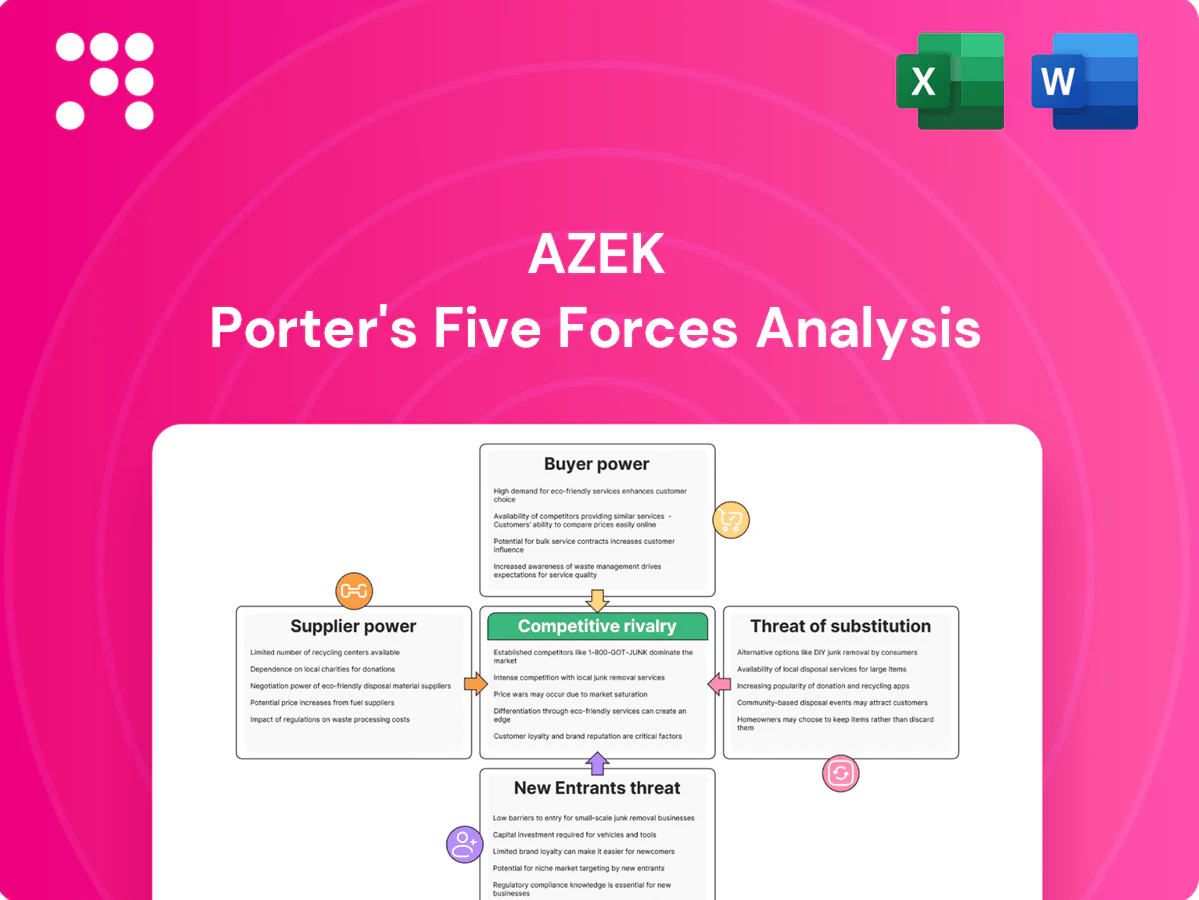
AZEK Porter's Five Forces Analysis

From Overview to Strategy Blueprint
AZEK operates in a competitive building-products market where supplier concentration, rising raw-material costs, and strong incumbent brands heighten pressure, while product differentiation and scale limit new entrants; substitutes like treated wood and PVC still pose moderate threat. This snapshot highlights key competitive tensions and strategic levers AZEK can exploit. Ready to move beyond the basics? Get a full strategic breakdown of AZEK’s market position, competitive intensity, and external threats—all in one powerful analysis.
Suppliers Bargaining Power

Concentration in resin/feedstock
AZEK depends on PVC/PE resins and recycled feedstock where qualified suppliers remain relatively concentrated, and 2024 commodity cycles have periodically tightened supply and pushed resin prices higher. Approved-substitute lists and dual-sourcing reduce supplier leverage, but spec-driven formulations and certification for recycled content limit rapid switching. Supply-security programs and inventory buffers are therefore strategically important to protect margins and production continuity.
Recycled material availability
Quality and consistency of post-consumer/post-industrial recyclate vary significantly, lowering yields and raising processing costs; in 2024 recyclate contamination rates in many U.S. bales still exceed 10%, pressuring margins. Regional collection networks and fluctuating bale prices give aggregators bargaining power in tight markets. AZEK's vertical integration into recycling reduces exposure but does not eliminate feedstock variability. Long-term supply agreements in 2024 helped stabilize a large share of input volumes.

Additives and specialty chemicals
TiO2, UV stabilizers and specialty pigments are concentrated among roughly four global producers controlling about 70% of capacity, tightening supplier leverage. Price pass-through lags often compress AZEK’s margins during input spikes as contracts reprice. New additive qualification typically takes 6–18 months, increasing supplier stickiness. Volume commitments and hedging programs are used to partially offset raw-material volatility.

Logistics and energy dependence
Extrusion is energy-intensive and freight-sensitive, giving utilities and carriers indirect leverage. Fuel surcharges and capacity constraints raise delivered costs; US diesel averaged about 4.00 USD/gal in 2024, squeezing margins. Co-locating near feedstock and customers reduces exposure and multi-modal shipping strengthens AZEK’s negotiating position.
- Energy & freight leverage
- Fuel surcharges impact costs
- Co-location + multi-modal = stronger negotiation
Tooling and OEM equipment
Extrusion dies, tooling, and OEM equipment for AZEK come from specialized vendors with typical die lead times of 6–12 weeks in 2024, creating switching frictions during changeovers and seasonal demand spikes. Preventive maintenance and growing in-house machining capacity have reduced supplier leverage, while platform standardization across product lines lowers dependence on any single OEM.
- 2024 die lead times: 6–12 weeks
- In-house tooling reduces supplier scope
- Platform standardization cuts single-OEM risk
Moderate-high supplier power: TiO2 concentration, long die lead times, energy costs tighten margins
Supplier power is moderate-high: resin and recyclate tightness and spec qualifications limit switching, while dual-sourcing and in-house recycling reduce exposure. Additives (TiO2 cluster ~70% capacity) and 6–12 week die lead times create stickiness; energy and freight (US diesel ≈ 4.00 USD/gal in 2024) add indirect leverage. Long-term contracts and inventory buffers are key to margin protection.
| Factor | 2024 datapoint |
|---|---|
| TiO2 market share | ~70% capacity |
| Die lead times | 6–12 weeks |
| Recyclate contamination | >10% bales |
| US diesel | ≈ 4.00 USD/gal |
What is included in the product
 Detailed Word Document
Tailored Porter's Five Forces analysis for AZEK that uncovers key drivers of competition, supplier and buyer power, substitution risks, and entry barriers, identifying disruptive threats and strategic levers to protect margins and market share.

 Customizable Excel Spreadsheet
A clear, one-sheet Porter's Five Forces summary for AZEK—quickly highlights supplier, buyer, and competitive pressures to speed strategic decisions and investor briefings.
Customers Bargaining Power

Distributor and dealer leverage
AZEK sells heavily through two-step distribution and pro-dealer networks, giving distributors and dealers significant leverage to negotiate pricing, payment terms, and shelf placement.
Large distributors can extract concessions such as volume rebates and marketing co-op funds, pressuring margin and promotions.
Diversifying channels and geographic mix mitigates concentration risk and reduces bargaining power of any single distributor.
Contractor influence
Installers often specify familiar AZEK systems for speed, training ease, and warranty confidence, with industry surveys in 2024 showing professional recommendations drive roughly 70% of homeowner product choices. Their brand advocacy moderates price sensitivity as installers prioritize reliable margins and reduced call-backs. AZEK's certified installer networks and loyalty programs—expanded in 2024—lower churn, while bundled decking, railing, and fasteners raise switching costs for homeowners.

End-customer price sensitivity
Homeowners still view AZEK as higher upfront cost versus traditional wood, so promotions and dealer rebates remain highly effective at closing sales.
Long-term lower maintenance, fade and rot resistance and superior aesthetics support price premiums, reinforced by AZEKs limited lifetime warranty and recycled-content sustainability claims.
Clear warranty terms and documented sustainability credentials reduce resistance, while dealer and manufacturer financing options moderate short-term price sensitivity.

Specifiers and code requirements
Architects and builders require code listings and ASTM/ICC approvals, and U.S. building codes are adopted nationwide; once AZEK products are specified they gain stickiness in project plans, reducing buyer bargaining power. Lack of listings can exclude entrants, while robust technical support and manufacturer-backed approvals improve retention and cross-sell.
- Codes adopted nationwide
- ICC/ASTM approvals drive inclusion
- Specification stickiness reduces alternatives
- Technical support boosts retention & cross-sell
Demand cyclicality
Repair-and-remodel activity and US housing starts (around 1.3M annualized in 2024) drive AZEK volumes, amplifying buyer bargaining power in downturns; in soft markets discounting and extended payment terms rise while product breadth lets AZEK manage mix to protect margins, and backlog visibility supports pricing discipline.
Installer ~70% influence and 1.3M starts support margins
Distributors and pro-dealers exert notable pricing and terms leverage, while installers drive roughly 70% of homeowner product choices (2024), moderating price sensitivity. Homeowner price resistance persists, so rebates and promotions remain potent. Product breadth, limited lifetime warranty, ASTM/ICC approvals and 1.3M US housing starts (2024) help AZEK defend mix and margins.
| Metric | Value |
|---|---|
| Installer influence (2024) | ~70% |
| US housing starts (2024) | ~1.3M |
| US remodel market (2023) | $422B |
| Warranty/approvals | Limited lifetime; ICC/ASTM |
Preview the Actual Deliverable
AZEK Porter's Five Forces Analysis
This preview shows the exact AZEK Porter’s Five Forces Analysis you’ll receive—no placeholders or summaries. The document displayed is fully formatted, professionally written, and ready for immediate download after purchase. You’re viewing the final deliverable; what you see is what you’ll get.

From Overview to Strategy Blueprint
AZEK operates in a competitive building-products market where supplier concentration, rising raw-material costs, and strong incumbent brands heighten pressure, while product differentiation and scale limit new entrants; substitutes like treated wood and PVC still pose moderate threat. This snapshot highlights key competitive tensions and strategic levers AZEK can exploit. Ready to move beyond the basics? Get a full strategic breakdown of AZEK’s market position, competitive intensity, and external threats—all in one powerful analysis.
Suppliers Bargaining Power
Concentration in resin/feedstock
AZEK depends on PVC/PE resins and recycled feedstock where qualified suppliers remain relatively concentrated, and 2024 commodity cycles have periodically tightened supply and pushed resin prices higher. Approved-substitute lists and dual-sourcing reduce supplier leverage, but spec-driven formulations and certification for recycled content limit rapid switching. Supply-security programs and inventory buffers are therefore strategically important to protect margins and production continuity.
Recycled material availability
Quality and consistency of post-consumer/post-industrial recyclate vary significantly, lowering yields and raising processing costs; in 2024 recyclate contamination rates in many U.S. bales still exceed 10%, pressuring margins. Regional collection networks and fluctuating bale prices give aggregators bargaining power in tight markets. AZEK's vertical integration into recycling reduces exposure but does not eliminate feedstock variability. Long-term supply agreements in 2024 helped stabilize a large share of input volumes.
Additives and specialty chemicals
TiO2, UV stabilizers and specialty pigments are concentrated among roughly four global producers controlling about 70% of capacity, tightening supplier leverage. Price pass-through lags often compress AZEK’s margins during input spikes as contracts reprice. New additive qualification typically takes 6–18 months, increasing supplier stickiness. Volume commitments and hedging programs are used to partially offset raw-material volatility.
Logistics and energy dependence
Extrusion is energy-intensive and freight-sensitive, giving utilities and carriers indirect leverage. Fuel surcharges and capacity constraints raise delivered costs; US diesel averaged about 4.00 USD/gal in 2024, squeezing margins. Co-locating near feedstock and customers reduces exposure and multi-modal shipping strengthens AZEK’s negotiating position.
- Energy & freight leverage
- Fuel surcharges impact costs
- Co-location + multi-modal = stronger negotiation
Tooling and OEM equipment
Extrusion dies, tooling, and OEM equipment for AZEK come from specialized vendors with typical die lead times of 6–12 weeks in 2024, creating switching frictions during changeovers and seasonal demand spikes. Preventive maintenance and growing in-house machining capacity have reduced supplier leverage, while platform standardization across product lines lowers dependence on any single OEM.
- 2024 die lead times: 6–12 weeks
- In-house tooling reduces supplier scope
- Platform standardization cuts single-OEM risk
Moderate-high supplier power: TiO2 concentration, long die lead times, energy costs tighten margins
Supplier power is moderate-high: resin and recyclate tightness and spec qualifications limit switching, while dual-sourcing and in-house recycling reduce exposure. Additives (TiO2 cluster ~70% capacity) and 6–12 week die lead times create stickiness; energy and freight (US diesel ≈ 4.00 USD/gal in 2024) add indirect leverage. Long-term contracts and inventory buffers are key to margin protection.
| Factor | 2024 datapoint |
|---|---|
| TiO2 market share | ~70% capacity |
| Die lead times | 6–12 weeks |
| Recyclate contamination | >10% bales |
| US diesel | ≈ 4.00 USD/gal |
What is included in the product
Detailed Word Document
Tailored Porter's Five Forces analysis for AZEK that uncovers key drivers of competition, supplier and buyer power, substitution risks, and entry barriers, identifying disruptive threats and strategic levers to protect margins and market share.
Customizable Excel Spreadsheet
A clear, one-sheet Porter's Five Forces summary for AZEK—quickly highlights supplier, buyer, and competitive pressures to speed strategic decisions and investor briefings.
Customers Bargaining Power
Distributor and dealer leverage
AZEK sells heavily through two-step distribution and pro-dealer networks, giving distributors and dealers significant leverage to negotiate pricing, payment terms, and shelf placement.
Large distributors can extract concessions such as volume rebates and marketing co-op funds, pressuring margin and promotions.
Diversifying channels and geographic mix mitigates concentration risk and reduces bargaining power of any single distributor.
Contractor influence
Installers often specify familiar AZEK systems for speed, training ease, and warranty confidence, with industry surveys in 2024 showing professional recommendations drive roughly 70% of homeowner product choices. Their brand advocacy moderates price sensitivity as installers prioritize reliable margins and reduced call-backs. AZEK's certified installer networks and loyalty programs—expanded in 2024—lower churn, while bundled decking, railing, and fasteners raise switching costs for homeowners.
End-customer price sensitivity
Homeowners still view AZEK as higher upfront cost versus traditional wood, so promotions and dealer rebates remain highly effective at closing sales.
Long-term lower maintenance, fade and rot resistance and superior aesthetics support price premiums, reinforced by AZEKs limited lifetime warranty and recycled-content sustainability claims.
Clear warranty terms and documented sustainability credentials reduce resistance, while dealer and manufacturer financing options moderate short-term price sensitivity.
Specifiers and code requirements
Architects and builders require code listings and ASTM/ICC approvals, and U.S. building codes are adopted nationwide; once AZEK products are specified they gain stickiness in project plans, reducing buyer bargaining power. Lack of listings can exclude entrants, while robust technical support and manufacturer-backed approvals improve retention and cross-sell.
- Codes adopted nationwide
- ICC/ASTM approvals drive inclusion
- Specification stickiness reduces alternatives
- Technical support boosts retention & cross-sell
Demand cyclicality
Repair-and-remodel activity and US housing starts (around 1.3M annualized in 2024) drive AZEK volumes, amplifying buyer bargaining power in downturns; in soft markets discounting and extended payment terms rise while product breadth lets AZEK manage mix to protect margins, and backlog visibility supports pricing discipline.
Installer ~70% influence and 1.3M starts support margins
Distributors and pro-dealers exert notable pricing and terms leverage, while installers drive roughly 70% of homeowner product choices (2024), moderating price sensitivity. Homeowner price resistance persists, so rebates and promotions remain potent. Product breadth, limited lifetime warranty, ASTM/ICC approvals and 1.3M US housing starts (2024) help AZEK defend mix and margins.
| Metric | Value |
|---|---|
| Installer influence (2024) | ~70% |
| US housing starts (2024) | ~1.3M |
| US remodel market (2023) | $422B |
| Warranty/approvals | Limited lifetime; ICC/ASTM |
Preview the Actual Deliverable
AZEK Porter's Five Forces Analysis
This preview shows the exact AZEK Porter’s Five Forces Analysis you’ll receive—no placeholders or summaries. The document displayed is fully formatted, professionally written, and ready for immediate download after purchase. You’re viewing the final deliverable; what you see is what you’ll get.
Original: $10.00
-65%$10.00
$3.50Description
From Overview to Strategy Blueprint
AZEK operates in a competitive building-products market where supplier concentration, rising raw-material costs, and strong incumbent brands heighten pressure, while product differentiation and scale limit new entrants; substitutes like treated wood and PVC still pose moderate threat. This snapshot highlights key competitive tensions and strategic levers AZEK can exploit. Ready to move beyond the basics? Get a full strategic breakdown of AZEK’s market position, competitive intensity, and external threats—all in one powerful analysis.
Suppliers Bargaining Power
Concentration in resin/feedstock
AZEK depends on PVC/PE resins and recycled feedstock where qualified suppliers remain relatively concentrated, and 2024 commodity cycles have periodically tightened supply and pushed resin prices higher. Approved-substitute lists and dual-sourcing reduce supplier leverage, but spec-driven formulations and certification for recycled content limit rapid switching. Supply-security programs and inventory buffers are therefore strategically important to protect margins and production continuity.
Recycled material availability
Quality and consistency of post-consumer/post-industrial recyclate vary significantly, lowering yields and raising processing costs; in 2024 recyclate contamination rates in many U.S. bales still exceed 10%, pressuring margins. Regional collection networks and fluctuating bale prices give aggregators bargaining power in tight markets. AZEK's vertical integration into recycling reduces exposure but does not eliminate feedstock variability. Long-term supply agreements in 2024 helped stabilize a large share of input volumes.
Additives and specialty chemicals
TiO2, UV stabilizers and specialty pigments are concentrated among roughly four global producers controlling about 70% of capacity, tightening supplier leverage. Price pass-through lags often compress AZEK’s margins during input spikes as contracts reprice. New additive qualification typically takes 6–18 months, increasing supplier stickiness. Volume commitments and hedging programs are used to partially offset raw-material volatility.
Logistics and energy dependence
Extrusion is energy-intensive and freight-sensitive, giving utilities and carriers indirect leverage. Fuel surcharges and capacity constraints raise delivered costs; US diesel averaged about 4.00 USD/gal in 2024, squeezing margins. Co-locating near feedstock and customers reduces exposure and multi-modal shipping strengthens AZEK’s negotiating position.
- Energy & freight leverage
- Fuel surcharges impact costs
- Co-location + multi-modal = stronger negotiation
Tooling and OEM equipment
Extrusion dies, tooling, and OEM equipment for AZEK come from specialized vendors with typical die lead times of 6–12 weeks in 2024, creating switching frictions during changeovers and seasonal demand spikes. Preventive maintenance and growing in-house machining capacity have reduced supplier leverage, while platform standardization across product lines lowers dependence on any single OEM.
- 2024 die lead times: 6–12 weeks
- In-house tooling reduces supplier scope
- Platform standardization cuts single-OEM risk
Moderate-high supplier power: TiO2 concentration, long die lead times, energy costs tighten margins
Supplier power is moderate-high: resin and recyclate tightness and spec qualifications limit switching, while dual-sourcing and in-house recycling reduce exposure. Additives (TiO2 cluster ~70% capacity) and 6–12 week die lead times create stickiness; energy and freight (US diesel ≈ 4.00 USD/gal in 2024) add indirect leverage. Long-term contracts and inventory buffers are key to margin protection.
| Factor | 2024 datapoint |
|---|---|
| TiO2 market share | ~70% capacity |
| Die lead times | 6–12 weeks |
| Recyclate contamination | >10% bales |
| US diesel | ≈ 4.00 USD/gal |
What is included in the product
Detailed Word Document
Tailored Porter's Five Forces analysis for AZEK that uncovers key drivers of competition, supplier and buyer power, substitution risks, and entry barriers, identifying disruptive threats and strategic levers to protect margins and market share.
Customizable Excel Spreadsheet
A clear, one-sheet Porter's Five Forces summary for AZEK—quickly highlights supplier, buyer, and competitive pressures to speed strategic decisions and investor briefings.
Customers Bargaining Power
Distributor and dealer leverage
AZEK sells heavily through two-step distribution and pro-dealer networks, giving distributors and dealers significant leverage to negotiate pricing, payment terms, and shelf placement.
Large distributors can extract concessions such as volume rebates and marketing co-op funds, pressuring margin and promotions.
Diversifying channels and geographic mix mitigates concentration risk and reduces bargaining power of any single distributor.
Contractor influence
Installers often specify familiar AZEK systems for speed, training ease, and warranty confidence, with industry surveys in 2024 showing professional recommendations drive roughly 70% of homeowner product choices. Their brand advocacy moderates price sensitivity as installers prioritize reliable margins and reduced call-backs. AZEK's certified installer networks and loyalty programs—expanded in 2024—lower churn, while bundled decking, railing, and fasteners raise switching costs for homeowners.
End-customer price sensitivity
Homeowners still view AZEK as higher upfront cost versus traditional wood, so promotions and dealer rebates remain highly effective at closing sales.
Long-term lower maintenance, fade and rot resistance and superior aesthetics support price premiums, reinforced by AZEKs limited lifetime warranty and recycled-content sustainability claims.
Clear warranty terms and documented sustainability credentials reduce resistance, while dealer and manufacturer financing options moderate short-term price sensitivity.
Specifiers and code requirements
Architects and builders require code listings and ASTM/ICC approvals, and U.S. building codes are adopted nationwide; once AZEK products are specified they gain stickiness in project plans, reducing buyer bargaining power. Lack of listings can exclude entrants, while robust technical support and manufacturer-backed approvals improve retention and cross-sell.
- Codes adopted nationwide
- ICC/ASTM approvals drive inclusion
- Specification stickiness reduces alternatives
- Technical support boosts retention & cross-sell
Demand cyclicality
Repair-and-remodel activity and US housing starts (around 1.3M annualized in 2024) drive AZEK volumes, amplifying buyer bargaining power in downturns; in soft markets discounting and extended payment terms rise while product breadth lets AZEK manage mix to protect margins, and backlog visibility supports pricing discipline.
Installer ~70% influence and 1.3M starts support margins
Distributors and pro-dealers exert notable pricing and terms leverage, while installers drive roughly 70% of homeowner product choices (2024), moderating price sensitivity. Homeowner price resistance persists, so rebates and promotions remain potent. Product breadth, limited lifetime warranty, ASTM/ICC approvals and 1.3M US housing starts (2024) help AZEK defend mix and margins.
| Metric | Value |
|---|---|
| Installer influence (2024) | ~70% |
| US housing starts (2024) | ~1.3M |
| US remodel market (2023) | $422B |
| Warranty/approvals | Limited lifetime; ICC/ASTM |
Preview the Actual Deliverable
AZEK Porter's Five Forces Analysis
This preview shows the exact AZEK Porter’s Five Forces Analysis you’ll receive—no placeholders or summaries. The document displayed is fully formatted, professionally written, and ready for immediate download after purchase. You’re viewing the final deliverable; what you see is what you’ll get.











