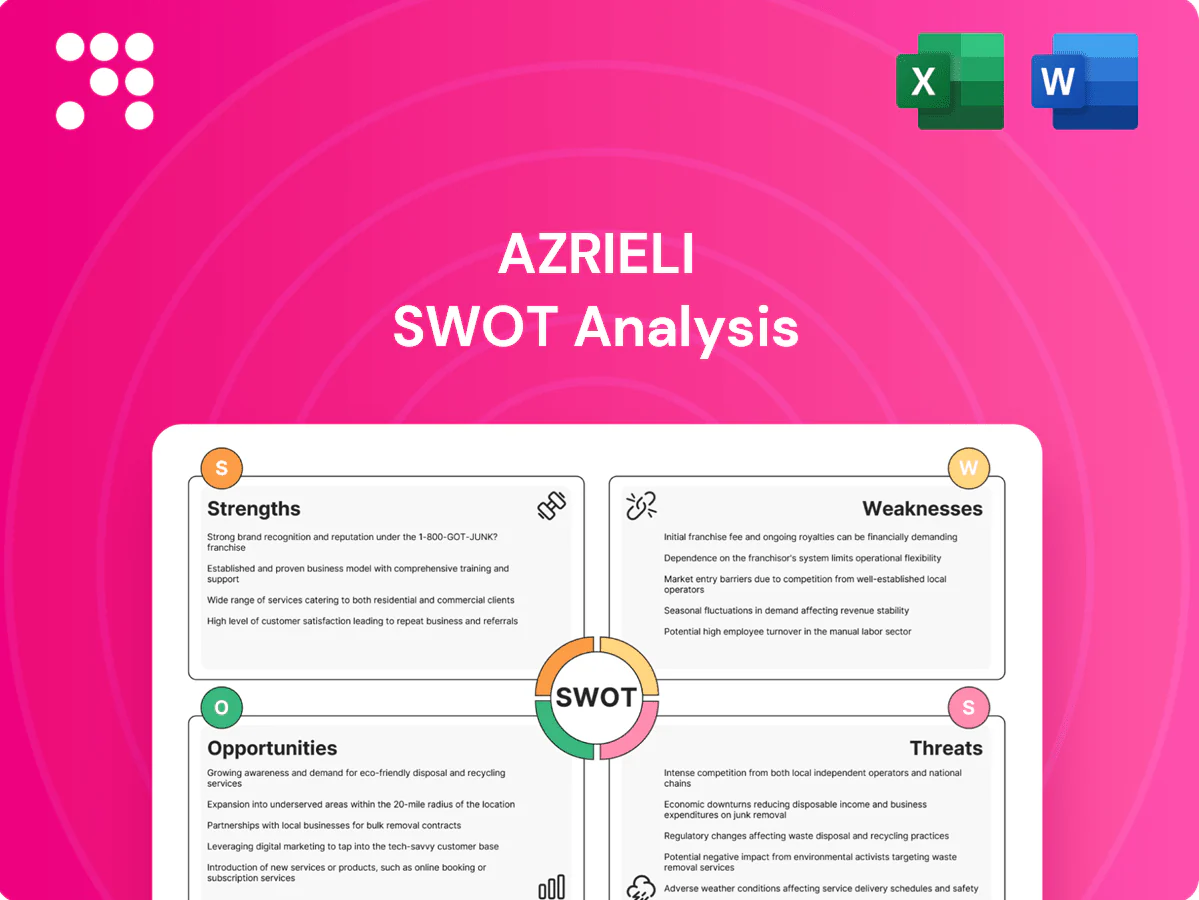
Azrieli SWOT Analysis

Make Insightful Decisions Backed by Expert Research
Azrieli Group’s diversified portfolio of shopping centers, offices and data-center assets offers strong cashflow and brand presence, but exposure to retail trends, leasing cycles and Israeli macro risks could pressure growth; operational efficiency and strategic landbanking are key strengths and levers. Want the complete picture with actionable recommendations? Purchase the full SWOT report—editable Word and Excel deliverables to support investment or strategic decisions.
Strengths

Dominant Israeli real estate footprint
Azrieli holds landmark malls and office towers—including the iconic Azrieli Center in Tel Aviv—anchoring predictable cash flows with blue-chip tenants and consistently high footfall. Scale provides strong bargaining power with contractors, municipalities and tenants, enabling cost control and favorable lease terms. Prime, centrally located assets drive pricing power and low structural vacancy, supporting resilient valuations across cycles.
Diversified portfolio mix
Azrieli's portfolio spans retail, offices and a fast-growing data-center footprint, reducing single-sector risk. In 2024 data centers helped offset retail cyclicality, improving cross-cycle resilience. Mixed-use assets enable repositioning and densification and support broader tenant relationships, strengthening leasing flexibility and revenue diversification.

Recurring, inflation-linked income
Lease structures at Azrieli commonly feature CPI indexation and extended tenors (typically 5–10 years), which stabilizes NOI and embeds automatic rent escalators that hedge inflation. Core assets report occupancy above 95%, enhancing cash-flow visibility and reducing vacancy risk. Durable, indexed cash flows underpin strong funding capacity and have historically supported regular dividend distributions.

Development and redevelopment capabilities
In-house development pipeline lets Azrieli create value beyond yield compression; deep planning and permitting expertise accelerate delivery. Ability to densify and reposition malls and offices unlocks latent NAV, and the group's long track record reduces execution risk versus peers—Azrieli Group (TASE: AZRG) continues executing its multi-year pipeline announced in 2024.
- In-house pipeline: value creation
- Planning & permitting: shorter timelines
- Densification/repositioning: NAV upside
- Proven track record: lower execution risk
Strategic data center platform
- Secular cloud/AI demand
- Long, investment-grade leases
- Premium yields, sticky tenants
- International tech exposure
Landmark malls and towers: >95% occupancy, bluechip tenants, CPI-indexed 5–10yr leases, data centers
Azrieli owns landmark malls and towers (Azrieli Center), delivering high footfall and blue‑chip tenants with occupancy >95%; scale enables favorable lease terms and cost control. Diversified portfolio—retail, offices, growing data centers—reduced cycle sensitivity in 2024. Leases are typically CPI‑indexed with 5–10 year tenors, supporting stable, inflation‑linked NOI.
| Metric | Value |
|---|---|
| Occupancy | >95% |
| Avg lease tenor | 5–10 years |
| CPI indexation | Common |
| 2024 data centers | Offset retail cyclicality |
What is included in the product
 Detailed Word Document
Provides a concise strategic overview of Azrieli’s internal strengths and weaknesses and external opportunities and threats, highlighting growth drivers, operational gaps, market risks, and competitive positioning to inform strategic decision-making.

 Customizable Excel Spreadsheet
Provides a concise SWOT matrix of Azrieli for fast, visual strategy alignment and stakeholder-ready summaries; editable format allows quick updates to reflect changing market conditions and ease analyst workload.
Weaknesses

Geographic concentration in Israel
Earnings are materially tied to Israel’s economy and policy environment, with over 85% of Azrieli Group’s rent roll and asset value concentrated domestically as of 2024. Local economic shocks and policy shifts can ripple across shopping centers, offices and logistics assets simultaneously, amplifying portfolio risk. Diversification abroad remains modest relative to domestic exposure, heightening volatility during regional disruptions.
Retail exposure amid e-commerce shift
Shopping centers face structural pressure from online penetration, which reached about 28% of global retail sales in 2024 (Statista), compressing mall retail sales and rents. Re-tenanting costs and capex to create experiential formats can dilute returns and extend payback periods. Variable rent components tied to sales may soften in downturns, and footfall volatility increases cash flow uncertainty for some Azrieli malls.

Capital-intensive, leverage-sensitive model
Development and acquisitions require continuous funding; Azrieli’s reported net LTV around 40% limits headroom and higher policy rates since 2022 have increased interest costs, compressing development spreads and cutting IRR on new projects. Elevated leverage reduces flexibility in stressed markets, while scheduled refinancing of significant maturities creates timing and market-access risk for ongoing growth.

Regulatory and zoning complexity
Entitlements, zoning changes and tightening building codes frequently delay Azrieli projects, pushing completion timelines and slowing rent/cash-flow ramp-up; municipal negotiations can also impose public-space or infrastructure contributions that raise upfront costs and compress IRRs. Timeline slippage increases financing costs and operational risk, complicating capital allocation across the group's NIS‑denominated portfolio.
- Permitting delays → later cash flows
- Compliance costs → lower IRR
- Municipal obligations → higher capex
FX and cross-border execution risk
Non-ILS assets and foreign financing expose Azrieli to currency volatility; hedging mitigates cash-flow risk but cannot remove translation P&L swings across reporting periods. Expanding abroad requires new vendor, legal and tax frameworks, raising setup costs and compliance risk. Integration missteps in operations or IT can erode projected returns and lengthen payback timelines.
- FX exposure: non-ILS assets/financing
- Hedging limits but not eliminate translation effects
- New vendor/legal/tax frameworks needed
- Integration risk can impair returns
85% Israel exposure; Net LTV ~40% raises refinancing risk
Earnings are concentrated: over 85% of rent roll and asset value in Israel, raising single-market risk. Retail faces e-commerce pressure (global online retail ~28% in 2024), compressing mall sales and variable rent. Net LTV near 40% and higher interest rates since 2022 reduce financing headroom and raise refinancing risk.
| Metric | Value |
|---|---|
| Domestic exposure | 85%+ |
| Online retail (global, 2024) | ~28% |
| Net LTV | ~40% |
Preview the Actual Deliverable
Azrieli SWOT Analysis
This is the actual Azrieli SWOT Analysis document you’ll receive upon purchase—no surprises, just professional quality. The preview below is taken directly from the full SWOT report you'll get; purchase unlocks the complete, editable version. You’re viewing a live excerpt of the final file, ready for immediate download after checkout.

Make Insightful Decisions Backed by Expert Research
Azrieli Group’s diversified portfolio of shopping centers, offices and data-center assets offers strong cashflow and brand presence, but exposure to retail trends, leasing cycles and Israeli macro risks could pressure growth; operational efficiency and strategic landbanking are key strengths and levers. Want the complete picture with actionable recommendations? Purchase the full SWOT report—editable Word and Excel deliverables to support investment or strategic decisions.
Strengths
Dominant Israeli real estate footprint
Azrieli holds landmark malls and office towers—including the iconic Azrieli Center in Tel Aviv—anchoring predictable cash flows with blue-chip tenants and consistently high footfall. Scale provides strong bargaining power with contractors, municipalities and tenants, enabling cost control and favorable lease terms. Prime, centrally located assets drive pricing power and low structural vacancy, supporting resilient valuations across cycles.
Diversified portfolio mix
Azrieli's portfolio spans retail, offices and a fast-growing data-center footprint, reducing single-sector risk. In 2024 data centers helped offset retail cyclicality, improving cross-cycle resilience. Mixed-use assets enable repositioning and densification and support broader tenant relationships, strengthening leasing flexibility and revenue diversification.
Recurring, inflation-linked income
Lease structures at Azrieli commonly feature CPI indexation and extended tenors (typically 5–10 years), which stabilizes NOI and embeds automatic rent escalators that hedge inflation. Core assets report occupancy above 95%, enhancing cash-flow visibility and reducing vacancy risk. Durable, indexed cash flows underpin strong funding capacity and have historically supported regular dividend distributions.
Development and redevelopment capabilities
In-house development pipeline lets Azrieli create value beyond yield compression; deep planning and permitting expertise accelerate delivery. Ability to densify and reposition malls and offices unlocks latent NAV, and the group's long track record reduces execution risk versus peers—Azrieli Group (TASE: AZRG) continues executing its multi-year pipeline announced in 2024.
- In-house pipeline: value creation
- Planning & permitting: shorter timelines
- Densification/repositioning: NAV upside
- Proven track record: lower execution risk
Strategic data center platform
- Secular cloud/AI demand
- Long, investment-grade leases
- Premium yields, sticky tenants
- International tech exposure
Landmark malls and towers: >95% occupancy, bluechip tenants, CPI-indexed 5–10yr leases, data centers
Azrieli owns landmark malls and towers (Azrieli Center), delivering high footfall and blue‑chip tenants with occupancy >95%; scale enables favorable lease terms and cost control. Diversified portfolio—retail, offices, growing data centers—reduced cycle sensitivity in 2024. Leases are typically CPI‑indexed with 5–10 year tenors, supporting stable, inflation‑linked NOI.
| Metric | Value |
|---|---|
| Occupancy | >95% |
| Avg lease tenor | 5–10 years |
| CPI indexation | Common |
| 2024 data centers | Offset retail cyclicality |
What is included in the product
Detailed Word Document
Provides a concise strategic overview of Azrieli’s internal strengths and weaknesses and external opportunities and threats, highlighting growth drivers, operational gaps, market risks, and competitive positioning to inform strategic decision-making.
Customizable Excel Spreadsheet
Provides a concise SWOT matrix of Azrieli for fast, visual strategy alignment and stakeholder-ready summaries; editable format allows quick updates to reflect changing market conditions and ease analyst workload.
Weaknesses
Geographic concentration in Israel
Earnings are materially tied to Israel’s economy and policy environment, with over 85% of Azrieli Group’s rent roll and asset value concentrated domestically as of 2024. Local economic shocks and policy shifts can ripple across shopping centers, offices and logistics assets simultaneously, amplifying portfolio risk. Diversification abroad remains modest relative to domestic exposure, heightening volatility during regional disruptions.
Retail exposure amid e-commerce shift
Shopping centers face structural pressure from online penetration, which reached about 28% of global retail sales in 2024 (Statista), compressing mall retail sales and rents. Re-tenanting costs and capex to create experiential formats can dilute returns and extend payback periods. Variable rent components tied to sales may soften in downturns, and footfall volatility increases cash flow uncertainty for some Azrieli malls.
Capital-intensive, leverage-sensitive model
Development and acquisitions require continuous funding; Azrieli’s reported net LTV around 40% limits headroom and higher policy rates since 2022 have increased interest costs, compressing development spreads and cutting IRR on new projects. Elevated leverage reduces flexibility in stressed markets, while scheduled refinancing of significant maturities creates timing and market-access risk for ongoing growth.
Regulatory and zoning complexity
Entitlements, zoning changes and tightening building codes frequently delay Azrieli projects, pushing completion timelines and slowing rent/cash-flow ramp-up; municipal negotiations can also impose public-space or infrastructure contributions that raise upfront costs and compress IRRs. Timeline slippage increases financing costs and operational risk, complicating capital allocation across the group's NIS‑denominated portfolio.
- Permitting delays → later cash flows
- Compliance costs → lower IRR
- Municipal obligations → higher capex
FX and cross-border execution risk
Non-ILS assets and foreign financing expose Azrieli to currency volatility; hedging mitigates cash-flow risk but cannot remove translation P&L swings across reporting periods. Expanding abroad requires new vendor, legal and tax frameworks, raising setup costs and compliance risk. Integration missteps in operations or IT can erode projected returns and lengthen payback timelines.
- FX exposure: non-ILS assets/financing
- Hedging limits but not eliminate translation effects
- New vendor/legal/tax frameworks needed
- Integration risk can impair returns
85% Israel exposure; Net LTV ~40% raises refinancing risk
Earnings are concentrated: over 85% of rent roll and asset value in Israel, raising single-market risk. Retail faces e-commerce pressure (global online retail ~28% in 2024), compressing mall sales and variable rent. Net LTV near 40% and higher interest rates since 2022 reduce financing headroom and raise refinancing risk.
| Metric | Value |
|---|---|
| Domestic exposure | 85%+ |
| Online retail (global, 2024) | ~28% |
| Net LTV | ~40% |
Preview the Actual Deliverable
Azrieli SWOT Analysis
This is the actual Azrieli SWOT Analysis document you’ll receive upon purchase—no surprises, just professional quality. The preview below is taken directly from the full SWOT report you'll get; purchase unlocks the complete, editable version. You’re viewing a live excerpt of the final file, ready for immediate download after checkout.
Description
Make Insightful Decisions Backed by Expert Research
Azrieli Group’s diversified portfolio of shopping centers, offices and data-center assets offers strong cashflow and brand presence, but exposure to retail trends, leasing cycles and Israeli macro risks could pressure growth; operational efficiency and strategic landbanking are key strengths and levers. Want the complete picture with actionable recommendations? Purchase the full SWOT report—editable Word and Excel deliverables to support investment or strategic decisions.
Strengths
Dominant Israeli real estate footprint
Azrieli holds landmark malls and office towers—including the iconic Azrieli Center in Tel Aviv—anchoring predictable cash flows with blue-chip tenants and consistently high footfall. Scale provides strong bargaining power with contractors, municipalities and tenants, enabling cost control and favorable lease terms. Prime, centrally located assets drive pricing power and low structural vacancy, supporting resilient valuations across cycles.
Diversified portfolio mix
Azrieli's portfolio spans retail, offices and a fast-growing data-center footprint, reducing single-sector risk. In 2024 data centers helped offset retail cyclicality, improving cross-cycle resilience. Mixed-use assets enable repositioning and densification and support broader tenant relationships, strengthening leasing flexibility and revenue diversification.
Recurring, inflation-linked income
Lease structures at Azrieli commonly feature CPI indexation and extended tenors (typically 5–10 years), which stabilizes NOI and embeds automatic rent escalators that hedge inflation. Core assets report occupancy above 95%, enhancing cash-flow visibility and reducing vacancy risk. Durable, indexed cash flows underpin strong funding capacity and have historically supported regular dividend distributions.
Development and redevelopment capabilities
In-house development pipeline lets Azrieli create value beyond yield compression; deep planning and permitting expertise accelerate delivery. Ability to densify and reposition malls and offices unlocks latent NAV, and the group's long track record reduces execution risk versus peers—Azrieli Group (TASE: AZRG) continues executing its multi-year pipeline announced in 2024.
- In-house pipeline: value creation
- Planning & permitting: shorter timelines
- Densification/repositioning: NAV upside
- Proven track record: lower execution risk
Strategic data center platform
- Secular cloud/AI demand
- Long, investment-grade leases
- Premium yields, sticky tenants
- International tech exposure
Landmark malls and towers: >95% occupancy, bluechip tenants, CPI-indexed 5–10yr leases, data centers
Azrieli owns landmark malls and towers (Azrieli Center), delivering high footfall and blue‑chip tenants with occupancy >95%; scale enables favorable lease terms and cost control. Diversified portfolio—retail, offices, growing data centers—reduced cycle sensitivity in 2024. Leases are typically CPI‑indexed with 5–10 year tenors, supporting stable, inflation‑linked NOI.
| Metric | Value |
|---|---|
| Occupancy | >95% |
| Avg lease tenor | 5–10 years |
| CPI indexation | Common |
| 2024 data centers | Offset retail cyclicality |
What is included in the product
Detailed Word Document
Provides a concise strategic overview of Azrieli’s internal strengths and weaknesses and external opportunities and threats, highlighting growth drivers, operational gaps, market risks, and competitive positioning to inform strategic decision-making.
Customizable Excel Spreadsheet
Provides a concise SWOT matrix of Azrieli for fast, visual strategy alignment and stakeholder-ready summaries; editable format allows quick updates to reflect changing market conditions and ease analyst workload.
Weaknesses
Geographic concentration in Israel
Earnings are materially tied to Israel’s economy and policy environment, with over 85% of Azrieli Group’s rent roll and asset value concentrated domestically as of 2024. Local economic shocks and policy shifts can ripple across shopping centers, offices and logistics assets simultaneously, amplifying portfolio risk. Diversification abroad remains modest relative to domestic exposure, heightening volatility during regional disruptions.
Retail exposure amid e-commerce shift
Shopping centers face structural pressure from online penetration, which reached about 28% of global retail sales in 2024 (Statista), compressing mall retail sales and rents. Re-tenanting costs and capex to create experiential formats can dilute returns and extend payback periods. Variable rent components tied to sales may soften in downturns, and footfall volatility increases cash flow uncertainty for some Azrieli malls.
Capital-intensive, leverage-sensitive model
Development and acquisitions require continuous funding; Azrieli’s reported net LTV around 40% limits headroom and higher policy rates since 2022 have increased interest costs, compressing development spreads and cutting IRR on new projects. Elevated leverage reduces flexibility in stressed markets, while scheduled refinancing of significant maturities creates timing and market-access risk for ongoing growth.
Regulatory and zoning complexity
Entitlements, zoning changes and tightening building codes frequently delay Azrieli projects, pushing completion timelines and slowing rent/cash-flow ramp-up; municipal negotiations can also impose public-space or infrastructure contributions that raise upfront costs and compress IRRs. Timeline slippage increases financing costs and operational risk, complicating capital allocation across the group's NIS‑denominated portfolio.
- Permitting delays → later cash flows
- Compliance costs → lower IRR
- Municipal obligations → higher capex
FX and cross-border execution risk
Non-ILS assets and foreign financing expose Azrieli to currency volatility; hedging mitigates cash-flow risk but cannot remove translation P&L swings across reporting periods. Expanding abroad requires new vendor, legal and tax frameworks, raising setup costs and compliance risk. Integration missteps in operations or IT can erode projected returns and lengthen payback timelines.
- FX exposure: non-ILS assets/financing
- Hedging limits but not eliminate translation effects
- New vendor/legal/tax frameworks needed
- Integration risk can impair returns
85% Israel exposure; Net LTV ~40% raises refinancing risk
Earnings are concentrated: over 85% of rent roll and asset value in Israel, raising single-market risk. Retail faces e-commerce pressure (global online retail ~28% in 2024), compressing mall sales and variable rent. Net LTV near 40% and higher interest rates since 2022 reduce financing headroom and raise refinancing risk.
| Metric | Value |
|---|---|
| Domestic exposure | 85%+ |
| Online retail (global, 2024) | ~28% |
| Net LTV | ~40% |
Preview the Actual Deliverable
Azrieli SWOT Analysis
This is the actual Azrieli SWOT Analysis document you’ll receive upon purchase—no surprises, just professional quality. The preview below is taken directly from the full SWOT report you'll get; purchase unlocks the complete, editable version. You’re viewing a live excerpt of the final file, ready for immediate download after checkout.











